
You've found a soft, beautifully coloured faux suede fabric that looks right for a skirt or jacket. Then you turn it over, notice a backing, and start wondering whether your usual needle, interfacing and washing routine will work. Those are the right questions to ask before buying the full length.
Treat faux suede as a synthetic textile first and a leather lookalike second. Its fibre content, backing and raised surface tell you more about how it will sew than its resemblance to suede. A little swatch testing can prevent mismatched panels, shiny seams and a garment that's awkward to clean.
What Faux Suede Fabric Is Made From
Faux suede, also called suedette or synthetic suede, is a textile made from synthetic fibres, usually polyester or polyester-rich microfibre, rather than animal hide. Manufacturers brush, sand or otherwise finish the face to raise a short nap, giving it the soft, velvety handle associated with suede.
The folded surface below shows the matt appearance that makes this fabric appealing for dressmaking.
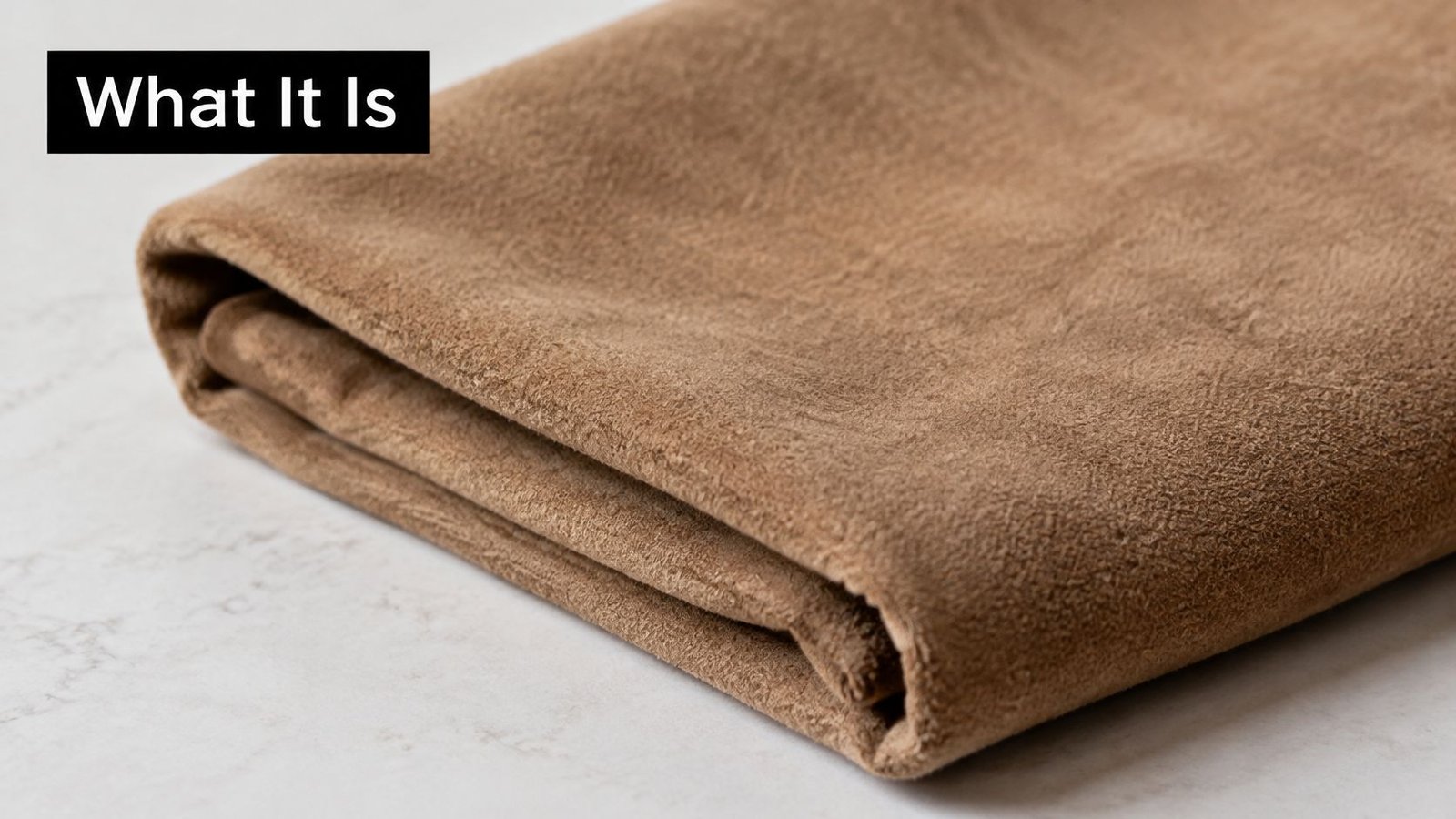
Think of the surface more like brushed fleece than a hide with a grain. The fibres lie in a direction, so stroking them changes how they reflect light. Turn a piece around and the same colour can look lighter or darker.
Recognise the construction
The versions a dressmaker commonly encounters aren't interchangeable:
- Plain polyester microfibre suedette can be supple and relatively light, making it worth sampling for skirts, draped details and decorative linings.
- Backed or laminated faux suede has an additional layer for stability. It may support a jacket front or bag panel well, but the reverse can be too stiff or uncomfortable for an unlined garment.
- Stretch faux suede includes a stretch construction, often with elastane. Check both the direction of stretch and how well it recovers before choosing a close-fitting pattern.
For a concrete lightweight example, Prinfab's faux suede specification lists 100% polyester at 150 g/m², with digital dye-sublimation printing. That's a different starting point from a substantial, backed bag fabric, even if both listings use the same material name.
Buyers often choose faux suede for consistent colour, predictable roll width and an alternative to animal hide. For furnishings, the broader upholstery insights from Suburban Furniture offer useful context when comparing materials, but a dressmaking fabric still needs assessing for its intended use.
Before cutting: establish the fibre content, identify any backing and find the nap direction. Appearance alone won't answer those questions.
Lay the swatch under daylight and stroke it both ways. Choose the appearance you prefer, then keep that orientation consistent throughout the project.
Faux Suede Versus Real Suede at a Glance
Faux suede fabric compared with real suede
| Property | Faux suede fabric | Real suede |
|---|---|---|
| Base material | Polyester or polyester-rich microfibre | Animal hide split from the leather |
| Washing and water | Often machine washable at low temperature if the care label allows | Usually needs specialist cleaning; water can leave marks |
| Colour and width | Consistent colour and standard width across a roll | Natural variation in colour, grain and skin size |
| Sewing behaviour | Many versions do not ravel, so seams can often stay unfinished | Thicker, and needle or pin holes can remain visible |
| Heat sensitivity | Flattens or can melt under direct high heat; press through a cloth | Can shrink or harden with excess heat or moisture |
| End of life | Synthetic and long-lived; not readily biodegradable | Natural material; tanning and finishing chemicals vary |
The base material changes the buying process. With faux suede, you're selecting a textile construction and ordering a length; with real suede, you're assessing individual skins and planning around usable areas.
Cleaning is often the deciding factor. A washable faux suede can make sense for an everyday skirt, but don't assume that a washable polyester face means its backing, adhesive and finished garment can tolerate the same treatment. Real suede generally asks for a more specialist care routine.
What those differences mean at the cutting table
Roll width makes faux suede easier to plan around, particularly for long skirt panels or matching jacket fronts. Nevertheless, buy coordinating pieces together where possible, since colour consistency within a roll doesn't guarantee an exact match between separate purchases.
Seam behaviour also changes your workload. A non-ravelling faux suede may allow a neat, exposed internal seam, whereas real suede needs a construction chosen around its thickness and permanent punctures. Some synthetic versions retain holes too, so neither material rewards repeated unpicking.
Both dislike careless pressing, but their failure modes differ. With faux suede, protecting the surface from flattening and heat damage is central; with real suede, excess heat and moisture can alter the hide itself.
For furniture rather than clothing, Indian River Furniture's discussion of fabric and leather upholstery differences provides broader context for balancing feel, cleaning and use.
Choose for the finished item
Choose faux suede for washable garments where the label permits, animal-free fabric choices, coordinated panels and tighter budgets. Choose real suede when its natural feel, breathability and capacity to develop character matter more than easy washing, particularly for a carefully maintained heirloom project.
End of life isn't a simple natural-versus-synthetic verdict. A University of Leeds-hosted textile biodegradation review reports no appreciable biodegradation for polyester in environmental compartments, while real suede's tanning and finishing also deserve consideration.
Neither is better in every case. Care, budget and actual use should decide, not the assumption that one is automatically the superior material.
Where Faux Suede Works Best in Projects
Say you're choosing between a waistcoat, a tote and a cushion cover. Each could use faux suede, but each needs a different balance of drape, stability and surface durability.
These examples show how the same suede-like appearance translates across clothing, accessories and furnishings.
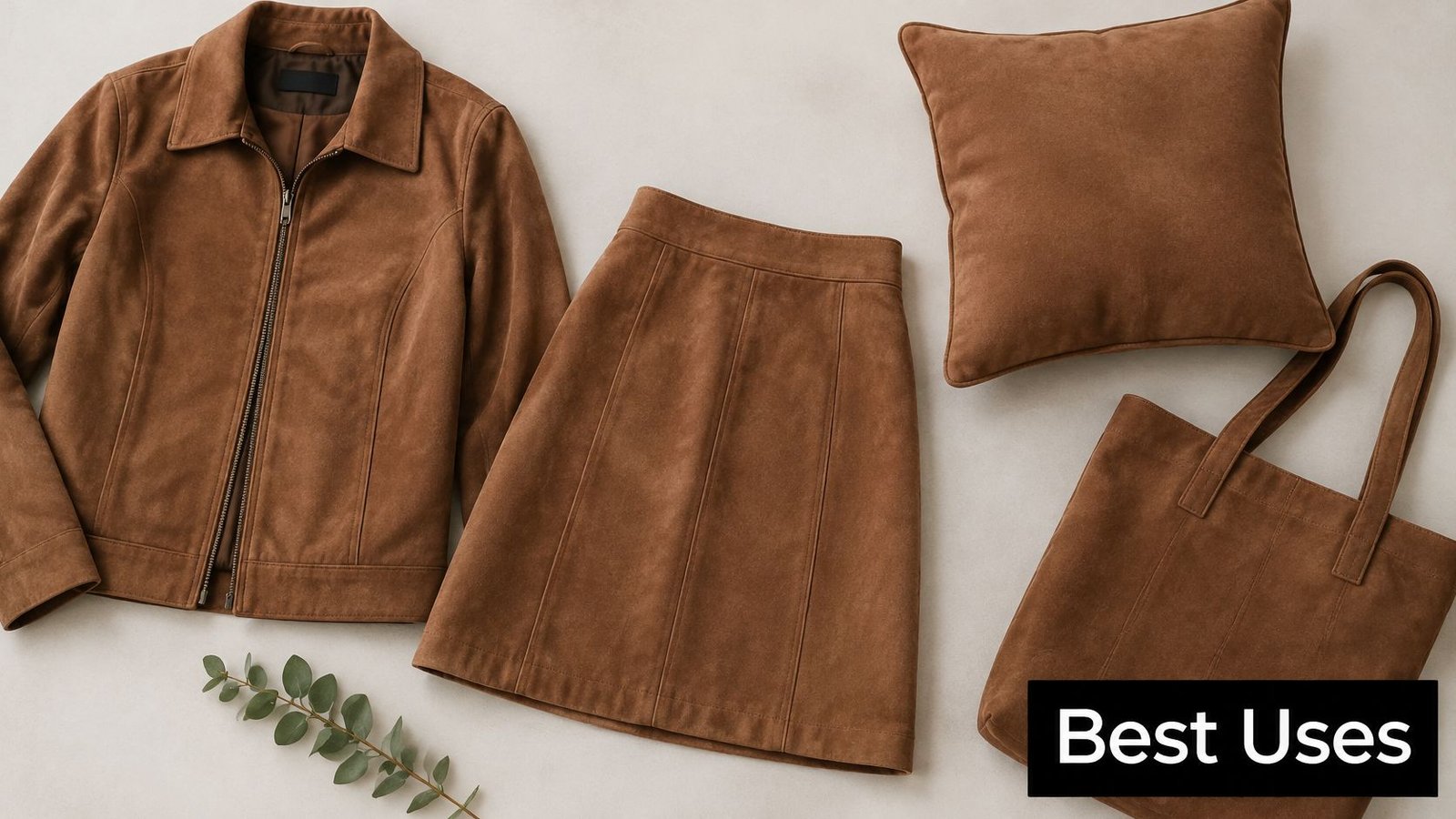
Garments that suit the handle
For an unlined waistcoat or relaxed jacket, start with a stable, heavier construction. Fold the swatch into a mock lapel and let it hang: if it springs out awkwardly or exposes an unattractive backing, either choose another fabric or plan a lining.
An A-line skirt needs a different test. Drape the swatch over your hand and look for soft folds rather than rigid corners. A lightweight printed polyester can work well here, provided it doesn't cling excessively or reveal seam allowances through the face.
Accessories and occasional-use furnishings
For a tote or shoulder bag, use faux suede as the outer layer over suitable support rather than expecting a soft fabric to hold a box shape by itself. Reinforce handle attachment points and consider a separate, harder-wearing base.
A pencil case or zipped pouch is a useful small project for learning how the fabric feeds. A lightly marked surface may respond to careful spot cleaning, but faux suede isn't automatically a wipe-clean coating.
For throw cushions, the nap gives a pleasing change of tone across the surface. A footstool cover needs more caution: shoes and repeated rubbing can be demanding, so choose a fabric intended for that use rather than using leftover dressmaking suedette.
For a visual companion while considering project shapes, this video is available to watch.
Match the construction to the stress point, not just the overall project.
Think twice about chair seats, frequently rubbed elbows and unsupported bag bases. Clothing that regularly gets wet, such as rain outerwear, also needs performance information beyond a suede-like finish.
Before committing, make a sample of the demanding part: a folded collar, reinforced handle tab or zipped cushion seam. That small assembly tells you more than handling a flat swatch.
How Faux Suede Holds Up to Wear and Testing
A soft handle doesn't prove durability. Faux suede can remain intact while its face becomes shiny, flattened or visibly lighter, so the question isn't only whether the fabric develops a hole. It's whether the surface stays acceptable in the places you'll use it.
The abrasion and colourfastness benchmarks for faux suede below come from the UK and EU apparel testing manual, which identifies shade change at 10,000 revolutions, apparel reference levels of 15,000 and 20,000 revolutions, and typical rubbing benchmarks of grade 4 dry and grade 3 to 4 wet for relevant categories.
| Test | Benchmark | What it tells you |
|---|---|---|
| Martindale abrasion (BS EN ISO 12947-2), shade change | 10,000 revolutions | Point where visible colour or nap change may begin |
| Martindale abrasion, light sewing apparel reference | 15,000 revolutions | Reference level for everyday garments |
| Martindale abrasion, heavy sewing and denim reference | 20,000 revolutions | Reference level for heavy-use items |
| Colourfastness to dry rubbing (BS EN ISO 105-X12) | Grade 4 | Low risk of colour transfer to pale clothing in dry use |
| Colourfastness to wet rubbing (BS EN ISO 105-X12) | Grade 3 to 4 | Moisture increases transfer; keep damp garments away from pale fabric |
Read the result, not just the number
These are testing references, not guaranteed lifespans for every fabric sold as faux suede. Ask what the supplier measured: shade change, surface breakdown and structural failure aren't interchangeable endpoints.
Repeated contact compresses or abrades the raised fibres. That's why a bag's underside or the edge of a cuff may look worn while a protected panel still looks new.
Moisture introduces another concern. A fabric that performs well against dry clothing may transfer more colour when damp from rain or perspiration, particularly against a pale blouse or lining.
For seating projects, Tyner Furniture's guidance on choosing durable sofa upholstery helps frame the intended-use question. Apparel benchmarks alone don't establish that a dressmaking fabric is suitable for a frequently used sofa.
Try a home swatch check
- Fold an offcut and rub the face repeatedly with a pale cotton cloth, keeping an untouched area for comparison.
- Inspect the cloth for transferred colour. Repeat on another scrap with a slightly damp cloth if the intended care method permits water.
- Examine the nap under angled light, looking for a polished patch, flattened fibres or an obvious change of shade.
- Request the supplier's abrasion result, test direction and face construction before choosing fabric for elbows, seats or bag bases.
This check won't replace laboratory testing, but it can expose an unsuitable fabric before you invest in a full project. Reject a poor match rather than assuming interfacing will protect the exposed face.
Checklist for Buying Faux Suede Fabric
Ask questions that identify the actual textile, not just its sales name. Suedette and microsuede describe an appearance or type of fabric, but they don't tell you what's in the roll.
The checklist below is useful when comparing listings or discussing a swatch.
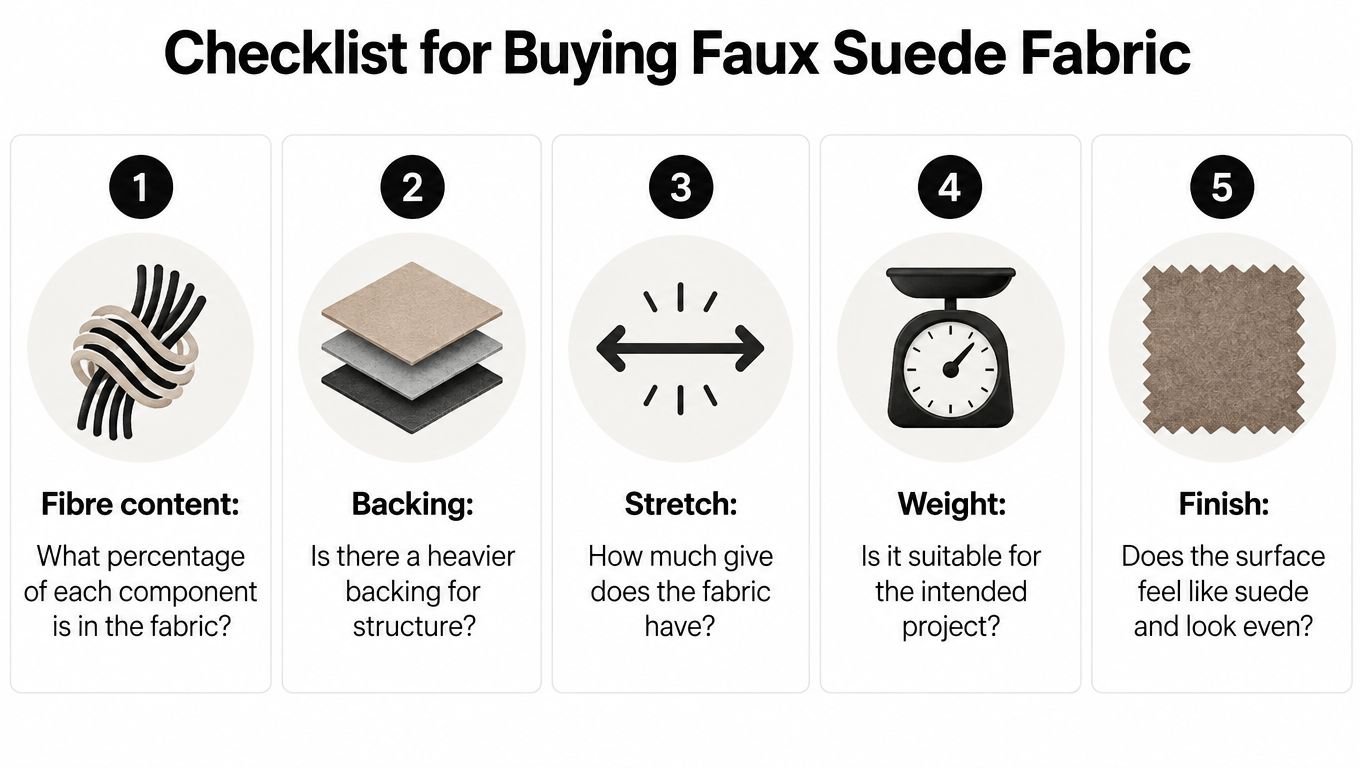
Questions to put to the supplier
- Fibre content: What percentage of each component is in the fabric? Ask for the actual composition, not a trade name. UKFT's labelling guidance identifies fibre-content requirements under the Textile Products (Labelling and Fibre Composition) Regulations 2012, including information for components with different fibre contents.
- Backing: Is there a heavier backing for structure? Establish whether there's a laminated layer or polyurethane face coating, since either can change pressing, washing and disposal options.
- Stretch: How much give does the fabric have? Ask which direction stretches and whether the fabric recovers cleanly, particularly for fitted skirts or trousers.
- Weight: Is it suitable for the intended project? Request the weight in g/m² alongside a description of drape. Weight alone doesn't tell you whether a backed fabric will fold comfortably.
- Finish: Does the surface feel like suede and look even? Inspect for patchy pile, unwanted shine and visible backing when the fabric bends.
- Testing and care: What can the supplier substantiate? Request abrasion information, test direction and the washing method, including whether low-temperature machine washing is allowed.
Check colour before committing
Ask for a swatch before a substantial order. View it beside your intended zip, thread and lining in daylight rather than choosing each component separately from a screen.
Our website colours can look slightly different from the original fabric because monitor settings vary. If you have questions about a fabric's colour, contact More Sewing before purchasing.
Record the composition, backing and care details in your project notes before washing the length or applying interfacing. Keep the labelled swatch with those notes so you can identify the fabric later.
How to Sew Faux Suede Without Marking It
Start with an offcut, not the garment. Heat, pressure, pins and adhesive can leave permanent evidence, and unpicking a seam may leave a visible track.
Use the same layered sample you'll sew in the finished item. A flat scrap won't reveal how a bulky hem or interfaced pocket edge feeds through the machine.
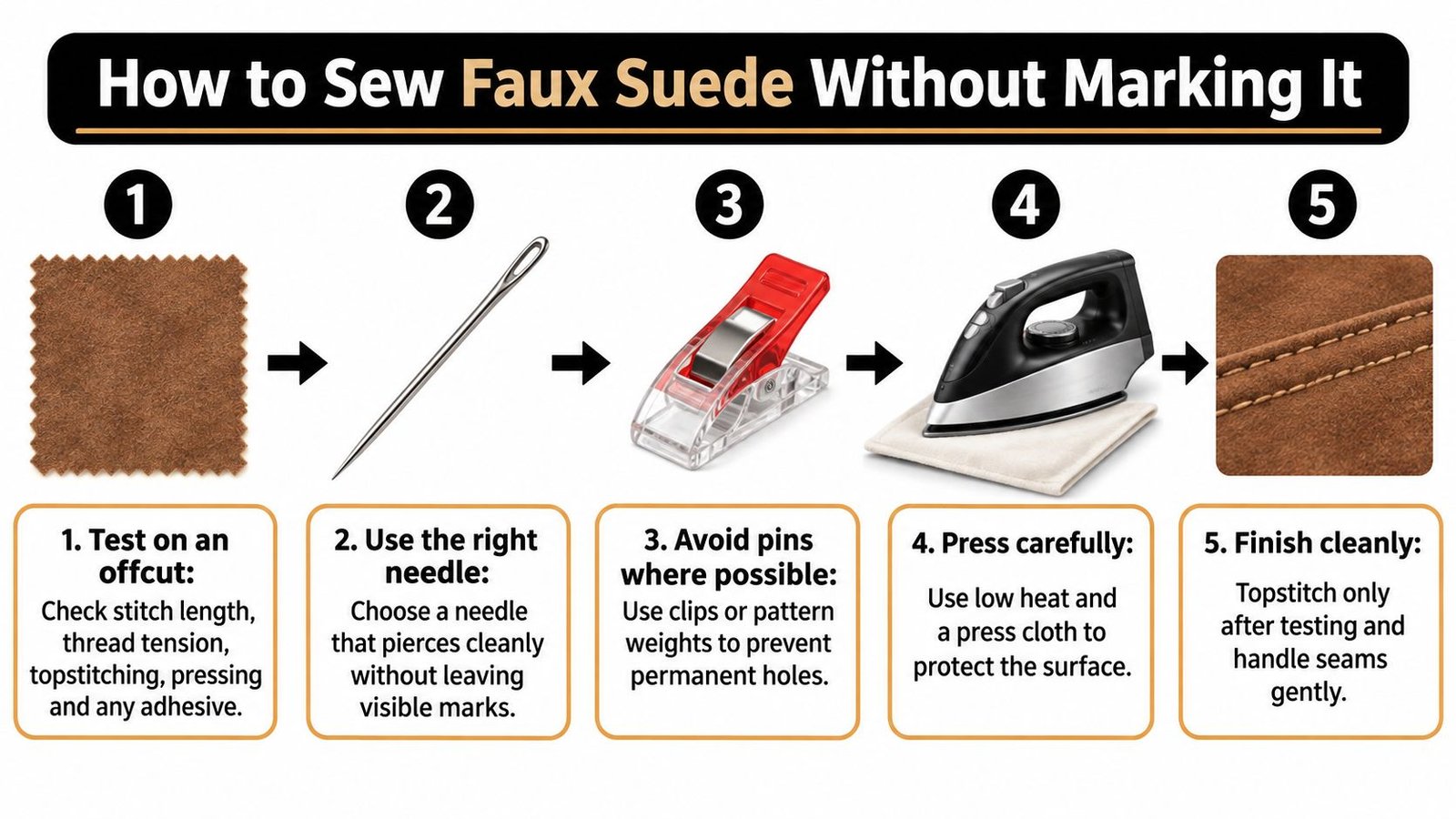
Set up on a sample
White Lodge Fabric's synthetic-suede sewing guidance suggests a 70/10 Microtex needle for many weights, polyester or cotton/polyester thread and a starting stitch length of approximately 2.0–2.5 mm.
| Setting or tool | Starting choice |
|---|---|
| Needle | Microtex, adjusted to fabric thickness after testing |
| Thread | Polyester or cotton/polyester |
| Feeding | Standard foot first; walking or roller foot if layers creep |
| Holding | Clips within allowances or pattern weights for cutting |
| Pressing | Low heat, press cloth and a supporting faux suede scrap |
Test every operation. Sew a seam and topstitching sample, adjust tension, then test pressing and any adhesive. Inspect the result from the right side before continuing.
Mark the nap direction. Draw arrows on the wrong side with a suitable removable marker and orient every pattern piece consistently. Use a with-nap cutting layout rather than turning pieces to squeeze them into gaps.
Fit the appropriate needle and thread. Start with the suggested setup for a fine synthetic suede, then change it if the sample shows skipped stitches or excessive punctures. A backed construction may need a different needle size.
Check the seam before sewing long panels. Use the suggested stitch-length range as a starting point, not a fixed setting. Don't pull the fabric through, since that can distort the seam.
Keep pins out of visible areas. Use clips within seam allowances and weights for cutting. If a pattern needs basting, test whether the temporary stitches leave marks when removed.
Choose a clean hem treatment. Many versions don't ravel, so overlocking every raw edge may add unnecessary bulk. Secure the folded hem with tested fusible web, topstitching or binding.
Press through protection. Use low heat and a press cloth, with a faux suede scrap nap-side up beneath the work. Lift and lower the iron rather than dragging it across the surface.
Handle feeding, hems and support
If the top layer creeps, try a walking foot or roller foot and reduce presser-foot pressure where your machine allows. Test on the complete seam sandwich, including any lining or interfacing.
For an unlined skirt, a sample technique is to place a 12 mm strip of fusible web inside the hem, fuse through a cloth, then topstitch 6 mm from the fold. Treat those as trial dimensions, not a universal hem specification; abandon the adhesive if it leaves stiffness, glue marks or shine.
For a bag front, try lightweight sew-in interfacing before heavy fusible support. Secure it within the seam allowances so you gain structure without pressing a dense adhesive layer into the pile.
The pressing mistake to avoid is direct contact with the right side. Once the face becomes shiny or heat-damaged, another pass with the iron won't restore it.
Caring for Faux Suede and Limiting Shedding
Synthetic pile can release fibres, but every faux suede fabric won't shed equally. Construction, finish, age and washing conditions all affect the result, so care should reduce unnecessary abrasion rather than promise a completely shed-free garment.
Production shedding and domestic laundering are separate issues. FashionCapital's account of textile-manufacturing microfibre research describes how fabric density, yarn construction and finishing affect shedding, which is why fibre content alone can't predict a finished fabric's performance.
A conservative care routine
- Read the care instructions first. If washing is permitted, pre-wash the fabric using the method intended for the finished garment before cutting.
- Spot clean before laundering. Test a barely damp, pale cloth on a hidden area, then blot rather than scrub. Avoid soaking a bonded construction.
- Wash only when needed. Air a garment between wears where appropriate, and deal with a local mark locally rather than washing the whole item automatically.
- Choose gentle, cool washing. Use a suitably full load without overcrowding the drum, and avoid abrasive companions such as exposed hook-and-loop fasteners.
- Use suitable fibre capture where available. An appropriate filter or fibre-catching washing bag may help contain released fibres; follow its maintenance instructions.
- Dry away from concentrated heat. Unless expressly allowed, avoid tumble drying and keep the item away from radiators. Support heavy wet garments so they don't stretch out of shape.
Restore the surface gently
Once dry, use a clean, soft, lint-free brush in a consistent direction to settle the nap. Don't attack a flattened area with a stiff brush, since pulling fibres out creates a different problem from temporary compression.
If the manufacturer allows steam, test light steaming from the wrong side without pressing the soleplate against the fabric. Let the sample cool and dry before deciding whether the treatment helped.
Hang garments on supportive hangers or fold them loosely, avoiding tight stacks that crush the surface. Store them dry, away from damp cupboards.
Natural fibres shed too, so replacing a synthetic with a natural fabric isn't an automatic solution. Repairing and wearing a well-made item for longer, while avoiding unnecessary washes, is more useful than relying on any single care accessory.
Plan Offcut Disposal and End of Life
Sort cuttings while their composition is still identifiable. Keep clean unbacked polyester separate from polyurethane-backed or laminated pieces, and put blends or contaminated scraps in another container.
Don't assume a textile bank accepts everything that looks like fabric. Business Waste's fabric-recycling guidance distinguishes clean synthetic materials from mixed, coated or contaminated fabrics that are harder to process.
Disposal route by faux suede construction
| Construction | Disposal route | Check before disposal |
|---|---|---|
| Pure polyester faux suede, unbacked | Clean textile collection if accepted, or patchwork | Confirm 100% polyester on the supplier label |
| Polyurethane-backed or laminated | Local authority or licensed textile collector, only if accepted | Check backing and coating details with the supplier |
| Polyester/elastane or other blend | Confirm acceptance with the collector before disposal | Check the fibre content of each component |
| Scraps with thread, zips or interlinings | Remove trims where practical; ask the collector, as contaminated pieces may be refused | Separate contamination first |
| Small clean scraps | Patchwork, stuffing or pet-bed filling | Keep dry and free of adhesive |
Reuse before discarding
Keep useful pieces for pocket facings, zipped pouches or patchwork panels. Small clean scraps can become contained pincushion stuffing or pet-bed filling, provided they stay securely enclosed and aren't accessible to an animal that chews.
Remove reusable zips and separate interlinings where practical. Don't shake loose scraps outdoors, and don't add rejected coated fabric to a recycling collection in the hope that someone else can separate it.
If a collector won't accept the construction, ask the local authority for the appropriate residual-waste route. Synthetic doesn't automatically mean unrecyclable, but a generic textile-recycling label doesn't guarantee acceptance.
Order from a cutting plan
Reduce leftovers before buying by laying out the pattern at the actual fabric width, including its directional nap. Allow a modest margin for matching the pile rather than assuming every piece can be reversed.
Our fabric is priced per half metre, and multiple units are sent as one continuous length. Round your cutting requirement up to the next half metre, then check the composition and care details before adding the length to your basket.
More Sewing offers fabric, haberdashery and sewing supplies to help you turn a tested idea into a finished project. Visit More Sewing to explore materials for your next make, and contact us before purchasing if you need help checking a fabric's colour.
