
You've found a leopard print you love, pictured it as a throw over the sofa arm or a pair of pyjamas for a cold weekend, and then stalled on the listing. It says fleece, but not how thick it'll feel, whether the spots will stay sharp after washing, or whether your machine will chew the seams into ripples.
That's the usual trap with animal print fleece fabric. The print sells it, but the weight, pile and finish decide whether the finished piece works. Treat the print as a finishing decision from the start, and you'll cut once, sew flatter seams, and keep the pattern looking clear for longer.
Animal Print Fleece Weights and Piles at a Glance
Start with weight, not the photograph. Gsm means grams per square metre, so it tells you density in a way that words like cosy or chunky don't.
| Weight band | Feel and drape | Warmth | Typical projects |
|---|---|---|---|
| Lightweight, roughly 150 to 200 gsm | Soft, fluid, folds easily | Light layer | Tops, lounge trousers, linings |
| Midweight, roughly 200 to 300 gsm | Balanced drape with some body | Everyday warmth | Loungewear, children's clothing, cushions |
| Heavyweight, roughly 300 to 400 gsm | Firm, holds its shape | Warm, insulating | Throws, pet beds, outerwear layers |
| Very heavy, above 400 gsm | Thick, spongy, little drape | Very warm | Blankets, padded projects |
A listing marked heavy can still be lighter than a dense midweight from another supplier, because sellers don't all use the bands the same way. Trust the gsm figure first, then check the description of drape. If there's no gsm at all, order a sample before you commit to yardage for a garment.
Two quick examples
Say you're choosing between two prints for different jobs. A 180 gsm zebra print will behave like a soft top fabric. It'll fold at the elbow, sit comfortably under a coat, and won't overwhelm a neckband.
A 320 gsm leopard print is a different animal. It holds a folded edge on a throw, doesn't collapse into wrinkles on a cushion, and gives you enough body for a pet bed cover. Sew the zebra weight as a throw and it'll feel thin and restless. Sew the leopard weight as a fitted top and you'll fight bulk at every seam crossing.
Pile height is the second check
Weight tells you warmth and body. Pile height tells you how the print will read.
- Short, flat pile: Tiger stripes, small spots and paw prints stay sharp. Seams sit cleaner and topstitching shows.
- Deep, lofty pile: Seams sink in and almost disappear, which is forgiving on a blanket. Fine detail blurs, and a small-scale print can turn muddy.
- Brushed both sides: Soft against skin for pyjamas, but check which side carries the clearest print before you cut.
Run your hand against the pile on a sample. If the print lightens dramatically one way, you've got a directional surface as well as a directional pattern, and your cutting layout needs to respect both.
Three-question check: What is it, how warm should it be, and how much of the print must show clearly? If the weight and pile don't answer all three, it's the wrong fleece for that project.
What Makes Animal Print Fleece Different
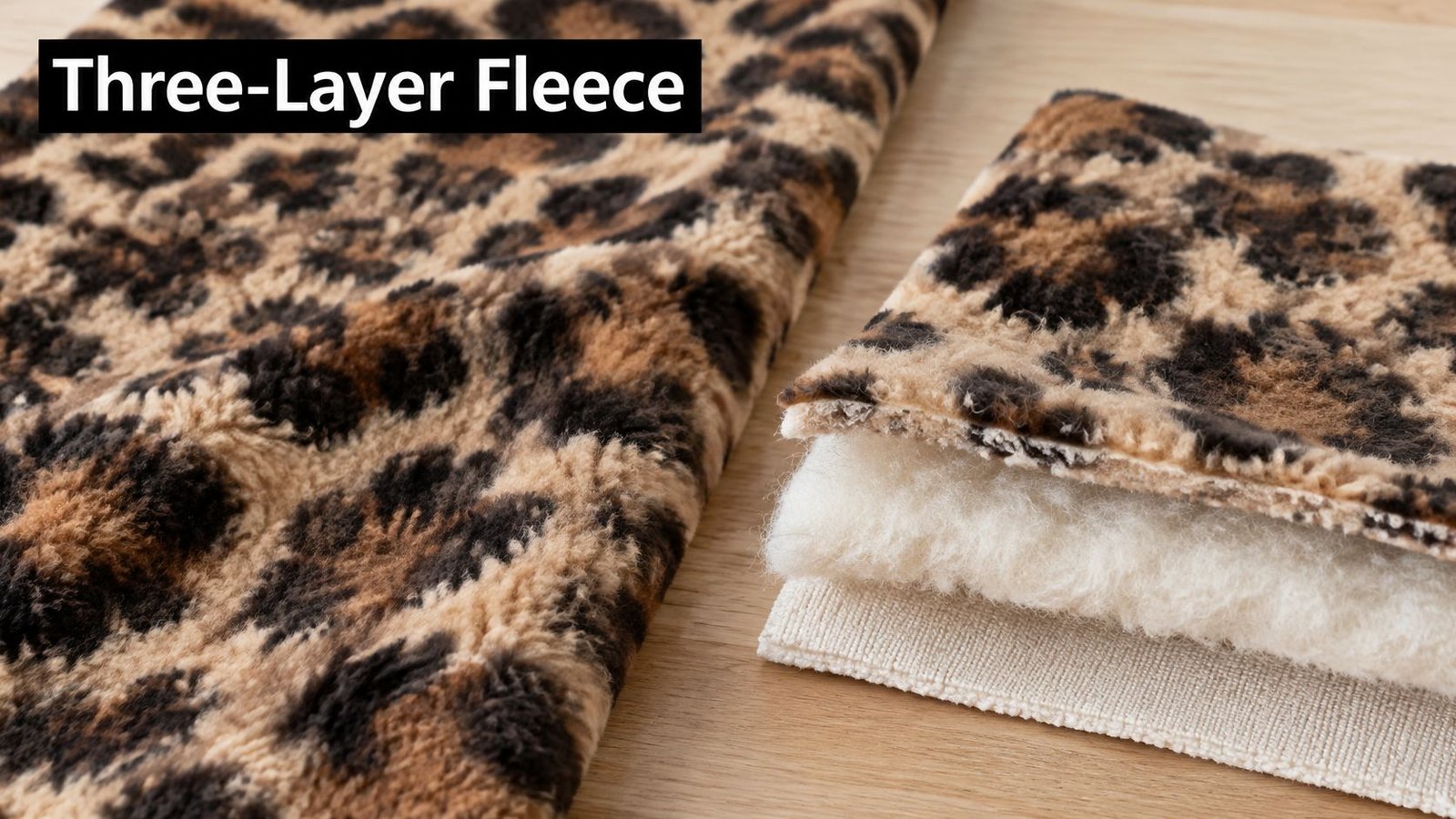
Most animal print fleece isn't woven. It's usually a knitted polyester base that's brushed so fibres lift into a soft pile. Those raised fibres trap air, and that trapped air is where the warmth comes from.
Think of it in three layers. There's the knit ground that gives stretch and strength, the raised pile that gives softness and insulation, and the print sitting on the surface of that pile.
Why the print looks softer than on cotton
Colour sits mainly on the tips of the pile, not on a flat surface. Stroke it one way and the spots look rich, stroke it back and the pale fibre roots show through, so the same leopard can look softer than it would on cotton poplin.
That's not a fault. It does mean you should judge colour with the pile smoothed in its natural direction, in daylight, and expect gentle softening over time rather than crisp, printed-paper edges forever.
An anti-pill finish helps here. It reduces the little bobbles that form where fabric rubs, under arms, at seat cushions, along a blanket edge you keep grabbing. A plain cotton jersey with an animal print behaves differently again. It has no pile, usually recovers differently after stretch, and won't hide a slightly wobbly seam the way fleece does.
Reading a listing properly
Don't buy on the word fleece alone. The UK Government textile labelling guidance requires fibre content to be stated using permitted fibre names, with constituent fibres listed by percentage in descending order, and labels must be durable, legible, visible, accessible, and in English.
On a listing or sample card, record these separately:
- Composition: for example, 100% polyester, rather than just fleece
- Surface type: brushed fleece or anti-pill fleece, stated separately from composition
- Weight and width: so you can calculate whether pattern pieces fit
- Print repeat and direction: one-way, two-way, or tossed with no clear up or down
If there's a contrasting backing, trim or bonded layer, that component may need its own composition identified. Fleece describes a raised construction. The fibre underneath could be polyester, recycled polyester, cotton or a blend, and that fibre decides your needle, heat tolerance and washing routine.
A giraffe print with heads all pointing up is the classic catch. Every piece must be cut in the same direction, you can't flip one sleeve to save fabric, and you'll need extra length. A tossed paw print with no up or down is far more economical.
Before you buy, check a sample for pile direction, stretch and recovery, print clarity when stretched over your hand, and whether dark colour rubs onto a white cloth. If spots crack or whiten the moment you stretch it, they'll do the same over knees and elbows.
Best Uses for Animal Print Fleece, from Throws to Baby Items
Match the project to weight first, then to finish. The same cheetah print can succeed as pyjamas and fail as a structured cushion if the pile is wrong.
| Project | Suitable weight | Key requirement | Finishing note |
|---|---|---|---|
| Loungewear (pyjamas, dressing gowns) | Midweight | Some stretch and a soft pile | Ribbed knit cuffs and neck trims |
| Baby items (blankets, hooded bibs) | Lightweight to midweight | Anti-pill finish and checked composition | Enclose or bind every edge |
| Throws and blankets | Heavyweight | Even, dense pile | Binding of 5 cm or more |
| Pet beds | Heavyweight | Durable base and dense pile | Double-stitched, sealed seams |
| Costumes and toys | Midweight | Print scale suits the finished size | Enclosed seams and secured trims |
| Hats and scarves | Midweight | Softness and stretch | Ribbed or folded edges |
| Cushions | Midweight to heavyweight | Firm, flat pile | Zip or envelope back |
Loungewear that stays comfortable
For pyjamas or a dressing gown, I would choose midweight fleece with gentle stretch. It moves when you sit, doesn't drag at the shoulders, and takes ribbed cuffs neatly. Cut trousers with the print running the same way on both legs, or a one-way animal motif will look upside down on one side.
Ribbing does real work here. It gathers the lofty fleece into a narrower cuff without bulky elastic channels, and it recovers after washing better than a turned-up fleece hem on an ankle.
Throws, blankets and pet beds
Heavyweight fleece earns its keep on a throw because it drapes in slow folds and stays put. Finish it with a generous binding, for example a 5 cm satin or jersey strip folded over the edge, so the binding covers the pile depth instead of perching on top of it. If you're browsing ready-made inspiration before cutting your own, you can find a cozy equestrian throw to see how a bold animal theme sits at full blanket scale.
For a pet bed, put the print on top and a tougher plain fabric underneath. Use a sealed top seam and double stitching where claws and washing will test it. A removable cover is worth the extra zip, because pet bedding needs frequent washing.
Baby items, toys and print scale
For stroller blankets and hooded bibs, choose lightweight or midweight anti-pill fleece, check the composition, and enclose every edge so no loose fibres or raw corners work free. Keep trims flat and firmly stitched, with nothing that can come away.
Print scale can sink a small project. A large zebra print cut into a small toy loses its recognisable stripes, leaving random black slabs. Hold your pattern piece over the fabric before cutting and check that a whole motif, or at least a readable part of one, fits inside it.
Two-way prints suit throws, scarves and toys where pieces flip during layout. One-way prints suit garments and cushions where you can plan every piece upright, provided you've bought enough length.
Setting Up and Stitching Animal Print Fleece Without Puckering
Puckering usually starts before the first seam. Pre-wash the full length in a laundry bag at the supplier's temperature, so loose fibres come out and any dimensional change happens before you cut. Let it dry flat and rest before layout.
| Setting | Recommendation | Why it matters |
|---|---|---|
| Needle | 75/11 ballpoint or stretch needle | Pushes between knit loops without snagging |
| Thread | Polyester thread | Stretches with the fabric |
| Stitch | Narrow zigzag or stretch stitch, 2.5 to 3 mm long | Lets the seam flex |
| Presser foot | Walking or even-feed foot | Stops the pile and print shifting |
| Pressure | Lightened to a medium setting | Avoids stretching the pile |
| Tension | Tested on scrap and adjusted | Prevents puckering and loops |
The setup below shows the sequence from test swatch to finished seam.
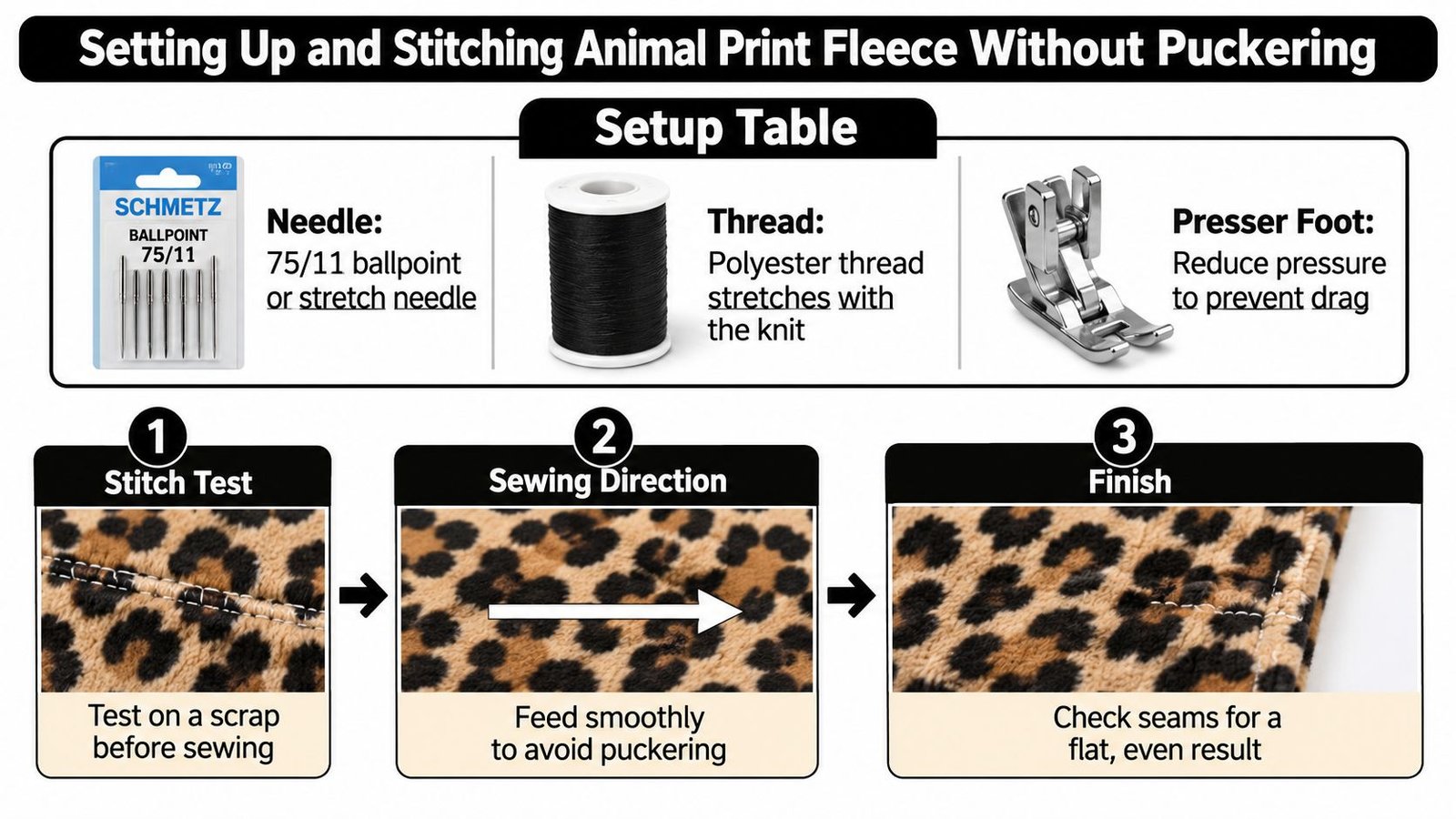
The sewing sequence
- Test a swatch first. Wash, press and sew a small piece to see whether the pile mats, sheds or transfers colour. A study in PMC on UK domestic-laundry microfibre emissions produced a baseline estimate of 16,384 tonnes of microfibres released annually, and its swatch-testing point applies directly here, because fleece behaviour varies by construction.
- Lay out along the print direction. Cut in a single layer with a rotary cutter or long shears. Folding lofty fleece in half lets the lower layer creep, so stripes drift.
- Pin in the seam allowance only, or use clips. Pins through the body can leave visible disturbances in deep pile, and clips grip bulk better at crossings.
- Set needle and stitch on scrap. Sew two layers, stretch the seam gently, and check for snapped stitches or wavy edges before touching the finished pieces.
- Sew with the walking foot. Guide the fabric, don't pull it through. Pulling stretches the knit ground, then it relaxes into puckers.
- Check, then press on the reverse with a cloth. Use low heat and lift rather than scrub the iron, so you don't flatten a shiny track into the pile.
Slips that cause most trouble
A straight stitch is the common one. It looks tidy on the table and snaps when the fleece flexes over a knee or shoulder. A narrow zigzag looks slightly less crisp up close, but it survives wear.
Heavy presser foot pressure is the other culprit. It compresses the top layer and pushes it forward, so spots that matched at the start of a seam drift by the end. Lighten the pressure, lengthen the stitch slightly on thick crossings, and trim seam allowances in layers where a hood or waistband builds up bulk.
If a test seam ripples, don't sew faster and hope. Change one thing at a time, pressure first, then stitch length, then tension, and keep the winning scrap pinned to your pattern.
Finishing Edges and Hems on Pile Fabric
Fleece doesn't fray like a woven cotton, so beginners often leave edges raw. That works until washing starts pulling loose fibres from every cut line and the edge thins, curls or sheds fluff over everything else in the machine.
Cut edges matter for durability as well as looks. Research from the University of Manchester on designing out microplastic pollution from textiles found that laser cutting reduced released microplastic fibres by more than one-third compared with scissor cutting and overlock serging, showing that cut edges are a significant source of release during laundering. You won't laser cut at home, but enclosing or covering edges follows the same logic.
Finishes from cleanest to most practical
- Enclosed seams: Hide the raw edge inside a lining or facing. This is the neatest option for hoods, collars and a toy with sealed seams, because nothing raw is exposed to rubbing.
- Close zigzag: Use about 1.5 to 2 mm width on exposed seam allowances. It contains fibres without adding a stiff ridge.
- Overlock or serge: Fast on long blanket and pyjama seams if you have the machine. Test first, because the blade can shave pile unevenly on thick fleece.
- Binding: Fold a 5 cm strip of cotton jersey or satin over the edge of a throw. Jersey binding stretches around corners, satin gives a smooth edge against skin.
- Twin-needle hem: Good on tops and lounge trousers where you want a flat, stretchy hem. Use a walking foot so the hem doesn't tunnel.
- Fusible hem tape: Only after testing on a swatch. Heat can flatten pile permanently and leave a glossy band that shows through the print.
Examples that work
On a dressing gown, turn the hem once, zigzag the raw edge first, then twin-needle stitch so the hem flexes instead of cracking. On a robe that'll be washed often, I would double-stitch the hem for security.
On a throw, mitre a satin binding and stitch in the ditch from the front so the print stays uninterrupted right to the edge. On a soft toy, keep every seam allowance inside the body and ladder stitch the closing gap, so stuffing pressure doesn't open a raw edge.
Finger-press seams open or to one side before any heat. Pile springs back, so a seam that looks bulky on the table often settles after a light steam from the reverse.
The rule is simple. Every raw edge that will be washed should be finished, enclosed, bound or stitched down. Raw is acceptable only on a quick costume or scarf fringe that won't see much laundering, and even then you should shake out loose fluff outdoors first.
Caring for Animal Print Fleece So the Print Lasts
Fleece care is mostly about reducing rubbing. Heat and agitation flatten pile, loosen fibres and soften the print faster than actual wear does.
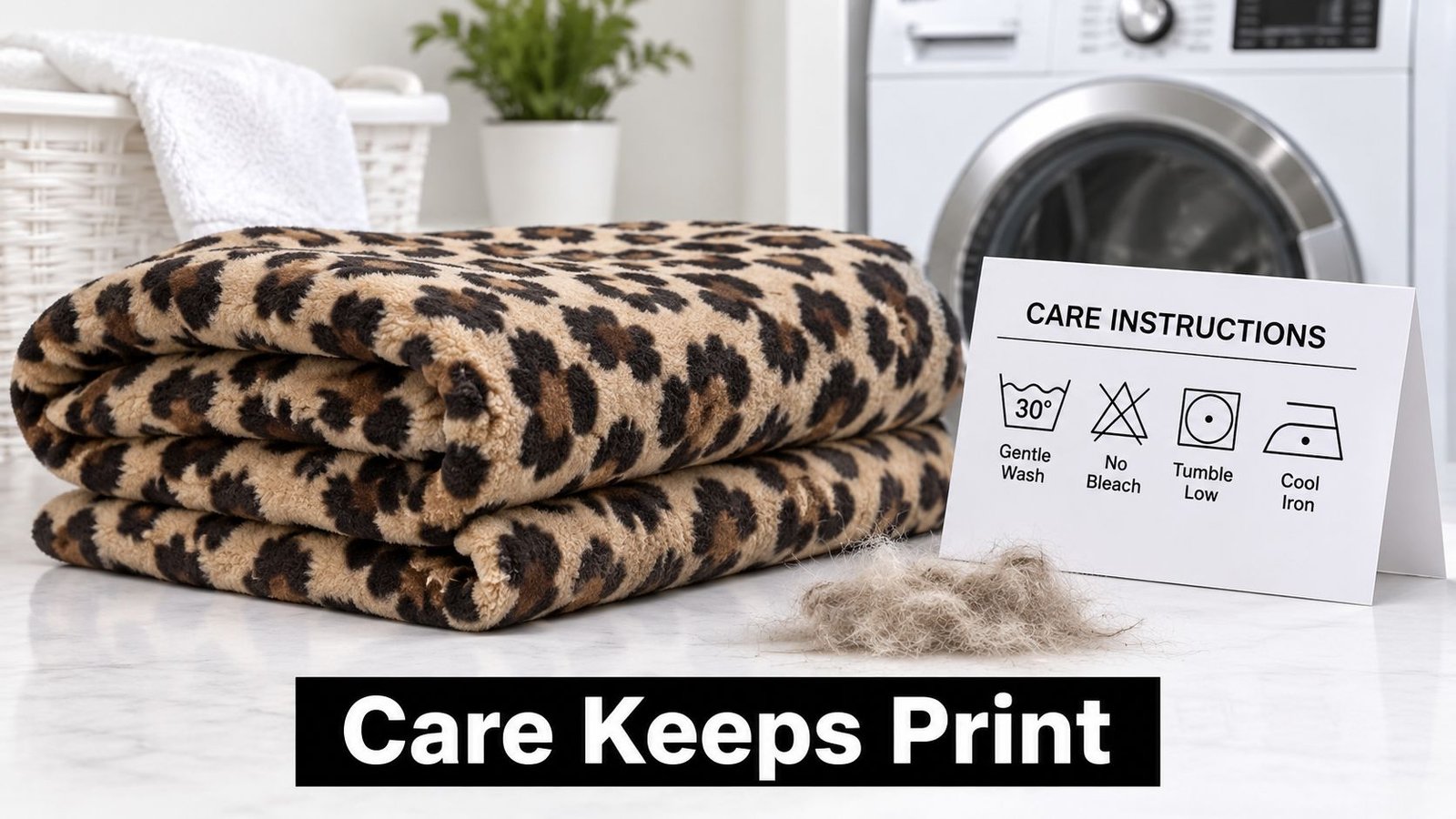
| Stage | Setting | Reason |
|---|---|---|
| Routine wash | 30-minute cycle at 15°C where the label allows | Shorter, cooler cycles shed fewer fibres |
| Machine programme | Gentle or synthetic setting, low spin | Less agitation protects the pile |
| Drying | Air dry flat or low tumble | High heat flattens the pile and sets creases |
| Ironing | Low heat, pressed on the reverse under a cloth | Avoids flattening the pile and print |
| Stain removal | Cold water and mild detergent, tested first | Heat can set stains and fade the print |
UK research cited by Keele University found that polyester fleece washed in a high-efficiency machine released 70% fewer microfibres than fleece washed in a traditional top-loading machine. The same research reported a 30% reduction when comparing a 30-minute, 15°C cycle with a standard 85-minute, 40°C cycle.
You don't need a new machine to use that finding. Wash only when needed, choose the shorter, cooler cycle your care label allows, and avoid stuffing the drum so pieces grind against each other.
Routine that protects the print
Turn garments inside out so the printed pile faces inward. Put small items, baby blankets and toys in a laundry bag, wash fleece separately from lint-catching towels, and clean the lint filter after each load.
Dry flat for heavy throws, or use a low tumble and remove while just dry. Over-drying leaves pile harsh. The first wash removes loose manufacturing fibres, so shedding usually settles afterwards, provided you don't keep using vigorous cycles. If pilling is your worry on other washable home textiles too, the same low-agitation logic sits behind gentle care for washable family sofa covers.
The short demonstration below shows gentle handling and drying in practice.
For stains, spot clean with cold water and mild detergent, testing first on an inside corner where a pale ring won't show. Press only on the reverse under a cloth at low heat, or hold steam slightly away from the pile. A hot iron directly on leopard spots will give you a shiny, flattened patch that no washing will restore.
Styling Animal Print Fleece with Solids, Trims and Linings
Use one bold print per item and let solids do the supporting work. Animal print already carries pattern, colour contrast and texture through the pile, so a second print usually fights it instead of framing it.
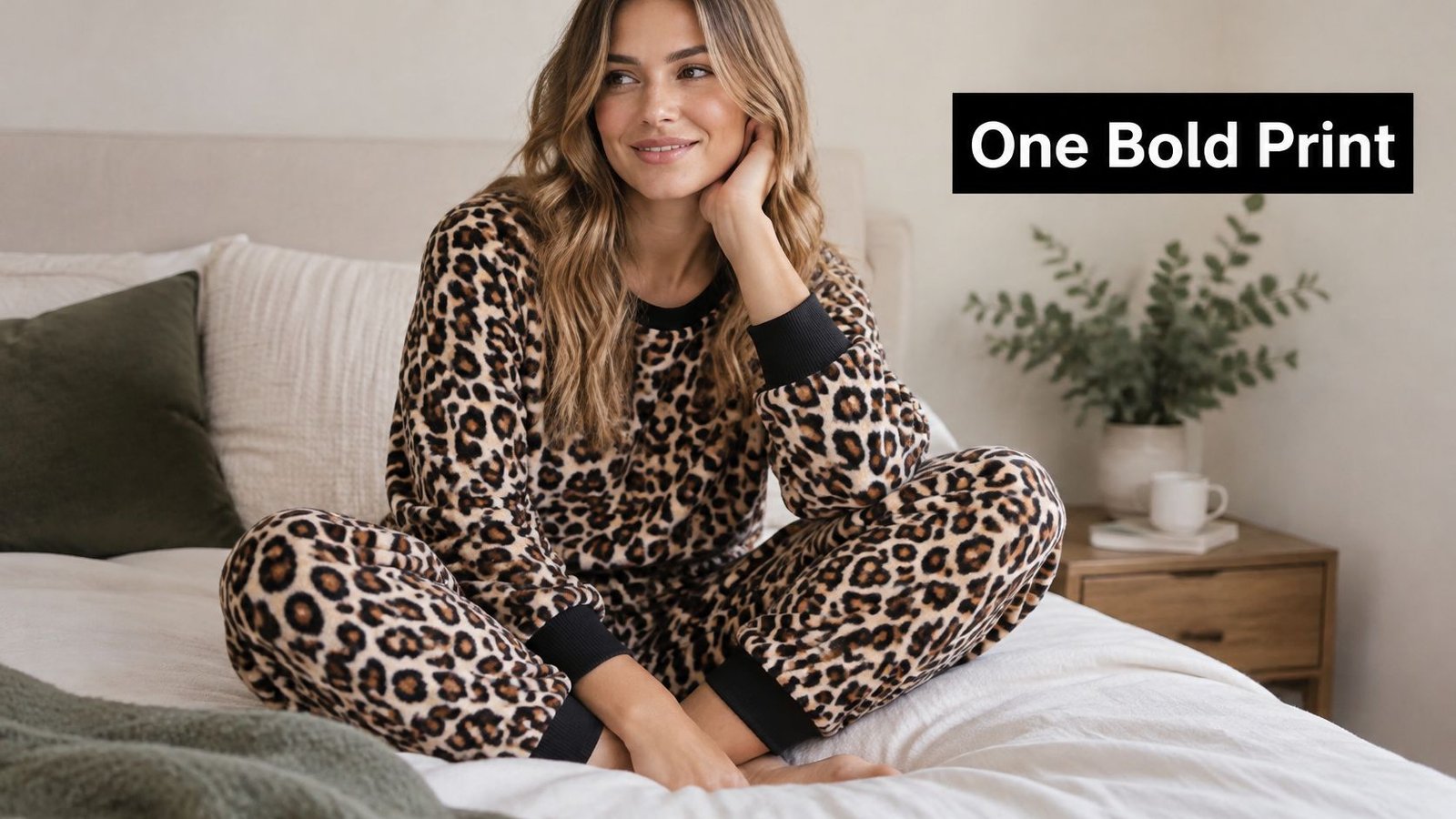
Combinations that look deliberate
- Leopard pyjamas with plain black ribbed cuffs: The black picks up the darkest spot colour and gives the set a finished edge at wrist, ankle and neck.
- Zebra hat with a solid camel pom-pom: Camel warms the black and white so the hat works with a brown or tan coat.
- Animal print throw with plain cream satin binding: Cream quiets the edge and stops the pattern spilling visually off the sofa.
- Hooded top lined inside the hood with plain jersey: The jersey feels smoother against hair and gives a clean flash of solid when the hood is down.
- Pocket bags in contrasting cotton: The pocket interior stays thinner than fleece, and the print remains clear because it isn't chopped up inside the garment.
Colour and stretch matching
Warm tan and brown ribbing gives a softer, vintage feel to leopard and giraffe. Black and white trims make zebra and dalmatian spots look graphic and sharp. Pick one direction per item rather than mixing warm and monochrome trims on the same piece.
Trims must match the fleece's stretch. A rigid woven tape sewn around a stretchy neckline will pull the print out of shape and crack stitches. Test ribbing, jersey binding and elastic by stretching them alongside the fleece. They should recover at a similar rate.
Lay every trim on the print in daylight before cutting. Artificial light flatters browns, and a ribbing that looked matched at night can look orange by morning.
Home textiles follow the same rule. Give a cushion a plain envelope back so the front print stays whole and you save fleece. Give a pet bed a solid base that hides muddy marks, keeping the printed top cleaner for longer.
Buying, Pricing and Offcut Planning
Buy in this order and you'll avoid most returns and shortages. Don't start with the prettiest photograph.
Pre-cut checklist
- Pick the weight band: Match gsm and pile to the finished item before choosing a colourway.
- Check composition and surface type: Confirm the fibre percentages and whether it's brushed or anti-pill.
- Test a swatch: Stretch it, rub it, wash it, and check for colour transfer onto white cotton.
- Allow for a one-way print: Buy extra so every piece can be cut upright in the same direction.
- Plan every edge finish: Binding, ribbing and thread belong in the first order, not as an afterthought.
Price context helps you budget a throw or garment before ordering. A UK retailer listed paw-print fleece fabric at £7.50 to £150.00 in 2025 depending on the quantity purchased, identified as 100% polyester. Another UK retailer listed white-paws-on-black printed fleece at £11.00 per metre in 2026. Use those as budgeting markers, then confirm the current price, width and weight on the listing you buy from.
We sell fabric by the half metre, and multiple orders are sent as one continuous length, so you can order a full throw or longer garment in one piece without a join across the print.
Plan the offcuts before you cut
Polyester fleece scraps are worth sorting, not binning automatically. UK households generate a large volume of textile waste, and fleece blends, elastane, thread and printed finishes can complicate recycling, so reuse at home is often the most realistic route. Reporting on WRAP's UK textile collection and recycling programme notes that around 49% of UK post-consumer textiles enters residual waste rather than reuse or recycling streams.
Keep larger pieces for pet blankets, hat linings, appliqué spots and patchwork cushions. Batch small clean scraps by colour for toy stuffing covers or craft groups, and donate tidy remnants to community sewing groups. Check your local textile collection rules before disposal, and separate unusable fluff from pieces someone could sew.
Choose one project, match it to a weight band, order the half metres you need in one continuous length, and sew a test seam before cutting the main pieces. That single test seam will tell you more about your fleece than any product photograph.
Browse animal print fleece fabric and check the weight, pile and composition against your project, then order by the half metre in one continuous length for a throw, pyjama set or pet bed. Visit More Sewing to choose your print, add matching ribbing and thread, and start with a test seam before you cut.
