
You're standing in a UK fabric shop with a pattern envelope in one hand and a row of cotton bolts in front of you. Poplin looks sensible, lawn looks beautifully soft, voile feels almost weightless, sateen catches the light and quilting cotton comes in the print you love. Online, the swatches look equally convincing. On the dress form, they won't behave equally at all.
The right cotton dressmaking fabric gives a shirt a clean placket, lets a summer dress gather without bulk and keeps a child's frock comfortable after repeated washing. The wrong one can make a good pattern look stiff, transparent, heavy or oddly shaped. This guide gives you a practical way to choose by garment outcome, not just by fibre name, then shows how to test, wash and source cotton in the UK, including deadstock and ex-designer lengths.
Standing in Front of the Cotton Shelf
The familiar mistake is choosing the prettiest bolt first and finding a pattern afterwards. A bright quilting cotton may look perfect for a gathered dress, yet its firm handle can make the skirt stand away from the body. A delicate lawn may look refined, but it can need lining and careful handling where a shirt demands a more stable cloth.
Cotton remains the natural starting point for many home dressmakers because it cuts cleanly, presses obediently and offers a wide range of weights and weaves. Britain's cotton history is particularly tied to Lancashire. By the late nineteenth century, almost 80% of Britain's cotton-industry workforce was located in Lancashire, and the 1911 Census recorded nearly 500,000 people in the county employed in cotton production (BBC Legacies on Lancashire's cotton industry). That industrial background helped establish the woven cloth expertise still associated with British cotton fabric.
The promise is simple. Before you spend money, decide whether your garment needs movement, crispness, opacity, structure or softness. Then check the fabric's weight, drape, grain and care requirements. A shop-floor decision should answer four questions:
- What will this garment do on the body?
- Will the fabric support the pattern's construction?
- Can I wash it in the way I'll wash the finished garment?
- Will it still look good after repeated wear?
A fabric that passes those tests is a better buy than a cheaper bolt chosen from a photograph.
The Main Cotton Families Used for Dressmaking
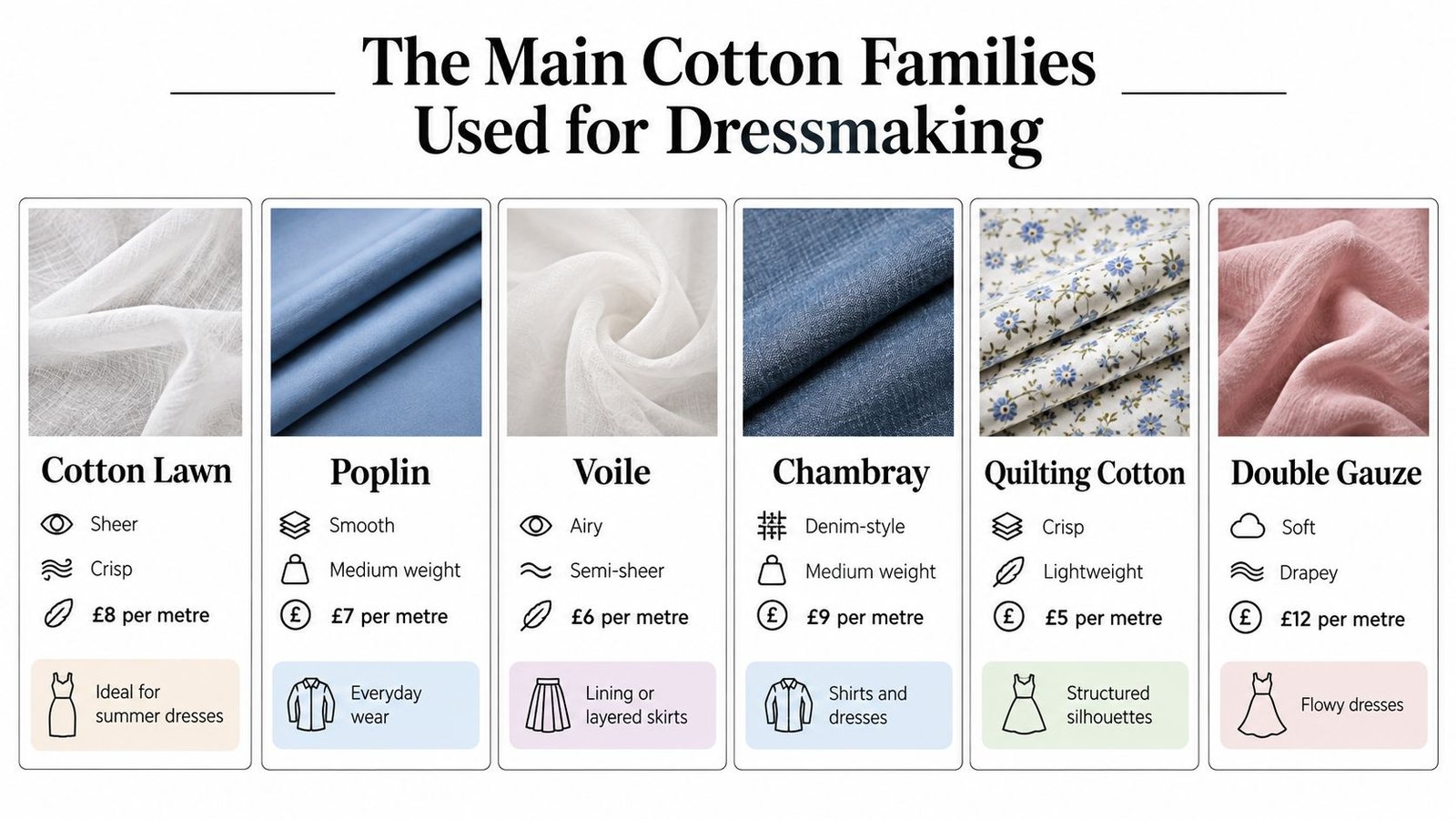
Start with the cloth's behaviour, then use the fabric name as a useful shorthand. The following families cover most cotton dressmaking choices in UK shops and online listings.
Lawn and voile
Cotton lawn is fine, smooth and light, with a soft drape and a more polished surface than ordinary quilting cotton. Choose it for blouses, gathered summer dresses, full sleeves and children's clothing where you want movement without a heavy skirt. Its warning is opacity. Hold it against the light and plan a lining or an underdress if the garment needs reliable coverage.
Voile is airier and often more transparent. It works well for layered skirts, loose tops and lightweight summer pieces, but it can shift during cutting and may need French seams or a neat enclosed finish. Don't mistake its softness for universal suitability. A voile button placket can lack the stability that a shirt pattern expects.
Poplin and chambray
Poplin is the dependable choice for button-up shirts, shirt dresses, pinafores and structured skirts. Its plain weave gives it a smooth, stable hand, so collars, cuffs and plackets press sharply. Choose poplin when the pattern calls for shirting. Lawn can work as an alternative, but it will give a softer and less assertive result.
Chambray has a denim-like appearance, usually with a lighter, more shirt-friendly construction. It suits casual dresses, shirts and skirts, particularly when you want a relaxed look without denim's bulk. Check the wrong side and wash a sample, because indigo-style colour can release excess dye.
Quilting cotton and sateen
Quilting cotton is often tightly printed on a crisp base. It's easy to cut and sew, making it useful for simple tops, children's garments, pyjama trousers and structured gathered skirts. It's a poor choice for a fluid wrap dress or a softly draped bodice because it can hold the body away from the figure.
Cotton sateen has a smooth surface and subtle sheen created by its weave. It can make a smart skirt or fitted dress, but the surface may show pressing marks, needle holes and seam imperfections more readily than poplin. Use a pressing cloth and test your iron temperature.
Double gauze and jersey
Double gauze is soft, breathable and layered, with a relaxed, slightly crinkled character. It's excellent for loose dresses, tops and children's garments where comfort matters more than sharp tailoring. It frays and can stretch at seams, so stabilise shoulder areas and avoid expecting a crisp collar.
Cotton jersey is knitted rather than woven and belongs with stretch patterns. It suits T-shirt dresses and close-fitting casual garments, but it shouldn't be substituted casually for woven cotton. If you're weighing fibre behaviour against synthetic alternatives, this practical guide to compare cotton and polyester is useful background.
The UK Government Buying Standards specification defines cotton as fibre obtained from the bolls of the Gossypium plant and sets chemical-residue limits for finished cotton products, including formaldehyde ceilings for babywear and skin-contact garments (UK Government textile specification). For babywear or close-fitting garments, buy from a seller who can identify composition and finishing rather than relying on a vague product title.
Reading GSM, Drape and Hand Before You Buy
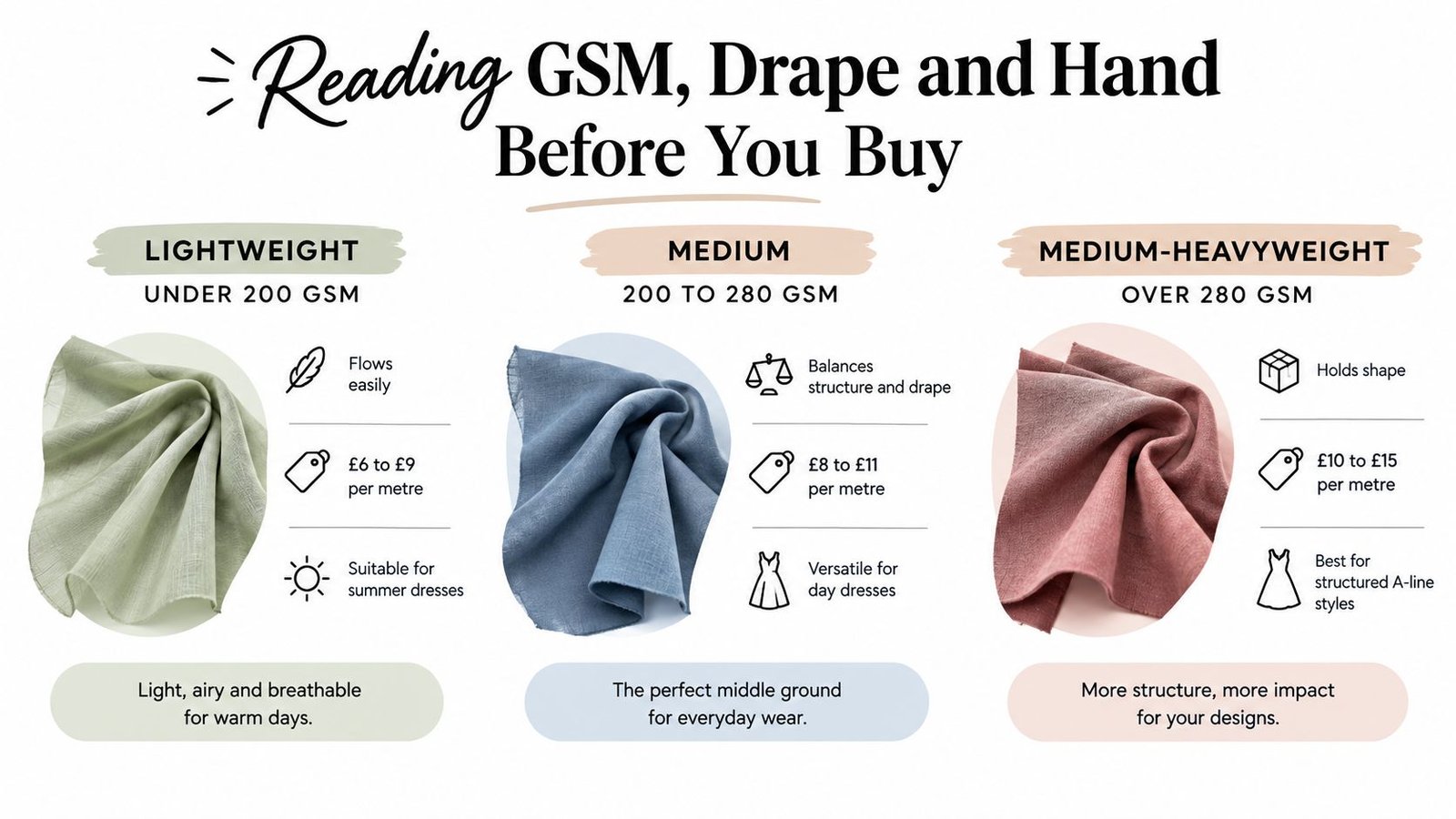
GSM means grams per square metre, but the number only becomes useful when you connect it to the garment. A lightweight cloth may gather beautifully and feel cool, while a heavier one supports a waistband, pocket or button placket. Neither is automatically better.
A UK fabric-weight guide classifies lightweight cottons such as poplin, chambray, cotton jersey and double gauze as below 200 GSM, with medium-heavyweight denims and cotton twills sitting around 270–340 GSM (UK fabric-weight guide). Use those bands as a starting check against the pattern envelope, not as a substitute for handling the cloth.
Match the weight to the shape
- Below 200 GSM: Choose lawn, light poplin, chambray or double gauze for shirts, summer dresses, gathered skirts and garments needing movement.
- Around 200 to 280 GSM: Expect a useful middle ground for everyday dresses, overshirts and skirts that need some body without feeling workwear-heavy.
- Around 270 to 340 GSM: Choose denim or cotton twill for structured skirts, trousers, jackets, utility dresses and bags. Bulky seams will need planning.
A heavier cotton may require a stronger needle, slower stitching and careful seam grading. Test a size 90 needle on denim or firm twill, and reduce thick intersections before asking the machine to climb them. For lighter cotton, a fine universal needle and a shorter stitch may give a cleaner result, but test on the actual cloth.
Run the folded-swatch test
Fold a swatch into a loose double layer and hold it from one corner. If it collapses into soft curves, expect gathers, sleeves and a fluid skirt. If it stands in a firm fold, expect structure, pleats and sharper edges. Then scrunch the cloth lightly in your palm and release it. A cotton that springs back into a reasonably smooth shape will usually press more easily than one that keeps every crease.
At home, place two swatches over the edge of a table with the same length hanging free. Photograph them side by side, then pin a small seam and press it. This reveals more than a product description. You'll see whether the fabric tunnels at the seam, shines under heat or refuses to hold a crease.
For broader fabric-weight terminology, the guidance on choosing GSM for merch blanks offers useful context, but your pattern's recommended fabric type remains the final authority.
Matching Cotton to the Garment You Are Making
A fabric should solve the garment's practical problem. A shirt needs stable edges and a collar that stays put. A gathered dress needs enough softness for fullness without turning the waist seam into a bulky ridge. A child's frock needs comfort, washability and seams that tolerate movement.
| Garment | Primary cotton | Alternative | Why it works |
|---|---|---|---|
| Classic button-up shirt | Stable cotton poplin | Cotton shirting or chambray | Poplin supports collars, cuffs, plackets and sharp pressing. Chambray gives a softer, more casual result. |
| Gathered summer dress | Cotton lawn | Soft poplin or double gauze | Lawn creates controlled gathers and a light skirt. Double gauze feels softer but gives a more relaxed silhouette. |
| Structured A-line skirt | Cotton twill or firm poplin | Medium denim | Twill holds the A-line shape and supports pockets. Denim adds durability but increases seam bulk and weight. |
| Child's summer frock | Cotton lawn or smooth poplin | Double gauze | Lawn is light and washable, while poplin handles everyday abrasion. Double gauze prioritises softness but needs more careful seam finishing. |
The shirt needs stability
For a classic button-up, choose poplin before lawn. The button band, collar stand and cuffs depend on a cloth that accepts a firm press and doesn't collapse while you stitch. A soft lawn can make a beautiful blouse, but it may need interfacing and more careful handling than the pattern intends. Chambray is the honest alternative when you want a shirt with a relaxed, denim-inspired appearance.
The dress needs the right fullness
A gathered summer dress is where quilting cotton often disappoints. It can make the waist feel bulky and the skirt stand out rather than swing. Lawn is my first choice because it gathers without excessive stiffness. If you want a softer, more casual finish, double gauze works, but expect a less precise silhouette and a more textured surface.
The skirt needs body and seam control
An A-line skirt benefits from twill or firm poplin. These fabrics hold the waistline, support pockets and make pressing pleats or shaped seams straightforward. Medium denim is durable and visually strong, but check the pattern's seam allowances. Several folded layers at a waistband or pocket opening can overwhelm a domestic machine.
Printed cottons introduce another decision. With stripes, checks or large motifs, mark the intended stripe or repeat across the bust, waist and hip on the paper pattern. Pin or baste two scraps together before cutting. If the lines don't continue smoothly across a side seam, adjust the placement before committing to the full length. Buy extra fabric when matching matters, because a standard layout may no longer fit.
For children's clothing, avoid choosing solely by colour. A smooth lawn or poplin is usually easier to wash and press than a loose gauze. Keep the inside comfortable, finish scratchy seams and test colour transfer before the first wear.
Where to Buy Cotton Dressmaking Fabric in the UK
The UK market is broad but increasingly dependent on imported and specialist supply. In 2024, UK cotton-fabric consumption was reported at roughly 14 million square metres, down about 7% year on year, with imports around the same volume and Pakistan the largest single supplier at about 6.1 million square metres (UK cotton-fabric market overview). For a home dressmaker, that means stock can vary, runs can be short and a favourite print may not return.
Use online specialists intelligently
A useful product listing should state fibre composition, usable width, fabric weight where available, care guidance and the quantity sold. Product photographs help with colour, but they can't show opacity, recovery or seam behaviour. Order a swatch for a fitted dress, shirt or expensive print, then record your observations in a small fabric notebook.
Established online shops are convenient for repeat basics. They're also useful when you need a particular colour family or enough continuous length for pattern matching. Don't buy by the photograph alone. Ask whether the fabric is woven straight, whether the listed width includes the selvedge and whether the stock is continuous.
Treat deadstock as a limited opportunity
Ex-designer and deadstock cotton can give you distinctive prints and better cloth than a generic bargain, but the cut may be the only available run. Inspect the full length where possible for shade variation, snags, oil marks, weak areas and a tight selvedge. A two-metre cut may be perfect for a blouse but useless for a gathered adult dress if the pattern needs more width or matching.
Buy a little extra when the fabric is scarce and the pattern is unforgiving. If the cloth is already discounted, a small remnant for a pocket, yoke or future patch can be more valuable than an exact purchase that leaves no repair reserve.
Don't ignore local shops
Independent sewing shops let you compare bolts by hand, check opacity against the shop light and ask about behaviour after washing. Phone before travelling and ask about end-of-bolt remnants. Those shorter pieces can be excellent value for a child's dress, blouse or colour-blocked skirt.
More Sewing is one UK option with online cottons, viscose and Tencel blends, jerseys and ex-designer deadstock, alongside a Worthing shop, fabric swatches, a Quality Guarantee, free shipping over £50 and sewing machine servicing. Use any retailer's guarantee and swatch service as a chance to verify the cloth before cutting, not as permission to skip the inspection.
Pre-Washing, Pressing and Caring for Cotton
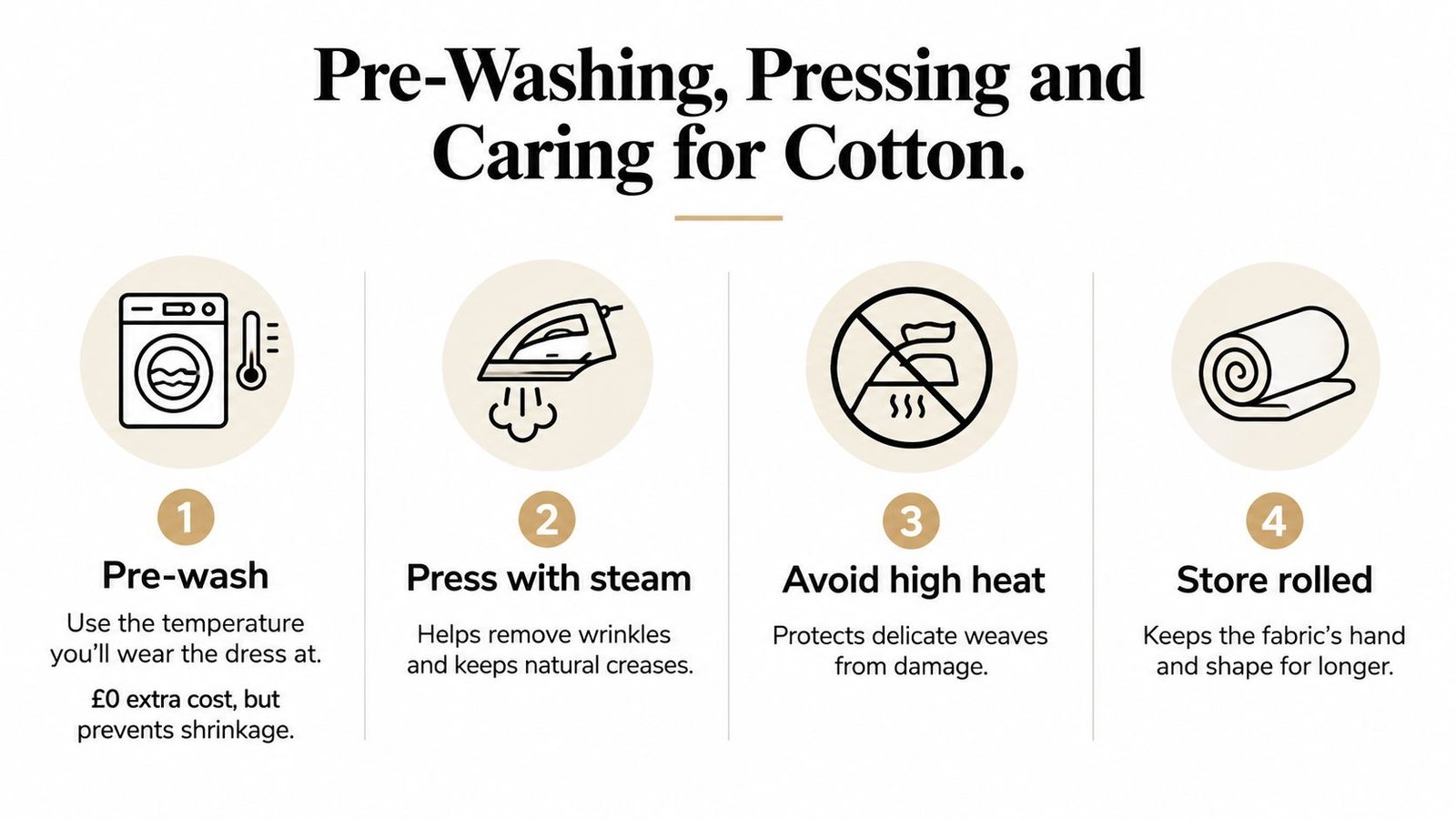
Pre-washing is part of construction. Cotton that shrinks after you've finished the dress can shorten a hem, tighten a bodice and change the balance of a skirt. One UK sewing guide estimates that fabrics containing cotton, wool, viscose or linen commonly shrink by around 3–10% and recommends buying roughly 10% extra fabric to allow for the loss (pre-washing guidance from Sew in Brighton).
Test the length before cutting
Use the full, uncut length whenever possible. Fold it loosely rather than forcing it into a small machine load, wash it using the intended garment routine, dry it in the way you'll dry the finished item and press it before laying out the pattern.
For a quick comparison, cut two identical postcard-sized cotton samples and mark the straight-grain direction. Wash one at the intended temperature, dry and iron it, then place it over the unwashed sample. Compare the length and width. If the change is mostly along the grain, account for it in garment length. If the width changes more, check whether the pattern pieces will still fit across the cloth.
Test dye and control the iron
Rub a damp white cloth firmly over a hidden area or a washed offcut. If colour transfers, wash the fabric separately or with similar colours. UK textile-care guidance states that white cotton can generally tolerate washing up to 95°C, while coloured cotton should normally be washed at no more than 60°C with a colour detergent (Miele cotton-care guidance). Follow the fabric's own label when it gives a lower limit, particularly for prints, blends and finished surfaces.
Poplin usually welcomes steam and a firm press. Lawn and sateen deserve more restraint. Use a pressing cloth, lift rather than drag the iron and test heat on a scrap. A shiny mark is difficult to remove once it's on a bodice.
For practical advice on maintaining washable cotton accessories, this washable tote bag care guide is also useful, especially when you're deciding how much handling a fabric finish can tolerate.
Store cotton clean and dry, protected from prolonged direct light. Roll delicate or printed lengths if folding would create hard creases, and keep a labelled offcut with the garment pattern. That scrap becomes invaluable for future repairs, colour matching and testing a new care routine.
Building a Cotton Dress That Lasts
The most responsible cotton choice is the one that produces a garment you'll keep wearing. Cotton's environmental cost varies with fibre origin, irrigation, dyeing, fabric weight, laundering and the number of times the finished garment is worn. A durable, repairable dress can be a better decision than a supposedly ideal fabric that twists, fades or fails at the seams after limited use.
UK evidence submitted to Parliament identifies colour fading, pilling, fabric breakdown, discolouration and seam holes among common clothing failure modes. It also cites WRAP's finding that extending clothing life by nine months of active use can reduce carbon, waste and water footprints by roughly 20–30% each (UK Parliamentary evidence on fashion sustainability). That makes seam stability and repair planning part of fabric selection, not an afterthought.
Build for the stress points
Use a stable plain weave or tightly constructed twill at pockets, waist seams and armholes. Reinforce pocket corners with a short bar tack, stay a shoulder seam before it stretches and grade bulky intersections rather than trimming every allowance aggressively. Leave a sensible seam allowance where future alteration is likely, especially at side seams and waist seams.
Printed cottons can make repairs less conspicuous. Save the hem offcut, a matching scrap or a cut section from a generous seam allowance. If you're working with stripes or a large repeat, mark matching points on the paper pattern before cutting and transfer them with tailor's tacks or washable chalk. A patch that follows the original direction looks intentional. A random rotation often looks like a repair made in a hurry.
WRAP research found that four out of every five repaired textile items displaced a new purchase, an 82.2% displacement rate, and estimates that repairing one cotton T-shirt instead of buying a new one can save more than 7.5 kg of CO2e (WRAP research on textile repairs). The lesson for dressmakers is direct: choose cloth and construction that make repair possible.
Cutting-table checklist: cotton family, GSM, drape, opacity, grain, pre-wash result, care temperature, seam reinforcement, alteration allowance and a saved repair scrap.
A good cotton dress isn't merely pleasant on the day you finish it. It keeps its shape, survives its washing routine and gives you enough structure to mend or alter it when your body, taste or wardrobe changes.
More Sewing offers cotton dressmaking fabrics, plain and patterned cloth, jerseys, denims, Tencel blends, ex-designer deadstock, haberdashery and fabric swatches online, with a Worthing shop for local support and sewing machine servicing. Visit More Sewing with your pattern requirements in hand, order a swatch where available and choose the cotton you can test, wash, wear and repair with confidence.
