
You pull a pattern envelope from a drawer and the corner crumbles in your hand, or you open a laptop and realise the PDF you were sure you saved has vanished into a folder you can't find. Most sewists only notice their storage system when something has already gone wrong, and by then the damage is annoyingly familiar, brittle tissue, missing pages, or a traced copy that's no longer obviously linked to the original.
A good pattern storage system solves both problems at once. It protects paper from the British home it lives in, and it keeps digital files recoverable when a laptop dies, a printer setting changes, or a project gets edited three times before you've even cut fabric.
Why Pattern Storage Matters More Than You Think
The first pattern I ever rescued from a loft looked fine until I unfolded it. The fold lines had gone chalky, then split, then started shedding tiny flakes every time I tried to smooth the pieces flat. That's the point everyone realises how to store sewing patterns isn't a tidy-up question, it's a preservation question.
The same thing happens in digital form. A Burda file can seem safely tucked away until a reset wipes the laptop, the download limit has passed, or the file sits in a folder named something so vague you never open it again. I've also seen a hand-drafted block disappear during a house move because it was treated like loose paper instead of a master record worth separating from the rest of the pile.
What fails is rarely the pattern itself. It's the system around it, paper stored in a warm cupboard, digital files left as one copy in one place, and project notes spread across scraps, screenshots, and memory. Once you accept that, the fix gets simpler.
Practical rule: if you can't find the original in under a minute, or you can't reprint the right version without guessing, the storage system isn't doing its job.
The good news is that pattern storage doesn't need to be fancy. It needs to be stable, labelled, and boring in the right way. That's what keeps a favourite dress pattern, a vintage tissue envelope, or a traced bodice block usable for years instead of months.
Folding, Flat Storage and Envelope Choices That Work
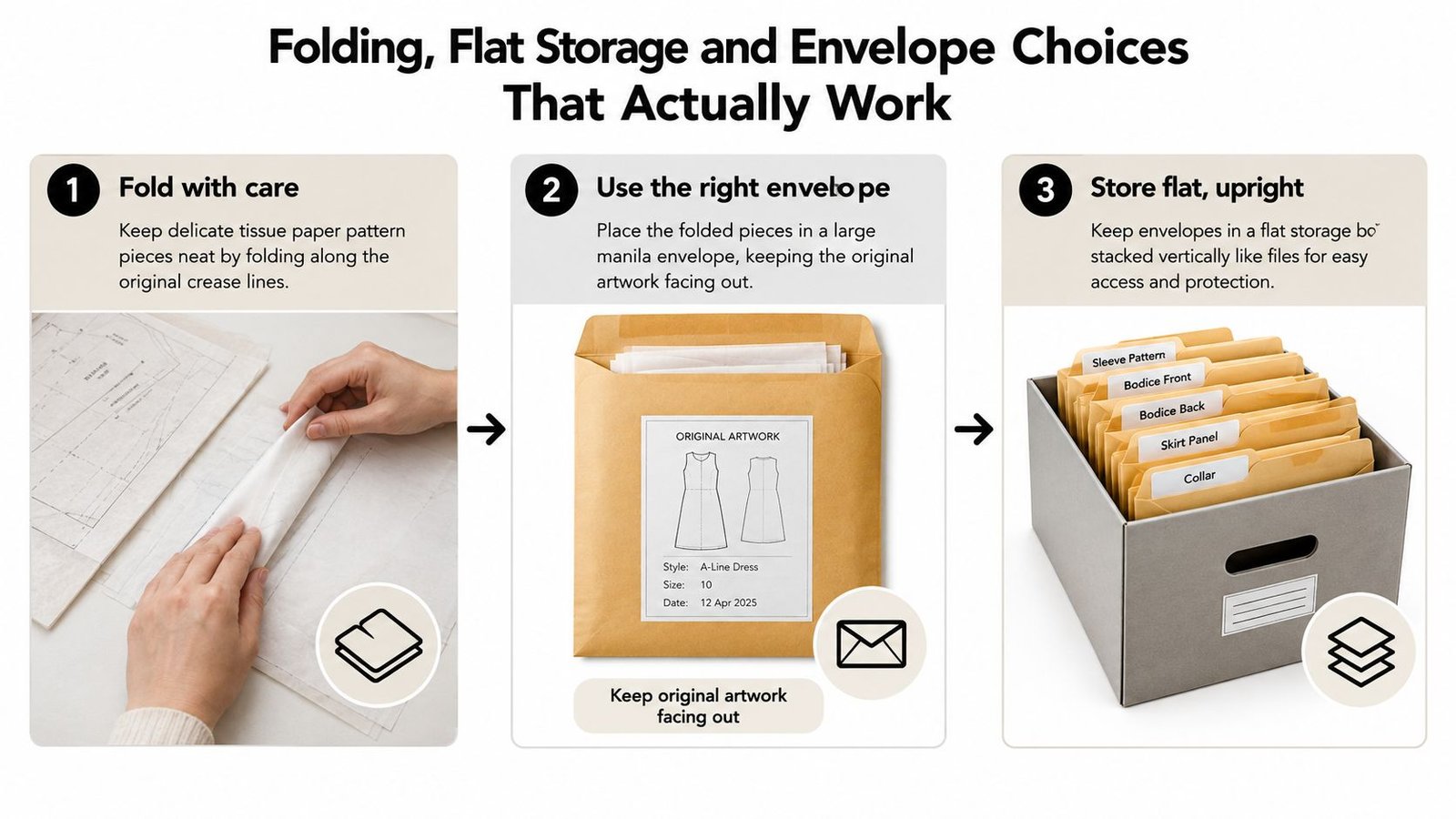
A pattern usually gets damaged at the moment you try to put it away in a hurry. Tissue tears at the corner, a long skirt piece is crushed into a pouch that is too small, or a printed PDF set loses half its instruction pages. The simplest physical system still holds up well: sort, trim, slip, store. Group each pattern first, trim only what helps it fit, keep the instructions with the pieces, and store the whole set so you can lift it out cleanly without scraping against everything around it.
Large envelopes suit tissue patterns
Old tissue patterns need a gentler hand than modern copy paper. I keep the original cover or artwork facing out, then fold the tissue to suit the envelope, not the other way round. If there are existing crease lines, use them. They are usually kinder than forcing in fresh folds across darts, notches, or narrow seam allowances. That matters more with vintage sheets, where one sharp new crease can become the next split.
If a piece is awkwardly long, I would rather use a larger envelope than keep refolding until the packet turns bulky and stiff. Flat enough to handle is the goal.
Plastic wallets suit printed PDFs
Printed PDFs behave differently. They are tougher than tissue, but they become messy fast. An A4 plastic wallet in a ring binder keeps assembled sheets, instruction pages, and any printed extras together, and you can pull out one pattern without disturbing the rest. For traced-off size adjustments or reprints, I keep those with the same wallet too, clearly marked as the current version, because paper clutter and version mix-ups tend to arrive together.
Accordion files suit active projects
An accordion file is best as a working tool, not long-term storage. Use it for current makes, by garment type or by project stage, so the printout, tracing, toile notes, and revised pieces stay together while you are using them. Once the project is finished, move the settled version into its proper home.
For paper patterns you reach for often, vertical storage is easier on both the envelope and your patience. Stacked flat in a deep pile, patterns slump, catch, and get crumpled at the edges. Upright storage in a rigid box lets you browse without dragging half the collection out first. Archive storage boxes with lids from Storage & Removal Boxes Ltd are one practical example of the kind of container that keeps envelopes upright, supported, and easier to sort.
Reading Your Home's Climate Before It Damages Your Patterns
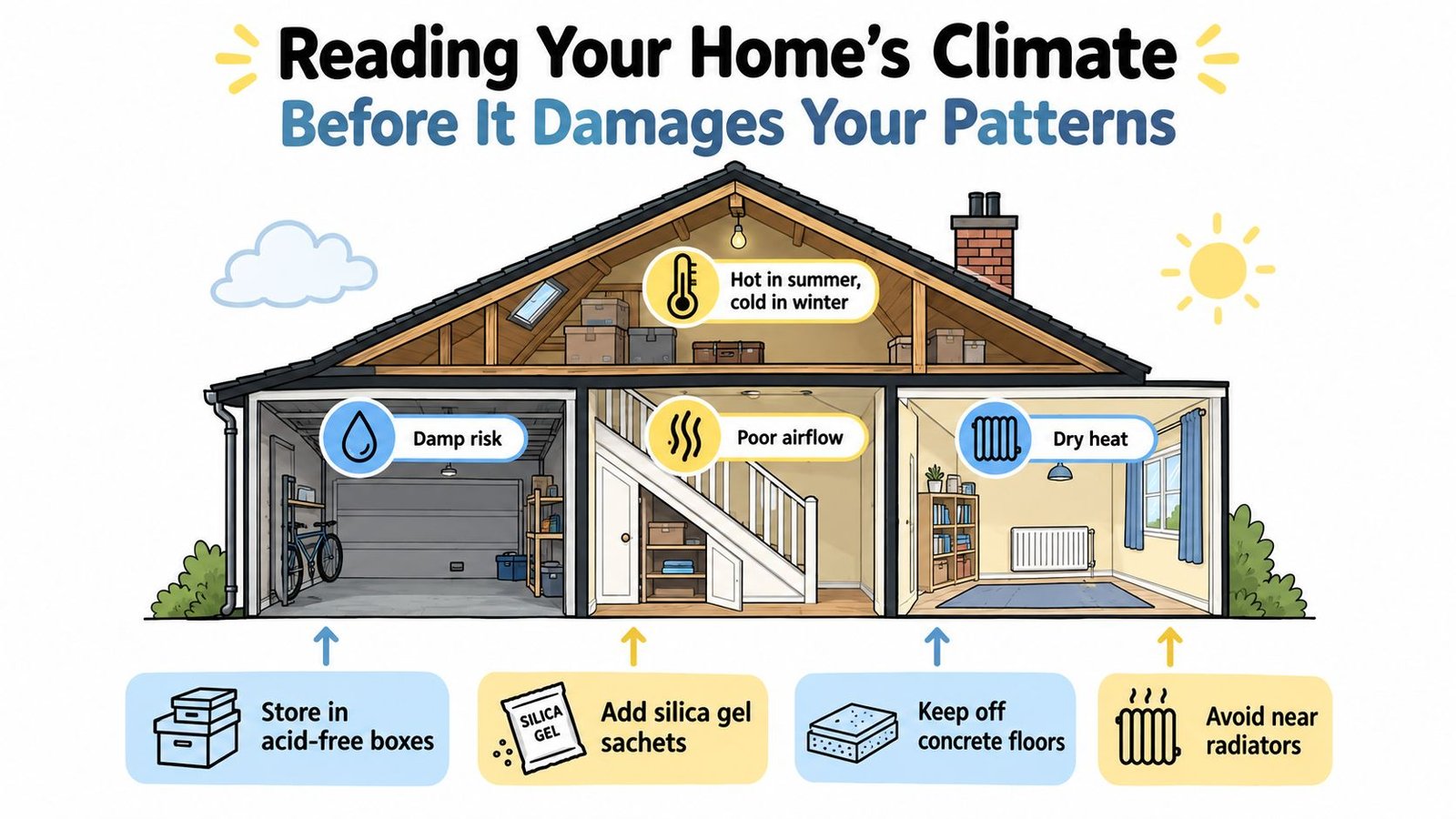
A British home can be perfectly comfortable for people and still rough on paper. A loft gets hot in summer and cold in winter. A garage often swings between damp and stale. A box room with a radiator under the window can dry tissue faster than you'd expect, especially if the heat switches on and off through the day.
The National Archives recommends 13–20°C and 35–60% relative humidity for paper-based material, with the emphasis on stable conditions, and it warns that paper and parchment shouldn't remain below 40% RH for long periods because they become more brittle. It also notes that mould can germinate and spread when humidity rises above 65% RH. Those figures are a useful yardstick for a home dressmaker, because they translate neatly into everyday choices about where patterns should live. National Archives environmental guidance
Where patterns usually fail
A damp external wall is a poor neighbour for tissue. So is a radiator, a conservatory, or an unventilated cupboard that traps stale air. If the room feels clammy, smells musty, or causes paperwork to curl, don't make it the home of vintage envelopes.
What to check before you store
A small digital hygrometer gives you a real reading instead of a guess. If the room regularly sits above the comfort zone or swings sharply between damp and dry, move the collection before you're dealing with mould or brittle fold lines. Keep patterns in an internal room with ordinary household conditions, away from direct heat, direct light, dust, pests, and stagnant air.
Paper likes predictability more than perfection.
If a loft is the only available space, use it only with caution and only for items you're prepared to lose less gracefully. Patterns that matter, vintage, heirloom, or frequently reused, deserve the driest stable room you've got.
Labelling and Filing Systems You Can Maintain
A filing system earns its place when you can identify a pattern quickly, even after months away from it. Mark three states clearly: original, personal traced copy, and altered. Put the status on the folder and the paper pattern. Otherwise, a sleeve adjustment made at 8 p.m. can be mistaken for the untouched master.
A simple colour code helps
Colour coding works best when the categories stay broad. Red for dresses, blue for tops, and green for trousers is easy to remember during a long sewing week. The colour code exists for instant sorting when the pile gets messy, rather than for decoration. Add a neutral label for outerwear if you want to avoid inventing a shade you will forget.
Make the label do the work
Give every folder a serial number that matches a spreadsheet entry. On the front, record the pattern name, brand, size, and version. A note such as “Size 12 traced to 14 at waist, June 2026” records the useful change and makes clear that the copy in your hand is not the master.
| A simple pattern filing scheme | |||
|---|---|---|---|
| Category | Label colour | Folder type | Notes |
| Dresses | Red | Large envelope or vertical box file | Mark original, traced copy, altered copy |
| Tops | Blue | Plastic wallet in binder | Keep instruction sheet inside |
| Trousers | Green | Accordion file for working projects | Add size changes and dates |
| Outerwear | Neutral | Acid-free folder | Store master pieces separately |
Keep the spreadsheet entry aligned with the physical label. If you alter a traced copy, update its status and date before returning it to storage. That small version-control habit prevents a common British sewing-room problem: reaching for a familiar envelope and discovering later that the useful adjustment exists only on another copy.
QR codes on envelope labels can link the physical folder to the digital master, saving a search through a crowded computer folder. Use them only if you will maintain the links. Consistency matters most. If each envelope uses different wording, the system becomes another source of confusion.
Backing Up Digital Patterns the Way Archivists Do
A pattern file can fail. A download link may disappear, an older PDF may behave badly on a new laptop, or a printer update may alter the scale enough to spoil a bodice. A reliable system uses separate copies, separate storage locations, and regular checks.
The National Archives preservation policy uses three copies, with one held securely off-site, alongside fixity checks that confirm files have not changed or become corrupted. That provides a practical model for home sewists. Keep one untouched master, one working copy, and another copy away from the main device. National Archives preservation policy
A workable home version
Store the untouched PDF in a folder named Patterns_Master. Put files being tiled, assembled, or altered in Current_Projects. Sync a duplicate to a reputable cloud service, then keep another copy on an external drive in a different room. This matters in a British home where a failed laptop, a power problem, or damp storage can remove access to every copy kept together.
Use filenames that carry the pattern name, size, format, and version, such as ClosetCase_Charlie_Caftan_Size14_Tiled_A4_2026. Keep the original download or scan separate from edited and tiled-print files. Printer settings, page assembly, and later adjustments can change the result, so the master should remain untouched.
Check that the backup still works
Open files occasionally and confirm they still read properly, not merely that they exist. After changing printer drivers or moving to another machine, print a test square before cutting expensive fabric. A backup earns its place only when it can recreate the pattern you intended to use.
Save the untouched master, instruction booklet, and purchase evidence together. Digital pattern providers may limit downloads, so saving each file when received is a sensible habit. More Sewing's guidance recognises that paper patterns need physical storage while PDFs occupy digital space, and that tracing can protect the original pattern. This supports a hybrid paper-and-digital library with clear versions and a recoverable master.
Archival Materials and Short-Term Protection
Match the storage material to the time span. A pattern you'll use next week can live differently from a vintage tissue set you want to preserve for years. In a British home, the box also needs to cope with damp air, cold lofts, and garages where temperature changes encourage mould.
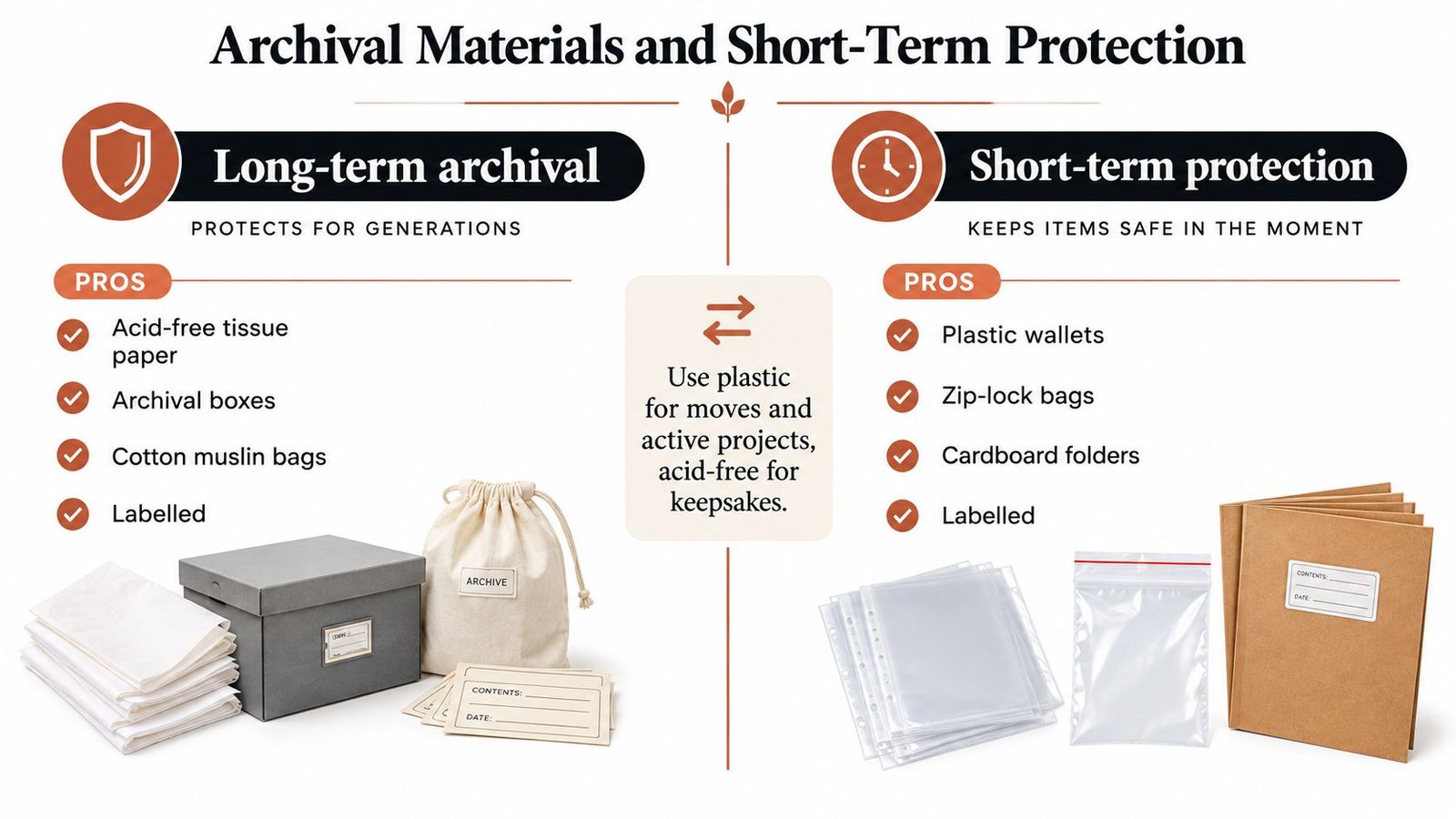
For long-term storage, use acid-free tissue around fragile folds, tears, or perforated sections. The National Archives identifies acid-free, undyed archival boxes as the professional benchmark for paper records and notes that translucent acid-free tissue suits interleaving or wrapping small items. For vintage patterns, heirloom drafts, or pieces left untouched for months, cushion the tissue, label it clearly, and keep it in a stable box rather than loose in a drawer.
Short-term protection serves a different purpose. A sealed plastic tub can help during a house move, while a plastic wallet keeps a current project free from dust as you cut and pin. Dry the pattern first. An airtight tub can trap existing moisture against the paper, particularly after storage in a cold loft or garage.
A breathable cotton bag works well for pieces currently on the table, protecting them from dust without holding in humidity. For a larger folder collection, rigid boxes are easier to retrieve from and less likely to collapse than soft containers. archive storage boxes with lids suit vertical filing and help prevent contents being squashed.
Keep archival boxes indoors, away from exterior walls and loft insulation. Use short-term plastic protection for transport or active projects, not as a permanent answer in a damp room.
Troubleshooting the Problems Every Sewist Meets
Yellowed tissue is irritating, but it's not automatically a disaster. I don't try to restore it. I isolate it, store it flat, and stop it from touching cleaner paper so the discolouration doesn't spread through the rest of the set. Prevention is what repairs this.
Creased tissue
A pattern crushed by an overstuffed envelope can usually be eased, not erased. Put the tissue between two sheets of baking paper and press it with low steam, keeping the iron moving and avoiding heavy pressure. Don't chase every line flat, because old paper will tear faster if you insist on perfection.
Mould on one pattern
Mould means isolation first, not rummaging. Separate the affected pattern from the rest of the stash, let it dry fully in a stable room, and seek professional advice if the mould is widespread or active. Wiping it down casually is how contamination moves from one envelope to ten.
Missing or wrongly traced pieces
If a piece has gone missing, or you realise the traced copy doesn't match the version you meant to keep, go back to the digital master and reprint only the page you need. Then mark the paper twin clearly so it doesn't re-enter circulation as the original by accident. That's where version control earns its place, because guessing with tissue wastes time and fabric.
Confused originals and personal copies
Copyright and storage overlap in this respect. GOV.UK explains that copying includes hand-copying, photocopying and scanning into a computer, and that a sewing pattern may contain written instructions protected as a literary work plus templates, illustrations or photographs protected as artistic works. A practical storage system should retain the original envelope, designer or publisher details, purchase information and any licence terms with the pattern. GOV.UK copyright notice for knitting and sewing patterns
Keep that paperwork with the pattern itself, not in a separate pile. Mark folders as original, personal copy, or licensed digital file, and you're far less likely to upload, share, or reuse something in the wrong way.
A simple weekly habit keeps everything steady: file as you finish, scan once, back up twice, check humidity, and audit the whole set once a year. If you want a printable checklist, write those five steps on a card and pin it above your cutting mat. That small routine does more for your sewing library than any “perfect” system ever will.
More Sewing can help you keep the practical side of sewing supplied, from fabric and notions to tools that support an organised workspace. If you're building a better pattern library alongside better projects, take a look at More Sewing and use it as one stop for the supplies that make the whole system easier to keep up.
