
You're standing at the counter with three bolts that all say 100% cotton, a shirt pattern in your bag, and no clear reason to pick one over the others. One feels papery, one feels like a bedsheet, one drapes over your hand like it wants to be a blouse. That's the moment most shirt projects are won or lost, long before you thread a needle. Choosing cotton fabric for shirts isn't about the fibre name. It's about matching construction to the shirt you want to wear.
Why Picking the Right Cotton Actually Matters
A dressmaker I talk to regularly made the same classic button-up twice, once in a light poplin and once in a soft lawn she'd fallen for on colour alone. The poplin version pressed into a sharp collar and held its placket flat. The lawn version looked lovely on the hanger, then the collar wilted, the cuffs rolled, and the button band rippled after washing. Same pattern, same cotton label, completely different shirt.
That's because poplin, oxford, lawn and twill don't behave alike under the needle, on the body, or after repeated laundering. Poplin is smooth and stable, so topstitching sits cleanly. Oxford has texture and body, so it forgives a slightly wobbly seam but feels warmer. Lawn is fine and fluid, beautiful for gathers, unforgiving if you need structure. Twill drapes with a diagonal hand and hides creases better, but it can shift on the bias at the cuff.
Fibre Content Is Only the Starting Point
UK sewists often ask whether cotton lasts longer. In the 2025 Global Durability Survey of UK consumers, 73% cited construction quality and 65% cited washing practices as important to longevity, both above the 60% who cited fibre content. People also stopped wearing clothes for loss of fit at 54%, holes or tears, and split seams, not because the label said the wrong fibre.
That history matters too. Cotton became mainstream for British shirts in the last quarter of the eighteenth century as mechanised spinning developed, and cotton rose from 2.3% of British imports in 1790 to 55% by 1830. Woven cotton got embedded in British clothing because factories could produce it consistently and washably, not because every cotton cloth was identical.
Shop-floor rule: Read the weave, weight, drape and finish before you read the price. Those four tell you how the collar will sit.
Spend five minutes handling a bolt properly and you'll avoid puckered seams, tired collars and cuffs that go limp by the third wash.
The Four Properties That Make or Break a Cotton Shirt
Handle a bolt in this order and you'll read it the way experienced shirtmakers do.
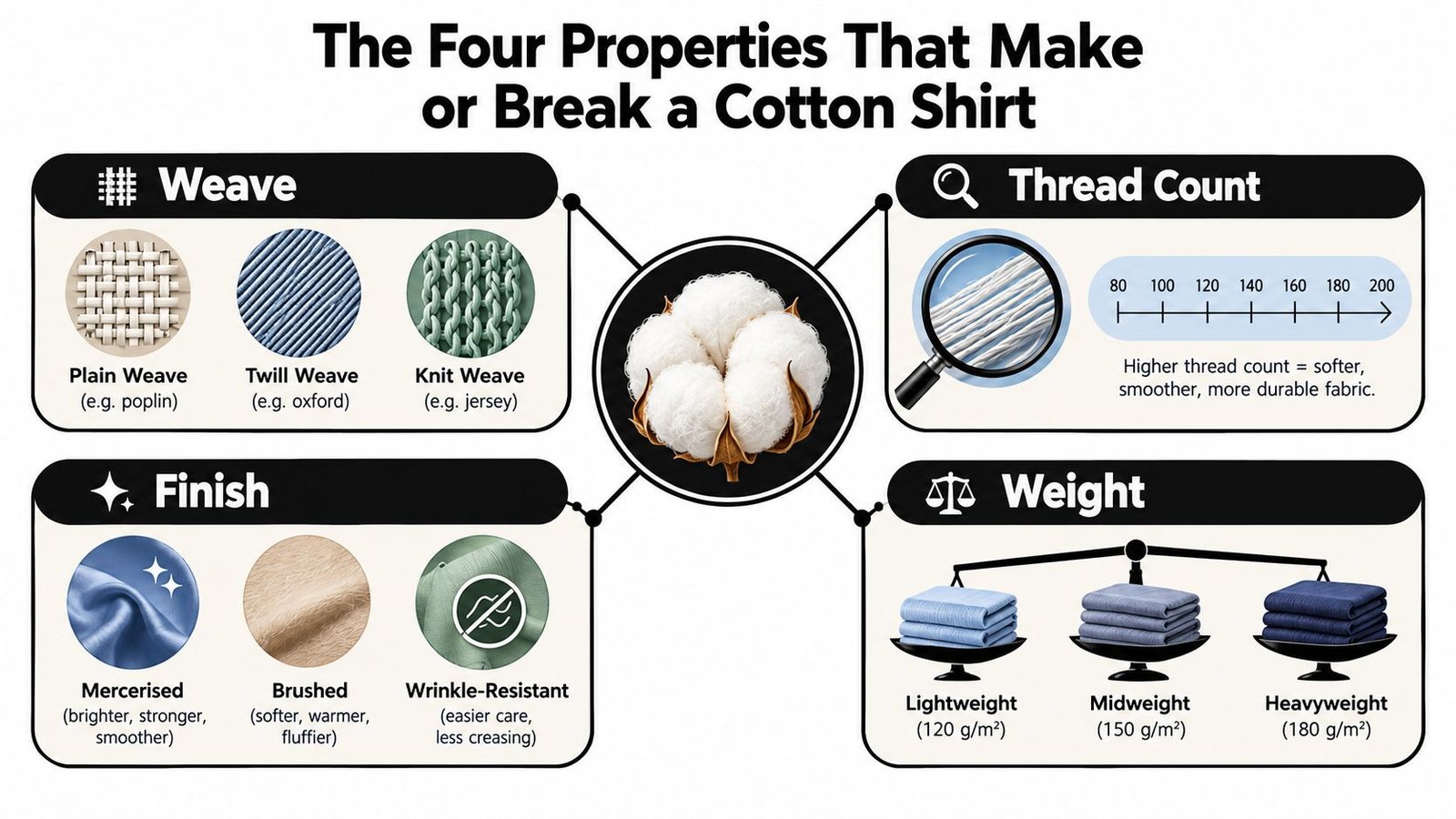
The map below summarises the four checks before you commit to a cut.
Weave Sets the Character
Plain weave gives you poplin and lawn. Threads go over and under in a simple grid, so the cloth is stable, presses crisply, and holds a collar point. Basketweave oxford pairs threads, which creates that pebbly texture and extra body for a button-down. Twill runs diagonally, drapes softer than poplin at the same weight, and suits overshirts. Jersey knit loops instead of weaving, so it stretches and needs a different pattern, a ballpoint needle, and seams that can move.
A UK educational textiles guide on cotton properties notes that 100% cotton can crease easily and feel stiff because it lacks elasticity. That's an advantage for a structured button-up that needs sharp pressing, and a drawback if you want movement across the back.
Weight, Drape and Finish in Your Hand
Weight is measured in GSM, grams per square metre. As an example, a fabric around 110 GSM will feel like a summer blouse lawn, while an example around 220 GSM behaves more like a winter overshirt twill. Don't judge by number alone. Hold a corner and let the cloth fall. If it drops in soft folds, it'll make a fluid collar and a hem that swings. If it holds a cone shape, it'll support a stand collar and a firm cuff, but gathers will look bulky.
Scrunch a handful for ten seconds, then release it.
- Springs back fairly smooth: Good for work shirts you won't iron daily.
- Holds every crease: Expect a crisp look that needs pressing.
- Feels boardy after scrunching: Check whether a finish is masking a coarse yarn.
Finishes change what the base cloth does. Mercerised cotton has smoother yarn, a slight sheen, and often takes dye more evenly. Brushed cotton is raised on one side for warmth, lovely for relaxed shirts, less sharp at edges. Sanforised cloth has been pre-shrunk by the maker, which reduces, but doesn't remove, your own testing. Easy-care coatings can help crease recovery, though they can also make a fabric feel less breathable against skin. If skin comfort is your main filter, it's worth comparing notes in ClothME's sensitive skin fabric picks alongside the finish declared on the bolt, because a coating matters as much as the fibre underneath.
How to Read a Cotton Fabric Spec Without the Jargon
A shirt listing can name the fibre and still leave out the details that decide how the cloth sews. Read the construction, weight and yarn information together, then check the sample if the description is thin.
GSM measures fabric weight, not quality. Two cottons with a similar GSM can behave differently: fine, tightly twisted yarns in a dense plain weave tend to feel smooth, while thicker, looser yarns often feel airier. The denser cloth may suit a neat collar and cuff, but can need a finer needle. The looser cloth may fray more at the seam allowance and press less crisply. If the listing gives GSM but not the weave, ask the shop before ordering enough for a shirt.
Thread count is the number of warp and weft threads in a given area of woven cotton. A higher count does not automatically make a better shirt fabric. Very dense cloth can be harder to ease into a sleeve head, and short stitch lengths may cause puckering. Look for an even construction and sound yarns rather than choosing by a headline count alone.
Yarn and Finish Words Worth Knowing
Combed yarn has shorter fibres removed, so it usually feels smoother and shows less surface fuzz. Carded yarn retains a wider mix of fibre lengths. It can feel more matte and textured, a sensible choice for casual oxfords or brushed shirts. Rub a swatch between finger and thumb, then hold it to the light to check for hairiness.
- Mercerised: A smoother surface and clearer colour can give a plain work shirt a more polished look.
- Sanforised: The maker has controlled shrinkage. Prewash and measure before cutting.
- Easy-care: The cloth is treated to resist creasing. Check the swatch for hand feel and breathability.
- Garment-dyed: Colour is applied after the fabric is made, which can leave a softer, slightly varied tone. Rub the sample to check for colour transfer.
When scanning any UK shop page, order a sample if the weave, GSM or finish is unclear. Use it to check how the cloth falls, creases and transfers colour at home. A small swatch can show whether the fabric will suit your collar and seams before you cut into shirt-length yardage.
Matching Cotton Types to the Shirt You Want to Sew
Start with the shirt's job, then pick the cloth. A summer blouse, a work shirt and a winter overshirt ask for opposite things from cotton fabric for shirts.
Cotton lawn suits a summer blouse with a soft collar, gathers at the yoke, and short sleeves. Use lightweight interfacing, or self-fabric interfacing, so the stand doesn't overpower the cloth. French seams keep the inside tidy because lawn can show seam allowances through. Voile is sheerer still, so plan it as a layered shirt over a camisole, test opacity in daylight, and choose small, light buttons that won't drag the front down.
Poplin is the classic work shirt choice. It gives crisp plackets, clean topstitching, and collars that stay defined with medium interfacing. It forgives precise work less than oxford, so slow down on buttonholes and test them on a double-layer scrap with the same interfacing sandwich you'll use in the garment.
Oxford suits a textured weekend button-down. The basketweave hides minor stitch wobble, supports a button-down collar, and softens nicely with washing. It needs a slightly longer stitch than lawn and a thorough press with steam to flatten seams before topstitching.
Twill and brushed cotton move you toward overshirts. Twill drapes in a softer line, works with larger buttons or snaps, and benefits from flat-felled seams for strength. Brushed cotton and lightweight denim make heavier winter layers, but reduce bulk by using a lighter poplin for inner yoke, inner collar stand and pocket bags.
| Cotton type | Typical GSM | Best shirt style | What it gives you |
|---|---|---|---|
| Lawn | Light example range | Summer blouse | Fluid drape, soft gathers |
| Voile | Very light example range | Layered sheer shirt | Airiness, needs lining layer |
| Poplin | Mid-light example range | Classic work shirt | Crisp collar, flat placket |
| Oxford | Midweight example range | Weekend button-down | Texture, structured collar |
| Twill | Mid to heavy example range | Soft overshirt | Drape with body, durable seams |
| Brushed cotton | Heavy example range | Winter relaxed shirt | Warmth, matte softness |
Quilting cotton tempts beginners because it's stable and widely printed, but it can feel stiff and boxy in a shirt body. If you're considering it, the guidance on soft quilting cotton for apparel sewing is a useful sense check on softness and drape before you commit it to sleeves and collars.
Pre-Cutting Tests That Save You From Shrinkage and Bleed
Don't cut expensive shirting on trust. Run these tests on offcuts, in the care conditions the finished shirt will meet.
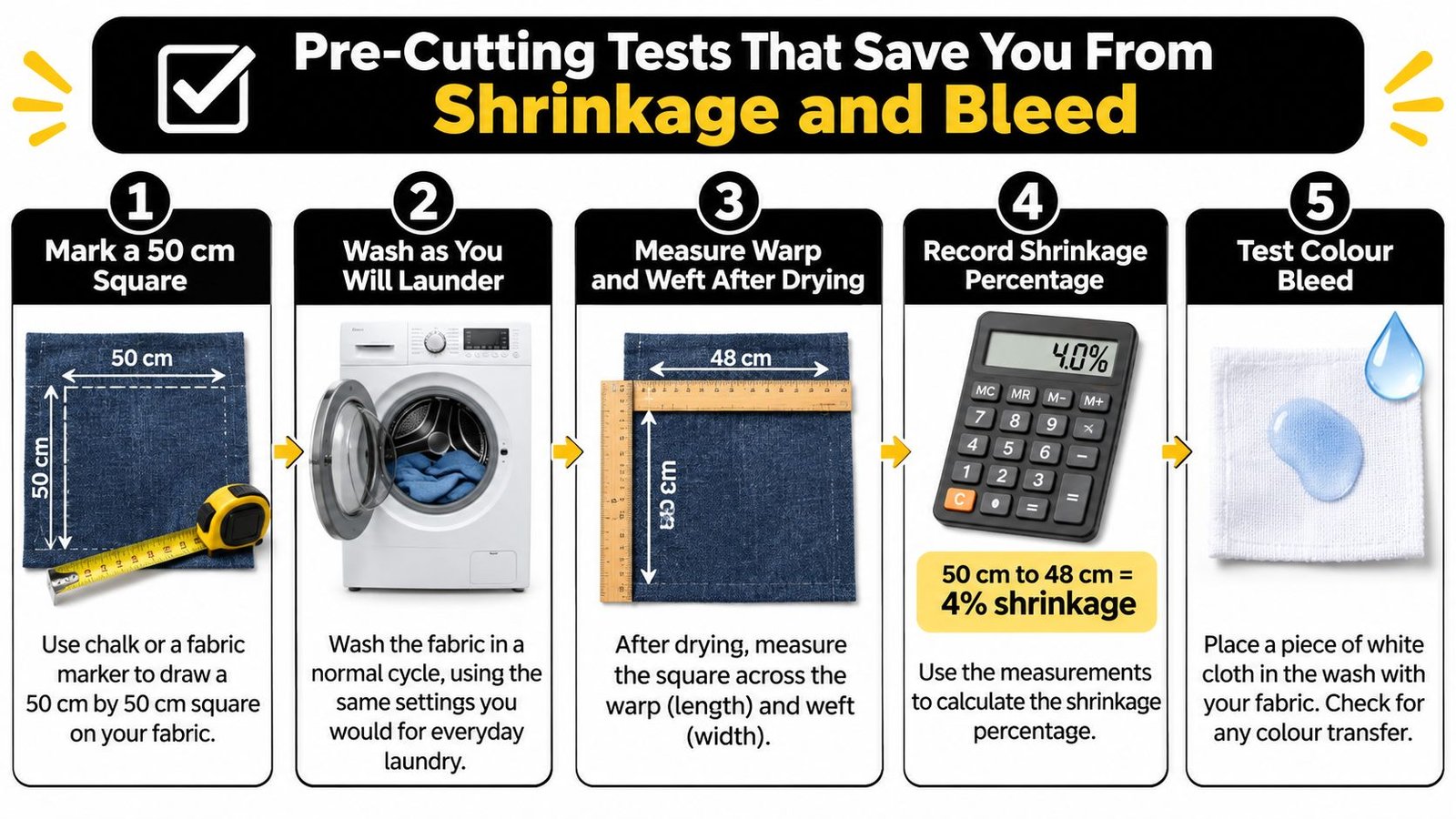
The checklist below sets out the sequence to follow before you lay out pattern pieces.
Shrinkage Test You Can Reproduce
Mark a 50 cm square, recording warp and weft separately. Wash and dry it exactly as you'll launder the shirt, let it condition fully dry, then measure again without pressing or stretching it first. A UK cotton textile manual on reference-state testing specifies five wash and dry cycles for a reproducible reference state and identifies tension-free washing followed by tumble drying as most effective for exposing relaxation. It also warns that garment shrinkage can't be predicted reliably from fabric shrinkage alone, because construction changes the result.
For a home benchmark, UK-adopted EU Ecolabel criteria for woven cotton specify dimensional change of no more than ±3% after washing and drying, tested over three washes with tumble drying. A 1 metre length losing 3% becomes about 97 cm, enough to shorten sleeves and body noticeably. Test a full-width piece from each dye lot, add any allowance your result demands, and prewash before cutting whenever the care label permits.
Watch this short demonstration before you run your own wash test, then repeat the measuring steps on your marked square.
Colour, Opacity and Recovery Checks
UK textile fitness-for-use guidance treats washing, perspiration, wet rubbing, dry rubbing and light as separate colourfastness issues in the government textile specification. At home, rub a damp white cotton cloth firmly over the dyed surface, then repeat dry. Wash an offcut with a white cloth and inspect both. Obvious transfer means caution with pale contrast cuffs, facings and interlining, especially in indigo, red and navy.
- Opacity: Hold cloth over printed text and against a lamp. If you can read through it, plan a camisole or choose poplin.
- Fraying: Sew and wash a test seam. If threads slip, widen seam allowances or use French or felled seams.
- Crease recovery: Scrunch, release, and check after a minute. Poor recovery suits relaxed styles, not formal collars.
Caring for Cotton Shirts So They Outlast the Trend
Care should match the testing you did, not a generic claim on a bolt end. The European colourfastness approach using ISO 105-C08 includes a controlled rise to 60°C with a 30-minute hold, which shows why warm washes are a serious test for dye. For everyday woven cottons at home, a cooler wash with mild detergent, a not overloaded drum, and prompt stain treatment reduce abrasion and colour loss. Specify temperature and drying method in your own care notes, because machine washable on its own isn't a reproducible instruction.
Drying matters as much as washing. Line drying is gentler on structured poplin and lawn and helps you smooth collars and plackets into shape while damp. If you'll tumble dry, test that route before cutting, use low heat, and remove the shirt slightly damp for pressing. Brushed cotton and oxford tolerate a firmer press with steam. Lawn and voile need a cooler iron and a pressing cloth, which also protects dark and printed cottons from shine.
Hang woven shirts buttoned on shaped hangers so collars keep their roll. Roll knit cotton shirts instead of hanging them, or the shoulders will stretch.
Sustainability needs the same honesty. Cotton isn't automatically harmless because it's natural. A Northumbria University and Microfibre Consortium research hub launched in January 2025 is testing fibre loss because even natural fibres can carry impacts from dyes and finishing chemicals. Choosing a durable construction, washing only when needed, using gentler cycles where suitable, and avoiding excessive tumble drying all extend the shirt's useful life, which is the most practical gain.
That long view fits UK shirtmaking history. Britain became a net importer of cotton cloth by 1958 after producing an estimated 8 billion yards at its 1912 peak, according to BBC reporting on the cotton industry. Most shirting you buy now travels through an international supply chain, so making it last is where your control lies.
Your Cotton Shirt Cheat Sheet and One Habit to Keep
Match the cloth to the job, then check the finished fabric in your hands:
- Lawn and voile: Summer blouses and layered shirts. Use light interfacing and French seams.
- Poplin: Work shirts with crisp collars. Test buttonholes on scraps first.
- Oxford: Weekend button-downs. Try steam pressing and medium interfacing.
- Twill and brushed cotton: Overshirts and winter layers. Use felled seams with lighter inner pieces.
Before cutting, mark, wash, dry and measure the fabric. Check rubbing, opacity and fraying. Keep one habit: Prewash on the intended care cycle before cutting. It helps prevent fit and colour-transfer surprises.
Browse cotton poplin, lawn, brushed cotton and sample swatches at More Sewing to assess weave, weight and drape by hand. Wash and rub-test a swatch before committing to a shirt.
