
Cotton sateen is a cotton fabric woven in a satin weave, usually a 4/1 construction in which each weft yarn passes over four warp yarns and under one before the binding point shifts along, so the sheen comes from the structure of the cloth itself and not from a fibre type or a surface finish. The same weave sits behind sheeting, dress fabric and upholstery swatches; weight and finishing decide which of those jobs the cloth can do.
So what is cotton sateen, really, and why does every answer stop at "smooth and lustrous"? That description is accurate and almost useless at the cutting table.
The lustre is a constraint as much as a selling point. It shows every pin hole, every stretched seam, every patch where the iron rested a second too long. Knowing what the floats do under a needle is the difference between a garment that looks considered and one that looks home-made.
What Cotton Sateen Is and How It Is Made
Sateen is defined by its weave, not by a separate fibre. UK textile-identification guidance describes it as a weft-faced cloth, where the weft threads cover more of the visible surface than the warp threads, producing the face we associate with satin. That account comes from a woven textile design study from the University of Huddersfield, which sets out the construction plainly.
The standard build is a five-end sateen: each weft yarn floats over four warp yarns and under one, then the binding point steps sideways so the floats never stack in a straight line. A float is a length of yarn crossing the surface without interlacing. Fewer interlacings mean light reflects off a flatter, more continuous surface, which is where the sheen lives. Turn the cloth over and the back is matte, because that side is mostly warp.
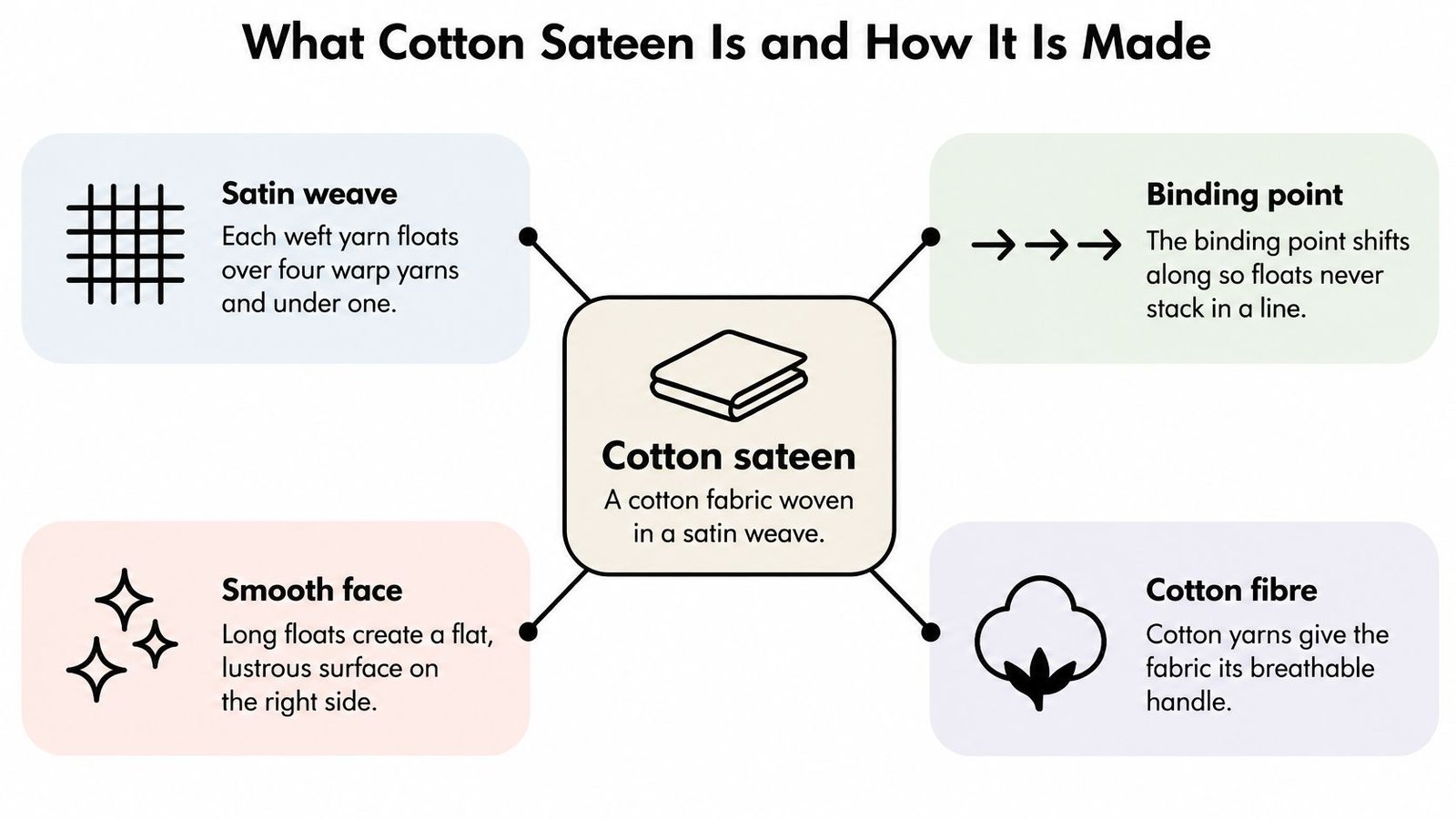
The same study notes that sateen carries infrequent, evenly distributed binding points and often uses more picks (weft insertions) than ends (warp threads). Combine that with a comparatively thicker cotton weft and you get the softer handle and stronger lustre that people recognise by touch. Sateen is the word for a satin-like weave worked in a staple fibre such as cotton; satin is the broader family name, usually worked in filament yarns. That's why a shop can use both words and mean two different cloths.
In the hand, dress-weight sateen feels cool and slightly slippery, and it folds into soft rounded creases rather than crisp ones. Weights run from roughly 110 gsm for a lining up to 250 to 300 gsm for furnishing, and the same word appears on duvet covers, dress-fabric listings and upholstery swatches. The finish that suits bedding isn't automatically what a fitted bodice needs. If you're new to cutting woven cotton and want the groundwork on grain, seam allowance and pressing before you commit, the getting-started instruction for new quilters from High Country Quilts covers exactly those fundamentals.
Britain's cotton trade is why this cloth is cheap enough to cut into without flinching. Research on the industry records UK consumption of about 3.0 thousand metric tonnes of raw cotton in 1780 rising to roughly 24 thousand tonnes by 1800, with Britain holding around 95% of the world's spindles at that point (study of the British cotton industry). None of that measures sateen specifically, but it explains how a specialised weave became an everyday fabric.
One thing to settle early: the shine is woven in, not applied. Ordinary washing won't remove it, though an enzyme wash will mute it, and heat or pressure can make the face shine in patches where you pressed hardest.
Cotton Sateen, Satin and Plain Weave Compared
Cotton sateen is a weft-faced satin weave, and the Dress and Textile Specialists guidance on identifying textile types and weaves spells out both halves of the consequence. The longer float sequence gives a smoother handle, subtle lustre and generally better drape. The same structure snags more readily and shows abrasion and pressure marks sooner than a tightly interlaced plain weave.
| Fabric | Weave structure | Face and feel | Typical fibre | Watch out for |
|---|---|---|---|---|
| Cotton sateen | Satin weave, usually a weft yarn over four warp yarns then under one | Smooth, faint sheen, soft drape, matte back | Spun cotton, sometimes a little elastane | Snagging and pressing shine on the face |
| Satin | Satin weave built from filament yarns | High liquid lustre, cool, fluid | Polyester, silk, acetate or blends | Pin holes, seam slippage, heat marks |
| Cotton percale | Plain weave, one yarn over one | Matte, crisp, slightly papery when new | Spun cotton, often long-staple | Creases sharply, holds less drape |
| Cotton poplin | Plain weave with a fine warp and thicker weft | Crisp with a faint crosswise rib | Spun cotton, often mercerised | Stiff until washed, can look flat |
| Cotton twill | Diagonal twill, usually 2/2 or 3/1 | Visible diagonal line, firm, hard-wearing | Spun cotton, sometimes elastane | Needle marks run along the diagonal |
Three confusions a table can't settle
The word on the label isn't the fabric. Retailers say "satin" about a polyester bedspread and "sateen" about a cotton sheet. The fibre-content line settles it; the noun doesn't.
Shine doesn't rank quality. A well-mercerised poplin can out-shine a dull sateen, and every sateen has a matte reverse. If both faces of your "sateen" gleam, you're holding satin.
Thread count counts yarns, not weave. A 300-count sateen and a 300-count percale behave nothing alike, because one has long floats and the other interlaces at every single yarn.
Swatch tests you can run at home
- Burn test: a snip of cotton smells of burning paper and leaves grey ash, while polyester melts, beads and smells chemical.
- Scrunch test: squeeze for ten seconds. Sateen releases into soft folds; percale holds a sharper crease.
- Reverse check: look at both faces under a lamp. Only one should carry the sheen.
Cotton and shining usually means sateen. Polyester and shining usually means satin.
How the Satin Weave Changes the Way It Feels
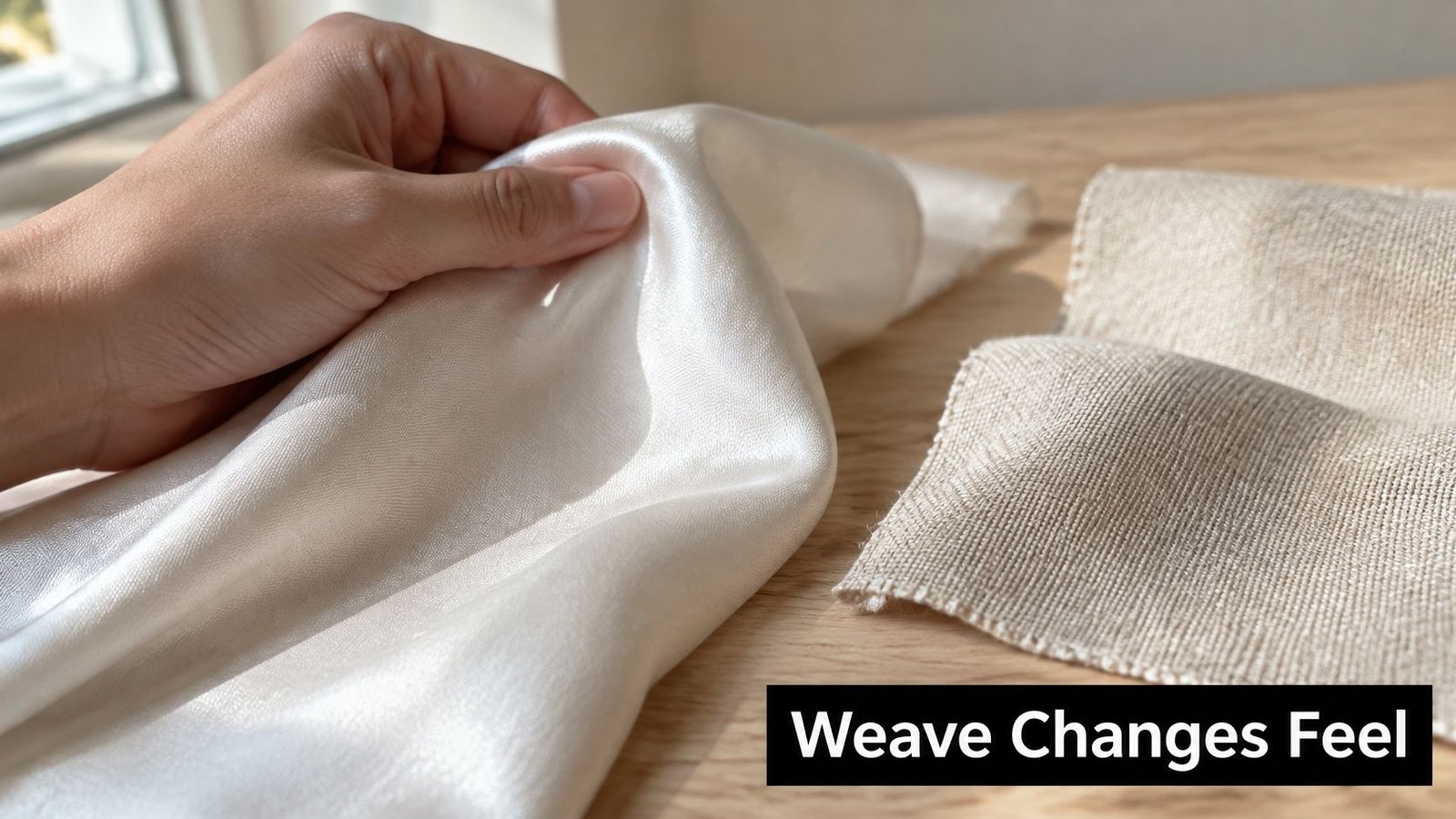
Plain weave is brickwork: every yarn interlocks with its neighbour at every second thread, which is why poplin and percale feel firm and matte. Sateen overlaps like roof tiles, four yarns across before one tucks under, so the surface is a run of continuous fibre. That's exactly why it slides, drapes and catches on things.
Four things that decide the hand
Yarn quality comes first. Long-staple and Pima cottons, combed smooth, give a cooler and slicker face; short-staple carded cotton can feel faintly dry and hairy under the finger.
Density comes next. More picks and ends per inch make a firmer, glossier cloth, while a loose sett feels limp and takes every crease.
Weight decides the job. Around 110 to 140 gsm is limp and drapey, 150 to 200 gsm behaves like a good shirt, and 220 gsm upwards feels crisp off the bolt and softens after the first wash.
Finishing changes the surface. Mercerising deepens the sheen, calendering flattens and polishes it, and an enzyme wash softens the cloth while muting the lustre.
Here's the difference between a fabric that merely reflects light and one where the reflection moves as the cloth turns:
The honest trade-offs are worth naming. Sateen creases along soft rounded folds rather than sharp ones, feels cooler than flannel and warmer than lawn, and shows water marks and pin holes that a textured cloth would hide. Heavy furnishing grades feel boardy and resist draping at all.
The test I use: hold a metre at eye level and turn it slowly. On a good dress-weight sateen the sheen slides across the surface as the cloth moves. On a cheap one the shine sits flat and slightly chalky, and it stays flat once it's made up.
Where Cotton Sateen Works Best
Sateen is a dress fabric for a particular kind of garment: some volume, a defined occasion, gentle laundering. Matching weight to project does more for the finished result than any other decision you'll make on the bolt.
| Project | Typical weight | What to look for | Sewing consideration |
|---|---|---|---|
| Slip dress or camisole | 130 gsm | Mercerised finish, even colour, good drape | Fine sharp needle, French seams, handle bias edges gently |
| Blouse or shirt dress | 150 gsm | Firm but fluid hand, no slubs | Test interfacing first, slightly longer stitch for topstitching |
| Wide-leg trousers or A-line skirt | 200–240 gsm | Body without boardiness, springs back after scrunching | Microtex 80/12, stay-stitch the waist, press seams open |
| Waistcoat or structured jacket | 240–280 gsm | Crisp face, matte back, minimal stretch | Test interfacing and canvas, bind or overlock the seams |
| Jacket and coat lining | 110 gsm | Smooth surface, low shrinkage, colourfast | French or overlocked seams, cut all pieces one way |
| Cushions, table linen, light upholstery | 250–300 gsm | Abrasion data, colourfastness to washing and rubbing | Longer stitch, reinforced seams, removable covers |
| Patchwork and craft | 130–150 gsm | Stable weave, no stretch, repeatable colour | Quarter-inch foot, prewash before cutting |
Where sateen will let you down
- Close-fitting garments under constant friction. Trousers that rub on a seat, anything under a bag strap, tight sleeves at the underarm: the floats abrade and the shine goes first.
- Anything washed weekly. A sateen shirt worn twice a week and tumbled dry will dull within a season. Choose twill or poplin for that job.
- Projects needing stretch or a matte face. Sateen announces itself. If you want quiet, matte and forgiving, buy lawn.
- Children's wear. Playground equipment, velcro and gravel snag a float in seconds, and a pulled float can't be repaired invisibly.
Stretch sateen is its own case. A small elastane content makes the cloth behave like a jersey, so it wants a stretch or ballpoint needle and a walking foot, and it should never hang on a hanger while damp.
Rule of thumb: if the garment will be worn once a month and pressed carefully, sateen earns its place. If it will be worn twice a week and tumbled, buy a twill.
Before you commit three metres to a pattern, sew a 15 cm test seam, press it the way you'll press the finished garment, and look at it under a lamp. That one habit catches more problems than any amount of reading.
Checks Before You Buy and Cut Cotton Sateen
There's no single UK-wide specification called cotton sateen, so performance depends on fibre preparation, yarn count, weave density, finishing and fabric mass. You judge the cloth, not the name, using recognised British and European test methods rather than marketing words (BSI colour fastness standards).
- Judge the sheen under a lamp. Turn the sample slowly and watch whether the lustre shifts evenly. Then flip it; the back should be matte.
- Scrunch it for ten seconds. Soft rounded recovery is what you want. A hard crease that stays put means it will mark in wear.
- Ask for laundering and abrasion data. Colour loss and staining after washing are assessed under BS EN ISO 105-C06, and abrasion resistance for trousers, cushions and hard-wearing makes under the Martindale method, BS EN ISO 12947.
- Wash and press an offcut the way you'll treat the garment, then measure it. A smooth face reveals shade change, glazing, shrinkage and seam distortion far more visibly than a textured cloth.
- Match the weight to the project on the table above, then plan to cut every piece in one direction.
- Buy half a metre first when the shade has to match something you already own. If you're unsure about a colour, contact us before ordering; a question costs nothing and a mismatched metre costs a garment.
Techniques for Cutting, Sewing and Pressing Cotton Sateen
A sharp Microtex needle in 70/10 to 80/12, a stitch length around 2.5 mm, pins kept inside the seam allowance, and pressing from the wrong side through a cloth. That's the core of it, as the Pound a Metre guide to sateen cotton sets out, and every step below follows from those four rules.
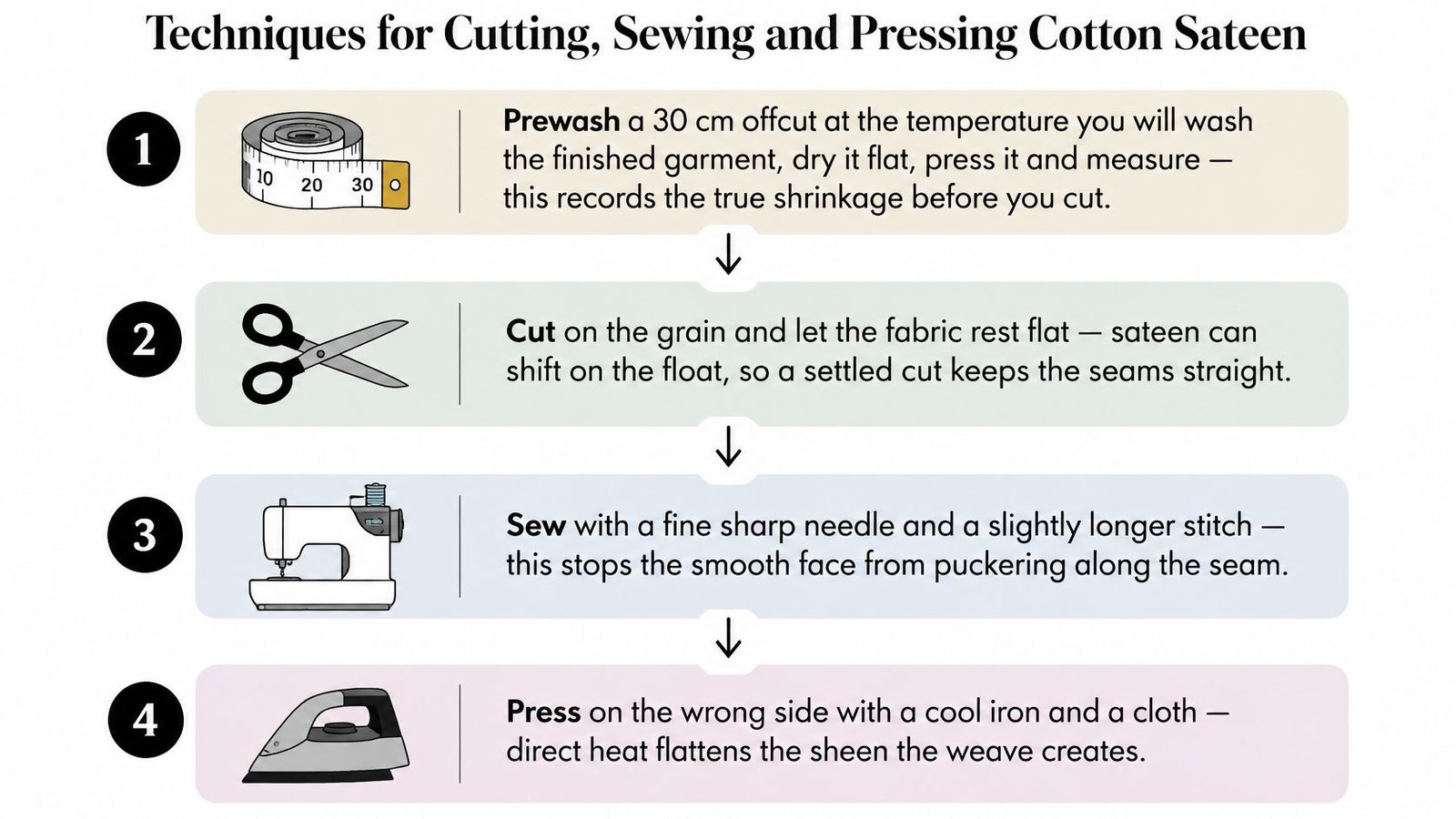
The sequence, with the reason attached
- Prewash a 30 cm offcut at the temperature you'll wash the finished garment. Dry it flat, press it, measure it. You now know the true shrinkage before you cut rather than after.
- Find the face. Hold the cloth at eye level under a lamp. The lustrous side is nearly always the right side, though on a dark navy or black the difference is faint enough to fool you.
- Lay every pattern piece the same way. The sheen changes when the cloth is turned end to end, so a sleeve cut in the opposite direction reads as a different colour under light.
- Fit a fresh sharp needle. A blunt one pushes fibres apart instead of piercing them, and on a float that shows as a row of tiny holes along the seam.
- Keep pins inside the seam allowance, or switch to clips and pattern weights. A pin through a float leaves a hole you can't fully press out, and on a dark sateen it glints.
- Finish the seams. Overlock or zigzag mid weights, French seam light sateen, bind the insides of an unlined jacket. Sateen frays along cut edges, and on a lightweight that fraying weakens the seam allowance where it matters most.
- Press as you go, wrong side up, through a cloth. Lift and lower the iron rather than sliding it, and let the cloth cool before you move it. Direct heat and pressure on the face create shiny patches that nothing removes.
When it goes wrong
A slippery edge that won't feed is usually the machine, not you. A strip of silk tissue or plain tissue paper under the seam stabilises the float long enough for the feed dogs to grip, and it tears away cleanly afterwards.
Needle marks along a seam will often lift if you hold the iron an inch above the cloth and steam rather than press. Don't touch the surface; the fibres relax back with moisture, not weight.
A popping sound as the needle enters means the point has burred. Change it immediately, because every stitch after that is damaging the face.
Buy needles in tens, not ones. Sateen is unforgiving of a dull point, and the cost of a fresh needle is nothing next to the cost of a marked bodice.
How to Wash and Care for Cotton Sateen
The routine matters more on sateen than on a matte cloth, because the same floats that produce the sheen are the fibres that abrade first. Follow the table, then read the reasoning underneath it.
| Step | What to do | Why it matters | If skipped |
|---|---|---|---|
| First wash | Wash a 30 cm offcut before cutting, or wash the finished piece alone at 30°C | Reveals shrinkage and any dye release | A finished garment that shrinks out of fit |
| Washing | 30°C gentle cycle, colour-safe detergent, low spin | Less abrasion on the surface floats, less dye loss | Dulling, glazing, patchy fading |
| Drying | Line dry in shade and reshape while damp | Heat and tumbling roughen the floats | Surface fuzzing and set creases |
| Ironing | Wrong side, warm setting, through a pressing cloth, steam rather than pressure | Direct heat glosses the lustrous face | Shiny patches and a flattened sheen |
| Storage | Fold loosely or hang on a padded hanger | A hard crease can set across a float | Permanent crease lines |
| Between wears | Air, brush lightly, spot clean small marks | Fewer washes means a longer life for the cloth | Unnecessary wear from over-washing |
Two of these rows earn extra explanation. The low spin matters because a fast spin forces the wet cloth against the drum hundreds of times per minute, and wet cotton fibres are weaker than dry ones, so each rotation scuffs the floats a little. Reshaping while damp works because cotton sets as it dries: smooth the seams flat and square the corners with your hands, and the garment dries in that shape instead of holding the twist of the line.
The impact extends beyond a single garment. UK parliamentary evidence puts clothing washing and care at about one-third of clothing's carbon footprint, and reports Cambridge research showing that eliminating tumble-drying and ironing alongside lower-temperature washing can cut a cotton product's global climate impact by around 50% (Environmental Audit Committee report on the sustainability of the fashion industry). Cotton also takes longer to dry than synthetics, and washing, drying and ironing are the major sources of use-phase energy, which is why a gentle routine serves the cloth and the meter together (UK Energy Research Centre technical summary).
Watch the places where sateen ages before the rest of the garment does: underarm abrasion, bag-strap rub, seat shine and cuff edges. Seat shine is the one most makers miss. Friction from sitting flattens the floats in one direction, and the patch reads as a permanent gloss that washing will not reverse, so rotating wear between garments buys real time. Structured occasionwear in a heavy sateen is better dry-cleaned than washed at home, and anything you plan to launder deserves the sink test first, checking for dye release before the first full wash.
Fibre length explains much of why one sateen feels cooler and smoother than another, and this explanation of extra-long-staple Pima cotton explained covers the staple grades and what they mean for smoothness and pilling.
Sateen-style cottons suit a shirt dress, a bias-cut slip or a lining, so check the weight against the project before choosing from More Sewing's cotton range, where fabric is priced per half metre. If you'd like to feel the face and watch the sheen move before you commit, order a sample swatch, and if a shade has to match something you already own, contact the shop before purchasing and the colour can be checked against the bolt. Browse the More Sewing fabric range to find the piece your next project deserves.
