
Blog, Dressmaking, Fabric
Jersey Dressmaking Fabric UK: Types, Stretch and Weight
You've found a print you love, the listing says "stretch jersey", and you're hovering over the buy button remembering the last lot. That tee came out of the wash a size smaller, the neckline gaped by lunchtime, and the elbows bagged after two wears. None of that was your stitching. It was the fabric, chosen on colour because the listing didn't tell you anything useful.
Buying jersey dressmaking fabric in the UK gets easier once you treat it as a specification rather than a description. Four things decide whether a knit works: how far it stretches, how well it springs back, how much it weighs, and how much it moves in the wash. You can test all four on a swatch before you pay for metres, and the tests take an afternoon.
Jersey Fabric Types Compared at a Glance
A fitted tee that sags at the elbows after two washes usually isn't a sewing failure. The knit had give but no memory, so every bend of the arm stayed in the cloth. Choosing by fibre and structure instead of by print fixes most of that before the scissors come out.
Six types cover almost everything sold for home dressmaking here. Read the table as a shortlist, not a verdict.
| Jersey type | Typical fibre make-up | Stretch and recovery | Drape | Care level |
|---|---|---|---|---|
| 100% cotton jersey | 100% cotton | Moderate stretch, can sag over time | Soft, fairly structured | Easy, expect some shrinkage |
| Cotton-elastane jersey | Cotton with typically 3-8% elastane | Good stretch and strong recovery | Smooth, close fitting | Easy, wash cool |
| Viscose jersey | 100% viscose, or viscose-elastane | Good stretch; recovery improves with elastane | Fluid and flowing | Gentle, cold wash and dry flat |
| Modal jersey | Modal, often with a small elastane share | Soft stretch, steady recovery | Soft and fluid | Easy, low pilling |
| Polyester-elastane jersey | Polyester with elastane | High recovery and strength | Smooth and springy | Easy, quick drying |
| Ponte knit | Double knit, polyester-viscose or wool blends | Low to moderate stretch | Firm and structured | Easy, holds shape |
What the fibre content actually decides
The fibre mix sets most of the behaviour you'll fight at the machine. Cotton gives you a stable, slightly dry hand that cuts cleanly and presses well, which is why it's kind to beginners. Viscose and modal feel cooler and slither under the presser foot, so they reward a walking foot and a bit of patience. Polyester blends resist creasing and dry fast, but they hold odour and shed fibres in the wash.
Structure matters as much as fibre. A single jersey has a smooth face and a looped back, and its cut edges curl towards the face the moment you cut them. A double knit such as ponte looks similar on both sides, lies flat on the table and hides a seam allowance far better.
Practical rule: decide the care level before the colour. A garment you'll wash weekly needs a knit you're happy to launder cool and dry flat, not one you'll resent hand washing.
Using the table when you browse
Keep it open beside the shop tab and filter on two columns first: recovery, then care. If a listing won't tell you the fibre percentages, the weight and the width, treat that as a gap in the specification and ask for a swatch. Two jerseys at the same weight can behave completely differently once elastane enters the mix, so the table narrows the field and the swatch settles the argument.
Stretch, Recovery and Weight Explained
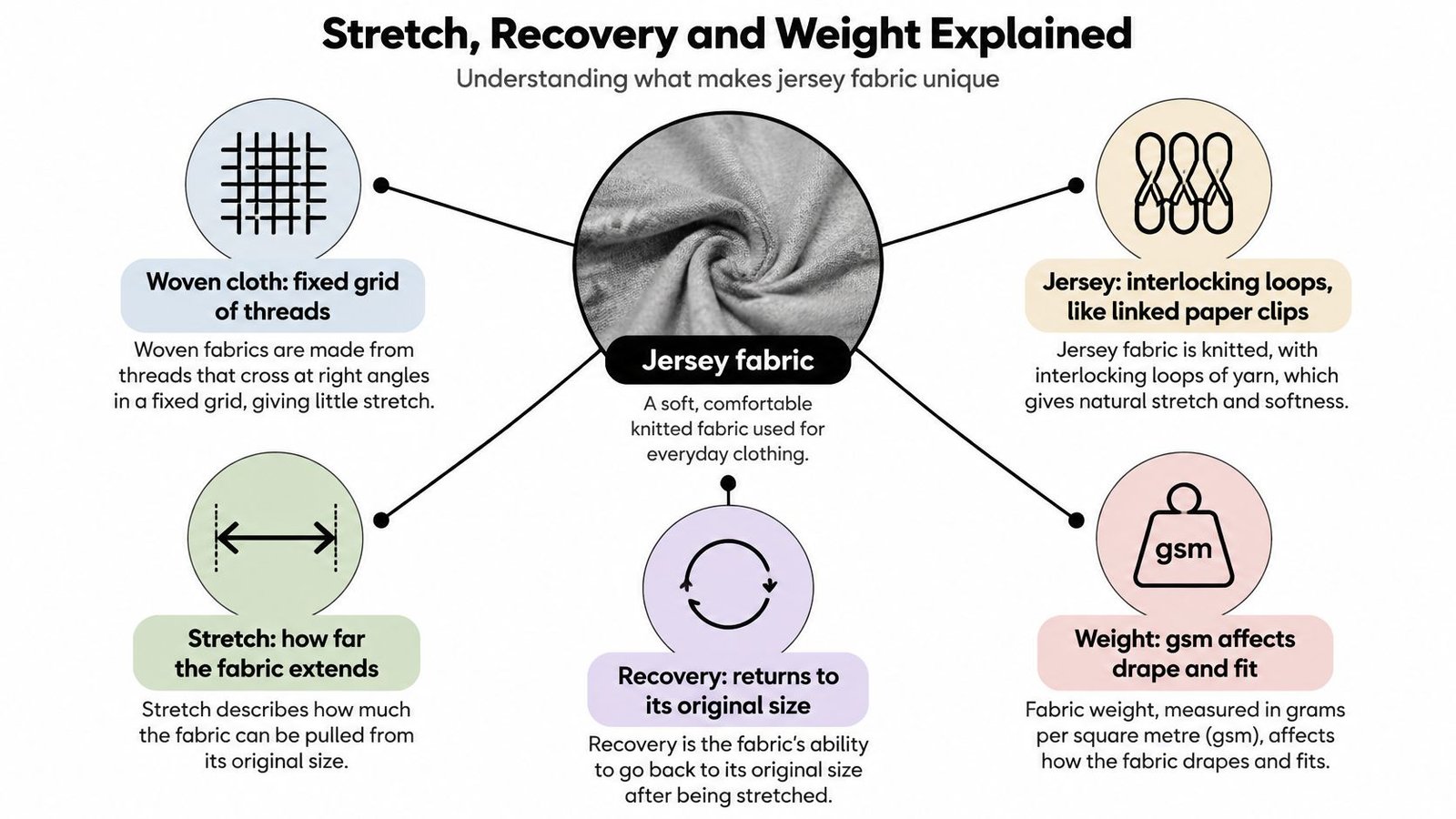
Woven cloth is a fixed grid of threads. Jersey is a chain of interlocking loops, like a line of linked paper clips that opens when you pull it and closes when you let go. Stretch is how far it opens. Recovery is whether it closes again, and that second number is the one most listings leave out.
Weight bands and the garments they suit
Weight is quoted as GSM, grams per square metre, usually in the product details or the specification tab of a supplier listing. If it's missing, ask, because a photo can't tell you whether a knit will show your bra through it.
| Weight band | GSM | Typical garments | Drape and feel | Main trade-off |
|---|---|---|---|---|
| Lightweight | 130-180 gsm | Vest tops, blouses, swing dresses | Fine and fluid | Shows seams and bra lines |
| Midweight | 180-240 gsm | T-shirts, fitted dresses, leggings | Balanced and smooth | Most forgiving for beginners |
| Heavyweight | 240-320 gsm | Sweatshirts, structured skirts, ponte-style dresses | Firm and stable | Harder to sew tight curves |
The swatch stretch test
Run this on any knit before you commit, in the shop or on a posted sample.
- Mark 10 cm on the swatch across the width, using two pins or a fine chalk line, with the fabric lying relaxed on a flat surface.
- Stretch it gently to 15 cm against a ruler. Don't force it, you're measuring comfortable working stretch, not the point of distortion.
- Release it, wait a few seconds, then measure the distance between your marks again.
- Treat a return within a few millimetres of the original as good recovery. If the marks stay well apart or the edge ripples, that knit will bag at knees, elbows and necklines.
The concept map below shows how these properties sit together.
Direction of stretch and the shape trade-off
Cut jersey with the greatest stretch running around the body, so the garment gives where you breathe and move. Two-way stretch means give across the width only, which suits loose tunics, swing tops and most everyday tees. Four-way stretch adds lengthwise give, and you want it for leggings, swimwear and close-fitting bodices drafted with negative ease. The looped structure is also why cut edges curl and necklines grow if you handle them roughly.
Heavier knits stretch less and hold their shape; lightweight knits drape beautifully and show every seam and strap underneath. That's the whole trade-off, and no clever stitching resolves it.
Knits aren't a fringe interest here. Office for National Statistics output figures record total UK wearing-apparel manufacturing output at £7,667.0 million in 1998 against £3,036.5 million in 2010, a nominal reduction of about 60.4%, so the knit heritage survives alongside globally sourced cloth rather than a large local apparel industry.
Reading Fibre Labels on UK Jersey
Two fabrics sit side by side, both sold as cotton jersey. One is 100% cotton and will stretch happily then stay stretched. The other is cotton 95%, elastane 5%, and it will snap back at the neckline all day. On a fitted bodice those are two different garments, and the shop's category name won't tell them apart.
"Stretch jersey" and "cotton jersey" are marketing descriptions. The fibre label is the specification, and UK rules make it a useful one. The UK textile labelling regulations require textile products to show their fibre composition, and a fabric made from several fibres must identify the fibres and their percentages. Where one fibre accounts for at least 85% by weight, the label may state that fibre with its percentage, use "85% minimum", or list all fibres in descending percentage order.
What the elastane share tells you
Elastane is legally defined as a segmented-polyurethane fibre that can stretch to three times its original length and recover rapidly and substantially. That's why a small percentage does so much work: it's the component pulling the loops back into shape at a neckband, cuff or waistband. A cotton-rich jersey with a modest elastane share suits everyday tops, while viscose or modal blends give the softer, more fluid drape you want for a wrap or a tunic.
A high elastane percentage doesn't guarantee high stretch. The knitting method and the elastane work together, so measure the cloth rather than trusting the blend.
A four-point label check before you buy
- Find the elastane percentage: if it's absent, assume recovery is modest and test before cutting anything fitted.
- Read the fibre order: descending percentages tell you which fibre dominates the hand, the drape and the washing behaviour.
- Note the care symbols: a cool wash and no tumble drying is a commitment, so decide now whether you'll keep it.
- Compare against the pattern: match the measured stretch to the pattern's stated minimum before ordering, not after.
If you're keeping records of composition and care for a small label or a student project, the traceability side is worth understanding too, and DPPWare textile and fashion solutions explains how digital product passports carry that fibre and care information through a garment's life.
How to Test and Pre-Wash Jersey Before Cutting
A cut that looks perfect on the table can finish shorter, narrower or twisted after its first wash. Jersey moves in the loom, in the dye bath and again in domestic laundering, so pre-treatment belongs in the cutting plan. UK government cloth specifications set out domestic washing and drying procedures under BS EN ISO 6330 and list dimensional change, breaking strength and colourfastness among the performance checks in the manufacturing specification for cloth. Borrow that logic at home, but keep the test practical: you are checking what this piece will do under the wash and drying method you will use.
The pre-wash test, step by step
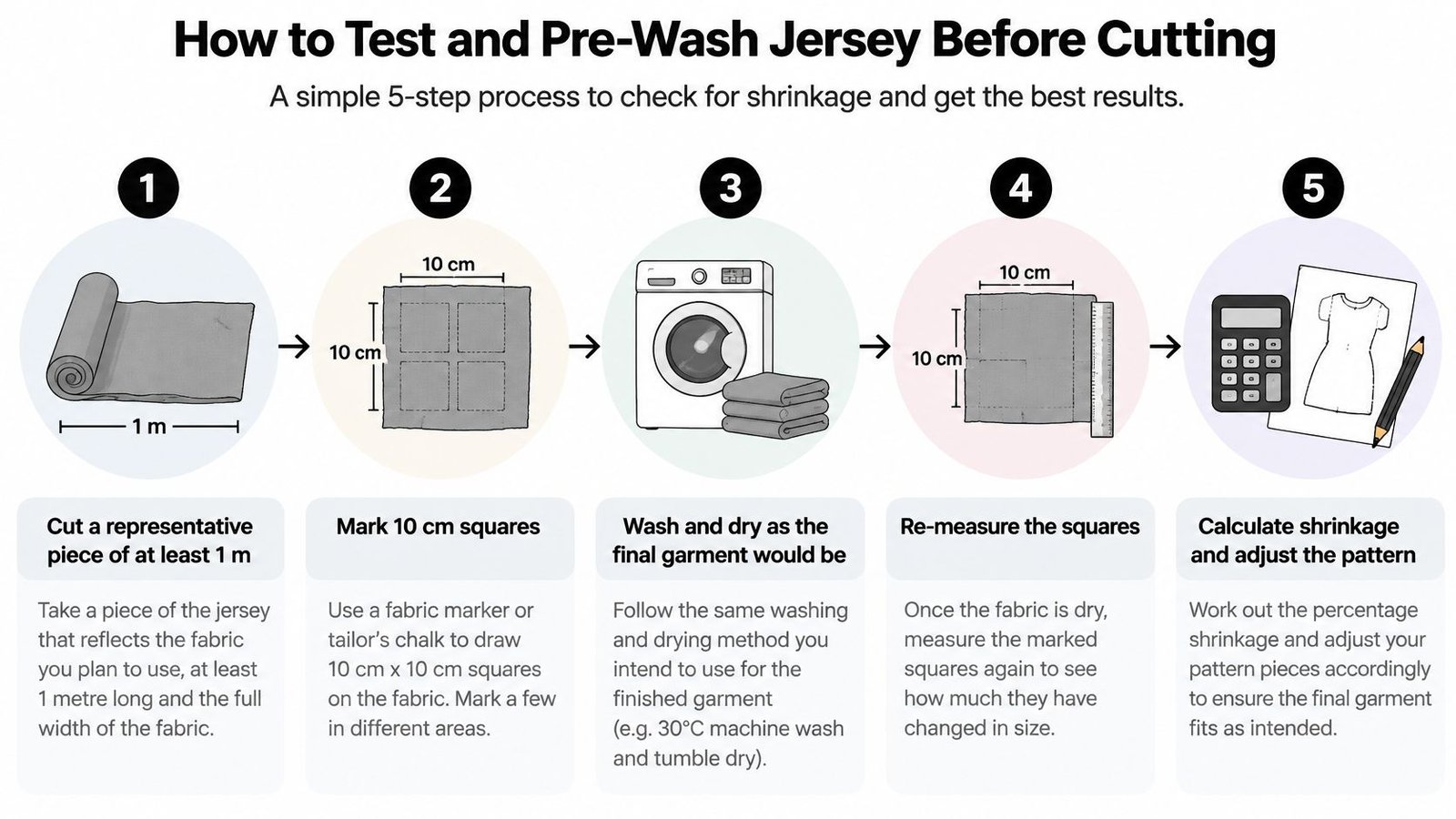
- Cut a representative piece of at least 1 m. A tiny swatch hides skew and doesn't let you judge how the fabric hangs after washing.
- Mark 10 cm squares in both grain directions and measure them. Use a fine permanent marker or thread traces, and write the starting measurements down.
- Wash and dry it using the care method you'll use for the finished garment. Same temperature, same detergent, same drying, otherwise the result tells you nothing about real life.
- Measure again once it's fully dry and relaxed. Don't measure damp knit, it's still moving.
- Check for twisting or skew. Lay the piece flat and see whether the marked squares have gone rhomboid, because skewed jersey makes side seams spiral even when the pattern was cut accurately.
- Press flat without stretching, then leave it to rest. Align the grain, support the whole length on the table, and give the knit time to settle before cutting.
The infographic below summarises the pre-wash test.
Doing the arithmetic
The maths is simple and worth doing on paper. A 100 cm length that becomes 96 cm has shrunk by 4%, so a 2 m cut would lose roughly 8 cm in that direction. On a dress that's a hem you didn't plan for, and on a fitted bodice it's a size.
Cotton, viscose and blends respond differently, so test each new fabric rather than carrying assumptions across projects. If the test shows noticeable shrinkage, buy an extra 5-8% length as a working allowance and pre-wash the whole piece before cutting. Do the same if the swatch pills under gentle handling or loses recovery after drying, because shrinkage is only one of the costs you are trying to avoid before committing to metres.
This short video walks through handling and pre-washing knits.
Keep a fabric notebook. Fibre percentages, GSM, width, wash method, measurements before and after. Three projects in, you'll be buying on evidence instead of hope.
Sewing Jersey Without Distortion
A skipped stitch on jersey usually points to the needle, not the machine. A ballpoint or stretch needle, size 75/11 for midweight knits, pushes between the loops rather than cutting through them. That gives a cleaner stitch and less chance of a ladder running along the seam. If the stitch begins skipping, change the needle before adjusting everything else.
Seams that move with the cloth
Use a dedicated stretch stitch if your machine has one. A narrow zigzag works well too, with a moderate stitch length and the width kept small. A straight stitch has no give, so it can pop when the garment stretches over a shoulder or across the back. Finish raw edges with an overlocker or a narrow zigzag inside the seam allowance, then press with a cloth instead of dragging the iron across the knit.
The aim is a seam that recovers with the fabric. Pull the seam gently after sewing. If it cracks, tightens or leaves the threads straining, adjust the stitch before committing to the garment pieces. A slightly longer stitch often helps jersey sit flatter, while too much width can make the seam look wavy.
Stabilising and hemming
- Shoulder seams and necklines: stitch 6 to 12 mm clear elastic or a strip of lightweight stay tape into the seam as you sew it, not afterwards. Retrofitting tape never sits as flat.
- Hems: use a twin needle over a stretch-friendly seam, or a narrow zigzag hem that moves with the fabric. Wind the bobbin slowly and lengthen the stitch slightly if the twin needle tunnels.
- Slippery viscose: fit a walking foot so the layers feed evenly, and pin across the seam line rather than parallel to it, keeping pins inside the seam allowance.
- Cutting: sharp shears or a rotary cutter on a flat surface, with the whole piece supported so nothing hangs off the table and stretches itself out of shape.
Hemming is where confidence often runs out, so practise on an offcut before working on the garment. A test hem shows whether the needle, stitch and presser foot are working with the knit or dragging it out of shape. Keep that offcut from each project and use it for a quick seam and hem check.
Sew a test seam on a scrap every time you change fabric, then pull it firmly. If it pops, adjust the stitch before you touch the garment pieces. Check the reverse as well as the right side, because tight threads can look fine on top and still restrict movement underneath.
Choose the needle and stitch for the fabric in front of you, then let the cloth feed at its own pace. Hold the work lightly, guide it without pulling, and support the length as it leaves the machine. Those habits keep jersey from growing, tunnelling or twisting while you sew.
Matching Jersey to Common UK Garments
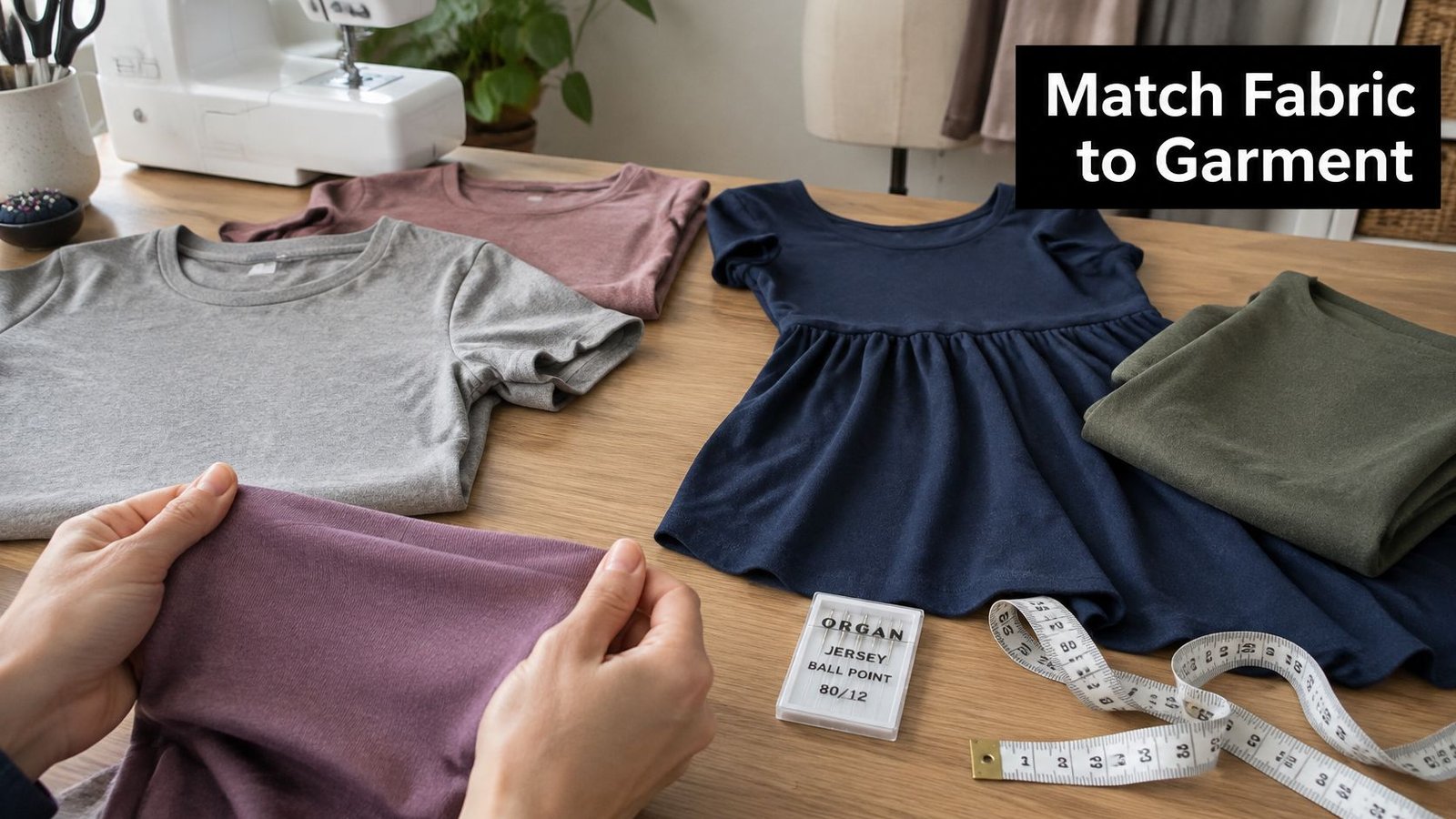
Choose for the stress points, not the print. Ask where the fabric must stretch, whether it has to spring back, how much drape the design needs, and whether it stays opaque under tension.
A fitted everyday tee
Cotton-elastane in the midweight band is the reliable choice: enough body to hide a seam, enough recovery to survive a day of movement. Test the neckband piece separately, stretch it and watch it return, because the band takes more abuse than any other part of the garment. Sew with a ballpoint needle and stabilise the shoulders.
The common mistake is skipping the stretch test on the neckband and cutting it from the body fabric assuming it behaves the same. If the band stretches too freely, the neckline ends up wider than the pattern intended.
A swing dress or fluid blouse
Viscose jersey in the lightweight band gives the movement the design depends on. Keep the hem narrow, a twin needle or a rolled narrow zigzag, and stabilise the neckline so the fluid knit doesn't grow while you handle it. A walking foot earns its place here.
The mistake is treating it like cotton: pulling it through the machine, pressing hard, and ending up with wavy seams. Let the feed dogs do the work.
Leggings and activewear
Polyester-elastane with high recovery, and four-way stretch, is what keeps knees from bagging. Check opacity under tension by pulling the fabric over a pale surface, or over your hand in strong light, because a knit that's opaque at rest can go sheer across the seat. Use a stretch needle rather than a ballpoint on very elastic cloth.
The mistake is buying on weight alone. A dense knit with weak memory still sags.
A sweatshirt or structured skirt
Heavyweight jersey or ponte gives clean lines and seams that hold their shape. Match the needle to the thickness and shorten the stitch slightly on tight curves so the seam follows the shape instead of faceting it.
The mistake is sewing a tight curve in thick ponte with a long stitch, then wondering why the edge looks angular. Clip the seam allowance, press over a ham, and take your time.
A garment you'll wear twice a week needs more recovery and durability than one you'll wear twice a year. Spend the money where the wear is.
Caring for Jersey So It Lasts
Pilling is worth checking before you commit to metres. Rub a swatch briskly against itself or with a fine pilling pad, wash it, then inspect the surface in raking light. A fuzzy surface on a new swatch is a warning: the cloth may look tired before the garment wears out. Compare the actual fabrics rather than assuming cotton-elastane, polyester-elastane and modal will behave alike.
Heat, chlorine and elastane
Elastane gives jersey its recovery, but heat, chlorine and repeated hot drying weaken it. Wash cool and avoid high-heat tumble drying. Dry flat or support the garment so the weight of wet knit doesn't stretch the shoulders, and fold heavy knits rather than hanging them.
Care affects shape as well as appearance.
Synthetic jersey sheds fibres in the wash, so use a wash bag or filter, wash full loads and keep the temperature down. Fibre choice involves a trade-off: cotton jersey can sag and shrink, while synthetics can resist sagging but shed fibres. Neither is automatically the better choice; recovery, shrinkage and surface wear all matter.
Repair, reinforce or repurpose
Written evidence to a UK parliamentary committee records that approximately 42% of UK garments are discarded because of poor fit, while around 19% are discarded because of damage or wear. The evidence also identifies pilling, fabric breakdown, seam holes, fading and discolouration as common causes of failure. Check whether the surrounding cloth still holds its shape before deciding to repair it.
- A skipped seam that has run: sew a narrow zigzag over the run, overlapping sound stitching at each end, and secure the ends with a few stitches on the spot.
- Small holes: darn with a fine needle and matching thread before they grow, working with the knitted loops.
- A stretched neckline: unpick the band, cut a slightly shorter replacement and stretch it evenly into the opening while sewing.
- Severe elastane degradation or heavy pilling: repurpose the fabric. Stitching cannot restore recovery to tired knit.
Keeping a garment in active use for longer reduces the need to replace it, but a poor repair can shorten its life. Repair where the fabric is still sound.
Elastane blends are difficult to recycle. Choose fabric suited to repeated wear and a care routine you can maintain, then pass on wearable garments or recycle them when suitable options are available.
Checking Jersey Before You Order
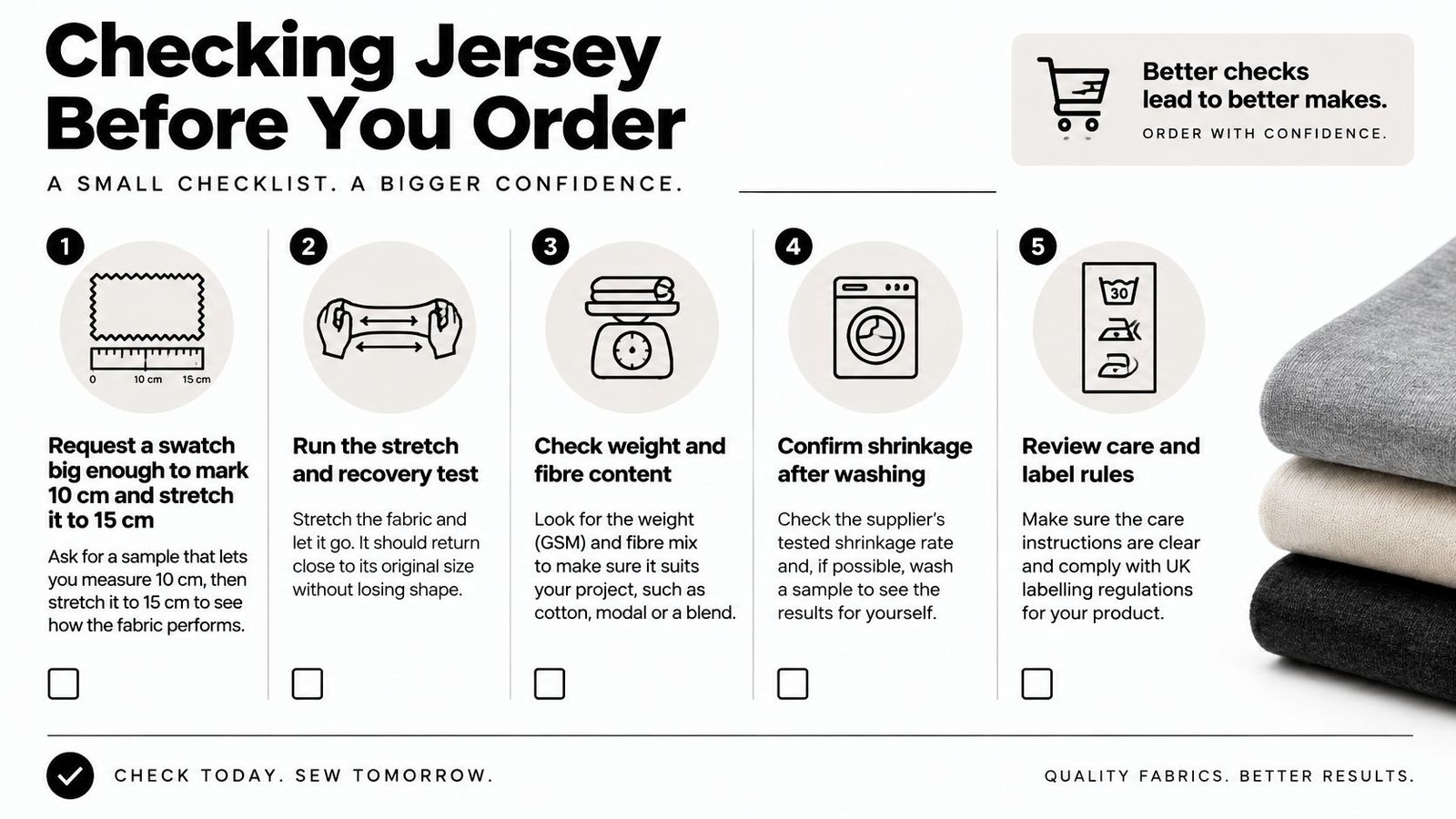
Turn the tests into a buying routine and you'll stop gambling on metres.
- Request a swatch big enough to mark 10 cm and stretch it to 15 cm.
- Run the stretch and recovery test across the width, then along the length if the pattern needs four-way stretch.
- Wash the swatch using the garment's care method and measure the result.
- Confirm the GSM and the width on the listing, and check the layout against that width before ordering.
- Add an extra 5-8% length if the swatch shows noticeable shrinkage.
A known reference makes the comparison easier. Our Grey Marl jersey is a cotton, polyester and elastane dressmaking knit with 4-way stretch and a moderate drape, sold by the half metre, so a swatch of it gives you a baseline to judge unfamiliar knits against. If you're unsure how much to buy once you've settled on a fabric, the sewing yardage advice at The Fabric Company covers working out length from width and pattern layout.
Sourcing is worth understanding too. IndexBox market figures for knitted or crocheted fabrics put UK consumption in 2020 at about 50,000 tonnes, with domestic production around 19,000 tonnes, roughly 39% of consumption, so most of the knit volume used here arrives through imports. That's why the range of cotton, viscose and blended jerseys is so wide, and why specification matters more than origin.
We deliver within the UK only at present, at £2.99 for fabric orders under £35 and free over £35. Order a swatch first whenever the garment is fitted or the fabric is new to you, and write down every result.
We stock jersey by the half metre alongside the ballpoint needles, clear elastic and twin needles you'll need to sew it properly, and we'll send a swatch so you can run the stretch and shrinkage tests before committing to metres. Browse the jersey range at More Sewing, pick two or three candidates for your next fitted tee, and let the swatch decide which one earns the pattern.
