
GSM means grams per square metre, the weight of one square metre of fabric, so a 150 GSM fabric weighs about 150 grams per square metre. You can read that number on a listing in two seconds and still have no idea what the parcel will weigh when it lands on your doormat. So here's the question most definitions skip: if you order three metres, how heavy is the bundle you'll be lifting, posting and pinning?
That gap matters because fabric is sold by length and width, while GSM is measured by area. Once you can move between the two, you can predict postage, judge whether a skirt will hang or stand, and decide if a tote bag will hold its shape before you spend anything.
Weight is also the one fabric property beginners tend to merge with fibre and quality. They're three separate dials. Learning to read them separately is what turns a hopeful purchase into a planned one.
GSM Explained as Grams per Square Metre
Start with something already in your house. Printer paper and card are both sold by grams per square metre, and that's why a sheet of copier paper flops while a greetings card stands up on the mantelpiece. Fabric works on exactly the same principle: mass per unit of area, with the area held constant so the numbers compare fairly.
Here's the definition mapped out, with the paper comparison alongside light and heavy cloth.
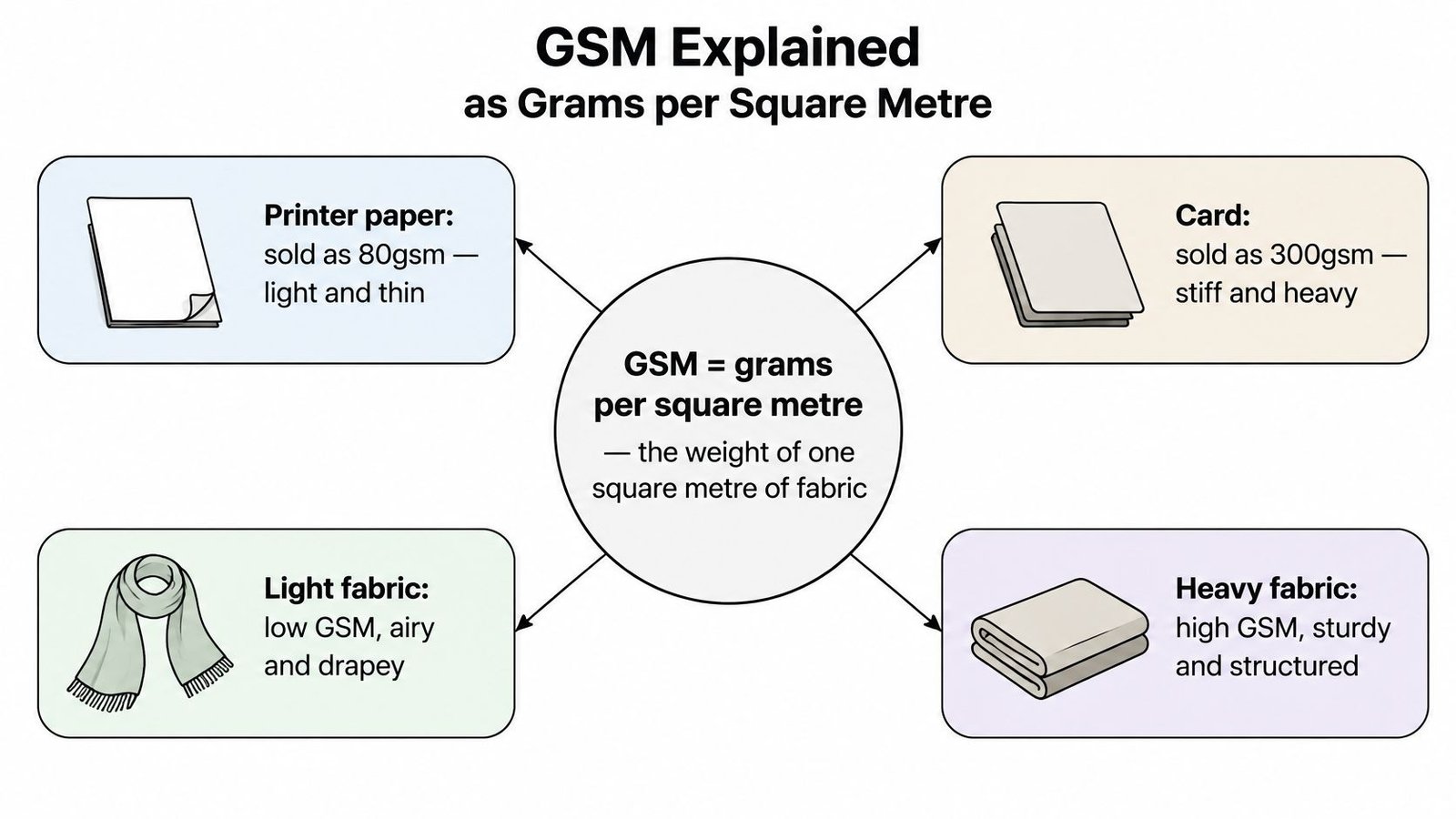
In UK textile terminology GSM describes fabric density or weight, not fibre type, thickness, quality or durability, and a fabric rated at 150 GSM weighs approximately 150 grams per square metre while a 300 GSM fabric weighs approximately 300 grams for the same area, as set out in the scope of BS EN 12127:1998, the UK standard for determining mass per unit area using small samples. That standard applies to both woven and knitted fabrics and defines the measurement as the mass of a known fabric area divided by that area.
Why the same length can weigh twice as much
Say you're choosing between two bolts of cotton, both 150 cm wide, and you ask for two metres of each. Identical dimensions, identical price per metre perhaps, yet one bundle can be twice the weight of the other because one cloth carries more mass in every square metre. That's the whole reason GSM exists as a comparable technical measure rather than a vague description like "medium weight".
Lower-GSM fabrics generally feel lighter and drape more readily. Higher-GSM fabrics generally give you more body, opacity, warmth or abrasion resistance. Generally is doing real work in those sentences, because fibre, weave, knit structure, finishing and moisture all pull the result around.
Shop-counter rule: a higher GSM means a heavier square metre, nothing more.
Fabric Weights by GSM at a Glance
These bands are the practical shorthand most dressmakers use, with the weight of one metre at a 150 cm width worked out for you.
| GSM range | Typical fabrics | Feel and drape | Weight per metre at 150 cm wide | Common uses |
|---|---|---|---|---|
| Under 100 GSM | Voile, chiffon, fine silk | Airy, sheer, flows loosely | Under 150 g | Blouses, scarves, linings |
| 100-150 GSM | Cotton lawn, poplin, light linen | Crisp to soft, light drape | 150-225 g | Shirts, summer dresses |
| 150-200 GSM | Single jersey, quilting cotton, chambray | Soft with some body | 225-300 g | T-shirts, quilt tops, casual shirts |
| 200-300 GSM | Sweatshirt fleece, heavy jersey, twill | Warm, structured, holds its shape | 300-450 g | Hoodies, sweatshirts, jackets |
| 300-400 GSM | Denim, canvas, heavy twill | Firm, sturdy, little drape | 450-600 g | Jeans, workwear, tote bags |
| Over 400 GSM | Duck canvas, upholstery fabrics | Stiff and very durable | Over 600 g | Bags, upholstery, outdoor covers |
Walk through the jersey row and the bands stop feeling abstract. Single-jersey fabrics commonly range from 140–240 GSM, according to Collective Studio Ltd's fabric and GSM guide, which is why the T-shirt jerseys you'll meet most often sit in that 150 to 200 band with a soft hand and enough body to hide a bra strap.
Turning a band into grams on the table
The fourth column comes from one sum: GSM multiplied by 1.5, because a 150 cm width gives you one and a half square metres for every metre you cut. Work it through on a listing: a jersey quoted at 180 GSM on a 150 cm width comes out at 180 × 1.5, about 270 grams per metre. Order three metres and you're handling three times that weight before packaging.
Now run the same sum on a denim quoted at 350 GSM, again on a 150 cm width. That's 350 × 1.5, about 525 grams per metre, and three metres triples it. That final figure is the one to reach for before you buy: it tells you how heavy the parcel lands on your doormat and how much cloth you'll be feeding under the needle on every pass.
Read the width before you trust the weight
The multiplication changes with the bolt. At 115 cm wide, one metre of cloth gives you only 1.15 square metres, so that same 180 GSM jersey drops to roughly 207 g per metre against 270 g at 150 cm. Two listings quoting identical GSM can therefore deliver noticeably different amounts of cloth per metre, and the narrower one may need extra length for your pattern pieces.
Choose the band your project needs first, then the fabric within it, then check the width. Treat these ranges as typical groupings rather than formal standards: a brushed finish, a slub yarn or a loose weave can shift how a cloth feels while leaving its weight sitting squarely inside the same band.
How GSM Changes Feel, Drape and Opacity
Think about a net curtain and a lined velvet curtain hanging at the same window. The net barely moves in a breeze and you can read the street through it. The velvet falls in deep, heavy folds and turns the room dark. Nothing about the fibre explains that difference on its own, and the same contrast plays out across your fabric stash.
Say you're comparing a cotton shirting at 120 GSM with a sweatshirt fleece at 250 GSM. The shirting slides against itself, creases softly at the elbow and collapses into small folds at a gathered waist. The fleece holds its loft, keeps a rounded shoulder line and refuses to sit flat under a collar. Both are doing exactly what their weight predicts.
Drape follows the same pattern. A viscose at 90 GSM pours into a gathered skirt and swings when you walk, while a twill at 300 GSM holds a pressed pleat with a sharp edge and stands slightly away from the body. If your pattern has soft gathers, cowls or a circle skirt, you want the pouring behaviour, not the standing behaviour.
Opacity is where weight earns its keep in dressmaking. Hold a light lining up and you'll see the shadow of your hand and the ridge of a seam allowance through it. A heavier cloth swallows both, which is why a pale summer dress often needs a second layer while a mid-weight twill doesn't.
Warmth is the exception worth remembering: a wool knit and a cotton jersey at the same weight won't feel equally warm, because trapped air does the insulating.
Three tests you can run on any sample, no equipment needed:
- Window test for opacity: hold the cloth against daylight and slide your hand behind it. If you can count fingers, plan a lining or a slip.
- Hand-drape test: lay a 30 cm piece over the back of your hand and watch the folds. Few large folds means body; many small folds means fluid drape.
- Crease-recovery test: fold the sample, press it hard between thumb and finger for a few seconds, then release. A crease that stays sharp suits pleats; one that springs out suits gathers and travel wear.
Higher GSM buys you body and durability. Fibre and weave decide the rest.
Myths About GSM and What It Misses
Four assumptions cause most of the disappointment beginners run into. Each one is easy to fix once you know what the number is measuring.
- Myth: heavier always means stronger. Strength comes from fibre, yarn, weave or knit structure and finishing, so a tightly woven cloth at 200 GSM can outlast a loose, spongy one at 250 GSM. Rub both between your palms and watch which one fuzzes first.
- Myth: GSM tells you the fibre content. It can't, and UK rules keep the two jobs separate. Government textile labelling guidance requires labels to show fibre content, with constituent fibres named by percentage by weight in descending order, so "cotton 95%, elastane 5%" tells you what the fabric contains while "220 GSM" tells you how much a square metre weighs.
- Myth: matching GSM means matching behaviour. Two jerseys may each be 200 GSM and still stretch, recover and drape quite differently if one is cotton-rich and the other carries a high percentage of synthetic fibre. That difference decides your needle, your interfacing and whether a stretch-sensitive pattern will fit as drawn.
- Myth: GSM measures quality. It measures mass per area. It says nothing about dye fastness, handle, pilling or how many washes the cloth will take, so a beautifully finished lightweight can be a far better buy than a coarse heavyweight.
The fibre label also governs your care decisions long before weight does. Washing temperature, pressing heat and whether you can use a hot iron on a seam all follow composition, not grams. Read the fibre percentages before you choose a needle type too, since a sharp ballpoint decision depends on the knit and the elastane, not on how heavy the cloth feels in your hand.
Notebook habit: write GSM and fibre composition side by side for every fabric you buy, plus the width and what you made from it.
That single line of notes becomes your own reference library. A year later, when you want another dress that hangs like the last one, you'll be searching for a weight and a fibre mix rather than a colour you half remember.
How to Measure GSM at Home
A weighed square is the simplest way to turn a fabric description into something your hands can judge. The formula is GSM = sample weight in grams ÷ sample area in square metres. A worked example makes it concrete: a 20 cm × 20 cm square has an area of 0.04 m², and if it weighs 12 g its calculated weight is 300 GSM, as demonstrated in this fabric GSM explainer for sewists.
That number works like a suitcase weight label for fabric. Before you buy, it helps you picture whether a metre at the listed width will feel like a light shirt, a soft dress weight or something bulky enough to affect postage and seam handling.
The five steps look like this on paper before you try them on cloth.
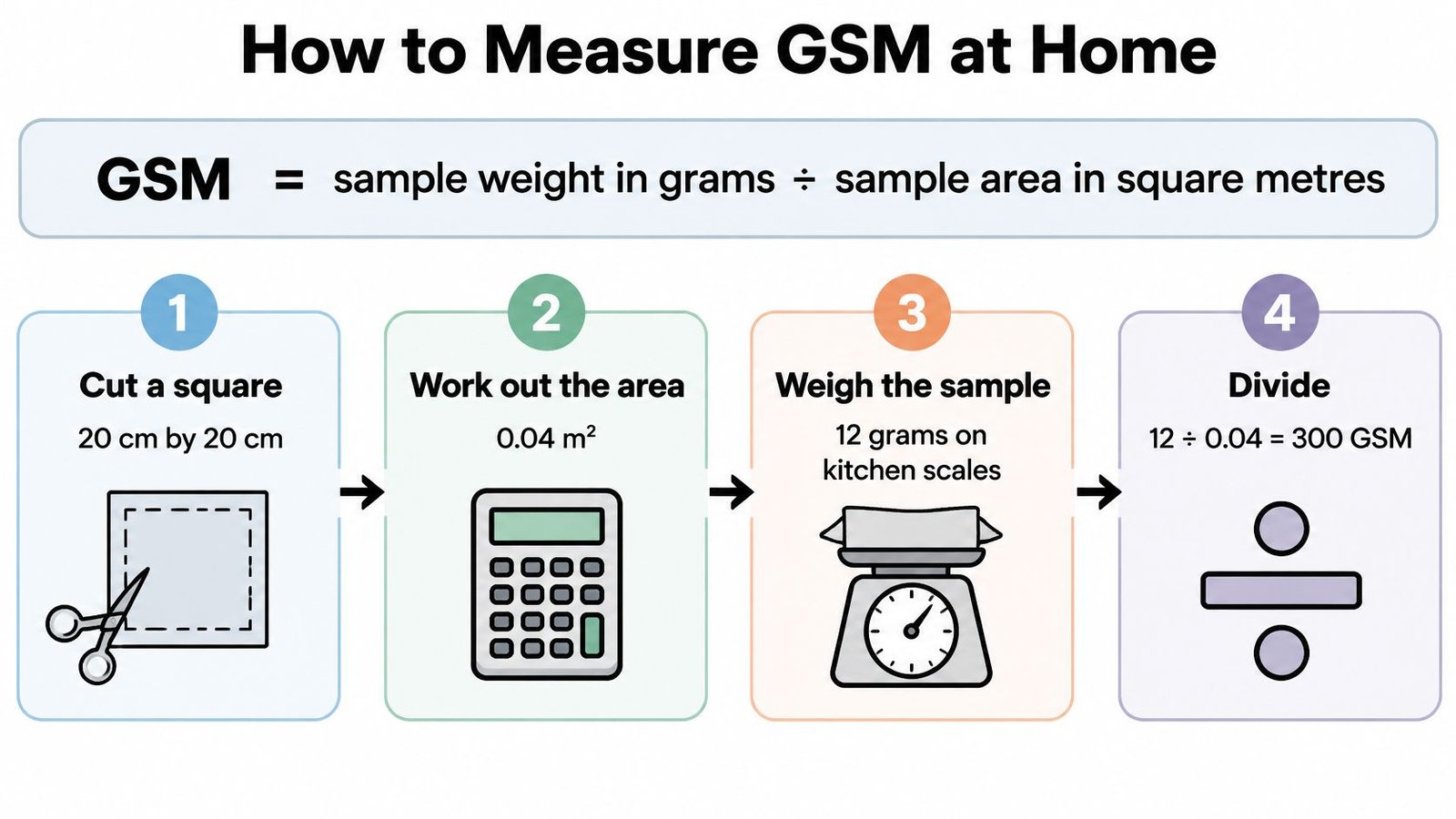
Cutting and weighing a sample you can trust
Cut a precise square. A 10 cm × 10 cm piece gives you 0.01 m², which makes the arithmetic easy. Use a quilting ruler and a rotary cutter on a mat, mark with a fine chalk line, and cut well away from selvedges and any stretched edge, because both distort the area you think you've measured.
Weigh it straight away. Jewellery or pocket scales that read to 0.1 g are the right tool here. A kitchen scale rounding to whole grams is too coarse for a small square. Weigh before the piece has sat in a damp room, since absorbed moisture adds mass that isn't fabric.
Divide weight by area. A sample weighing 2.5 grams over an area of 0.01 square metres gives 250 GSM when you multiply by 100. BSI's standard for determining mass per unit length and mass per unit area of woven fabrics uses the same mass-per-area idea. With a 10 cm square you can move the decimal point two places to the right.
Repeat across the cloth. Take three to five samples from different areas, including near each edge and the middle, then average the results. Roll edges and centres aren't always identical, especially where a fabric has been under tension.
Compare with the listing. Small variation is normal. A large gap is worth querying with the supplier before you cut into the length. If colour also matters, contact More Sewing before purchasing.
If you'd rather watch the cutting and weighing done in real time, this demonstration follows the same sequence.
The two commonest slips are cutting from a stretched area, especially on jersey pulled off a roll, and weighing after the fabric has picked up moisture. Lay knits flat and relaxed for a few minutes before cutting, and let a sample sit in the room where you'll weigh it. Treat the result as a practical guide, not a laboratory certificate.
For formal testing, the reference points are BS EN 12127:1998 for small samples of woven and knitted fabric, and BS 2471 for woven fabrics. Record your average in your project notebook next to the supplier's stated figure, then add the width. That way, a number such as 300 GSM becomes useful before you buy: at 150 cm wide, one metre is about 450 g, so a few metres stop being an abstract shopping choice and become a weight you can picture carrying home or posting.
Choose Fabric by GSM for Your Project
Work backwards from the garment, not forwards from a fabric you like the look of. A summer blouse or a lightweight lining belongs in the lower bands, a fitted dress or shirt in the middle, and outerwear, workwear and bags in the heavier ones. For a child's cotton pyjama set, something around 130 to 160 GSM gives softness without bulk at the seams. A tote bag needs 300 GSM or more to stand up on its own, and a lining should always be lighter than the shell it sits inside so it doesn't fight the outer cloth.
Keep three numbers together
Supplier GSM, fibre percentages and fabric width belong in the same notebook line, and the fibre percentages deserve a closer read than most makers give them. The UK textile labelling regulation allows a fibre accounting for up to 5% of total product weight, or fibres collectively accounting for up to 15%, to be described as "other fibres" when they can't easily be stated at manufacture. That's a labelling allowance, not a fabric weight statement, which is exactly why GSM can't be read as a fibre-content claim.
With those three numbers you can estimate running weight before you order. A 150 cm-wide fabric at 300 GSM gives one metre weighing approximately 450 g before allowances for finishing or variation. Think of GSM as the weight of a square, then stretch that square across the actual cutting width. Multiply by your pattern's metreage and you know whether you're posting a light envelope or a heavy parcel, and whether the finished garment will swing or sit stiffly.
Our Grey Marl jersey is a useful live example: it's 150 cm wide and weighs 215 gr/m2, a cotton, polyester and elastane dressmaking knit. Apply the same multiplication and you get the weight of every metre you cut, so a two-metre T-shirt project arrives as a manageable bundle rather than a hefty one.
A five-point check before you buy
- Pick the GSM band your project needs, using the feel and drape column rather than the number alone.
- Read the fibre composition and note the percentages, since they set your washing temperature and needle choice.
- Check the width and work out the running weight per metre, then multiply by your metreage.
- Request a sample and test it: weigh a square, drape it over your hand, hold it to the window.
- Record GSM, fibre content and width together so the next version of the project starts from evidence.
For a jersey T-shirt, start in the 150 to 200 band and test a sample before committing. For anything heavier, compare denim and jersey weights side by side and practise the weighing method on real cloth rather than trusting the listing alone. Makers who learn best with structured guidance can also explore longarm quilting training online for teaching that walks through materials and machine handling step by step.
More Sewing stocks fabric by the half metre, including cotton lawn, chambray, plain jersey, denim, coatings and wool. Multiple units are sent as one continuous length, so the running-weight calculation stays practical when you cut more than one piece. Fabric is priced per half metre, and UK delivery costs £2.99 for fabric orders under £35 and is free on orders over £35. Browse More Sewing, pick two fabrics from different bands, and run the 10 cm square test on both to see how quickly the numbers start meaning something.
