
Blog, Dressmaking, Guides
How to Remove Fabric Stains Without Ruining Your Project
The spill usually happens at the worst possible moment. You've cut a length of viscose for a new dress, it's draped over the back of a chair, and a toddler arrives with blackberry-stained fingers. Or a mug tips beside a freshly sewn cotton bodice. The first instinct is to grab a cloth and scrub, but that quick reaction can turn a removable mark into a fuzzy, spread-out patch.
Learning how to remove fabric stains safely starts with the fabric, not the product. Fibre, dye, weave, finish, stain chemistry and the age of the mark all matter. A treatment that works on colourfast cotton may shrink viscose, lift indigo from denim or permanently disturb silk.
Why Stain Removal Starts Before You Touch the Spot
A spill on fabric is rarely a single problem. It is a stain, yes, but it is also a fibre question, a dye question, and sometimes a construction question. The safest first move for a length of washed linen is often wrong for a rayon challis bodice that is already sewn, pressed and lined.

Before you touch the mark, stop long enough to answer four things. What is the fibre? Cotton and linen usually cope with water and light agitation better than viscose, wool or silk. What caused the stain? Grease, blood, coffee, berry juice and ink each need a different first response. How old is it? Fresh residue usually lifts more cleanly than anything that has dried, oxidised or been pressed with heat. What stage is the project at? A flat, uncut piece gives you room to test. A finished garment does not.
That last point is the one sewing guides often skip. On uncut cloth, you may have a selvedge, an offcut or a corner to test with water, detergent or solvent. On a partly sewn skirt or bodice, the same test can leave a ring where the fabric dried unevenly. On a completed garment, you also have to judge interfacing, lining, topstitching, covered buttons, trims, seam allowances and any area where one layer may react differently from the one beneath it.
Practical rule: Identify the fibre and read the care label before applying water or detergent.
Special-occasion fabrics prove the point quickly. Silk, suede and velvet can all mark from the stain itself, then mark again from rough handling or the wrong cleaner. Even ordinary party spills such as drinks, food and make-up become more awkward when the cloth has pile, unstable dye, sizing, coating or a finish that changes with moisture. The Samsung UK laundry survey on party-clothing stains and delicate fabrics reflects that anxiety, but the practical lesson is simpler. Delicate fabrics punish haste.
Sometimes the right decision is to do less.
If the label says dry clean only, the dye looks suspect, the fabric is expensive, or you cannot tell whether the surface has a finish, stop at careful blotting. Do not scrub. Do not chase the mark across the weave. A cleaner has a better chance if you can say what spilled, when it happened and what you already used. Good stain removal starts with restraint, especially when the fabric matters more than winning the fight in one go.
The Treat-Rinse-Inspect-Wash Sequence
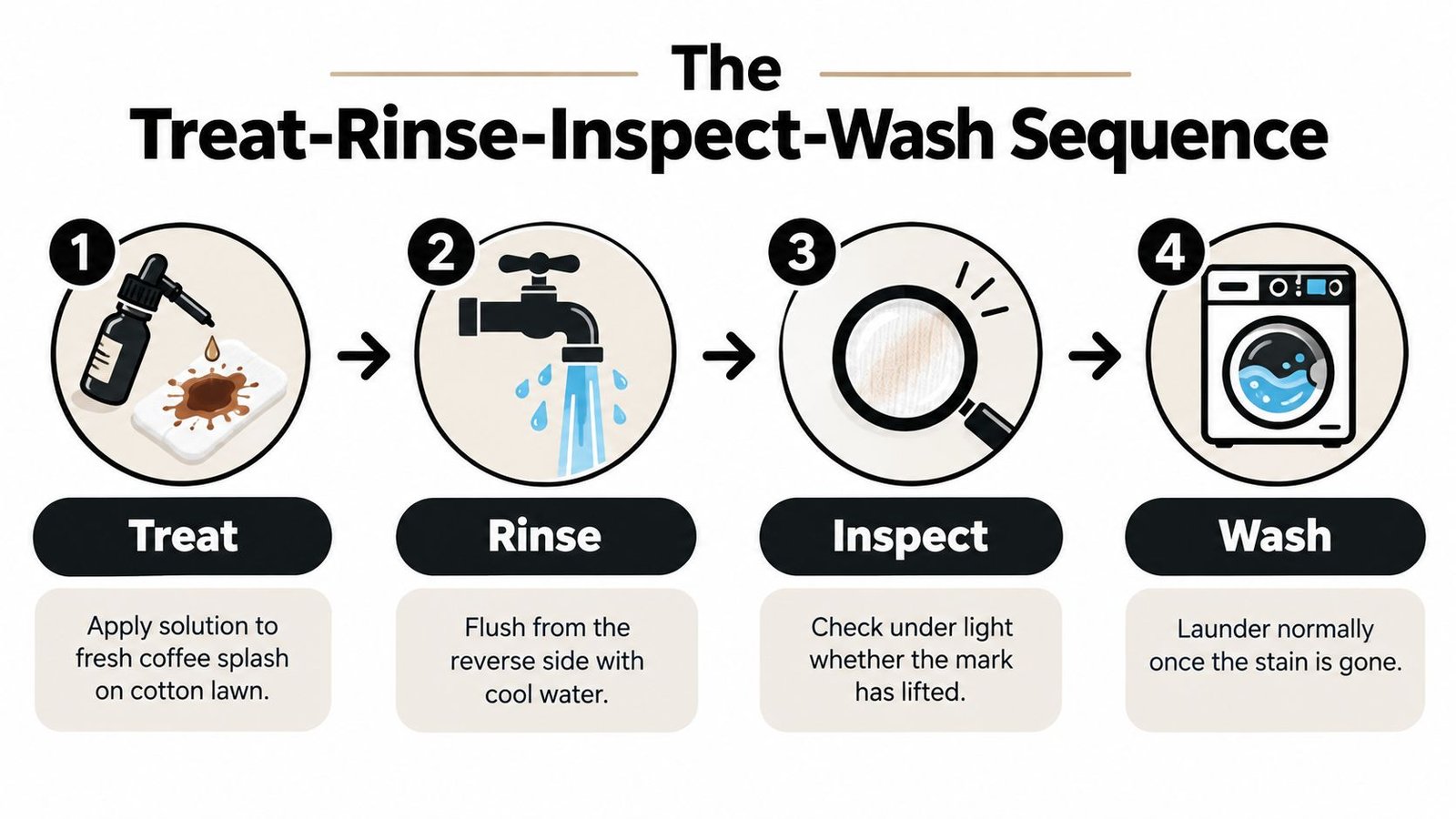
A reliable stain job follows four stages. Don't skip ahead because the mark looks small. The sequence keeps you from washing a product deeper into the fabric or drying a residue that hasn't properly lifted.
Treat the mark without spreading it
Take a fresh coffee splash on cotton lawn. Place a clean, absorbent towel beneath the stain, then blot the surface with another clean cloth. Work from the outside towards the centre so you lift liquid rather than enlarging the wet area.
Turn the fabric so you can work from the reverse. Apply a small amount of a compatible liquid detergent to the back of the mark and ease it into the fibres with your fingertip. Don't flood the cloth, and don't scrub with a hard brush. If the coffee contained milk, treat it as a mixed tannin and protein mark, so a mild liquid detergent is more sensible than reaching immediately for a harsh bleach.
A suitable biological or enzyme detergent can help with food-based marks on compatible washable cottons. A 2024 University of Birmingham study found that adding the cleaning cellulase enzyme Whitezyme to a UK Ariel liquid detergent increased the average soil-removal index on chocolate-milk-stained cotton from 49.3% to 58.1%, an improvement of 8.8 percentage points, or approximately 17.8% relative, during a 30-minute wash at 20°C. Read the University of Birmingham study. That result supports using an appropriate enzyme product on suitable washable fibres, not treating every textile with the same formula.
Rinse from the reverse
Run cool water through the back of the cotton lawn, allowing it to carry loosened coffee away from the face. Rinsing from the front can drive residue further into the weave. Keep the water flow controlled, especially with a loose lawn that can distort when wet.
Silk, wool and fabrics with uncertain dye stability need a more cautious approach. In those cases, blotting and a tiny hidden-area test may be as far as you should go at home.
Inspect before the wash becomes heat
Hold the fabric under good light and look at the whole area, not just the original spot. Check for a remaining halo, a change in colour or a stiff patch from detergent. If you can still see the stain, repeat the treatment and rinse again.
Do not tumble-dry, iron or place the fabric near a radiator while a shadow remains. Heat can make leftover residues much harder to remove.
Wash only after the mark has lifted
Once the fabric looks clean, wash it according to the care label. Choose a gentle cycle for a delicate weave and avoid adding unnecessary bleach. Remove the item promptly at the end and inspect it once more before drying.
For a curry mark on a dark denim apron, the method is similar but the risks differ. Scrape away any solids, blot oil from the surface, test a small amount of liquid detergent inside a hem, then treat from the reverse and rinse. Denim can tolerate more handling than lawn, but indigo may bleed or lighten, so avoid aggressive rubbing and check the treated area before a normal wash.
A short demonstration can help you see the handling and order of the stages:
Matching Treatment to the Chemistry of the Stain
Every stain leaves a different kind of residue, and the safest first move is the one that loosens that residue without stripping colour, roughing up the surface or setting the mark deeper into the cloth. For sewing fabric, that judgement matters even more. A flat metre of cotton poplin can be rinsed and supported one way. A finished bodice with interfacing, topstitching and seam allowances asks for much more restraint.
Oil and grease
Oil-based marks sit in the fibre and often spread farther than they first appear. Sunflower oil, butter, salad dressing and foundation all leave that familiar greasy halo, especially on tightly woven cloth where the surface looks clean before the residue is fully removed. Lift any excess first with the edge of a spoon or a dry absorbent cloth.
On a washable, colourfast fabric, a small amount of washing-up liquid applied from the reverse can help break down that film before laundering according to the label. Use a light hand. Too much soap creates its own ring, and heavy rubbing can push grease into the weave or raise the surface on softer fabrics.
This is one of the places where fibre and finish change the decision. I am careful with dark viscose, coated cloth and hand-dyed fabric because the detergent may solve the stain and leave you with a dulled patch instead. Test first. If a shadow remains, keep heat away until it has fully lifted.
Protein marks
Blood, sweat, milk and egg need a cooler start and less fussing. Warmth encourages these residues to bind more firmly, which is why an eager hot rinse can make a fresh mark harder to shift.
Flush cold water through the reverse. Then dab with diluted mild liquid detergent, using an absorbent towel under the area so the residue has somewhere to go. Blot from the outside towards the centre and rinse well.
Enzyme detergents can help on suitable washable fabrics, but they are a poor gamble on wool and silk. Those fibres are protein too, and protease-heavy products can leave the cloth weakened or harsh. On a cut wool panel or a silk garment piece, I would rather leave a faint mark for a specialist than trade it for fibre damage.
Tannin and food dyes
Tea, coffee, red wine and berry juice usually reward quick work. Remove any solids, blot the liquid, rinse from the reverse with cool water and use a compatible pre-wash stain remover or liquid detergent. For some colourfast washable fabrics, an oxygen-bleach soak can be useful, but only if both the product directions and the care label allow it.
These stains are awkward because they are often mixed stains. A splash of coffee may include milk. A spoonful of cranberry sauce may carry sugar and colour. Red wine can travel quickly along seam lines, facings and hems in a finished garment, while the same spill on an uncut length is easier to isolate and rinse through cleanly. One remedy rarely suits every version of the mark.
If a spill happens outside the sewing room, the same handling still applies to surrounding textiles. Good stain control depends on quick blotting, limited moisture and avoiding methods that spread the mark. The same principles show up in advice on how to prevent carpet stains in facilities.
Ink and pigment
Ink and pigment stains are the ones that make experienced makers pause. Biro, felt tip and poster paint behave very differently from food marks because you are often dealing with colour particles, solvents or binders that want to cling to the surface.
On tested, washable cotton, a controlled dab of isopropyl alcohol may loosen some inks. Put a disposable towel underneath, work from the reverse and change the towel as pigment transfers across. Slow, repeated lifting works better than flooding the area.
Do not try that casually on silk, viscose, acetate or fabric with a special finish. Alcohol can leave a pale ring, disturb the surface or shift dye beyond the original mark. At that point, stopping early is the more skilled choice.
| Stain family | Typical examples | First move | Avoid |
|---|---|---|---|
| Oil and grease | Sunflower oil, butter, foundation | Test washing-up liquid, then rinse | Ironing before the residue has gone |
| Protein | Blood, milk, egg, sweat | Cold reverse rinse, then dab with mild detergent | Hot water and protease products on wool or silk |
| Tannin and dye | Coffee, tea, red wine, berries | Cool rinse, compatible pre-treatment, then inspect | Chlorine bleach without fibre and colourfastness checks |
| Ink and pigment | Biro, felt tip, poster paint | Controlled solvent test on suitable cotton | Solvent experiments on delicate or dry-clean-only fabric |
Fabric-Specific Instructions That Actually Differ
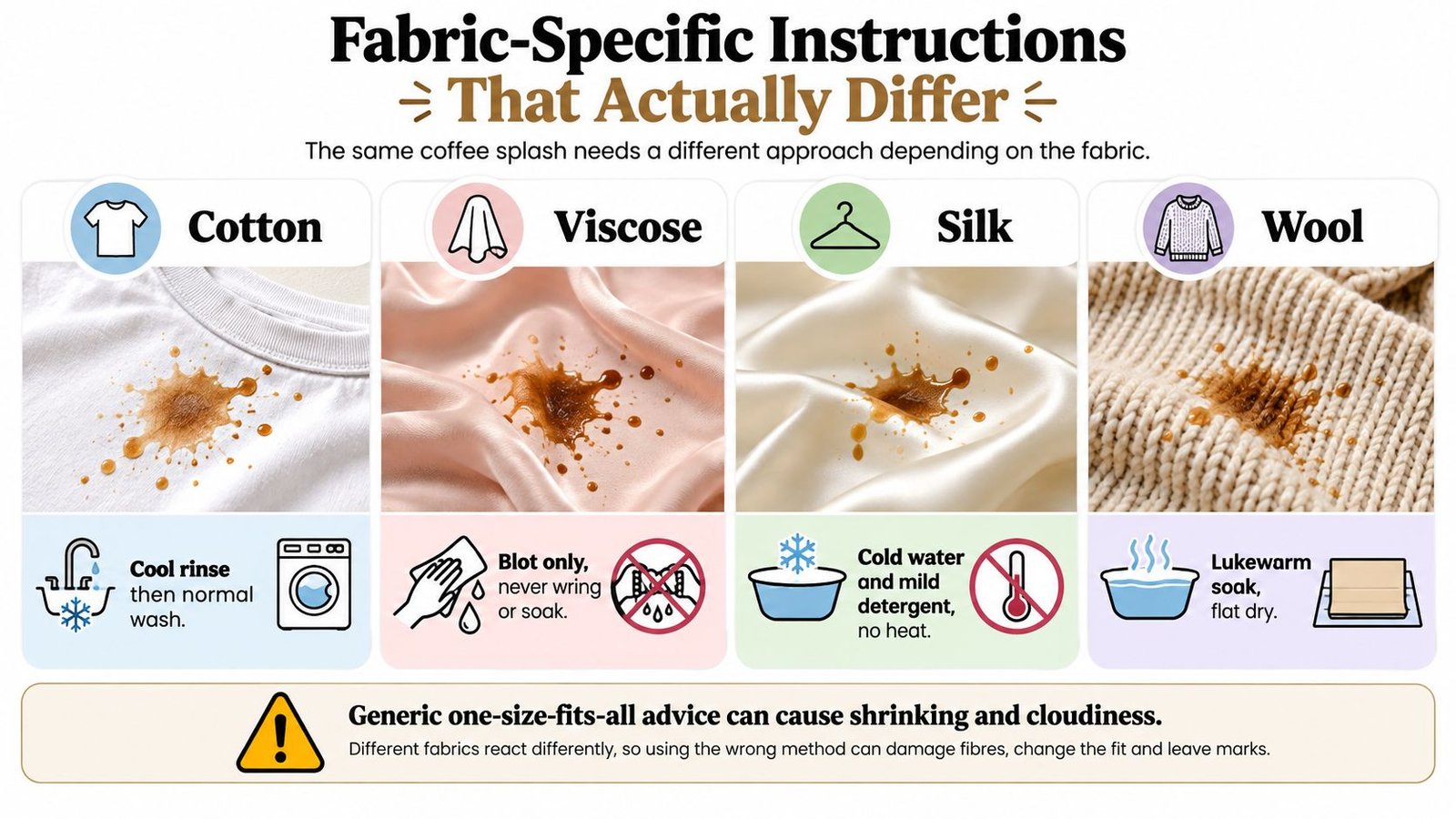
The same coffee splash needs different handling on cotton lawn, viscose, denim and silk. Fibre strength, absorbency, stretch, dye and surface finish determine how much water, movement and chemistry the textile can tolerate.
Cotton and linen
Cotton lawn, poplin and many cotton jerseys are forgiving when colourfast. Blot, treat from the reverse, rinse cool and wash according to the label. Keep the project flat while treating so you don't stretch a cut panel or distort a neckline.
Linen usually tolerates more movement, but its creases can hold residue and its texture can make a faint mark look uneven. UK linen-management guidance recommends biological detergent for the first wash of stained items and a 30–40°C pre-wash, while requiring the item to be removed for re-treatment before drying. Consult the linen-management guidance.
Viscose and Tencel
Viscose weakens when wet and can develop a cloudy or tideline effect if you soak only one small area. Blot rather than wring, support the fabric with a towel and use minimal agitation. Tencel may be more stable, but the care label still controls the decision.
For a coffee mark on a finished viscose dress, I'd test a tiny amount of mild detergent on an inside seam, dab from the reverse and rinse with carefully controlled water. If the colour shifts or the fabric surface changes, stop. A discussion of oxygen-based products and how to protect garment vibrancy with OxiClean can be useful background, but no branded product replaces a hidden-area test.
Jersey and knitwear
Treat jersey flat on a towel, not hanging over a sink. A wet knit can stretch under its own weight, and rubbing may create a fuzzy patch. Use gentle pressure and reshape the piece before it dries.
Wool needs even more restraint. Avoid enzyme products intended for food stains, keep agitation low and dry flat if the label permits washing. Felting, shrinkage and distortion are difficult to reverse once they happen.
Denim
Denim is sturdy, but its indigo dye isn't invincible. Test on an inside seam, expect some colour transfer during rinsing and avoid chasing a small stain with repeated hard brushing. A slightly softened area may be less damaging than a pale, visibly scrubbed circle.
Silk and lace
Silk and lace deserve a conservative policy. Blot fresh liquid, support the fabric and follow the care label. Don't use bleach, strong enzymes, vigorous rubbing or an improvised soak on a valuable piece.
Lace may have unstable dyes, metallic threads, sizing or an attached lining that reacts differently from the lace itself. If the item is structured, vintage, embellished or marked dry-clean only, hand it over with a clear account of the stain and previous treatments.
| Fabric | Safer first response | Main risk |
|---|---|---|
| Cotton lawn | Cool reverse rinse and compatible detergent | Dye loss from unsuitable bleach |
| Linen | Controlled pre-wash within the label | Residue trapped in texture |
| Viscose or Tencel | Blot, minimal water and minimal movement | Weakness, tidelines and distortion |
| Jersey or knit | Treat flat and reshape | Stretching and surface fuzz |
| Denim | Test dye, treat gently and rinse well | Indigo loss or a scrub mark |
| Silk or lace | Blot and seek professional advice when uncertain | Water marks, colour shift and structural damage |
Testing, Laundering and Knowing When to Stop
The most valuable tool in stain removal is a hidden test. Before treating the front of a finished garment, turn it inside out and choose an inside seam, hem allowance or area beneath a facing.
Apply the proposed product sparingly and wait 5–10 minutes, then rinse and inspect the test area for colour change. The American Cleaning Institute recommends this concealed-seam process before treating the visible area. Read its laundry basics guidance.
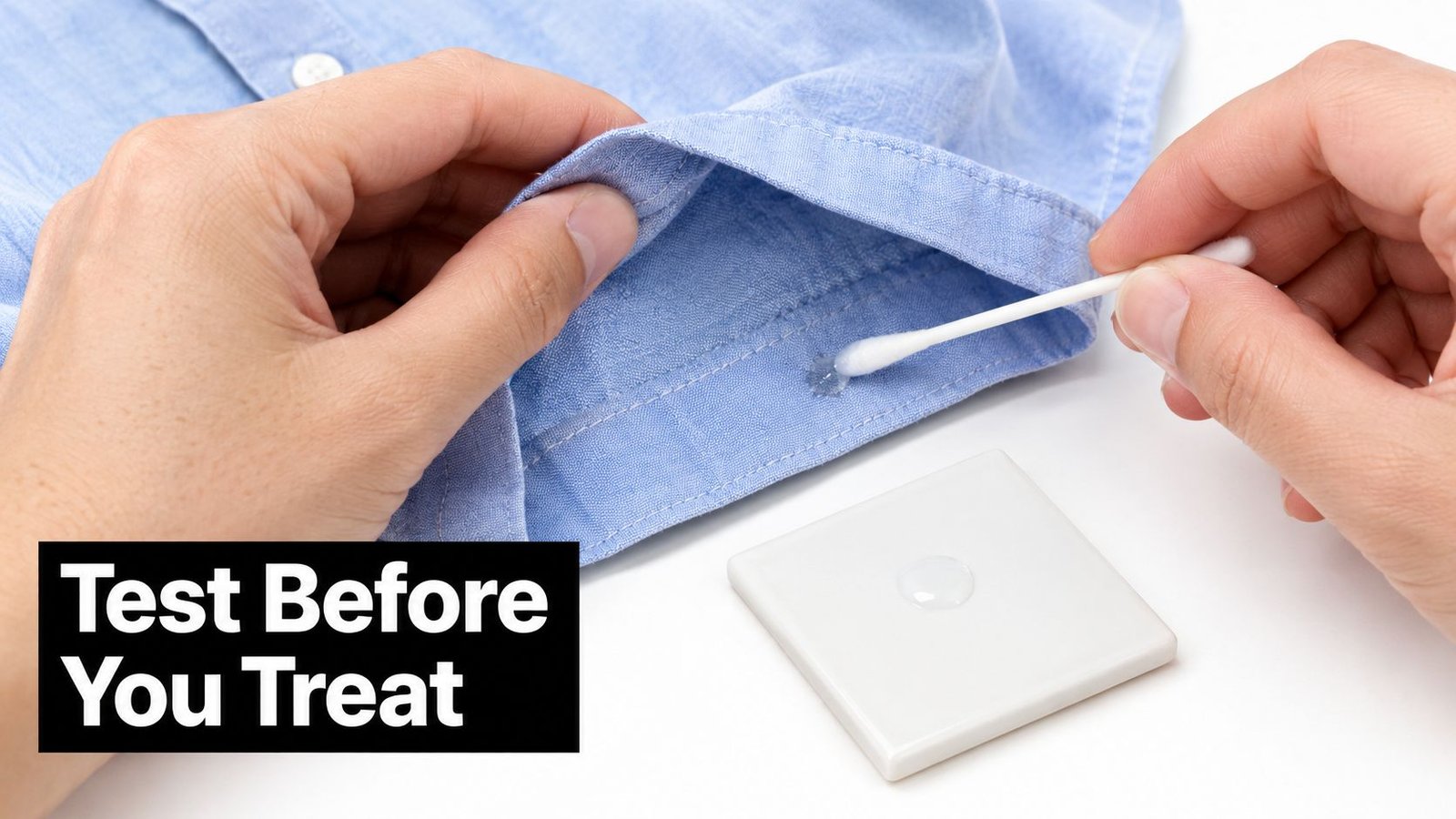
Look for more than colour loss. Check whether the seam has shrunk, whether the weave has become rough, whether the surface has gone shiny and whether the product has left a ring. A treatment that removes the mark but leaves a pale patch hasn't rescued the garment.
Choose the wash around the fabric
A colourfast cotton lawn may tolerate a normal wash after spot treatment. A jersey or delicate blouse may need a gentle cycle, while viscose may benefit from minimal handling and prompt removal. If you soak a dye or food mark, allow sufficient contact time for the product to work, but don't assume longer is safer. Product instructions and the care label take priority.
A dark viscose dress illustrates the decision. Suppose a grease shadow remains after washing. Don't iron it and don't put it in the dryer. Test a little washing-up liquid on an inside seam, dab the shadow from the reverse, rinse carefully and inspect the area while it is still damp. If the colour changes, stop. If it remains stable, repeat the treatment rather than increasing the product strength.
A nearly invisible stain is still a stain until the garment has passed inspection dry and under good light.
A cotton lawn can usually be retreated if a faint coffee halo remains. A silk blouse with a spreading water mark may not be worth a second home experiment. That's the point at which restraint becomes part of the craft.
When Stains Need a Professional, a Cover-Up or a Fresh Start
Some stains are not a challenge to conquer at home. They're a signal to stop. Silk, wool, structured tailoring, vintage cloth, unstable dyes and dry-clean-only garments can suffer more from repeated treatment than from the original mark.
Give a professional cleaner useful information rather than handing over the garment. Explain whether the stain is blood, grease, wine, ink or an unknown spill, when it happened and whether you've used detergent, alcohol, bleach or heat. Previous treatments change what a cleaner can safely do.
A stain also doesn't always need to disappear. On a handmade jacket, a carefully placed appliqué can look intentional. A patch, visible darn or decorative pocket may preserve more of the garment than repeated washing. On a length of fabric, overdyeing can shift the whole colour direction, while a smaller project may position the mark inside a seam, under a pocket or within a gathered section.
That choice matters beyond one garment. An estimated 336,000 tonnes of used clothing are discarded annually in the UK, and staining, greying and yellowing are repeatedly cited as reasons pale garments are rejected by owners and second-hand buyers. See UK wear, care and repair guidance.
Before reaching for stronger bleach, ask whether the proposed treatment could damage the fibre more than the mark does. Spot-cleaning an otherwise clean garment may be kinder than washing the whole piece. Repairing, overdyeing or repurposing can be a successful finish, not a consolation prize.
Keeping the Next Project Clean and What to Carry Forward
Keep this short decision list beside the ironing board:
- Check the label: Confirm whether the fabric is washable.
- Identify the fibre: Cotton, linen, viscose, jersey, denim, wool and silk need different handling.
- Identify the stain: Choose treatment for the chemistry, not the colour alone.
- Blot, don't rub: Remove excess without spreading it.
- Work from the reverse: Push residue out through the cloth.
- Test first: Use a hidden seam and inspect for colour change.
- Treat, rinse, inspect, wash: Never dry a mark you can still see.
- Prevent the next mishap: Cut and baste over a scrap, keep tea towels and cool water near the machine, and pre-wash bright cottons or ex-designer deadstock before cutting.
A small mark isn't a catastrophe when you have a plan. More Sewing's care advice, fabric ranges and practical sewing supplies can help you choose materials that suit both the project and the life you expect them to live.
More Sewing offers cottons, viscose and Tencel blends, jerseys, denims, ex-designer deadstock, haberdashery and ready-to-sew kits for makers. Visit More Sewing to explore fabric options, order sample swatches and find the tools for your next project.
