
You're standing in a fabric shop or scrolling at midnight, pattern envelope in one hand, looking at cotton lawn, viscose, jersey, denim and forty other bolts that all look lovely. The wrong choice won't show up until you've cut, sewn, washed and tried to wear it. By then you've lost the hours as well as the cloth.
Choosing fabric for dressmaking UK sewists can trust comes down to one test. Will it drape, stretch, press and wash the way this garment needs it to, for as long as you mean to wear it? Judge it on its working life, not on its label alone.
Which Dressmaking Fabric Suits Your Garment
Choose fabric through three linked decisions, in this order: garment type, then fibre, then weight. Don't start with colour or print. A pattern asks for behaviour first, and the garment decides the fabric much as the road decides which tyres give grip.
A wrap dress in quilting cotton can sit away from the body because the cloth won't swing. The same dress in viscose challis falls against you. A collar in soft viscose collapses. A T-shirt in stable woven cotton gapes at the neck because it can't recover. None of those fabrics are bad. They're matched to the wrong job.
The breadth on sale reflects a large national base. The UK Government textiles sector analysis sits alongside Office for National Statistics data recording 10,685 businesses and 90,390 people in employment for one reported textile related category. You're not short of choice. You need a filter.
Garment to Fabric Quick Pick
| Garment | Best fabrics | Typical weight | Why it works |
|---|---|---|---|
| Summer blouse or shirt | Cotton lawn, viscose challis | Light | Soft drape, breathable, easy to press |
| Sundress or fitted dress | Cotton poplin, Tencel twill | Light to medium | Flows while holding its shape |
| Trousers or workwear | Cotton twill, stretch denim | Medium to heavy | Abrasion resistance and structure |
| Jersey top or leggings | Cotton jersey, viscose jersey | Medium | Stretch and recovery |
| Jacket or structured skirt | Denim, chambray | Medium to heavy | Crisp shape and sturdy seams |
| Evening or fluid dress | Viscose crepe, Tencel satin | Light | Heavy drape and fluid movement |
Read the table from left to right. Start with how often you'll wear the garment, because a daily trouser needs abrasion resistance that an occasion blouse doesn't. Check fibre and weight together, since a light denim and a heavy denim behave like different fabrics. Then confirm with a washed swatch before you cut the full length.
Practical rule: Choose the garment's required behaviour before you choose its fibre name.
Take three questions to the shop. Does it need to drape or hold its shape? How often will it be washed? Does it need stretch, and if so, does it spring back when you pull and release it? If a cloth fails any one of those, put the bolt back, however pretty it is.
Fibre Types from Cotton to Denim
Think of fibre as the ingredient and weave or knit as the recipe. Both decide the finished cloth. Cotton woven into poplin, knitted into jersey and twilled into denim gives you three very different fabrics from one fibre.
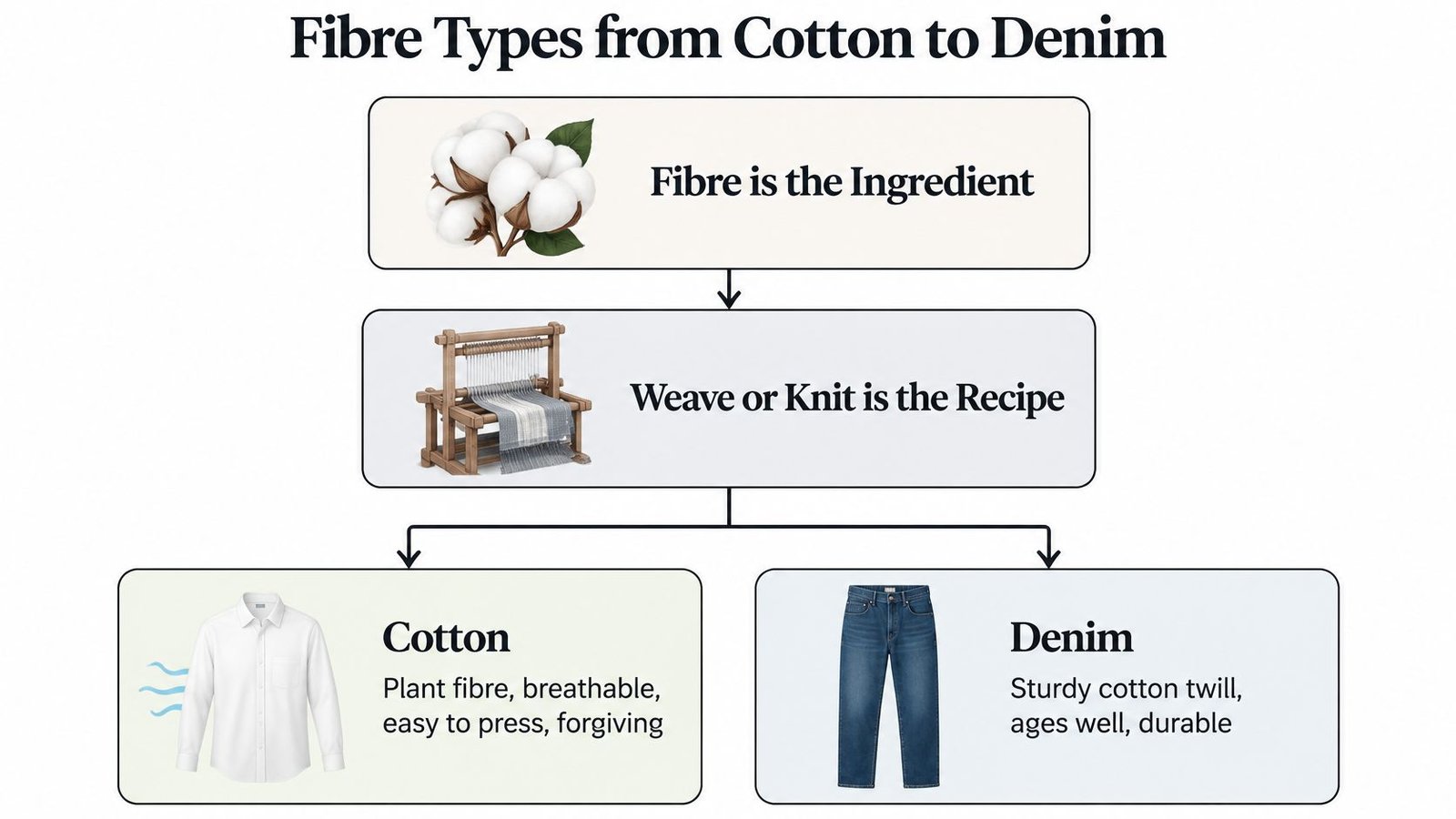
Cotton and Cotton Lawn
Cotton is a plant fibre that's breathable, easy to press and forgiving to sew. It stays put under pins, takes a sharp crease with steam, and doesn't slide on the table. Its weaknesses are wrinkling and shrinkage, so a fitted cotton dress cut without pre-washing can come out of the first wash shorter and tighter.
Cotton lawn is the finer example, made from long fibres for a soft, strong, slightly crisp finish. I'd use it for blouses, summer dresses and linings, with French seams where the allowance allows. Poplin is a step firmer and better for collars, cuffs and plackets. If you're comparing cotton blends for home furnishing rather than garments, this guide to cotton linen for curtains and upholstery explains how a sturdier weave suits a different job.
Viscose and Tencel
Viscose is a regenerated cellulose fibre. It drapes like silk, feels cool, and skims rather than stands away from the body. It also slips under the presser foot, frays readily, distorts if you pull it while cutting, and can weaken when wet. Cut it flat with pattern weights and sharp shears or a rotary cutter, pin sparingly, and finish seams promptly with an overlocked edge, narrow zigzag or French seam.
Tencel, a lyocell regenerated fibre, feels cool and drapes smoothly with a little more substance, especially in a twill. It usually shrinks less than cotton and presses more predictably than viscose challis. Cut it on the straight grain, let it rest flat before cutting, and lift the iron with steam rather than sliding it across the surface.
Jersey and Denim
Jersey isn't a fibre. It's a knit structure, so cotton jersey, viscose jersey and a cotton, polyester and elastane grey marl jersey all stretch because of how they're looped. They need a ballpoint or stretch needle, often 80/12, a narrow zigzag or stretch stitch, and stay tape at shoulders. Test recovery by stretching a corner and letting go. If it stays baggy, don't use it for necklines or fitted cuffs.
Denim sits at the opposite end. It's a cotton twill, usually indigo dyed, woven firm and built to take abrasion. It shrinks, it can bleed dye, and thick intersections will defeat a light needle. Use a jeans needle such as 90/14 or 100/16 for heavy layers, lengthen the stitch, grade bulky allowances, and use topstitch thread where you want that workwear line to show.
If the cloth springs back under your finger, handle it like a knit. If it stands in folds, approach it like tailoring.
Read the composition before you pattern. Under UK Government textile labelling guidance, textile products sold in the UK must show fibre content, and products with two or more components with different compositions must identify each one. A 3% elastane addition can materially change fitting requirements and may need a stretch needle and a pattern drafted for negative ease. Keep that label with the cloth and let it inform needle, seam finish and care, not just the wash bin it goes into.
Drape and Weight Reference for Dressmaking
Weight is the fastest way to narrow a search, so start there. Weight is measured in grams per square metre, written as gsm. Drape is how fabric falls under its own weight. A high gsm usually means more body and opacity, but construction matters too, which is why a medium jersey and a medium poplin don't hang the same way.
Fabric Weight Classes and Typical Uses
| Weight class | Approx. weight (gsm) | Typical fabrics | Drape and use |
|---|---|---|---|
| Very light | under 100 gsm | Voile, lawn, batiste | Floaty and sheer; blouses and linings |
| Light | 100-150 gsm | Cotton lawn, poplin, viscose challis | Soft drape; shirts and summer dresses |
| Medium | 150-250 gsm | Cotton twill, chambray, light denim, cotton jersey | Holds shape; skirts, trousers and tops |
| Heavy | 250-350 gsm | Denim, canvas, heavy jersey | Structured; jackets and workwear |
| Very heavy | over 350 gsm | Heavy canvas, wool coating | Stiff; coats and bags |
Run the Drape Test
Hold one corner between finger and thumb at shoulder height and let the cloth hang. Watch it for a few seconds. Soft, deep curves that fall close together suit gathers, cowls, soft sleeves and bias cuts. Wide folds that stand away suit pleats, structured bodices and fuller skirts.
It helps to think of a tablecloth versus a sheet of card. They're the same size on the table and nothing alike once lifted. A fabric can feel soft in your hand and still have too much body for a gathered waist, because softness and drape aren't the same thing.
Next, hold roughly a metre in one hand and feel the pull. Check opacity against light, because a light lawn dress may need lining even though it looked solid on the roll. Fold two layers together and pinch them. That's roughly your seam bulk, and four layers at an intersection will tell you whether your machine will cope happily.
Match Weight to the Pattern
Check the weight and fabric types printed on the pattern envelope and treat them as a specification, not a suggestion. Go lighter for gathers and softness, heavier for structure. A gathered skirt asking for light to medium fabric works beautifully in 120 gsm viscose challis, where the fullness collapses into controlled folds. Make it in 220 gsm twill and it'll stand out stiffly, with bulky gathers at the waist.
Two edge cases catch people out. A heavy fabric in a shirt makes seams and collars bulky, so choose a lighter weight or trim and grade the allowances carefully. A very sheer fabric shows every raw edge inside, so add a lining or use French seams to enclose them.
- For gathers: stay at the lighter end of the pattern's range, so fullness doesn't turn to bulk.
- For darts and collars: choose a cloth that holds a press and doesn't collapse around the point.
- For large pattern pieces: remember weight adds up, and a heavy full skirt pulls on its own waistband all day.
How to Pre-Wash and Test Fabric Before Cutting
Shrinkage changes ease, seam alignment and hem length, especially in cotton rich fabric and denim. Wash the cloth the way you'll wash the garment, before you cut, and that change happens on the roll instead of on your body. Skipping this step is the cheapest mistake to avoid and one of the most expensive to fix.
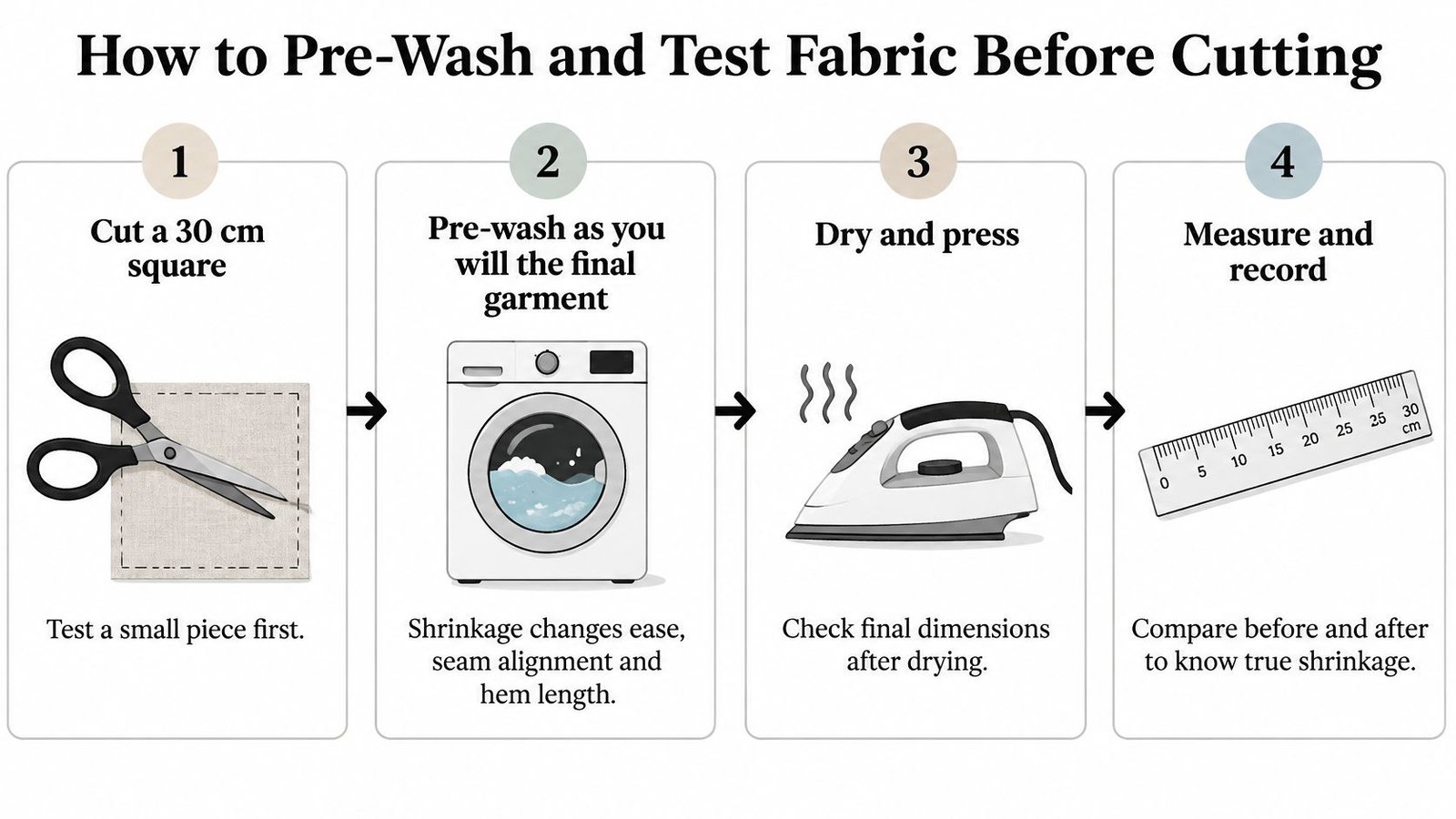
The Swatch Test Step by Step
- Cut a 30 cm square swatch: take it from the length you plan to use, so it shares the same dye lot and finish.
- Mark a 10 cm square: draw it in the centre with a fabric marker, on grain, well away from the selvedge.
- Wash it as you'll wash the garment: use 30 degrees for most cotton and cold for viscose, with your usual detergent.
- Dry it the same way too: flat, on the line or in the dryer, whichever the finished garment will get.
- Measure and record: measure the square again and note the percentage change in length and width separately, because they rarely match.
- Press it at your working heat: check for shine, distortion, colour bleeding onto a white scrap, and any change in hand.
- Pre-wash the full length: do this before cutting, and add a margin if the swatch shrank more than about 3 percent.
That test also tells you about shedding and surface change. UK domestic laundry research published in Environmental Science and Pollution Research estimates annual microfibre release at a baseline of 16,384 tonnes, with modelled scenarios ranging from 6,490 to 87,165 tonnes depending on fabric, laundering and household variables. Fibre content alone doesn't determine shedding, since construction, yarn type and brushing all play a part. If a swatch pills, thins or sheds heavily in one wash, believe it.
Edge Cases and Fixes
Deadstock and dry clean only fabrics may not survive washing, so ask the seller first and test a scrap before committing a full length. Photograph the label and note usable width while you can still check it. Viscose can lose strength and shrink in hot water, so wash it cold, support it when lifting it wet, and never wring it.
Dark denim deserves its own wash, inside out, because indigo will move onto paler cloth. Let slippery viscose and Tencel lie flat and relax before you lay pattern pieces on them. Wet, stretched fabric cut too soon gives you hems that creep up later.
Care, Laundry and Microfibre Release
Care is set by fibre and construction together, so one wash rule doesn't suit every garment you've made. A tightly woven cotton and a loose cotton knit share a fibre and need different handling. Write the routine on a label or card when you finish sewing, while you still remember what the swatch told you.
Care Settings by Fabric
- Cotton lawn and poplin: wash at 30 degrees on a gentle cycle, then iron on a cotton setting while slightly damp for a crisp seam.
- Viscose and Tencel: wash cold, reshape gently, dry flat away from direct heat, and hang rather than wring.
- Denim: wash inside out at 30 degrees to protect colour, and keep the iron moving carefully around raised topstitching.
- Cotton, polyester and elastane jersey: use a short cycle and dry flat, so the elastane keeps its recovery and necklines don't grow.
Hang drying can pull a wet, fluid garment longer, particularly at bias hems. Drying flat costs you a towel and some floor space and saves the shape. Store finished pieces away from prolonged sunlight, since cotton can yellow and viscose can fade.
Reduce Shedding in the Wash
Construction, yarn type, brushed surfaces and garment design all affect how much a fabric sheds, and synthetic jersey and fleece can release persistent fibres. You can't eliminate shedding, but you can lower it without giving up practical fabrics.
- Wash less often: air garments between wears and spot clean marks where you can.
- Use lower agitation: choose a gentler cycle and wash a full load rather than a half empty drum.
- Contain loose fibres: put high shedding knits in a fine mesh laundry bag or use a filter.
- Favour tighter constructions: for garments worn and washed often, a tightly woven cloth tends to shed less than a loose, brushed knit.
Sustainable Fabric Choices Beyond Fibre Labels
The most sustainable fabric isn't always the one with the lowest fibre level impact. That runs against the usual natural good, synthetic bad ranking, but dressmaking rewards a longer view. A well fitting, frequently worn, repairable garment in a mid impact cloth beats a virtuous fabric made into something you wear twice.
Scale matters here. According to the UK Government waste prevention programme for England, textiles represented 4.2% of all municipal waste by weight in England, and approximately 620,000 tonnes of used textiles are separately collected across the UK each year, with around 60% of that collected material exported. What you buy, cut badly and bin joins a stream that mostly goes to landfill or incineration.
What the Fibre Numbers Actually Say
A UK clothing material flow analysis found cotton, polyester and viscose represent approximately 48%, 26% and 10% of clothing consumption respectively. It estimates cradle to consumer emissions at 12 to 42 kg CO2e per kg for cotton and 15 to 30 kg CO2e per kg for polyester. Those ranges overlap, which is exactly why a simple fibre league table misleads.
Viscose is the clearest warning against broad claims. Its estimated fibre production impacts vary from 0.3 to 9 kg CO2e per kg, a thirty fold spread driven by processing and sourcing. A label saying eco viscose or natural fabric tells you very little until you know how it was made. Ask what you can, and don't pay a premium for a vague adjective.
A jacket worn a hundred times spreads every cost of making it, money, carbon and your own hours, across a hundred wears. One worn ten times doesn't.
A Three Question Framework
- How many times will this be worn: if the honest answer is a handful, borrow, hire or make something you'll reach for weekly instead.
- Can it be repaired: choose seams you can unpick, hems you can let down, and cloth that won't ladder or tear around a patch.
- Does it fit well enough to keep: poor fit is the fastest route to the back of the wardrobe, so toile close fitting styles in cheap calico first.
Match durability to the job. Put hard wearing twill or denim where thighs rub and bags swing, and save delicate lawn for blouses that won't take that punishment. Use remnants for linings, pockets, bias binding and children's clothes rather than binning them. Above all, buy only the metres your pattern requires, confirmed against the actual fabric width. Overbuying just in case is where most home sewists waste cloth.
Where to Buy Fabric and How to Order Swatches
Where you buy changes what you can check before money leaves your account. Feeling drape in person is worth a great deal when you're learning, while online ranges give you depth in a fibre or print that a small local shop can't stock. Use both deliberately.
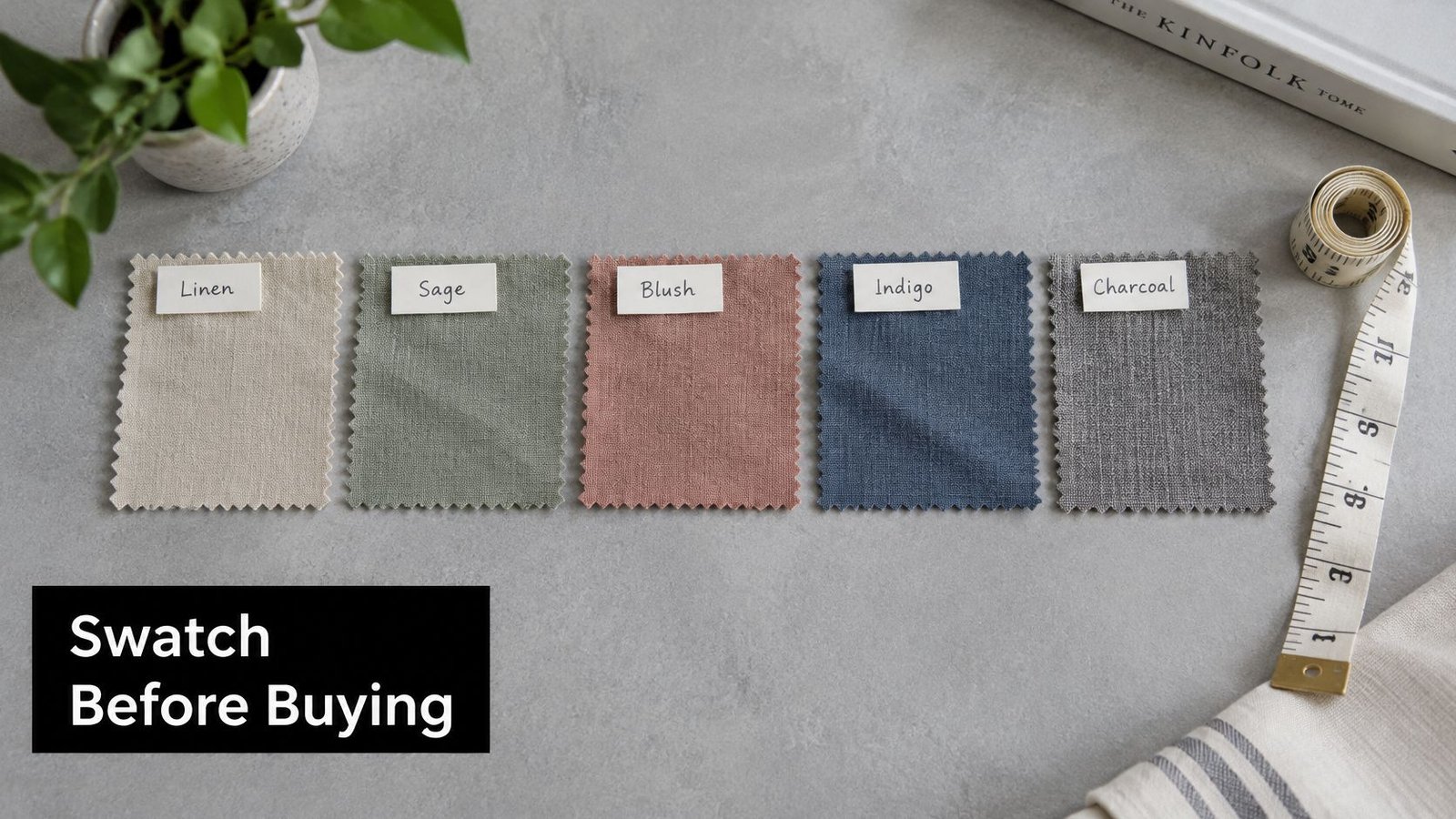
The swatches below show why ordering small samples first saves a wasted length.
UK Buying Sources Compared
| Source | Best for | Watch for |
|---|---|---|
| Specialist UK online fabric shops | Wide range, swatches and half-metre cuts | Delivery charges and cut-off times |
| Local independent fabric shops | Feeling fabric in person | Narrower colour range and higher per-metre prices |
| Deadstock and end-of-line sellers | Unique prints and premium cottons | One-off lengths and no reorder |
| Remnant and sale sections | Small projects and fabric testing | Short lengths and mixed quality |
| Haberdashery and kit suppliers | Notions bundled with fabric | Pre-selected fabric and less choice |
Order Swatches Like You Mean It
Order several small samples before committing to a full length, including one you think is too heavy and one too light. That bracket teaches you more than three near identical options. Label each swatch on the back with fibre, weight, width, price and the garment it's for, because unlabelled swatches become mystery squares within a month.
Then wash them, press them, sew a short seam in each, and pull the seam to see if it puckers or grins. Hold them against your skin and against clothes you'll wear with the finished piece. Check colour in daylight near a window, not under warm kitchen lighting.
Watch this short demonstration of handling and comparing fabric before you commit to a length.
Deadstock and Remnants Without Regrets
Deadstock is a sourcing category, not a fibre. It's end of line or designer surplus, often a single roll with no reorder, so plan pattern placement before cutting and buy a little extra where pattern matching matters. Inspect it harder than a stocked basic. Measure usable width rather than selvedge to selvedge, lay a pale cotton scrap underneath to reveal thin spots and holes, and compare shade at the start, middle and end of the roll.
Check for tight selvedges pulling the cloth off grain, snags, needle lines and oil marks. Measure the pattern repeat before you pay. A cheap metre price stops being cheap if you lose a panel to a flaw and can't replace it.
Remnants suit small projects, toiles in a similar weight, and fabric testing. Confirm actual length and width, and check quality across the piece rather than trusting the folded top layer. A remnant that's too short for your back bodice is only a bargain if you have a second project for it.
Always check width, typically 115 cm or 150 cm, because your pattern's yardage depends on it. Ask about dye lots before ordering in two batches, since a second order may not match the first exactly. Note that a dedicated haberdashery kit can be convenient for beginners, but it limits your fabric choice.
Before you pay, run this checklist: fibre content, width, weight, care guidance, whether it's sold by length or half metre, and whether swatches are available. If a listing won't tell you fibre and width, don't buy it for a fitted garment.
Confirm Your Metres and Order With Delivery in Mind
Work the calculation on paper before you open your basket. Guessing yardage is how sewists end up one sleeve short, or with two spare metres they never use. Fabric at More Sewing is priced per half metre, so the arithmetic below uses half metre units throughout.
The Calculation Step by Step
- Read the pattern yardage: find the figure for your size and your fabric width, for example 1.5 m at 150 cm wide.
- Add about 10 percent: allow for shrinkage, pattern matching or a cutting error, which takes 1.5 m to 1.65 m.
- Convert to half metres: 1.65 m divided by 0.5 is 3.3 half metres, so round up to 3.5 half metres.
- Multiply by the half metre price: Cotton Fabric Mustard Floral 115cm Wide costs £4.00 per half metre, so 3.5 half metres comes to £14.00.
- Add delivery and compare totals: compare the full landed cost across sellers, not the headline metre price.
Delivery changes the comparison more than people expect. Delivery within the UK costs £2.99 for fabric orders under £35 and is free on orders over £35, so combining two small projects, or adding the interfacing, zip and thread you'll need anyway, can cost less than ordering twice. Don't pad an order with cloth you have no pattern for just to cross a threshold. That's a saving on postage and a loss on fabric.
Width deserves a second look at this stage. That mustard floral example is 115 cm wide, not 150 cm, so a pattern drafted for the wider cloth may need more length to fit wide pieces side by side. Lay your widest pattern piece against the stated width mentally before ordering. Large sizes and full skirts are where narrow fabric catches people out.
Ask whether multiple units will be sent as one continuous length. It matters because a join in the middle of your length can wreck a layout and force pattern pieces onto the wrong grain. A continuous cut gives you freedom to place a long skirt panel where it fits best.
Order swatches first, wash and test them, then order the full length once, in one go, from one dye lot.
That order of operations costs a few days and a few pounds in samples. It prevents the far more common outcome, which is a finished garment that shrinks, sags or never gets worn. Your time at the machine is the expensive part of dressmaking. Spend the small money protecting it.
Browse cotton, cotton lawn, viscose and Tencel, jersey, denim, chambray and deadstock by the half metre, order swatches to wash and test at home, and add the patterns, thread, zips and interfacing to finish the garment properly. Visit More Sewing to choose your cloth, check its width and weight against your pattern, and order the length you've calculated with delivery in mind.
