
You're standing in the sale corner with a folded piece of cotton in your hands. The bolt is gone, the ticket says 80cm, and you're not sure the length will make anything you wear. That leftover is one of the remnants of fabric shops sell once a full roll has been cut down. It can be a bargain, or it can sit in a drawer because the width, fibre, or stretch doesn't match the job.
Match the offcut to a use before you pay or bin it. Repair comes first, a small new make second, and recycling or disposal only after that. Size and fibre decide which of those three is honest.
What Fabric Remnants Are and How They Are Sold
Picture a shop assistant rolling the last of a cotton lawn onto the counter. The customer wanted two metres. What's left is shorter than a standard cut, often narrower in usable length than the ticket on a full bolt, and it goes into the remnant bin. That leftover piece is a remnant: the cloth left after a full roll or cut length has been sold.
Remnants reach you in three main ways. Mills and wholesalers send end-of-bolt lengths once a roll won't make another full garment cut. Fabric shops keep the cut-length offcut after your neighbour buys from the bolt. Deadstock and designer sample lengths are cloth a brand or mill didn't cut into production, often in a print you won't see sold by the metre again.
A piece is sold either at a fixed price for the whole length, or by the half metre. A 1.5m length can be good value if your pattern fits inside it. It needs planning, because you can't go back for a matching second cut.
| Remnant type | Typical size | How it is sold | Best use |
|---|---|---|---|
| End-of-bolt remnant | Often 2m to 5m | Fixed price per piece | Garments and quilt backing |
| Cut-length offcut | Whatever is left after a customer's cut | Per half metre | Patchwork and small projects |
| Deadstock or designer sample | Often 1m to 3m | Per piece or per half metre | Unusual prints and fabrics |
| Sample swatch | About 10cm square | Free on request, or a small fee | Checking colour and drape before buying |
Common cloth widths are 110cm and 145cm. A 50cm strip of the wider cloth can still make a pouch or a bag handle. A 1m by 110cm cotton remnant is enough for two child-size tote panels plus straps, with a little left for a pocket.
Before you buy, check three things: the width, the fibre content, and whether the piece is one continuous length or several bits pinned together.
Why Remnants Are Worth Buying and Where They Fall Short
A patchwork quilt and a fitted bodice front sit at opposite ends of what remnants can do. The quilt is built from dozens of small squares, so a mixed bag of offcuts suits it perfectly. The bodice needs one continuous panel, on one grain, in one colour, and a bundle of short pieces will never give you that.
That contrast explains both halves of the value case. A remnant usually costs less than the same cloth cut from a full bolt, and buying it moves stock that would otherwise sit unsold. Deadstock prints are the clearest case: you get a fabric the shop would not sell by the metre.
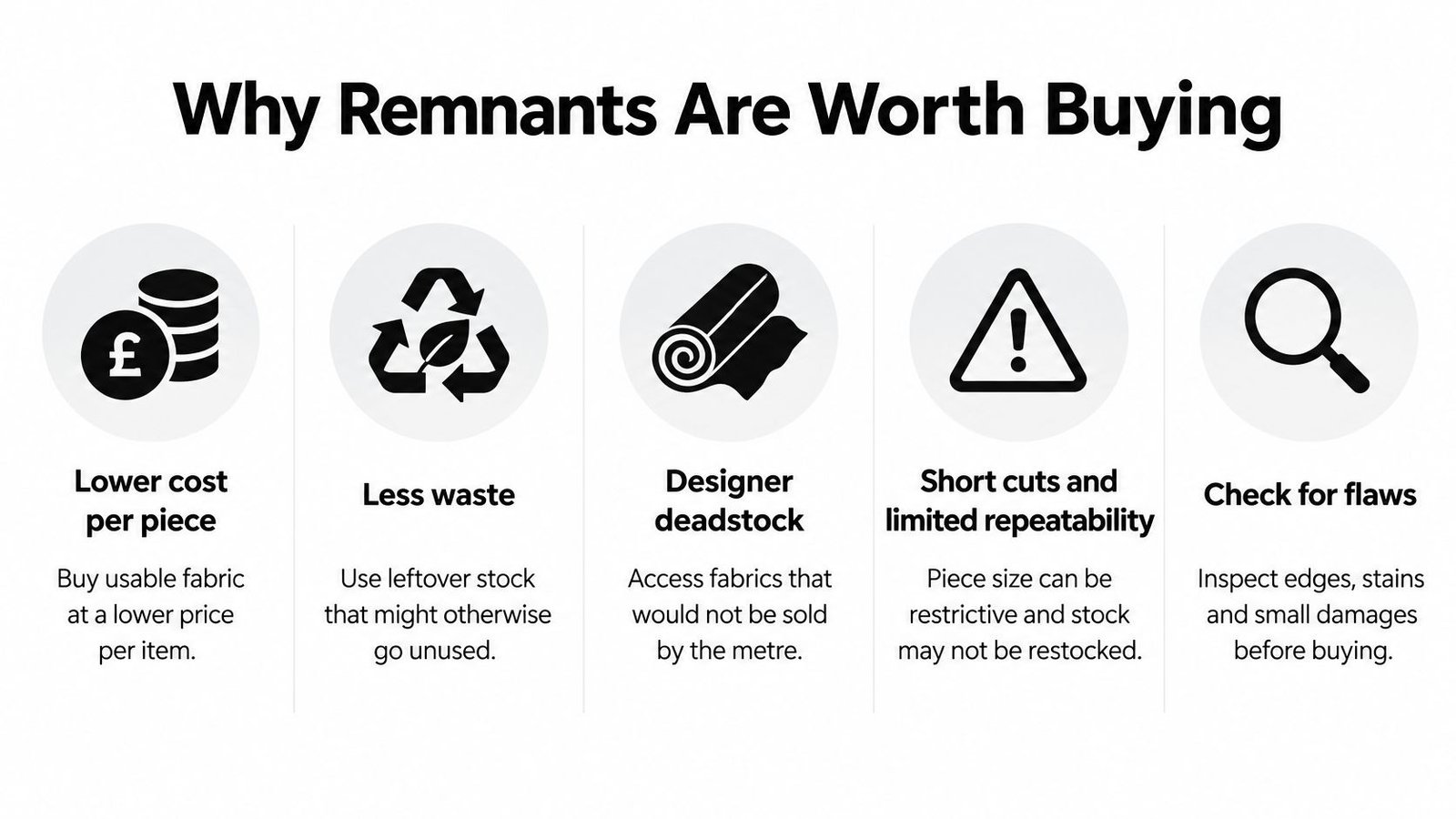
The limits are just as real.
- Too short for a garment: a bodice front often needs one continuous piece, and a remnant made of scraps joined at the selvedge won't give you that.
- No second dye lot: if you run out, the next piece may not match in colour or hand.
- A label isn't a test: fibre content on a ticket doesn't prove stretch, drape, or whether the cloth will bag at the knee.
The same logic scales up past your sewing box. The WRAP textiles resource hierarchy orders the options as prevention first, then reuse, then recycling, and a large share of used textiles in the UK still never reaches any of those routes. A remnant you sew sits in the reuse tier. One that sits in a drawer for years and then gets binned does not.
So decide the route before you pay. Cloth that could still mend a garment goes to repair first. Pieces big enough to become something new count as reuse. Anything too small, stained, or blended to sew belongs in the recycling stream.
Practical rule: Buy remnants for projects with flexible dimensions. Buy by the metre when several pattern pieces must match.
Run a quick price check before you commit. Divide the piece price by its length in half metres: a 1m piece at £6 works out to £3 per half metre. Hold that figure against the bolt price per half metre, and the remnant only wins if it comes out cheaper or gives you a fabric you cannot get any other way.
Sort Remnants by Size and Fibre Before You Store Them
Grade your own offcuts the day you cut them, or you'll hunt through a mixed bag every time you want a patch. Sort by size first, then by fibre.
| Size band | Best uses | Cutting note |
|---|---|---|
| Under 10cm | Bias binding, patch corners, appliqué accents | Cut on the grain; stretch pieces need stabilising |
| 10 to 30cm | Lavender bags, pin cushions, pocket welts | Keep one straight edge so pieces join cleanly |
| 30 to 60cm | Pouches, cushion fronts, linings | Press flat and place the largest piece first |
| Over 60cm | Garment panels, quilt backing, tote bodies | Check grain and width before you commit a pattern |
Then split by fibre. Keep 100% cotton together. Keep jersey away from wovens. Set blends, coated cloth, and laminated pieces in their own bag.
Why fibre decides the later route
The waste prevention programme for England notes that most textile recycling is still shredding into lower-value outputs such as industrial rags and insulation, and that economies of scale for textile recycling do not yet exist. An intact cotton or denim offcut can be sewn today. The same piece mixed with elastane, a coating, or a zip may be downgraded or turned away.
Write fibre, colour, dimensions, and stretch direction on a card and clip it to the bag. Record the usable size, not the weight. Store pieces flat in clear boxes, away from damp, so you can see colour without unpacking everything.
If a piece stretches, mark it in large letters so you never cut it as a woven pattern piece.
Where to Find Remnants in the UK
You don't have to wait for a mill sale. UK sewists pick up remnants from a handful of regular places, and each one shows you something different.

Online remnant and sale sections usually list length, width, and fibre, which is what you need when you're matching a pattern. You can't feel the hand through a screen. Independent fabric shops let you handle weight and drape, and the remnant basket changes with whatever was cut that week. End-of-roll sales and deadstock sales are where unusual prints turn up, often as a single length with no restock. Sewing groups and swap meets are good for tiny pieces and for asking whether a cloth frays or pills.
What to check before you pay
- Width: 110cm and 145cm are the widths you'll meet most often. Measure if the ticket is missing.
- Fibre: Read the composition. A cotton-elastane blend behaves nothing like a woven cotton.
- Wash behaviour: If the piece will be laundered, ask about colourfastness. A dark print on a pale lining can bleed.
- Returns: A cut remnant is often excluded from refunds once it leaves the shop. Read the policy.
- Price per half metre: Compare it with the same cloth on the bolt, using the division in the price check above.
Colours shift between monitors. If the shade is critical, ask us for a swatch before you buy, because on-screen colour can differ from the cloth.
Say you need a child's top. Order two 145cm jersey remnants in the same print, one long enough for the body and one for the sleeve bands, so the colours match. Pieces ordered together are often sent as one continuous length, which can save a second delivery.
The short film below shows how a small leftover becomes a finished make, which is the habit worth copying when you shop.
Creative Projects That Turn Small Pieces Into Something Useful
A finished patchwork cushion cover, made from 10cm squares in two or three colours, is the clearest proof that small cloth isn't waste. You join the squares into a front, back it with a plain piece, and add a simple envelope closure. The whole front can come from one printed remnant if you cut carefully.
| Project | Piece size needed | Why the remnant suits | Common slip |
|---|---|---|---|
| 1. Patchwork cushion cover | 10cm squares in two or three colours | Small squares use up scraps | Using a stretch knit for the square front |
| 2. Lavender bag | 15cm square of tightly woven cotton | Tight weave holds the filling | Loose weave lets the lavender escape |
| 3. Pin cushion | 10cm circle with toy stuffing | Tiny piece, quick to make | Overstuffing splits the seam |
| 4. Washable sandwich wrap | 30cm square of plain cotton | Cotton survives washing | Coated fabric cracks in the wash |
| 5. Reusable cleaning cloths | 20cm towelling or cotton offcuts | Absorbent and uses small pieces | Unfinished edges fray |
| 6. Bunting | 20cm triangles cut on the grain | Small triangles suit any colour | Off-grain cutting makes triangles droop |
The lavender bag is the fussiest of the small makes. A 15cm square of tight cotton, sewn on three sides, turned, and filled, keeps the buds inside. A loose weave lets them leak through the cloth itself, not just the seam.
A pin cushion from a 10cm circle takes ten minutes. Stop stuffing when the seam still lies flat. One more handful and the stitching pops.
For a sandwich wrap, cut a 30cm square of washable cotton and finish with a fold-over edge. Skip coated scraps here. The coating cracks once the wrap goes through a hot wash.
Cleaning cloths want 20cm squares of towelling or cotton, edges finished. Bunting wants 20cm triangles cut on the grain. Off-grain triangles droop on the tape after a day on the line.
Pair cloths of a similar weight, and finish raw edges with a zigzag or an overlocker so the small pieces don't fray in the wash.
How to Lay Out Cuts to Get the Most From a Remnant
Pre-wash and dry the remnant exactly as the finished item will be washed. Cotton and jersey shrink, and a piece you've already cut can't be put back.
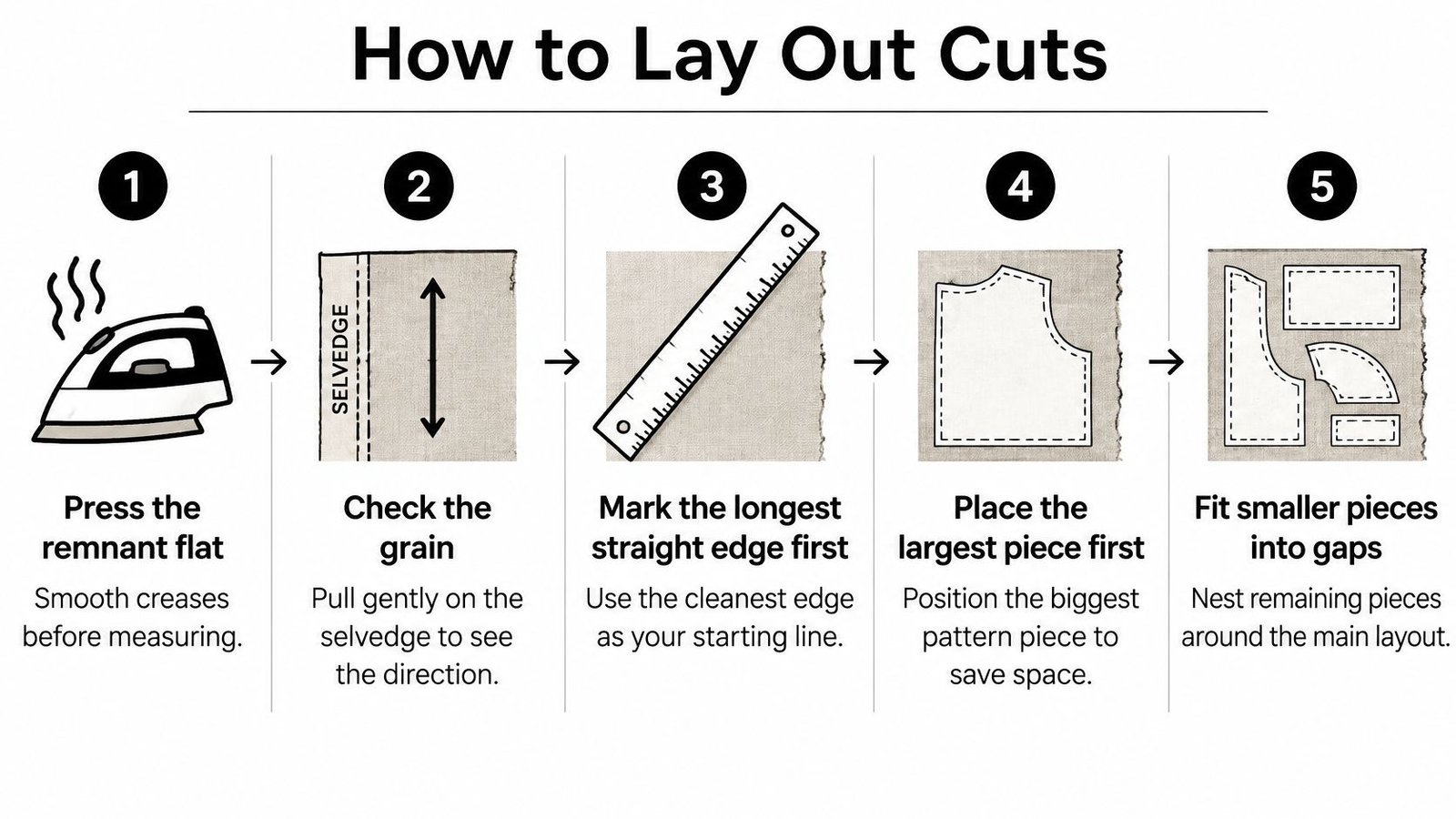
- Press the remnant flat. Creases hide the true size. Then check the grain by pulling gently along the selvedge. The direction that stays stable is your grain.
- Mark the longest straight edge first. Place the largest pattern piece on the grain against that edge. A skewed first piece wastes every gap around it.
- Nest the smaller pieces around the largest. Rotate them only where the pattern allows a turned layout, such as a plain pouch panel with no nap.
- Cut bindings and ties from the leftover edges before you cut the main shapes. Those long strips disappear if you slice them into odd offcuts.
- Photograph the layout before the scissors come out. A picture catches a piece placed on the cross grain while you can still move it.
- Cut straight edges with a rotary cutter and mat, and curves with shears. The cutter stays accurate on a short remnant where shears tend to wander.
Say the remnant is 35cm by 60cm and you need four pouch panels of 10cm by 15cm. Place three panels with the 15cm side along the 60cm edge. Turn the fourth 90 degrees into the remaining strip. All four fit, with a narrow offcut for a tie.
The slip that ruins a woven piece is cutting across the grain. After washing, the panel pulls out of shape and the seam won't lie flat. A good layout leaves only small offcuts, ready to drop into the size bands you already use for storage.
Choosing the Right Route for Each Offcut
Use this order and don't skip ahead: repair, then reuse, then recycle or dispose.
A repair keeps a garment you already wear. A small patch of matching denim on a jeans knee, a reinforced pocket corner in lightweight cotton, or a replaced cuff cut from a matching woven and backed with interfacing, all do that job. The remnant should match weight and stretch, not just colour.
Repairs fail in predictable ways. A pretty contrasting patch on a high-stress seam splits because the patch and the garment move differently. A synthetic scrap with more stretch than the cloth around it puckers, then tears at the stitching. If the patch will take strain, add interfacing and sew it by hand or with a short stitch, rather than a single line of long machine stitches.
When reuse and disposal are the honest options
A clean 100% cotton offcut around 25cm still has a project in it: a bag, a cloth, a test square. A coated elastane scrap does not. Direct reuse keeps the cloth doing what it was woven to do. Mixed, coated, or elasticated scraps are a poor match for fibre-to-fibre recycling.
Collection is uneven. A 2025 Scottish consultation analysis reported that no local authority then accepted textiles through household kerbside recycling. Don't put loose fabric in the household recycling bin. Use a textile bank, a charity shop, or a local scheme, and check that scheme's rules before you take very small offcuts. Clean and dry cloth travels better. Remove zips and buttons if the scheme asks.
If the piece could serve a project in the next year, keep it. If it couldn't, send it on a named route rather than into the general bin by habit.
Start Your First Remnant Project Today
Buy one cotton remnant and make the patchwork cushion. A few 10cm squares are all the front needs, so a single piece can supply the whole panel. Our Cotton Fabric Footballs remnant is 100% cotton, 85cm by 110cm, suited to crafting and patchwork, and priced at £7.00. A stretch option such as the Palm Digital Print Jersey, 145cm Wide remnant at £11.00 is the wrong cloth for a square cushion front, because the squares will distort.
Before you check out, confirm the width, the fibre, and that the cloth doesn't stretch. After you cut, sort the offcuts into size bands, label each card with fibre, colour, and dimensions, and keep them in one clear box.
Choose that cushion, or one other project from the list above, and buy the matching remnant this week.
More Sewing is a UK fabric shop with a Sale and Remnants section, dressmaking cloth, haberdashery, and kits for makers who want a clear starting point. If you're ready to match a small project to a real offcut, browse the remnant lengths and cottons at More Sewing.
