
A fabric swatch is a small physical sample used to judge real colour, handle, weight and drape before committing to metreage, a practical approach British textile buyers have used for at least 250 years.
You're choosing cloth for a dress, and the photograph looks promising. Before you buy the zip, clear the cutting table and commit to the fabric, a sample lets you check whether that promising picture matches the garment you want to wear.
What a Fabric Swatch Is
The cotton that looked soft mint on your phone might look khaki under the kitchen light. A viscose that feels wonderfully fluid in the parcel might hang like a sack when you wanted a skirt with shape. A sample helps you spot those mismatches before you cut.
A fabric swatch is a representative piece of textile used to inspect its colour, pattern, fibre appearance, weave, surface texture and finish before buying or cutting a larger length.
It might arrive as a labelled square, hang from a supplier's card or sit on a page in a sample book. It's like trying a paint tester on your actual wall rather than trusting the colour on the tin lid. You're checking the material in the setting where you'll use it.
A sample is a working record
The Metropolitan Museum of Art's British textile sample book, made in Manchester by Benjamin and John Bower in 1771, records fustian samples combining wool, silk, linen and cotton, evidence of British sample use extending back at least 250 years. Its catalogue also records thread-count information, showing that buyers could compare construction as well as appearance.
That's the useful answer to what is a fabric swatch: evidence about a particular cloth, not just a pretty scrap. For a home dressmaker, the sample stands in for the roll while you decide whether the material suits your pattern.
The same practical thinking applies beyond clothing. Vinson Fine Furniture's guidance on sit-testing swatches in the showroom offers an upholstery comparison: assess cloth in relation to its intended use, not just its appearance.
This visual brings those decisions together.
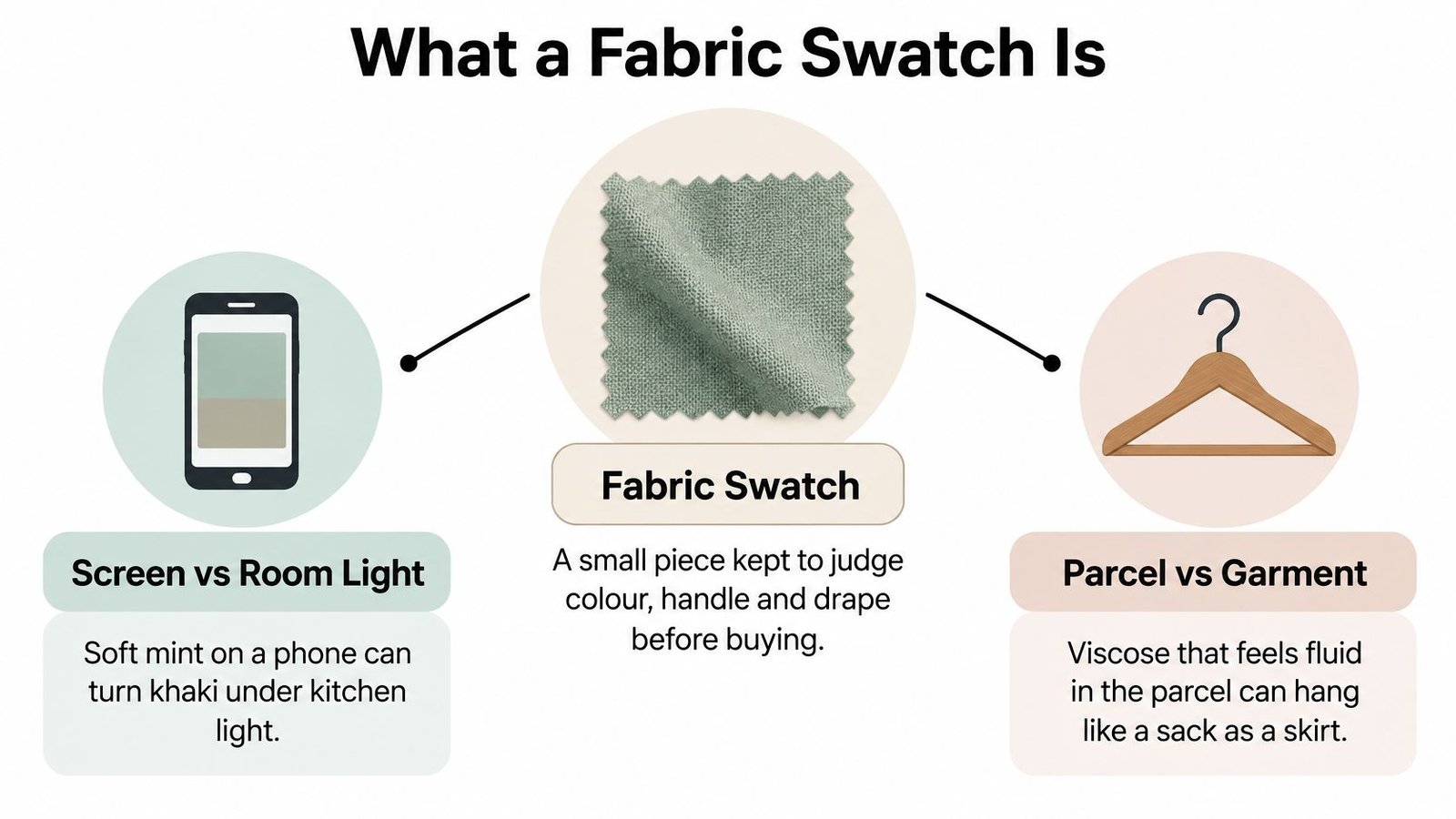
A swatch isn't necessarily a free scrap large enough to make a pocket, and it isn't proof that every part of the roll matches. Its first job is to support colour, texture, weight and drape checks.
How to Judge Colour Texture Weight and Drape
What to check on a fabric swatch
| Check | How to do it | A good sign | A warning sign |
|---|---|---|---|
| Colour | Compare in daylight and indoor light beside thread, lining and trims; view face and reverse | Matches the palette in both lights | Shifts under the lamp, or pile direction changes the shade |
| Texture | Rub, pinch and look for nap, slub, sheen or rib | Handle suits the garment and both sides are as expected | Scratchy face, unexpected coating, or a nap you cannot match at seams |
| Weight | Note GSM if given, or compare with lawn, shirting and denim you already own | Feels right for the pattern's suggested weight | Too floppy for structure, or too heavy for the drape the pattern needs |
| Drape | Hold the top edge and watch the folds | Soft folds for fluid styles, or cloth that holds shape for tailored ones | Pools, sticks out, or refuses the silhouette |
| Opacity | Hold to a window, and over the underlayer if sheer | Coverage matches the design | Shows underwear or lining colour you didn't plan for |
| Stretch | Pull along the grain and across it; note recovery | Stretch and recovery match the pattern, greatest give where needed | Bags and doesn't spring back, or stretches the wrong way |
Start with colour and touch
Lay the swatch beside the thread, zip, lining and any garment it must match. Look in daylight, then under the lamp you dress by. Fold opaque cloth over itself so light doesn't shine through, and inspect both the face and reverse.
With velvet, corduroy or towelling, stroke the pile in opposite directions and turn the piece around. A change of shade tells you to pay attention to nap direction when planning the cutting layout.
Fabric colours on screen may differ slightly from the original because monitor settings vary. If you're unsure about a shade, contact us before purchasing rather than trying to correct your monitor by guesswork.
For texture, rub both surfaces with your fingertips, then pinch a fold. Notice whether a slub feels pleasantly irregular, a sateen surface feels smooth, or cord ribs feel too bulky for the gathers you're planning. Hold the reverse against your wrist if it will touch bare skin.
Separate weight from movement
Record GSM, meaning grams per square metre, when it's supplied. Without it, compare the piece with familiar cotton lawn, shirting and denim from your stash, using similarly sized pieces where possible.
Weight alone won't tell you how fabric hangs. Hold the top edge loosely and let the rest fall: fluid viscose or silk may form soft folds, while crisp cotton or coating may stand away from your hand.
For another material comparison, Willis Furniture & Mattress discusses breathable linen or easy-care polyester. Use fibre descriptions as a starting point, then let the actual sample settle questions about feel and movement.
Check opacity against a window and over the intended underlayer. For jersey, pull gently lengthways and across the width, release it, and watch whether it returns to shape without a lingering ripple.
These checks help you decide whether the cloth suits the design. They don't establish how it will survive washing.
How to Test a Swatch Before You Buy
Keep an untouched piece as your reference and use a spare for washing. If the sample is too small to divide or mark accurately, request a larger cutting rather than pretending a tiny fraying corner gives a reliable measurement.
Make a record before washing
Label the sample. Write the fabric name, supplier reference, colour and date on a card. Add the width and fibre content, especially for deadstock that may be difficult to identify later.
Copy the composition accurately. The UK textile-labelling guidance requires constituent fibres to be identified using permitted names, with percentages by weight in descending order. Keep that description beside the sample, but don't assume touch alone can confirm a blend.
Record the specification. Note GSM if available, care symbols and the direction of greatest stretch. Sketch an arrow on the card so you can recognise the lengthwise direction after washing.
Mark a measured area. Use a ruler and test a fine tailor's-chalk mark on an edge first. The dimensional-change criteria describe formal testing involving three washes; a practical home adaptation is a 10 cm by 10 cm marked square, measured before and after the intended care routine.
Make the marks inside the edges rather than measuring from a fraying cut. If chalk won't survive washing, use small contrasting thread marks that don't pull the cloth tight.
Compare the dry results
Wash and dry as intended. Follow a care method suitable for the fabric and realistic for the garment. Don't tumble-dry a test piece if you plan to dry the finished dress on an airer.
Measure each direction separately. Lay the dry sample flat without stretching it. Calculate percentage change as (original measurement − final measurement) ÷ original measurement × 100.
For a hypothetical marked side measuring 10 cm before washing and 9.5 cm afterwards, the calculation is (10 − 9.5) ÷ 10 × 100 = 5% shrinkage. Calculate the crosswise result separately rather than assuming both directions changed equally.
Reassess the cloth. Hang the washed and untouched pieces beside each other. Compare softness, surface finish, colour, drape and stretch recovery, not just the ruler readings.
Make a buying decision. Choose whether to pre-wash the metreage, reconsider the pattern or reject the cloth. Establish dimensions after pre-washing before making deliberate hem or sleeve adjustments; adding extra length won't correct distortion.
The visual below is a useful reminder of the preparation and comparison process.
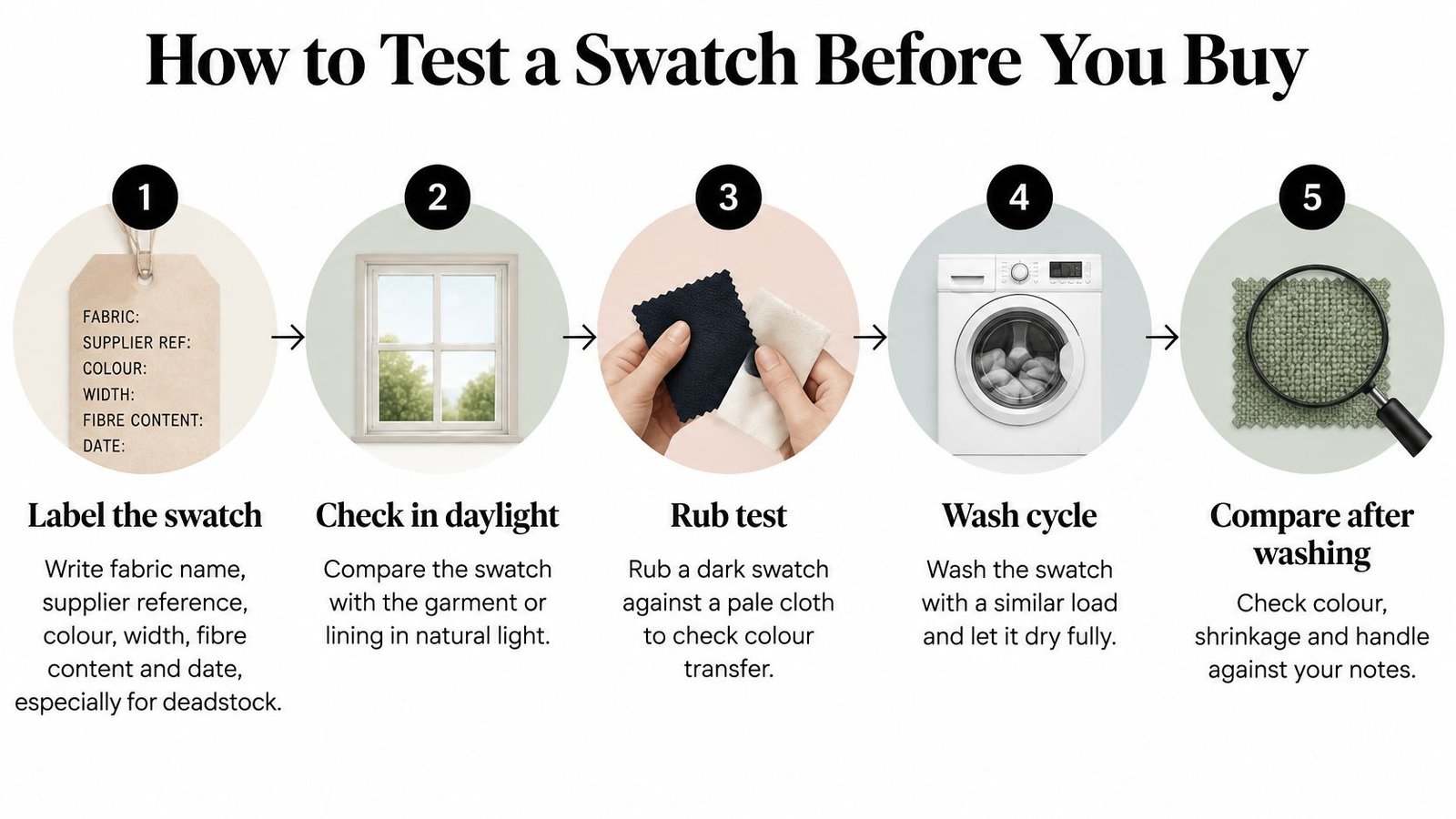
For checks, stripes and carefully placed hems, dimensional change matters before the scissors come out. A home wash gives you a practical warning, not a laboratory result.
Colour Fastness Checks on a Spare Piece
Colour fastness means how well colour resists changing or transferring under particular conditions. That matters for children's clothes, frequently washed shirts, pale linings and any garment combining dark and light fabrics.
The rubbing check is simple to set up with spare white cotton.
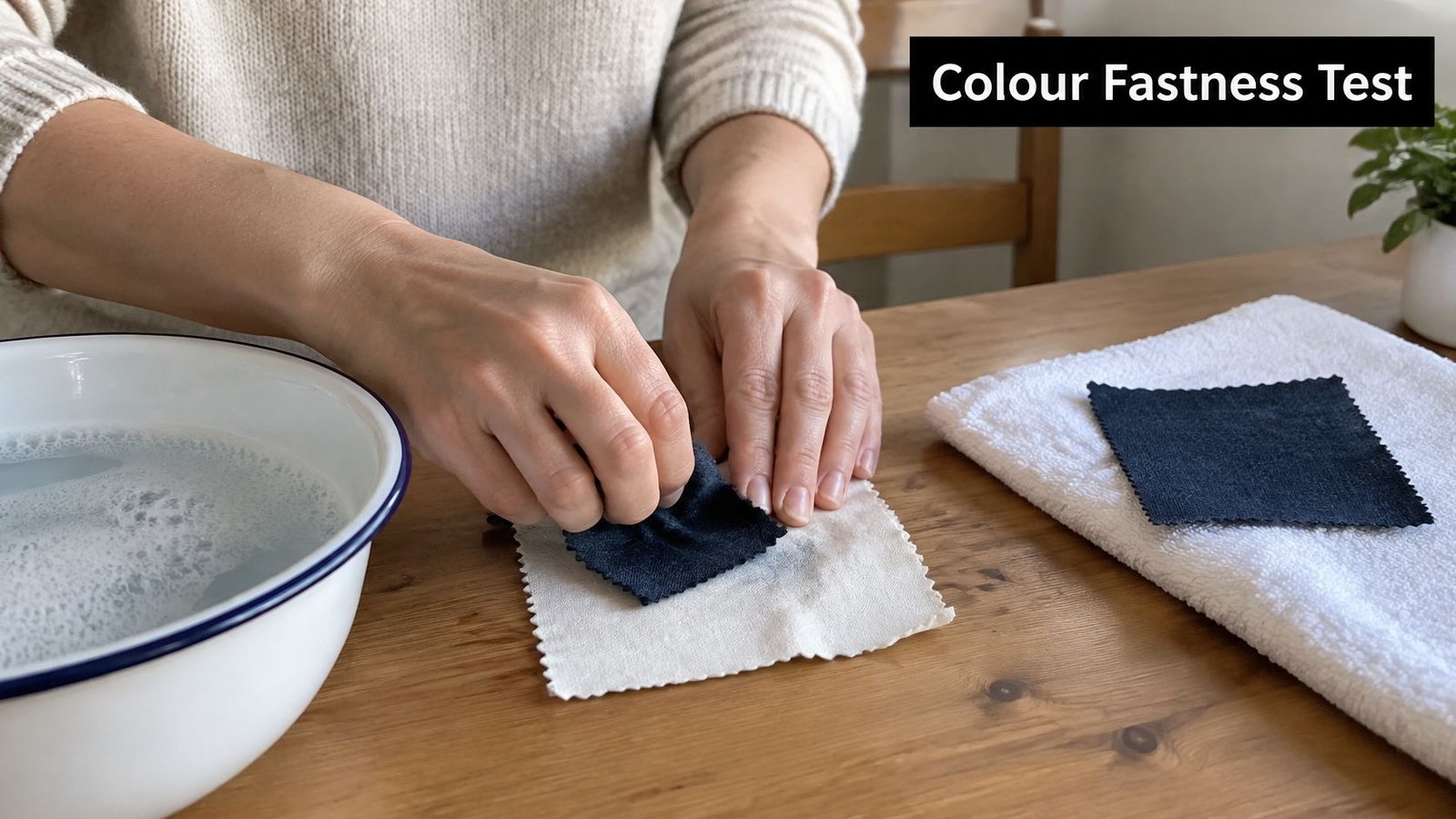
Wash against white cotton first
Place a duplicate sample against a clean piece of white cotton and wash them using the detergent and care method planned for the garment. Keep an unwashed sample away from the load so you have a genuine control.
Dry the washed pieces fully, then compare them in daylight. Look separately for fading on the sample and staining on the white cloth. A fabric can retain a strong colour while still transferring dye to neighbouring material.
If you're planning a navy dress with cream binding, test those actual fabrics together as well. White cotton is a useful warning surface, but the intended binding or lining is the combination you need to assess.
Practical rule: A home colour-fastness check is a sewing-room screen, not a certificate.
Follow with a dry and damp rub
For dark denim, vivid red, navy or printed viscose, rub the dry sample against fresh white cotton. Repeat on a clean area with the sample slightly damp, not dripping, and inspect for transferred colour.
Record what you did rather than writing passed. Useful notes include:
- Wash conditions: Detergent, programme and temperature.
- Drying method: Air-dried flat, hung or tumble-dried.
- Visible result: Fading, staining, surface change or no obvious transfer.
- Next action: Retest after pre-washing, change the contrast fabric or reject the colourway.
A pink halo on the cotton is enough to pause before attaching pale pocket bags. Pre-washing may help, but retest rather than assuming the problem has disappeared; adding a lining won't stop dye reaching adjacent cloth.
This video provides another visual reference for the technique.
The UK ecological textile criteria distinguish tests for light, laundering, water, perspiration, dry cleaning and rubbing, and specify at least grey-scale level 3–4 for colour change and staining in the cited washing test. Your kitchen-table rub cannot assign that grade or establish performance under all those conditions.
What a Small Swatch Cannot Prove
A swatch reduces uncertainty, but it doesn't remove buying risk. A successful small-piece check isn't a promise that the finished garment will fit, hang beautifully or resist every kind of wear.
What a swatch can and cannot prove
| Question | A swatch can show | A swatch cannot guarantee |
|---|---|---|
| Colour | Shift between daylight and indoor light, face and reverse, nap direction | That every metre on the roll matches the sample |
| Pattern | Scale only if the piece shows a full repeat | Placement of a large print, border or one-way design on a whole garment |
| Handle and drape | Fold, weight in the hand, short hang | How viscose pools at a seat or hem after hours of wear |
| Stretch | Direction of greatest give and immediate recovery | Bagging after a day of sitting |
| Care | Shrinkage and dye transfer from a home wash on a marked square | Laboratory fastness grades or shrinkage after many washes |
| Buying risk | A reason to order, pre-wash or reject | A refund of sewing time if the full cut behaves differently |
Match the sample to the question
A tiny floral cutting can hide a large repeat, while a plain-looking corner might miss a border entirely. Ask for a piece showing a complete repeat and enough surface to judge nap or directional sheen. When the length arrives, inspect the full cut before washing or cutting.
A short hanging sample also leaves out the weight of the garment below it. Viscose and some Tencel blends may pool or grow around a seat or hem even when a dry sample falls neatly from your hand.
For a rough comfort check, safety-pin the sample inside an existing skirt or pair of trousers and sit down, keeping the pin clear of your skin. This can reveal an irritating surface, but it cannot simulate the strain or drape of a complete garment.
The distinction between a sample and a finished item is worth keeping visible.
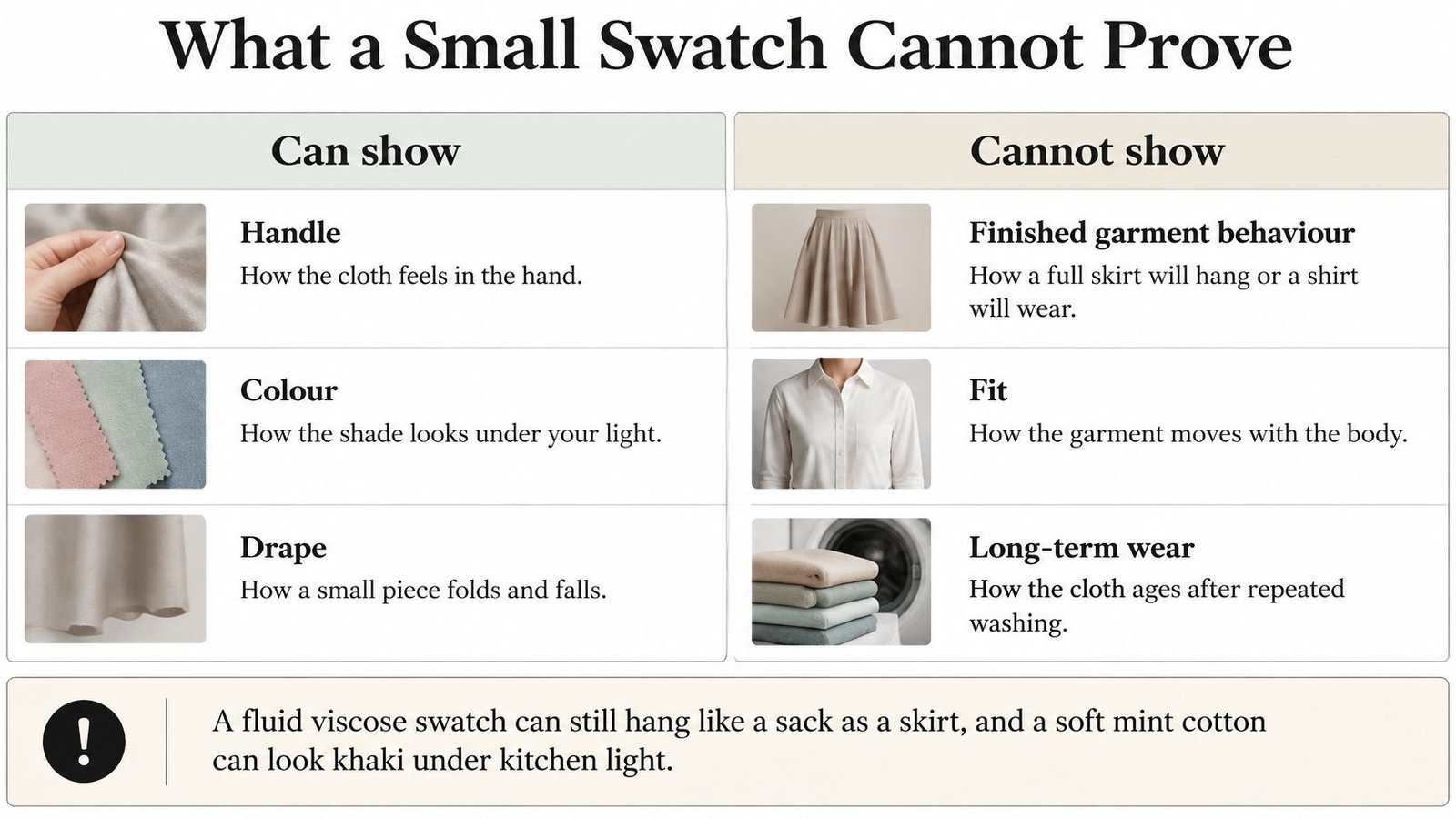
Keep the conclusion proportionate
Uneven shrinkage across a full cut may escape a small marked area. Likewise, dye-lot or finish differences mean the sample cannot guarantee uniformity throughout the delivered length.
The statutory textile sampling method describes representative sampling for fibre-composition analysis. That formal process is different from washing a consumer cutting at home.
For deadstock, keep the labelled washed sample even if you assume the cloth won't be available again. Order metreage when colour, handle, drape and care results suit the pattern; walk away when a requirement fails.
How to Keep Swatches Useful
Keep tested pieces as a mini sample book, not an anonymous bundle of scraps. The combination of cloth and written observations is useful when you want to repeat a successful garment or avoid buying something you've already rejected.
Copy this onto a swatch card
- Fabric identity: Name, supplier reference and colour name or code.
- Composition: Fibre names and percentages as supplied.
- Dimensions and weight: Fabric width and GSM, where available.
- Purchase record: Supplier and date.
- Care method: Washing and drying routine used for the test.
- Test outcome: Lengthwise and crosswise shrinkage, colour transfer and changes in handle.
- Project decision: Suitable pattern, intended lining and reason for accepting or rejecting it.
Punch the card rather than the cloth, then attach washed and unwashed pieces side by side with enough freedom to lift and feel them. A ring binder works well, but a labelled biscuit tin is perfectly serviceable.
Safety-pin a spare to the pattern envelope so your next version begins with a known material. When a worn patch needs repairing, take the sample to compare replacement cloth or thread, remembering that the garment itself may have faded.
Build a reference you'll actually use
British sample books are the larger-scale version of this habit: the V&A's textile collections include British swatch books from around 1960–1970 containing 10 samples each, and a 1930s Morton Sundour book with 26 British chintz patterns. Such collections preserve material and process choices, not just attractive colours.
Photograph your card and sample together, then add a searchable note to your phone album. Include a rejection reason such as too scratchy for an unlined bodice, so you don't order another sample of the same unsuitable cloth.
Keep the piece that tells you something, including the failed test.
A 2024 WRAP market report, covered by Sourcing Journal, estimated that about 711,000 tonnes of used textiles entered UK household bins and general-waste containers in 2021, equivalent to 49% of used textiles. That isn't a swatch-waste estimate, but it provides context for keeping useful textile references rather than discarding them automatically.
For unwanted scraps, check local council guidance. Tiny pieces, coated cloth and mixed fibres may not suit a particular collection scheme, so don't assume every textile bank accepts them.
Request a Sample Before You Commit
Start with the fabric types named on your sewing pattern. A design drafted for stable woven cloth won't automatically work in stretchy jersey, and a softly gathered style needs more than the right colour to look convincing.
Choose your likely cloth, request or cut a representative sample, and decide what would make it unsuitable. For a summer blouse, that might be transparency or a rough reverse; for trousers, it might be poor recovery or a weight that can't support the intended shape.
Choose the cloth before calculating the order
At More Sewing, our range includes calico, chambray, coatings and wool, corduroy, cotton, cotton lawn, crepe, deadstock, denim, jersey, plain jersey, linen and linen mix, linings, polyester, silk and silk blend, and viscose and Tencel. Some fabrics are ex-designer deadstock, so keep the reference attached to any sample you're considering.
Once you've approved the cloth, work out the pattern quantity using its actual width, your size and any directional layout. Allow for print matching or nap where the design requires it rather than relying on the smallest quantity printed on the envelope.
Our fabric is sold by the half metre, and multiple orders of the same fabric are sent as one continuous length. Make the cloth decision first, then calculate how many half metres your project needs.
Set a clear buying rule
Before paying, make a short decision note:
- Order: The sample supports the silhouette, feels comfortable and behaves acceptably under the intended care method.
- Pause: The colour remains uncertain, the repeat isn't visible or the sample is too small to answer an important question.
- Reject: The cloth fails a requirement you can't sensibly change without redesigning the garment.
If a shade is still doubtful, contact us before purchasing. Describe what it needs to match, such as a cream lining or an existing jacket, rather than relying on colour names alone.
Don't talk yourself into unsuitable metreage because you love the print. A sample costs less than committing fabric, notions and sewing time to a garment you won't wear.
More Sewing offers fabric sample swatches so you can handle the cloth and make your own labelled checks before choosing a length. Visit More Sewing to find a fabric for your pattern, request a sample and settle the colour, feel and care questions before ordering.
