
Approximately 50,000 tonnes of children's clothing are sent to landfill in the UK each year, according to WRAP, as reported by The Observer. Choosing fabric for children's clothes is therefore about more than finding a lovely print. The useful choice is cloth that a child can comfortably wear, you can reliably wash, and someone can repair or pass on.
Why Fabric Choice Matters More Than Style
At the fabric counter, a parent might hold a soft jersey beside a crisp cotton print for school trousers. Before choosing the colour, ask four practical questions: is it safe for the garment, comfortable for this child, tough enough for the activity, and washable using the household's normal routine?
A rough-finished cotton can irritate more than a smooth polyester blend. Equally, a lightweight jersey with an appealing environmental label may be a poor choice for a child who spends playtime kneeling on concrete. Fibre content is a starting point, not a verdict.
Bring the child into the choice where possible, especially when texture is a concern.
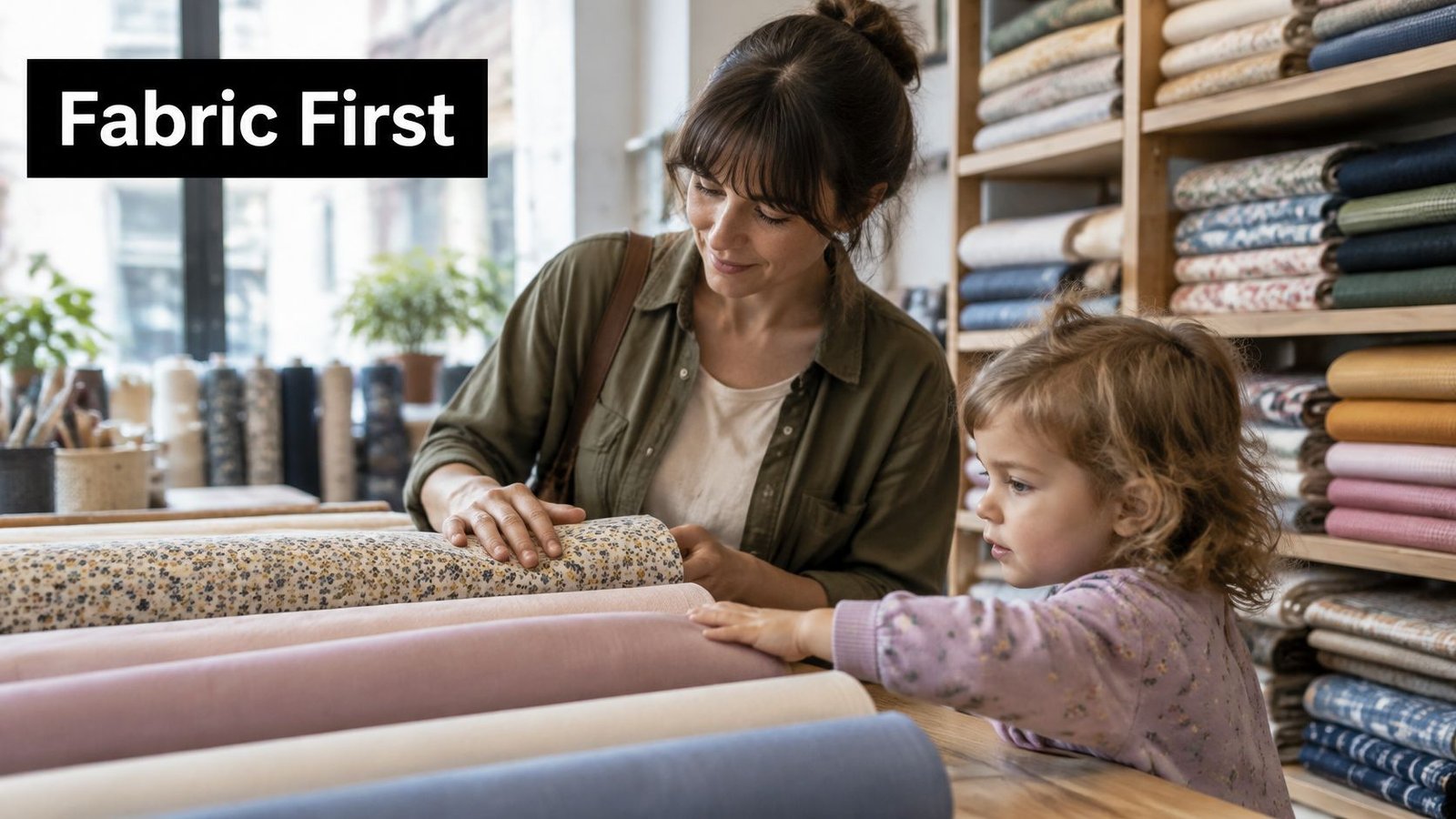
Match the cloth to the risk
Fabric behaviour and garment shape matter together. A parliamentary debate on flame-resistant nightwear recorded approximately 80–90 deaths among children under 15 in England and Wales during 1958 from burns caused by clothing in the home, and identified loose, full-skirted garments as presenting greater risk than close-fitting clothing.
That history doesn't make ordinary fabric automatically unsuitable. It does mean loose shapes and nightwear need deliberate safety checks, while hood and neckline cords create a separate catching hazard.
Use the fabric comparison, skin test and high-wear checks to narrow your options. Then assess laundering and fit before committing to the full length.
The buying filter: After a school term of wear and washing, would this garment still be safe, comfortable and intact?
Fabric Options Compared for Children's Wear
Children's fabrics compared by comfort, durability, care and best use
| Fabric | Comfort on skin | Durability | Care | Best use |
|---|---|---|---|---|
| Cotton lawn | Light, soft, breathable | Moderate; tears under heavy wear | Machine wash at 30°C, medium iron where permitted | Summer dresses, blouses |
| Cotton jersey | Stretchy and soft; can feel fluffy when new | Good recovery in suitable constructions; can pill | Wash inside out at 30°C, dry flat | Tops, leggings, pyjamas subject to nightwear checks |
| Denim | Stiff initially; softens with washing | Very high abrasion resistance in substantial cloth | Cold wash; expect fading | Trousers, jackets, shorts |
| Sweatshirt fleece | Warm and soft; some cheaper polyester-rich surfaces irritate | Good; friction can cause pilling | Wash at 30°C; low-heat dryer only if permitted | Warm layers, hoodies, casual coats |
| Wool knit | Warm; can itch sensitive skin | Good in a sound knit; hot washing can felt it | Hand wash or wool cycle; reshape flat | Winter knits, jumpers |
| Linen | Cool and breathable; softens after washing | Strong woven options; creases readily | Warm wash if permitted; iron damp | Summer shorts, light tops |
| Viscose | Smooth with fluid drape | Lower abrasion tolerance; needs care when wet | Gentle wash if washable; dry flat | Dresses, linings |
| Polyester blend | Smooth options available; can feel warm or clammy | Generally durable and quick-drying | Cool wash; check drying instructions | School wear, sportswear |
Treat these care routines as starting recommendations, not universal permissions. The supplier's instructions for the actual cloth take priority, particularly for coated, printed, blended or dry-clean-only materials.
The comfort column describes the surface against skin. Durability concerns rubbing, tearing and recovery after stretching, rather than whether the fabric feels thick. Care includes the drying method because a fabric that needs careful reshaping may not suit a busy school-week laundry routine.
Choose by garment, not by favourite fibre
For a playground-active child, I'd shortlist jersey for tops and substantial denim for trousers. Jersey allows movement through its stretch; denim supplies resistance where knees scrape and seats rub. Heavy denim can feel restrictive, though, so check whether the child can squat comfortably in a test garment.
Cotton lawn suits a gathered summer dress because it's light without behaving like a stretchy knit. It isn't a substitute for trouser-weight woven cotton. Viscose gives a fuller skirt attractive movement, but a slippery length requires more careful cutting and handling than stable lawn.
For wool, examine the actual surface rather than trusting a luxurious description. For fleece, stroke against the pile and rub the reverse, because the inside is what the child wears.
Occasion clothing needs a different balance again. If you're comparing making with buying for a group performance, ChoirBuy's children's choir robe cost guide offers useful budgeting context alongside your fabric and construction decisions.
Shortlist a small selection, then test it. A fibre name alone can't tell you whether a particular bolt suits your child.
Comfort Tests for Sensitive Skin and School Uniforms
Textiles, garment design and construction are distinct contributors to discomfort for children with sensory overreactivity, identified in a qualitative study of school-uniform experiences. Changing cotton for another fibre won't solve a hard waistband, an abrasive label or a seam positioned directly under a backpack strap.
Stain-resistant, non-iron and easy-care finishes can trouble sensitive skin. School jumper surfaces also deserve attention: a fluffy new surface may feel tickly, while repeated washing can leave another knit feeling rough. Test the cloth after laundering, not just fresh from the bolt.
A repeatable home comfort test
- Wash and dry the swatch using the intended garment-care routine.
- Try gentle forearm contact. As a practical trial, lightly rub it against the inner forearm for two minutes, stopping immediately if it feels unpleasant.
- Extend contact cautiously. If comfortable, try a loose test piece for half a day and note redness, scratching or persistent fidgeting.
- Test construction separately. Sew a sample seam and waistband so you aren't assessing only the smooth centre of the cloth.
This isn't a medical allergy test. Don't rub fabric over broken or inflamed skin, and don't continue a trial after a reaction. For eczema, exclude fabrics and finishes that have already caused problems; seek clinical advice for persistent or unexplained symptoms.
Change the part that causes discomfort
Flat seams reduce a raised ridge, but only if the stitching itself feels soft. On suitable garments, move seam allowances away from the skin or cover them with lightweight binding.
- Labels: Unpick scratchy labels cleanly rather than leaving sharp cut corners; retain care details separately.
- Waistbands: Enclose elastic fully and check that the casing doesn't twist.
- Warm layers: Trial a smooth cotton lining inside wool or fleece, allowing enough room that the lining doesn't pull.
Comfort check: Ask where the garment bothers the child before replacing the whole fabric.
For school uniform, families can request reasonable adjustments. UK government guidance says schools should allow individual variations where necessary to avoid indirect discrimination. Describe the specific problem and propose a workable alternative, such as a softer shirt or a different jumper worn in the school colour.
Durability for Play, School and Hand-Me-Downs
British respondents discard nearly 17 children's clothing items per year, compared with nine among French respondents, according to a BirminghamWorld report citing research across seven European countries. The useful buying question is which cloth will survive school, play, laundering, growth and repair.
Use this checklist when inspecting a garment before finishing it.
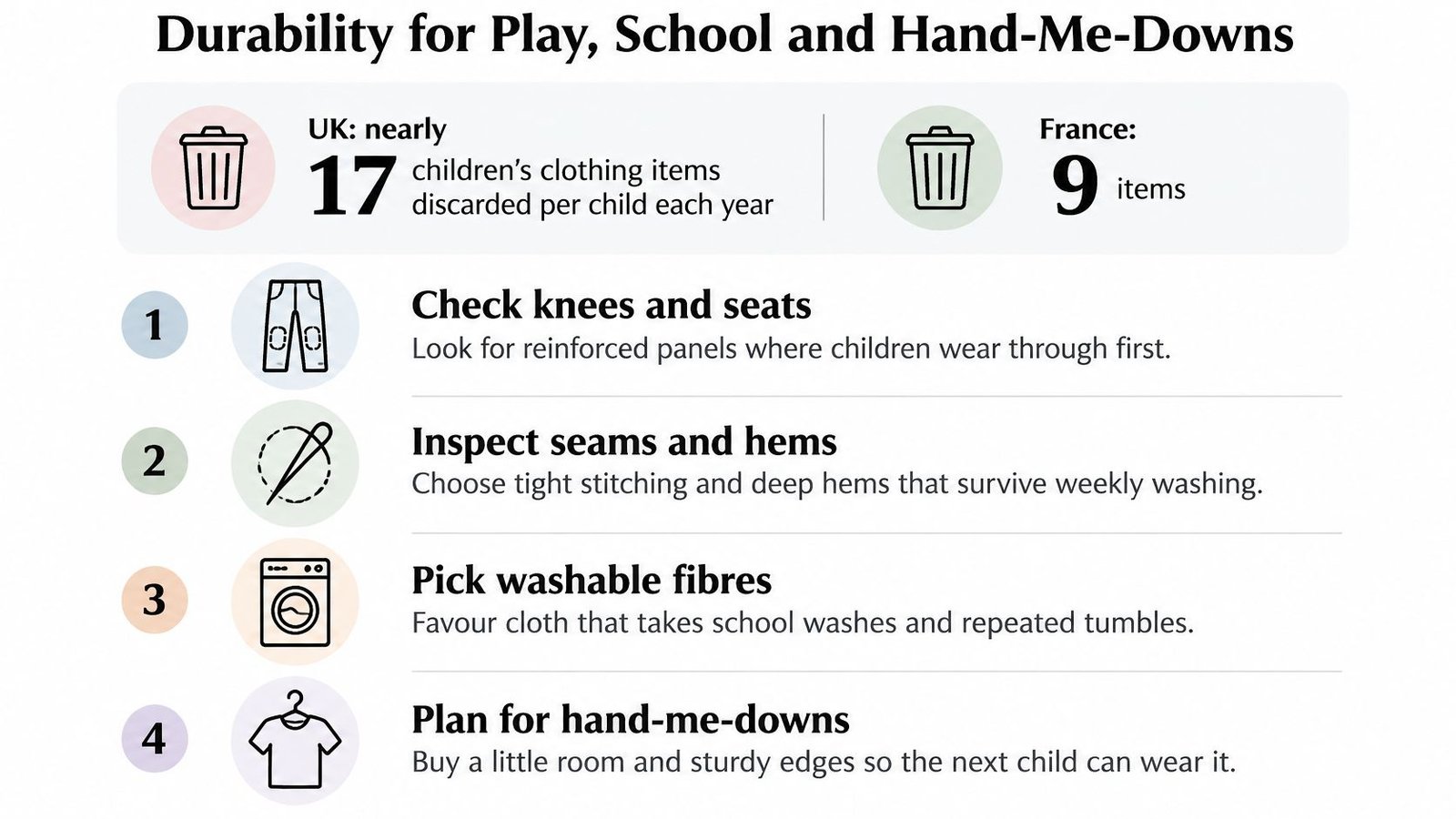
Put strength where the child needs it
Fabric choice by high-wear garment zone
| Garment area | Best fabric | Why it lasts |
|---|---|---|
| Knees | Denim or woven cotton twill | Resists abrasion from kneeling and crawling |
| Elbows and seat | Tough woven cotton or ripstop | Withstands friction on chairs and climbing frames |
| Cuffs and hems | Cotton rib jersey | Suitable rib recovers after repeated stretching |
| Shoulders and hood | Reinforced seams on woven fabric or fleece | Reinforcement supports strain from backpacks and play |
| Full garment for handing down | Woven cotton or denim | Well-chosen cloth retains a usable shape through repeated wear |
Rib suits stretch cuffs and knitted hem bands, not every trouser hem. Likewise, a woven knee patch on stretch leggings can restrict movement. Shape the patch generously and test the child's bend before sewing it permanently.
Make repairs accessible
Leave generous hems that can be released, and avoid trimming every internal allowance down to the minimum. Fit adjustable waistbands with enclosed buttonhole elastic rather than dangling ties.
Attach replaceable knee panels while the trouser leg is still flat. Use an appropriate jeans needle for substantial denim and test topstitching on layered scraps. Double stitching won't rescue fabric that's already too weak, but sound stitching helps a suitable panel stay attached.
A heavier cotton twill with reinforced knees may serve successive siblings better than lightweight jersey chosen solely for its environmental marketing. That's a wear-life judgement, not a quantified environmental comparison. Deadstock is useful when the cloth itself suits the job, not because it's surplus.
For occasional garments intended to be kept or shared, the Baptism Robes kids' clothing guide provides occasion-specific context. Keep alterations accessible and avoid personalisation that makes reuse unnecessarily difficult.
Allow reversible garments enough movement through both layers; hidden seams aren't helpful if the finished piece feels stiff. Use the following video as a supplementary sewing resource while planning your project.
Nightwear and Cord Safety Rules to Check
The Nightwear (Safety) Regulations 1985 require applicable children's nightwear to meet BS 5722 flammability performance, including after laundering, as explained in Liverpool Trading Standards' nightwear guidance. Its listed exceptions include garments for babies up to three months with a chest measurement of 53 cm or less, pyjamas and cotton terry-towelling bathrobes, but relevant safety labelling still applies; where flame-retardant treatment is used, the label must state not to wash above 50°C.
An exception from a performance requirement isn't an assurance that cloth won't burn. Don't assume ordinary cotton complies, and don't borrow sleepwear advice written for another country.
Choose evidence, not a fibre slogan
For home-sewn nightwear, select fabric specifically sold or tested for that purpose and retain its documentation. Ask what the evidence covers, including laundering and whether it applies to the finished construction.
Pre-washing can reveal dimensional changes, but a home wash isn't a flammability test. Don't test fabric with a match. Keep loose ribbons and unsecured appliqué out of the design, and don't assume a compliant main fabric makes every added trim acceptable.
Remove catching hazards
BS EN 14682 covers children's clothing up to age 14, with younger-child restrictions on hood, neck and upper-chest cords; the requirements associated with the BSI children's clothing cord standard prohibit functional cords in those areas for young children and decorative cords on hoods or at the back of the neck. Where permitted decorative cords occur elsewhere in the neck or upper-chest area, free ends must not exceed 7.5 cm, with no knots, toggles or three-dimensional embellishments, and mustn't tie across the throat.
The simplest home-sewing choice is usually to omit these cords.
- Shape the hood: Adjust the pattern rather than adding a drawstring.
- Enclose elastic: Secure it inside a stitched casing without accessible loops.
- Use suitable fasteners: Fit child-safe snaps securely where the design needs closure.
Inspect the finished garment for loops that could catch on furniture or playground equipment. Homemade nightwear intended for sale must be assessed against applicable requirements, including labelling, rather than relying on a general fabric description.
Pre-Washing and Care Before You Cut
Test laundering before cutting the garment pieces. Use this simple shrinkage check:
- Prepare a measured sample. Following the example in Euverify's textile-safety guidance, a 50 cm sample that measures 48 cm after washing has shrunk by 4%; the same guidance reports a 75 mg/kg formaldehyde limit under the cited restrictions for relevant skin-contact textiles.
- Wash and dry it using the method intended for the completed garment.
- Measure again once the sample is fully dry and relaxed, checking both length and width.
Mark your measurement points with contrasting tacking thread before washing. This is more reliable than measuring a frayed edge, and it helps you spot unequal shrinkage across the cloth.
Read the result before changing the pattern
If the sample shrinks substantially, pre-wash the full length and cut from the stabilised fabric. Don't automatically cut a larger pattern size: that can enlarge the neckline and shoulders while still failing to provide the required length.
As a hypothetical example, a cotton lawn dress washed at 30°C might show 2% shrinkage, while another lawn shows 4%. Neither result translates automatically into going up a size. Recheck the pre-washed fabric, available yardage and finished measurements instead.
Pre-washing also removes some manufacturing finishes and reveals colour bleeding, distortion and pilling. It doesn't prove that every chemical residue has disappeared or that a fabric is suitable for a particular child.
A fibre label describes composition. It doesn't certify every dye, finish, lining or fastening.
Finish the surfaces that touch skin
Use enclosed seams where the fabric weight allows them. French seams work well in lightweight woven cloth, but become bulky in thick denim; a neatly bound allowance may be more suitable there.
Apply lightweight binding to an uncomfortable neckline or cuff without pulling it tight. Remove scratchy labels cleanly, and retain their useful care information somewhere accessible.
Before cutting, check wash result, shrinkage, colour transfer, seam finish and labels. Recognised chemical-safety certification can support your decision, but inspect the actual scope rather than treating a logo as a guarantee of comfort.
How to Measure and Allow for Growth
Age labels are approximate fitting aids, not reliable cutting measurements. Warwickshire Trading Standards' cord-safety guidance identifies the younger-child category as under seven years or under 134 cm. A tall six-year-old may therefore need a larger pattern for fit while still needing the younger-child safety treatment.
Use this measuring sequence before choosing the cutting line.
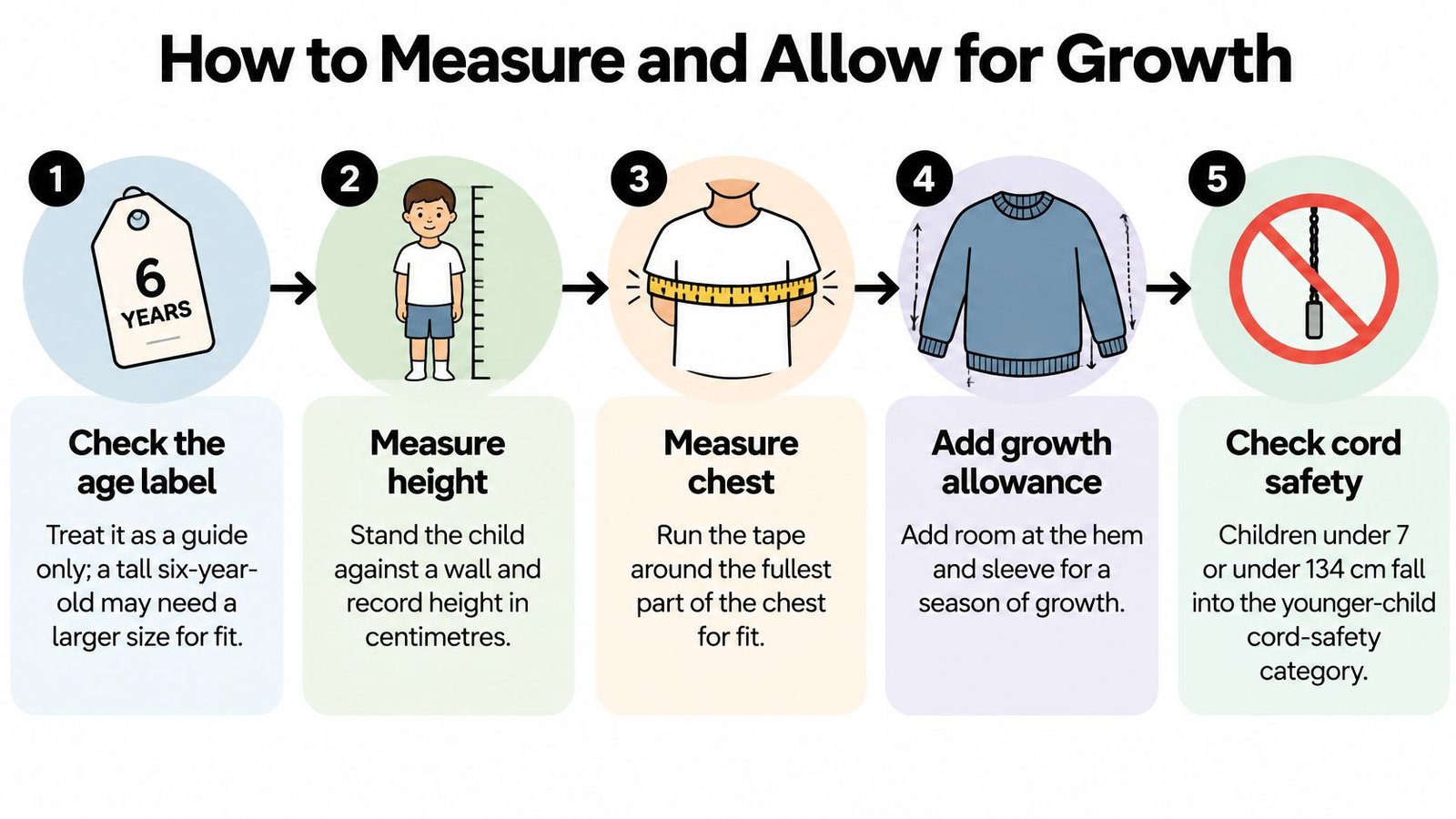
Fit the body before adding growth room
- Record body measurements. Measure height, chest, waist and back length with a flexible dressmaking tape.
- Compare the pattern charts. Use body measurements to select a starting size, then check the finished-garment chart for ease.
- Make a toile. Choose inexpensive calico for woven garments or similarly stretchy test cloth for jersey.
- Alter the toile. Correct length, shoulder position and movement before cutting the chosen fabric.
- Build in adjustable growth room. Use releasable hems, accessible shoulder allowances or enclosed buttonhole elastic.
- Keep openings proportionate. Preserve sensible armhole and neckline shapes when grading between sizes.
- Inspect adjustments. Check that elastic, tabs and fasteners can't create hazardous loops.
Measure over the sort of underlayer the child will wear. Keep the tape level around the chest and waist without squeezing, and ask the child to stand naturally rather than stretching upwards.
Add length without making everything oversized
For a hypothetical child with a 52 cm chest and 40 cm back length, start with the pattern's corresponding body-chest size, check its finished ease, and alter the back length separately. A 3 cm hem allowance could provide releasable length if the design permits it; it isn't a reason to enlarge the entire garment.
Ask the child to sit, squat and reach while wearing the toile. A garment that looks roomy when standing may still pull across the seat or underarm.
Controlled ease provides movement without gaping necklines or oversized openings. Fit belongs in the fabric decision because stretchy jersey normally needs a different allowance from non-stretch woven cotton.
Confirm Your Fabric Before You Buy
Write down the child's known skin triggers, usual activity, weather needs and expected wear life. Then choose a main fabric and, where useful, a compatible reinforcement or cuff fabric. Reject anything unsuitable for the garment's safety requirements or associated with a previous reaction.
Finish the buying checks in one sitting
- Choose the test length. At More Sewing, our range includes cotton lawn, jersey, denim, linen and linen mix, wool, linings, deadstock, and viscose and Tencel, giving you practical alternatives for different garment jobs.
- Plan the order. Our fabric is priced per half metre, and multiple quantities of the same fabric are supplied as one continuous length. Allow enough for a test piece as well as the pattern layout.
- Resolve colour questions. Contact us before purchasing if you're unsure about a fabric's colour rather than relying entirely on a screen.
- Approve the cloth. Launder the test piece, record dimensional changes and assess its surface before cutting the garment.
If you want to test before committing to the full garment length, make the test purchase first. Ordering everything together is convenient, but it means buying the larger quantity before knowing the result.
Keep a labelled scrap with its care notes for future repairs. Test the length, wash, measure, then cut.
Our fabrics and haberdashery can help you match soft everyday layers with sturdier cloth for hard-working children's garments. Visit More Sewing to choose a suitable test length, then wash and assess it before committing to your next make.
