
There's a length of printed viscose on your table, a pattern pinned out on top of it, and a small doubt at the back of your mind about what happens the first time the finished dress goes into water. That doubt is well earned. Viscose is a regenerated cellulose fibre, fluid and soft when dry, noticeably weaker when wet, and prone to changing size when it meets heat, agitation or a tumble dryer.
Viscose fabric care, in practice, starts before the first wash. Most guides begin at the washing machine; I'd start at the cutting table, because that's where the problem is cheapest to solve. Cut a skirt panel, sew it up, wash it, and find it short at the hem and tight across the hip, and you've lost the fabric and the weekend. Measure first and the same cloth behaves predictably.
Viscose Care Settings at a Glance
Care symbols outrank any general rule about viscose, including mine. A garment printed with a 40°C basin and a normal cycle still goes into cool water on a delicate programme, because 40°C is the ceiling the maker tested to, not a temperature to aim for. Wet viscose loses strength, so the gentlest setting the label allows is nearly always the right one.
Read three marks together before anything gets wet. The basin sets temperature and cycle type, the crossed-out dryer decides how the item dries, and the iron sets the pressing ceiling.
| Label symbol | What it means | Viscose setting |
|---|---|---|
| One dot in basin | Very mild wash | Delicate or hand wash, 30°C or cooler |
| Two dots in basin | Mild wash | Delicate cycle at 30°C |
| Basin with no dots | Normal wash | Avoid unless the label allows it; choose delicate instead |
| Hand in basin | Hand wash only | Cool water, gentle squeezing, no wringing |
| Crossed-out basin | Do not wash | Spot clean or dry clean only |
| Crossed-out tumble dryer | No tumble drying | Dry flat or line dry |
| Iron with one dot | Low heat, about 110°C | Iron inside out over a damp cloth |
| Iron with two dots | Medium heat, above the silk setting | Only if the label specifies it; a cloth is still safer |
| Iron with three dots | High heat | Avoid for viscose |
Two cases need a decision rather than a lookup.
- A crossed-out basin: no water at all. Spot clean with a damp cloth and mild detergent, or send it out. If the piece is dry-clean-only viscose, it helps to know what the process does, and Top Cleaners' guide to green dry cleaning walks through the solvents and which ones suit heat-sensitive cellulose.
- A missing or unreadable label: treat the garment as hand wash only until you've tested it. The swatch method below settles the question in an afternoon.
Iron dots cause the most confusion. One dot is the silk setting, and that's what I use on viscose, through a cloth. Two dots only when the label says so, still with a cloth over the top. Three dots don't belong near a viscose garment.
Test a Swatch Before You Cut or Wash
Before you cut into anything, cut a test piece instead. Take a 50 × 50 cm square from the end of the length, or use the offcut that came with your order.
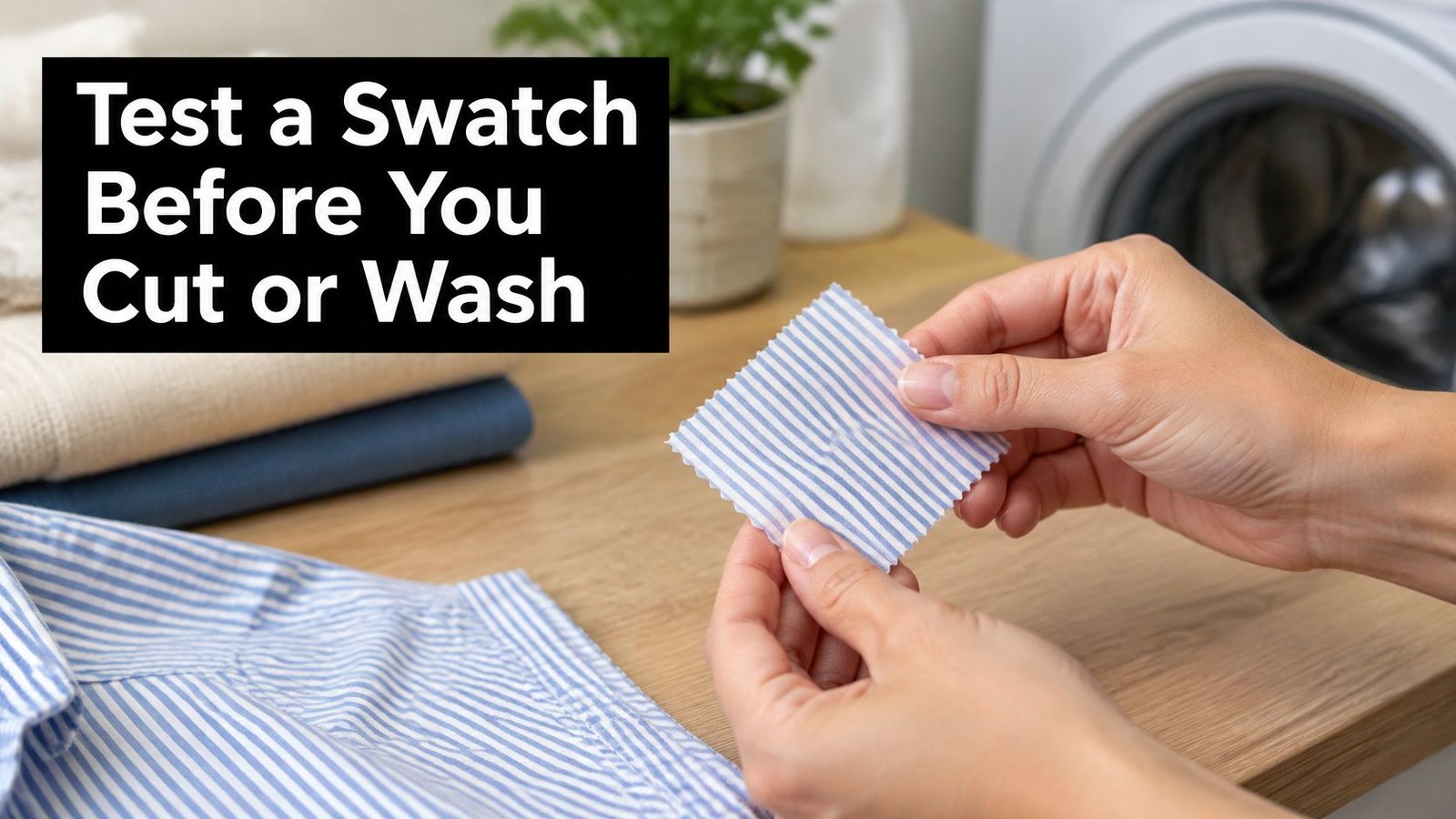
Viscose changes size, and how much depends on fibre content, finishing, agitation, temperature and drying method. Published guidance reports typical first-wash shrinkage of about 3 to 8% for woven viscose and 8 to 15% for viscose knits, with higher losses after aggressive heat or tumble drying, as set out in this viscose shrinkage guide.
Here's the sequence.
- Mark the grain. Draw a 20 cm line along the length and another across the width, following the grainline, in permanent marker.
- Wash the swatch exactly as the garment will be washed. Same temperature, same detergent, same spin, same drying method. A swatch washed at 30°C and dried flat tells you nothing about a garment you plan to tumble.
- Dry it flat first, then measure both lines and work out the change: original minus new, divided by original, times 100.
- Add the percentage to the cutting layout. A panel that must finish at 100 cm after a 5% loss gets cut at about 105.3 cm.
Woven viscose, viscose jersey, viscose-linen and viscose-elastane don't recover alike, so temperature alone won't control distortion. Hanging a wet swatch stretches it lengthways; flat drying reveals the shrinkage you need to allow for.
Buy the spare half metre when you buy the main length. It costs less than remaking the garment.
At More Sewing, fabric is sold by the half metre and multiple orders are sent as one continuous length, so the spare piece comes off the same bolt. The Exotic Flowers Print 100% Viscose, 140 cm wide and ideal for a first prewash test, is £5.00 per half metre.
How to Wash Viscose by Hand or on a Machine
Two things damage viscose in the wash. Heat shrinks the fibres, and mechanical action stretches fabric that has already lost strength in water. Both are controllable.
The process below keeps drape intact on a blouse, a dress or a pair of wide-leg trousers.
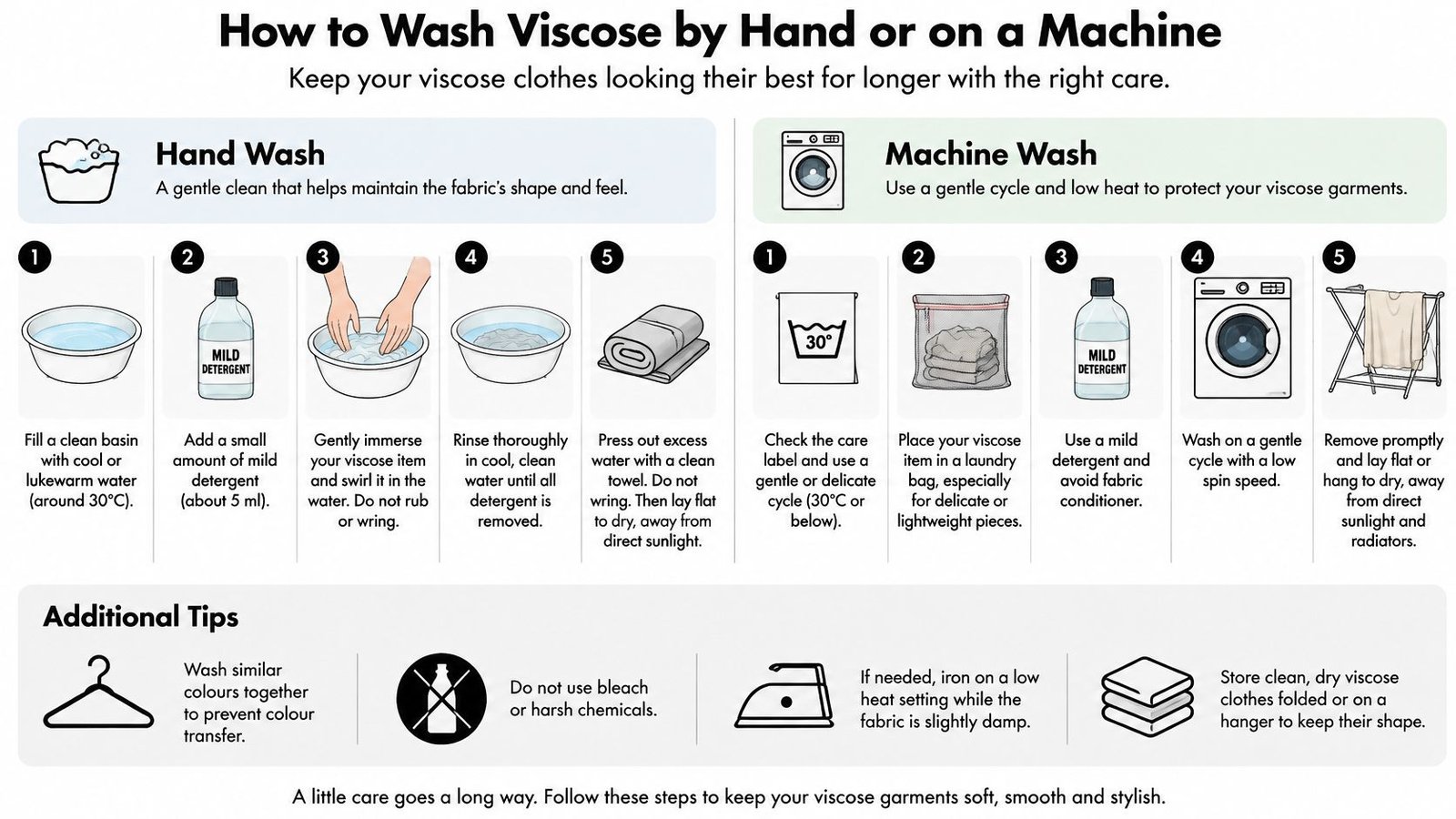
The wash cycle, step by step
- Set 30°C or cooler on a fine, delicate or hand-wash programme. Heat plus agitation is what makes wet viscose shrink, and a delicate cycle keeps the drum turning slowly.
- Use a mild liquid detergent. Bleach and strongly alkaline powders attack wet cellulose, and a neutral liquid rinses out cleanly at low temperature without residue.
- Wash similar lightweight items together and leave the drum two-thirds full at most. A viscose dress rubbing against denim raises surface pilling fast, and a cramped drum gives the fabric nowhere to move.
- Hand wash by swirling, not scrubbing. In a basin of cool water, move a blouse gently for two or three minutes. Keep your hands off collars and seams, which are the first places rubbing shows.
- Remove water by rolling, not wringing. Lay the item on a clean towel, roll it up and press. Twisting wet viscose distorts the weave and leaves seams wavy.
- Reshape while it's still damp. Ease side seams, hems and necklines back to their original lines with your palms before the fabric dries, because a garment that dries out of shape tends to stay there.
Care-label guidance draws the line between normal, mild and very mild cycles for exactly this reason, and puts the sewn-in symbol above any generic fabric rule. The Hertfordshire County Council care label guide recommends a 30°C fine or delicate cycle, blotting rather than twisting, and a mild detergent in place of bleach or strongly alkaline products.
Where most viscose washes go wrong
The two habits behind most ruined garments are a hot rinse and a high-speed spin. A hot rinse shocks fabric that has already relaxed in cool water, and a fast spin forces the water out so violently that the garment stretches against the drum and then dries into tight lengthwise shrinkage. If your machine lets you set both, set the rinse to cold and the spin to 400 or 600 rpm.
Practical rule: the label has the final say over anything on this page. If it says hand wash, don't talk yourself into the delicate cycle.
Fabric softener is the other recurring mistake. It coats cellulose in a film that flattens the drape you bought viscose for, and it does nothing about creasing. The same holds for knitwear generally, and Luca & Charlize's guide to keeping hoodies soft makes the point neatly: washing habits, not conditioning products, keep knit surfaces smooth.
Drying and Shaping Viscose Without Distortion
Drying decides whether a garment keeps its length. Water is heavy, a wet viscose dress carries several times its dry weight in moisture, and the fibre can't resist the pull. Hang it from the shoulders and the hem drops while the shoulder seams stretch into points.
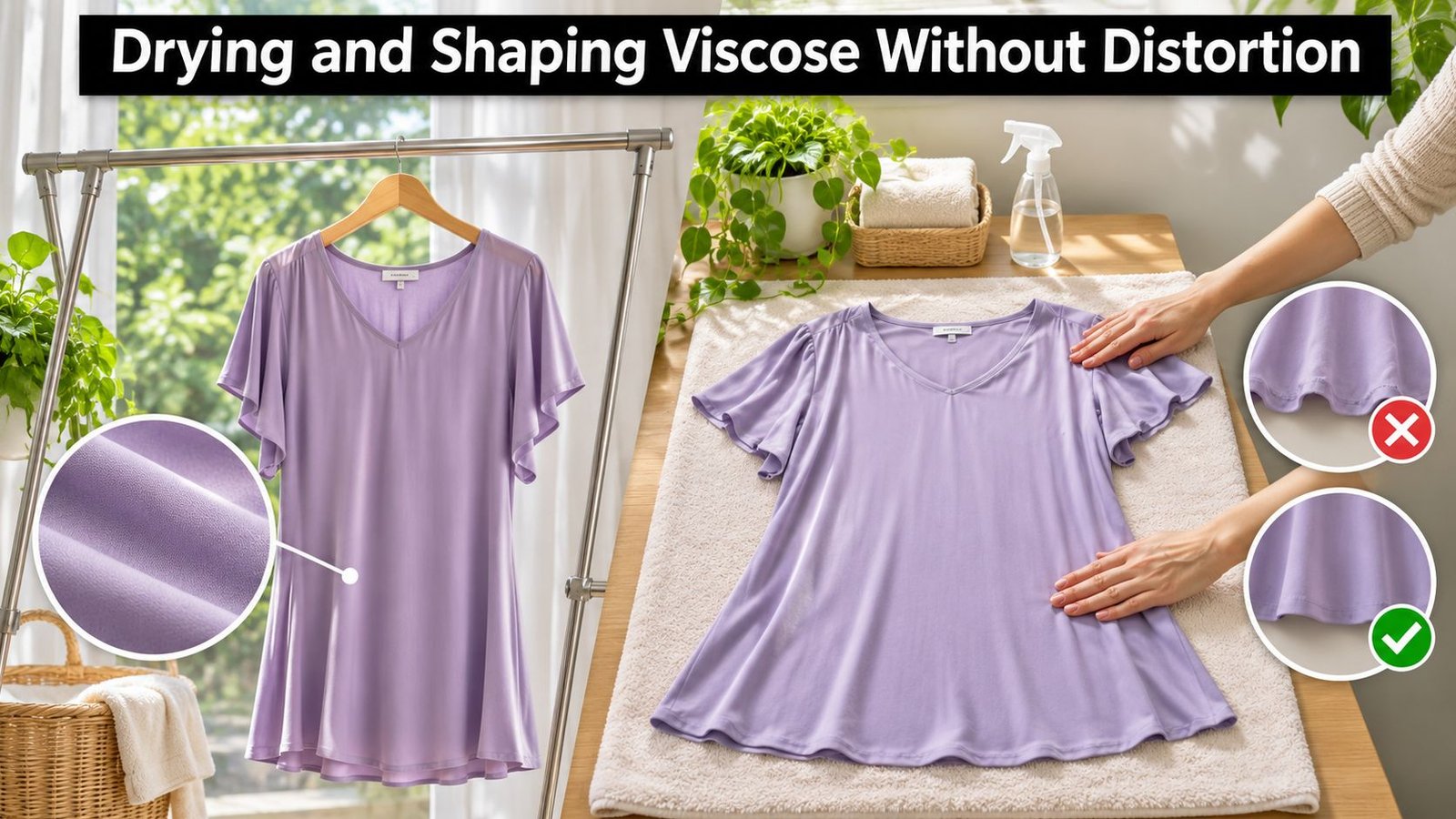
Why a hanger is the wrong place for wet viscose
Lay the item flat on a dry towel, reshape it with your palms, and keep it away from radiators and direct sun, which fade colour and stiffen the fibre. That single change prevents most of the hem drop people blame on the fabric.
Match the method to the garment.
- Flat on a towel: the default for knits, jersey and anything cut on the bias.
- Shaded line, pinned at the shoulders or waistband only: workable for sturdy wovens when the label permits it, so the weight is shared rather than concentrated.
- Lowest-heat tumble, removed while still damp: only where the label allows it, and only for a fabric you've already tested.
- Never over a radiator: heat plus hanging weight is the quickest route to a shorter dress.
For a sense of how much movement is normal, the UK-adopted EU Ecolabel criteria test dimensional change across three washes at the temperature stated on the product label, with tumble drying after each wash where that's the specified method. The tolerances they set include ±3% for ordinary woven cotton or cotton-mix fabrics, ±4% for knitted fabrics and ±5% for interlock, as listed in the EU Ecolabel textile criteria. Those are product-category standards rather than a viscose allowance, so treat them as a benchmark for your own swatch measurements.
Run the numbers on a real project and the risk becomes obvious. A 60 cm bodice panel that shrinks by 5% finishes at 57 cm. Three centimetres is nothing on a curtain. On a fitted bodice with a waist seam, it's a garment that pulls across the bust.
Ironing and Steaming Viscose Without Scorching
Pressing is where careful washers undo their own work. Viscose takes a shine from a hot iron faster than most fabrics, and that shine doesn't wash out.
- Set the iron to one dot, the silk or wool setting, and let it reach full heat before the first pass. A warming iron drags across the surface.
- Turn the garment inside out, so the heat meets the wrong side and any sheen lands where nobody sees it.
- Lay a damp cotton tea towel or pressing cloth over the fabric. Press by lifting and placing for about five seconds, then lift again. Gliding stretches the weave.
- Work in one direction on flat panels, following the grain, and open seams with the tip of the iron rather than the soleplate.
- Use steam at a low setting and keep the iron moving. Water left sitting on viscose leaves rings, and heavy steam flattens the drape.
- Hang the item on a padded hanger while it cools. The shape it cools in is the shape it keeps.
The difference the cloth makes is easy to see on a pleated viscose midi skirt. Pressed through a damp tea towel at one dot, every pleat takes a crisp fold and the surface stays matte. Pressed on a high setting with no cloth, the same skirt comes back with a dull sheen along the pleat edges, and repeated washing won't lift it.
If you're unsure, iron less, not hotter. A crease can be pressed twice. A scorch mark can't be undone.
Pressing is one part of viscose fabric care. Storage and wash frequency do the rest.
Storing Viscose and Cutting Down on Fibre Loss
A garment you don't wash is a garment that isn't shrinking. That's the self-interested reason to wash viscose less often, and there's a wider one. A 2023 study of 16 commonly used fabrics, including viscose, cotton, polyester and blends, estimated that domestic washing releases between 6,860 and 17,847 tonnes of microfibres into the UK environment each year, equivalent to as much as 243 grams per person, as reported in this 2023 UK laundering study.
Fibre composition, yarn structure, fabric construction, agitation and the volume of water used all shift that total, which means your wash settings have a measurable effect. Gentler programmes, a sensible load and fewer washes cut both fibre loss and wear on the cloth.
The storage routine that follows from it is short.
- Air between wears. A day on a hanger in moving air does more for a blouse worn once than a 30°C cycle.
- Spot clean early. A damp cloth and a drop of mild detergent lift most marks before the whole garment needs washing.
- Use padded or shaped hangers for dresses and blouses. Wire hangers leave shoulder points that no amount of pressing removes.
- Fold knits and jersey rather than hanging them. A hanger stretches the shoulders and lengthens the body.
- Store in a breathable cotton bag, away from damp and direct sun, and don't compress the garment against its neighbours.
Wash less, air more, fold the knits. Three habits that add years to a viscose wardrobe.
Creasing is the usual complaint after storage. Hang a folded garment in a steamy bathroom for ten minutes, or pass a steamer over it on a low setting, then reshape it by hand while it's warm and let it dry flat. Pilling on viscose jersey comes off with a fabric shaver worked over the reverse side, and the garment then wants loose storage rather than tight packing, which pushes pills back into the surface.
If you'd rather test the cloth before you commit to it, More Sewing sends sample swatches so you can wash, measure and press a piece of the exact fabric you plan to sew. Browse the viscose and Tencel range, the all-in-one dressmaking kits and the haberdashery at More Sewing, and add the spare half metre to your order while you're there.
