
Blog, Dressmaking, Fabric
Best Fabric for Dressmaking: A Complete UK Guide
You're standing in front of a row of fabric bolts with a simple shift pattern folded over your arm. One fabric is crisp cotton poplin, the other is soft Tencel twill. Both are beautiful. Only one will give you the shape, movement and sewing experience you want.
That decision is why the best fabric for dressmaking isn't one particular fibre. It's the fabric whose drape, weight, stiffness, stretch and care requirements suit the garment. UK textile research identifies drape, bending stiffness, shear stiffness, tensile strength and abrasion resistance as important predictors of how cloth behaves, and links those properties to fibre, yarn, density, thickness and construction UK textile research on fabric properties.
The advice below comes from the practical end of fabric selection, where a lovely bolt has to survive cutting, pressing, fitting, washing and repeated wear. Start with performance, then choose the fibre and colour.
Why Your Fabric Choice Matters More Than Your Pattern
The pattern gives you the outline. Fabric decides whether that outline holds, collapses, swings or stretches. I've seen the same shift dress look neat and architectural in poplin, relaxed in linen and unexpectedly fluid in a soft viscose. The pattern hasn't changed, but the garment's character has.
A gathered skirt drafted with a light cotton lawn can form soft, controlled fullness. Make the same skirt in a heavy satin and the gathers may become bulky at the waist while the lower edge hangs heavily. A fitted ponte bodice needs a fabric that can stretch around the body. Use a crisp shirting instead and the seams may pucker, the darts may look harsh and the wearer will feel restricted.
Three familiar fabric mistakes
A wrap dress is a useful example. Quilting cotton is stable and easy to handle, but it has limited drape. In a wrap style, it can lose the soft swing across the front and sit away from the body instead of moving with it.
A T-shirt pattern needs a fabric with suitable stretch and recovery. Stable cotton woven fabric won't recover around the neckline in the way jersey does, so the opening can gape or lose its intended shape. The pattern calls for knit behaviour, not just a cotton fibre.
A trench coat needs body through the collar, lapels and shoulders. Soft viscose may feel wonderful in your hand, but it can collapse where the coat needs structure. A cotton twill or suitable coating will support those lines far more reliably.
Practical rule: Choose the garment's required behaviour before you choose its fibre name.
That approach also helps with blends. A cotton jersey, viscose jersey and ponte knit may all be sold as jersey, yet their stretch, recovery, thickness and stability can differ sharply. For home dressmaking, the best sequence is simple: read the pattern, identify its performance requirements, then test fabric against them.
Reading a Fabric Before You Buy It
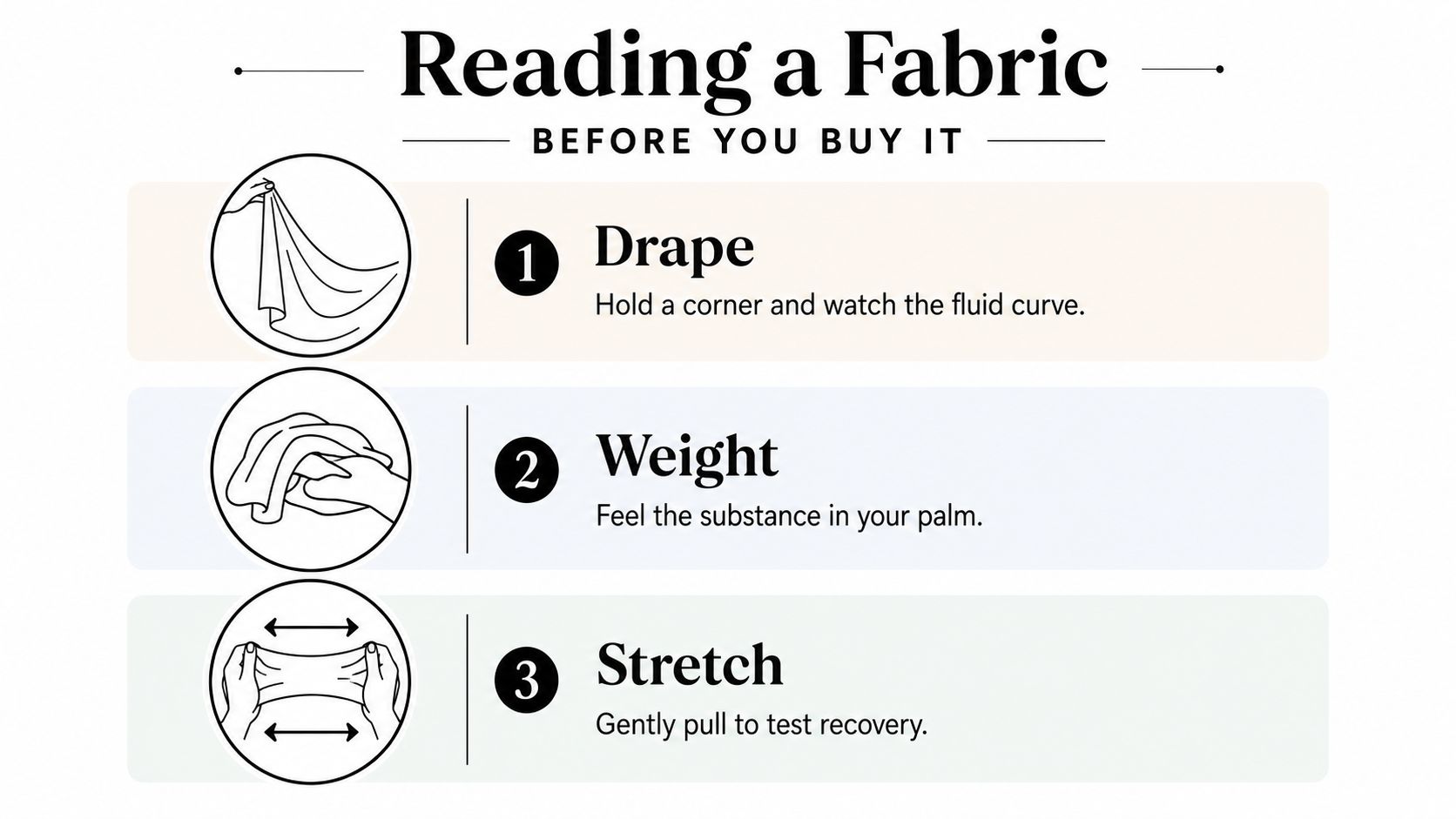
You can learn a great deal from a fabric before buying a metre. In a shop, don't rely only on the label or fibre content. Hold the cloth, pull it gently and watch how it responds.
Test the drape
Hold a corner or a short length of the fabric at shoulder height and let it fall. A deep, fluid curve suggests a fabric suited to gathers, cowl details, soft sleeves and bias-cut styles. A straight, firm drop points towards crisp collars, structured bodices, pleats and fuller skirts that need to stand away from the body.
Drape is closely tied to stiffness, but don't confuse softness with quality. A fluid cloth can be exactly right for a dress and completely wrong for a structured jacket.
Feel the weight
If the shop has a sample, hold roughly a metre square in one hand. Compare a light cotton voile with a much heavier denim and notice how much substance each has, how easily it folds and how much support it offers. Weight affects opacity, seam bulk, warmth, pressing response and how much a garment pulls on its own shoulder seams.
Ask whether the fabric is likely to need lining or interfacing. A lightweight lawn may need lining in a dress, while a dense poplin may not. A heavy fabric may look luxurious on the roll but become tiring to wear if the pattern has large amounts of fabric.
Check stretch and recovery
Pull across the width, then along the length. Woven fabrics usually give more across the cross-grain, while knits can offer substantial mechanical stretch. Stretch the fabric gently and release it. If it springs back neatly, it has useful recovery. If it stays distorted, avoid using it for close-fitting necklines, cuffs or fitted dresses unless the pattern allows for that behaviour.
Before cutting, inspect the cloth for:
- Bias distortion: Lay it flat and look for diagonal twisting or a side that refuses to sit square.
- Uneven weave: Hold it towards the light and check for inconsistent spacing.
- Loose selvedges: Excess tension at the edge can pull the body of the fabric off grain.
- Slubs and weak areas: Pronounced irregularities may catch under the needle or pucker around seams.
These checks matter because fabric performance depends on construction as well as fibre. A beautifully soft cloth with poor grain can be harder to sew than a plainer, more stable alternative.
Cotton and Its Many Faces
Cotton remains a reliable starting point because it's soft, strong, absorbent and receptive to dye. Plain weave is simple, strong and predictable, which is why woven cotton has been such a useful foundation for garments and sewing practice BBC Bitesize textile guidance.
Britain's textile history is closely connected with cotton. Raw cotton imports rose from 934 million pounds in 1820 to 4,072 million pounds by 1850, illustrating the scale of the industrial transformation that established cotton as a foundational garment fabric historical UK textile trade data.
| Cotton Subtypes at a Glance | Typical Weight (gsm) | Best For | Drape | Care Note |
|---|---|---|---|---|
| Quilting cotton | Light to medium | Pyjamas, gathered skirts, simple tops | Limited to moderate | Pre-wash and press carefully |
| Poplin | Medium | Shirts, shirt dresses, structured skirts | Crisp | Steam press for sharp seams |
| Lawn | Light | Blouses, summer dresses, linings | Soft and light | Consider lining for opacity |
| Shirting | Light to medium | Fitted shirts, shirt dresses | Moderate | Check for mechanical give |
| Canvas | Heavy | Utility dresses, structured bags, jackets | Low | Use sharp scissors and strong needles |
| Brushed cotton | Medium to heavy | Winter shirts, casual dresses | Moderate | Check nap direction before cutting |
| Denim | Medium to heavy | Jeans, skirts, structured dresses | Low to moderate | Test colourfastness and bleed |
Quilting cotton is forgiving under the presser foot. It stays put while you pin, cuts accurately and presses well, but it won't create the soft movement of a drapey dress fabric. Poplin is excellent for sharp collars and plackets. Use a hot iron with steam, and press each seam before crossing it with another.
Cotton lawn has a finer hand and gentler movement, making it useful for blouses and lined dresses. Cotton shirting may have slight mechanical stretch from its weave, so test the cross-grain before cutting a close-fitting shirt.
Heavy cotton needs preparation
Canvas and denim demand more from your equipment. Use sharp shears, lengthen stitch settings where appropriate, grade bulky seams and reach for a size 90 needle when sewing heavier layers. Reduce bulk at intersections rather than forcing every seam allowance into one thick stack.
Pre-wash cotton in the way you'll launder the finished garment. Washing at 30 to 40°C, using similar colours, and tumble drying to preshrink are practical steps, followed by pressing the fabric flat before laying out the pattern. Don't skip this for a fitted dress, because later shrinkage can alter length and ease.
UK fabric imports reached £5.341 billion in 2024, down from £5.584 billion in 2023, showing how strongly the fabrics available to UK dressmakers are shaped by international supply chains UK textile import reporting. That makes consistent care and testing even more useful, since bolts from different mills can finish and behave differently.
For shops and makers managing premium ranges, tools such as upscale Shopify support automation can help organise customer enquiries around fabric details, samples and care information. The sewing decision still belongs at the cutting table, where handle and grain tell you more than a product title.
Viscose and Tencel for a Fluid Drape
Choose viscose or Tencel when movement matters more than crisp structure. Viscose challis is lightweight, smooth and fluid, so it skims the body beautifully in dresses, trousers, skirts and tops. It's also slippery, prone to fraying and easily distorted while cutting.
Tencel, or lyocell, often has more body than challis, particularly in a twill weave. It can offer a subtle sheen and a little more control through seams and waistbands, while still giving the relaxed movement associated with drapey fabrics.
| Property | Viscose challis | Tencel lyocell twill |
|---|---|---|
| Handle | Soft, smooth and fluid | Smooth with more substance |
| Drape | High, with a fluid hang | Fluid but more controlled |
| Cutting | Can shift and stretch | More stable, though still needs care |
| Pressing | Can mark or distort | Usually holds a press more readily |
| Seam finishing | French seams, narrow zigzag or overlocked edges | Bound, overlocked or enclosed seams |
| Best suited to | Soft dresses, blouses, skirts and wide trousers | Dresses, skirts, trousers and relaxed jackets |
Control the cloth before sewing
Cut both fabrics on a flat, clean table. Use pattern weights rather than relying on pins, and choose a rotary cutter or very sharp shears. If viscose continues to shift, place tissue paper underneath it while cutting and remove the paper carefully afterwards.
A microtex or fine silk-finish needle, such as a 70/10, helps reduce drag on lightweight cloth. A walking foot can keep the layers moving together, particularly on long seams. Clip seam allowances before sewing where the pattern curves, but don't over-clip and weaken the edge.
Viscose frays readily, so finish seams promptly with an overlocker, zigzag stitch or French seam. Tencel copes better with bound seams and usually responds more predictably to pressing, but neither fabric benefits from aggressive ironing. Use steam and lift the iron rather than sliding it across the surface.
Cutting-room advice: Let fluid fabric settle before you ask it to become a garment.
Wash viscose and Tencel gently, use a cool cycle and minimise spinning. Hang-drying can pull wet fabric into long, stretched hems, so dry delicate garments flat where possible. These fabrics reward careful handling, but they won't forgive rough cutting or careless pressing.
Jersey Versus Denim Two Very Different Constructions
Jersey and denim often appear together in dressmaking searches, but they need almost opposite treatment. Jersey stretches because it's knitted. Denim is woven, firm and usually much less forgiving. The right choice depends on whether the garment needs to follow the body or hold a designed shape.
Cotton jersey with useful four-way stretch suits T-shirt dresses, body-skimming tops and casual dresses. Ponte and scuba have more structure and can support a clean sheath silhouette without the fluidity of a thin jersey.
Sewing jersey without losing its stretch
Use a ballpoint or stretch needle, commonly a size 80/12, and test the stitch on a scrap. A narrow zigzag keeps the seam elastic. A twin needle can finish hems neatly while retaining movement, and a walking foot reduces unwanted rippling as the layers pass under the presser foot.
Stay tape is useful at shoulder seams and sometimes at necklines, but don't stabilise an area that needs to stretch over the head. Pre-wash jersey before cutting so the fabric can relax and any laundering change occurs before fitting.
Denim gives you the opposite result. Shirting-weight denim can suit a summer dress, while heavier bull denim supports jeans, pinafore dresses, utility skirts and structured jackets. Use a jeans needle, such as 90/14 or 100/16, for thick layers. Topstitching thread and an edgestitch foot help create even, durable detail.
Denim construction details
Clip curves on princess seams, grade bulky seam allowances and use a firm construction order. A cotton canvas waistband can provide dependable support without relying solely on fusible interfacing. Topstitching each major seam reinforces the design and gives the garment a finished workwear character.
The simple test: If the cloth stretches back under your finger, handle it like a knit. If it stands in folds, approach it like tailoring.
UK sewing guidance distinguishes jersey as a stretch knit for dresses, tops and loungewear, while denim is described as a heavyweight woven fabric suited to structured garments UK fabric selection guidance. Match your needle, stitch and seam finish to that construction, not merely to the colour or weight on the label.
Deadstock Fabric for Unique Pieces
Deadstock is a sourcing category, not a fibre. It may be a leftover roll from a fashion house, a mill overrun or a small job lot, and there may be only one or two bolts available. That scarcity makes it attractive for one-off garments, but it also means you need to inspect the fabric more carefully than you would a continuously stocked basic.
A lower price per metre doesn't automatically make deadstock better value. Irregular finishing, slubby selvedges, thin areas and shade variation can create waste during cutting. If a dress needs pattern matching or you have to recut a damaged panel, the apparent saving can disappear.
A practical deadstock inspection
Take a tape measure when you shop. Measure the usable width, not just the distance between the selvedges, and place a scrap of cotton underneath the fabric to reveal thin spots, holes or uneven transparency.
Check the roll for:
- Selvedge tension: A tight edge can pull the fabric off grain.
- Shade consistency: Compare the start, middle and end of the roll.
- Surface damage: Look for snags, needle lines, oil marks and weak patches.
- Pattern repeat: Measure the repeat before buying if matching will matter.
- Usable quantity: Allow extra for recutting and matching rather than buying to the exact pattern requirement.
Wash a 10 cm swatch before committing. Check dye bleed, shrinkage, texture and recovery, then press it as you would the finished garment. A tiny test won't reveal everything, but it can expose a serious care problem before it reaches a full skirt.
Deadstock can support small mills, reduce waste and give a dressmaker access to distinctive cloth that won't appear in every wardrobe. The sustainability benefit depends on whether you'll wear and care for the finished garment, not on the word “deadstock” alone.
Photograph the bolt end, fibre label and colour in natural light. Record the usable width and any washing notes. Once the roll has gone, those details may be the only way to identify a similar fabric or explain how you achieved a successful result.
UK textile consumption reached 1,420 kilotonnes of virgin textiles in 2022, according to WRAP, which gives durability and long wear practical importance when choosing cloth WRAP textile consumption information. A unique fabric only earns its place if the finished garment stays in regular rotation.
Matching Fabric to Garment and Skill Level
Start with the pattern envelope, not the fabric shelf. Read the recommended fabric types, the stated weight range in gsm or ounces, the stretch requirement and any notes about drape or lining. Treat those details as your starting specification.
Then make a quick audit:
| Garment and Skill Level Fabric Match-Up | Best Fabric Choice | Skill Level |
|---|---|---|
| Fitted bodice | Crisp cotton shirting or lightweight denim | Beginner to intermediate |
| Sharp-collar shirt | Poplin, shirting or stable linen blend | Beginner to intermediate |
| Bias-cut dress | Viscose challis or Tencel | Intermediate |
| Gathered skirt | Cotton lawn, poplin or soft Tencel | Beginner to intermediate |
| Stretch sheath dress | Ponte or stable jersey | Intermediate |
| Body-skimming T-shirt dress | Cotton jersey with suitable stretch | Intermediate |
| Structured pinafore or utility dress | Denim or canvas | Beginner to intermediate |
| Fluid wrap dress | Viscose or Tencel with controlled drape | Intermediate |
Build a two-column check
On the left, write what the garment needs: structure, drape, stretch, opacity, lining and ease. On the right, record what the fabric does. This catches the common mistake of choosing a fabric because it looks right on the bolt while ignoring how it will behave in a sleeve, neckline or waistband.
A fitted bodice needs enough body to support darts and seams. Crisp cotton shirting or lightweight denim will generally behave more predictably than fluid viscose, which may collapse around the bust and make accurate pressing difficult. A bias-cut dress needs movement, so Tencel or viscose is more logical than canvas, which can stand away from the body.
Beginners usually find cotton, denim and stable knits easier because the cloth holds its position while pinning and stitching. Slippery viscose and fine jersey are rewarding, but they demand accurate cutting, appropriate needles, stay tape where needed and restrained pressing.
A useful fitting habit: Make a small test section in the actual fabric before cutting the whole garment.
This might be a neckline, waistband or sleeve seam. It tells you whether the fabric stretches, puckers, frays or needs reinforcement. The UK Sewing Directory recommends judging fabric by type, cost, pattern, width, handling, washing, comfort, structure and drape, then matching it to the garment rather than choosing by colour alone dressmaking fabric selection guidance.
Cutting and Caring for Your Chosen Fabric
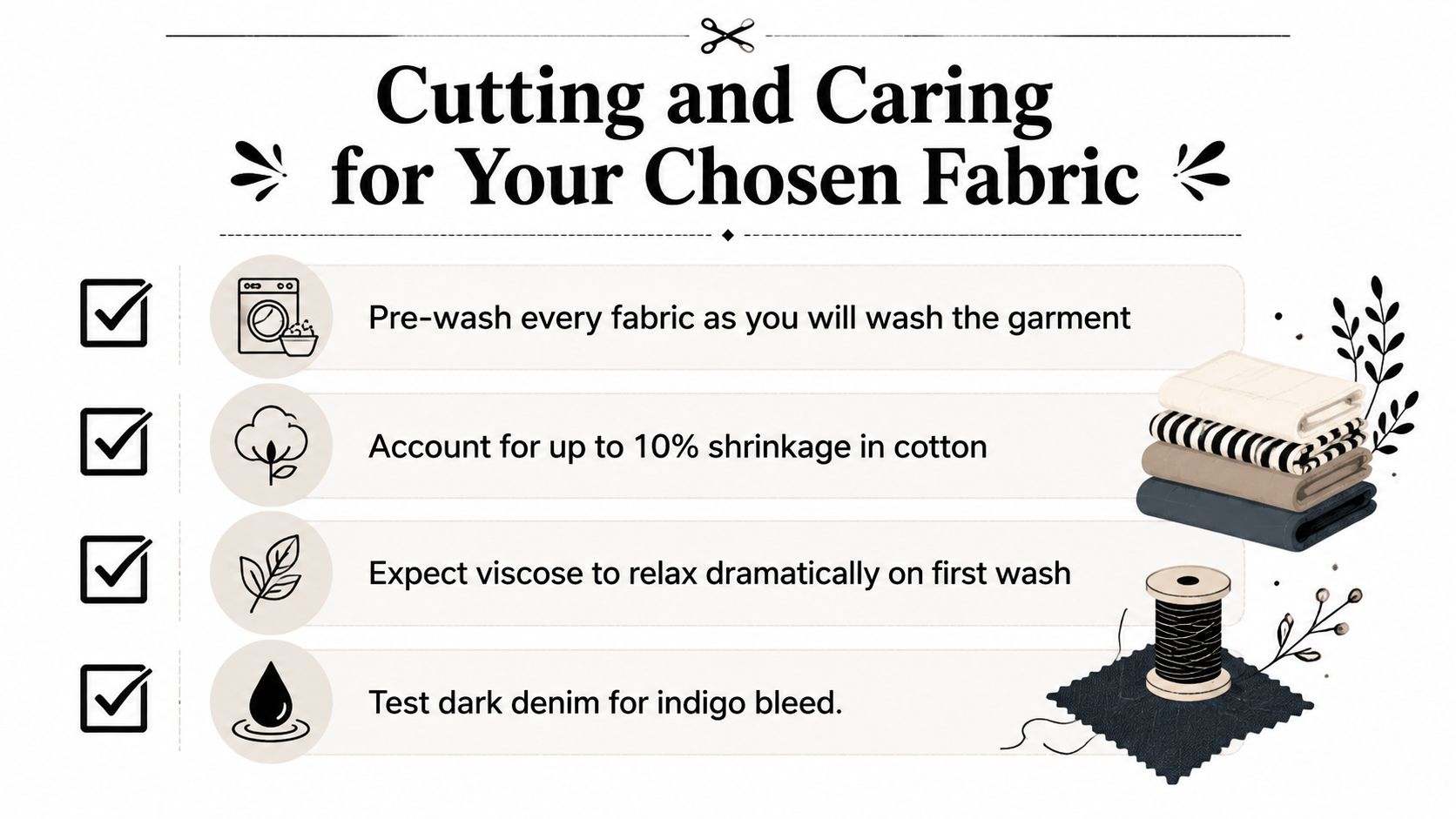
Pre-wash every fabric in the manner you intend to wash the finished garment. Cotton can shrink substantially, viscose may relax dramatically during its first wet wash and dark denim can release indigo into the machine. The care label and a swatch test are more trustworthy than assumptions based on fibre name.
Press fabric while it's slightly damp where suitable. Use a cotton setting for cotton, low heat with steam for viscose and Tencel, and a hot iron with a pressing cloth for denim. Keep the cutting table clean and washed, particularly when working with dark dyes.
Make the cut suit the cloth
Use a fresh rotary blade on linen and other tightly woven fabrics. Weigh slippery fabric with pattern weights rather than pinning through every edge, and let viscose or Tencel lie flat for 24 hours before cutting so the bias can settle.
Check the grain by tearing along a selvedge warp thread where the fabric allows it, then square the cloth before placing the pattern. If the selvedge and cross-grain don't meet cleanly, don't force the pattern into position. Correct the grain first or expect twisting in the finished garment.
Finish seams according to the fabric:
- Cotton lawn: Use French seams where the seam allowance and design permit.
- Jersey: Serge the edge or use an overlocker, keeping the seam elastic.
- Denim: Choose a flat-felled or topstitched seam for a durable interior.
- Viscose: Finish quickly because exposed edges can fray while you work.
Store rolls upright in a dry cupboard away from direct sunlight. Cotton can yellow over time and viscose can fade, so protect both from prolonged light. Fold smaller cuts without crushing delicate surfaces, and keep labels with them.
Before your next project, check the fabric's drape, test its stretch, wash a swatch, confirm the grain and sew a small sample seam. That performance-first routine will tell you far more than searching for a single universal answer to the question of the best fabric for dressmaking.
More Sewing offers dressmaking fabrics, haberdashery and ready-to-sew kits, including cottons, viscose and Tencel blends, jerseys, denims and ex-designer deadstock. Visit More Sewing to order fabric samples, compare handle and choose the tools you need for your next garment.
