
Deadstock fabric is often sold as an easy sustainability win. Find a leftover roll, pay less than you would for new cloth, and turn surplus into a collection. That advice leaves out the difficult parts: the roll may not be repeatable, the description may blur deadstock with returns or seconds, and the material may not be suitable for direct reuse at all.
For a UK buyer, how to source deadstock fabric is really a procurement question. You need a clear specification, a supplier-screening habit, a quality inspection process, and a plan for the day the colour or cloth disappears. The opportunity is substantial, but the reliable pipeline matters more than one fortunate bargain.
Why Deadstock Sourcing Is Harder Than It Looks
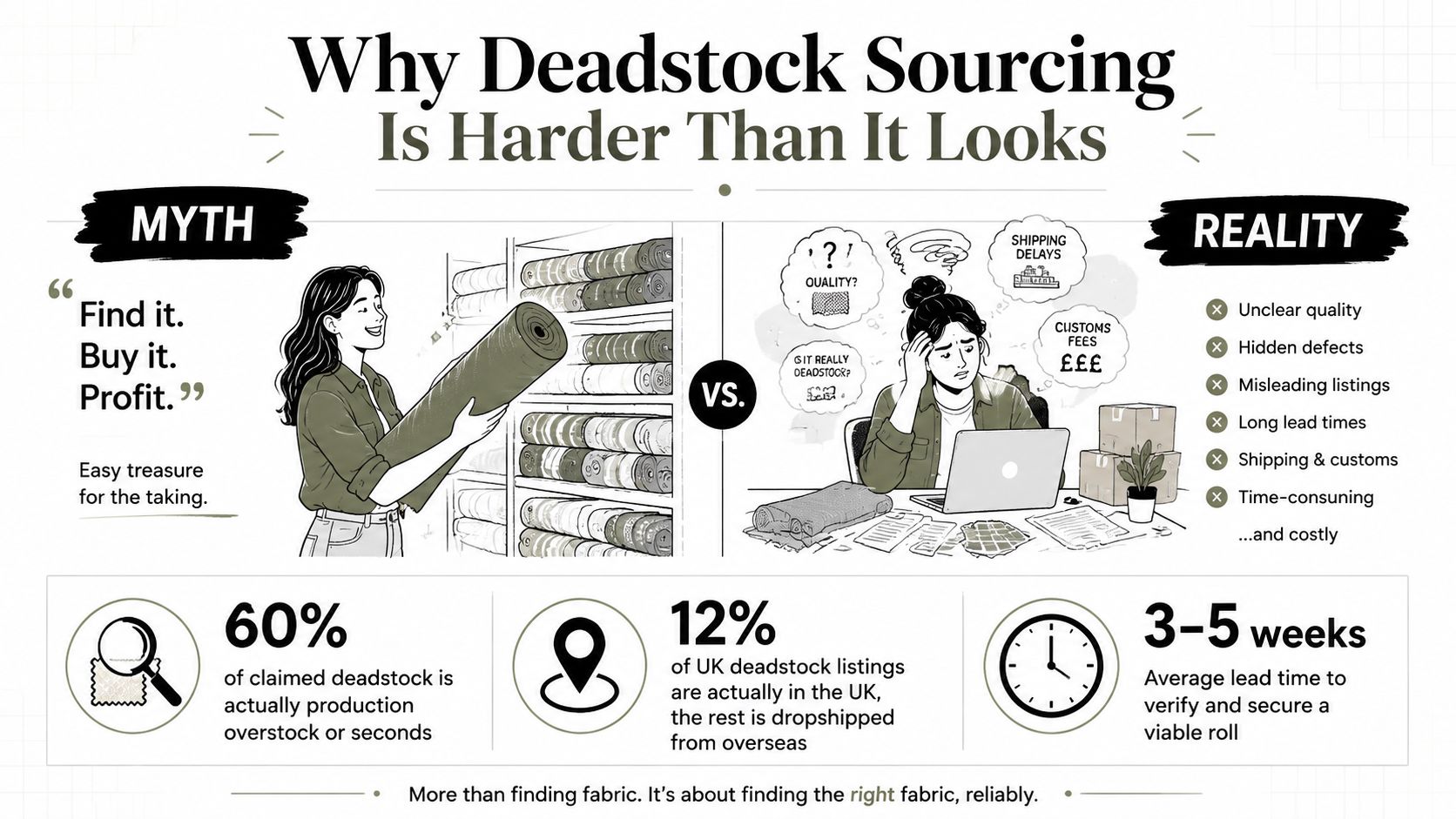
Cheap surplus is easy to find. A dependable supply is not. Deadstock can keep existing fabric in use, yet it comes from a production system that creates cancelled orders, end-of-line rolls, overproduction, and other excess. WRAP records 1.42 million tonnes of textiles bought in 2022, 1.45 million tonnes of used textiles generated, and 711,000 tonnes of post-consumer textiles entering residual black bins and general waste (WRAP textile waste data). Deadstock belongs to that wider system, so its environmental value depends on where the material came from and what happens next.
The same WRAP findings report that 49% of used textiles were disposed of in residual waste, while each person in the UK discarded an average of 35 unwanted textile items a year. That volume supports sorting, grading, storage, and resale businesses, but it also creates a sourcing risk. A managed surplus roll is very different from material recovered after it has entered an uncontrolled waste stream.
The label is less precise than buyers expect
“Deadstock”, “surplus”, “returns”, “overrun”, and “seconds” can refer to different origins, conditions, and liabilities. WRAP's waste-hotspots work places returned products, deadstock products, and surplus stock within retail-phase categories, while noting that consistent definitions were still being developed with Defra and the UK textile industry (WRAP's Textiles Waste Hotspots Report).
A clean, labelled roll from an unused mill stockholding may be ready for production. A returned garment fabric, mixed bale, or damaged clearance lot may require extensive checking. Ask for the stock's origin, fibre content, width, finish, batch information, and storage history before treating the price as a saving. Low cost does not repair missing information.
Procurement rule: assess origin, condition, and repeatability separately. A low price can't compensate for unclear provenance.
Availability creates the next constraint. Deadstock is generally a short-run opportunity rather than a repeat-buy channel. UK suppliers with limited stock report that about 95% of their stock isn't repeatable, so a successful sample may be impossible to reorder (UK textile resource-efficiency report).
Plan the product around that uncertainty. Buy enough for the intended run, record batch details, approve substitute fabrics before cutting, and keep several supplier relationships active. Finding a cheap roll is a transaction. Building a reliable pipeline requires records, inspection, and a clear response when the same fabric disappears.
Where to Find Deadstock Fabric in the UK
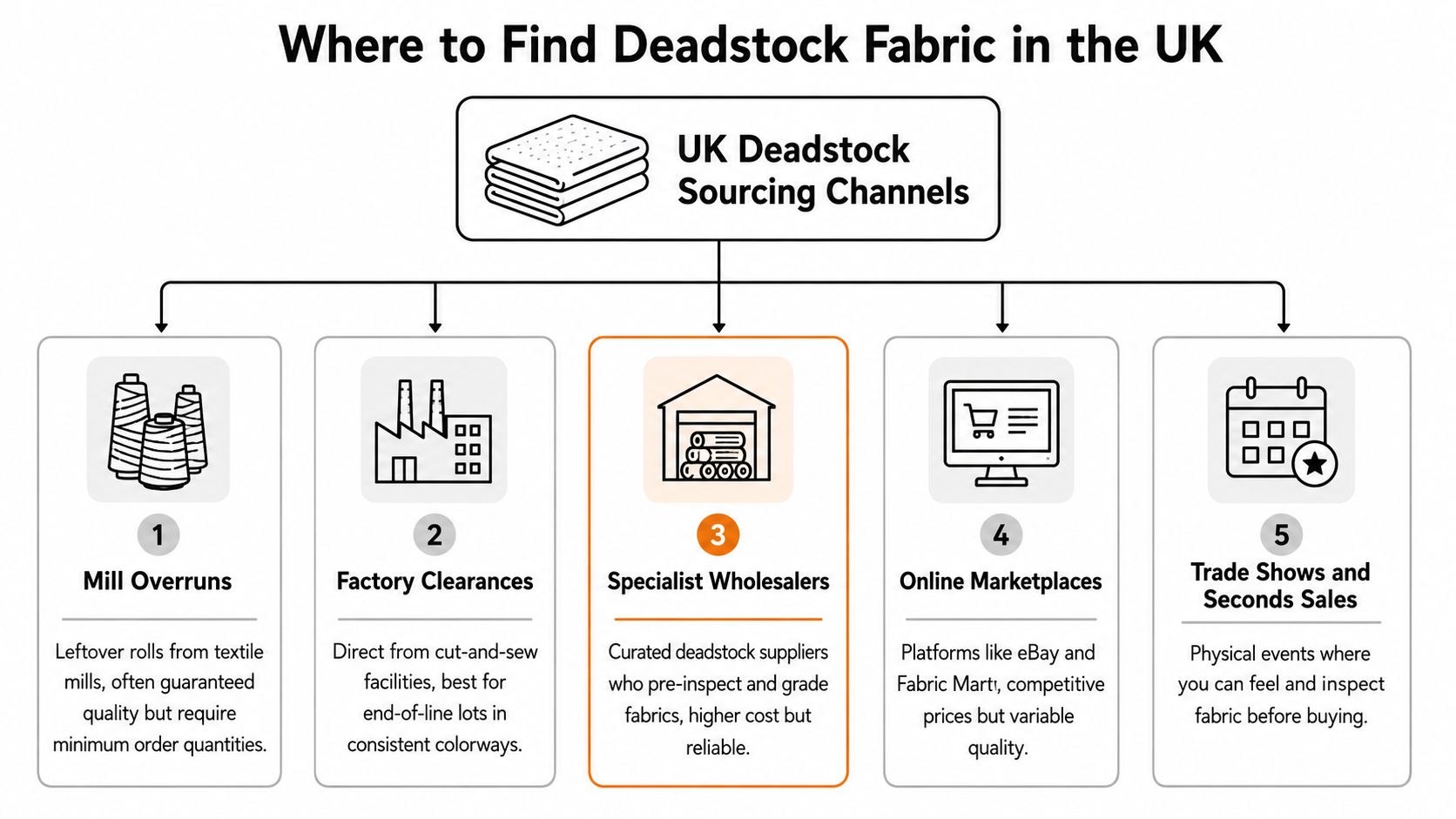
The most dependable channels usually capture stock before it reaches residual waste. Government evidence indicates that textiles sent through separate collection systems are estimated to be 93% reused, whereas only 36% of textiles disposed of through used-textile and waste-management systems are reused overall (UK textile waste hotspots evidence). For sourcing, that points you towards managed stockholdings, mill clearances, factory overruns, and specialist wholesalers rather than post-bin recovery.
Start with mills and manufacturers
Mill overruns can offer known fibre compositions, stable widths, and consistent finishing because the material originated in a normal production environment. Contact the sales or stock-clearance team with a concise request that includes fabric type, fibre preference, weight, width, colour family, intended use, and required meterage.
Don't lead with an apology about being small. Explain that you're a UK maker or independent label, that you can buy short runs, and that you're willing to take end-of-line colours or mixed lots. Ask:
- Origin: Was the fabric made as a mill overrun, cancelled order, sample length, return, or seconds?
- Specification: What are the fibre composition, finished width, weight, finish, and usable meterage?
- Condition: Has it been stored indoors, and are there stains, odours, fading, or faults?
- Continuity: Is more stock available, or is the lot strictly one-off?
- Evidence: Can the seller provide batch photographs, labels, and mill metadata?
Factory clearances can be useful for end-of-line lots, particularly where one colourway has been cut consistently. Ask whether the fabric was stored before or after cutting, and don't assume a photograph of a full roll proves that the whole roll is usable.
Use wholesalers, marketplaces, and physical events differently
Specialist wholesalers often charge more than a direct clearance, but they may pre-inspect, grade, photograph, and catalogue stock. That service can save time for a small buyer who can't visit every warehouse. Marketplaces such as eBay can produce strong finds, but seller descriptions vary, so request a sample before treating a listing as production stock.
Trade shows and seconds sales remain valuable because you can feel the handle, check opacity, inspect the selvedge, and compare rolls under the same light. Take a tape measure, fibre notebook, and phone camera. Photograph the roll label beside the fabric, not just the fabric alone, so you can trace your decision later.
A useful first-contact test: reliable sellers answer specific questions with specific evidence. Vague replies about “designer quality” or “premium surplus” should trigger a sample request, not an immediate order.
The embedded video offers another visual reference for evaluating sourcing channels and fabric handling:
Don't confuse a managed wholesaler's unused stock with post-consumer bales. The former may be ready for direct use. The latter can contain mixed conditions, hidden damage, and classification issues. Your supplier list should record which stream each seller handles.
How to Inspect and Verify Deadstock Quality
A fabric photograph can show colour and broad texture, but it can't prove usable meterage, hidden faults, or storage condition. Inspection starts before the parcel arrives. Ask for a labelled batch photograph, a close-up of the selvedge, a width measurement, fibre composition, roll length, and a clear statement of defects.
Build a physical inspection routine
When the sample or roll arrives, inspect it in natural light before cutting. Compare the listing, supplier message, invoice, and physical material. If any detail conflicts, pause production until the seller confirms which information is correct.
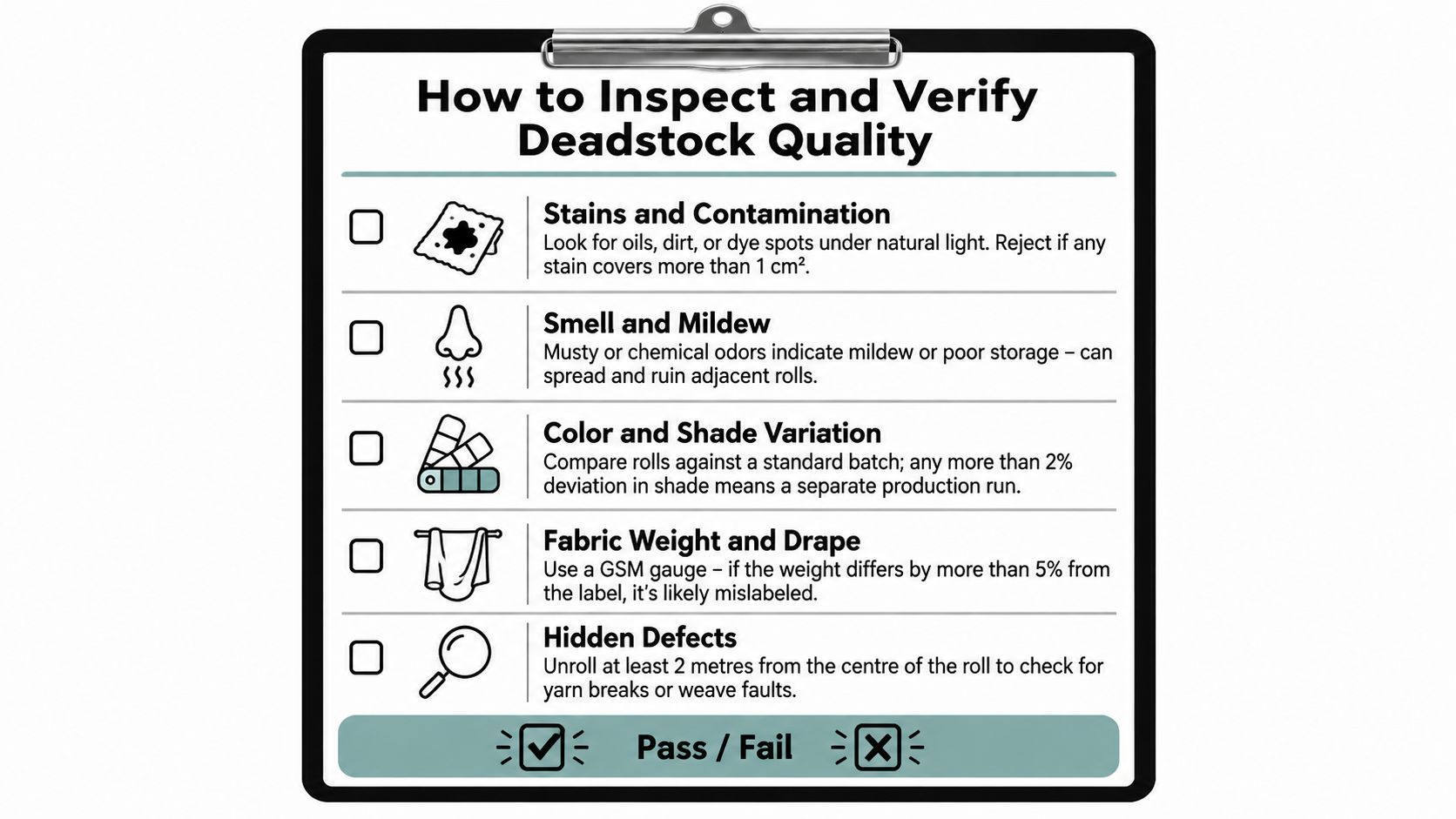
A practical check includes:
- Stains and contamination: Look across the face, reverse, fold lines, and roll edges for oil, dirt, dye marks, and transfer.
- Mildew and storage odour: A musty smell suggests poor storage. A strong chemical odour needs clarification about finishing or treatment.
- Colour variation: Compare the beginning, middle, and end of the roll. Photograph each section beside the same neutral reference.
- Handle and drape: Check whether the cloth behaves as the specification suggests. A stiffened or brittle surface can indicate age or storage problems.
- Selvedge and width: Measure usable width between selvedges and note curling, fraying, printing, or missing identification.
- Hidden faults: Unroll enough fabric to inspect for yarn breaks, slubs, weave faults, pin marks, and repeated defects.
Apply the direct-reuse test
UK guidance says a textile is waste if it has been discarded, is intended or required to be discarded, or can't be used for its original purpose. It is non-waste only when it is suitable for direct reuse, according to UKFT's report on non-fashion textile flows.
That distinction is practical, not semantic. Unused rolls in original condition are more likely to support direct reuse. Fabric mixed with discarded offcuts, damaged stock, or material requiring recovery before use needs a much more cautious assessment.
Ask the supplier for provenance paperwork where available. Reject unclear stock if the seller can't separate unused mill surplus from post-consumer or mixed textile bales. A deadstock label doesn't override the material's actual condition.
Inspection standard: if you wouldn't confidently cut and sew the fabric for its intended purpose without reprocessing, don't treat “deadstock” as proof of quality or non-waste status.
Pricing Benchmarks and Negotiation Tactics
Deadstock only creates a saving when the usable fabric remains cheaper after sampling, transport, sorting, and likely waste are included. A UK circularity report records an average of £9.78 per metre for deadstock offered through The Materialist, compared with £16.63 per metre for new fabric, implying a 70% unit-cost reduction (CFIN 2025 report). The same report says 80% of showcased fabrics were priced below £10 per metre, a useful pre-screening benchmark before you commit to inspection and logistics.
| Metric | Deadstock Fabric | New Fabric |
|---|---|---|
| Indicative unit price | Average £9.78 per metre in the cited UK report | £16.63 per metre in the same comparison |
| Availability | Usually limited and often non-repeatable | Generally easier to reorder |
| Colour continuity | May depend on one batch or dye lot | More likely to have an established shade reference |
| Quality information | Must be verified lot by lot | Usually supported by a regular product specification |
| Best use | Capsules, samples, limited runs, distinctive one-off pieces | Core products needing continuity and predictable replenishment |
Negotiate the total buy, not just the metre price
Small buyers rarely win by demanding the lowest unit price. They can create value by making the seller's job easier. Offer to take several compatible rolls, accept a less popular colour alongside a core colour, or collect from a UK warehouse if that reduces handling.
Request a clear break between fabric price, sampling, delivery, and any cutting or preparation charge. Then calculate the cost of usable fabric, not listed fabric. A roll with defects through a central panel may look inexpensive but produce a poor yield.
Ask for a better price when you can provide a fast decision, pay promptly, or take a complete lot. Don't accept a large minimum order to access a low price if you can't use the material. New fabric can be better value when consistent reordering, reliable testing, and low defect risk matter more than the opening price.
Navigating UK Waste Classification Rules
A supplier's use of the word “deadstock” doesn't settle the legal position. UK guidance treats a textile as waste when the holder discards it, intends or is required to discard it, or can't use it for its original purpose. A textile is non-waste only when it's suitable for direct reuse, as set out in UK environmental guidance on importing and exporting waste and non-waste textiles.
For a buyer, direct reuse means the fabric can be used as fabric without a recovery process that changes its status. An unused roll from a cancelled order may fit that practical description. A mixed bundle of discarded offcuts, stained cloth, or damaged rolls may not.
Ask for a paper trail
Before buying, request:
- Provenance: Who held the stock, and why was it released?
- Condition: Was it unused, returned, sampled, cut, or stored with waste?
- Composition: Is the fibre content documented by a mill label, specification sheet, or other record?
- Separation: Has the stock been kept apart from discarded or post-consumer textiles?
- Movement details: If it crosses a border, what classification and paperwork does the supplier apply?
Store the answers with the purchase order and photographs. This helps you explain what you bought, how it was described, and why you considered it suitable for direct reuse.
Cross-border movement deserves particular caution. The classification affects handling, storage, transport, and the controls that may apply when material moves between countries. If a supplier can't explain whether the stock is reusable fabric or waste, don't assume the buyer can resolve the issue after dispatch.
Compliance rule: classify the material from its condition and intended use, not from the marketing label attached to the listing.
A defensible supplier separates unused mill surplus from post-consumer or mixed bales. It also tells you about stains, moth damage, sun fading, brittleness, and inconsistent dye lots before you pay. That level of transparency is more valuable than a sustainability claim with no supporting record.
Building a Repeatable Sourcing Pipeline
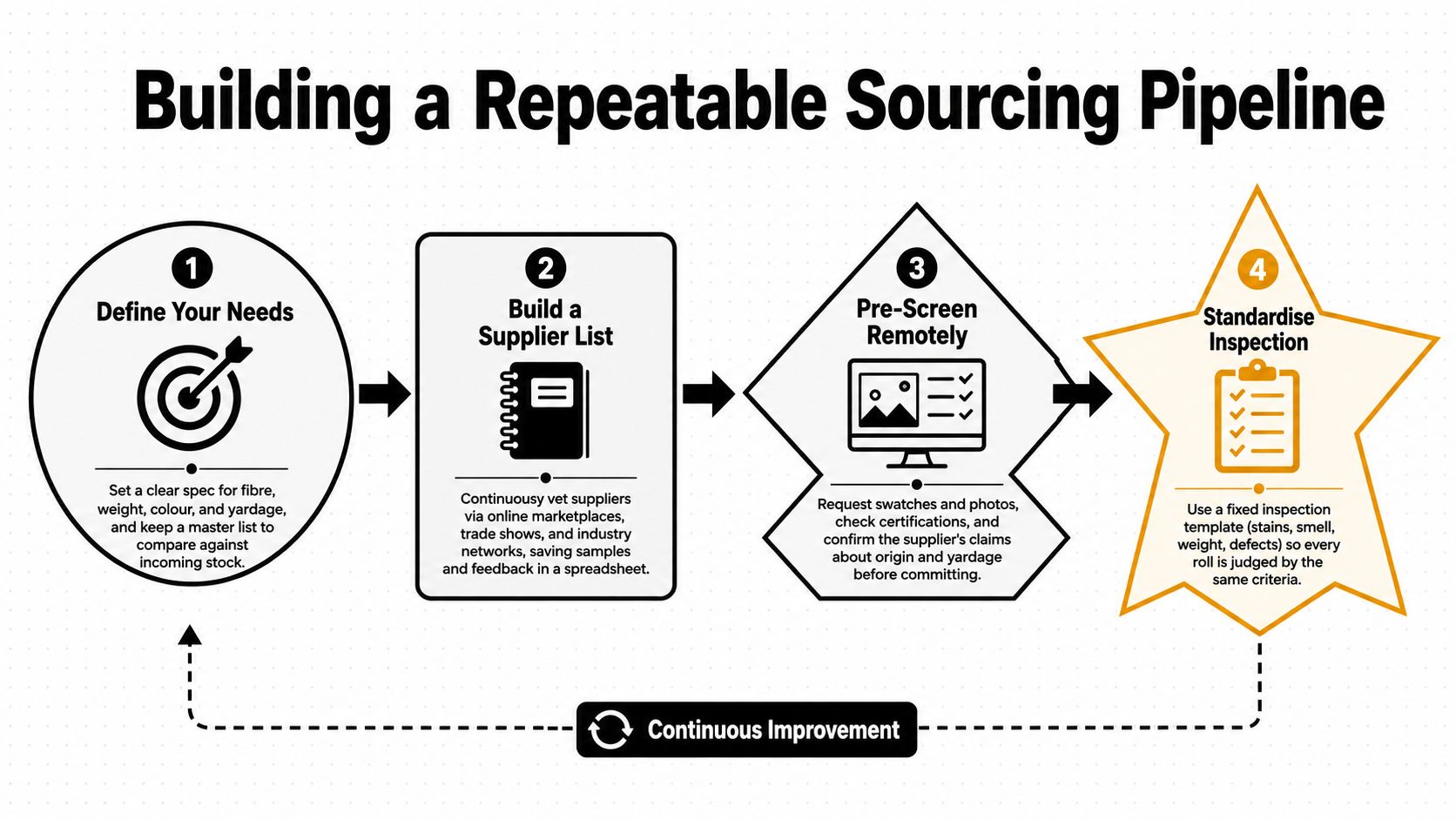
A repeatable deadstock pipeline begins with acceptance that most opportunities won't return. The answer isn't to avoid deadstock. It's to make each purchase produce useful information, supplier history, approved samples, and a clearer substitute plan.
Define the specification before browsing
Create a master sheet with fibre, construction, weight, width, colour tolerance, intended garment, minimum usable meterage, and acceptable defects. Add a column for alternatives, such as a similar cotton twill or a comparable viscose blend. This stops an attractive roll from changing the project's requirements mid-search.
Your first outreach message should be short:
“I'm looking for unused UK deadstock suitable for . Please confirm fibre composition, finished width, weight, usable meterage, origin, storage condition, defects, and whether the lot can be repeated. Please include roll and label photographs.”
A supplier who answers fully gets a sample request. A supplier who avoids composition, origin, or defects stays in the prospect column.
Record every supplier interaction
Use a spreadsheet to save contact details, categories handled, sample outcomes, price bands, delivery performance, and reasons for rejection. Ask good suppliers to alert you before new stock goes public. Early access matters because one-off lots can disappear while you're still deciding.
Lock down the minimum order quantity and confirm fibre composition before approving a production sample. Also record dye-lot references and photograph the approved fabric in consistent light. If you need to match later, those records won't recreate the cloth, but they will help you reject a visibly unsuitable substitute.
Plan for stockouts at design stage. Use pattern layouts that tolerate width variation, reserve enough fabric for replacements, and avoid promising permanent colour continuity when the source can't provide it. A capsule or limited run is often a more honest fit than a core product expected to remain unchanged.
Design teams can also use AI for fashion design workflows to explore silhouettes and variants before committing scarce deadstock to sampling. The tool doesn't replace physical inspection, but it can help you test how a limited lot might support several coordinated design directions.
Standardise the decision
Give every roll the same pass, conditional-pass, or fail outcome. Keep the approved swatch with the order record, and note which defects are acceptable for that particular product. Over time, this creates a supplier score based on evidence rather than excitement.
The pipeline becomes dependable when each purchase answers a future question: what does this supplier handle, what defects recur, how quickly do they respond, and which substitute fabrics can keep the design viable?
Real-World Deadstock Sourcing Scenarios
A dressmaker buying a non-repeatable lot may find the second roll has a different dye character from the first. Treat each batch as a separate production decision. Allocate one lot to bodices and another to skirts, then make the contrast deliberate only after checking both under daylight and indoor lighting. A cheap mixed lot becomes expensive if the difference appears accidental in finished photographs.
A textile student preparing a graduate collection can reduce exposure by choosing designs that tolerate limited meterage. Start with a physical sample, map every pattern piece against the fabric's actual width, and reserve the most distinctive sections for visible panels. Approve that layout before buying trims or booking final photography. The roll must support the collection, not merely look affordable in a listing.
Small brands also need to account for the legal and ethical status of surplus stock. A supplier may describe cloth as deadstock, while its handling requirements depend on whether it remains a usable product or has entered a waste stream. Ask for the material's status, keep the paperwork, and describe the fabric accurately. Surplus use gives existing cloth another purpose, but it does not erase the overproduction that created it.
Deadstock fits limited runs, experimental pieces, and makers able to design around uncertain replenishment. New fabric is often the safer choice for a core style requiring stable colour, repeat orders, and controlled specifications. The decision rests on product lifespan and procurement risk, not the deadstock label alone.
For a limited run, compare unusual surplus cloth with dependable everyday materials and request a sample before committing. More Sewing lists deadstock and ex-designer fabrics alongside cotton, viscose, Tencel blends, jerseys, denims, haberdashery, and sewing kits, with sample swatches available. Check the swatch against your pattern, record the specification, and buy only when the actual cloth supports the intended make.
