
Blog, Dressmaking
Patterns of Jackets: A Maker’s Guide to Styles and Fit
You're standing at the fabric shelf with a swatch of heavyweight wool in one hand and a softer cotton twill in the other. On the workbench, a folded jacket pattern promises a satisfying new project, but the central question isn't which cloth looks nicest. It's whether the fabric, pattern family, interfacing, lining and ease will cooperate at the sewing machine.
That decision separates a wearable jacket from an expensive experiment. A blazer, bomber, trench, denim jacket, coatigan, anorak and jacket may all begin as paper pieces, but they demand very different handling. The right choice fills a genuine wardrobe gap, suits your current skills and gives the cloth enough support to behave as intended.
The history of British tailoring helps explain why these choices matter. The fitted jerkin emerged during the Middle Ages, the button and buttonhole appeared in the 13th century, and British tailoring moved through frock coats into the modern lounge suit by the 19th century. The blazer has a recognised origin at Cambridge in 1825, when the Lady Margaret Boat Club wore bright red jackets, as documented in the history of the suit jacket. Those traditions established the waist shaping, lapels, collars and balanced sleeves that still define many patterns of jackets today.
Finding Your Next Jacket Project
The most useful way to choose a jacket pattern is to treat it as an engineering decision. A dramatic collar may attract you first, but the pattern will succeed or fail according to the relationship between its silhouette and the fabric's weight, stability and recovery.
Start with the wardrobe gap. If you need a layer for commuting, an anorak or utility jacket makes more sense than a delicate unlined blazer. If your wardrobe lacks something smart enough for work but relaxed enough for weekends, a soft blazer or coatigan may earn more wear than a formal jacket. A denim jacket can handle everyday use, while a cropped trench brings a sharper fashion direction without requiring the full structure of traditional tailoring.
Read the cloth before the envelope
Hold the pattern pieces against the fabric rather than relying only on the photograph. A heavyweight wool coating may overwhelm a darted bodice with narrow seam allowances, whereas a stable cotton drill can give a denim or chore-style jacket enough body without becoming unmanageable. Soft Tencel, viscose and ponte can produce a comfortable bomber or relaxed blazer, but they won't automatically create a crisp lapel.
The fabric also determines the support plan. Merchant & Mills' Paynter jacket pattern is graded XS–XXL, includes 1.5 cm seam allowances, recommends light to medium weight woven fabrics up to 8 oz, and specifies about 0.8 m of interfacing plus several button sizes, details given on the Paynter jacket pattern page. Those requirements show why interfacing isn't an afterthought. It affects collar roll, pocket stability and the way the front closes.
Choose a project you'll finish
A first jacket doesn't have to be plain, but it should keep the construction demands visible. An unlined denim jacket or simple coatigan lets you practise accurate cutting, pressing, topstitching and sleeve insertion without adding a complex internal architecture. A bomber introduces zips and ribbing, while anoraks add casings, hoods and technical details.
Jackets sit at the most demanding end because lapels, shoulder balance, sleeve heads and internal support all interact. British tailoring education treats jacket pattern cutting as a distinct technical skill, including altered pattern pieces, dart movement, changed seam lines, fit and silhouette work, as reflected in the menswear pattern-making course information from Leeds School of Beauty and Aesthetics.
The anatomy below gives you the vocabulary to judge those demands before you cut.
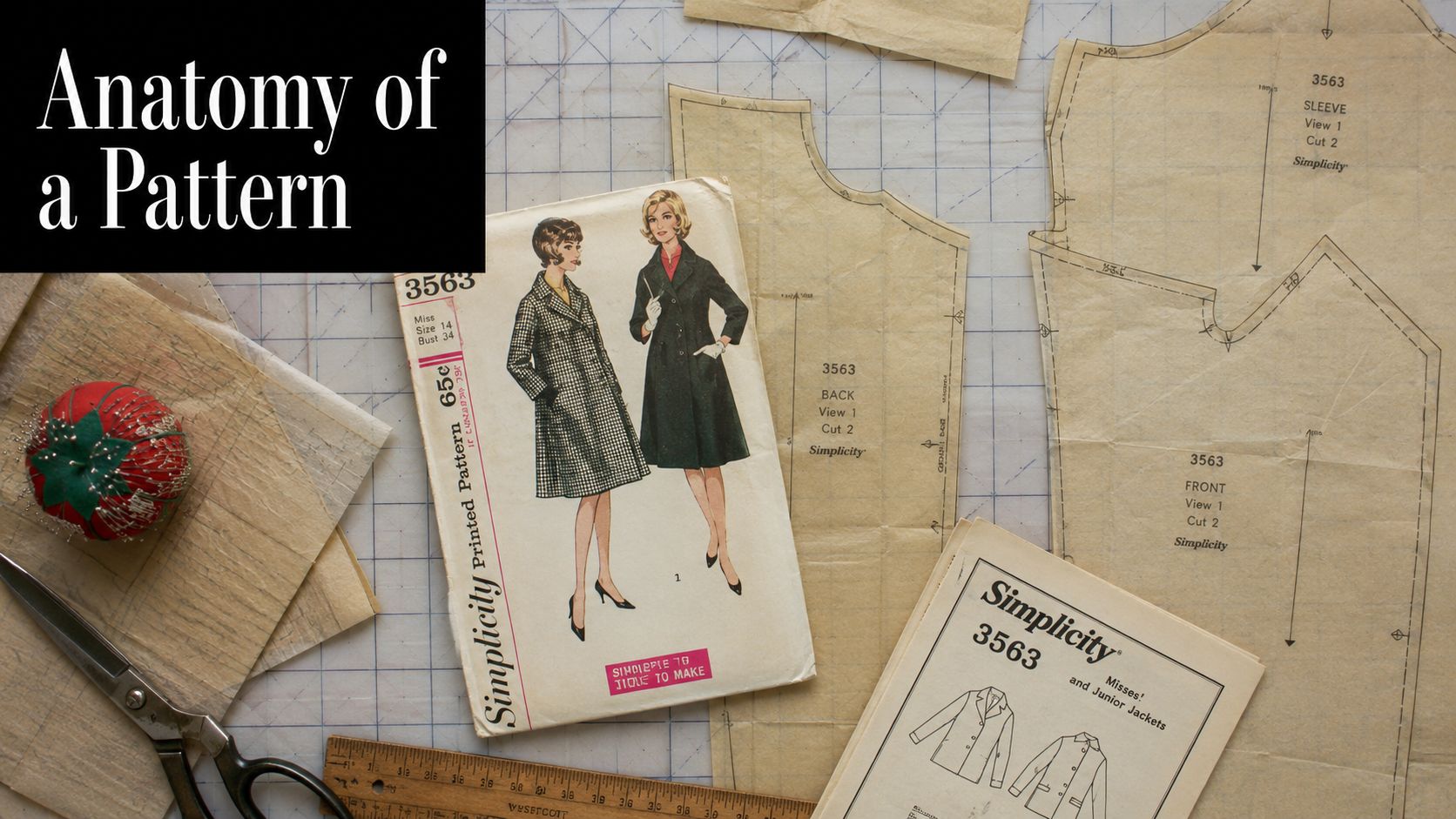
The Anatomy of a Jacket Pattern
A jacket pattern starts with a bodice block, the basic fitted upper-body shape from which a designer develops a particular style. The block establishes the bust, waist, shoulder and side-seam relationships. A blazer may retain close waist shaping, while a bomber or anorak usually adds room through the chest and hem for layering.
Ease is the space between your body and the finished garment. Wearing ease allows movement and clothing underneath. Design ease creates the intended silhouette, such as the volume of a boxy coatigan or the relaxed body of a bomber. Check the finished garment measurements, not only the body chart. Extra room at the bust can be useful, but too much at the shoulder may make a jacket look dropped and unstable.
A dart controls volume. A fitted blazer often uses a bust dart, which may continue towards the side seam or move into a princess seam. A French dart starts lower on the bodice and can create a long, elegant line. A casual bomber might use a French-dart-like shaping approach, although many bomber patterns rely instead on a loose block, ribbed hem and gathered sleeve.
Front edges and internal support
A facing finishes an edge from the inside. It's common around an unlined blazer front, neckline or armhole, and it keeps the project lighter than a full lining. A full lining covers the inside of the jacket, conceals construction, helps the garment slide over other clothes and can make a piece feel substantially more polished.
On a notched collar, the collar stand is the part that rises from the neckline, while the collar fall turns away from the neck. A stable stand supports the collar's roll. If the fabric is too limp or the interfacing is poorly matched, the notch can collapse or sit away from the body.
Sleeves also reveal the pattern's ambition. A cut-on sleeve is quick and often suits an easy coatigan or relaxed jacket. A two-piece sleeve takes longer to assemble, but its seam allows shaping around the elbow and forearm. It can provide better movement and a neater line than a wide one-piece sleeve.
Interfacing zones
Apply support where the jacket needs controlled behaviour, not automatically across every piece. Front edges, collars, cuffs, pocket mouths and waistbands commonly need interfacing. A structured fabric may need lighter support than a soft cloth, but a heavy interfacing can create unwanted bulk at seams and buttonholes.
The guide to comparing clothing design platforms can help if you're exploring digital design tools, but software won't decide whether a cloth needs a firm or flexible interlining. That judgement still comes from the pattern, the fabric and a test sample.
Comparing the Major Jacket Families
The table below gives a practical first sort. Fabric weight is expressed in gsm, but treat the ranges as working guidance rather than rigid rules. A pattern's seam structure, interfacing and intended ease can shift the suitable cloth considerably.
Jacket families at a glance
| Jacket family | Silhouette | Key features | Fabric weight (gsm) | Difficulty |
|---|---|---|---|---|
| Blazer | Shaped, waist-defined or relaxed | Lapels, buttons, pockets, optional lining | 180–350 | Beginner plus to intermediate |
| Bomber | Short, relaxed and rounded | Zip, ribbed hem, cuffs, knitted collar | 140–280 | Beginner plus to intermediate |
| Trench | Structured, layered and often belted | Storm flap, collar, sleeve tabs, bound seams | 180–350 | Intermediate to advanced |
| Denim jacket | Boxy or fitted, waist to hip length | Patch pockets, metal buttons, topstitching | 250–400 | Beginner plus to intermediate |
| Coatigan | Relaxed, cardigan-like outer layer | Open front, facing or minimal closure, soft shaping | 250–500 | Beginner plus |
| Anorak | Practical, loose and protective | Hood, zip or snaps, casing, patch or bellows pockets | 100–250 | Intermediate |
| Tailored jacket | Precisely shaped and balanced | Canvas, pad-stitched lapels, set-in sleeves, welt pockets | 250–450 | Advanced |
A blazer looks accessible because the pieces resemble a bodice, but lapel construction, front edge pressing and sleeve setting can expose fitting problems quickly. Choose a relaxed commercial blazer pattern in stable twill before attempting a narrow, fully lined version.
A bomber is shorter and more forgiving at the body, yet the zip, ribbing and sleeve cuff need accuracy. The Fibre Mood bomber style is a useful search reference for this family. A stretch jersey or ponte makes the first version easier, provided the pattern permits stretch and the ribbing is compatible.
A trench is where a simple outline hides substantial work. Storm flaps, bound seams, belt loops, sleeve tabs and a double-breasted front multiply the points that must align. It's rewarding in a crisp cotton or technical woven, but it isn't a sensible first jacket merely because the pattern pieces look rectangular.
A denim jacket teaches excellent fundamentals. Patch pockets and visible topstitching demand patience, while heavier cloth makes pressing and seam management important. A coatigan, such as Tilly and the Buttons' Eden style, can be more forgiving because its relaxed shape often avoids a complicated closure.
An anorak is practical but technically busy. Hoods, channels, elastic, snaps and bellows pockets require careful construction order. A fully constructed jacket is the most exacting option. Pad-stitched lapels, canvas support, shoulder shaping and welt pockets reward slow work, not rushed confidence.
Closures, Collars and Construction Details
A jacket's closure often reveals its workload more clearly than the illustration. A simple button band still needs accurate spacing and stable interfacing. A double-breasted wrap front adds overlap, button placement and a wider area that must stay balanced. Zips require careful insertion and a clean top edge, while snaps are quicker but still need reinforcement.
Ties and frogs suit a coatigan or relaxed jacket when you want to avoid buttonholes, although they give the garment a softer, more decorative emphasis. A zip keeps a bomber practical and sporty. Metal buttons with dense topstitching reinforce a denim jacket's workwear character. The closure alone does not decide difficulty. Fabric weight, interfacing and the support around it determine how forgiving the operation will be.
Collar decisions
A notch collar has a break point, roll line, and separate stand and fall. A peak lapel sharpens the shoulder line, so the point and adjoining seams need exact matching. A shawl collar removes the notch but depends on a smooth curve and controlled pressing. A stand collar or funnel neck may involve fewer pieces, yet the neckline must fit closely enough to look deliberate rather than loose or strained.
An anorak hood replaces the usual collar construction with a shaped hood and often a casing. A shirt collar has familiar points, but adding a stand creates extra layers that must be clipped, turned and pressed accurately. Bomber ribbing avoids a woven collar, though stretching, joining and attaching the rib evenly can still challenge a beginner.
Choose the collar with the fabric in mind. A crisp cotton drill can support a defined notch or stand collar. A softer viscose or Tencel blend is better suited to a relaxed, open edge where the cloth can fall without fighting the shape.
Pockets and inside finishing
Pocket design affects both appearance and construction. Patch pockets are visible and relatively direct. Flap pockets add layers and placement decisions. Welt pockets demand accurate cutting, marking and stitching, while bellows pockets create volume through pleats or gussets. In-seam pockets are discreet, but the opening can gape if its length and the fabric weight are poorly controlled.
| Detail | Skill Level | Typical Technique | Pattern Example |
|---|---|---|---|
| Single-breasted buttons | Beginner plus | Interfaced band, marked buttonholes | Simplicity blazer range |
| Zip front | Beginner plus | Stabilised zip insertion and topstitching | Fibre Mood bomber |
| Open front | Beginner | Facing, clean edge pressing | Tilly and the Buttons Eden coatigan |
| Notch lapel | Intermediate | Roll-line pressing and careful clipping | Simplicity blazer range |
| Bound seams | Intermediate | Bias binding, enclosed raw edges | Trench pattern |
| Welt pockets | Advanced | Precision window construction | Structured jacket |
| Pad-stitched lapels | Advanced | Hand stitching canvas and shaping roll | Traditional structured jacket |
| Ribbed cuffs and hem | Intermediate | Stretch control and even distribution | Fibre Mood bomber |
Lining changes the order of construction. A lined blazer may use a bagged lining method, while an unlined jacket needs seams finished neatly because they remain visible. Bias-bound seams take time, but they suit a garment intended to look considered inside and out. Hand-stitched hems are slower than machine topstitching and preserve a clean outer line on a softly structured coat.
Matching Jacket Patterns to Fabric
Fabric selection starts with stability. A jacket pattern with a darted bodice, lapel or set-in sleeve needs a cloth that can hold a pressed edge without fighting every seam. More Sewing's range includes cottons, denims, viscose and Tencel blends, jerseys, and ex-designer deadstock, which gives a home dressmaker several routes into the same jacket family through different fabric behaviours.
| Fabric Category | Best Jacket Patterns | Why It Works |
|---|---|---|
| Cotton drill | Denim jacket, chore coat, utility blazer | Stable, durable and able to support patch pockets and topstitching |
| Denim | Denim jacket, cropped jacket, relaxed coatigan | Holds shape and makes strong workwear details |
| Viscose or Tencel | Soft blazer, bomber, unlined jacket | Drapes well and gives movement to relaxed silhouettes |
| Jersey or ponte | Soft bomber, knit blazer, casual jacket | Stretch supports comfort and reduces restriction |
| Deadstock wool coating | Trench, coatigan, simple boxy jacket | Provides warmth, body and a distinctive surface |
| Ex-designer wool or cashmere | Boxy jacket, coatigan, understated blazer | Elevates a simple shape through cloth quality |
| Technical woven | Anorak, utility jacket, cropped trench | Handles practical details and protective outer layers |
A mid-weight cotton drill is a sensible partner for a structured denim jacket because it supports pocket mouths, button bands and topstitching without the bulk of very heavy coating. Denim behaves similarly, but pre-wash it if the final garment will be laundered. Test shrinkage and colour transfer before cutting.
Viscose and Tencel are useful for a relaxed blazer or bomber, especially when paired with a smooth lining. They drape, so they won't create the crisp architecture of wool without additional support. Stretch jersey or ponte can make a forgiving bomber, but don't force it into a pattern drafted for rigid woven cloth. Check the pattern's stretch guidance and stabilise zip seams where necessary.
Handling wool and deadstock
Deadstock wool coating suits a coatigan, boxy jacket or uncomplicated trench. Ex-designer wool and cashmere can make a simple pattern look exceptional, but expensive cloth doesn't excuse poor preparation. Press a test scrap, examine the nap, identify the grain and plan pattern placement before cutting.
Avoid putting heavy coating on a darted bodice block unless the pattern specifically allows it. Thick cloth can make darts bulky, distort facings and overwhelm a narrow sleeve cap. In that situation, choose a simpler seam structure, convert darts into panels where appropriate, or select a lighter coating.
Always pre-wash, steam or otherwise treat the cloth according to its care requirements before cutting. Align checks and stripes carefully. For a jacket, a visible grid helps you plot and trace pieces accurately, and the tailored jacket drafting guidance from The London Pattern Cutter recommends measuring the check units across multiple checks before building the drafting grid.
Fitting and Altering a Jacket Pattern
Jacket fitting starts before the good fabric leaves the shelf. Choose the closest size, alter the paper pattern first and make a toile in calico or an old sheet. The Sewing Directory recommends 1.5 cm seam allowances as standard and sometimes 2.5 cm for testing, with the reminder that seams may need releasing or darts adjusting before changes are transferred back to the pattern in its accurate fitting guidance.
Make the toile diagnostic
Construct the body, shoulder seams and one sleeve. You don't always need every pocket or facing for the first fitting, but you do need enough of the jacket to judge balance. Close the front as the finished garment will close. A jacket that looks fine open may pull across the bust or sit unevenly when buttoned.
Look first at the shoulder. A sloping shoulder can create diagonal drag lines from the neckline towards the arm, while a straighter shoulder may need extra support at the outer edge. Narrow shoulders can leave the sleeve seam falling beyond the arm, and broad shoulders can make the armhole feel tight even when the bust measurement looks correct.
Correct movement and balance
Restricted movement often comes from the armhole, sleeve cap or back width rather than the sleeve length. Check whether the sleeve is too shallow at the biceps, whether the cap is too high, or whether the back needs more room. A two-piece sleeve can be altered for a forward arm posture by adjusting the forearm and elbow shaping, then walking the seams together again.
Use the high bust as an anchor when grading between sizes. Blend towards a fuller bust or waist size through the side seam, but preserve the shoulder and neckline if they already fit. Add or remove ease through the bust and back in controlled amounts, and keep the front-to-back balance even so the side seam hangs straight.
Lengthen or shorten at the pattern's lengthen-shorten line, not randomly through the hem. A jacket hem, pocket and button position all depend on that length, so move the relevant markings with the adjustment.
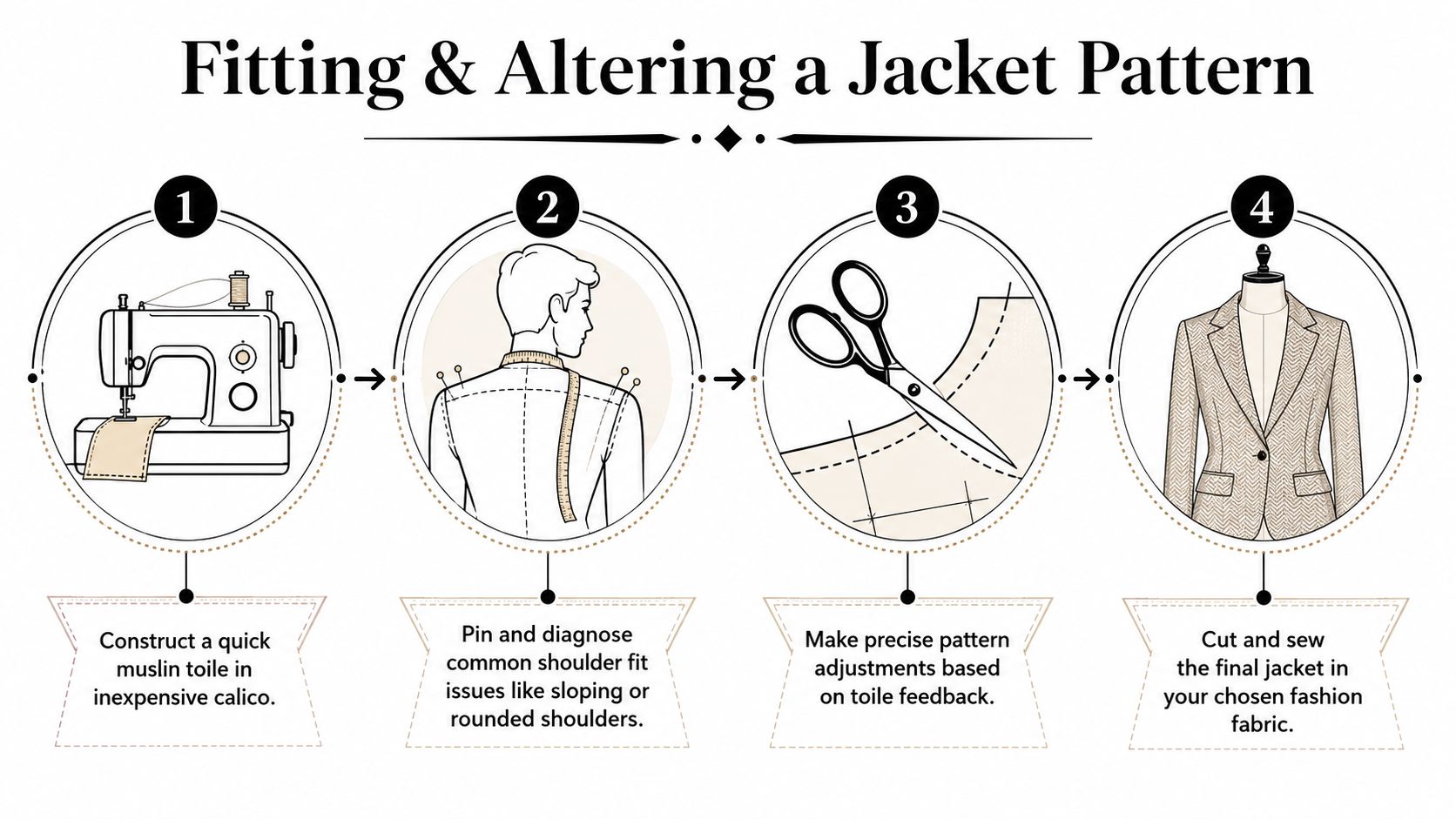
For a more precise approach, jacket fitting is best treated as diagnosis followed by remedy. Savile Row Bespoke Academy presents jacket work in that iterative spirit, rather than as a matter of choosing a size once and sewing without revision, in its bespoke jacket-fitting training context.
A useful fitting demonstration is also available below.
Choosing Your Next Jacket Pattern With Confidence
The best pattern is the one whose demands match your life as well as your sewing ability. Use four filters before buying paper or downloading a PDF: where you'll wear the jacket, whether you can execute its techniques, how much uninterrupted time you have, and whether a suitable fabric is available.
Filter one is actual wear
A jacket for daily errands needs different priorities from one intended for occasional dressing up. An anorak earns its place through weather-friendly practicality. A soft blazer can cover work and social occasions. A cropped jacket may look current and still work as a wardrobe layer if the hem sits comfortably over the clothes you already wear.
UK fashion coverage identifies cropped trenches, heritage checks, technical utility and funnel-neck silhouettes among the spring 2026 outerwear directions in Harper's Bazaar UK's jacket trend coverage. That makes trend awareness useful, but the practical question remains whether the pattern can work across your wardrobe and climate.
Filter two is honest technique matching
A first jacket maker might choose an unlined denim jacket or coatigan. Those styles teach accurate seams, pressing, pockets and edge finishing without demanding full tailoring. An intermediate sewist ready for linings and set-in sleeves could choose a relaxed blazer or bomber in Tencel, where the fabric adds drape without requiring a rigid structure.
Advanced makers can move towards a jacket with welt pockets, a full canvas interfacing system and pad-stitched lapels. The drafting space alone can be substantial. One UK-facing lesson specifies a 27-inch, 68.6 cm square of unlined paper, lines 2 inches, 5.1 cm, from three edges, and a separate piece measuring 8 by 24 inches, 20.3 by 61.0 cm, as shown in the jacket draft and drape lesson. Another women's jacket guide specifies paper measuring 29 by 36 inches, 73.7 by 91.4 cm, with slopers about 4 inches, 10.2 cm, apart and about 9 inches, 22.9 cm, above for the collar area, in this pattern-cutting resource.
Filter three and four are time and cloth
A simple anorak can be the first project in a three-jacket progression. The maker might then sew an unlined denim jacket with patch pockets, using it to improve topstitching and sleeve control. The third project could be a fully structured jacket, where the earlier fitting and pressing practice makes the technical work less intimidating.
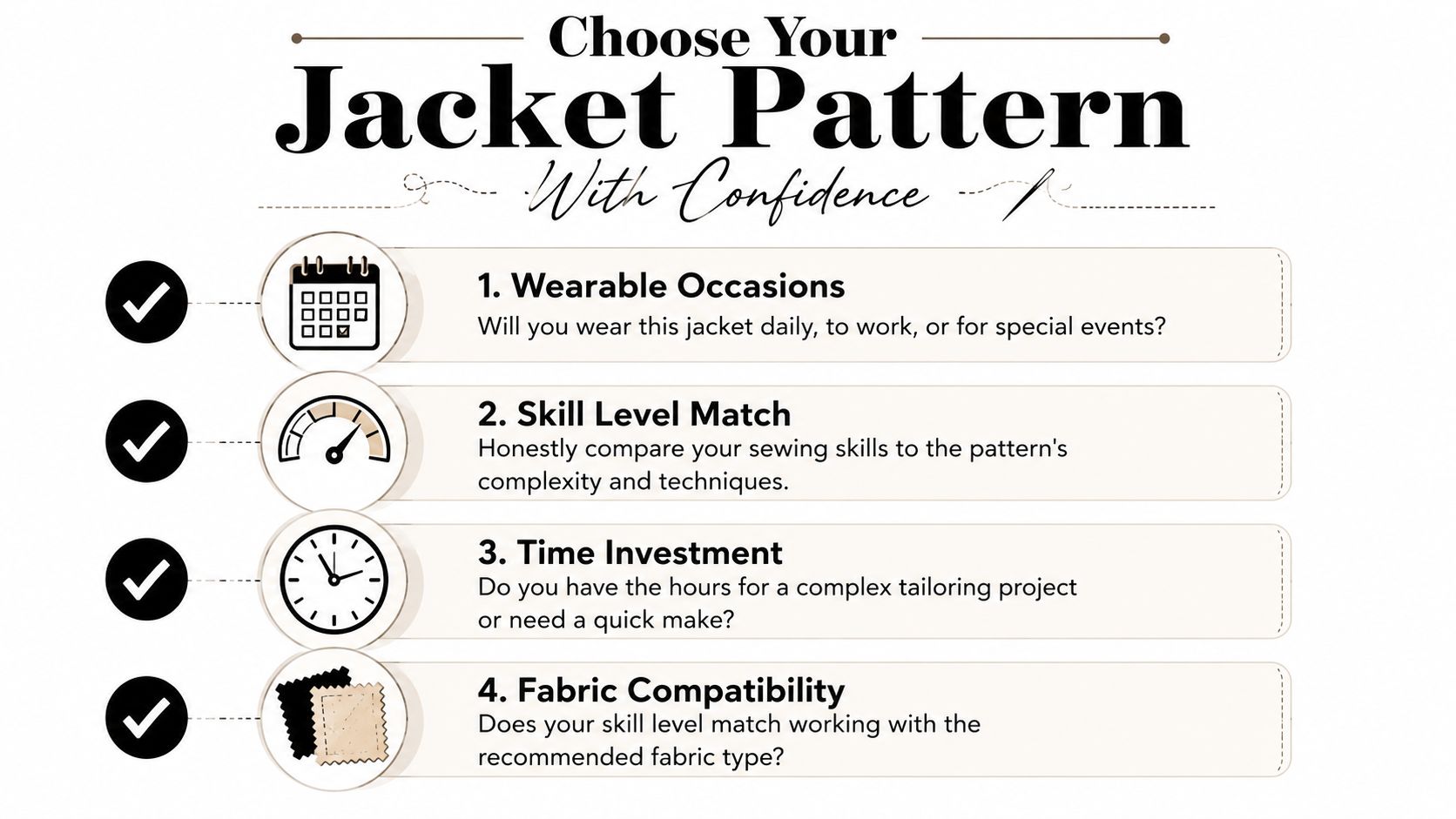
Before committing, lay out the pattern pieces and compare them with the cloth's width, nap, checks and stability. More Sewing offers fabrics and haberdashery relevant to jacket sewing, including cottons, denims, viscose and Tencel blends, jerseys and ex-designer deadstock, as well as ready-to-sew kits and practical sewing supplies. Its sample swatches can help you judge surface, drape and weight before choosing the final pattern pairing.
The same maker may progress from a practical anorak to a denim jacket and then to tailoring, but each project should answer a real wardrobe need. That's how patterns of jackets become a useful sewing practice rather than a pile of ambitious paper waiting for the right weekend.
Choose your next jacket pattern by writing down the occasion, construction technique and fabric you'll use before cutting. Visit More Sewing to explore suitable jacket fabrics, haberdashery, sample swatches and ready-to-sew kits, then select a project that matches both your wardrobe and your confidence at the machine.
