
You've threaded the machine, lowered the presser foot and chosen a straight stitch. Then you look at the fabric beside you and wonder whether that old sheet, shiny remnant or soft jersey will make a sensible first lesson. That hesitation is normal. The best fabric for sewing machine beginners to practice on isn't necessarily the prettiest or cheapest cloth. It's the one that lets you see what the machine is doing while giving you enough control to correct small mistakes.
For most UK beginners, that means a stable woven cotton, especially quilting cotton, cotton poplin or calico. These fabrics make it easier to practise straight seams, accurate cutting, pressing, tension checks and simple construction before slippery, stretchy or highly draped materials make those same skills harder.
Why Your First Fabric Choice Matters More Than You Think
A new sewist often blames the machine first. The stitches look uneven, the fabric creeps sideways and the bobbin thread appears on top, so the machine must be faulty, right? Not necessarily. The fabric may be shifting under the presser foot, stretching as you sew or resisting the needle because it's too slippery or lightweight for an easy first session.
Take two beginners practising the same seam. One uses a firm quilting cotton and marks a clear seam line. The other chooses a satin remnant because it looks like something worth making. The first person can concentrate on guiding the edge, keeping a steady speed and stopping at the right point. The second is managing shine, sliding layers, possible puckering and a surface that can hide what the stitches are doing. They're learning the machine and fighting the material at the same time.
A useful rule: If you can't tell whether the problem comes from your technique, your settings or the fabric, choose a more stable fabric before changing everything on the machine.
The UK's long relationship with cotton helps explain why it remains the default teaching fabric. Cotton was first imported to England in the 16th century, and pure cotton cloth was being produced in Britain by 1750, according to Historic UK's history of the cotton industry. By the late 1700s, cotton products accounted for around 16% of Britain's exports, rising to about 42% in the early 1800s, with 100,000 spinners and 250,000 weavers working in the industry by 1812, as the same source records.
That history isn't just an interesting footnote. It helped establish cotton as a familiar, widely available family of woven cloths in British sewing culture. The more predictable the weave, the easier it is for a beginner to compare fabrics, repeat a machine setting and understand why a seam behaves differently after pressing.
Early success changes how you learn
A first practice piece doesn't need to be perfect. It does need to give you useful feedback. On stable cotton, a crooked line is usually your guiding or marking issue, not the fabric skating away. A small loop on the underside points you towards threading or tension. A puckered seam invites you to inspect stitch length, pressing and fabric handling.
Those clear signals build confidence. You can make one adjustment, test again and see whether it helped. That steady cycle is far more productive than abandoning the project because the fabric appears impossible.
The Properties That Make Fabric Beginner-Friendly
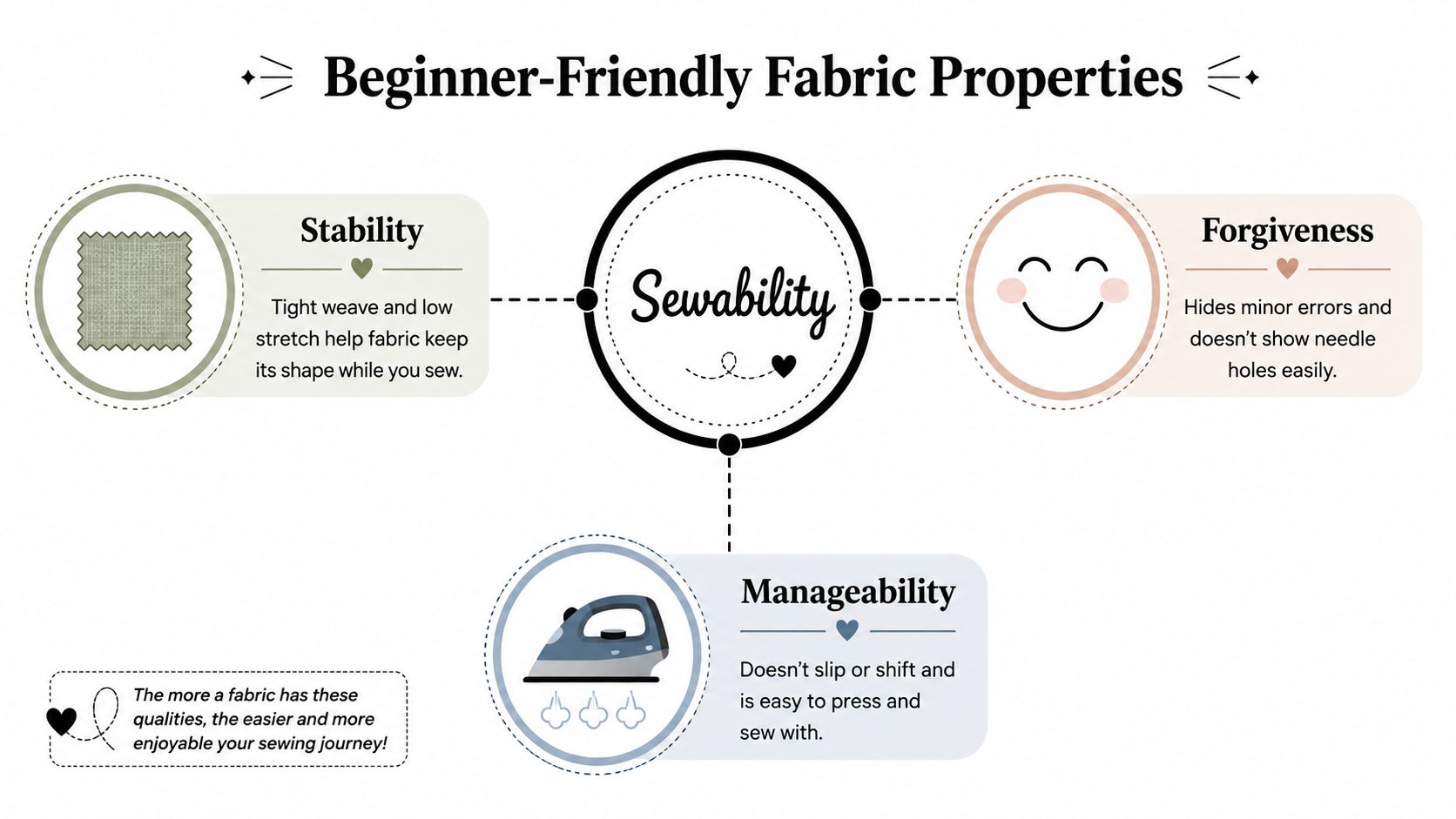
A beginner-friendly fabric is stable, reasonably firm, non-stretch and easy to see and handle. You're looking for cloth that stays close to its original shape as it passes under the presser foot, rather than fabric that slides, curls, grows or collapses.
Stability comes first
A tight weave gives the needle a consistent surface to enter. Quilting cotton is a good example. The threads sit firmly together, the cut edge is relatively predictable and the fabric usually stays flat when you guide it through a straight seam.
Stretch is the main complication to postpone. A jersey can lengthen as you sew, while a woven cotton generally holds its dimensions. That difference matters when you're trying to keep two edges aligned or learn to maintain an even seam allowance.
Cotton Club Sew describes quilting cotton, cotton poplin and cotton lawn as suitable UK starting points because they're non-stretch, crisp and tightly woven, reducing slippage under the presser foot. Its guidance also notes that a medium weight around 200gsm can feel easier for a novice than a very light fabric because the denser structure provides a sturdier base for stitching and control. Read the UK guide to beginner-friendly fabrics when you're comparing descriptions online.
Weight affects feedback
Very light voile or lawn may feel delicate and pleasant, but it can shift more readily and show distortion if you pull while sewing. A denser cotton gives your fingers more to hold and makes pressing lines easier to establish.
Weight alone doesn't decide whether fabric is suitable. A light, crisp lawn can be manageable once you've developed control, while a heavy, loose weave can still be awkward. Rub the fabric between your fingers, hold a cut edge and check whether it springs, stretches or collapses.
Surface and pressing matter
A smooth surface helps the fabric slide under the foot without catching. A crisp hand lets you fold, press and align layers accurately. “Forgiving” doesn't mean the fabric conceals every error. It means small inaccuracies are less likely to become distorted seams or difficult-to-correct ripples.
Old sheets, curtains and offcuts can work well if they're clean, firmly woven and free from excessive wear. Liberty's beginner fabric guide distinguishes quilting cotton, poplin, lawn and chambray as useful woven starting points, while also recognising household textiles as practical practice sources.
Comparing the Best Cotton Types for Practice
Not every cotton gives the same lesson. Quilting cotton is excellent for control, but poplin can feel more relevant to dressmaking. Lawn develops a lighter touch, while calico offers an inexpensive surface for testing without worrying about print direction or matching.
| Fabric Type | Weight/Feel | Best For Practising | Typical Cost |
|---|---|---|---|
| Quilting cotton | Stable, smooth and crisp | Straight seams, seam allowance, patchwork and pressing | Usually accessible and economical |
| Cotton poplin | Smooth, firm and suitable for garments | Garment seams, collars, simple curves and button plackets | Often affordable |
| Cotton lawn | Lightweight, soft and finely woven | Gentle handling, narrow hems and lighter garments | Can cost more than basic practice cotton |
| Calico | Unbleached, firm and plainly woven | Toiles, machine tests and construction exercises | Inexpensive practice option |
| Chambray | Woven, lighter than many denims and often soft | Casual garment panels, topstitching and handling a slightly different surface | Varies by quality and finish |
Match the cloth to the skill
Choose quilting cotton if your immediate goal is to sew a straight line, turn corners, make a coaster or practise joining two pieces accurately. Its regular construction makes mistakes visible without adding unnecessary movement.
Choose poplin when you're preparing for a first shirt, skirt or simple dress. It remains stable, but its smoother garment-fabric feel can make the transition from practice to clothing less abrupt. Cotton lawn is better saved for the point where you're comfortable controlling fabric without pulling it.
Calico sits slightly apart from the prettier cottons. It's particularly useful for a toile, a test version of a garment or a machine sample. UK clothes-making courses use calico as an unbleached cotton practice cloth, and Westminster Adult Education Service's clothes-making course information shows how it supports testing construction before committing to final fabric.
If you're unsure about quilting cotton's weave, print scale or suitability for a project, SouthShore Fine Linens' quilt fabric guide offers useful background on choosing quilting fabrics. In a shop, scrunch the fabric gently, inspect both sides and hold it against the light. Online, order a swatch where possible rather than guessing from a product photograph.
Setting Up Your Machine for Practice Fabric
Use the same short testing routine every time you begin. A reliable setup gives you a baseline, so you can identify whether a new fabric needs a small adjustment instead of changing several controls at once.
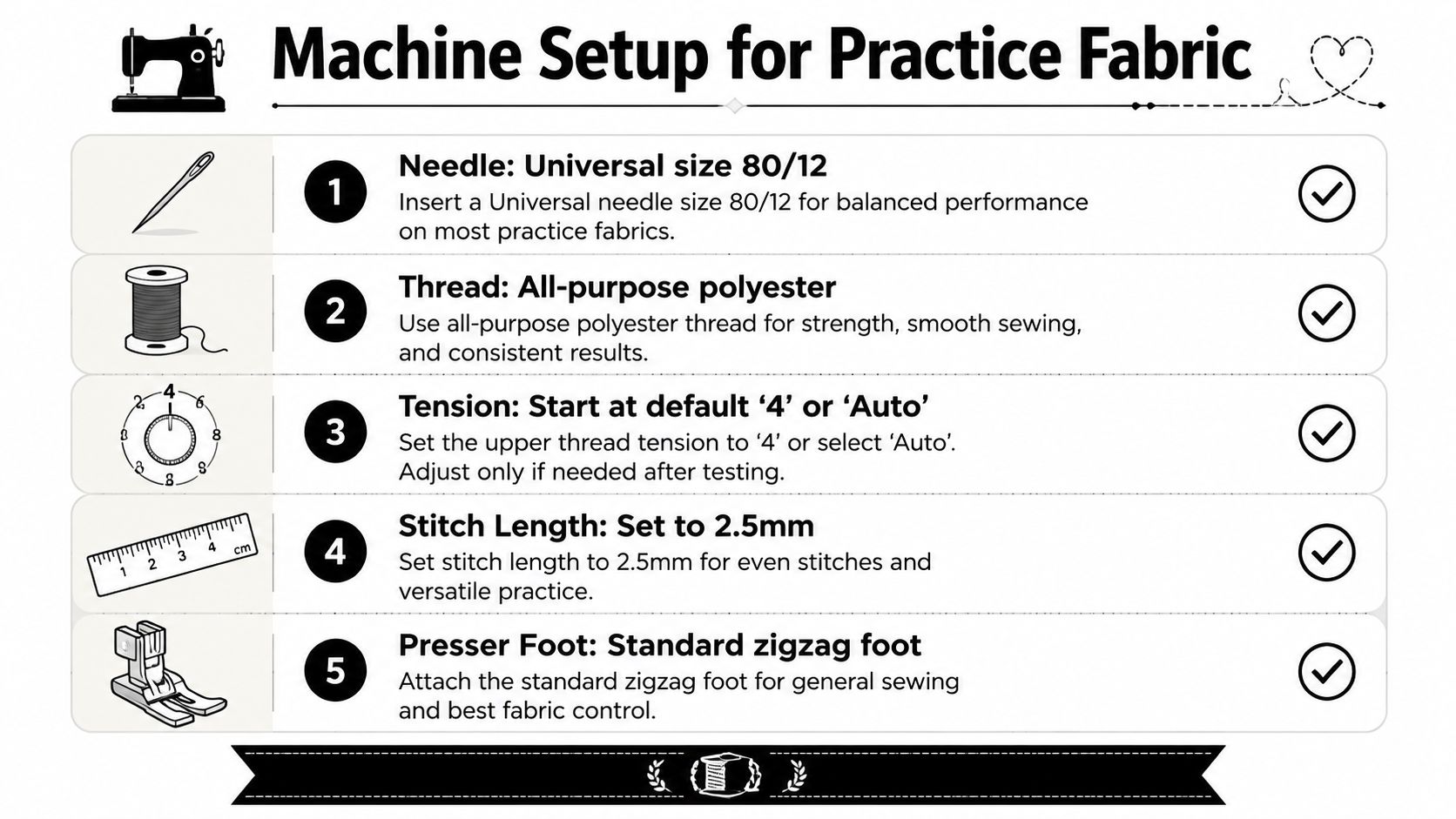
Start with a universal needle, an all-purpose polyester thread and the standard zigzag foot. Check that the needle is inserted fully and that the machine is threaded with the presser foot raised, which helps the thread sit correctly between the tension discs.
For cotton, UK machine guidance commonly suggests starting thread tension around 4 or 5, then testing and adjusting gradually. For lighter fabrics, a stitch length of 2.0 to 2.5 mm is a useful starting range. See the fabric-specific sewing machine settings guide for the recommended cotton baseline and the importance of checking both sides of the sample.
Sew, inspect and adjust
Cut a scrap from the same fabric and, if your project uses layers, test the same number of layers. Sew a short line without pulling the fabric. Look at the top and underside.
- Balanced stitches: The upper and bobbin threads meet within the fabric, with no loops or loose sections.
- Bobbin thread visible on top: Lower the tension gradually, following the practical guidance from My Fabrics' beginner sewing advice.
- Thread bunching underneath: Rethread with the presser foot raised, check the bobbin is correctly inserted and test again.
- Puckering: Avoid stretching the cotton as you sew, check the stitch length and press the seam rather than dragging an iron across it.
- Skipped stitches: Replace a blunt or bent needle and confirm that the needle suits the fabric.
Secure the beginning and end by sewing a few stitches forward, a few back and then forward again. Keep your hands lightly on either side of the seam. They should guide the fabric, not force it through the machine.
Practice Projects That Actually Build Skills
Endless lines on a scrap can teach coordination, but a small finished object gives each exercise a reason. Start with something that uses one or two techniques, then add a feature that requires more careful control.
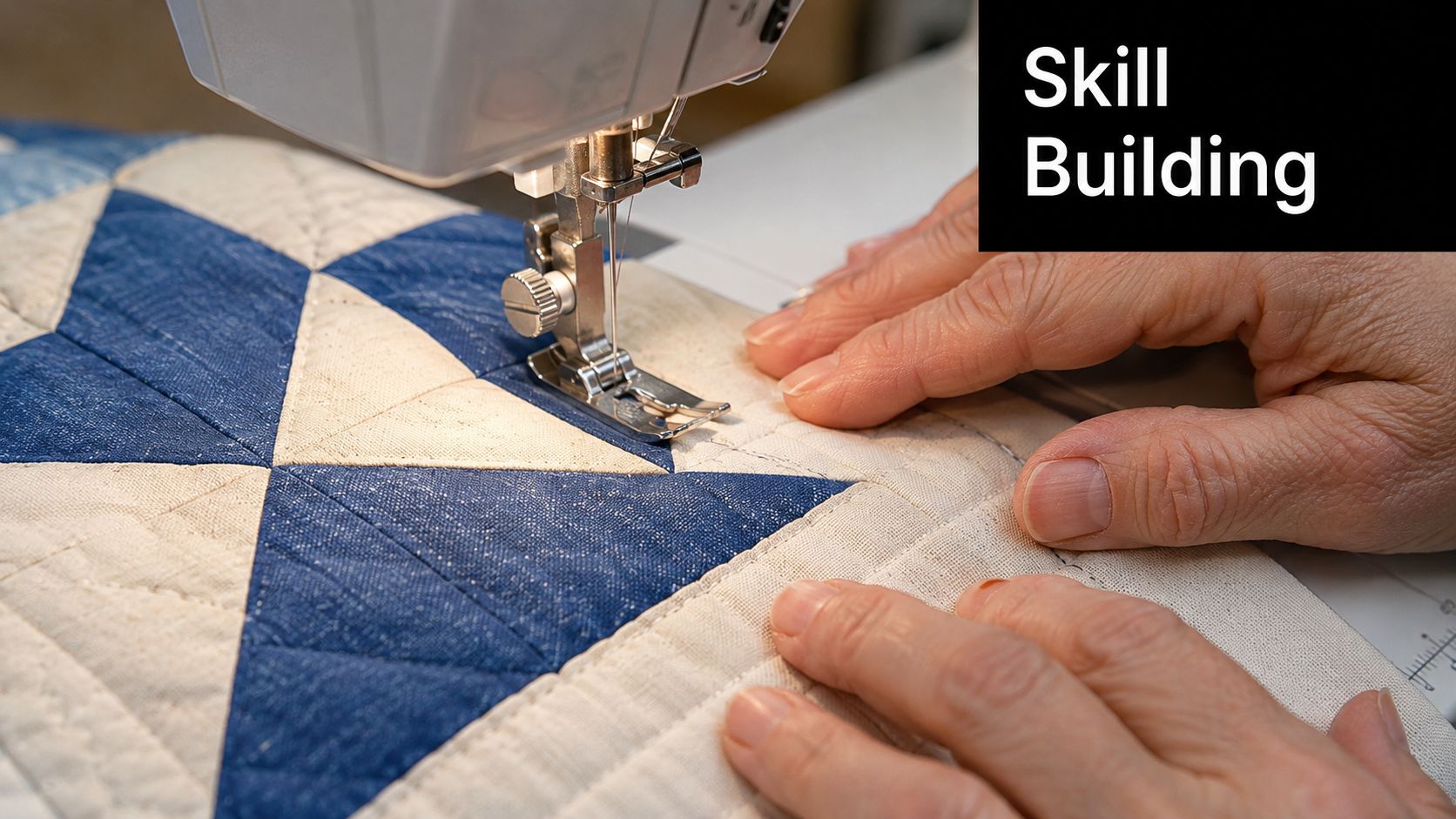
A pair of fabric coasters makes a useful first project. Quilting cotton gives you a stable surface for straight seams, clipping corners and turning a small shape right side out. Press the edges before topstitching, and you'll learn that the iron can correct construction more effectively than repeated machine adjustments.
A bookmark with a pointed or folded corner adds accuracy. You'll practise pivoting with the needle down, stopping at a marked point and trimming bulk before turning. Those are small skills, but the same actions appear in collars, pocket corners and many bag details.
Add controlled complexity
A drawstring bag introduces a casing, a folded edge and a larger piece that needs even feeding. Use poplin or quilting cotton first. Once you can sew the casing without catching the drawstring channel, try a gentle curve at the base to improve your control around changing directions.
A patch pocket is an excellent garment exercise. Mark the fold line, press it accurately, stitch the opening and attach the pocket without stretching the garment panel. You're practising a visible feature, so accuracy matters, but the cotton remains cooperative.
Build one skill per project: A useful sample should tell you what you were practising, such as turning a corner, easing a curve or keeping parallel topstitching lines.
For a modern alternative, use an old cotton shirt or sturdy household textile for visible mending. Practise securing a patch, stitching repeated lines and reinforcing a worn area. UK sewing interest is connected with upcycling, repair and social crafting, and a UK market report records that 17% of adults took part in textiles activities in the last 12 months, while more than half of adults did some form of arts and crafts. These figures appear in the 2025 UK sewing market report.
Once you've finished each exercise, keep a small sample with the fabric type, needle, stitch length and tension written on the back. That record becomes more useful than a pile of anonymous scraps.
The following demonstration can help you observe how fabric is guided under a machine needle. Watch the hands rather than trying to copy the speed.
Common Beginner Mistakes and How to Avoid Them
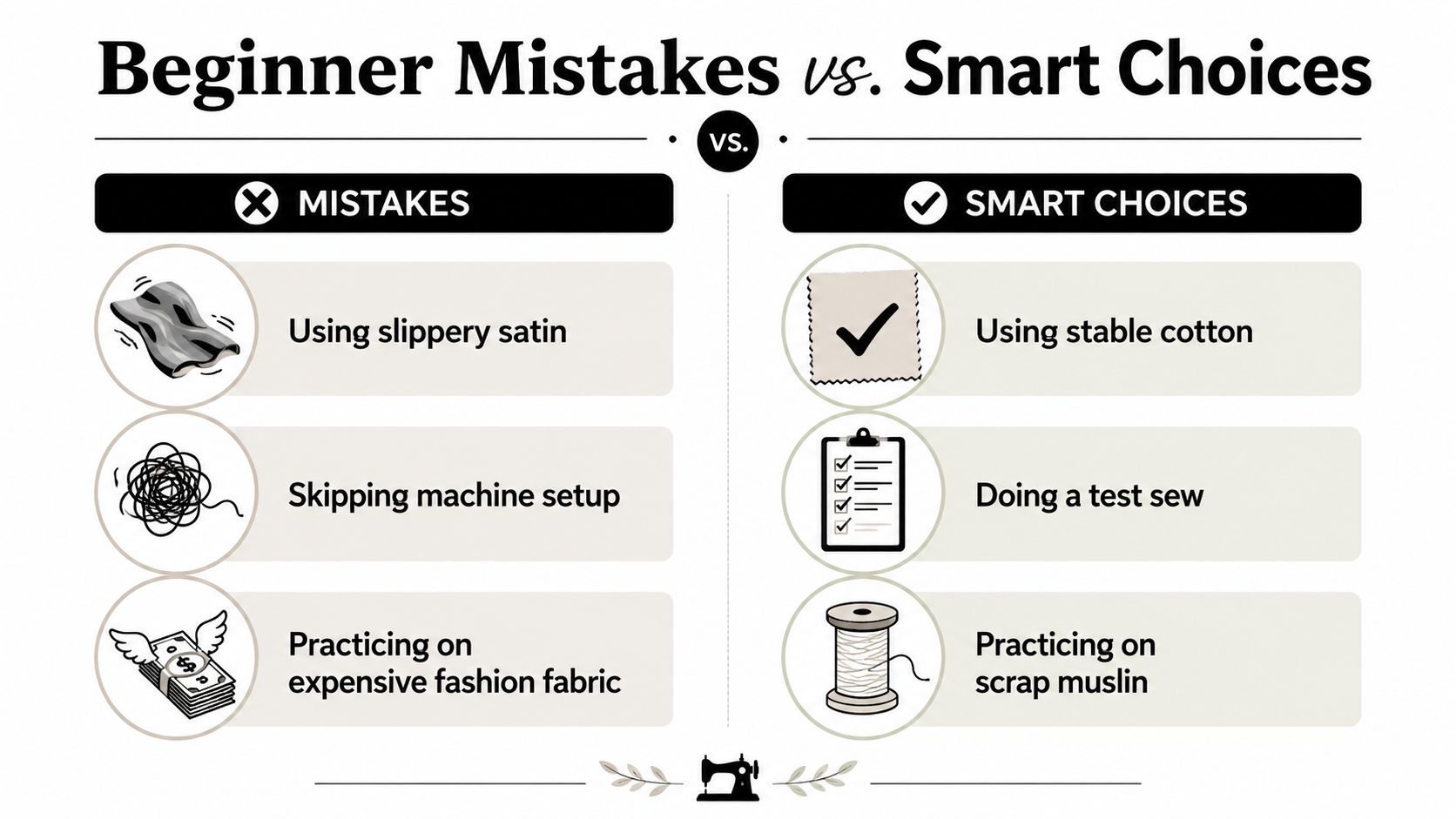
The most expensive fabric in your sewing room is often the one you're too nervous to cut. Saving it for your first project sounds sensible, but precious cloth adds pressure. A mistake becomes emotionally larger, and you may rush, avoid testing or continue with a setting that clearly needs changing.
Stable cotton solves that problem better than determination does. Practise on scraps, calico or an old sheet first, then use a more attractive poplin when the technique feels familiar.
Mistakes that look like machine problems
A beginner may sew with the fabric off-grain, skip pre-washing or leave deep fold lines in the cloth. The machine then seems inconsistent because the material isn't presenting a flat, stable surface. Press fabric before cutting, follow the grain and store it folded or rolled without crushing it.
Another common error is changing tension, stitch length and needle without recording what happened. Make one adjustment at a time. Sew on the same scrap, inspect both sides and write down the result.
Practising only one cotton forever can also create a false sense of security. After you're comfortable with quilting cotton, move to poplin, then a lighter cotton such as lawn. This staged change teaches you to respond to fabric behaviour without throwing you straight into satin or a highly elastic knit.
When to try stretch fabric
You don't need to avoid jersey permanently. You do need a foundation in woven fabric first, because stretch introduces feeding and recovery issues that can disguise otherwise solid technique. When you're ready, test on a scrap, use a suitable needle and follow the pattern's fabric guidance rather than treating every knit as interchangeable.
Pressing deserves the same attention as stitching. Set each seam with the iron, press it open or towards the instructed side and avoid moving the fabric aggressively while it's warm. Good pressing makes a basic seam look intentional and helps you evaluate the actual construction.
Building Your Practice Fabric Collection
A useful stash doesn't need to be large. It needs to give you clear comparisons. Keep a firm quilting cotton for basic control, a poplin for garment-style seams, calico for toiles and machine tests, and a lighter cotton for the point when you want to practise gentler handling.
Calico is especially practical when you're testing a pattern shape or construction order. For a straightforward explanation of how muslin and related practice cloths are used, Lewis and Sheron Textiles' muslin guide is a useful reference. Look for fabric that's clean, free from permanent creases and large enough to cut a meaningful sample.
Buy less, inspect more
Fabric shops and online retailers often provide swatches, which let you assess colour, opacity, texture and drape before buying more. More Sewing's sample swatches can help you compare fabrics at home, while its range includes cottons, jerseys, denim, viscose and Tencel blends, so you can expand beyond woven practice cloth when your skills are ready.
Second-hand textiles can be excellent practice material. Check old sheets, curtains and charity shop garments for a stable weave, then wash and press them before cutting. Avoid fabric with weakened areas, strong odours or finishes that make it unusually slippery.
Store scraps by type rather than by colour. A labelled bag for quilting cotton, a folder for garment samples and a separate box for repair projects will make practice easier to begin. Add a note to each finished sample recording the fabric, needle, stitch length, tension and what you'd change next time.
Your first “real” fabric is ready when you can sew a straight seam, turn a corner, press accurately and diagnose a basic tension issue without panic. You don't need perfect stitching. You need enough repeatable control to know when a problem belongs to the fabric, the machine or your technique.
Visit More Sewing to explore beginner-friendly cottons, fabric sample swatches, haberdashery and ready-to-sew kits for your next practice project. Choose a stable fabric, test your machine settings on a scrap and start with one useful item you'll be happy to finish.
