You've found the fabric. The photograph shows a beautiful Italian wool, the price looks unusually reasonable, and the listing says “deadstock”. Then you notice the seller has only a short length left, the composition is described as “probably wool blend”, and the product image may have been taken before the roll reached the warehouse. You can't touch the cloth, check the drape, or inspect the full piece before paying.
That's the appeal and the risk of trying to buy deadstock fabric online in the UK. Surplus rolls can offer unusual colours, designer-quality cloth, and lower prices, but the useful question isn't whether deadstock is cheaper. It's whether the listing gives you enough information to buy the right fabric, in the right quantity, with a realistic expectation of what will arrive.
Why Deadstock Fabric Is on Every UK Sewist's Radar
A home sewist scrolling through Instagram on a Tuesday evening might spot a striking wool coating, save the post, and discover that the seller has only a partial roll. The photograph may show a clean, uncut bolt, while the actual stock has changed several times since the image was taken. That moment captures the attraction of deadstock, beautiful cloth can appear suddenly, and disappear just as quickly.
Price is part of the appeal. A 2025 UK industry report recorded deadstock at an average of £9.78 per metre, compared with £16.63 per metre for new fabric, around 70% lower in that comparison (the 2025 UK circular fashion report). That difference can make a good-quality wool, viscose, linen blend, or printed cotton accessible to a student, home dressmaker, or small label working with a tight budget.
The environmental argument is also difficult to ignore. The UK bought 1.42 million tonnes of textiles in 2022, generated 711,000 tonnes of post-consumer textile waste, and 49% of used textiles still went into the bin, according to reporting linked to WRAP data (the UK circular fashion report). Reusing unused cloth keeps an existing material in circulation, but it doesn't remove the need to check its fibre content, quality, or suitability.
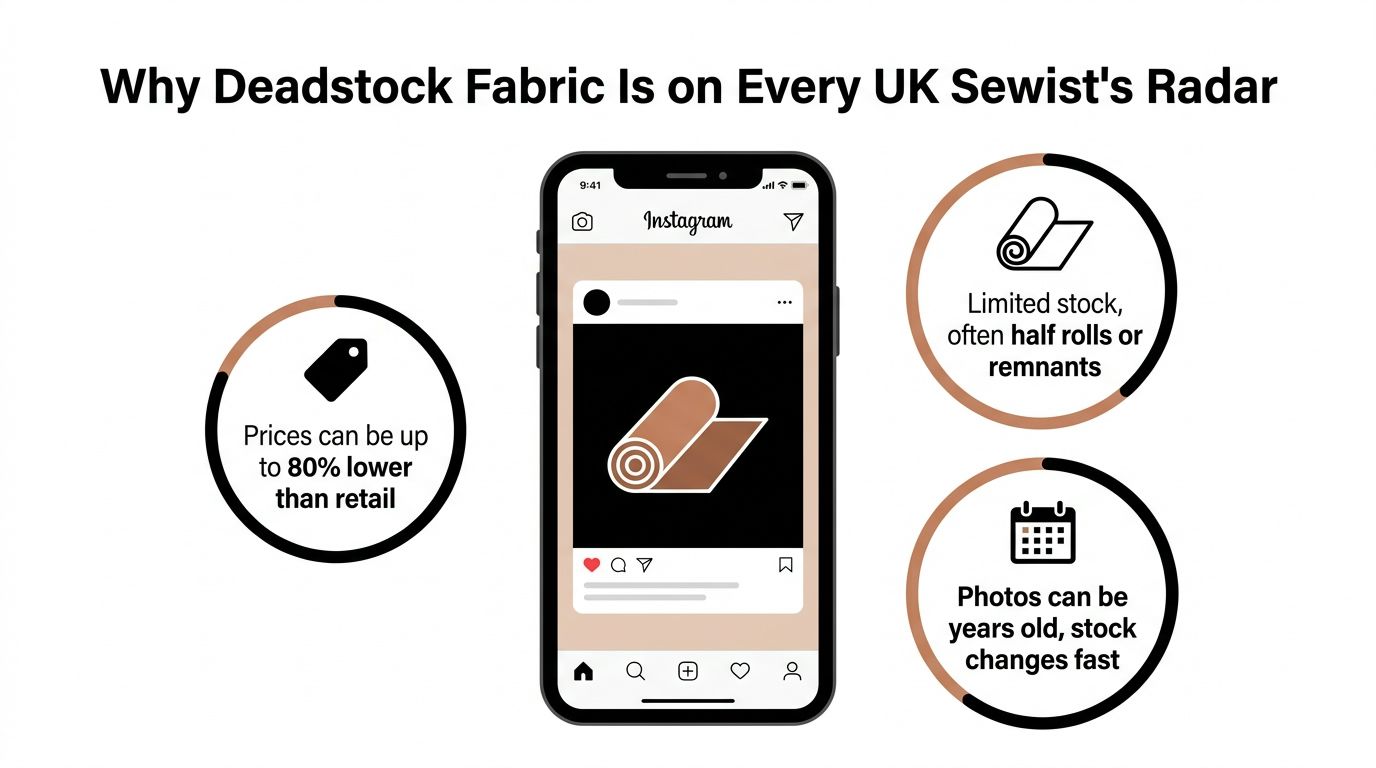
The trade-off is practical. You may get a distinctive fabric at a lower metre price, but you might also receive a shorter usable length, a narrow width, an unrepeatable dye lot, or a roll with flaws that weren't obvious in the main photograph. This guide focuses on the checks that reduce those surprises, from reading fibre descriptions to asking for a swatch before ordering a cut you can't re-handle.
What Deadstock Fabric Actually Means
Deadstock fabric is unused textile stock that no longer has its original route to market. It can come from mill overproduction, a cancelled fashion order, an end-of-line run, or cloth held in a warehouse after a customer no longer needs it. The fabric hasn't necessarily been worn or rescued from a garment. It's usually new material that has become surplus to the original plan.
A useful comparison is a cancelled restaurant order. The meal was prepared for a specific customer, but the customer didn't collect it. The food hasn't become inferior because the original order disappeared, although it may no longer be available in the same way. Deadstock works similarly. The cloth may be excellent, but the original production context has gone.
The main UK supply routes
UK buyers commonly encounter deadstock through several routes:
- Mill surplus: Mills around textile-producing areas such as Leeds, Huddersfield, and Manchester may have unsold seasonal runs or excess production.
- Fashion overrun: A fashion house or manufacturer may have ordered more cloth than its production required.
- Cancelled export orders: Fabric can remain in UK warehouses after an overseas order is cancelled or interrupted.
The label matters because deadstock, surplus, vintage, and remnants aren't interchangeable. Surplus may describe current stock sold at a discount. Vintage fabric has age and may have been stored for a long period. A remnant is usually a small leftover cut, whether or not it came from a deadstock roll. Ask the seller which description applies, rather than assuming every reduced fabric has the same history.
Why the word doesn't guarantee sustainability
Deadstock avoids commissioning another production run, but the fibre origin, dyeing process, transport, and eventual use still matter. A roll may have been manufactured under conditions you can't verify, then become surplus. The strongest sustainability benefit comes when you buy an amount you'll use, store it properly, and plan a project that makes good use of the width.
Stock size is another defining feature. One listing may offer only a couple of metres, while another has a much longer roll. Reordering usually isn't guaranteed, so deadstock suits one-off garments and limited runs better than products that need a repeatable supply chain.
The Real Cost of Deadstock in the UK
The displayed metre price is only the starting point. Deadstock can look inexpensive until you account for unusable sections, uncertain width, delivery, and the extra time needed to assess whether the cloth will work for your pattern.
Consider a five-metre order priced at £30, with £6.50 postage and 15% wastage. The order contains 5 metres, but only 4.25 metres may be usable after removing damaged selvedges, shading, or sections that won't work with the pattern. The effective cost is therefore about £8.59 per usable metre, before you account for your time.
A retail comparison priced at £60 with free delivery and 5% wastage leaves 4.75 usable metres. Its effective cost is about £12.63 per usable metre. Deadstock still offers the lower effective price in this example, but the saving is smaller than the product page suggests.
The important point is that the wastage figures in that example are scenario assumptions, not a universal industry average. A roll can be clean throughout, or it can contain a flaw that affects the exact pattern piece you need. Treat the seller's inspection notes as more valuable than a generic promise that the cloth is “good quality”.
| Cost Element | Deadstock | New Fabric |
|---|---|---|
| Listed five-metre fabric cost | £30 | £60 |
| Delivery | £6.50 | Free |
| Assumed wastage | 15% | 5% |
| Estimated usable length | 4.25 metres | 4.75 metres |
| Approximate cost per usable metre | £8.59 | £12.63 |
Costs that can change the calculation
A folded cut may travel differently from a fabric roll. Long parcels can attract different courier treatment, and delivery terms can become more complicated when the seller dispatches from outside the UK. Imported stock may also involve customs handling, so read the dispatch location rather than relying on the seller's brand location.
Pattern efficiency changes the result too. A short length may suit a camisole but fail to provide enough cloth for a coat with a nap, a matched check, or directional print. A fabric with a damaged selvedge may still work for patchwork, but not for a garment that needs its full stated width.
Practical rule: Calculate the project cost from the usable length, not the advertised length. If the seller won't confirm flaws, width, or remaining meterage, price in the possibility that part of the cut won't serve your pattern.
How to Verify Quality and Composition Online
The composition line deserves more attention than the product name. Under the UK textile labelling rules, textile products placed on the UK market must identify the name and percentage by weight of every constituent fibre in descending order. Multi-component items must show the fibre content of each component, and labels must be durable, legible, visible, accessible, and in English (UK textile labelling regulations).
That gives buyers a useful standard for judging listings. “Cotton blend” isn't enough if you need to know whether the fabric will stretch, shrink, crease, or accept a particular finish. Ask for the mill tag, technical datasheet, or a clear photograph of the original roll information. If the seller can only offer an estimate, the listing should say so plainly.
A reliable pre-purchase check
Use this sequence before ordering:
- Confirm every component. Ask whether the description applies to the shell only, or also covers lining, coating, bonded layers, trims, and decorative elements.
- Check the usable width. Request the measured width between selvedges, not just the nominal width in the listing.
- Ask about weight. GSM can help you assess whether a cloth is appropriate for a shirt, skirt, jacket, curtain, or bag, but don't use weight alone to predict drape.
- Request close-ups. Natural-light photographs can reveal slubs, glazing, stains, pin marks, colour variation, and weave irregularities.
- Ask whether it's first quality. Factory seconds may be perfectly usable, but you need to know where the defects are and whether they repeat through the roll.
- Order a swatch. A small cutting lets you test pressing, washing, shrinkage, colourfastness, and handle before committing to a larger piece.
The law's fibre-content requirements help create a practical sourcing filter, but deadstock sellers may not possess the original technical records. One UK retailer acknowledges that it “can't always be certain about the composition” of deadstock fabrics and may provide only its best estimate (More Sewing's deadstock fabric listings). That uncertainty should affect how confidently you use the fabric, especially for fitted garments or products sold to customers.
Keep the swatch with your notes. Record the seller's composition statement, width, weight, washing advice, and order date. If a second cut arrives later, compare it with the first swatch before cutting, because colour and finish can vary between batches.
Where to Buy Deadstock Fabric Online in the UK
The safest buying channel depends on what you're making. A one-off dress gives you more tolerance for an unusual cut than a small production run, where matching composition, width, and handle matters across every garment.
| Channel | Typical Minimum | Return Policy | Information Depth |
|---|---|---|---|
| Specialist deadstock seller | Often a small cut or limited roll length | Can be restrictive once cut | May include origin, roll notes, and known defects |
| General fabric retailer with a deadstock section | Commonly sold by a stated metre fraction | Depends on the retailer and cut status | Varies from detailed specifications to brief descriptions |
| Curated shop such as More Sewing | Often listed in manageable cuts | Check the individual product terms | Usually organised around fabric type, composition, and use |
| Instagram destash seller | Set by the individual seller | Often informal or limited | May rely heavily on photographs and direct messages |
| B2B auction or clearance platform | May favour lots or larger quantities | Usually less flexible | Can provide commercial details, but inspection may be limited |
Specialist marketplaces offer discovery and variety, but the information can be uneven. Check whether the seller states the actual remaining length, dispatch location, width, fibre content, and condition. A general fabric retailer may provide clearer customer-service routes and more familiar payment protection, although its deadstock section may still contain fabrics with limited repeat stock.
Curated shops often do more of the sorting before the listing goes live. That can mean clearer descriptions, graded condition, swatches, or testing notes. It doesn't remove the need to ask questions, but it reduces the amount of detective work. For household projects where handle and appearance matter, a guide to wall sticker friendly cotton linen can also help you think about the practical differences between fibre blends and surface performance before choosing a cloth.
Read the terms before you fall for the photograph
Look for a stated cut policy, because cut fabric may not be returnable. Check whether the photograph shows the actual roll or a representative fabric image, and whether the seller describes the colour under daylight or studio lighting. Reviews mentioning accurate lengths, consistent batches, and honest fault descriptions are more useful than reviews that only praise fast delivery.
For Instagram sellers, request the same information in writing before paying. For B2B auctions, ask whether inspection is possible and whether the lot includes mixed compositions or widths. A seller who answers clearly about defects and uncertainty is easier to work with than one who relies on “designer” as a substitute for technical detail.
Techniques for Buying, Storing, and Using Deadstock
Start with a swatch-first workflow whenever the fabric is unfamiliar or the project is important. Order a small square, then wash or steam it using the treatment you expect for the finished garment. Press the sample, check whether the colour bleeds, measure any change in size, and hold it against your pattern fabric or existing wardrobe before ordering more.
A swatch also exposes problems that a flat product photograph hides. Viscose may look opaque online but become more transparent when held to light. A woven cotton may feel stable until it's washed. A coating may press beautifully on one side and mark permanently on the other. Keep the swatch after testing and write the result on a tag or in a fabric notebook.
Plan around the actual cut
Lay out your pattern pieces before buying when the listing gives a limited length. For checks, stripes, nap, or one-way prints, allow for matching and direction. A short cut that theoretically fits your size may fail once you account for pattern placement and a flawed section near the fold.
A simple cost note can prevent false savings. Record:
- Purchase cost: Fabric price, delivery, and any sample charge.
- Usable cloth: Length after removing faults, damaged edges, and unsuitable sections.
- Project allocation: The amount used for the main garment, lining, and accessories.
- Remaining value: Offcuts that can become binding, pockets, facings, patchwork, or small accessories.
One three-metre viscose cut illustrates why this matters. If the dye shifted noticeably across the length, treating it as one uninterrupted colour could make the finished garment look accidental. A colour-blocked top, contrasting yoke, or panelled skirt can turn the variation into a deliberate design feature. The technique works because the defect becomes part of the layout instead of being hidden and discovered after cutting.
Store the roll as carefully as the garment
Use a bolt tube for longer lengths where possible, and wrap delicate cloth in acid-free tissue rather than leaving it compressed in plastic. Attach a label with the fibre composition, weight, width, washing treatment, seller, purchase date, and remaining length. Store smaller cuts flat, away from direct light, and keep tested and untested fabrics separate.
Photograph the finished garment with a note about its deadstock origin when you sell or share it. Unique cloth can give a one-off piece useful provenance, while clear fibre and care information helps the next owner maintain it rather than discard it.
Making Deadstock Part of a Sustainable Sewing Habit
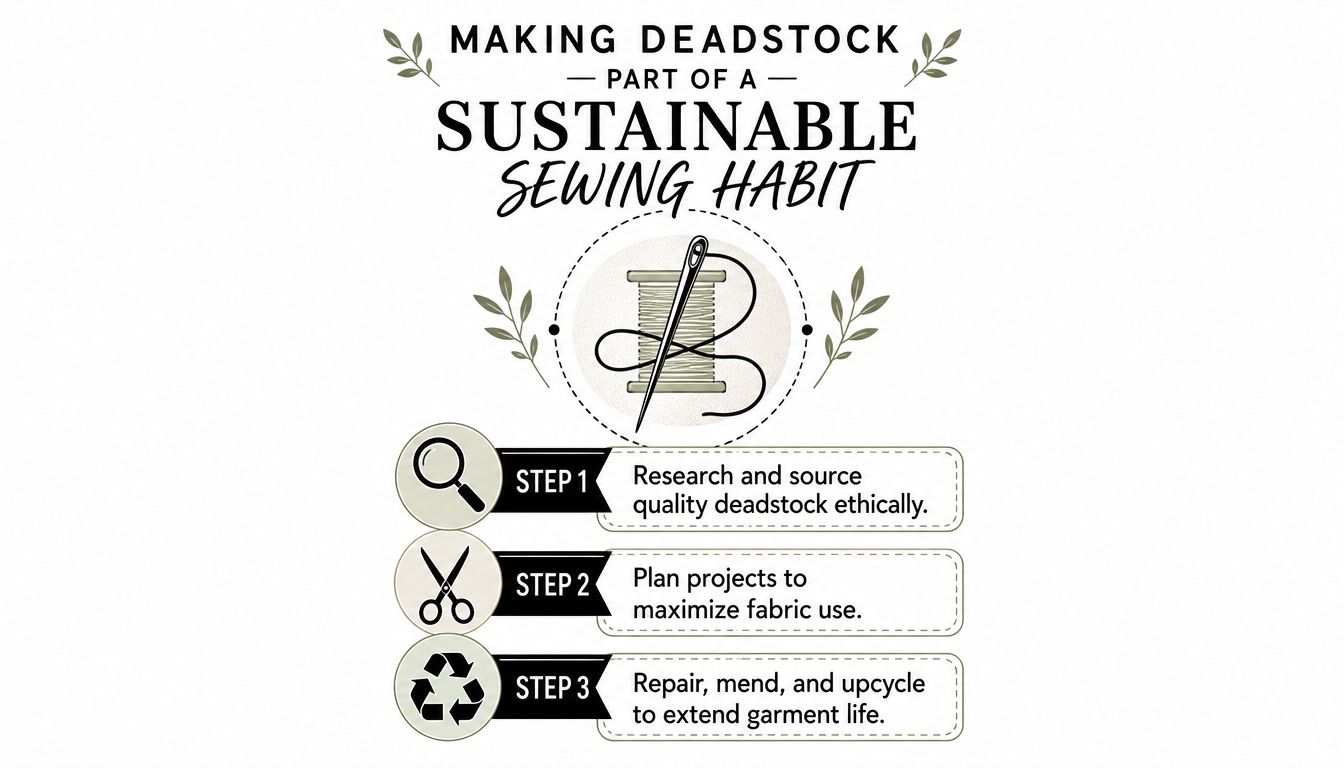
Buying surplus cloth only becomes a sustainable habit when the fabric moves from a warehouse to a useful object, then stays useful for as long as possible. The first habit is to buy to a plan. Save the listing, check the pattern requirements, confirm the width, and decide what will happen to the offcuts before placing the order.
The second is to keep material in circulation. Fabric swaps, remaking projects, and shared student collections can give larger leftovers another purpose. A broad offcut might become a lining panel, while narrow strips can become bias binding, pocket bags, ties, or patchwork. UK reporting indicates that 93% of textiles are sent for reuse, but only 36% of textiles entering used-textile and waste-management systems are reused after sorting, excluding direct peer-to-peer resale (the GOV.UK textiles report summary). Using and passing on fabric before it reaches those systems matters.
The third habit is to choose fibres thoughtfully when the composition is known. Natural fibres may suit some projects and care routines, but fibre choice should follow the garment's intended use, durability, and washing needs rather than a simple sustainability label. Repair, alteration, and careful storage often extend a garment's useful life regardless of its fibre.
UK circular-fashion work is putting more attention on textile collection, reuse, repair, and resource efficiency. The disposal problem remains substantial: the UK discarded about 1.45 million tonnes of used textiles in 2022, while WRAP estimated that 711,000 tonnes went into household bins or general waste at Household Waste Recycling Centres in 2021, equal to 49% of used textiles and an average of 35 items per person per year (WRAP's textiles resource-efficiency report). Reusing a carefully chosen roll won't solve that alone, but it's a practical action within a sewist's control.
Before your next purchase, check the composition, actual width, usable length, known flaws, wash response, dispatch location, and return terms. Log each metre bought, then record what becomes a garment, what is gifted, and what is used for smaller makes. More Sewing offers deadstock listings, fabric swatches, and sewing supplies for this kind of measured buying, so visit More Sewing to inspect the current fabrics and request the information you need before ordering.
