
Your fabric has arrived, the table is clear, and the pattern is already out of its envelope. Before the scissors come out, an hour of unglamorous testing decides whether the top you're about to cut still fits after three washes.
The phrase cotton viscose jersey fabric covers a wide spread of cloth. A 70% cotton, 30% viscose single jersey at 160 GSM behaves nothing like a 30% cotton, 70% viscose version at 130 GSM, yet both get the same name on the listing. One holds a neckline; the other slides off the shoulder an hour into wearing.
Five things are worth measuring before you cut: the composition on the label, the weight in GSM, stretch and recovery on a swatch, how that swatch behaves in the wash, and the machine settings the fabric needs. Every one of them is checkable at your own table with a ruler, a pair of kitchen scales and your own washing machine.
Why Cotton Viscose Jersey Sits Between Two Familiar Fabrics
A grey jersey T-shirt looked perfect on the cutting table. One 40°C wash later, the hem had dropped, the side seams had twisted forward, and the neckline sat wider than the pattern intended. Nothing was wrong with the sewing. The fabric hadn't been tested before it was cut.
That's the case for treating cotton viscose jersey as a set of properties rather than a name. It's a knitted fabric blending cotton and viscose, and where it sits between the two familiar extremes depends entirely on the ratio between them.
Cotton is the frame. It brings softness, strength and breathability, and it holds a shape once it's been set. Viscose is the curtain. It brings drape, a smooth hand and a cool feel against the skin. A cotton-heavy jersey reads as T-shirt fabric. A viscose-heavy one reads as dress fabric that happens to be knitted.
The frame and the curtain: if a jersey collapses at the shoulder seam under its own sleeve weight, the viscose share is doing more work than the pattern allows for.
Both fibres are mainstream in the UK market. WRAP's UK Textiles Market Situation Report records estimated 2022 consumption of 313,064 tonnes of cotton and 101,034 tonnes of viscose, up from 282,400 tonnes and 82,300 tonnes in 2021, a rise of roughly 22.7% for viscose in a single year. The same report records that cotton, viscose, acrylic, spandex and flax all rose in price by more than 10% between the third quarter of 2017 and the first quarter of 2023. Fibre prices have climbed at source, whatever the finished cloth ends up called on a listing.
Knit structure is the part makers underestimate. Loops stretch in both directions and recover less predictably than woven cloth, so a jersey cut on the cross-grain can grow lengthwise within a few wears. That growth is exactly what a pinned swatch and a tape measure reveal before it can ruin a garment. The blend is a practical middle ground, but only once you've tested it.
Blend Ratios and What Each One Feels Like
| Cotton to viscose | Feel and drape | Typical weight | Best garment type | Stretch and recovery |
|---|---|---|---|---|
| 70:30 | Crisp, stable hand with a soft finish | 150-180 GSM | Fitted tops and T-shirts | About 25% stretch, recovery usually reliable |
| 50:50 | Balanced softness with light drape | 140-170 GSM | Tops, dresses and loungewear | Check both directions, recovery varies |
| 30:70 | Fluid, smooth drape that flows | 120-160 GSM | Flowing dresses and blouses | At least 30% stretch, stabilise seams |
Read the rows as three different fabrics. A 70:30 at 150 to 180 GSM holds a set-in sleeve and a neckband without help. A 50:50 in the 140 to 170 GSM band gives you a soft top that still behaves, but the recovery needs testing in both directions because it can differ across the grain and along it. A 30:70 at 120 to 160 GSM drapes like a curtain and will not support a shoulder seam without interfacing or tape.
Reading the label properly
Composition isn't a marketing line, it's a legal statement. UK textile labelling regulations require products containing multiple fibres to identify each fibre and its percentage, listed in descending order of weight, and a fibre making up at least 85% may be labelled with its percentage or described as "85 per cent minimum."
The same regulations set agreed moisture allowances used when a lab calculates percentages from a fibre test: 8.5% for normal cotton and 13% for viscose. That's why a lab result can land a point or two away from the printed label and still be correct.
Before you buy, photograph the composition and care text from the listing or the bolt end, then read it against the washing advice. Handle and appearance are poor evidence: a soft, drapey jersey can be cotton-rich with a brushed finish, and a crisp one can be viscose-heavy with a tight knit.
A label that gives you three numbers, composition, weight and stretch, tells you more about the finished garment than a photo of it draped over a chair ever will.
Note three figures before cutting: composition percentage, weight in GSM, stretch percentage. Everything in the rest of this guide hangs off those.
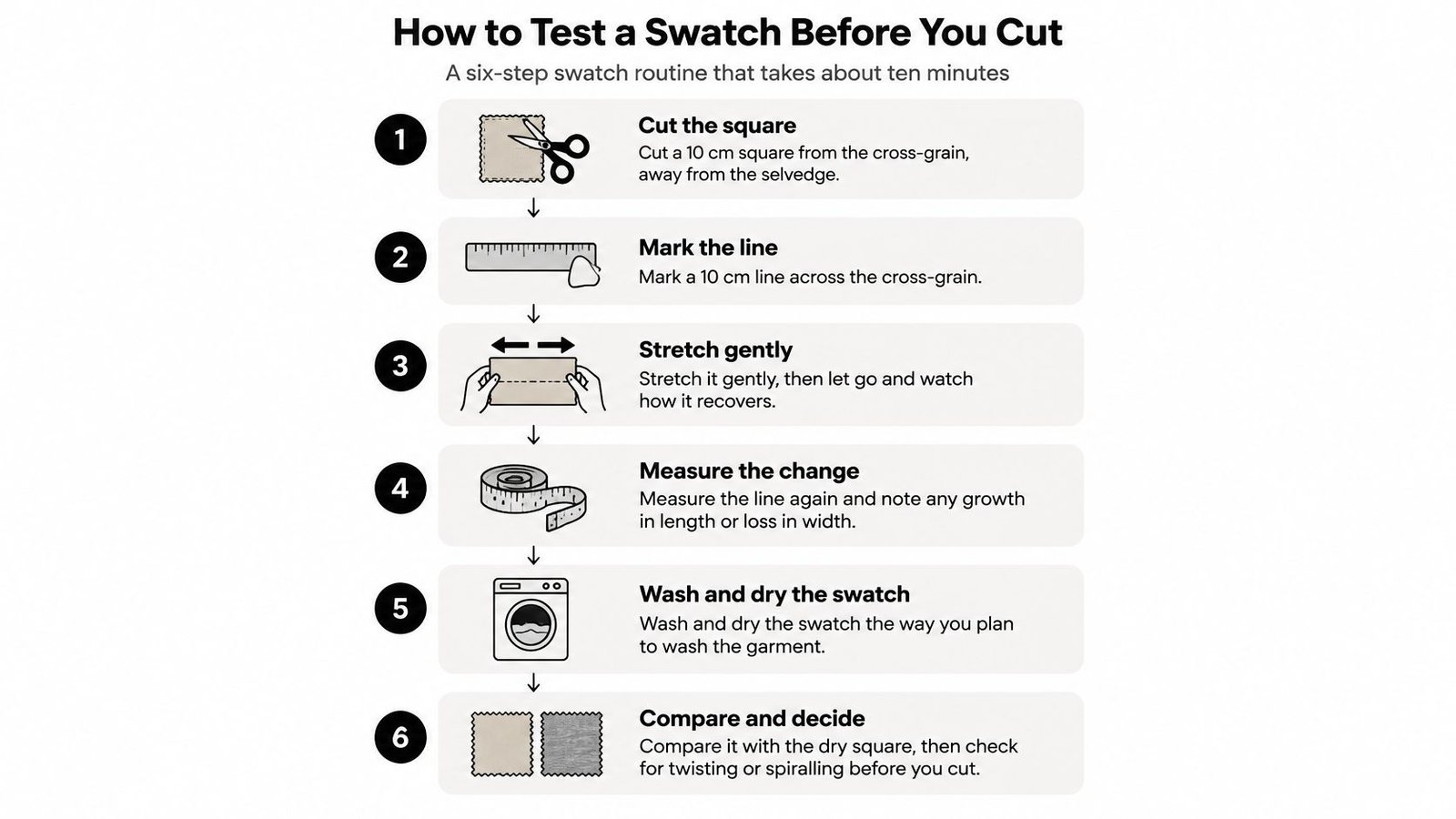
How to Test a Swatch Before You Cut
A pattern drafted for a stable jersey will sag at the shoulders in a light viscose-rich knit, and a wrap dress cut for fluidity will stand away from the body in a firm cotton-heavy one. Ten minutes with a swatch settles which fabric you have. The aim is to match measured weight and stretch to what the pattern asks for, never to the fibre name on the listing.
Six checks, run in order:
- Cut the square. Take a 10 cm square from the cross-grain, well away from the selvedge and any creased edge, because the selvedge is denser and gives a falsely stable reading.
- Mark a 10 cm line. Draw it across the cross-grain with chalk or a washable marker, marking the line's exact ends rather than trusting the fabric edge.
- Stretch it gently. Hold both marks and extend without distorting the fabric. 25% stretch takes the section to about 12.5 cm and 30% to about 13 cm. Measure against a ruler; judging by eye flatters the fabric.
- Repeat along the length. Knitted fabrics can recover differently in each direction, so a fabric with 30% cross-grain stretch may give you only 15% lengthwise.
- Let go and check recovery. If the fabric stays elongated, avoid close-fitting patterns or plan stabilisation at shoulder seams, necklines and waistlines. A fabric that springs back to the line can sit close to the body.
- Weigh the square. A 10 cm square is 0.01 m², so multiply its weight in grams by 100 to get GSM. 150 to 180 GSM suits everyday cotton jersey and cotton-elastane jersey, while flowing viscose-rich jersey usually sits at 120 to 160 GSM with at least 30% stretch.
Write the result down
Numbers in a notebook do nothing; numbers taped to the pattern decide what gets cut. A swatch at 150 GSM with 25% stretch and good recovery suits a fitted top. A 130 GSM sample with 35% stretch suits a wrap dress, where the fluidity is the point and the neckline will need support.
Cut a second scrap from the same test piece and pin it to the pattern envelope, with four lines written beside it: weight, cross-grain stretch, lengthwise stretch, and what the recovery did. The next time a similar jersey lands on the cutting table, the comparison is already made.
Washing and Drying Without Losing Shape
Shape loss isn't mysterious. Regenerated-cellulosic fibres swell and relax in water, and the looped knit structure amplifies whatever the fibre does: lengthwise growth, widthwise contraction, spirality where the seams rotate, and edge distortion at hems. Viscose-rich jersey changes most, which is why the prewash matters more here than with a stable cotton interlock.
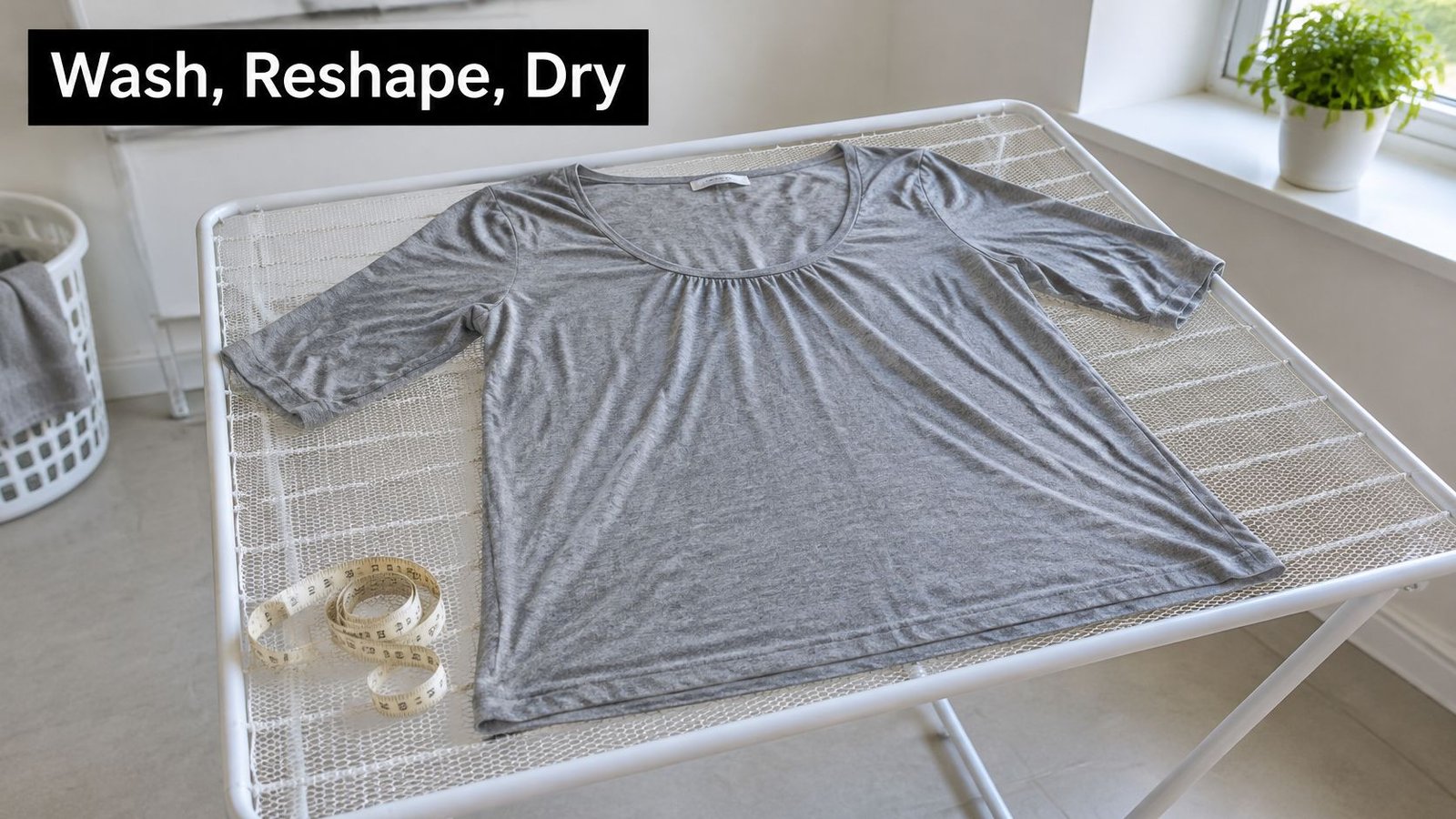
The prewash routine that prevents the surprise
- Cut a 1.5 m length and tack a 50 cm mark down the length and a 50 cm mark across the width with contrasting thread, so you can find them after washing.
- Wash at 30°C on a full cycle with a low spin, using the detergent you'd use for the finished garment.
- Dry flat, away from radiators, and never in the tumble dryer at this stage.
- Re-measure both marks once the fabric is completely dry and record the change in each direction separately.
- Cut only after it has settled. If the marks have moved, press lightly and leave it another day.
Run the numbers before you place the pattern. Growth of 3% on a 50 cm mark is 1.5 cm, which on a dress length becomes a hem that sits visibly lower at the front than the back.
Settings that hold the shape
| Stage | Setting | Why it matters |
|---|---|---|
| Prewash | 30°C full cycle, low spin | Relaxes the knit before cutting |
| Routine wash | 30°C, short cycle, fuller load | Limits shrinkage and fibre loss between wears |
| Drying | Lay flat or hang, no tumble dryer | Heat and tumbling stretch viscose-rich loops |
| Pressing | Low setting, with a pressing cloth | Prevents stretching and shine |
The testing reference behind those settings comes from commercial quality control. The UK and EU apparel testing manual specifies BS EN ISO 6330:2012 for domestic-wash dimensional stability, and assesses knitted fabrics containing more than 55% viscose at a tolerance of roughly +3%/−7%. It also checks declared fibre composition against EU Regulation 1007/2011 with a manufacturing tolerance of ±3% from the care-label composition.
That tolerance is the reason to wash the finished garment exactly the way you prewashed it. Switch to a 40°C cycle with a spin, and you've changed the conditions the fabric was stabilised under.
The video below is a useful companion to the routine above.
Press on a low setting through a cloth, lifting rather than dragging the iron. Viscose glazes and shines under direct heat, and a pressed-out seam that has been stretched along its length never comes back.
Sewing Cotton Viscose Jersey Without Puckering or Stretching Out
Machine set-up decides more than technique does. Match the needle and stitch to the weight before you thread up.
| Fabric weight | Needle | Stitch | Thread |
|---|---|---|---|
| Light, 120-149 GSM | 70/10 ballpoint or stretch needle | Narrow zigzag, 1.0-1.5 mm | Fine polyester |
| Medium, 150-180 GSM | 75/11 ballpoint or stretch needle | Narrow zigzag, 1.5 mm | Polyester |
| Heavier, over 180 GSM | 80/12 or 90/14 ballpoint or stretch needle | 2.5 mm stretch stitch, or twin needle for hems | Polyester |
Needles, stitches and thread by weight
A ballpoint needle has a rounded tip that pushes between the loops instead of piercing them, which stops ladders running down the seam line. A stretch needle has a deeper scarf and a slightly sharper point, and it's the one to reach for when a ballpoint gives you skipped stitches on a tightly knitted viscose blend.
Use a fresh needle for every project. A blunt needle on jersey produces small pulls along the seam that no amount of pressing will remove.
Never use a straight stitch on a seam that has to stretch. A 1.5 mm zigzag on a 150 GSM cotton viscose tee gives you a seam that moves with the fabric; a straight stitch gives you a seam that snaps the first time the garment is pulled over the head.
Feeding the machine without hand tension
Pin inside the seam allowance only, or use clips, because pins placed across the seam line distort the knit as it feeds. Let the feed dogs move the fabric and keep your hands flat and light on either side. Pulling from the front is the single most common cause of a wavy seam that looks like a tension fault.
Stabilise before you sew, not after. A strip of lightweight knit interfacing or clear elastic along the shoulder seams and neckline, fused or basted on before the seam is closed, stops the garment growing as it hangs. On a flowing dress in a 30:70 blend, tape the neckline and armholes and use a double-needle hem rather than a single turned hem.
Troubleshooting in cause and fix pairs
- Puckered seams: tension is too tight or the stitch is too long for the weight. Loosen the upper tension a quarter turn at a time and shorten the stitch.
- Skipped stitches: the needle is wrong or blunt. Swap to a stretch needle and re-test on a scrap.
- Wavy seams: the fabric was stretched while feeding. Re-sew with less hand pressure and a strip of stabiliser underneath.
- Tunnelling between twin-needle rows: needle tension is too high. Reduce it, and loosen the bobbin slightly.
- Popped seams after wearing: a straight stitch was used. Unpick and re-sew with a narrow zigzag or stretch stitch.
Shedding, Wear Life and Buying Responsibly
The assumption runs that a cotton and viscose jersey is the lower-impact choice because both fibres are plant-derived. The laundering evidence complicates that. Research on household laundry, published in Environmental Science and Pollution Research, estimates that domestic washing releases between 6,490 and 87,165 tonnes of textile microfibres a year in the UK, depending on fabric and washing conditions.
Why natural doesn't mean microfibre-free
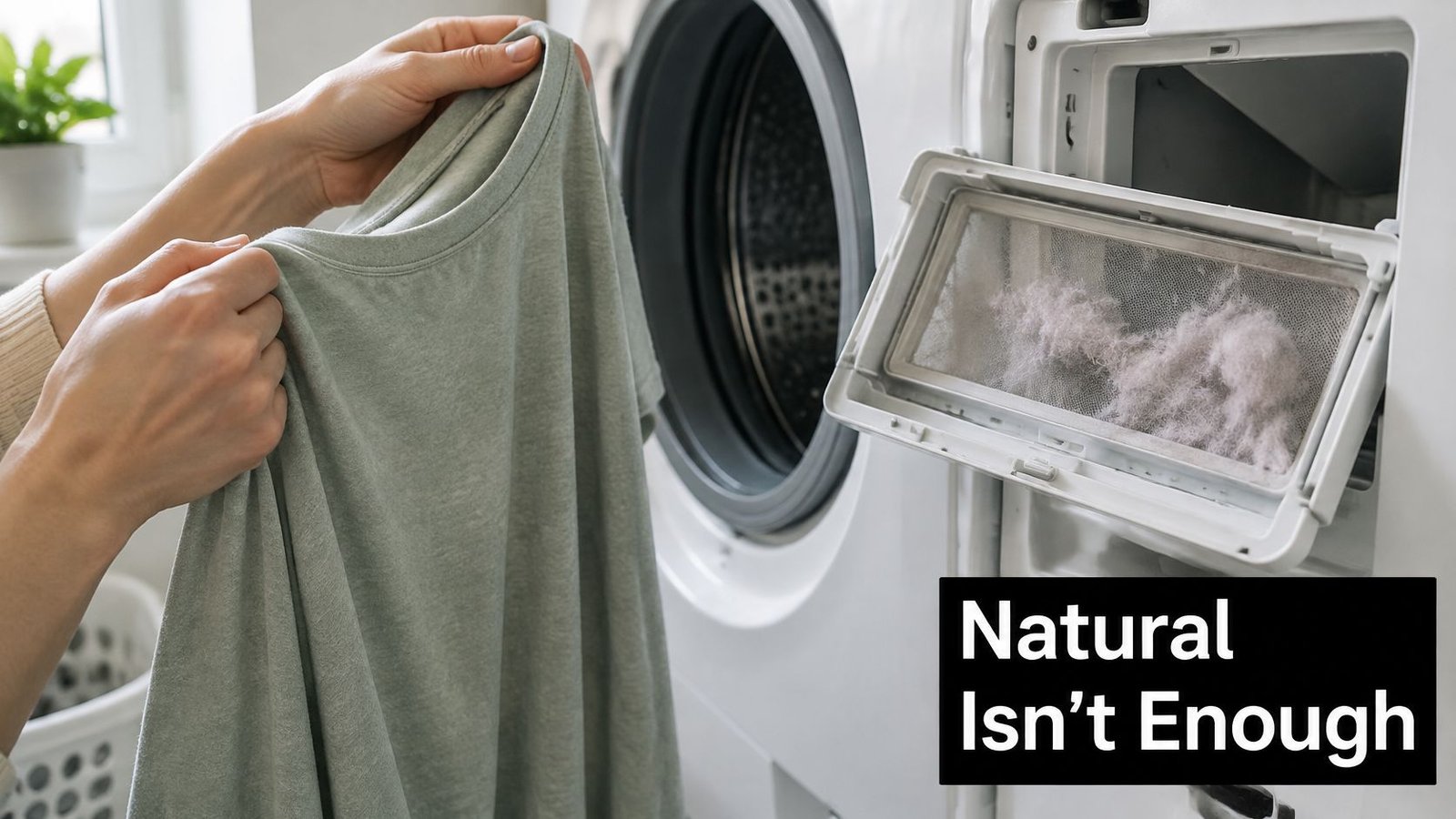
In that UK household-laundry study, 96% of the released fibres were natural, including cotton, wool and viscose, rather than polyester or other synthetics. Shedding isn't a plastics problem alone, and a natural-fibre jersey still loses fibre in the drum.
The encouraging finding is that you control most of the variables. A 30°C-equivalent, 30-minute wash cut fibre release by 30% compared with an 85-minute, 40°C cycle, and fuller but not overfilled loads also reduced release. Fabric variables had a greater influence on release than laundering variables, though no single fabric characteristic consistently dominated, so a tight knit may shed less than a loose one of the same blend.
Fibre choice carries a resource story too. Written evidence to the UK Parliament's environmental audit inquiry records that cotton accounted for about 43% of the UK clothing-fabric market share but contributed approximately 60% of the sector's fabric-processing water footprint, with an estimated 446 million cubic metres of water for fibre and fabric processing of garments bought in the UK in 2016. Swapping cotton for viscose shifts drape and moisture handling, but viscose production is chemically intensive, so a blend name alone doesn't settle the question. Ask for fibre percentages, the viscose source or certification, the recommended wash temperature, and independent shrinkage and colourfastness results.
The habits that do the work: wash cold and short, fill the drum properly, air garments between wears, wash less often, and buy fewer better pieces.
Judging wear life after each wash
Keep a note per garment. Record lost stretch at the cuffs and neckline, bagging at the knees, edge curl on hems, and pilling under the arms or where a bag strap rubs. Two T-shirts in the same blend can age completely differently, so the record matters more than the label.
Choose Your Cotton Viscose Jersey Before You Cut
The decision follows from the swatch, not from the description. Match the garment type to the blend first: a cotton-heavy 70:30 at 150-180 GSM with about 25% stretch for fitted tops and T-shirts with a stabilised neckline; a viscose-rich 30:70 at 120-160 GSM with at least 30% stretch for flowing dresses and blouses with stabilised seams; a 50:50 for loungewear once weight and stretch check out.
A worked decision
Say the label reads 50:50 and the swatch comes back at 140 GSM with 28% cross-grain stretch and good recovery in both directions. That fabric suits a loose-fitting top or a simple dress. Prewash it using the marks, re-measure, then cut. If the swatch had stayed elongated after the stretch test, the same fabric would still work for a loose style with taped shoulders, but not for a fitted bodice.
Durability research makes the point that composition alone can't predict performance: even 100% cotton single-jersey T-shirts can't be assumed to perform alike, as the study of physical garment durability sets out. The same body of work reports that repairing an item leads people to keep it for at least another year on average, which reframes a slightly dearer fabric as the cheaper option over three winters.
More Sewing lists jersey alongside viscose and Tencel as separate categories, so you can read the composition before you commit.
Test one swatch this week. Note the composition, the weight and what the recovery did, and cut only when the note says the fabric suits the pattern.
A jersey that passes the swatch test is worth buying by the half metre rather than the metre, so you can try one garment before committing to a second. More Sewing stocks cotton, jersey and viscose and Tencel fabrics with the composition and weight listed, and if you aren't sure how a length will behave you can order a sample swatch and put it through the tests above first. Take a look at the More Sewing fabric range before your next project and choose the piece that matches your pattern rather than the prettiest photo.
