
Dressmaking
Playsuit vs Jumpsuit: A Sewist’s Guide to Choosing
You've found a pattern you like, you've got a length of fabric in your basket, and you're hovering between two very similar-looking projects. One promises an easy summer make you'll wear on repeat. The other looks polished, dramatic, and a bit more ambitious. That's where most sewists get stuck with the playsuit vs jumpsuit decision.
From the cutting table, these garments are cousins, not twins. They share the all-in-one appeal, but they behave differently in fabric, fit, and construction. A playsuit can be a quick, satisfying project. A jumpsuit can become one of the hardest-working garments in your wardrobe, but only if you get the fit right.
As makers, we need more than styling advice. We need to know what drapes well, what needs extra stability, where the pattern is likely to let us down, and which alterations are worth doing before we touch the good fabric.
Your Next Sewing Project Playsuit or Jumpsuit
A common sewing dilemma goes like this. You want a one-piece garment because it feels fresh, useful, and just structured enough to look like you made an effort. But when you start browsing patterns, the choice splits in two. Do you make a playsuit for sunny weekends, or a jumpsuit that can move from daywear to something smarter?
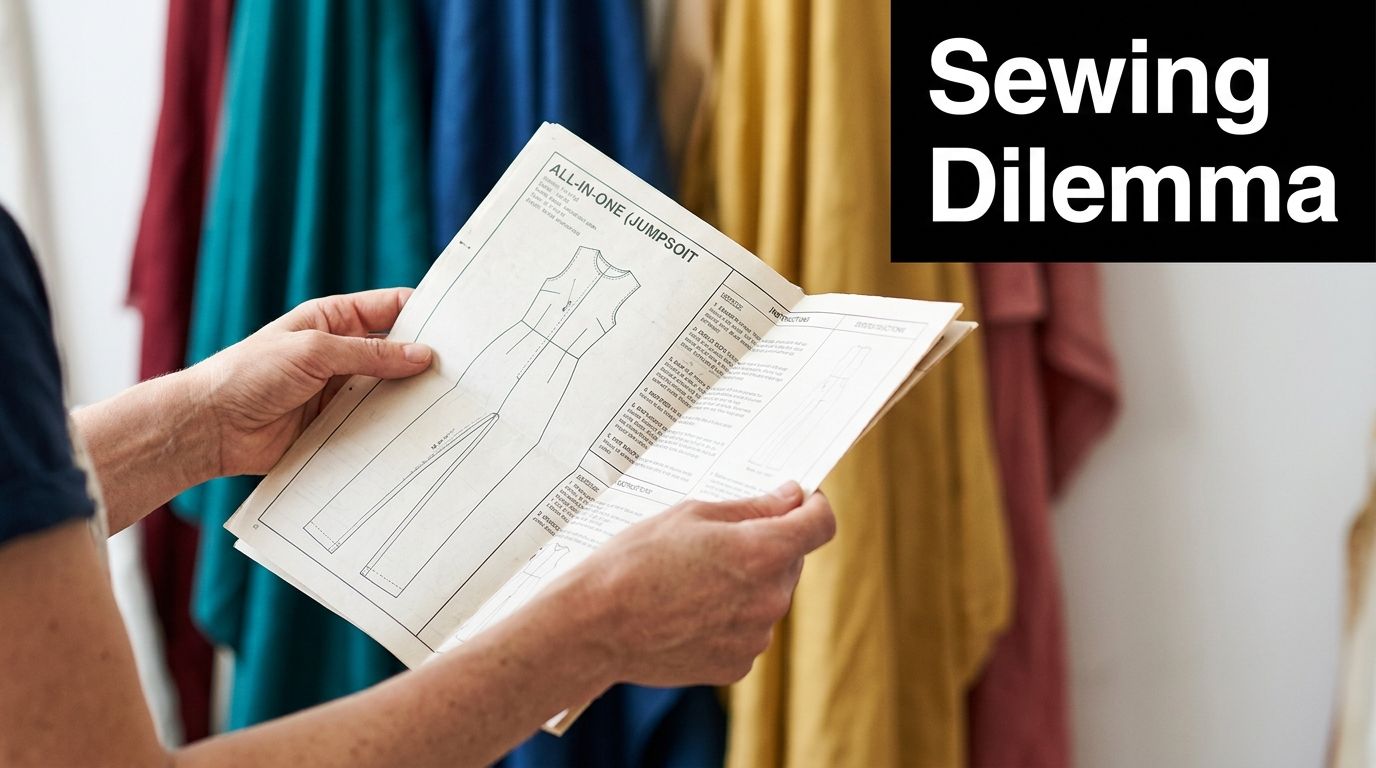
That question matters more than it first appears. The project that looks simpler on the line drawing may be trickier in wear, and the one that seems advanced may suit your wardrobe much better. Search behaviour reflects that split in interest too. Consumers in the UK and US saw a 40% rise in search volumes for the Playsuit / Romper trend over the SS17 season, which points to strong appetite for short-legged, warm-weather options in casual dressing, according to Stylumia's review of the SS17 playsuit and romper trend.
Start with how you want to wear it
If you need something for a holiday, garden party, or hot-weather weekend, a playsuit often makes the most sense. It uses less fabric, usually sews up faster, and doesn't ask you to fit a full trouser leg.
If you want one piece that can earn its keep beyond summer, a jumpsuit usually wins. It gives you more styling range, more fabric options, and more opportunities for shape through the waist, hip, and leg.
| Feature | Playsuit | Jumpsuit |
|---|---|---|
| Lower half | Shorts | Full-length trousers |
| Best for | Warm weather, casual wear | Year-round wear, casual to polished |
| Typical difficulty | Beginner to confident beginner | Intermediate and up |
| Fabric handling | Lighter, less bulk | More fabric, more seam management |
| Main fit challenge | Torso length and shorts balance | Torso length, crotch depth, hips, leg length |
| Sewing time | Usually quicker | Usually longer |
Maker's rule: Don't choose from the sketch alone. Choose from your fabric, your patience, and the occasions you'll actually dress for.
What usually works best
Before buying fabric, ask yourself three practical questions:
- Will I wear bare legs often enough? If not, the playsuit may end up hanging unworn.
- Do I want a quick finish? A simple elastic-waist playsuit is often more forgiving.
- Am I willing to toile the bodice and crotch area? If yes, a jumpsuit becomes much more realistic.
That small pause at the start saves a lot of unpicking later.
The Core Difference Jumpsuit vs Playsuit Explained
You pull out a pattern labelled "romper," cut your fabric, and only later realise you were expecting trouser fitting while the pattern was drafted for shorts. That mix-up is common, and it matters more to a sewist than the styling names suggest.
A playsuit is the shorts version. A jumpsuit has full-length trousers. On paper, that sounds like a small distinction. At the cutting table, it changes the balance of the whole garment, how the weight is distributed, and which fitting problems are most likely to show up.
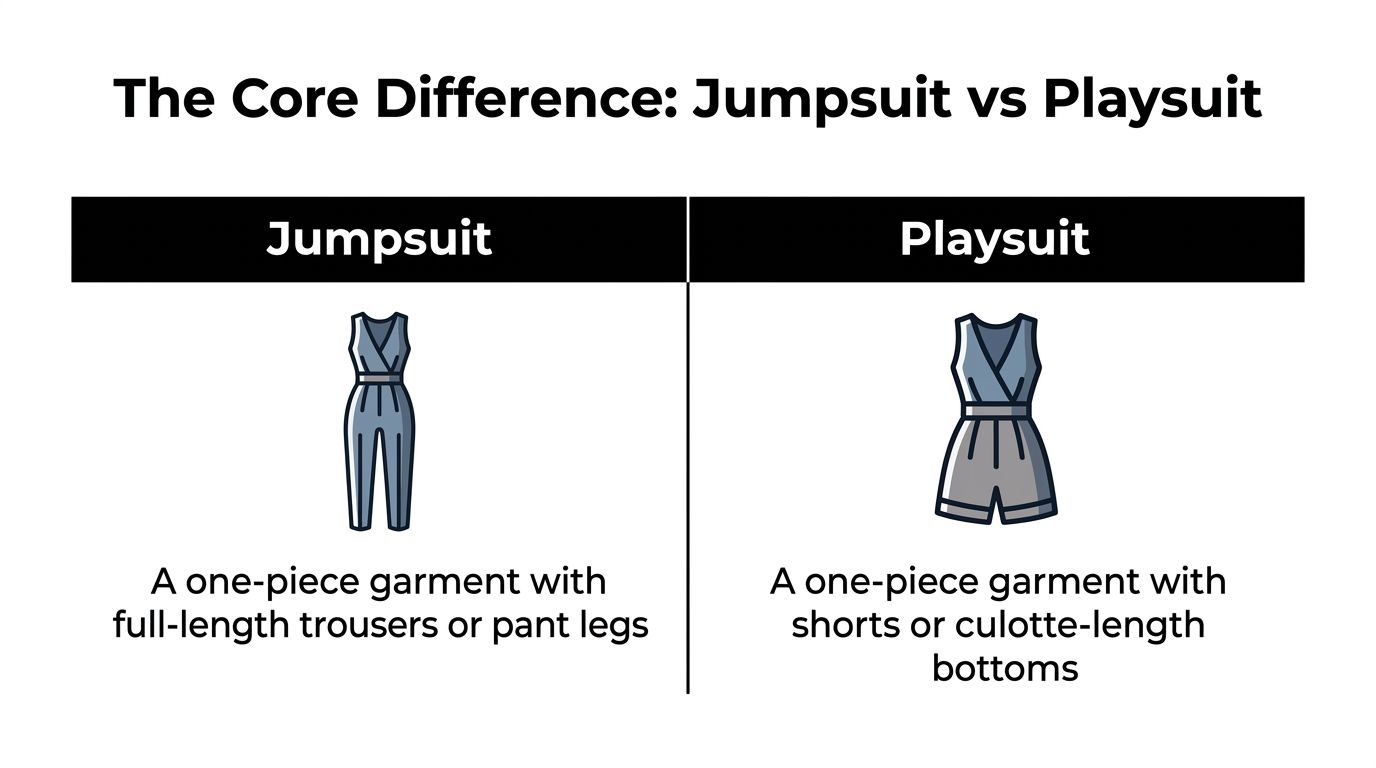
Aza Fashions' guide to jumpsuit vs playsuit gives the cleanest retail definition. A playsuit is an all-in-one with shorts, while a jumpsuit extends into full-length trousers. It also points out a useful terminology difference. In UK usage, playsuit is the usual adult term, while romper often refers to infant clothing.
For dressmaking, the lower half tells you where the work sits.
A playsuit puts more visual and fitting pressure on the bodice, waist, seat, and leg opening because there is less length below to balance the garment. If the shorts are cut a touch too snugly, you feel it straight away when sitting or walking. If they are too wide, the shape can turn bulky or skirt-like.
A jumpsuit spreads the eye downward, but it asks more from the draft. The rise, hip line, thigh shape, and trouser hang all have to cooperate. A slightly off crotch depth in a jumpsuit rarely hides itself. You see it in drag lines, feel it when you sit, and often end up tracing the problem back to torso length rather than the trouser leg alone.
Why pattern names cause confusion
Pattern companies are not consistent. You will see playsuit, romper, short jumpsuit, and sometimes even boiler suit used loosely in listings and reviews. The name on the envelope is less useful than the actual draft.
Check three things instead:
- the length of the lower half
- whether the pattern is shaped like shorts or trousers through the crotch and thigh
- how much ease is built into the seat and leg
That quick check saves a lot of wrong assumptions before you even reach the toile stage.
What the silhouette tells you
A playsuit usually reads lighter, more casual, and more exposed through the leg. That affects sewing choices as much as styling. Pocket bulk shows more easily. A heavy zip can feel out of scale. Waist placement becomes very obvious because the eye moves from bodice to shorts without the visual pause a trouser leg gives you.
A jumpsuit has more length to carry details. Topstitching, pleats, a fly front, tie belts, and wider legs often sit more naturally because the garment has enough vertical space to support them. That is why two patterns with a similar bodice can sew and wear very differently once one becomes shorts and the other becomes trousers.
The practical definition is simple. The sewing implications are not. For makers, the difference is not just shorts versus trousers. It is where the garment needs accuracy, where it tolerates compromise, and where a pattern is likely to ask more of your fitting skills.
A Sewists Comparison Fabric and Pattern Choices
Fabric decides whether your all-in-one looks expensive, homemade in the best way, or faintly miserable. In a playsuit vs jumpsuit decision, I'd start with the fabric you want to use before I commit to the pattern.
Fabrics that suit a playsuit
A playsuit usually wants movement without too much bulk. Soft fabrics that skim the body work well because the shorts need to sit comfortably and the bodice shouldn't feel stiff or boxy.
Good options include:
- Viscose challis or twill for drape and swish. These are lovely for tie-front or buttoned styles, but they can shift at the cutting stage, so use plenty of pins or pattern weights.
- Tencel or lyocell blends when you want a fluid shape with a slightly more substantial hand.
- Cotton lawn for crisp summer versions with gathers, elastic channels, or simple facings.
- Chambray if you want the casual look of denim without the weight of denim.
Shorter garments also show every wrinkle less harshly than a full-length jumpsuit, which is why breezy fabrics often feel at home in a playsuit.
Fabrics that suit a jumpsuit
A jumpsuit gives you a broader range. You can sew one in something soft and elegant, or in a more structured cloth that nods to workwear.
Here's how I'd break it down:
| Fabric | Best use in a jumpsuit | Watch for |
|---|---|---|
| Viscose crepe | Fluid, dressy, soft waist detail | Slippery cutting and stretching |
| Satin back crepe | Evening or occasion wear | Needle marks and pressing care |
| Linen | Relaxed daywear, holiday, layering | Creasing and seam finish visibility |
| Cotton twill | Utility style, topstitching, patch pockets | Bulk at waistband and seams |
| Denim | Structured boiler-suit look | Heavy hems, bulky crotch intersections |
| Corduroy | Autumn and winter makes | Nap direction and seam thickness |
Pattern details worth checking before you buy
Not all all-in-one patterns are drafted with the same intentions. Some are designed to be loose and forgiving. Others depend on close fit and precise closure placement.
For playsuits, look for:
- elasticated waists
- grown-on sleeves or sleeveless bodices
- tie straps
- simple back openings
- loose shorts with enough walking ease
For jumpsuits, check whether the pattern includes:
- darts or princess seams
- a zip, button placket, or wrap front
- trouser style options such as wide-leg, straight, or tapered
- pockets placed in seams or as patch pockets
- waist seams that allow easy bodice-length adjustment
Practical rule: If you're buying fabric first, stable drapey cloth usually gives you more pattern flexibility than stiff cloth. Stiff cloth can turn a soft design into a costume very quickly.
Matching fabric to technique
Many handmade versions go off course. A pattern with gathers, neck facings, and an elastic waist often behaves best in something light. A pattern with a collar, placket, and topstitching usually needs a fabric that can hold a crease and support detail.
A few combinations that tend to work well:
- A viscose playsuit with a faced neckline and waist tie
- A cotton lawn playsuit with buttons and a softly gathered short
- A linen jumpsuit with a wide leg and invisible zip
- A denim jumpsuit with patch pockets, belt loops, and contrast topstitching
- A crepe jumpsuit with a wrap bodice for evening wear
What doesn't work so well? Heavy denim in a very gathered playsuit. Ultra-slippery satin in a beginner pattern with tiny facings and no stabilising. Thick corduroy in a close-fitting jumpsuit with several intersecting seams. The fabric fights the design, and you feel it at the machine.
Navigating Fit and Common Alterations
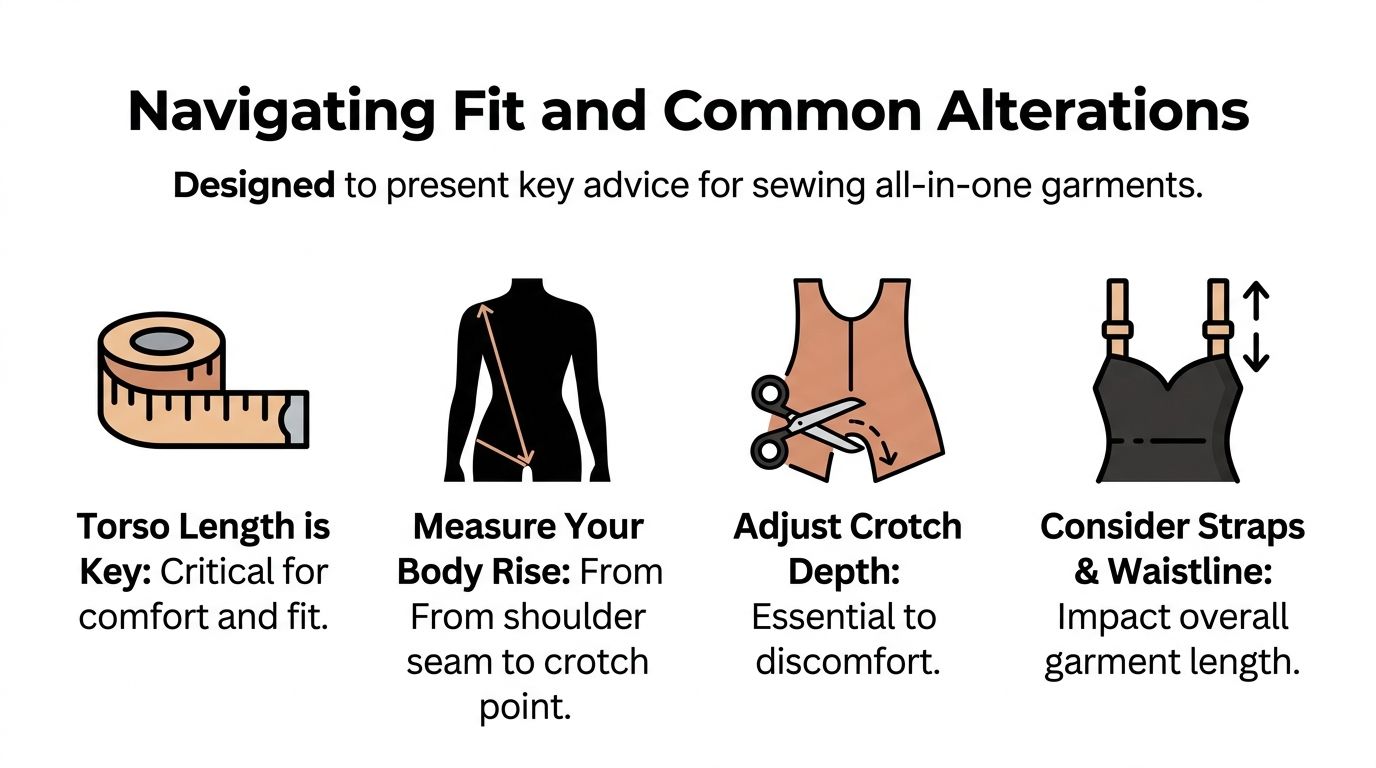
Fit is where an all-in-one either becomes a wardrobe favourite or a lesson in why toiles matter. With separates, a slightly imperfect top can still work with a different pair of trousers. With a playsuit or jumpsuit, every area is connected. If the torso is off, the whole garment feels off.
Measure body rise before cutting
The most useful measurement here is body rise. Sit on a hard chair and measure from your natural waist at the back, down between the legs, and back up to the natural waist at the front. Compare that with the pattern's finished measurements if they're given, or measure the pattern pieces with seam allowances in mind.
That number helps you spot one of the biggest all-in-one problems early. If the rise is too short, the garment pulls upward and becomes uncomfortable fast. If it's too long, the crotch hangs low and the waist drops.
Alterations that help a playsuit
Playsuits can still be fiddly, but the fitting work is usually more contained. The lower half is shorter, so you're not also chasing trouser drag lines and hem balance.
Useful playsuit adjustments include:
- Shorten or lengthen the bodice at the printed adjustment line if the waist seam sits too high or low.
- Add to the crotch depth carefully if the shorts pull when you sit.
- Widen the shorts leg slightly for comfort if you want more ease through the thigh.
- Raise or lower the waist elastic channel on simple patterns to hit your natural waist better.
- Adjust strap length on camisole styles before assuming the torso itself is wrong.
Alterations that matter on a jumpsuit
Jumpsuits are less forgiving because the full leg exaggerates fit issues. A small problem at the crotch can turn into dragging side seams, twisting legs, or folds under the seat.
Try this order when fitting:
- Fit the bodice first. Get bust, shoulders, and waist placement right.
- Check torso length next. Pin out or add length above the waist if needed.
- Assess crotch depth and shape. Walk, sit, and bend.
- Then refine the trouser leg. Adjust width, taper, or hem only after the upper fit is stable.
If you sew for a taller frame, leg length and torso length often need attention together. For shape references and proportion ideas, I like seeing how finished garments are styled on longer bodies, especially in resources on enchanting styling for tall denim, because they show how leg shape and waist placement affect the whole look.
Don't trust a standing mirror alone. Sit down in your toile. Climb stairs. Reach forward. All-in-one garments reveal their real fit in motion.
Toile the right sections
You don't always need a full practice garment, but you do need a meaningful test. For a playsuit, a partial toile of the bodice and upper shorts can be enough. For a jumpsuit, I'd toile the bodice, crotch, and enough of the leg to judge hang through the hip and thigh.
Use a fabric with similar weight and drape if possible. Cheap calico is fine for a structured twill jumpsuit. It tells you much less for a fluid viscose design.
A few practical habits save headaches:
- Mark the waistline clearly on the toile so you can see if it's dropping.
- Transfer grainlines accurately because twisted legs often start with inaccurate cutting.
- Baste the zip area closed first if you're only checking fit.
- Write changes on the pattern immediately rather than trusting memory.
Common signs and what they usually mean
| Symptom | Likely issue | First fix to try |
|---|---|---|
| Front pulls upward | Torso too short | Lengthen bodice or rise |
| Droopy crotch | Torso too long or crotch too deep | Shorten between bodice and crotch |
| Side seams swing forward | Hip balance off | Recheck size and side seam shaping |
| Shorts ride up | Too little thigh ease | Add width to shorts leg |
| Trouser folds under seat | Seat shape or crotch curve needs work | Adjust back crotch curve |
Fit is slower here, but it pays you back every time you wear the garment.
Construction Difficulty and Key Sewing Techniques
A lot of sewists decide between a playsuit and a jumpsuit at the cutting table, not on a mood board. If you want a quicker make with fewer points where fit and construction can go off course, a playsuit usually gives you a friendlier start. If you want a project that teaches careful order of assembly, pressing discipline, and more precise handling through the legs and closures, a jumpsuit will ask more of you.
That difference shows up fast once sewing begins.
Why playsuits are usually simpler to build
Most playsuits have a shorter construction path. You are handling less fabric, sewing shorter inseams, and dealing with less drag from the garment as it feeds through the machine. That matters more than many beginners expect, especially on lighter fabrics that shift while you sew.
Pattern details also tend to be simpler. Common features include elastic waists, grown-on facings, tie shoulders, button backs, or a straightforward centre back zip. Those techniques still reward care. A neckline that is not understitched properly will roll outward. An uneven elastic casing can make the whole garment look homemade in the wrong way.
On a playsuit, I would focus on getting these techniques clean:
- Understitching facings so necklines and armholes sit flat
- Staystitching curves early before lightweight edges stretch
- Even waist casings so elastic does not twist inside
- Neat short hems because puckers show quickly on curved shorts hems
- Pocket accuracy if the pattern includes in-seam or patch pockets
Why jumpsuits ask for more control
A jumpsuit has more opportunities for small errors to become visible. The long leg magnifies grain problems. A slightly twisted cut can turn into a side seam that creeps to the front. A rushed press at the hip can leave drag lines that look like a fit issue even when the pattern is sound.
Closures are often more involved too. Depending on the style, you may be sewing a concealed zip, front placket, shirt collar, cuff, or waistband. None of that is advanced couture work, but the order matters, and accuracy matters. If one step is off by a few millimetres, the mismatch tends to travel.
If you want a refresher on clean fundamentals before starting, Display Guru's guide to sewing covers useful basics such as seam finishing, pressing, and accurate handling.
The techniques that make the biggest difference
For both garments, the crotch seam deserves proper attention. Sew each leg first, with the inseams completed and pressed. Then turn one leg right side out, place it inside the other leg, and match the front and back crotch points carefully before stitching the full curve in one pass. That method keeps the shape truer and makes it easier to clip and finish neatly.
Pressing matters just as much as stitching here.
A crotch curve can be sewn accurately and still look poor if it is not clipped where needed and pressed over a curved surface. I keep a tailor's ham nearby for this stage because a flat ironing board rarely gives the right shape.
A few priorities help each style come together better:
- For playsuits, stabilise necklines on soft fabrics, reduce bulk at the waist seam, and choose finishes that stay light
- For jumpsuits, press every seam after sewing, reinforce stress points near the zip and crotch, and grade seam allowances where layers stack up
- For both, match your seam finish to the cloth. Overlocking suits everyday makes, French seams work well on finer fabrics, and bound seams are a good choice for unlined utility styles
If you are choosing based on sewing experience, the trade-off is fairly clear. A playsuit is often the better first all-in-one because it is faster to assemble and easier to handle at the machine. A jumpsuit usually takes longer, but it gives you more practice in precision, fabric control, and finishing.
Styling Your Handmade Garment When to Wear Each
You finish pressing the last seam, try the garment on, and then the primary question arrives. Where will you wear it, and what shoes, layers, and bag will make it feel like part of your wardrobe rather than a one-off sewing win?
That question usually separates a playsuit from a jumpsuit more clearly than any definition does.
A playsuit earns its keep in warm-weather, low-fuss dressing. It suits holidays, garden parties, festivals, beach cafés, and the sort of summer days when you want to get dressed quickly and stay comfortable. In sewing terms, it also tends to work best with styling that keeps the garment light. Flat sandals, canvas trainers, an open shirt, a straw bag, simple jewellery.
A jumpsuit gives you a broader range. The full-length leg shifts the look straight away, so the same handmade garment can move from daytime to dinner with a change of fabric and accessories. Linen keeps it relaxed. Crepe, twill, or a dark fluid viscose can make the same basic pattern feel polished enough for a meal out, an event, or a workplace with a fairly flexible dress code.
That workplace point matters in practice. Plenty of ready-to-wear jumpsuits look smart on the rail but fail in real life because the fabric creases badly, the neckline drops when you sit, or the trouser leg fights with the shoes you own. A handmade version has an advantage here. You can choose a higher neckline, add sleeves, raise the waist, or cut the leg shape to suit loafers, boots, or a low heel.
The styling decisions that usually pay off are simple.
For a handmade playsuit:
- sleeveless, short-sleeved, or easy camp-collar styles
- shorts with enough width to sit and walk comfortably
- breathable cloth such as washed cotton, linen blends, double gauze, or soft viscose
- casual shoes that match the hem proportion
- light layers only, such as an overshirt or denim jacket
For a handmade jumpsuit:
- a waistline that is either clearly defined or intentionally loose
- trouser legs cut for the shoes you plan to wear most often
- layers that work with the neckline and sleeve shape, such as a blazer, cardigan, or fitted knit
- fabric chosen for the setting, from denim and linen to crepe and wool blends
The nicest results come from matching the pattern's attitude to the occasion. A strappy playsuit in cotton lawn reads casual and summery. A collared jumpsuit in navy twill with a tapered leg reads sharper and more structured.
We see the same mistake in the shop again and again. Sewists choose a formal fabric for a very casual pattern, or pick a drapey fabric for a style that needs body through the waist, collar, or trouser leg. The garment is well made, but it never feels quite right on the body.
Choose the setting first, then style and sew for that use. That is usually what turns an all-in-one from a nice project into a garment you reach for often.
Your Sewing Checklist Which One Is Right For You
If you're still undecided, the answer usually sits in a mix of wardrobe need, skill level, and fabric preference. A playsuit gives you speed, ease, and a relaxed finish. A jumpsuit asks for more fitting and more sewing accuracy, but it pays off with range.
Technically, naming matters too. This explanation of jumper, romper, and jumpsuit terminology makes the distinction clearly. A romper or playsuit is a standalone outfit with shorts, while a jumpsuit is defined by its long pants. That sounds basic, but in sewing it helps you choose the right pattern expectations from the start.
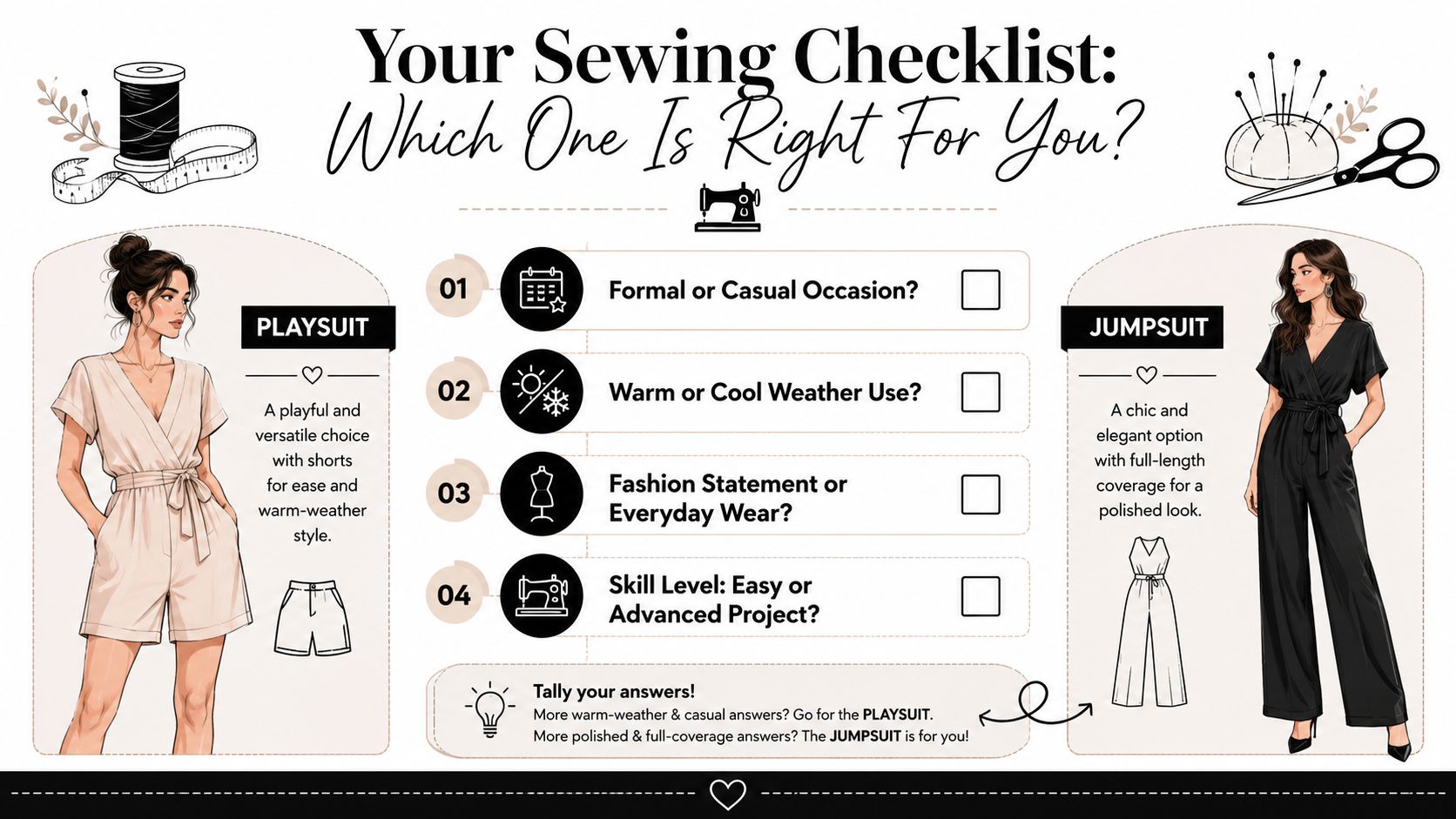
Choose a playsuit if
- You want a quicker finish. There's less garment to fit and hem.
- Your fabric is light and summery. Cotton lawn, chambray, viscose, and Tencel all make sense here.
- You're building a warm-weather wardrobe. Holidays, weekends, festivals, and casual days out suit it well.
- You prefer simpler closures. Elastic waists, ties, and basic zips are common.
- You're learning. It's a good place to practise facings, casings, and clean curved seams.
Choose a jumpsuit if
- You want more versatility. It can move across seasons and dress codes.
- You're willing to toile. Torso and crotch fit matter too much to skip it.
- You've found a fabric with body or elegant drape. Linen, twill, crepe, denim, and corduroy can all shine.
- You enjoy more involved construction. Zips, plackets, collars, and structured trousers make it a richer sewing project.
- You want a statement piece. A well-fitted jumpsuit often becomes the garment people ask about.
Choose the garment you'll actually wear, then choose the version of it your current sewing skills can support.
A good all-in-one is very satisfying to make because everything has to work together. When it does, you get that rare combination of comfort, usefulness, and handmade pride.
If you're ready to turn a pattern idea into a finished garment, More Sewing is a practical place to start for quality dressmaking fabrics, haberdashery, and sewing supplies. Whether you're planning a breezy summer playsuit or a more structured jumpsuit, having the right cloth and notions on the table makes the whole project go more smoothly.
