
You've found a floral print that would make a lovely dressing gown, but the listing says little beyond soft and cosy. Before you buy enough for the pattern, you need to know whether it'll drape comfortably, stretch out at the elbows or lose its fluffy surface in the wash. Floral fleece fabric is worth choosing by its construction first, then checking whether the flowers suit your project.
Floral Fleece Fabric at a Glance
Floral fleece fabric is generally a brushed, knitted polyester fabric with a floral print, suited to warm, soft garments and blankets. The fleece is the fabric type. The floral describes the decoration, not its warmth, durability or stretch.
That distinction matters when similar-looking prints appear on very different cloths. A fine microfleece can slip comfortably beneath another layer, while a substantial double-faced fleece can make the same garment feel bulky.
Floral fleece types by fibre, weight and use
| Fleece type | Typical fibre | Common uses |
|---|---|---|
| Microfleece | Polyester | Pyjama tops, linings, light tops |
| Standard anti-pill fleece | Polyester, often recycled PET | Hoodies, dressing gowns, jackets |
| Heavyweight or double-faced fleece | Polyester, sometimes two-sided pile | Winter jackets, cosy blankets, lined hats |
| Stretch fleece | Polyester with a small elastane percentage | Leggings, fitted tops, children's wear |
Most floral fleece sold for these projects is polyester; stretch versions may include elastane. Check the actual composition, rather than assuming that a knitted fabric will have enough stretch for a close-fitting pattern. Recycled content should also be stated explicitly.
The listing should give grams per square metre, or gsm, alongside fibre content. This measures fabric mass, not thickness, so it's useful for comparison without being a complete description of warmth.
Compare weight before choosing the print
For a hypothetical comparison, put a 180 gsm microfleece beside a 300 gsm anti-pill fleece carrying the same roses. You might choose the lighter cloth for a layering top and the heavier cloth for a loose jacket, but you'd still need to assess recovery, density and handle.
Don't confuse a taller pile with a better fabric. A deep, loose surface may feel luxurious on the roll yet prove awkward around a neckline; a shorter, denser pile can be easier to sew neatly.
Likewise, anti-pill isn't a promise that the surface can never change. It's a useful product description, but a sample tells you more about the cloth you're buying.
If the seller supplies neither composition nor weight, ask before ordering garment quantities. A pretty photograph can show motif scale and colour, but it can't show how firmly the knit holds together.
Weight and fibre tell you how a fleece will behave; the print tells you how it will look.
Judging and Testing Floral Fleece Before You Buy or Cut
Specify construction and mass, then inspect the print. The raised pile works rather like the nap on a brushed carpet, holding still air within the surface. That helps explain why fleece can feel warm without the weight you might expect from a dense woven coat fabric.
The University of Leeds account of microfibre testing identifies fibre, yarn and fabric construction as important influences on release during laundering. It also reports lower release from tightly knitted structures, a useful reason to inspect the base rather than judging softness alone.
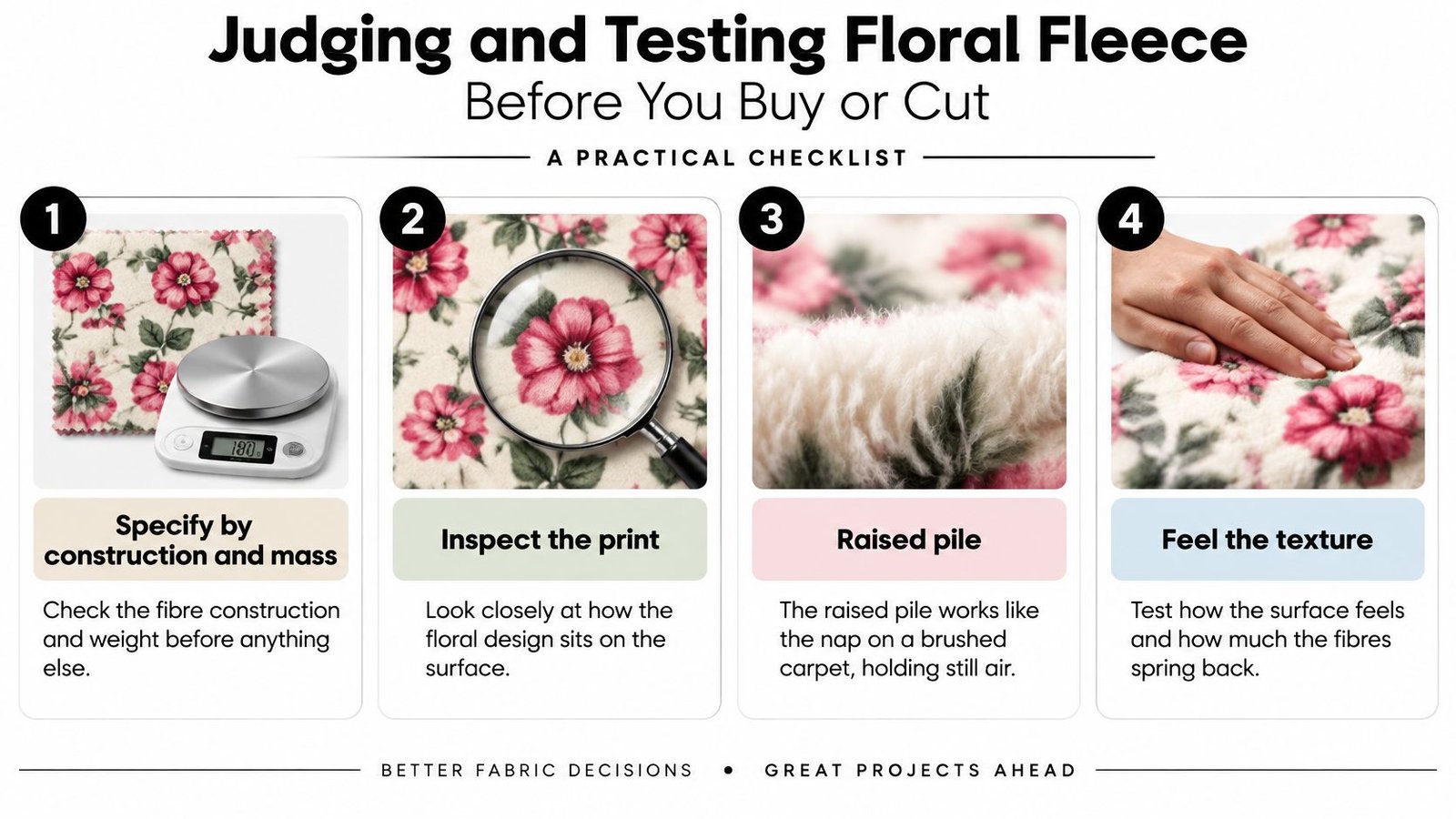
- Read the weight. Match the cloth to the pattern's recommended fabric, then consider how much bulk the cuffs, collar and seams will contain.
- Stroke the pile both ways. Notice whether the colour looks darker in one direction, and check whether the flowers have an obvious top.
- Test stretch recovery. Mark a short length, stretch it gently and release it. A lingering ripple is a warning for fitted knees, elbows and necklines.
- Examine edge curl. Strong rolling makes accurate handling harder. It isn't, by itself, proof of poor finishing, because knitted structures naturally behave differently.
- Check print alignment. Compare the motif with the selvedge and the relaxed knit. Don't pull the fabric off grain just to straighten a crooked print.
- Wash a sample. Assess the finished result before committing the entire length.
For a visual explanation of different surface structures, That Blanket Co's guide to understanding fleece texture and pile height helps distinguish plushness from the underlying fabric.
Make the swatch test repeatable
Prepare separate pieces for an unwashed control, a wash test and a sewn test. Photograph them together, mark their length and width, and record the programme, detergent and drying method so you can repeat the conditions.
Sew a representative seam and hem into the sewn sample. After washing and drying, compare dimensional change, pile flattening, colour transfer onto a damp white cloth and seam distortion. Examine the reverse too, especially where a printed face hides a pale base.
Choose a stable cloth for garments that'll see frequent wear, and make fasteners replaceable. WRAP findings reported by Circular Online found an 82.2% displacement rate, meaning repaired textile items often took the place of new purchases. Repairability belongs in the buying decision, not just the mending basket.
Project Ideas and Yardage for Floral Fleece
Blankets, relaxed tops, hats and dressing gowns make good use of fleece's softness and forgiving edges. It's less convincing when a design needs crisp lapels, sharp creases or closely pressed darts. Keep the silhouette simple when the floral print is bold.
Yardage needs a real cutting layout. Without the pattern pieces, garment size and motif repeat, a precise buying quantity would be guesswork.
Project ideas with approximate floral fleece yardage
| Project | Construction note |
|---|---|
| Children's pyjama top, age four to six | Simple shapes, potentially a continuous front-and-back body where the pattern permits; use the size-specific layout for buying length |
| Cosy hat, adult | A single-piece crown with a separate ribbed brim; measure the crown pattern's cutting height |
| Snood or scarf | Single layer with zigzagged edges; buying length follows the rectangle's orientation across the cloth |
| Adult dressing gown | Use the pattern's size and width chart; a directional print can require extra length |
| Appliqué on a plain jumper | Fusible web and close zigzag; use an offcut large enough for the selected motif |
Work out the length on the cutting table
For a hypothetical layout on 150 cm-wide fabric, arrange the actual pieces within that width, including seam allowances. Keep every piece facing the required direction, then measure the total occupied length. Add space for straightening the cut ends, your wash-test result and any deliberate motif placement.
A child's top could use a lightweight stretch fleece, a generous neckline and a narrow zigzag hem. A continuous shoulder construction only works if the pattern allows it and the print still looks right on the back. Don't sacrifice fit or put flowers upside down merely to remove a seam.
For an adult hat, use the fleece for the crown and ribbing for the brim. Choose ribbing with firm recovery, and check the join on a sample because a thick seam can feel uncomfortable against the forehead.
A throw is a useful first project because you can concentrate on cutting square and managing the edge. For example, a finished throw measuring 130 by 150 cm needs a cut size that also allows for its chosen edge treatment; a wide, plain binding can frame a busy floral design without competing with it.
Use the motifs rather than wasting them
Cut a recognisable flower from an offcut and appliqué it onto a plain jumper. Test fusible web on scrap first, using a pressing cloth and the lowest effective heat, then secure the edge with a close zigzag without packing the stitches so tightly that they distort the knit.
Buying rule: Lay out a one-way print as a one-way print before ordering. Extra length can't rescue a motif that won't fit across the usable width.
Pairing Floral Fleece with Other Fabrics
Floral fleece is soft, bulky and often stretchy, so partner fabrics should either move with it or stabilise a particular area. A contrasting fabric isn't automatically compatible because its colour matches. Test how the joined layers hang and stretch.
Partner fabrics for floral fleece
| Partner fabric | Best role | Why it works | Watch for |
|---|---|---|---|
| Plain cotton jersey | Side panels, sleeves | Can match the stretch and weight of mid-weight fleece | Pick a colour from the print background and compare recovery |
| Ribbing | Cuffs, neckbands, hat brims | Recovers stretch so openings hold shape | Run the greatest stretch around the opening |
| Plain solid fleece | Hoods, pockets, linings | Calms a busy print | Match weight and pile direction |
| Quilting cotton | Patch pockets, bindings | Stable woven fabric holds shape at seams | Pre-wash to avoid shrinkage mismatch |
Match behaviour at the join
Cotton jersey works best when it isn't dramatically thinner or stretchier than the fleece. Hold the proposed layers together vertically: if the fleece drags the jersey down, use the jersey for a smaller inset rather than an entire sleeve.
Ribbing has a different job. It needs to draw an opening in gently and recover after dressing, so don't calculate a cuff purely by copying the fleece edge length. Fit a trial loop around the wrist or head and check comfort before attaching it.
Plain fleece gives the eye somewhere to rest, particularly around a hood or large pocket. However, a second full layer can make an already substantial garment cumbersome, so handle the proposed combination before deciding to line everything.
Build a balanced combination
Consider a floral fleece hoodie with a plain navy hood lining, ribbed cuffs and a quilting cotton patch pocket. The navy can echo the print background, while the woven pocket keeps its opening tidy. Stabilise the pocket opening locally rather than stiffening the whole front.
Quilting cotton binding needs similar care. It can stop a stretchy edge from growing, but a straight-cut strip can also restrict an opening that needs to expand.
Avoid these combinations unless there's a clear construction reason:
- Chiffon beside heavy fleece: The difference in weight can make the woven layer drag or pucker.
- Very light lawn as a structural panel: It needs support where it carries the fleece's weight.
- Delicate silk at high-friction joins: A beautiful contrast may still be impractical for everyday laundering.
Washing Floral Fleece Without Losing Loft or Colour
A colder wash isn't automatically the lowest-shedding wash. Temperature, agitation, water-to-load ratio and fabric construction interact, so choosing a temperature alone doesn't settle the question.
In polyester-fleece laboratory testing described by The Conversation's account of UK laundry emissions, doubling the water-to-clothing ratio released more than twice as much material, while reduced agitation cut release by over 50%. Separately, mixed household laundry generated 30% fewer microfibres on a 15°C, 30-minute cycle than on a 40°C, 85-minute cycle; that result wasn't specific to floral fleece.
Care choices and what they do to shedding and print
| Care choice | What the evidence or care guidance indicates | Practical setting |
|---|---|---|
| Water-to-load ratio | More water relative to clothing increased release in fleece testing | Full but not overloaded load |
| Agitation | Reduced agitation substantially lowered release in the tested conditions | Low-agitation programme compatible with the label |
| Wash temperature | Shorter, colder washing reduced generation in mixed household laundry | Use the gentlest effective label-approved cycle |
| Drying | Excessive heat can flatten and roughen fleece surfaces | Air dry, or low tumble dry if permitted |
| Softener and combined detergents | Specialist fleece-care guidance warns against them | Regular non-bio detergent without softener |
| Early washes | Shedding can change before settling | Test offcuts and inspect subsequent washes |
| Filter or capture bag | Purpose-made devices retain some released fibres | Use where compatible and maintain as directed |
Choose the programme, not just the temperature
A half-empty, high-water wash isn't necessarily gentle on fibres. Load the machine appropriately, but don't pack it so tightly that the fabric cannot move or rinse properly. Check the programme's load allowance, because a synthetics cycle may accept less laundry than a cotton cycle.
Lower agitation is a useful adjustment, but programme names can mislead. Some delicate settings use plenty of water, so compare the machine's actual options rather than assuming that the word delicate guarantees the best outcome.
A purpose-made capture bag or machine filter adds another measure; neither eliminates shedding. Remove collected lint and dispose of it with household rubbish rather than rinsing it down the sink.
Protect the printed surface
Equafleece's fabric-care guidance recommends gentle 30°C or 40°C washing, regular non-bio detergent and avoiding fabric softeners and combined detergents. It also warns against laundering fleece with lint-shedding towels or linen.
Keep fleece with compatible, soft-textured items rather than abrasive garments or exposed hook-and-loop fasteners. Follow the fabric's care label instead of chasing a laboratory shedding result with heat that could damage the surface.
- Pre-wash offcuts: Record the settings before sewing.
- Turn garments inside out: Reduce rubbing against the printed face.
- Air dry where possible: Reshape without stretching the wet garment.
- Compare successive washes: Check colour, loft and the sewn sample under similar lighting.
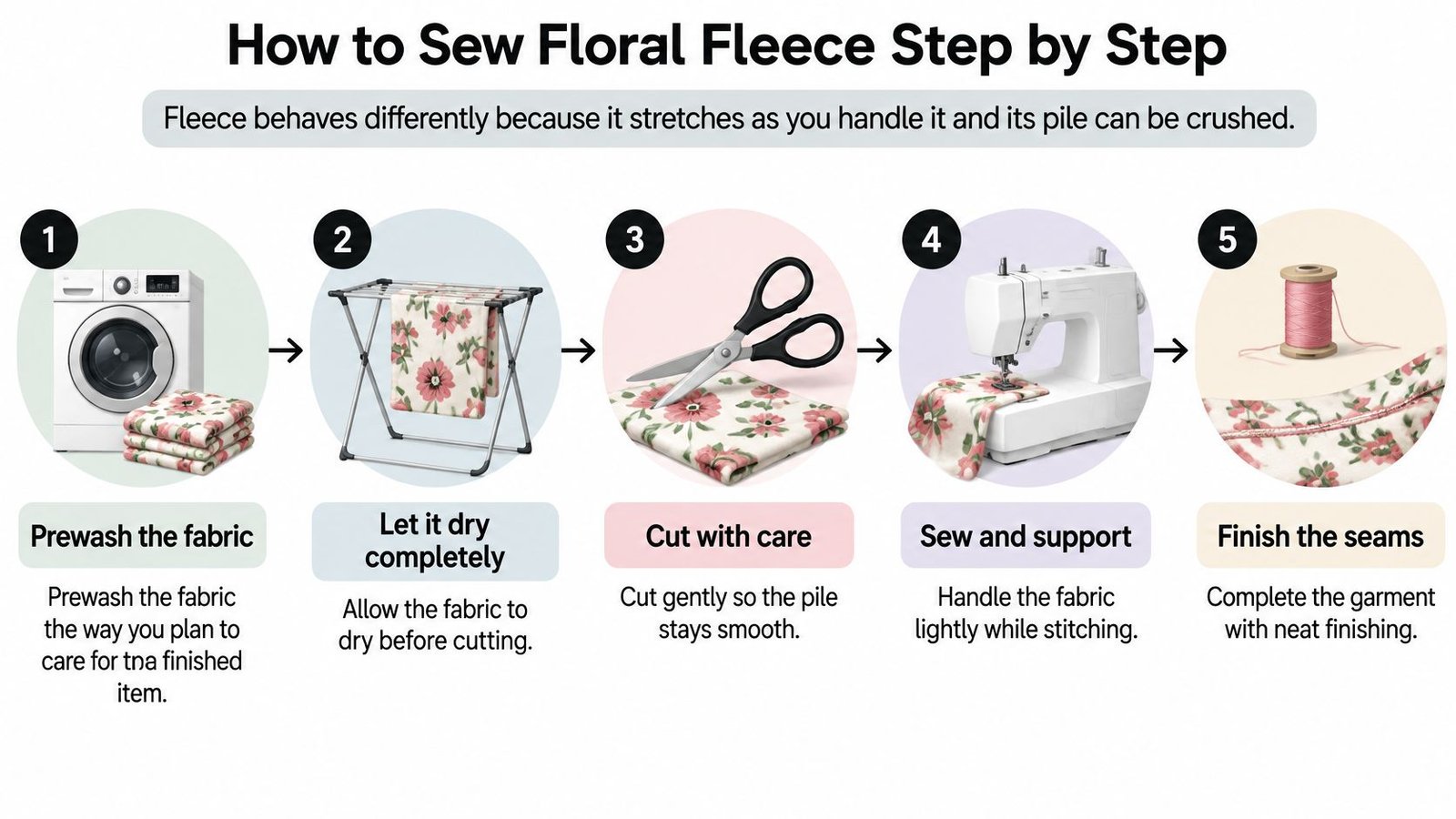
How to Sew Floral Fleece Step by Step
Fleece stretches as you handle it, and its pile can be crushed, so support the fabric rather than pulling it into position. The following workflow keeps the cutting accurate and gives you opportunities to adjust the machine before sewing visible seams.
Prepare, cut and test
Prewash as you intend to launder the finished item. Let the length dry completely and relax flat so you aren't cutting damp, stretched cloth.
Smooth it onto the cutting surface without tension. Use a rotary cutter and pattern weights where practical, checking the nap arrow on every piece before cutting. Cut a single layer when matching a prominent flower across a centre-front opening.
Fit a ballpoint or stretch needle and polyester thread. Sewdirect's guide to sewing fleece recommends a 90/14 needle and a starting stitch length of approximately 3–4 mm, tested on the project fabric. The rounded needle point helps pass between knitted loops rather than damaging them.
Test the seam under realistic conditions. Fold the scrap to reproduce the number of layers at the bulky area, then stitch and stretch it gently. Short, densely packed stitches can pucker fleece and are unpleasant to unpick through the pile.
Join thick layers with clips. Position them without stretching either edge and remove each clip before it reaches the presser foot. Match notches first, then distribute the remaining fabric evenly.
Sew without stretching the edges
Choose a narrow zigzag or suitable stretch stitch for seams that must move. Test its recovery rather than judging appearance alone, because a neat seam that snaps when stretched isn't suitable for a fitted opening.
Trim and grade bulky seam allowances. Stagger the trimmed edges so they don't form a single hard ridge, while leaving enough cloth to keep the seam secure. Fleece usually doesn't need an anti-fraying finish, so avoid adding unnecessary overlocking bulk.
Stabilise non-stretch zip edges. Use compatible interfacing or stabilising tape to prevent waviness, testing any fusible product carefully so you don't crush or overheat the pile.
Finish hems with a tested twin needle, coverstitch or narrow zigzag. A twin needle can tunnel on some fleece, so adjust the sample before committing to the garment. Don't stretch the hem as it passes beneath the foot.
If the layers creep sideways, check their nap direction and alignment, then reduce handling pressure. Let the feed dogs advance the fabric; supporting a dressing gown's weight is helpful, but pulling it through the machine isn't.
Repair, Reuse and Disposal of Floral Fleece
A vivid novelty print can remain useful long after its original garment stops fitting. Plan for the part most likely to fail, whether that's a zip, cuff, pocket corner or stretched neckline. Polyester fleece isn't made responsible by calling it durable, but keeping a useful item in service is a practical aim.
A dense fleece that survives repeated wear and repair may serve its owner better than a supposedly preferable alternative that needs early replacement. That's a durability judgement, not a complete environmental comparison. Construction, laundering and how long someone uses the item all matter.
Decide what can stay in use
Choose for the wear pattern. A daily dressing gown needs stable seams and comfortable bulk, while an occasional decorative throw has different demands. Don't buy solely for the appeal of the flowers.
Make vulnerable parts replaceable. Attach cuffs and fasteners so you can remove them without dismantling the garment. Repair a small pocket tear with a backing patch before it spreads into the surrounding knit.
Sort scraps by useful shape. Keep recognisable flowers for appliqué, strips for small accessories and larger pieces for replacement pockets. Don't add fleece cuffs to a garment unless the fabric has enough recovery to work there.
Assess the whole item before disposal. Offer clean, wearable pieces for reuse, but check whether an organisation accepts damaged textiles before donating them.
Check the local route
Textile collection rules aren't universal, and a recycling label doesn't guarantee that a particular fleece item can be processed locally. Ealing Council's clothing and household textile guidance illustrates why checking the relevant council's reuse and collection instructions is more useful than assuming every textile bank accepts everything.
Keep contaminated or unusable scraps out of donations intended for wearable clothing. Before buying the next length, request a sample and carry out the wash-and-seam test so your choice rests on the cloth's behaviour, not just its photograph.
More Sewing offers fabrics, haberdashery and fabric sample swatches to help you plan a project before committing to a full length. Visit the shop to explore suitable materials and ask about a swatch for your floral fleece project, then test its wash behaviour alongside your chosen thread, seam and finishing method.
