You're standing in a fabric shop with a beautiful bolt across your arm, and the label says deadstock. The colour is exactly right, the handle feels expensive, and there's just enough cloth for the jacket you've been planning. Then the doubt arrives. Is buying it a responsible way to use existing material, or are you helping the fashion industry tidy up its overproduction?
The honest answer to is deadstock fabric sustainable is conditional. Reusing an unwanted bolt can avoid the need to buy newly manufactured cloth, but the word “deadstock” doesn't tell you where the fabric came from, what chemicals were used, or whether the supplier is describing genuine brand leftovers rather than ordinary surplus. The useful question isn't whether deadstock is automatically green. It's whether this particular fabric replaces a new purchase and can be used carefully for a long-lived project.
What Deadstock Fabric Really Means
A sewist lifts a bolt from a basket marked “deadstock”, checks the width, and starts doing mental arithmetic. There's enough for a blouse, perhaps, but not enough to cut the matching trousers. The fabric looks untouched, so it's tempting to assume it has been rescued from disposal. Sometimes that's accurate. Sometimes the label is doing more work than the evidence.
Deadstock fabric generally means woven or knitted cloth produced for a particular buyer or collection that never sold, was cancelled during production, or remained unsold after a season. It hasn't normally been worn. That distinguishes it from second-hand textiles, which have already been used as garments or household goods. It also differs from a remnant, which is the smaller piece left after a larger length has been cut.
The terms overlap, but they aren't interchangeable:
- Ex-designer fabric usually describes cloth associated with a fashion label or designer collection, although the seller may not always provide documentation.
- Mill surplus can include excess production, end-of-run lengths, test pieces, or cloth made beyond the original order.
- Cancelled-order fabric was finished for a buyer who later withdrew, leaving the mill or intermediary with stock.
- Remnants are cutting-room leftovers, not necessarily unused full rolls.
A useful way to remember the difference
Think of a kitchen shelf. A tin of ingredients bought for a recipe but never opened is similar to unused production fabric. The heel of bread left after making sandwiches is closer to a remnant. A jumper bought, worn, and then donated belongs in the second-hand category. All three may be useful, but their histories and environmental implications aren't the same.
The distinction matters because unused fabric already carries the impacts of fibre production, spinning, weaving or knitting, dyeing, finishing and transport. Reusing it may extend that material's life, but it doesn't erase what happened before it reached the shop. A supplier who can explain the bolt's history gives you a stronger basis for judging the purchase than a listing that uses “deadstock” as a sales adjective.
That's why I treat the label as an opening question, not a sustainability certificate. Ask whether it came directly from a brand, a mill, a wholesaler, or a cancelled programme. The more precise the answer, the more confidently you can decide whether you're rescuing a genuine leftover or buying surplus with a fashionable name.
Where Deadstock Comes From and Why It Exists
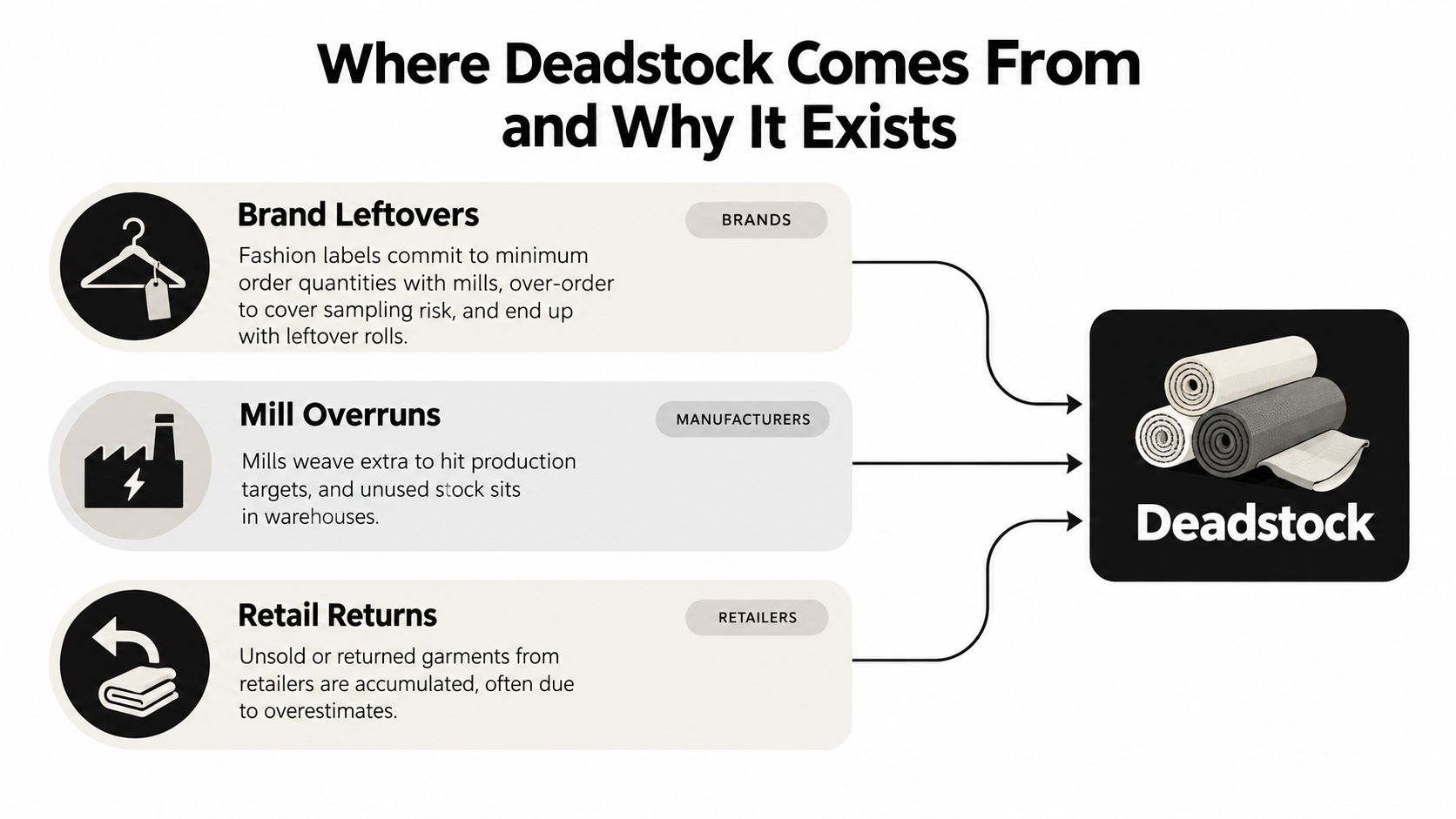
Deadstock usually enters the market through one of three routes. Understanding them helps you ask better questions before ordering a swatch or committing to a whole roll.
Brand leftovers
Fashion labels often order cloth before they know exactly how many finished garments will sell. Mills may also require a minimum production quantity, so a label orders more fabric than its sampling and cutting plans appear to need. That extra material can remain unused when a collection changes, a colour is dropped, or a forecast proves too optimistic.
A simple production-line analogy helps. A bakery doesn't bake one loaf at a time for each customer because the ovens, dough preparation and staffing wouldn't work efficiently. Textile mills face a similar problem. They organise machinery, yarns, dye baths and finishing processes around viable batches, which can leave a tail-end length after the main order is complete.
Mill surplus
Mill surplus can include unused cloth, overrun lengths, colour-lot leftovers, test pieces and fabric that falls outside a buyer's exact shade or specification. It may be perfectly suitable for a dressmaker, even when it no longer fits the original production schedule. It isn't automatically the same as ex-designer deadstock, because the material may never have been allocated to a named fashion brand.
Cancelled orders
A retailer or clothing manufacturer may cancel a programme after the mill has already woven, knitted, dyed or finished the fabric. The cloth then needs a new buyer. Independent UK fabric shops and online resellers may purchase these lots, while some material can also pass through textile reuse or recycling networks.
There's no standard UK volume that a home sewist can assume for a “deadstock” listing. One supplier might have a few dress lengths, another several rolls, and another a warehouse batch bought through a wholesaler. Limited availability is part of the appeal, but it also makes repeat production difficult for small brands.
Ask this first: Was the cloth made for a named brand, produced as mill surplus, or left over after a cancelled order?
Marketing language deserves care here. A practical explanation of ESG marketing and how claims are framed is useful background, especially when a sustainability term appears without evidence. “Deadstock” may accurately describe the material, but it doesn't prove that the original production was low-impact or that buying it changes future manufacturing behaviour.
The Lifecycle Impact of a Deadstock Bolt
A deadstock bolt arrives in your sewing room near the middle of its story, not at the beginning. Before you cut it, a fibre was grown, extracted or manufactured. Yarn was spun, the cloth was woven or knitted, and the surface was dyed, printed, softened, coated or otherwise finished. It may then have travelled between mills, warehouses, brands, resellers and your own home.
Reuse can avoid another round of those upstream activities. If the bolt replaces a purchase of newly manufactured cloth, you're not creating fresh demand for another batch of fibre, yarn, dyeing and finishing. You're also giving existing material a second commercial life instead of leaving it in storage or allowing it to enter a disposal route.
The UK context shows why this matters. WRAP estimated that the UK generated about 1.45 million tonnes of used textiles in 2022, while around 711,000 tonnes of discarded textiles in 2021 went into household bins and household waste recycling centres. Of that discarded material, 84% was incinerated and 11% was landfilled, while about 650,000 tonnes were diverted to reuse and recycling. These figures come from the UK Parliament report discussing WRAP's textile waste evidence.
What reuse avoids, and what it inherits
Deadstock reuse doesn't wipe the slate clean. Cotton still carries the impacts of growing and processing the fibre. Polyester still began with fossil feedstocks. Dye chemistry, finishing agents and any performance coating were applied before the bolt became “deadstock”. If the supplier can't identify the mill or finish, you may not know enough to assess those factors properly.
| Lifecycle stage | Impact saved by reuse | Impact already embedded |
|---|---|---|
| Fibre production | A new fibre supply may not be needed for your project | Cotton, wool, viscose or synthetic fibre has already been produced |
| Spinning and cloth formation | Your purchase may avoid demand for another yarn and fabric batch | Energy and processing for the existing yarn and cloth remain part of its history |
| Dyeing and finishing | A replacement purchase may avoid another dye bath or finishing process | Colour, coatings and softeners already used aren't removed |
| Transport and storage | Local resale can keep existing stock moving through a new route | Previous shipping, warehousing and handling still occurred |
| Second life | The bolt becomes a garment, accessory or household item instead of unused stock | Cutting waste and care impacts depend on your decisions |
| End of use | Repair, reuse and fibre-specific recycling can extend its life | Disposal may still be difficult, especially for mixed fibres or treated cloth |
The net benefit therefore depends on what happens next. A well-made coat worn for years can make much better use of the original material than an impulse purchase that sits unworn. Efficient cutting, repair, alteration, careful washing and a realistic end-of-life plan all matter.
WRAP says UK circular interventions have already avoided 3.2 million tonnes of CO2eq, and its ACT UK pilot is developing domestic sorting and processing infrastructure for unwanted textiles. That broader work supports a sensible principle for sewists: reuse is strongest when it extends material use and displaces new output, not when it encourages more buying. The ACT project details are available from WRAP's textile circularity work.
Deadstock Compared With New and Recycled Fabrics
Deadstock is often compared with new fabric as though the decision were simple. It isn't. Recycled fabric changes the starting material, while deadstock changes the timing and destination of material that already exists. The right choice depends on composition, intended use, documentation and how long the finished item is likely to serve you.
| Metric | Deadstock | New conventional | Recycled |
|---|---|---|---|
| Waste diversion | Can keep existing unused cloth in use | Creates demand for newly made fabric | Uses recovered material, depending on the system |
| Fibre production | No new fibre is needed for the deadstock length itself | New fibre is produced for the cloth | Existing material is processed into new fibre or yarn |
| Water and processing | Upstream dyeing and finishing have already happened, but the details may be unknown | Production impacts are part of the new order | Recycling avoids some virgin input, but processing still requires resources |
| Chemical certainty | Often limited unless the supplier has mill data | May be clearer where standards and documentation are available | Depends on the source fibre, recycling method and certification |
| Traceability | Can be weak, particularly through multiple intermediaries | Varies by brand, mill and certification | Varies, and recycled content claims need checking |
| Availability | Limited and difficult to repeat | Usually easier to reorder | May be available consistently, depending on supplier |
| Best fit | Limited runs, adaptable patterns and long-life projects | Projects requiring exact quantity, colour and repeatability | Projects where verified recycled content suits the end use |
Deadstock's strongest point is that the fabric already exists. If you were going to buy a new virgin cloth for the same garment, choosing a sourced leftover can reduce pressure for another production cycle. Its weak point is information. You may know the fibre content but not the dye house, finish chemistry, original order or storage conditions.
Recycled fabric can be a better option where you need consistent availability, clear certification or a known composition. It isn't impact-free, and it still requires processing, but it may offer more reliable documentation than a mystery bolt. New conventional cloth can also be the responsible practical choice if a precisely fitted project would otherwise waste a large amount of unsuitable deadstock.
For a closer look at cotton choices, including how organic cotton fits into slow-fashion decisions, the organic cotton fabric guide 2026 provides useful buying context. Don't choose by the sustainability label alone. Compare the whole project, including the amount you'll use, the garment's expected life and what will happen to the scraps.
Why Deadstock Is Not Always the Greener Choice
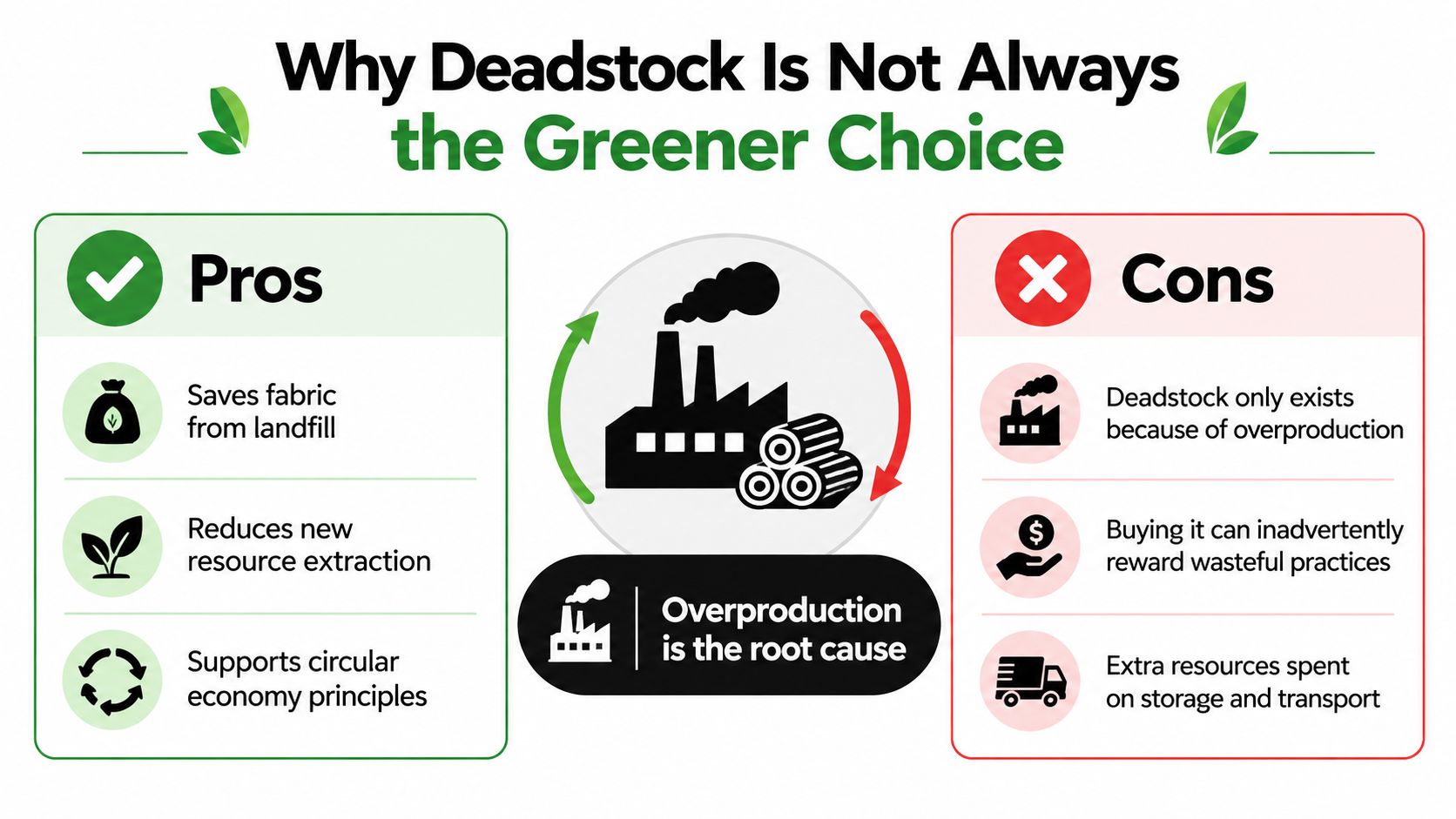
The halo around deadstock can hide the central problem. Deadstock exists because someone produced more material than the original buyer needed, or because a buyer changed its plans after the cloth had been made. Reusing the result is preferable to wasting it, but it doesn't make overproduction a good system.
A purchase can also create a misleading sense of achievement. You buy an attractive bolt because it carries a circular label, then discover that the fibre mix doesn't suit the pattern, the width causes excessive waste, or the finish makes the garment uncomfortable. If the cloth sits in your stash, the claimed benefit remains theoretical.
Red flags behind the label
Traceability varies sharply. A seller may know only that a bale came from a broker. That doesn't necessarily make the fabric unusable, but it means you should be cautious about claims concerning brand origin, environmental controls or chemical treatment.
Pay particular attention to:
- Unclear fibre content: A vague “poly blend” description makes laundering, recycling and end-of-life decisions harder.
- Unknown finishes: Water-repellent, stain-resistant, flame-resistant or heavily coated fabrics may contain treatments you don't want next to skin.
- Unverifiable designer claims: “Ex-designer” should mean more than an attractive print and a premium price.
- Suspiciously permanent availability: A supposedly unique leftover that appears in endless, identical supply may be ordinary surplus or deliberately produced stock.
- No basic answers: If the seller can't explain where the bolt came from, why it was excess or how its composition was checked, treat the listing as unverified.
Some deadstock may also carry finishes or dyes that are restricted or scrutinised in the UK today, even though the cloth was made under an earlier specification or in another market. That doesn't mean every colourful or synthetic fabric is hazardous. It does mean you shouldn't make chemical-safety assumptions from the word “deadstock”.
A UK-focused critique points out that about 80% of UK textile waste is incinerated rather than landfilled, so the stronger argument is waste prevention and reuse, not a simplistic “saved from landfill” story. You can read that distinction in The Eco Desk's discussion of deadstock sustainability.
The practical conclusion is uncomfortable but useful. Buying leftovers can reduce waste, yet it shouldn't excuse brands from ordering more accurately, reducing production or improving disclosure. Choose deadstock because the fabric fits a real project and has a credible history, not because the label removes the need to think.
Practical Techniques for Buying and Using Deadstock
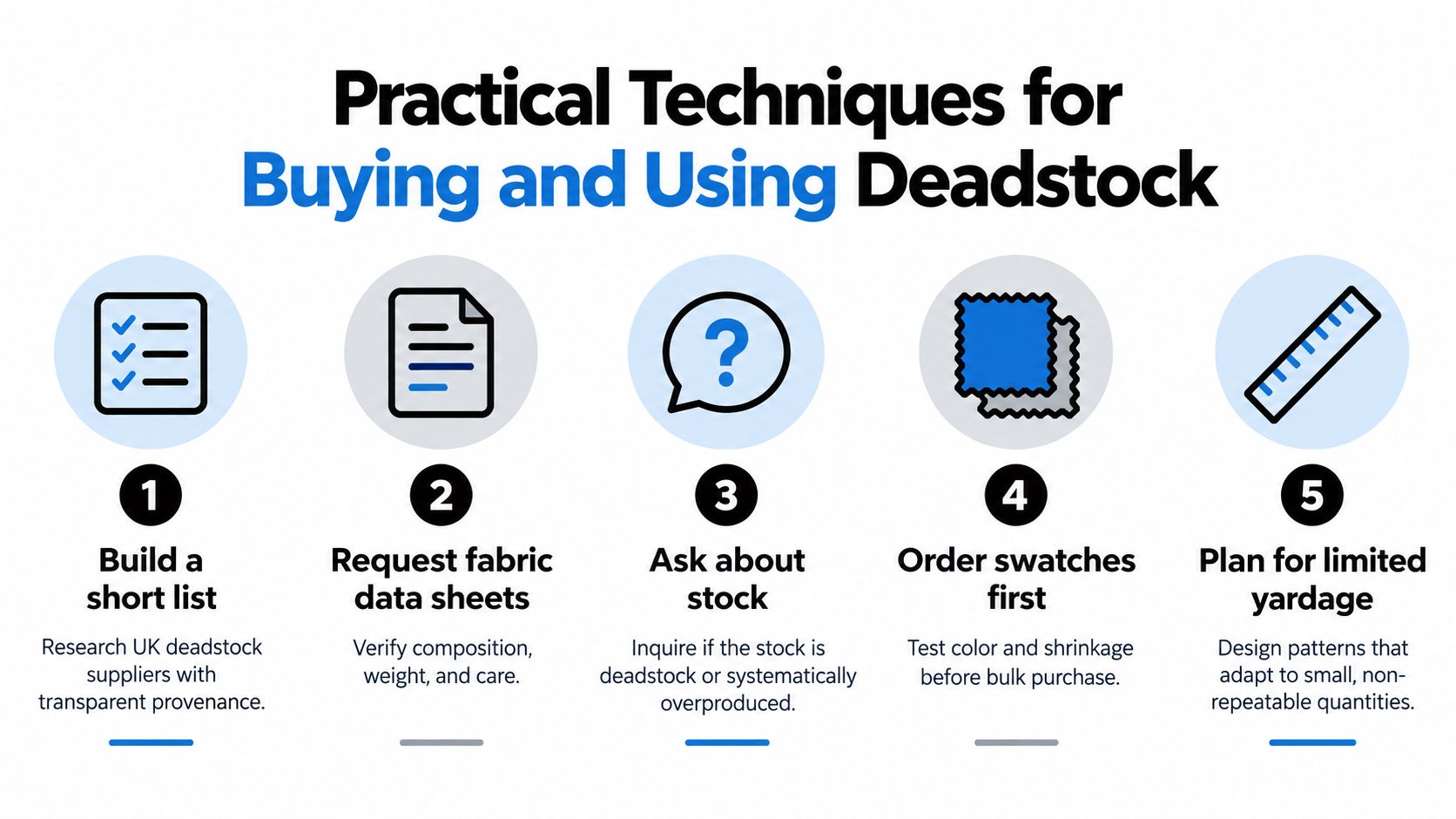
A bolt can look like a bargain online and still create waste if it shrinks unpredictably, has an unknown finish or is too short for the pattern. Check the information before checkout. Shortlist UK suppliers that describe stock clearly, then ask for the composition, usable width, weight, care advice and known origin. The direct question is: is this mill surplus, a brand end-of-line, a cancelled order, or something else?
Ask whether the supplier knows the original manufacturer and how the cloth was stored. Dry, protected storage reduces the chance of mildew, fading and damage, but older stock may still have incomplete records. A seller does not need every document. They should distinguish clearly between what they know, what they have been told and what remains unverified.
Check the cloth before cutting
Order a swatch where possible. View the colour in daylight, compare both sides, check the handle and wash a small piece using the care method you expect for the finished item. A washed sample reveals shrinkage, colour bleeding, distortion and changes in texture that a product photograph cannot show.
For unidentified fabric, use a qualified textile professional or testing service rather than guessing. A burn test may suggest fibre behaviour, but it destroys the sample and cannot provide a complete composition or chemical analysis. If you carry one out at home, use a tiny snip, good ventilation and proper fire safety. Treat the result as an indication, never proof of a fibre blend.
Examine the selvedge or snip a corner for clues about weave, finish and manufacturing marks. Photograph those details and save the supplier's description with your project notes. This record helps when matching thread, repairing the garment or passing on information about the cloth.
Make the cutting plan do the environmental work
Limited yardage rewards preparation. Measure the usable width, lay out the pattern before cutting, and mark flaws, holes or shade changes. A zero-waste layout may suit a boxy top, tote bag or simple skirt, while a directional print needs careful placement.
Use smaller pieces deliberately:
- Pair large and small pieces: Combine the main garment with patch pockets, a yoke or contrast facings.
- Keep useful offcuts: Store strips for bias binding, narrow straps, appliqué and visible mending.
- Match scraps by fibre: Label bags as cotton, wool, viscose, polyester or mixed fibre instead of combining everything.
- Plan samples: Use deadstock ends for toile sections, pocket tests and stitch practice before cutting the garment.
Choose a pattern that fits the available length. Forcing a bolt into an unsuitable design can create avoidable waste. Pre-wash before cutting, especially with cotton, linen, viscose and washable jerseys. Record the finished item's composition and care instructions so its future use remains traceable.
UKFT guidance highlights recycling, repurposing, redesigning and transforming rescued textiles into new products. In a sewing room, that means efficient layouts, repairable construction and purposeful offcut projects. For ready-to-sew comparisons, More Sewing lists fabric samples, haberdashery, sewing kits and ex-designer deadstock, allowing you to assess the cloth before committing to a make.
When to Choose Deadstock and When to Walk Away
After years of handling bolts, my decision is fairly simple. Deadstock deserves a place in your sewing room when the fabric has a credible history, the quantity suits the project and you're likely to use the finished item for a long time.
Choose it when:
- You're making a small run: Limited collections, one-off jackets and special occasion pieces can use a fixed length without needing future replenishment.
- You're working with adaptable patterns: A simple top, gathered skirt, patchwork bag or colour-blocked jacket can accommodate an unusual width or short quantity.
- You need practice fabric: Scrappy ends are useful for test pockets, seam finishes, samples and beginner projects where a perfect repeat isn't important.
- You're making accessories or linings: Smaller pieces can become bags, belts, facings, cuffs or lining panels, provided the fabric's handle and performance suit the job.
- The limitation improves the design: A discontinued print, unusual colour or one-off texture can produce a distinctive garment rather than encouraging a larger purchase.
Walk away when the blend is undisclosed, the coating is heavy or the supplier refuses basic provenance questions. I'd also avoid a suspiciously cheap bolt from an unknown middleman if the listing makes dramatic sustainability claims but gives no composition, width, care or origin information.
Be cautious with cloth that smells strongly of storage, shows brittle finishes, has extensive fading or has been folded so long that the marks may not recover. A bargain isn't a bargain if you can't cut around defects or if the fabric fails after the first wash.
The same applies to a project with exact metreage needs. If you need a matching length later, a precise colour lot or enough fabric for repeated production, a traceable conventional or certified recycled cloth may create less waste overall. The UK Circular Fashion Innovation Network interim report defines deadstock as unsold stock and describes recirculating excess fabric as a way to prevent waste, while also highlighting the value of recyclable compositions. That supports choosing mono-material or clearly labelled cloth where end-of-life recovery matters.
My rule of thumb: If the fibre content is honest, the supplier is transparent and the project suits the metreage, deadstock usually wins. Otherwise, a traceable conventional or certified recycled fabric is the more responsible cut.
Sustainability isn't decided by one label. It's built through buying less blindly, cutting accurately, making durable things, repairing them and finding a useful route for every leftover piece.
Visit More Sewing to browse ex-designer deadstock, fabric samples, haberdashery and ready-to-sew kits that help you plan a project around the cloth you'll use. Choose your fabric with the questions above in hand, order a swatch where possible, and make your next purchase a considered second life rather than an impulse addition to the stash.
