
What if your next patchwork sewing project didn't need to be a full-size quilt? A cushion cover or table runner can deliver a useful finish quickly, while a tote, baby quilt, wall hanging or garment gives you a different way to practise piecing, pressing and construction. Patchwork is a flexible textile skill, not a single destination.
This roundup moves from accessible home accessories to more demanding wearable art. Each idea includes its purpose, difficulty, realistic time expectation, fabric direction, technique examples, practical tips and variations, plus a sensible route to fabrics or kits from More Sewing where relevant. Use fabric samples or coordinated cottons to test colour, scale and texture before cutting into a larger piece. That small planning step can prevent an expensive fabric mistake.
British patchwork has a particularly rich design history. The British Quilt Heritage Project recorded more than 4,000 quilts and related items, including 4,183 items at 30 venues, and found strong preferences for hexagons and squares in documented quilts across England, Scotland and Wales (British Quilt Heritage Project). The projects below draw on that tradition while keeping the making practical for contemporary sewists.
1. Traditional English Paper Piecing Patchwork Quilts
Purpose: A portable hand-sewing project that develops precision and patience.
Difficulty: Beginner-friendly at a simple scale, advanced for complex assemblies.
Estimated time: Several relaxed sessions for a small panel, considerably longer for a quilt.
Fabric direction: Lightweight quilting cottons, coordinated prints and carefully chosen scraps.
English paper piecing, or EPP, wraps fabric around paper templates before the shapes are hand-stitched together with small whipstitches. The paper stabilises each piece, so you can achieve remarkably accurate hexagons, diamonds and stars without relying on a sewing machine. It's especially useful when you want to sew while travelling or away from a cutting table.
The method has a strong British connection. The Quilters' Guild collection includes the 1718 Silk Patchwork Coverlet, identified as the earliest known dated British patchwork, while Heritage Crafts places patchwork's UK origin in the eighteenth century. York Castle Museum holds over 100 historic patchwork quilts dating back nearly 300 years, and museum collections show a particularly strong nineteenth-century quilting tradition in Wales and northern England (Quilt history in UK collections).
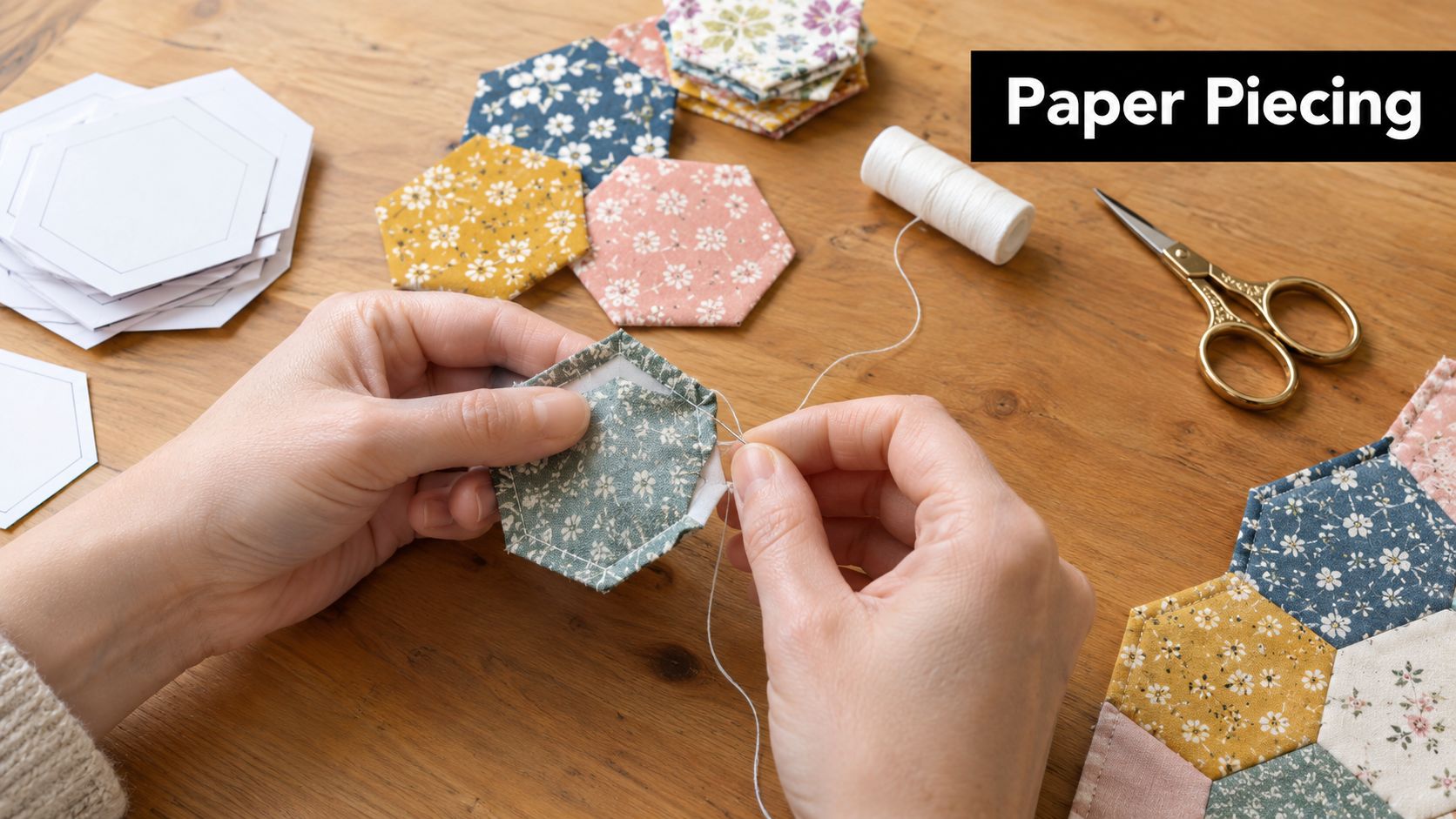
Start with a pattern you can control
Begin with larger hexagons rather than tiny shapes. A Victorian-inspired rosette, a modern minimalist wall hanging or a scrappy charm-style arrangement will teach you the essentials without making every seam feel fiddly. Diamond pieces can build towards stars, while wildflower-inspired designs can introduce more expressive colour placement.
Keep a small pressing board beside your templates and use strong, fine thread for whipstitching. Make a design wall visible from your usual chair, then join finished blocks as you go instead of leaving the entire assembly until the end.
Practical rule: If a fabric frays heavily or feels too thick around the template, reserve it for another project. EPP rewards stable cotton with a clean turn-under edge.
Combine premium cottons from More Sewing with paper-pieced scraps for contrast. A traditional golden anniversary quilt, such as the work discussed by That Blanket Co, can also inspire a meaningful colour story without copying its exact layout.
2. Modern Improvisational Patchwork Wall Art
Improvisational patchwork removes the pressure of matching a conventional block pattern. You cut strips, wedges and irregular shapes, then join them into a composition that develops as you work. The result suits makers who enjoy colour, texture and visible decision-making more than perfect repetition.
Purpose: Textile art for a wall, shelf or creative workspace.
Difficulty: Intermediate, although beginners can start with straight strips.
Estimated time: A small hanging can take a focused weekend, while a layered art quilt may require several sessions.
Fabric direction: Cotton prints and solids, deadstock, lightweight canvas and selected texture contrasts.
A graffiti-like hanging might combine bold prints with narrow solid strips. A nature-inspired piece can move gradually from deep tones to lighter ones, while a geometric abstract can rely on colour blocking rather than recognisable motifs. Textile collage also works well when you want to combine different fabric weights, but keep the heaviest pieces away from delicate cottons that may distort.
Make improvisation look intentional
Limit your palette to two to four colours when you're learning. Within that palette, mix large, medium and small print scales so the eye has movement without losing cohesion. Lay the pieces on a design wall before sewing, take a photograph, then remove only the sections that need attention.
Press every seam as you go. Irregular pieces can create distortion quickly, and pressing won't correct an inaccurate cut, but it will help the assembled surface lie flatter. More Sewing's fabric samples are useful here because a tiny swatch reveals whether colours compete, disappear or create the texture you wanted.
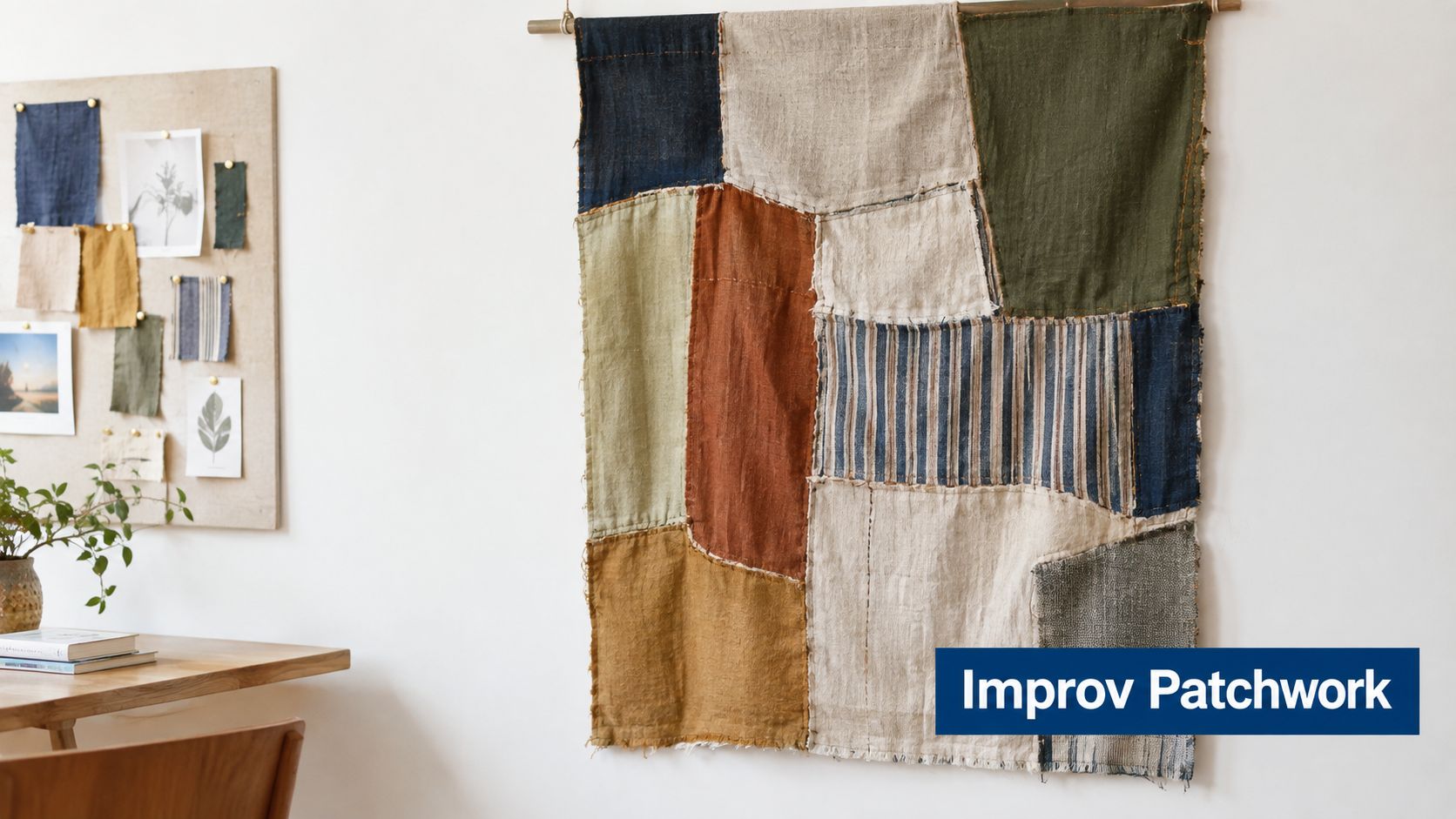
For a gallery-style finish, mount the completed textile on stretcher bars or use a concealed hanging sleeve. Photographing the stages can also help you understand how your compositions evolve. Unlike a repeating quilt block, improv gives you no formula to rescue an unbalanced section, so stepping away and reviewing the whole piece matters.
A limited palette gives freedom somewhere else. You can make the shapes more adventurous because the colour relationship is doing some of the organising.
3. Scrappy Patchwork Cushion Covers
A cushion cover is one of the best patchwork sewing projects when you want a useful result without committing to a large quilt. The front is small enough to manage, yet it still teaches accurate cutting, seam pressing, backing construction and finishing details such as zips or piping.
Purpose: A practical home accessory or handmade gift.
Difficulty: Beginner to intermediate.
Estimated time: A straightforward front and envelope back can be completed in a day, depending on preparation.
Fabric direction: Coordinating quilting cottons, solids and durable cotton backing.
Start with a scrappy nine-patch, then try chevrons, herringbone strips or a rainbow gradient. Seasonal versions can shift from spring florals to autumn plaids, while a coordinated group of cushions can use one repeated solid to make different prints feel connected. A sofa arrangement doesn't need identical covers, but it benefits from a shared colour or fabric scale.
Piece the front before fixing the final size
Join the patchwork front first, press it thoroughly, and cut the finished panel to the exact size required. Cutting before assembly can leave you with a front that's slightly too small after seam allowances and pressing have taken effect. Use a quality cotton for the backing, especially if the cushion will be handled often.
A concealed zip gives a clean finish, while an envelope back is more forgiving for a first attempt. Piping adds structure around the edge, but it also creates extra bulk at the corners. If you're using a zip and piping together, test the sequence on scraps before sewing the final cover.
- Prepare the fabrics: Prewash cottons before cutting so later shrinkage and colour bleeding are less likely.
- Reduce bulk: Press individual seams before joining larger blocks.
- Choose the insert carefully: A slightly larger cushion form creates a plumper cover, provided the seams can withstand the tension.
- Build a set: Matching pairs or a small mix-and-match group can make one patchwork design work across a room.
More Sewing's cotton collections, haberdashery and samples can help you coordinate the front, backing, zip and piping instead of trying to match everything after cutting. Choose thread that blends into the solid or dominant background where you want the stitching to recede.
4. Patchwork Tote Bags and Everyday Carriers
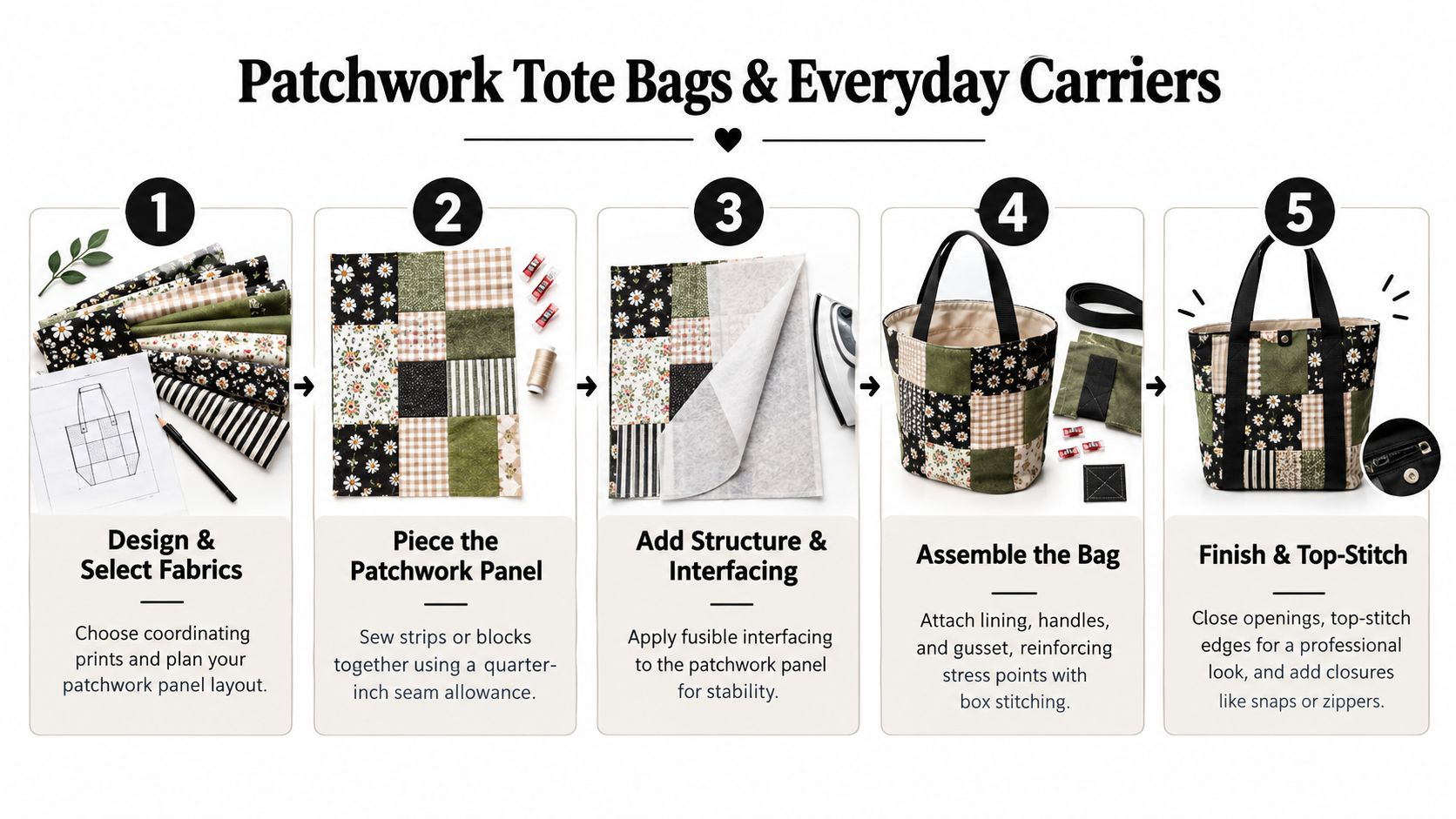
Patchwork works particularly well on a tote because the main panel can carry the visual interest while the lining and handles provide structure. A large market bag might use a six- or eight-piece patchwork front with a solid back. A reversible version can put patchwork on one side and a coordinating print on the other.
Purpose: A daily carrier for shopping, work, travel or gifts.
Difficulty: Intermediate.
Estimated time: A simple tote can take a day; structured versions with pockets and closures need longer.
Fabric direction: Medium- to heavyweight cotton, canvas, sturdy lining and stable interfacing.
Choose fabric weight before choosing the pattern. Lightweight quilting cotton can make a lovely outer panel, but it usually needs interfacing and a durable lining. Canvas creates a more sturdy body, although sewing several layers at the handles and boxed corners can challenge a domestic machine.
Treat stress points as part of the design
Interface the exterior, particularly when your patchwork combines fabrics with different amounts of body. Reinforce handle attachment points with extra rows of stitching, and test the handle length with a scrap mock-up before cutting your final pieces. Interior pockets made from lining scraps add real function without competing with the patchwork.
A walking foot can help feed layered sections evenly, while a heavy-duty needle may be appropriate for canvas or dense intersections. Test-sew on scraps first. If the needle struggles, the thread breaks or the fabric shifts, changing the needle or reducing bulk is better than forcing the finished bag through the machine.
Consider a magnetic snap or another simple closure if the bag needs security. A structured weekend bag with expandable sides is rewarding, but it introduces more points where inaccurate seams become visible. Make a sample tote before producing gifts or selling a design. The sample will reveal whether the handles, lining and interfacing behave as intended.
More Sewing's cottons, viscose and cotton blends, deadstock fabrics and haberdashery offer different routes depending on whether you want a soft everyday bag or a firmer carrier. Keep the body fabrics compatible, and use the lining to add contrast without adding unnecessary thickness.
5. Patchwork Baby Quilts and Nursery Textiles
A baby quilt combines patchwork practice with a clear practical purpose. It can become a tummy-time mat, a nursery layer or a keepsake, but its frequent washing means fabric choice and construction matter more than decorative complexity.
Purpose: A washable gift, nursery textile or heirloom-style keepsake.
Difficulty: Beginner to intermediate.
Estimated time: Several sessions, depending on the quilting and binding method.
Fabric direction: Soft, securely dyed cottons, cotton blends and gentle flannels.
Pre-cut charm packs make cutting simpler and can provide a cohesive colour family without buying many separate fabrics. A neutral quilt might combine white, cream and soft grey prints, while animals, leaves and simple geometric motifs can create a gender-neutral design. Personalisation is possible through embroidery or appliqué, but any added element needs to remain secure and safe.
The British craft audience includes substantial interest in textile activities. A UK market report linked to the Crafts Council says 17% of adults did textiles such as sewing or knitting, while more than a third of under-35s took part in three or more arts-and-crafts activities during the prior 12 months (UK sewing market report). That broad participation makes an approachable baby quilt a useful project for a new maker building confidence.
Design for washing and handling
Prewash all fabrics thoroughly. Babies' textiles will be washed repeatedly, so fabric that shrinks unpredictably or releases colour can spoil an otherwise careful finish. Avoid small buttons, beads and loose appliqué embellishments.
Quilt the layers closely enough to prevent the wadding shifting during use. A simple grid or diagonal quilting design is easier to control than an intricate motif, and curved safety pins are safer for basting than ordinary straight pins. Add a care-instruction card when giving the finished quilt so the recipient knows how to wash and dry it.
Choose a calm, repeatable block before chasing a complicated design. The softness, binding and washability will matter more than the number of shapes in the top.
More Sewing can be a practical source for coordinated cottons, fabric samples and sewing supplies. Matching nursery items, such as burp cloths or changing-pad covers, can use the same palette, but keep the fabrics soft, stable and easy to launder.
6. Patchwork Garment Construction
Patchwork clothing sits at the demanding end of these projects because the patchwork must work with a body-shaped pattern. A beautiful panel can still fail if it changes the garment's drape, distorts at a seam or places a strong motif awkwardly across the silhouette.
Purpose: Wearable art, statement clothing or a detailed portfolio piece.
Difficulty: Intermediate to advanced.
Estimated time: Multiple fitting and construction sessions.
Fabric direction: Similar-weight cottons, stable woven fabrics, denim or compatible deadstock.
Start with a simple shift dress, vest or jacket yoke. A patchwork bodice paired with a solid skirt lets the piecing act as a controlled focal point. A quilted vest can combine patchwork with a solid back, while a jacket with a patchwork yoke keeps the sleeves and body more manageable. Children's clothing can provide a smaller canvas for colour sorting, but it still needs accurate pattern matching and comfortable seams.
Draft the patchwork around the pattern
Trace the relevant pattern piece before piecing the fabric. Add the seam allowances required by the garment pattern, then plan the patchwork so the finished panel will fit that shape. Sewing a generic square panel and hoping it will match later usually creates waste, especially around armholes, necklines and curved edges.
Use fabrics with similar weight and movement. Mixing a crisp cotton with a drapey fabric can produce puckering or a garment that hangs unevenly. Interfacing may stabilise the patchwork during construction, but test it first because too much stiffness can change the intended silhouette.
Make a practice version of the panel and sew a toile or partial garment before committing to valuable fabric. Try the garment on more than once during construction. Contrast binding can provide a professional edge finish, particularly on a vest, while a reversible jacket requires careful planning so both sides look intentional.
A dressmaking kit from More Sewing can simplify the materials decision, while its cottons, denims, jerseys and ex-designer deadstock provide scope for a more individual garment. Keep a record of the fabric placement and construction decisions. That documentation is useful for a portfolio and for repeating what worked.
The construction stages are also demonstrated in this patchwork sewing video.
7. Charm Pack Strip Piecing and Jelly Roll Quilts
Pre-cut fabric gives patchwork a clearer starting point. Charm packs contain ready-cut squares, while jelly rolls offer coordinated strips, reducing measuring and leaving more time for arranging, joining and pressing. They suit a first quilt, a coordinated gift or a controlled experiment with colour and value.
Purpose: A first quilt, a coordinated gift or a design-led scrap project.
Difficulty: Beginner to intermediate.
Estimated time: A manageable quilt top can be built over several focused sessions.
Fabric direction: Pre-cut quilting cottons, coordinated solids and low-volume prints.
Charm packs work for random patchwork, dark-to-light gradients or neutral layouts with carefully placed accents. Jelly rolls are well suited to rail fence patterns, strip-pieced blocks and spiral effects. Combining collections creates a broader scrappy result, provided the fabrics share enough colour or value to keep the finished top connected.
Arrange before you sew
Lay the pieces on a design wall or clean floor before joining them. This reveals repeated prints, unwanted clusters and sudden value changes while rearrangement is still easy. A rotary cutter and mat help trim extra strips and completed units accurately.
Chain-piecing rows keeps the machine running and reduces thread cutting. Press seams consistently, alternating the direction on neighbouring rows so intersections can nest when the rows meet. For machine piecing, a new size 80 needle and a stitch length of 2.5 to 3 are commonly recommended in UK beginner guidance (Prima's patchwork quilting guide).
- Keep the fabric crisp: Light spray starch can steady fabric that shifts during piecing.
- Control the layers: Use a walking foot when quilting the finished top, wadding and backing together.
- Choose an achievable finish: Grid quilting, diagonal lines or simple stippling keep attention on the pieced design.
- Plan supplies early: Record fabric, wadding and binding requirements before ordering or cutting.
More Sewing's coordinated pre-cut collections, quilting cottons and haberdashery provide a practical starting point for this format. If the first arrangement looks crowded, add a solid or low-volume fabric as a visual pause instead of introducing more prints.
8. Patchwork Table Runners and Seasonal Textiles
A table runner is a focused project with a visible result. It can refresh a dining table, console or bedroom bench without requiring the commitment of a bed-sized quilt, and its long, narrow format offers useful practice with borders, binding and straight-line quilting.
Purpose: Seasonal home styling, entertaining or a handmade housewarming gift.
Difficulty: Beginner to intermediate.
Estimated time: A simple runner can be completed in a day or across a few evenings.
Fabric direction: Quilting cottons, seasonal prints, tonal solids and a contrasting backing.
Measure the table before choosing the finished dimensions. A spring runner might combine florals with a fresh solid and matching binding, while an autumn version could use plaids with a leaf appliqué. Winter metallics, white and silver prints can feel festive, and a monochromatic tonal design offers a quieter result for everyday use.
Use the narrow shape to practise accuracy
Long seams make small cutting errors obvious, so measure twice and keep the patchwork layout simple at first. A contrasting solid backing can make the runner reversible, while a table-runner pad or non-slip underlay helps protect the table and keeps the textile in position.
Quilt the layers closely enough to prevent shifting during use. Straight lines every four to six inches are a practical starting point for a runner, but avoid adding dense quilting before checking how it affects the drape. Matching napkins can use leftover fabric, although the napkins should be comfortable to handle and easy to wash.
- Build a seasonal rotation: Make one design for each season if you enjoy changing the room regularly.
- Use arrivals as prompts: More Sewing's seasonal fabrics can suggest a palette before you settle on a block.
- Create a complete set: A runner with four to six napkins gives a table a coordinated finish.
- Record the result: Photograph the finished textile and note which fabrics handled washing and quilting well.
The runner is also a useful test piece for a larger quilt. You can trial a binding method, quilting thread or colour combination on a contained project before investing in a more ambitious top.
Patchwork Sewing Projects, 8-Item Comparison
| Project | Complexity 🔄 | Resources & Tools | Speed/Efficiency ⚡ | Quality & Impact ⭐📊 | Ideal Use Cases & Tips 💡 |
|---|---|---|---|---|---|
| Traditional English Paper Piecing Patchwork Quilts | High 🔄🔄🔄 | Needles, thread, paper templates/freezer paper, scissors, premium cotton | Slow ⚡ | ⭐⭐⭐⭐⭐, Extremely precise, heirloom-quality, durable | Ideal for intricate geometric quilts and heirlooms. Tip: start with larger shapes; join blocks as you go |
| Modern Improvisational Patchwork Wall Art | Medium 🔄🔄 | Sewing machine, assorted scraps/deadstock, rotary cutter, design wall | Moderate ⚡⚡ | ⭐⭐⭐⭐, High originality, gallery-ready one-of-a-kind pieces | Best for upcycled art and bold composition. Tip: limit palette and use a design wall before sewing |
| Scrappy Patchwork Cushion Covers | Low–Medium 🔄🔄 | Small scraps, basic sewing notions, optional zippers/piping, pillow forms | Fast ⚡⚡⚡ | ⭐⭐⭐, Practical, visible home décor; quick skill-builders | Great beginner projects and gifts. Tip: piece front then square up; choose slightly larger pillow forms |
| Patchwork Tote Bags and Everyday Carriers | Medium–High 🔄🔄🔄 | Medium/heavy fabric, interfacing, strong thread, handles, lining materials | Moderate ⚡⚡ | ⭐⭐⭐⭐, Durable, functional, showcases fabrics well | Ideal for market totes or small-business products. Tip: reinforce handles and use a walking foot |
| Patchwork Baby Quilts and Nursery Textiles | Low–Medium 🔄🔄 | Soft preshrunk cottons/flannel, lightweight batting, bias binding, safe notions | Moderate ⚡⚡ | ⭐⭐⭐⭐, Meaningful, frequent-use items; heirloom potential with safe construction | Perfect for baby gifts and nursery use. Tip: prewash fabrics and quilt densely for safety |
| Patchwork Garment Construction (Dresses, Vests, Jackets) | Very High 🔄🔄🔄🔄 | Coordinated-weight fabrics, commercial patterns, interfacing, advanced tools | Slow ⚡ | ⭐⭐⭐⭐⭐, High perceived value; wearable art with strong visual impact | Best for advanced sewists and sustainable fashion. Tip: make panels to pattern size and test seams/fits |
| Charm Pack Strip Piecing and Jelly Roll Quilts | Low 🔄 | Pre-cut charm packs/jelly rolls, rotary cutter, batting, backing, basic quilting tools | Very Fast ⚡⚡⚡⚡ | ⭐⭐⭐⭐, Big quilts quickly; beginner-friendly and efficient | Ideal for quick, coordinated quilts and gifts. Tip: chain-piece rows and press seams alternately to reduce bulk |
| Patchwork Table Runners and Seasonal Textiles | Low 🔄🔄 | Scraps or charm packs, light batting, backing, binding materials, optional embellishment supplies | Fast ⚡⚡⚡ | ⭐⭐⭐, High visible impact for small investment; seasonal refreshes | Great for seasonal décor and gifts. Tip: measure table first and make reversible or matching napkin sets |
Turn Scraps Into Something Useful
Choose according to the time you have, not the project you admire most. A cushion cover or table runner offers a contained start, with enough construction detail to practise seams, pressing and finishing without creating a large unfinished project. A tote adds practical structure, while a baby quilt gives you a meaningful reason to repeat simple blocks and learn how wadding, backing and binding behave.
If you want the most straightforward route into a quilt, use pre-cut charm squares or jelly-roll strips. They reduce the amount of cutting and let you concentrate on layout, accurate seams and pressing. UK sewing guidance commonly recommends joining fabric squares right sides together with a quarter-inch seam allowance, then pressing seams open for a flatter finish or to one side so adjoining rows can nest (Prima's beginner guidance). A practical quilt tutorial also demonstrates building a first row from seven squares, repeating the process across rows and alternating pressing directions to help seams align (LoveCrafts quilt tutorial).
Choose EPP or improv when the creative process matters as much as the finished object. EPP suits slow hand sewing and precise geometry, while improv suits fabric exploration and one-off wall art. Neither is automatically easier. EPP demands repeated small stitches and careful basting, while improv asks you to make design decisions without a fixed pattern.
Garments should wait until you're comfortable with pattern pieces, fitting and fabric behaviour. Patchwork panels need to be planned around the garment shape, not assembled separately and forced into place. A simple vest or shift dress is a more sensible first wearable than a fitted jacket with multiple curves and closures.
Before sewing, sort scraps by colour and fabric weight. Make a small layout, photograph it, check the materials list and test a seam on fabric from the same group. Accurate cutting matters, and UK beginner guidance recommends a rotary cutter for larger pieces, thorough pressing and a quarter-inch presser foot where available (Crafters Companion patchwork guide).
More Sewing offers fabric samples, quilting cottons, haberdashery, deadstock and ready-to-sew kits that can fit different levels of patchwork sewing projects. Its range also includes tools and fabrics for makers moving from home accessories into garments, so you can build skills without abandoning the colour direction you've already developed. For related home sewing, you can also explore this guide to sewing your own duvet cover.
More Sewing offers quilting cottons, deadstock, fabric samples, haberdashery and ready-to-sew kits for patchwork makers who want to plan carefully and buy compatible materials. Visit More Sewing to choose fabrics and supplies for your next cushion, runner, quilt, bag or garment.
