
You're at the cutting table with a roll of power mesh material beside your pattern. It looks delicate, almost like fine netting, but when you pull it across your fingers, it pushes back. That springy resistance is what makes it useful for a bra cradle, a swimwear lining or a fitted dance bodice, yet it also raises practical questions. Which weight should you buy? Is nylon better than polyester? Will it still recover after washing?
Power mesh becomes much easier to use once you stop treating it as a mysterious “supportive mesh” and start reading it as a technical fabric. Its fibre blend, weight, width, stretch direction and recovery all affect the finished garment. The right choice can add control without unnecessary bulk. The wrong one can leave a panel too sheer, too firm or baggy after wear.
Why Power Mesh Deserves a Second Look
The first time you handle a good power mesh, the fabric often seems to contradict itself. It feels light in the hand, yet it has a definite body. It stretches generously, but it doesn't just flop back into a loose net. Unroll it on the sewing table and you'll notice that it wants to return to its original shape, which is very different from the behaviour of ordinary decorative mesh.
That reaction explains why power mesh material costs more than a basic stretch net in some fabric shops. You're paying for a knitted construction designed to combine airflow, controlled stretch and recovery, rather than for an open surface alone. UK fabric listings describe it in measurable terms, including different fibre blends, weights and widths, so the fabric's performance can be assessed before you cut into it.
Practical rule: Don't choose power mesh by appearance alone. Stretch a fabric across its width, along its length and on the diagonal, then check how quickly and evenly it returns.
A home sewist might use a light mesh behind the upper section of a bodice, a denser version in a bra band, and another construction for a sportswear panel. Those fabrics may all be sold under the same name, but they won't produce the same result. UK listings include examples from 75 g/m² to about 120 g/m², with widths around 150 cm, while blends range from polyester and elastane to nylon and elastane, as shown by UK power mesh fabric specifications.
This guide focuses on the decisions that matter at the machine: identifying genuine power mesh, comparing it with tulle and ordinary stretch mesh, matching weight to garment function, sewing without distorted seams, and protecting recovery during a typical UK laundry routine. By the end, you should be able to look beyond the label and choose fabric for a reason.
What Power Mesh Actually Is
Power mesh is an open knitted fabric containing a stretch fibre, usually elastane or spandex, alongside a synthetic base such as nylon or polyester. The holes allow air to pass through, while the knitted structure and elastane provide the tension that makes the fabric suitable for fitted garments.
A UK supplier describes a benchmark construction of 75% polyamide and 25% elastane at 120 g/m², while other UK listings show different mixes, including 92% nylon and 8% spandex and 94% polyester and 6% elastane. These differences matter. A fabric with more elastane may feel firmer, but fibre content alone doesn't determine whether it's right for your project. Knit density, yarn, finishing and weight also influence the hand and recovery.
Read the specification before touching the fabric
Start with four questions:
- What fibres are used? Nylon or polyamide often gives a smooth, soft hand. Polyester and elastane can provide a slightly different feel and may suit projects where durability and easy care are priorities.
- How heavy is the fabric? UK listings give examples from 75 g/m² ±5% to about 120 g/m², according to UK retail power mesh listings.
- How wide is the roll? A width around 150 cm appears in UK technical listings, including this power mesh specification.
- Where is the greatest stretch? Many power meshes stretch in both directions, but the width usually offers more room than the length. Test the actual fabric rather than assuming every roll behaves identically.
The phrase 4-way stretch means the fabric yields across both the width and length. It doesn't mean that the stretch is equal in every direction. A garment panel may need generous horizontal stretch around the body but less vertical stretch to prevent the hem from dropping.
Typical Power Mesh Specifications
| Property | Typical Range | What It Means |
|---|---|---|
| Fibre blend | Polyester/elastane or nylon/polyamide/elastane | Determines hand feel, recovery and how the fabric suits the garment |
| Weight | 75–120 g/m² | Lighter versions suit layering, while heavier versions offer more body |
| Width | Around 150 cm | Gives useful cutting room for panels and linings |
| Stretch | Often 4-way, with direction-dependent yield | Check width and length separately before pattern placement |
| Appearance | Fine, tulle-like open knit | Creates breathability and controlled transparency |
| Recovery | Designed to return after stretching | Helps fitted garments keep their shape |
A useful visual reference is the Nuair Mesh Flex bra collection, where mesh is used as part of a close-fitting garment system rather than treated as a purely decorative overlay. That distinction is central to understanding power mesh. It's a structural layer that can remain light and breathable while helping a garment sit close to the body.
Power Mesh Compared to Other Mesh Fabrics
Mesh names can be confusing because retailers sometimes use “net”, “stretch mesh” and “power mesh” interchangeably. Hold the fabrics together and the differences become clearer. Tulle tends to feel crisp or stable and is often chosen for veils, petticoats and sculptural details. Nylon net is usually more open and less interested in returning to its original shape.
Standard stretch mesh is closer to power mesh, but it generally feels softer and less controlling. It can be excellent for a floating sleeve, an airy overlay or a lightweight lining. Power mesh has more resistance under tension because its blend and knit are intended to provide support as well as stretch.
| Fabric | Weight (g/m²) | Stretch & Recovery | Transparency | Best For |
|---|---|---|---|---|
| Power mesh | 75–120 g/m² in UK listings | Often 4-way stretch with purposeful recovery | Sheer to semi-sheer, depending on weight and layering | Lingerie, support panels, swim linings and activewear |
| Tulle | Varies by construction | Often stable or only lightly yielding | Usually sheer | Veils, petticoats and decorative overlays |
| Nylon net | Varies by construction | Often limited recovery | Open and visibly netted | Costume details, structural inserts and craft work |
| Standard stretch mesh | Varies by construction | Softer stretch with less firm control | Usually sheer | Draped overlays, sleeves and light linings |
The important distinction is not the size of the holes. Elastane content and knit density work together to create power mesh's snap-back. A very open mesh may let through more air, but it may not hold a seam or support a fitted panel in the same way.
A quick handling test
Stretch a fabric between both hands, then release it. Power mesh should feel as though it's working against your pull and should return without a permanently widened section. Repeat the test in the lengthwise direction. If it stretches easily but stays relaxed after release, it may be a standard stretch mesh rather than a supportive construction.
For a draped evening overlay, that softer behaviour could be exactly what you want. For a bra side panel or a fitted swim lining, it may leave the garment feeling under-anchored.
Where Power Mesh Works Best in a Wardrobe
Power mesh earns its place when a garment needs controlled movement, not just decoration. The best choice depends on where the fabric sits, how much tension it carries and whether the outer layer already provides opacity or structure.
Lingerie needs targeted support
A bra cradle or side support panel benefits from a denser power mesh because those areas help anchor the garment around the body. A construction near the upper end of the UK-listed range, around 110–120 g/m², can provide more body for a band or stabilising panel. The same fabric may feel excessive in an upper cup, where a lighter mesh can give gentle hold without adding unnecessary thickness.
Try making a small test section first. Place the mesh behind the pattern piece, baste it to the outer fabric and check whether the cup still folds naturally. If the fabric fights the curve, use a lighter construction or restrict it to the part of the cup that needs control.
Swimwear benefits from a carefully placed inner layer
Power mesh can work behind a cup or across a front panel when you want coverage and modest shaping without turning the garment into a rigid foundation. A mid-weight fabric can support the outer layer while preserving the stretch needed for movement.
For pool garments, fibre choice deserves attention. The available UK listings show that power mesh is sold in several synthetic blends, so don't assume every fabric has the same resistance to chlorine or repeated wet wear. Check the supplier's intended use and test a small sample if the garment will be worn and washed frequently.
Activewear and dancewear need movement and airflow
A racerback sports bra, dance leotard or fitted bodice can use power mesh in a panel where ventilation matters. The open knit allows air to move through the garment, while recovery helps the panel return after stretching during movement. A mid-weight construction often provides a useful balance between body and comfort, but the outer fabric must still have compatible stretch.
| Garment | Weight (g/m²) | Role in Garment | Stretch Direction |
|---|---|---|---|
| Bra cradle or side panel | 110–120 g/m² | Anchors and stabilises | Greatest stretch around the body |
| Upper lingerie cup | 75–85 g/m² | Adds light hold with minimal bulk | Stretch follows the cup's shaping |
| Swimwear lining | Around 80–95 g/m² | Adds coverage and controlled support | Usually across the body |
| Activewear or dance bodice | Mid-weight construction | Balances breathability and recovery | Match the outer fabric |
Power mesh isn't the best choice for every garment. A soft evening overlay that needs graceful drape may look better in a lighter, less supportive mesh. If the fabric is meant to float away from the body, power mesh's resistance can make the design look stiff.
Sewing Power Mesh With Confidence
Power mesh rewards a light touch. Pulling it as you sew can create wavy seams, while treating it like a woven fabric can produce popped stitches. Set up a sample first, because the ideal combination of needle, pressure and tension depends on the specific blend and weight.
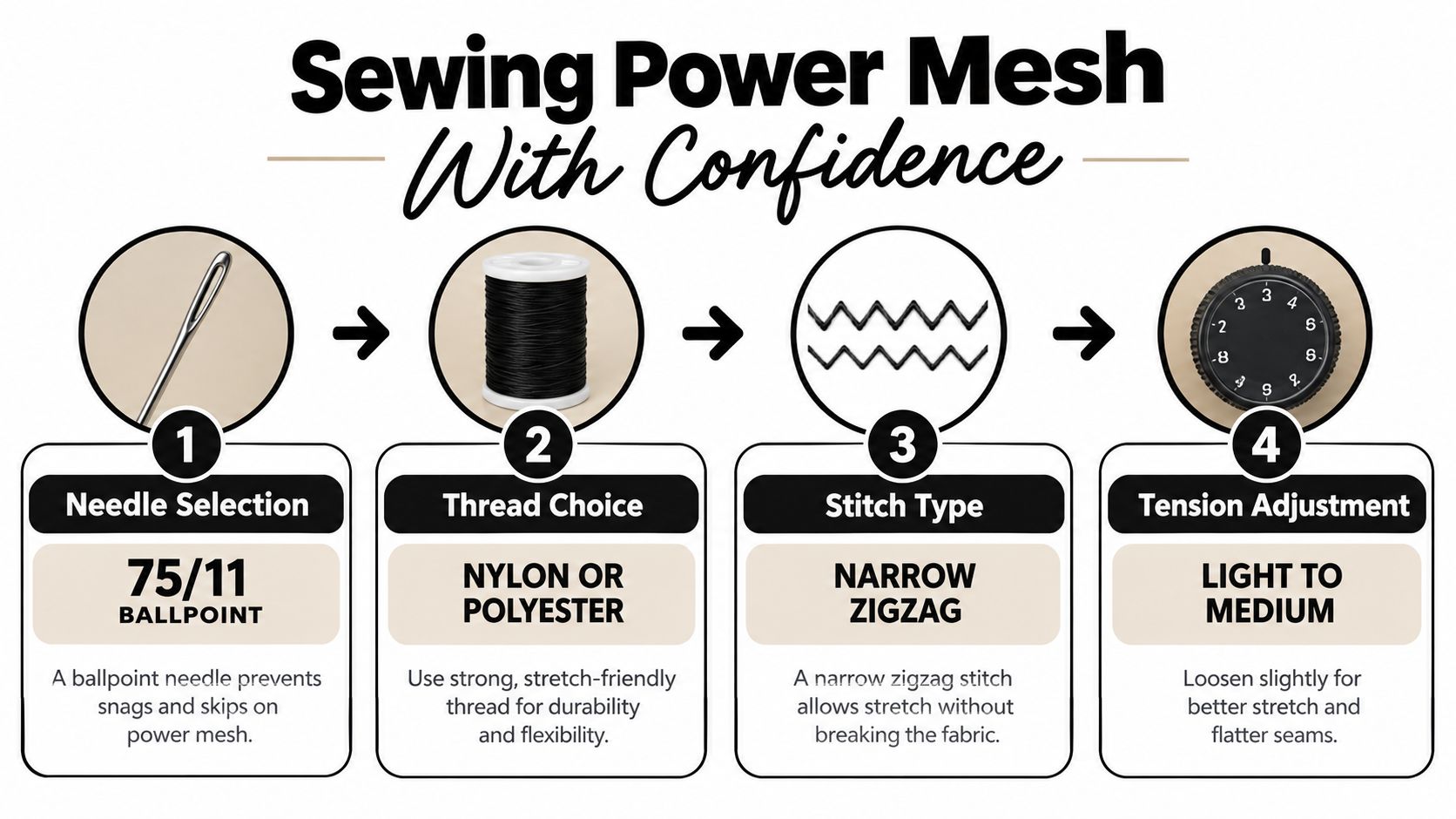
Start with a 75/11 ballpoint or stretch needle for lighter and medium fabrics. For heavier power mesh around 110–120 g/m², try an 80/12. Use polyester thread or textured nylon thread, both of which can flex more comfortably with a stretch seam than a rigid thread.
Choose a stitch that can move
A narrow zigzag is a dependable starting point. Set it to approximately 1.0 mm wide and 2.5 mm long, then test the seam by stretching it in the direction the garment will pull. A triple straight stretch stitch can also work, especially where you need a strong seam, though it may be harder to unpick cleanly.
A conventional straight stitch doesn't have enough built-in movement. It can look neat on the table and then pop when the wearer pulls the garment over the body.
Use a fresh needle and reduce presser-foot pressure if your machine allows it. If the mesh creeps towards the needle, place light tissue paper between the fabric and the feed dogs, or use a walking foot to help the layers travel together.
Two practical seam finishes
For a bra neckline, butt the mesh edge against the adjoining edge rather than creating a bulky turned hem. Secure it with a narrow zigzag, then topstitch carefully with a twin needle if your machine handles the layers smoothly. The joined edges should flex without a hard ridge.
For a full bodice lining, trim the seam allowance to 5 mm after confirming the fit. Finish the edge with a three-thread overlocker, keeping the differential feed gentle enough that the mesh doesn't ripple. Test the overlocked edge before assembling the entire bodice, because a dense stitch can draw up lightweight fabric.
Keep scraps from the same roll beside the machine. They're useful for checking whether the stitch stretches, whether the needle is snagging the knit and whether the seam returns to its original length after being pulled.
Here's a short visual demonstration to watch before your first sample:
Caring for Power Mesh So It Lasts
The most careful sewing can't compensate for harsh laundering. Elastane needs gentler treatment than many everyday fabrics, and power mesh garments are often worn close to the skin, which makes frequent washing tempting.
A 30°C delicate or hand-wash cycle is a sensible starting point for power mesh, particularly when the fabric contains elastane. UK supplier descriptions identify nylon/spandex and polyester/elastane blends as common constructions, so always check the care label or supplier guidance for the specific fabric before choosing a hotter programme.
Make the wash less aggressive
Place a small garment in a mesh laundry bag and use a mild non-bio liquid detergent. Avoid fabric softener. It can leave a coating on fibres and may change the way the open knit feels and recovers. Biological detergents may also be unnecessarily harsh for delicate stretch garments, so a gentler formulation is the safer everyday option.
The practical signs of poor care appear gradually. A bra band may feel looser, a sportswear panel may begin to bag, or a seam may stop lying flat. Those changes don't always come from one wash, which is why a careful routine is more useful than trying to rescue a stretched garment later.
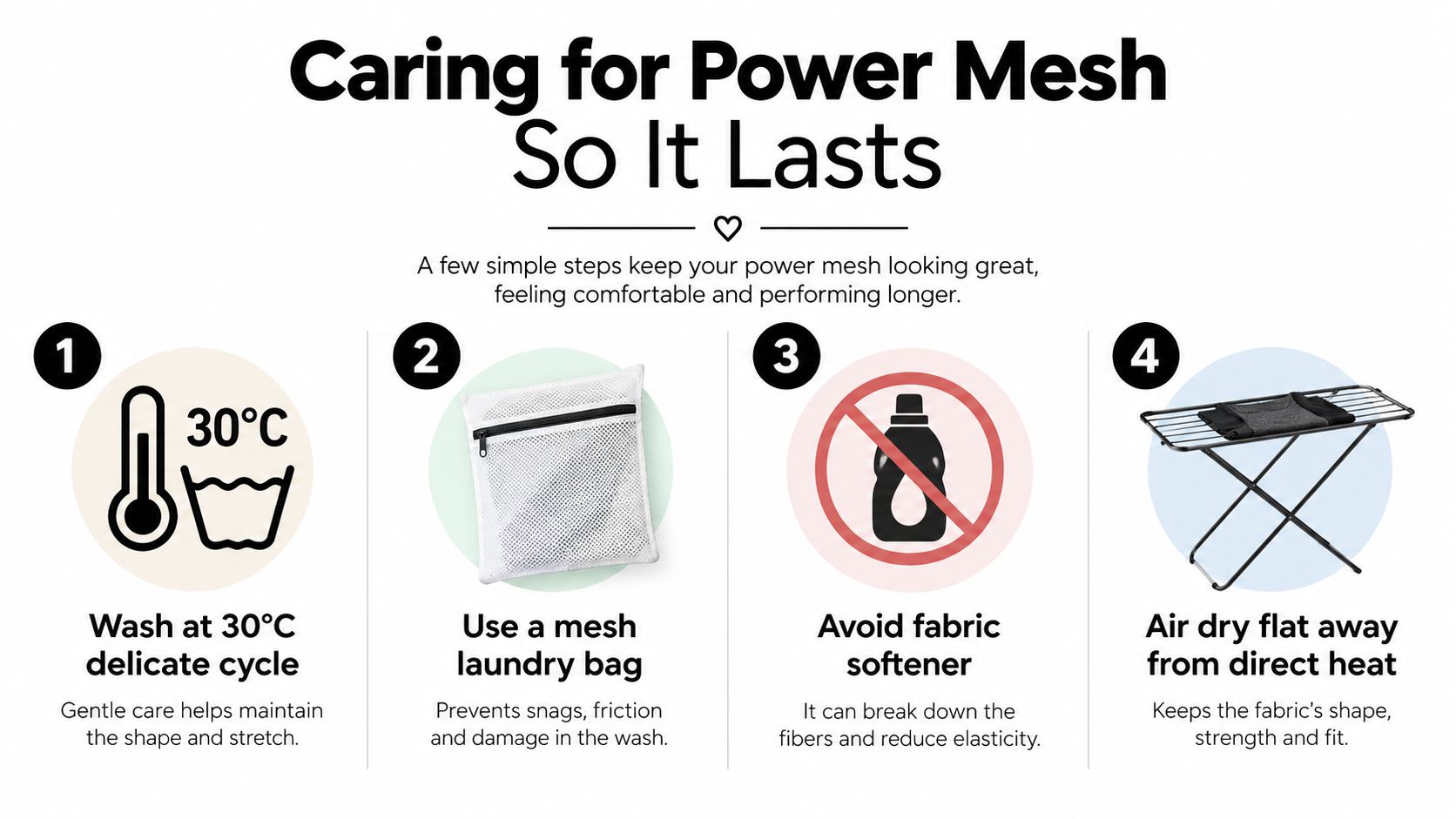
Drying deserves just as much attention. Lay the garment flat or line dry it away from direct radiator heat. Tumble drying and concentrated heat can put unnecessary stress on elastane, especially in a fitted lining that already works under tension.
Laundry habit: Treat power mesh like a technical garment, not like a towel. Cool washing, gentle handling and air drying protect the recovery you selected at the cutting table.
Store bras with power mesh cups folded rather than hanging from the straps, because prolonged hanging can distort the cradle and stretch the surrounding fabric. If you see a loose thread, trim it with sharp scissors instead of pulling it. Pulling can spread the open knit and leave a visible distortion.
Choosing the Right Power Mesh for Your Project
Choosing power mesh starts with the garment's job. Don't begin with colour or the prettiest surface. Decide how much support, opacity, stretch and washing the finished piece will need.
A simple decision order works well:
- Support: Will the mesh anchor a band or merely soften show-through?
- Opacity: Is it hidden inside the garment, layered beneath a sheer outer fabric or visible on its own?
- Stretch direction: Does the body need the greatest stretch across the garment?
- Laundry demand: Will it be worn occasionally, or washed after regular training?
For a sheer yoke or decorative dance overlay, a lighter construction around 60–75 g/m² may be appropriate when the design needs airiness and doesn't rely on the mesh for strong support. For a bra cradle, a denser fabric around 100–120 g/m² can provide more structure, provided the wearer can still move comfortably.
Swimwear needs a separate check. The available UK listings show blends such as 82% nylon and 18% spandex at 95 g/m² and 94% polyester and 6% elastane at 75 g/m², demonstrating why you should compare the actual specification rather than order by name alone. For pool use, ask whether the supplier recommends the fabric for chlorine exposure and whether its recovery suits repeated wet wear.
| Application | Weight (g/m²) | Typical Blend | Stretch Range | Key Feature |
|---|---|---|---|---|
| Sheer yoke or overlay | 60–75 g/m² | Polyester/elastane or nylon/elastane | Light to generous, depending on fabric | Minimal bulk and visible openness |
| Support panel | 100–120 g/m² | Nylon/polyamide with elastane | Firm across the body | More body and anchoring power |
| Swim bra liner | Around 80–95 g/m² | Nylon/spandex or polyester/elastane | Multi-directional stretch | Coverage with movement |
| Activewear insert | Mid-weight construction | Nylon/spandex or polyester/elastane | Match the outer garment | Breathability and recovery |
A higher elastane percentage isn't automatically the better choice. A very firm fabric may be ideal for a side panel but uncomfortable in a full lining. Conversely, a lighter polyester/elastane mesh may be easier to wear in a dance bodice, even if it offers less control.
Order a sample when possible. Stretch it in both directions, hold it against the outer fabric for opacity, and make a small seam sample. That short test tells you more than a product name.
Bringing It All Together at the Cutting Table
At the cutting table, power mesh material becomes straightforward when you read it as a set of working properties. Check the weight, fibre blend, width and recovery before deciding where it belongs. Then compare the fabric with the alternatives. Tulle may give you stability, ordinary stretch mesh may offer softer drape, while power mesh is the better candidate when the garment needs controlled stretch and support.
Match the construction to the job. Use lighter mesh where you want layering without bulk, and denser mesh where a band, cradle or support panel must hold its shape. Keep the greatest stretch aligned with the body when the pattern requires it, and test the direction instead of trusting the label.
Your machine setup matters just as much. A suitable ballpoint or stretch needle, flexible thread, a narrow zigzag or another stretch stitch, and gentle handling will protect the knit. Pre-wash a sample or the fabric according to its care guidance before cutting the full pattern, then check whether the recovery and hand feel remain suitable.
Before cutting: Make one test square, sew one seam, stretch it, wash it and inspect it. A few minutes of testing can prevent an entire garment from being built around the wrong mesh.
Choose one upcoming project and write down the weight, blend and stretch direction you need. Once you've made that small sample, you'll approach the fabric shelf with a much clearer eye.
If you're ready to choose fabric, notions or a complete kit for your next stretch project, explore More Sewing for practical sewing supplies and quality textiles suited to home dressmaking. You can also order sample swatches before committing to a full length of power mesh.
