
Dressmaking, Fabric
Sewing with Bamboo and Modal Fabric – What to Know
Most advice on bamboo and modal gets one thing badly wrong, it treats them like the same fabric. They're not. Modal holds its shape better after washing, while bamboo viscose is softer but more likely to shrink and distort, and that difference shows up fast at the cutting table, at the neckline, and after the first wash. If you want sewing with bamboo and modal fabric – what to know in plain English, start with this rule, modal is the safer pick for fitted knits, bamboo viscose is the softer pick for loose comfort wear.
Both fabrics sit in the regenerated cellulose family, alongside viscose and lyocell, so the basic handling rules overlap. But the moment you put them under the presser foot, the gap opens up. If you want a quick refresher on the fibre family itself, how viscose is made is worth reading because it explains why these cloths behave more like engineered textiles than old-school cotton jersey.
Why Bamboo and Modal Are Not the Same Fabric
Bamboo and modal get lumped together because both feel soft, drapey and easy to wear. That's the lazy version. The practical version is simpler, modal is the steadier cloth, bamboo viscose is the more temperamental one, and that matters the second you wash, press and sew it.
The difference you actually feel
Modal is a regenerated cellulose fibre made from beechwood pulp, and UK dressmakers can treat it as a high-performance alternative to standard viscose because it's engineered for greater wet strength, smoother drape and lower shrinkage. One comparative reference notes that modal can recover ≥99% of solvents in a closed-loop system, while bamboo fabric is typically produced through an open-loop viscose route that's more chemically intensive. That's not just processing trivia, it's why modal behaves more predictably in jersey tops, underwear and sleepwear where shape retention matters more than crisp structure.
Bamboo viscose earns its place for softness and breathability, especially in loungewear and T-shirts. But it's usually the cloth I warn people about when they want a fitted pattern with sharp seams or a garment that must survive repeated laundering without wandering out of shape. If you cut both fabrics the same way, bamboo is the one more likely to bite you later.
Practical rule: if the pattern depends on recovery, choose modal. If the pattern depends on float and softness, bamboo viscose can work, but only if you stabilise it properly.
The same broad sewing techniques apply to both, because they're both regenerated-cellulose knits or woven variants, but the margin for error is smaller with bamboo. That's why I split the advice here by fibre rather than pretending they're interchangeable.
How Bamboo and Modal Actually Behave as Fabric
Think of modal as the reliable cousin and bamboo viscose as the soft cousin who needs more supervision. That sounds flippant, but it's accurate. Modal is built to drape smoothly and stay stable, while bamboo viscose leans into comfort, breathability and a slightly looser, more mobile feel.
What the cloth is telling you
Modal is often described as 50% more absorbent than cotton, with very low shrinkage and strong wet performance for a regenerated fibre. A technical comparison also notes that its wet strength sits below cotton but still close to polyester strength at 35 cN/tex, which is why it stays manageable in the wash and on the machine bed. Bamboo viscose, by contrast, is valued for absorbency and airflow, but it's more prone to shrinkage and pilling, so it needs a calmer hand in construction and care. Those differences are why modal is the better pick for fitted knits, neckbands and repeated laundering, while bamboo often wins for softer loungewear and easy T-shirts.
For UK sewists, weight matters too. Bamboo knit fabrics are typically around 150–220 GSM, and that's a useful middle range for tops, sleepwear and relaxed dresses. A lighter modal jersey can feel almost slippery under the presser foot, but it rewards you with a clean, fluid finish if you stop trying to force it into behaving like cotton.
Bamboo viscose vs modal at a glance
| Property | Bamboo viscose | Modal |
|---|---|---|
| Feel | Soft, breathable, comfort-led | Smooth, fluid, stable |
| Wet behaviour | More prone to shrinkage and weakening when wet | Better wet strength and dimensional stability |
| Sewing reliability | Needs more stabilising and pre-treatment | Usually easier to control and fit |
| Best use | Loungewear, T-shirts, relaxed garments | Jersey tops, underwear, sleepwear, fitted knits |
Use that table effectively. If you want a garment that stays put after washing, modal is the cleaner choice. If you want a softer hand and can tolerate more prep, bamboo viscose can still be a good buy.
Pre-Washing, Drying and Cutting Without Distortion
The biggest mistake I see is simple. People treat regenerated cellulose like it'll stay the same after the first wash. It won't. Wash it the way you intend to care for the finished garment, because shrinkage happens before you notice it happening.
Wash first, then cut
For bamboo jersey, the safest routine is a 30°C gentle wash before cutting, then no tumble dryer. Industry guidance says shrinkage can reach 10–15% if heat-setting or pre-washing is inadequate, and I believe that number because I've watched too many hems jump and necklines tighten after a careless wash. Let the fabric air dry flat or on a line without stretching it off grain, then give it a light press if needed.
That “cook it the way you plan to wash it” idea is the one to remember. If the finished top will be washed cool and air-dried, then pre-wash the cloth that way. If you'll never tumble-dry it, don't throw it into the dryer during prep and expect a clean result later.
Shop-floor rule: cut bamboo and modal only after they've been washed, dried and fully relaxed. Skipping that step is how you end up recutting a front piece after the first laundry cycle.
Cutting control that actually helps
Single-layer cutting is safer than doubling up slippery knit panels, especially on modal jersey where the layers can creep. A rotary cutter on a mat gives you cleaner edges than trying to drag scissors through the cloth, and pattern weights are kinder than pins because they don't distort the fabric line.
If you need a real-world example, a modal jersey top that looked perfect on the table can come out of the wash with the front riding short and the neckline sitting differently if it was cut unwashed. That's not bad luck. That's the fabric doing exactly what it told you it would do.
Needles, Threads, Stitches and Tension Settings
Needle choice matters, but it's not the whole story. On bamboo and modal, the machine settings are a package deal, needle, thread, stitch length and tension all have to suit the fabric's stretch and drape. If one of those is wrong, the seam will remind you.
My machine settings for these fabrics
For fine bamboo and modal knits, I reach first for a ballpoint needle in 70/10 to 80/12. That rounded point stops the needle from pushing fabric into the needle plate and gives the fibres a cleaner path through the stitch. For modal wovens or slippery dress-weight pieces, a Microtex 70/10 is the better pick because it slips into the weave without chewing the surface.
Thread should be good-quality polyester or cotton-wrapped polyester. Cheap cotton thread snaps too easily on knits, especially if you're topstitching, stretching seams or sewing something that will be worn and washed often. On modal jersey, a 2.5 mm straight stitch with reduced upper tension is a sensible starting point for non-stretch seams, while stretch seams need something more forgiving.
Here's the short version I use at the machine:
- Fine knit seams: ballpoint needle, 70/10 or 80/12, reduced tension
- Modal woven pieces: Microtex 70/10, standard straight stitch
- Stretch seams: narrow zigzag, lightning bolt stretch stitch, or 4-thread overlock
- Test first: always sew on offcuts before bulk sewing, especially on viscose-rich fabrics
Which stitch for which job
A narrow zigzag is useful when you need a bit of stretch without a full overlock setup. The lightning bolt stretch stitch is better when you want seam stretch with a flatter look on jersey. A 4-thread overlock is the most reliable seam finish for stretch seams because it holds the edge and the seam together at the same time.
UK-facing sewing guidance on viscose-rich regenerated-cellulose fabrics also recommends a cool wash under 30°C, minimal tension settings, and testing offcuts before bulk sewing to cut down seam damage. I follow that advice because it stops guesswork. If your sample seam tunnels, waves or breaks, fix it on the scrap, not on the garment.
Seams, Hems, Interfacing and Stabilisers in Practice
Work starts once the fabric is under control. Here, people either build a garment that behaves, or skip the boring stabilisers and complain later when the neckline stretches out and the hem waves. You don't need more romance here. You need structure.
A modal jersey top that stays in shape
For a close-fitting modal jersey top, I reinforce the shoulder seams with stay tape or clear elastic. That one move stops the neckline from collapsing under its own weight. I also stabilise the neckline with a strip of lightweight knit interfacing, then finish the hem with a narrow twin needle or coverstitch so the edge keeps its recovery.
A small hem allowance helps too. If you leave yourself a touch more room, you can press and adjust without stretching the edge while you wrestle it under the foot. That matters on modal because the fabric is smooth enough to slide away from you when you least want it to.
A quick lead on pressing: if the edge is shiny, back off the iron and use steam more gently instead of grinding the soleplate into it.
A bamboo viscose blouse that looks intentional
For a loose bamboo viscose blouse, I prefer French seams because they enclose the raw edge and stop fraying without adding bulk. A baby hem works well on floaty edges, but only if you roll it by hand or take your time, because bamboo can stretch while you're trying to persuade it into a curve.
Interfacing belongs on collars, cuffs and button bands, not everywhere. Use the lightest weight that gives support without turning a soft cloth into cardboard. Beginners often skip stabilisers on pocket openings too, then wonder why the pocket mouth grows after a few wears. Don't skip it. Bamboo stretch will punish that shortcut.
The sewing machine doesn't care about your plan. It only reacts to what you feed it. Give it stable edges, and the garment behaves.
Troubleshooting Puckering, Slipping and Wavy Hems
I've seen all three of these problems on the shop floor, usually on the same week. A customer comes in with a seam that looks crumpled, a side seam that's shifted half a centimetre, and a hem that waves like a flag. The fabric usually isn't the villain. The settings are.
Diagnose the problem fast
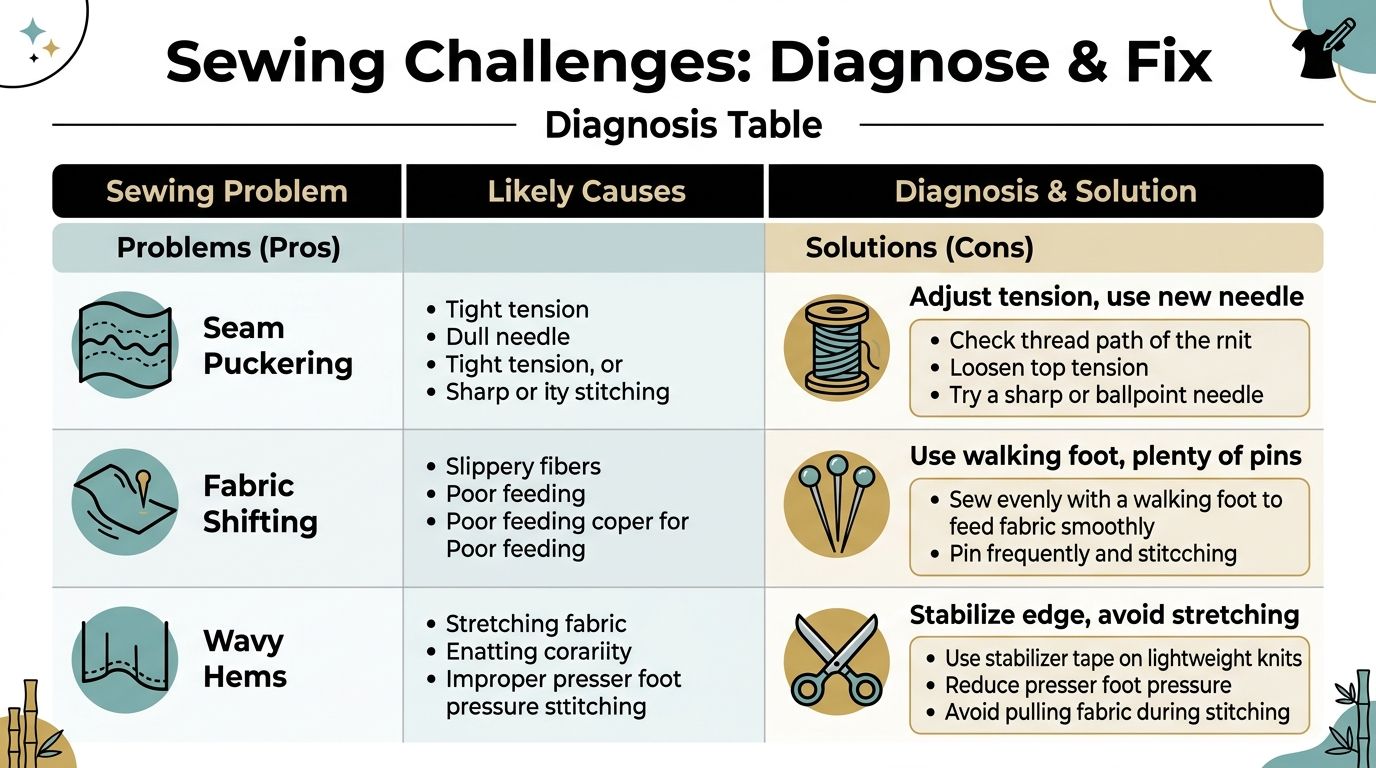
| Problem | Likely cause | What fixes it |
|---|---|---|
| Seam puckering | Tension too high, worn needle | Lower the tension, change the needle |
| Fabric shifting | Layers moving on the feed | Use a walking foot, plenty of pins, or tissue paper underneath |
| Wavy hems | Stretching the edge while sewing | Stabilise the edge, use a coverstitch or twin needle, press cool |
The fixes that actually work
If modal puckers, the first thing I do is change the needle. A dull or wrong needle creates more grief than people admit. If the seam still gathers after that, I reduce upper tension and test again on offcuts before touching the garment.
If the layers keep slipping, a walking foot helps, and so does a small amount of temporary adhesive or tissue paper underneath the seam. That paper tears away cleanly and gives the feed dogs something to grip. It sounds old-fashioned because it is, and it still works.
Wavy hems usually come from dragging the edge while stitching or pressing too hot after the fact. A coverstitch or twin needle gives the cleanest result on these fabrics, then a cool press sets it without stretching the line out of shape.
Before you blame the fabric, check these three things: needle condition, tension settings, and whether you pre-washed properly. Most problems start there.
Pressing, Care, Labels and Making Garments Last
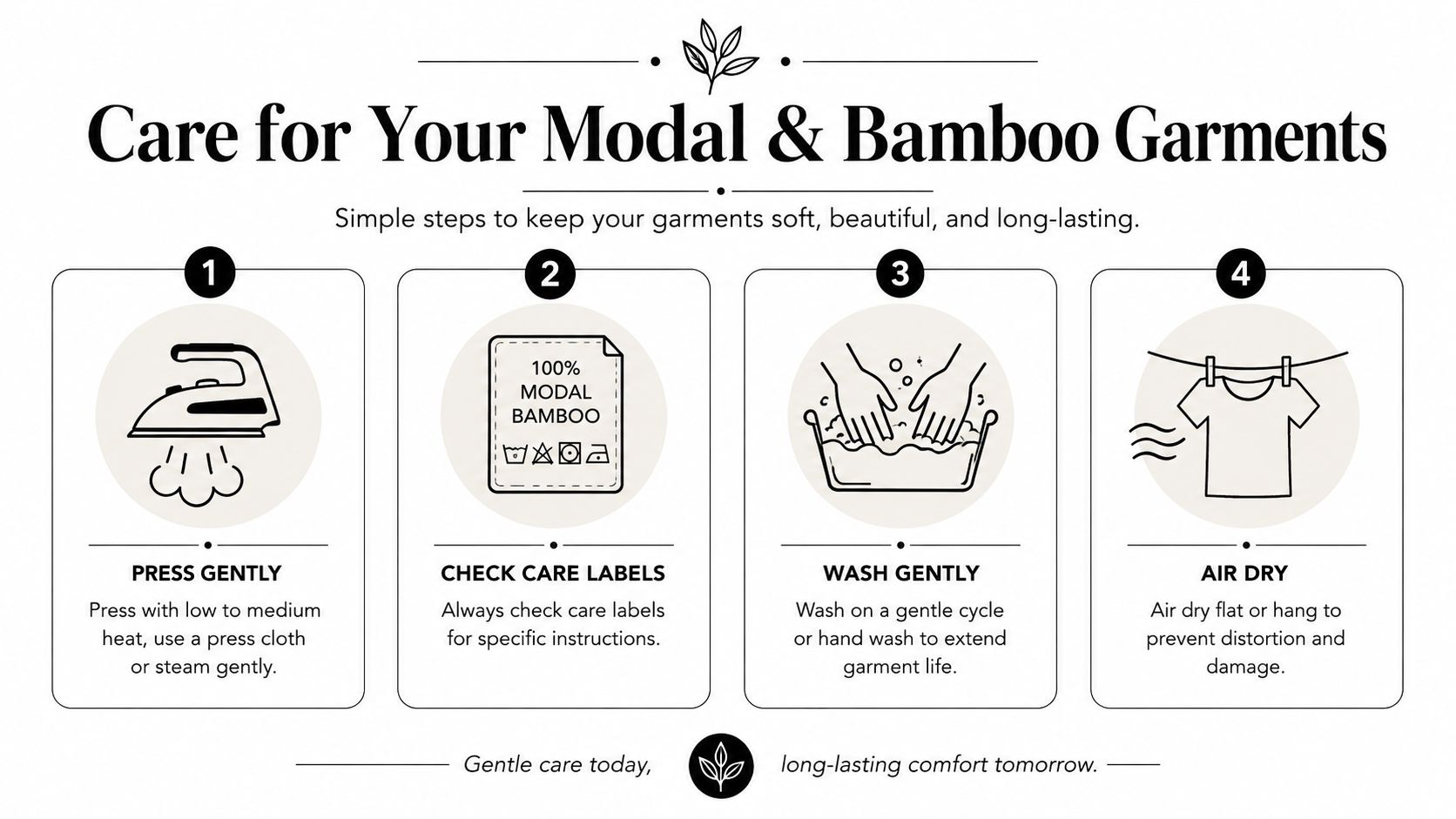
Pressing bamboo and modal is gentle work. Use low to medium heat, keep a press cloth between the iron and the fabric when you're near shiny areas, and switch to steam before you start forcing the cloth flat. High heat can scorch some modal blends, and once the surface goes shiny or damaged, there's no neat fix for that.
Read the label, not the marketing
Most “bamboo” fabric on the UK market is really bamboo viscose or rayon, not mechanically processed bamboo fibre. That matters because the label tells you what the cloth will do, while the marketing name often just tells you what sounds nice. Modal should be listed by its fibre name, and if you want a clean explanation of care symbols and natural fibre handling, natural fibre garment care is a useful reference to keep nearby.
Wash these garments at 30°C, avoid the tumble dryer, and air-dry flat or hang carefully so the weight of the fabric doesn't pull it out of shape. Cool washing, air-drying and mending all extend garment life in a very practical way. That's the sustainability angle that matters at home, not grand claims, just fewer replacements and less waste.
If you're wondering whether modal is beginner-friendly, yes, if you respect the pre-wash and keep the tension modest. For children's sleepwear, modal can be a sensible option when the pattern and care label are right, but I'd still check the garment fit after washing before committing to a full run. Bamboo viscose is lovely for comfort, but it asks for more discipline. That's the truth of it.
If you want fabric that behaves properly instead of fabric that surprises you later, shop with that difference in mind. More Sewing is a good place to pick up quality jerseys, viscose and Tencel blends, plus the haberdashery that makes these fabrics easier to manage, so visit More Sewing and choose the cloth that matches the garment you want to make.
