
You're standing at the cutting table with a jersey bolt in one hand and a pattern envelope in the other. The listing says “stretch jersey”, but that tells you almost nothing about whether the fabric will make a neat children's dress, a fluid wrap dress, or leggings that keep their shape at the knees. With UK jersey fabric, the successful choice starts before the scissors come out. You need to match the knit structure, fibre blend, weight, stretch and recovery to the garment you want to wear.
What Jersey Fabric Is and Why It Behaves Differently
Jersey is a knitted textile, not a woven one. Its yarn forms interlocking loops rather than crossing at fixed angles. Those loops can open and shift across the width, giving jersey its familiar stretch, soft drape and comfortable fit.
That structure explains many sewing problems associated with jersey. Woven cotton generally stays put as the presser foot moves across it. Jersey can distort when layers feed unevenly, particularly if a lightweight piece hangs over the edge of the sewing table. Cut edges may curl, while pulling the fabric through the machine can create ripples.
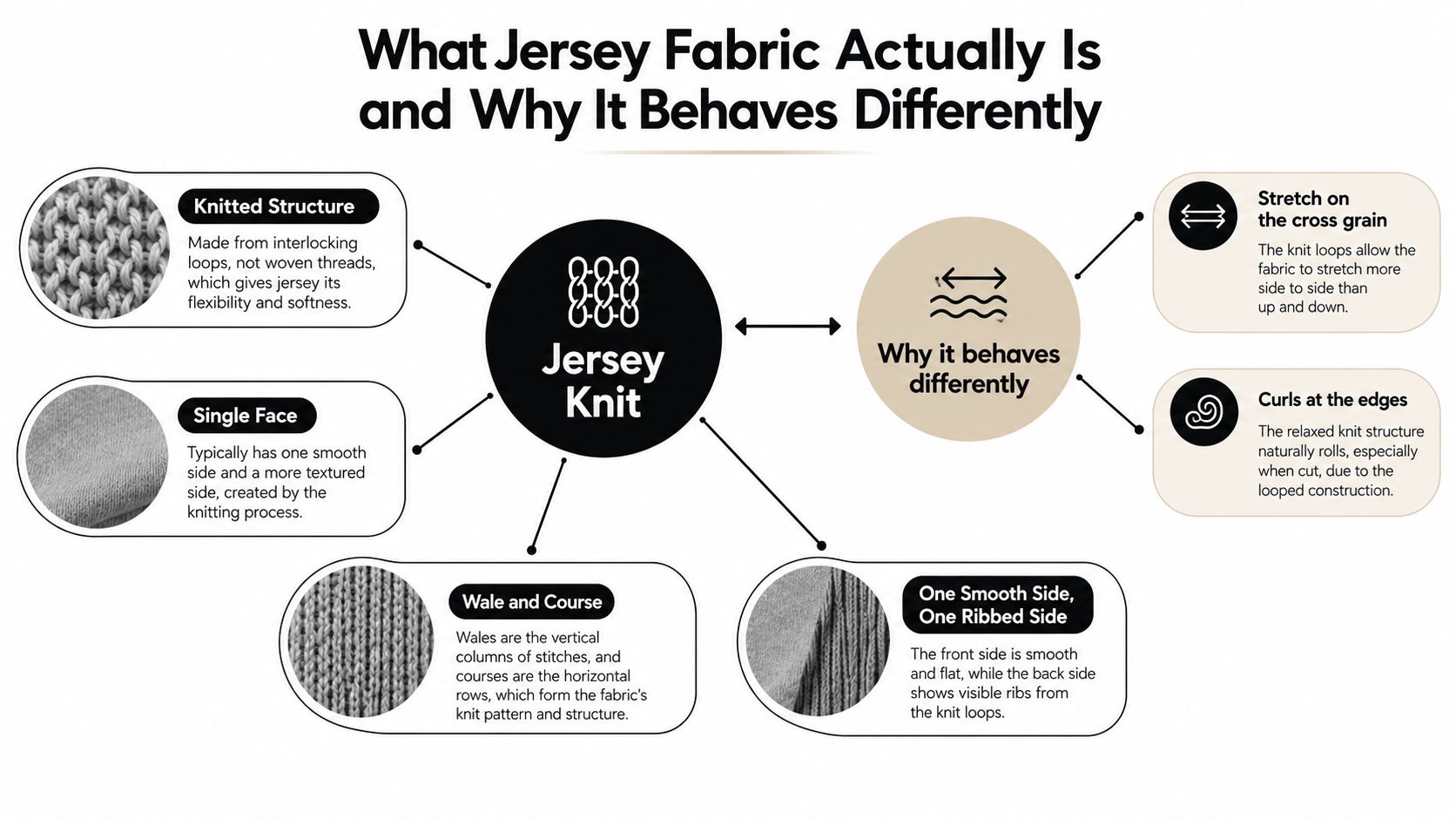
The looped structure controls the result
Single jersey usually has one smooth face and a looped or ribbed reverse. Interlock feels smoother and more stable on both sides because its denser construction creates a double knit. Rib knit has pronounced vertical ridges and substantially more stretch, making it useful where a garment must expand and recover.
Elastane changes the behaviour further. Cotton jersey without elastane may stretch comfortably but recover less reliably. Adding elastane, Lycra or another stretch fibre can improve recovery after extension. That difference matters at necklines, waistbands, elbows, knees and close-fitting seams, where repeated movement quickly exposes weak recovery.
Practical rule: Treat jersey as a moving structure. Keep it supported, avoid pulling it, and choose stitches that can extend with the loops.
The fabric's history helps explain its name. Textile histories link “jersey” to the Channel Island of Jersey, where fine knitted cloth was exported to mainland England and across Europe from the 16th century (The textile history of jersey). William Lee's late-16th-century knitting machine in Nottinghamshire helped knitting spread through England. Coco Chanel's use of jersey in 1916 is often identified as the point when it entered mainstream women's dressmaking. Jersey moved from practical knitted cloth to a fabric used in fashion as well as everyday garments.
The Main Jersey Subtypes UK Sewists Will Meet
Most project disappointments happen because a sewist chooses by colour first and structure second. The five types below feel and behave differently, even when their listings all use the word “jersey”.
Single jersey
This is the familiar T-shirt knit. It's usually soft, relatively light and pleasantly drapey, with a smooth face and a less tidy reverse. The cut edges can curl strongly, especially when the fabric is fine or has a high stretch.
Use single jersey for everyday T-shirts, relaxed tops and lighter dresses. It's forgiving to wear, but not always forgiving to cut. A drapey single jersey can grow under its own weight if you leave it unsupported.
Interlock
Interlock is a double-knit structure with a smooth appearance on both sides. It has more body than a typical single jersey and lies flatter during cutting, so it's a useful choice for children's clothing, stable tops and garments where you want a tidy inside as well as outside.
It won't usually give the same fluid movement as viscose single jersey. That's the trade-off. You gain stability and opacity, but lose some liquid drape.
Rib knit
Rib has visible vertical ridges and substantial stretch. It's the fabric to reach for when a neckband, cuff or close-fitting section must expand and recover repeatedly.
A rib can work for fitted tops and dresses, but it needs careful pattern matching. Its stretch can make a neckline look larger than expected if you cut it like a stable knit.
Ponte di Roma
Ponte is a firm double knit with a smooth, substantial handle. It has enough structure for trousers, skirts and fitted dresses, while remaining more comfortable than a woven suiting fabric.
It's a poor choice for a floaty summer top. The weight gives clean lines, but it won't produce the soft swing of a lighter viscose jersey.
Scuba
Scuba is dense, smooth and slightly spongy. It holds sculptural shapes and has a springy hand, making it suitable for structured dresses, skirts and fashion-led pieces.
It can look bulky in small gathers and may feel warmer than expected. Use it where shape matters more than breathability.
| Subtype | Typical Weight (gsm) | Stretch and Recovery | Best For |
|---|---|---|---|
| Single jersey | Light to medium | Moderate to high, depending on blend | T-shirts, relaxed tops, draped dresses |
| Interlock | Medium | Moderate, stable recovery | Children's wear, structured tops |
| Rib knit | Light to medium | High stretch and recovery | Cuffs, neckbands, fitted garments |
| Ponte di Roma | Medium to heavy | Moderate stretch, firm recovery | Trousers, skirts, structured dresses |
| Scuba | Medium to heavy | Springy stretch, stable shape | Sculptural dresses, skirts, costumes |
UK retailers commonly group jersey into single knit, interlock and rib knit, so those labels are a useful starting point when browsing. This UK jersey collection also reflects why project-specific guidance matters, with a UK-facing industry report finding that 80% of respondents wanted jersey sourced from the UK. The demand isn't just for more fabric. It's for better information before buying.
Reading the Specs Weight Fibre Blend and Stretch
Product listings become much more useful once you stop reading gsm, width and fibre content as separate facts. Together, they predict how the fabric will hang, stretch and cope with wear.
GSM means grams per square metre. A lower gsm usually indicates a lighter, more fluid fabric. A higher gsm generally brings more body, opacity and seam stability. Width matters too, particularly with dresses and trousers, because a wide piece may reduce the number of joins required.
Fibre content tells you why two fabrics with similar weights can feel completely different. Cotton usually gives a breathable, familiar handle. Viscose tends to create a cooler, more fluid drape. Polyester can hold printed colour well and may be easier to care for. Elastane improves stretch recovery, but it also makes heat and harsh drying more significant care concerns.
Two listings read in practice
Consider a 180gsm, 150cm-wide, 95% cotton and 5% elastane single jersey. It should feel like an everyday T-shirt fabric with useful recovery, moderate body and enough width for many simple tops. It's a sensible choice for a fitted T-shirt, children's top or uncomplicated day dress, provided its measured stretch suits the pattern.
Now compare a 280gsm, 145cm-wide ponte made from 67% viscose, 28% nylon and 5% elastane. This is much denser and more stable. Expect a smoother, heavier drape with stronger shape retention, making it more appropriate for trousers, pencil skirts or a structured dress than for a floaty top.
Stretch percentage is a pattern requirement, not a decorative detail. Measure the fabric across the width before cutting and compare it with the pattern's stretch guide.
UK cotton jerseys can offer substantial crosswise stretch, while rib knits often give more. Don't assume the blend alone predicts the result. The knitting method and elastane content work together.
| Spec | Example A: Cotton Jersey | Example B: Ponte Roma |
|---|---|---|
| Weight | 180gsm | 280gsm |
| Width | 150cm | 145cm |
| Fibre blend | 95% cotton, 5% elastane | 67% viscose, 28% nylon, 5% elastane |
| Likely handle | Soft, everyday, moderately drapey | Dense, smooth, structured |
| Suitable projects | T-shirts, children's tops, simple dresses | Trousers, skirts, fitted structured dresses |
A UK-made benchmark illustrates how specific a listing can be. One 230gsm, 140cm-wide jersey is made from 95% polyester and 5% Lycra, with four-way stretch and described as having excellent memory. Its supplier recommends delicate washing at 40°C, a useful reminder that the care label belongs alongside the technical specifications. This UK-made polyester-Lycra jersey specification connects fibre, weight, recovery and care in one product decision.
Matching Jersey to the Garment You Want to Make
Start with the garment's stress points, not the print. Ask where the fabric must stretch, whether it needs to recover, how much drape you want and whether the garment must remain opaque under tension.
T-shirts and everyday tops
For a child's T-shirt, a 150 to 180gsm cotton-elastane jersey is usually practical. It's light enough for comfortable wear and sturdy enough for ordinary handling. An adult T-shirt can use the same general weight, although a finer, softer jersey may give a more relaxed drape.
Interlock works when you want a tidier, slightly more substantial top. Choose single jersey when softness and movement matter more than a crisp outline.
Dresses
A wrap dress benefits from a drapey jersey, such as a lighter viscose blend. The fabric needs to fall into the wrap rather than stand away from the body. For a toddler's dress, a 200gsm cotton interlock offers more body and can cope well with repeated washing.
A heavy ponte may produce an attractive fitted winter dress, but it's the wrong tool for a floaty summer shape. The dress may look stiff and feel warmer than intended.
Leggings and close-fitting garments
Leggings need four-way stretch, opacity and dependable recovery. A 220 to 280gsm ponte or scuba can work when the fabric has at least 50% horizontal stretch, but test the actual cloth rather than relying on the product name. A lightweight single jersey may feel comfortable on the cutting table and still sag at the knees after wear.
Rib can be suitable for very close-fitting garments, although its high give requires careful pattern handling. If the pattern expects firm recovery and the rib stretches too freely, the finished garment may feel loose.
Loungewear and trousers
Joggers need more structure than standard lightweight jersey. Ponte gives a cleaner trouser-like finish, while French terry offers a softer, more relaxed result. For a plain sweatshirt, reach for 280 to 320gsm loopback French terry rather than a thin T-shirt knit.
| Garment | Best Jersey Subtype | Weight (gsm) | Min Stretch % |
|---|---|---|---|
| Children's T-shirt | Cotton-elastane single jersey | 150 to 180 | Pattern dependent |
| Adult T-shirt | Fine cotton or cotton-elastane jersey | 150 to 180 | Pattern dependent |
| Wrap dress | Drapey viscose jersey | Around 150 | Pattern dependent |
| Toddler dress | Cotton interlock | Around 200 | Pattern dependent |
| Leggings | Ponte or scuba | 220 to 280 | 50 horizontal |
| Joggers | Ponte or French terry | Medium to heavy | Pattern dependent |
| Sweatshirt | Loopback French terry | 280 to 320 | Pattern dependent |
A useful shop-floor check is to stretch a small section as the garment will demand. Test the bust area for a fitted top, the waistband for joggers and the knee area for leggings. Opacity under tension, not just opacity at rest, can decide whether the fabric is wearable.
How to Judge Jersey Quality Before You Buy
A fabric can look beautiful on a screen and still disappoint at the cutting table. The quickest checks are simple, and they work whether you're handling a roll in a shop or examining a sample at home.
First, pull a 10cm sample widthways to about 50% stretch and release it. Good recovery should bring the cloth back towards its original shape. If it stays extended, develops ripples or looks permanently distorted at the edge, be cautious about using it for fitted garments.
Next, hold one layer over your hand under strong light. Stretch it as the finished garment will be stretched. If your skin shows clearly, the fabric may need a lining, a different project or a more forgiving fit.
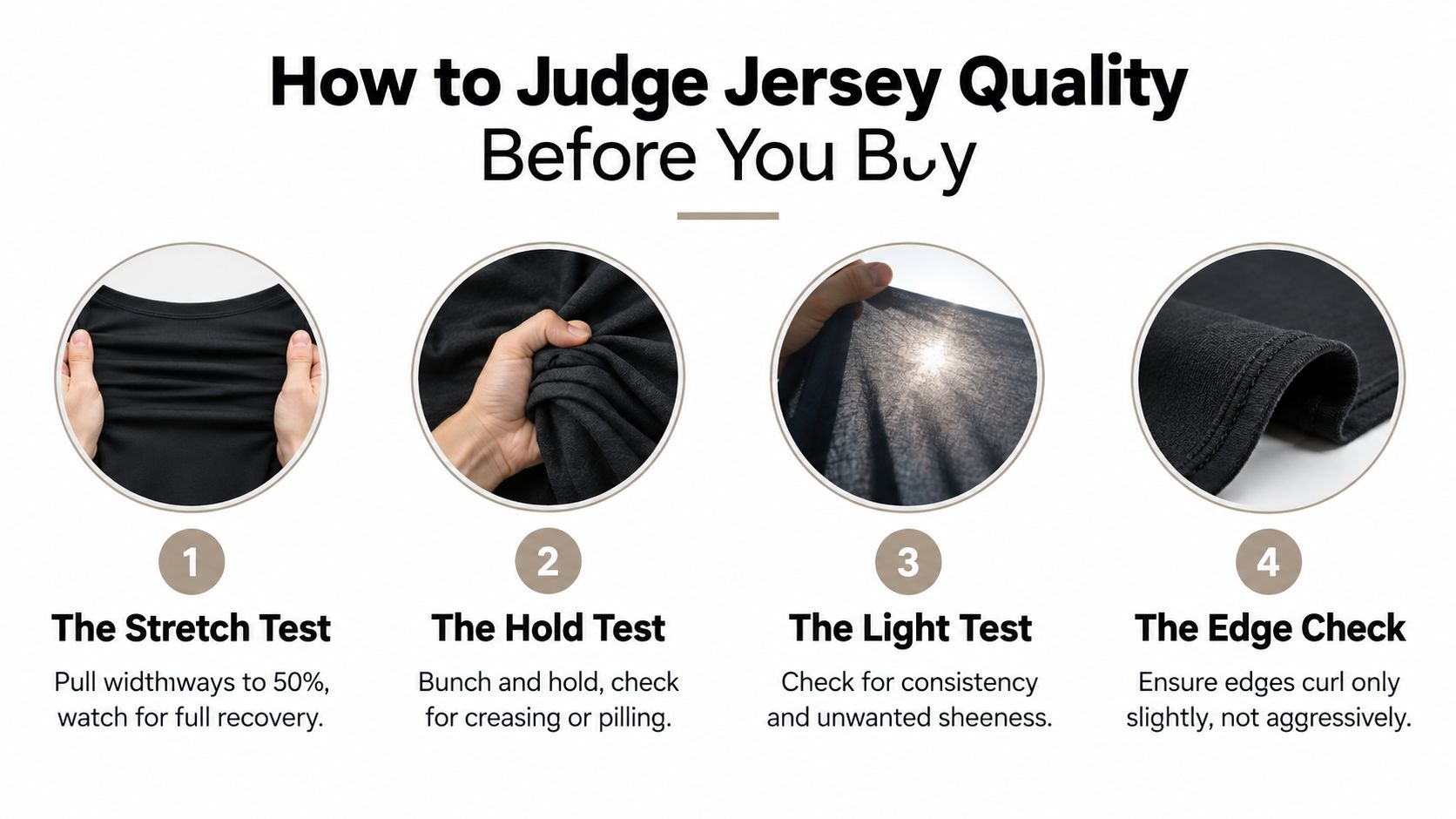
Look at the surface and the edge
Run your thumb across the face. A stable, even surface should feel consistent rather than fuzzy or loosely fibred. Loose fibres don't guarantee future pilling, but they're a warning sign worth taking seriously.
Inspect the cut edge too. Some curling is normal in single jersey. Aggressive rolling can make accurate cutting and hems much harder, particularly on a narrow neckline or sleeve edge.
The listing should give you fibre percentages, gsm and width. If it doesn't, ask before ordering. A swatch is a small cost compared with discovering that several metres are too sheer, too heavy or too weak in recovery for the intended pattern. UK retailers such as Minerva, Fabric Godmother and independent mills commonly offer sample cards, often for under £2. A UK jersey buying guide recommends washing jersey before cutting, allowing it to rest, and checking its stretch against the pattern markers.
Wash the swatch on the intended cycle, let it dry as you'll dry the garment, then measure it again. If shrinkage approaches 5%, allow for it when buying and cutting. The exact result depends on fibre and finish, so the swatch tells you more than a generic care assumption.
Cutting and Sewing Jersey With Confidence
Jersey becomes much easier when you prevent distortion before it reaches the needle. Lay it flat without tension, support the full piece on the table and don't allow the fabric to hang from the edge.
Paper weights and a rotary cutter are often more controlled than repeated pinning and scissor lifting. Cut on a self-healing mat where possible, keeping the blade perpendicular to the surface. If you use pins, place them within the seam allowance so they don't leave unnecessary marks in a delicate knit.
Choose the needle for the fabric
Use a ballpoint or stretch needle. The rounded point moves between knitted loops instead of cutting through them.
- 75/11 or 80/12: light-to-medium jersey.
- 90/14: heavier jersey, ponte and scuba.
- 70/10: useful for very light knits, but test it on a scrap before committing.
The UK sewing guidance at The Sewing Directory's jersey tutorial recommends ballpoint or stretch needles and explains why a straight stitch can fail when a seam is pulled.
Let the stitch move
A straight stitch has no built-in flexibility. Use a dedicated stretch stitch if your machine has one, otherwise start with a narrow zigzag. A practical starting point is around 2.5mm stitch length, with the width kept narrow enough to avoid a visibly wavy seam.
A walking foot can feed layers more evenly. Reduce presser-foot pressure if your machine allows it, and guide the fabric without pulling. An overlocker gives a neat stretchable seam finish, but it isn't essential. On a standard machine, use a narrow zigzag for seams, then a twin needle for hems. A wide zigzag along the seam allowance can help secure raw edges.
Press with a cloth and low-to-medium heat. Don't drag the iron across the fabric, as that can stretch the garment before it has even been worn. UK guidance on handling jersey also recommends supporting the fabric's weight and using a walking foot to reduce distortion.
Washing and Care That Match the Fibre
Care should follow the fibre blend, not the word “jersey” on the label. A polyester-Lycra knit and a cotton-elastane knit may both stretch on the cutting table, but they don't respond identically to heat, spin and drying.
A 95% polyester and 5% Lycra jersey can usually cope with a cooler, shorter wash and line drying, subject to the supplier's label. One UK-made example specifies delicate washing at 40°C and is designed with recovery and print integrity in mind. Keep it away from harsh heat if you want the elastane to retain its performance.
A 92% cotton and 8% elastane jersey needs more attention to shrinkage and shape. The UK specification for this 240gsm, 160cm-wide cotton-rich jersey describes a mid-to-heavy construction suited to fitted garments. Compared with a lighter 156gsm 100% cotton jersey, it should have more body, less transparency and better resistance to distortion at seams and hems. This cotton-rich jersey listing provides the technical comparison.
A practical care table
| Fibre Blend | Wash | Dry | Iron |
|---|---|---|---|
| Polyester and Lycra | Delicate cycle at the labelled temperature | Line dry where possible | Low heat |
| Cotton and elastane | Cool wash, moderate spin | Reshape and air dry | Low to medium heat |
| Viscose jersey | Gentle wash with a mild, pH-neutral detergent | Dry flat or supported | Low heat, press carefully |
| Wool jersey | Follow the wool-care label | Dry flat | Cool setting through a cloth |
Avoid tumble drying elastane-rich garments when you can. Repeated heat can weaken recovery over time. Fold heavy knits rather than hanging them, because a hanger can pull the shoulders and lengthen the garment.
Store wool jerseys folded with cedar blocks nearby, and keep offcuts flat in labelled bags. Include the fibre blend and original care information with each remnant. That small habit prevents a useful piece being treated like an unidentifiable scrap months later.
Common Jersey Mistakes and Quick Answers
A jersey T-shirt can fail before the first wash if the fabric, needle and seam are mismatched. These are the problems I see most often at the cutting table:
- Skipping the correct needle: A sharp universal needle can catch knitted loops. Use a ballpoint or stretch needle.
- Using a straight stitch: The seam can pop as the garment stretches. Choose a narrow zigzag or stretch stitch.
- Ignoring recovery: Stretch alone does not show whether fabric will return to shape. Test both stretch and recovery before cutting.
- Choosing ponte for a light dress: Ponte adds body and warmth, so it may make a summer design feel heavy and rigid.
- Pulling while sewing: Let the feed dogs move the fabric. Tugging produces stretched, rippled seams.
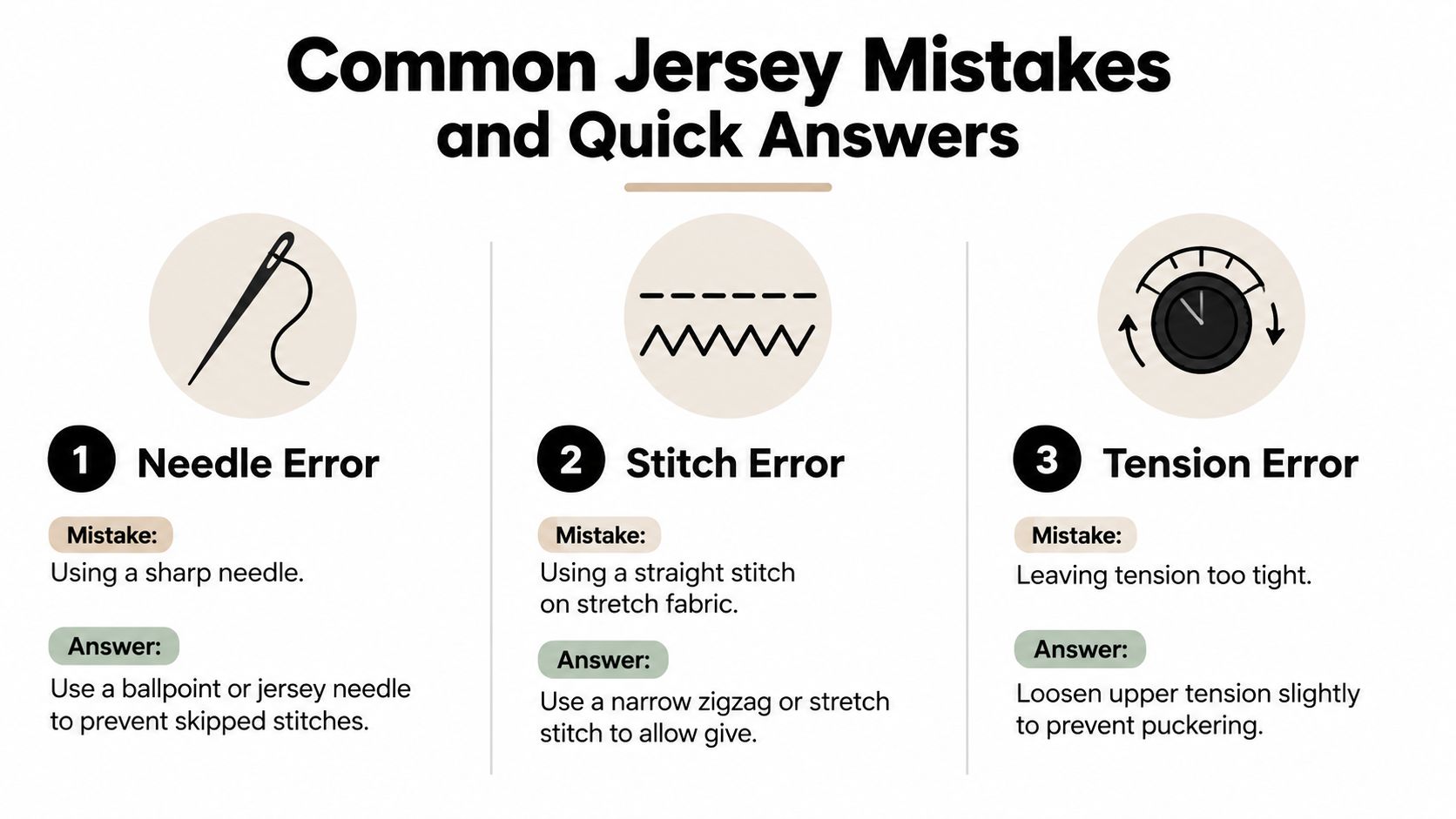
Quick answers from the cutting table
Should I pre-wash jersey?
Yes. Wash and dry the fabric as you plan to care for the finished garment, then let it rest before cutting. Cotton-rich jersey deserves particular care because shrinkage can alter the fit.
How much should I buy?
Start with the pattern's fabric allowance, then check width, print direction and nap. A wide roll may place pattern pieces differently from a narrow one, while a directional print can require extra fabric. For UK sourcing, compare fabric samples, jersey guidance and suitable sewing supplies at More Sewing. Choose a swatch first, measure its stretch and recovery, then buy the quantity your pattern requires.
Which needle suits standard jersey?
Use a fresh 75/11 or 80/12 ballpoint or stretch needle for light-to-medium jersey. Choose 90/14 for heavier fabrics such as ponte or scuba, and test the stitch on a spare piece.
Are Lycra and elastane the same thing?
They describe the same type of stretch fibre in everyday fabric listings. Lycra is a brand name; elastane is the generic fibre term.
Before cutting the full length, sew a test seam and stretch it firmly. That small check exposes skipped stitches, tunnelling and poor recovery while there is still time to change the setup.
