
Dressmaking, Fabric
Viscose Dressmaking Fabric: A Guide to Drape and Weight
You've got the fabric in your hand, the pattern in your bag, and one nagging question at the cutting table. The viscose that looks perfect for a shirt dress on the roll can turn into a slippery, disappointing mess once it's washed, cut, and sewn, and that's exactly why so many home dressmakers hesitate before they buy.
Viscose has been part of dressmaking for a very long time. The fibre was patented in Britain in 1892 by Charles Cross, Edward Bevan, and Clayton Beadle, and the first commercial viscose rayon was produced by Courtaulds in the UK in November 1905, which helps explain why it still feels so familiar in British sewing rooms today. It's a semi-synthetic regenerated cellulose fibre made from plant cellulose, usually wood pulp, and that gives it a place between cotton and polyester in feel and behaviour. Viscose's British roots and dressmaking history and the regenerated cellulose explanation are both worth keeping in mind if you want to understand why this cloth has lasted.
The reason sewists keep coming back to it is simple. Viscose dressmaking fabric gives dresses and blouses a fluid line, takes dye thoroughly, and feels cool against the skin because it absorbs moisture readily. The trade-off is just as real, though, because the same qualities that make it lovely on the body can make it awkward on the table. If you like comparing how fabric behaves across different garment uses, the practical buying advice in top printing materials for 2026 is a useful mindset to borrow, even if you're sewing for yourself rather than printing for a brand.
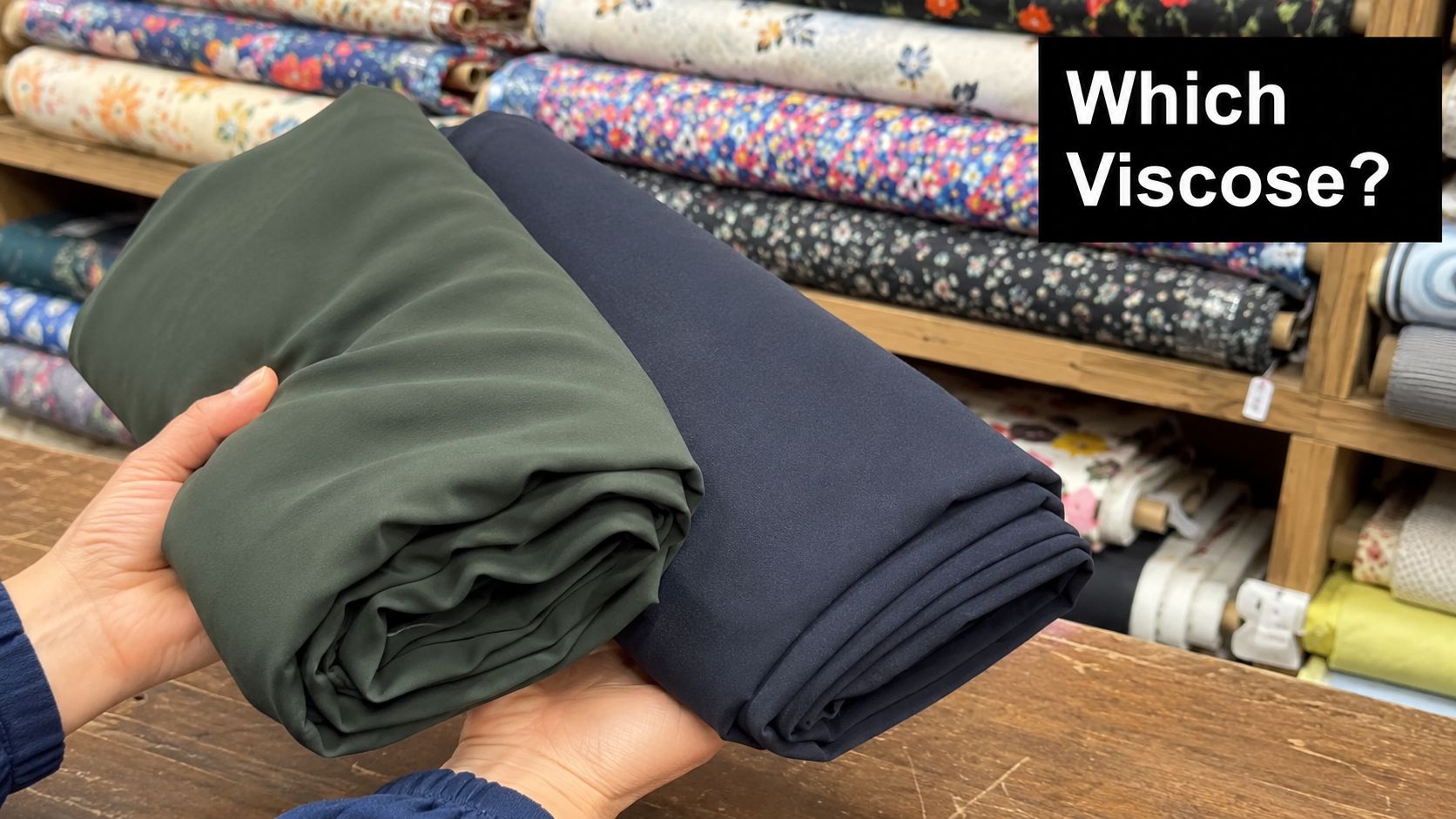
When You Stand in Front of the Viscose Roll and Hesitate
You know the moment. Two rolls are hanging in front of you, both labelled viscose, one with a soft hand and a floral print, the other with a cleaner finish and a deeper colour. The pattern in your bag is for a shirt dress, and you are trying to work out which fabric will behave on your machine, which one will need lining, and which one will hang badly after the first wash.
That hesitation is earned. Viscose became a silk-like textile because it combines softness, drape, and comfort, but those same qualities can hide how it will behave once you start sewing and wearing it. It is also a fabric with long-standing scale behind it, with Apex Fashion Lab's viscose fabric overview citing production at about 5.8 million tonnes in 2018 and a 2025 figure of around 6.3 million tonnes. That kind of volume tells you something practical, people keep using it because it solves real dressmaking problems.
What the fabric really is
Viscose is not a natural fibre in the way cotton is, and it is not a petrochemical synthetic in the way polyester is. It starts with plant cellulose and is then regenerated into fibre form, which is why it behaves so differently from stable woven cottons at the cutting table. That middle-ground behaviour is exactly why many sewists reach for it when they want a garment that moves rather than stands up on its own.
The British sewing world has never really let it go. It was already being used by the 1920s and 1930s in women's stockings and underwear, replacing traditional cotton and wool in everyday apparel, which tells you how quickly it moved from novelty to normality. Plastiquarian's historical note shows that the fibre found a lasting place because it fitted ordinary wardrobes, not just one fashion moment.
Practical rule: if you want a garment to skim the body, viscose is often a good candidate. If you want a garment to hold a shape sharply, you usually need another cloth, or extra support.
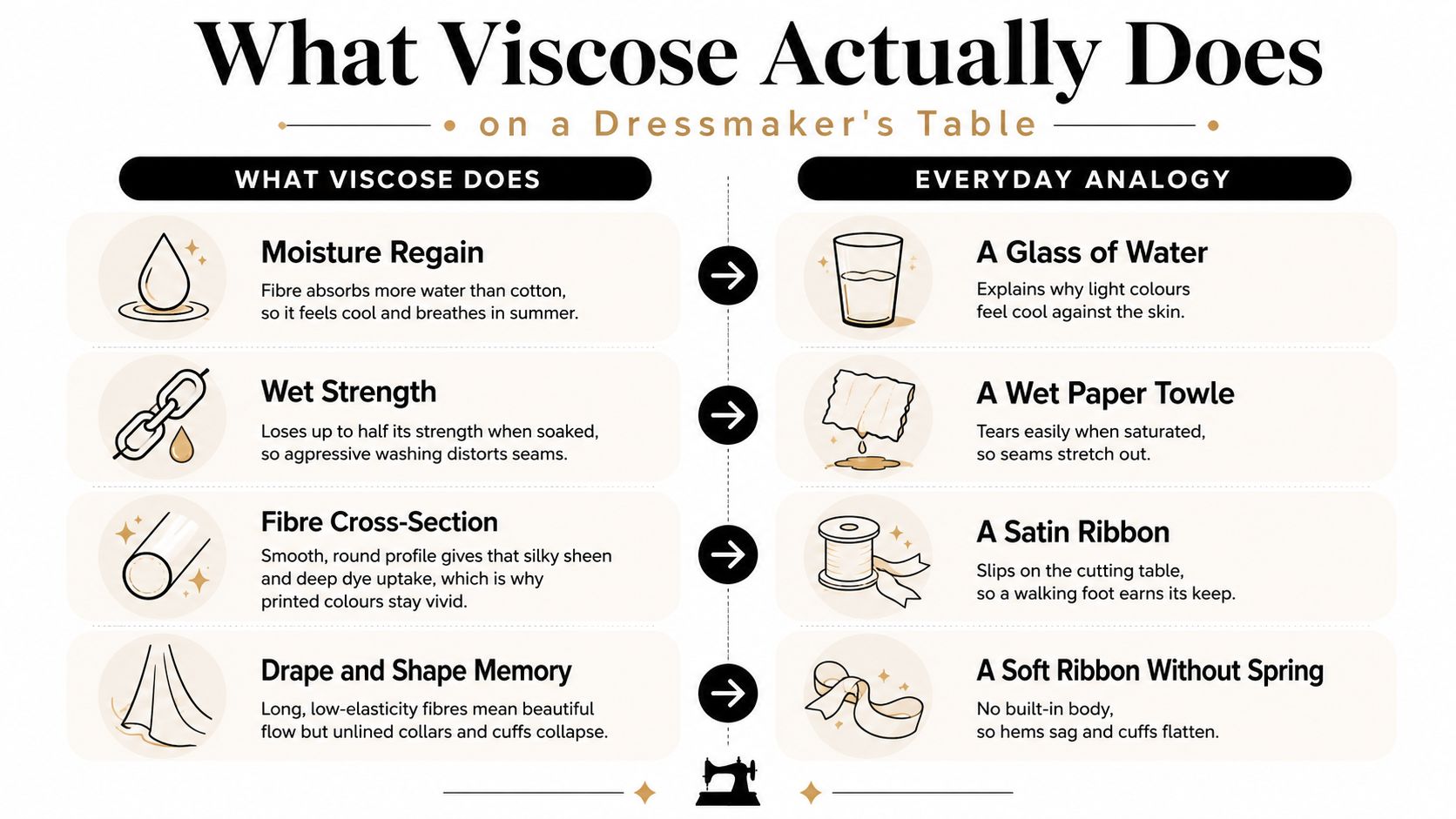
What Viscose Actually Does on a Dressmaker's Table
The easiest way to understand viscose is to stop thinking about the label and start thinking about four behaviours, moisture, wet strength, fibre structure, and drape. Those are the things that decide whether your dress comes out fluid and elegant, or wavy and awkward.
Moisture regain and why it feels cool
Viscose is reported to have 11 to 14% moisture regain, compared with cotton's 8% Plastiquarian. In plain language, it holds more moisture from the air and from the body, which is part of why it feels comfortable in warm weather. The cloth doesn't trap heat in the same way denser fibres can, so a summer dress in viscose often feels easier to wear than the same shape in a heavier cotton.
Think of a glass of water. A fibre that absorbs and releases moisture more readily tends to feel cooler against the skin, which is why lightweight viscose is such a common choice for floaty dresses and loose blouses. That comfort is real, but it comes from a fibre structure that also makes the cloth more sensitive to handling.
Wet strength and why washing changes everything
This is the part that catches people out. Textile guidance notes that viscose swells strongly when wet, becomes stiffer in water, and stretches or distorts more under tension than cotton. One technical guide cites a 40 to 60% reduction in tensile strength when soaked Viscose recommendations PDF.
A good comparison is a wet paper towel. Dry, it can hold together well enough. Soaked, it tears or stretches far more easily. Viscose behaves in a similar way, which is why you don't yank it around the machine, and why you treat hanging hems, bias pieces, and damp seams with care. If the fabric is allowed to distort while wet, it may never sit quite right again.
Practical rule: handle viscose like a cloth with a memory for bad treatment. Gentle wash, gentle lift, gentle press.
Fibre cross-section and drape
Viscose has a smooth, round fibre cross-section and lower crystallinity than cotton, which helps it absorb dye thoroughly and gives it that soft sheen Leeline Apparel's viscose fabric guide. That's why print colours often look so saturated and why the cloth can look more expensive than its price suggests.
It also has less shape stability than many other apparel fibres. A satin ribbon is a useful picture here, because it slips on the cutting table and doesn't hold a rigid shape by itself. That is exactly why viscose excels in gathered skirts, bias-cut dresses, and loose sleeves, and why unlined cuffs or crisp collars often feel flimsy unless you support them.
Viscose Against Its Closest Alternatives
| Fabric | Drape | Breathability | Wet strength | Typical shrinkage behaviour | Sustainability profile |
|---|---|---|---|---|---|
| Viscose | Very fluid | Very breathable | Lower when wet | Can shrink or skew if not pre-washed | Depends heavily on processing route |
| Modal | Soft and fluid | Breathable | Often more stable than standard viscose | Usually less fussy in wear | Also a man-made cellulosic fibre, with route and source mattering |
| Lyocell | Fluid with a slightly cleaner line | Breathable | Generally better behaved in handling | Often calmer than standard viscose | Often discussed as a lower-impact MMCF option |
| Cotton | More body, less fall | Breathable | More forgiving | Usually easier for beginners | Natural fibre, but still varies by farming and finishing |
The thing people often get wrong is treating viscose and rayon as separate fibres. They're not. Viscose is a type of rayon, and that matters because it stops the shopping confusion before it starts. It also helps explain why the same rail can include fabrics that feel very different even when they share a family name.
Where each one earns its place
Modal is the softer cousin you reach for when you want a drapey top or a cosy layer that feels a bit more forgiving than standard viscose. It's a sensible choice when you want comfort without quite as much slippage on the table. Lyocell, including Tencel as a brand name, is the cleaner, often more controlled option when you want movement without the same degree of fuss. Cotton stays the best first-project choice if the pattern needs structure, pressing ease, and a fabric that won't overwhelm you.
That's why a shirt dress in viscose can look beautiful while still being a poor match for a beginner's first collar-and-cuff project. A simple cotton poplin may be less glamorous, but it gives you far more forgiveness when you're learning seam accuracy and pressing discipline.
A useful way to think about the choice is this.
Pick viscose when the pattern wants flow. Pick cotton when the pattern wants certainty.
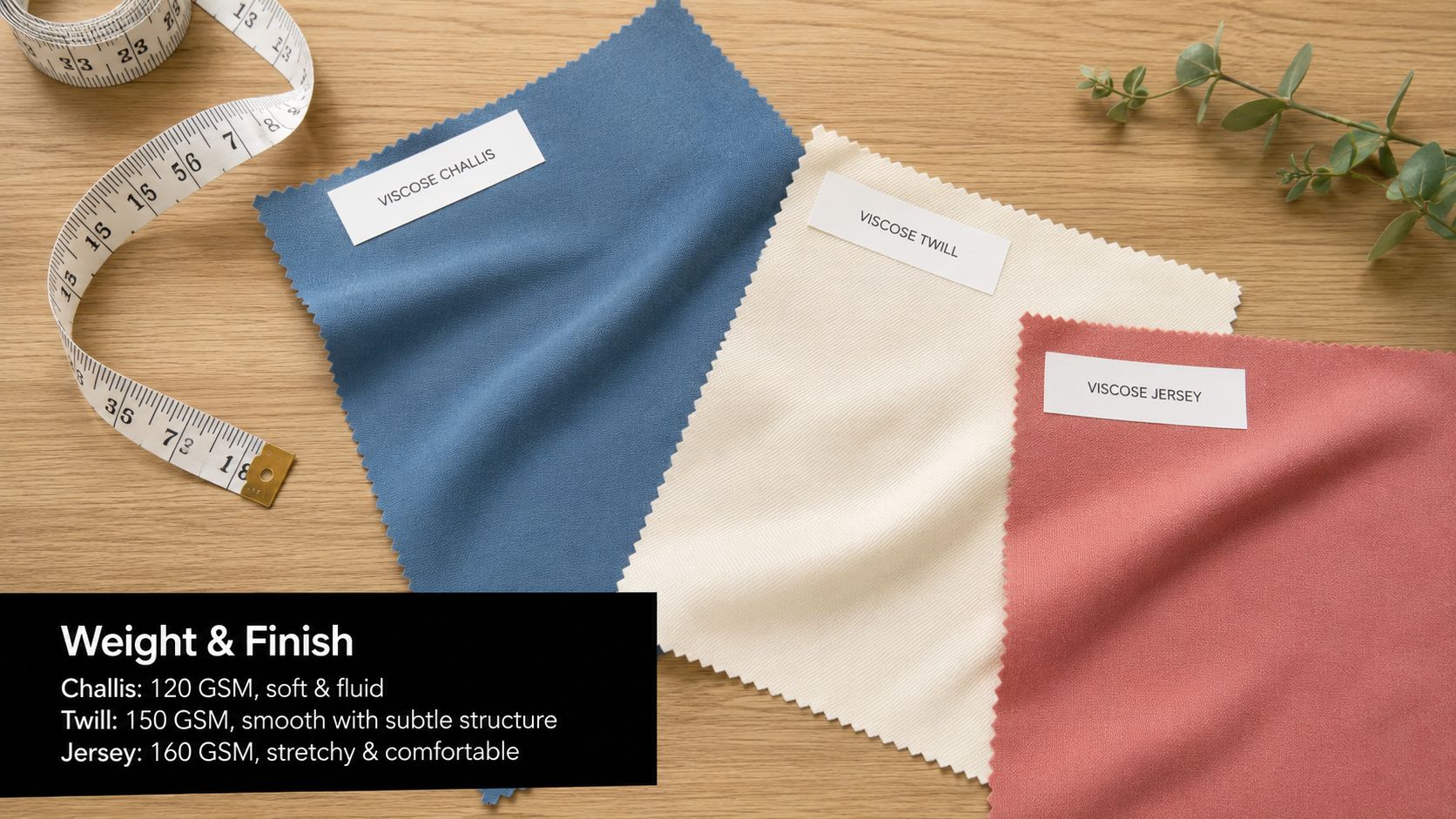
GSM, Weight and Finish in Plain Language
The label “viscose” doesn't tell you enough. A light challis, a stable twill, a soft jersey, and a glossy satin-back all start with the same fibre family, but they won't behave the same way in a dress.
What the common weights feel like
A viscose challis is the classic blouse-and-dress cloth. It's soft enough to skim the figure and fluid enough for gathers, but it often sits on the sheer side, so you need to check transparency against your pattern. If you're making a summer midi dress with a lined bodice and floaty skirt, this is usually the kind of viscose you're looking at.
A viscose twill has more body. It's a better match for a jumpsuit, a wide-leg trouser, or a dress with patch pockets that need a little support. That extra structure helps it hold a pocket bag without collapsing into itself, which is exactly where many lightweight viscose fabrics start to struggle.
A viscose jersey is the route to a drapey T-shirt dress or a soft day dress with stretch. It behaves differently from woven viscose, so your needle choice and stitch control matter more, especially around shoulder seams and hems. A ballpoint needle can make a real difference here, because it helps the machine move through the knit without damaging the loops.
How finish changes the result
The finish often matters as much as the weight. A crepe finish gives you more texture and a slightly drier hand, which can help with sewing confidence. A satin-back finish will feel more polished but can be more slippery, so it rewards careful cutting and patient pinning. A plain woven challis is usually the most familiar starting point for dresses and blouses, while a jersey asks for knit techniques rather than woven assumptions.
Here's the practical test I use in the shop. Hold the fabric up, let it fall, and look at what gravity does to it. If it drops in a soft line and comes back without fighting you, it may be right for a fluid dress. If it barely folds and tries to stand away from the body, it may be better for a different pattern.
Garment Types That Show Viscose at Its Best
A viscose dress can be a triumph when the pattern and the cloth want the same thing. The best results usually come when you stop trying to make it behave like cotton and let it act like the fluid fabric it is.
Four projects where it makes sense
A 1930s-inspired bias-cut midi is a natural match. The cut wants movement, the fabric wants to fall, and the result can be elegant without needing extra fuss. The one thing to watch is stretch-out on the bias, especially at the neckline and hem, so hanging it before final finishing is smart practice.
A peasant-sleeve blouse with gathered cuffs is another strong use. The fullness in the sleeves plays nicely with viscose's drape, and the gathers soften the whole shape. Depending on the weight, lining is usually optional, but if the cloth is very light or the print shows shadowing, a camisole or underlayer solves the problem fast.
A wide-leg jumpsuit needs more caution. In a medium-weight viscose twill, it can look sharp and move well, but lining often becomes the difference between a garment you wear and one that clings or goes see-through in the wrong light. The challenge here is not the shape, it's managing the fabric's growth during sewing and hanging.
A tiered maxi dress in a viscose challis print is where the fabric's easy fall really earns its keep. The tiers gather without feeling bulky, and the print movement can look far more expensive than the cloth was. The downside is that a sheer challis can demand modesty layers, so check opacity before you cut.
If you're comparing viscose projects with other custom garment ideas, the fit-and-finish thinking behind order custom shirts and hoodies from Custom from Custom Mark is a useful reminder that fabric choice always starts with intended use, not just appearance.
Good viscose patterns don't fight gravity. They use it.
Sewing Viscose Without the Tears
Start before the scissors come out. Pre-wash the fabric, then dry it flat or handle it carefully so you're not cutting into a cloth that's still changing shape. That matters because unfinished viscose can shrink or skew on the first wash, and one sewing guide flags first-wash shrinkage at 5 to 10% Arcus AG's viscose sewing guide.
Once it's dry, cut it single layer on a flat surface. A rotary cutter helps because it lets you keep the cloth still instead of dragging it against the table. If the pattern has bias-cut panels, mark them carefully and keep them supported, because bias pieces stretch with enthusiasm the moment you handle them.
The settings that usually behave
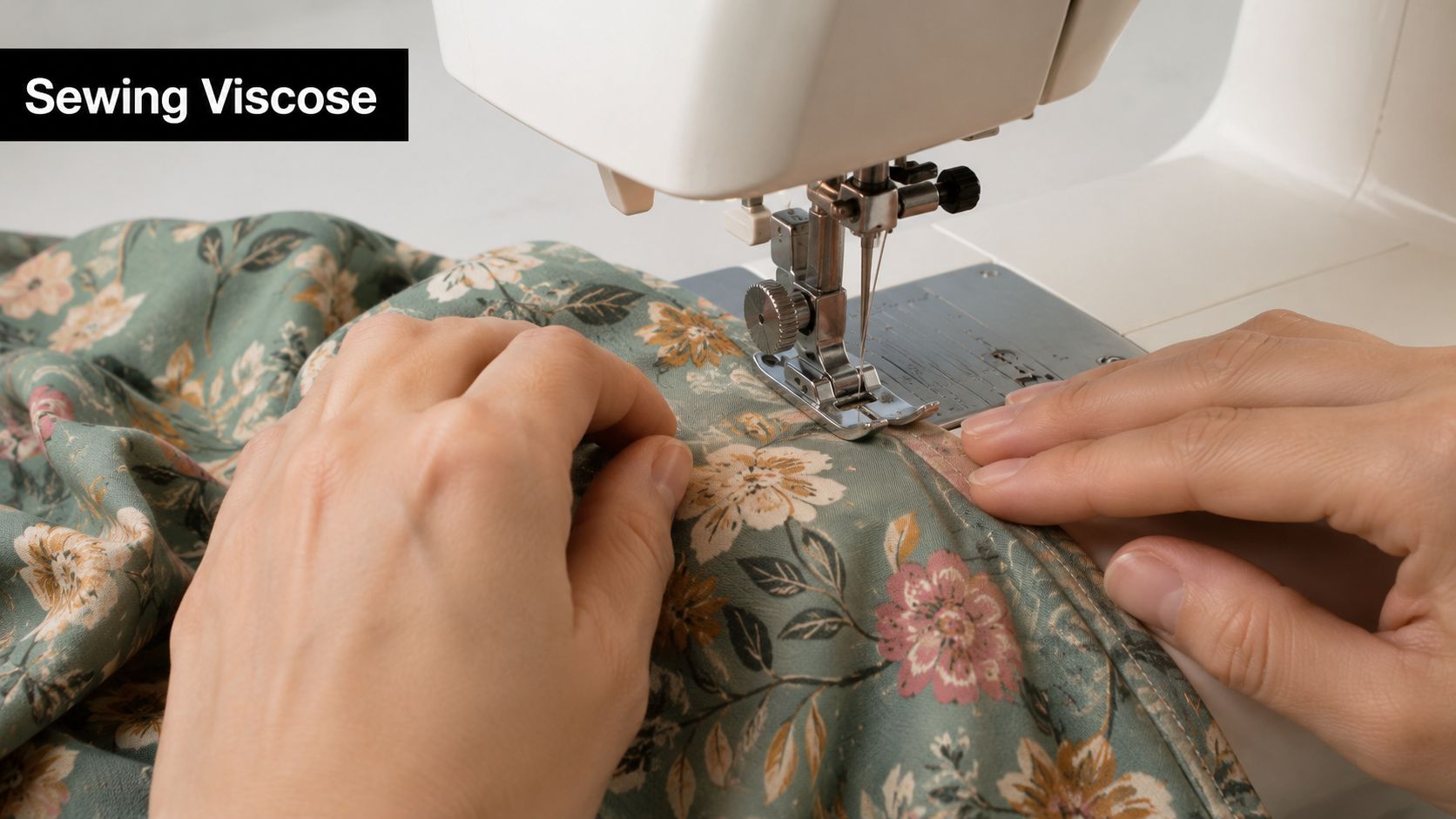
A microtex or sharp 70/10 needle is a sensible starting point for woven viscose. Use a fresh polyester thread, shorten the stitch length to around 2.0 mm, and lower presser foot pressure if your machine allows it. Those tweaks help the needle penetrate cleanly and reduce the risk of puckering on a fabric that hates rough treatment.
Stabilise shoulder seams, button plackets, and other areas that need body with lightweight interfacing. If the pattern wants a crisp collar or a structured cuff, don't expect the base cloth to supply that on its own. Viscose is generous with drape and stingy with shape memory.
Finishing and pressing
For seams, a French seam works beautifully on lightweight viscose because it traps fray and keeps the inside neat. An overlocked edge is also practical if you're comfortable controlling the fabric while it feeds. Either way, press with patience, not heat aggression, because the cloth can become stubborn if you try to bully it into shape.
Hang the finished garment overnight before hemming, especially if the design uses bias or soft gathers. That small pause lets the drape settle, and it saves you from a hem that looks straight on the table but wobbles on the body.
If you're photographing the finished garment for your shop listing or sewing journal, a clean mannequin setup helps the drape read properly. MerchLoom's guide to a perfect product photos setup is a useful reference if you want the fall of the fabric to show clearly.
Sustainability, Care and the Questions Worth Asking Before You Buy
The word “viscose” gets treated as if it automatically means kinder, softer, greener. It doesn't. The better question is which viscose you're buying, how it was processed, and whether the fabric has been handled in a way that makes sense for dressmaking.
The questions that cut through the marketing
Ask what processing route was used, whether the pulp is FSC or PEFC linked, and whether the fabric has been pre-washed. Then ask what wash cycle the seller recommends and whether the weight will need lining. Those five questions tell you far more than a generic “soft and breathable” product description ever will.
That matters because standard viscose and lower-impact MMCFs such as lyocell and modal are not the same thing in environmental profile or sewing behaviour. A fabric can feel lovely in the shop and still be a poor fit for your project if the finishing route, opacity, or care method doesn't line up with what you want to make.
Care that keeps the garment wearable
For home care, a cool 30 degree machine wash on a gentle cycle is the safest everyday approach. Avoid the tumble dryer, reshape while damp, and dry flat if the garment is heavy or bias-cut. Steam usually does more good than a hard press, especially if you're trying to refresh rather than flatten the cloth.
That approach doesn't just protect the fabric, it protects the shape you spent time building. If you've lined the garment, interfaced the key areas, and handled the seams carefully, the finish is usually much better after a gentle wash than after an aggressive one.
Your Viscose Buying Checklist for the Counter
Choose the garment first, then choose the weight. A blouse, a bias dress, a jumpsuit, and a tiered skirt don't want the same cloth, even if the shop label says viscose on every roll.
Before you buy, check pre-wash status, GSM and width, opacity, drape, and the needle or finishing advice if the seller gives it. If the fabric is sheer, assume you'll need a lining or underlayer. If it feels heavy and fluid, think about whether the pattern wants movement or body.
The cleanest shortcut is simple. Match the weight to the garment, plan for lining if the cloth shadows, pre-wash before cutting, and sew it with a gentle hand. Viscose rewards that sort of respect with a garment that hangs beautifully and wears well.
More Sewing stocks viscose dressmaking fabric alongside other dressmaking cloths, so it's easy to compare weights and finishes before you commit to a project. If you want a UK source with practical fabric choices for dresses, blouses, and linings, take a look at More Sewing and use the fabric range to narrow down the right viscose for your next make.
