Deadstock fabric is already-produced textile that wasn't used in its intended production run. In the UK, that surplus sits within a textile system that bought 1.42 million tonnes of textiles and generated approximately 1.45 million tonnes of used textiles in 2022, with 49% of used textiles entering general waste streams. WRAP's 2024 Textiles Market Situation Report
You may be standing in a fabric shop with one hand on a beautiful roll and the other on your phone, trying to decide whether the odd colour name, short quantity, or low price is a bargain or a warning sign. Deadstock can be an excellent find, but it rewards a different buying habit from standard dressmaking cloth. You need to check what it is, work out how much is usable, and plan your pattern around the fabric you can buy.
A Plain English Definition of Deadstock Fabric
You're browsing a roll-end bin in a Manchester market. Behind the counter is a discounted length of soft printed fabric, perhaps with a branded selvedge or a handwritten label. The shopkeeper tells you it's deadstock, but that doesn't yet tell you whether it's cotton, viscose, polyester, or a blend, nor whether another roll will appear next month.
Deadstock fabric is surplus textile inventory that was made but never used in the production run it was intended for. A mill may have produced more metres than a clothing brand ordered. A customer may have cancelled an order. A designer may have changed a colour, print, or pattern after the fabric had already been woven, knitted, dyed, or finished. The remaining cloth then moves into remnant shops, online deadstock collections, independent fabric retailers, or clearance stock.
It's different from both second-hand clothing and recycled fibre:
- Second-hand clothing has already been made into a garment and worn, sold, or returned.
- Recycled fibre has been processed from existing textile or other material into a new fibre or yarn.
- Deadstock fabric is usually unused cloth. It may still be made from virgin fibre, even though reusing it avoids commissioning another production run.
WRAP's textiles waste hotspots report describes the need for more consistent definitions around retail waste categories such as returned products, deadstock products, and surplus stock. That distinction matters because a roll of unused cloth, a returned garment, and a damaged product don't enter the same resale or waste route.
Why the roll may never return
Deadstock generally comes from a finite batch. Once a retailer sells the last usable metres, the mill may no longer have the yarn, dye lot, print screen, finish, or original order available. UK deadstock sellers warn that some lines cannot be repeated once sold out, and composition may sometimes be an informed estimate rather than fully documented fibre content. Guthrie & Ghani's deadstock fabric collection
That limited supply is part of the appeal, but it changes your approach. Buy a swatch if possible, record the product name and fibre information, and don't cut into the cloth until you've checked the full length. If you need fabric for several matching garments, a standard repeatable line is safer. If you're happy to make one distinctive piece, deadstock gives you room to work creatively.
How Deadstock Fits Into the UK Textile Waste Picture
Deadstock isn't an isolated bargain category. It belongs to the same wider production-and-disposal system that creates surplus, offcuts, over-ordered stock, and unwanted garments.
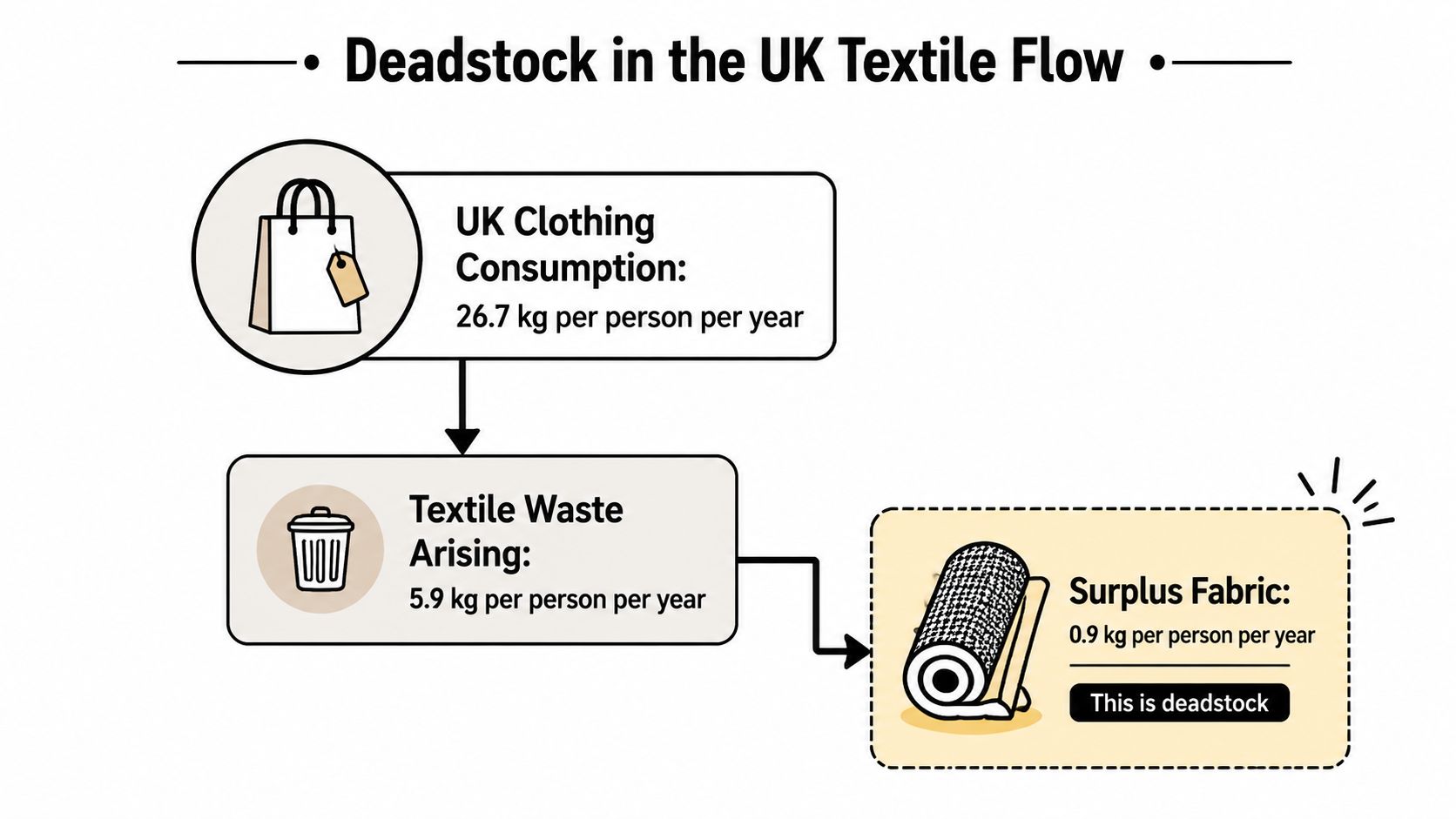
The UK Parliament's Fixing fashion report recorded UK clothing consumption of 26.7 kg per person, higher than any other European country in the evidence cited. The report also estimated that 1,130,000 tonnes of clothing were purchased in the UK in 2016, almost 200,000 tonnes more than in 2012, and noted that hundreds of thousands of tonnes of fabric were wasted during design and production before clothing reached customers. The UK Parliament Environmental Audit Committee report
That upstream waste is where deadstock begins. A cancelled order or mill overrun happens before a customer owns a garment, while post-consumer waste appears after clothing has been used and discarded. Buying surplus fabric doesn't solve every problem in textile production, but it gives an already-existing material another route into use.
Why diversion matters
WRAP reported approximately 1.45 million tonnes of post-consumer textiles generated in the UK in 2022. Its data also records 711,000 tonnes discarded through household bins or general waste at Household Waste Recycling Centres in 2021. WRAP's UK textile waste figures
The disposal route makes reuse particularly practical. WRAP reported that 84% of this material was incinerated with energy recovery and 11% was sent to landfill. WRAP's report on residual textile waste
Deadstock is usually pre-consumer surplus, so it isn't the same material as the clothing in household bins. The connection is that both arise from a system producing more textile than the intended use can absorb. Reusing a suitable roll keeps the cloth in service without sending it through another fibre-production cycle, although responsible buyers should still assess quality, composition, durability, and likely end-of-life options.
Practical rule: Treat deadstock as a waste-reduction opportunity, not as automatic proof that a finished garment is sustainable.
Types of Deadstock You Will See in UK Shops
A deadstock label can cover several very different shop-floor situations. The source affects what you'll see on the roll, how much you can buy, and how confidently you can describe the finished garment.
| Deadstock Type | What It Looks Like | Typical Length | Composition Info |
|---|---|---|---|
| Mill overrun | Extra metres from a brand order, sometimes with a recognisable print or branded selvedge | May be a substantial roll, but availability is finite | Often documented, though still check the retailer's information |
| Cancelled order | A complete colourway or print made for a customer that withdrew | Can appear as matching rolls or several lengths | May have original labels, tags, or batch details |
| Part-roll or cut piece | The end of a bolt, a short length, or pieces left after earlier cuts | Usually limited and irregular | Label may be missing or incomplete |
| Ex-designer or sample yardage | Strike-offs, header rolls, showroom cuttings, prototypes, or development fabrics | Often short lengths or assorted pieces | Composition and finish may need careful verification |
Mill overruns
A mill overrun is cloth produced beyond the quantity required by a customer. On the counter, it might look like a conventional commercial fabric, with a neat fold, consistent width, and a full print repeat. You may find a named print, a branded selvedge, or a colour that looks more familiar than the rest of the deadstock rack.
The advantage is often consistency within that roll. The limitation is repeatability. Once the stockist has sold the batch, the mill might not produce the same design again.
Cancelled orders
Cancelled-order fabric can be especially attractive because it may come from a planned production run rather than a random end-of-bolt. You might find several matching rolls, original swing tags, or packaging that suggests the cloth was intended for a specific collection. Don't assume that the original garment label proves every technical detail, though. Check the seller's composition notes and test the fabric yourself if the information is incomplete.
Part-rolls and cut pieces
Part-rolls are common in haberdashers and remnant shops. They're useful for children's garments, bodices, sleeves, bags, collars, cuffs, and colour-blocked designs. The price may be lower because you're buying a short or awkward length, but the fabric can still have a flaw, crease, or previous cut line that reduces the usable area.
Ex-designer and sample yardage
Ex-designer stock includes header rolls, strike-offs, showroom pieces, and textiles made during development. These can have unusual prints, luxurious finishes, or slight variations between samples. They're ideal for a statement panel or special-occasion detail, but composition certainty may be lower. The more unusual the source, the more carefully you should check drape, colourfastness, stability, and care behaviour before committing to a fitted garment.
How to Buy Deadstock Without the Guesswork
Deadstock buying becomes much easier when you separate identity, condition, and quantity. Don't let a low price push you past those checks. A fabric that behaves differently from your pattern's requirements can turn an apparent bargain into an expensive toile.
Start with the roll
Inspect the selvedge first. Look for fibre information, a manufacturer's name, a printed design reference, width, country of origin, and any surviving batch or dye-lot code. A label may give you useful clues, but it isn't a substitute for testing when the seller says the composition is estimated.
Ask for a swatch, then test it before washing the whole length. A 10 cm square is enough for a first check. Stretch it, scrunch it, hold it to the light, and compare the face and reverse. A small burn test can help distinguish fibres when labelling is missing, but only do this safely, outdoors or over a suitable non-flammable container, with ventilation and water nearby. Never hold the fabric in your hand while testing it, and don't rely on a burn test to identify a complex blend with certainty.
| Fabric Family | Key Test | What to Look For |
|---|---|---|
| Cotton | Wash and press a small swatch | Shrinkage, colour loss, softened handle, and whether the print remains even |
| Linen | Scrunch, wash, and inspect the weave | Creasing, fraying, openness of the weave, and how much the surface relaxes |
| Wool | Rub, steam, and check recovery | Felting risk, stretch recovery, nap direction, and reaction to moisture |
| Polyester or viscose blend | Heat, drape, and wash test | Scorch risk, drape changes, seam slippage, static, and possible shrinkage differences |
Measure what you can cut
Ask the seller for the usable width, not just the stated width. Roll edges can be damaged, printed areas can shade, and a crease or flaw can make part of the width unsuitable for a prominent pattern piece. Unroll enough fabric to inspect for shading lines, slubs, roller creases, holes, oil marks, and abrupt changes in colour.
Cutting-room habit: Mark every defect with a removable pin or chalk before you lay out the pattern. You'll see the real cutting area instead of an optimistic rectangle.
Draw your pattern pieces to scale on paper. Place the largest pieces first, then sleeves, facings, collars, and pockets. If you're matching a stripe, check, nap, or placement print, allow extra fabric for alignment. For practical planning, leave a 10 per cent buffer for matching where the design demands it, and ask whether the roll has been pre-shrunk or contains remnants from previous cuts.
A useful technical reference for organising your wider online shop content is RankEngine's fashion SEO audit, particularly if you're a small brand explaining fabric specifications clearly on product pages. Clear product information helps customers understand what they're buying before a limited roll disappears.
Project Ideas That Make the Most of Limited Yardage
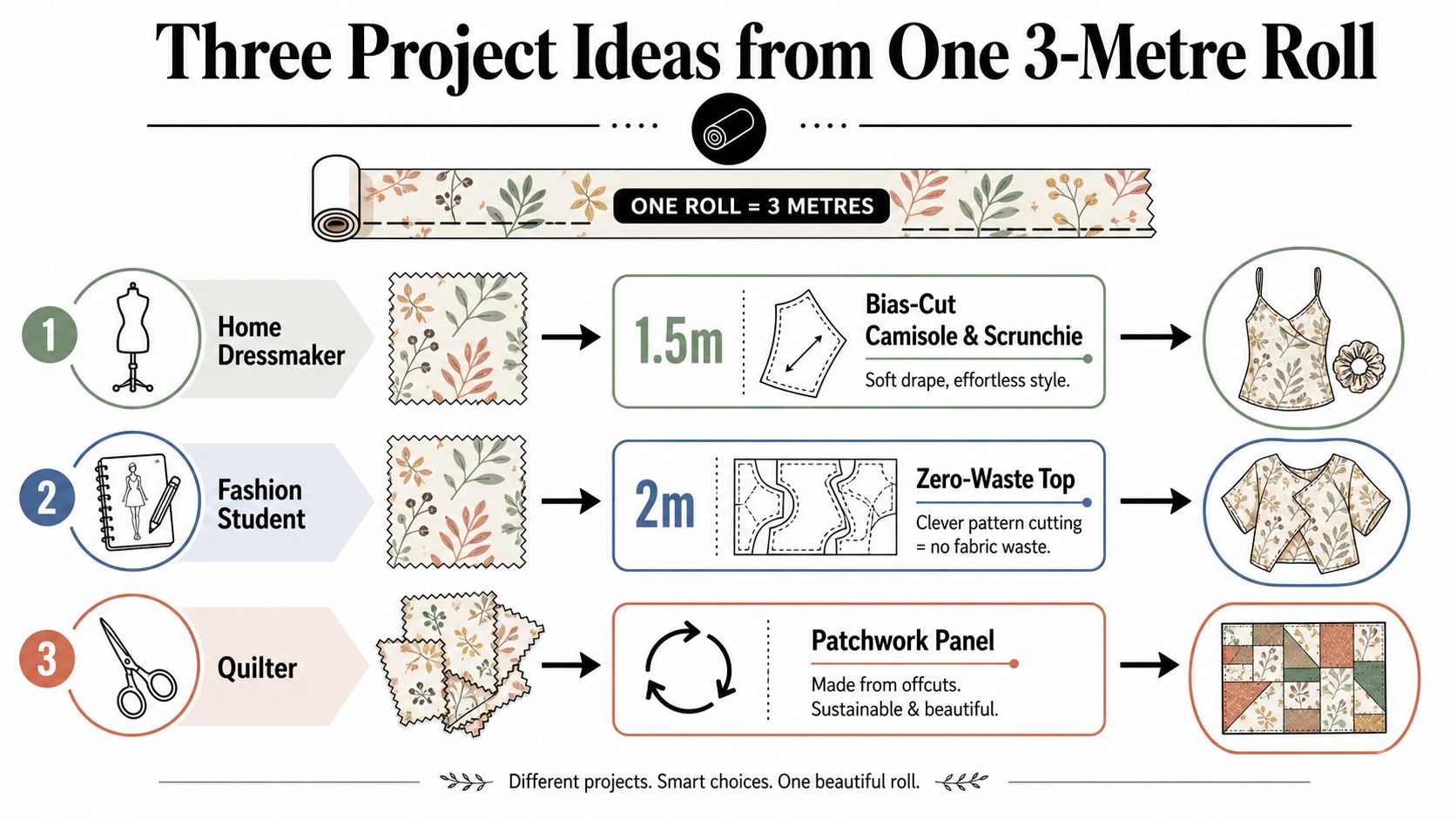
A three-metre roll doesn't prescribe one project. It gives you a fixed cutting puzzle, and the answer depends on your measurements, pattern, fabric width, print direction, and willingness to piece.
The home dressmaker in our example wants a bias-cut camisole and a matching scrunchie. She doesn't begin by cutting the camisole from the centre of the roll. First, she checks the grain, confirms that the cloth can tolerate a bias layout, and places the front and back pieces where the print looks most balanced. She reserves a narrow strip for the scrunchie and keeps every triangular offcut in a labelled envelope.
A camisole can be a sensible choice for limited cloth because it uses relatively compact pieces. The matching accessory also gives small scraps a clear job instead of leaving them mixed into an unmarked scrap bag.
One roll, three approaches
The fashion student approaches the same quantity differently. She chooses a zero-waste top, arranging rectangles and near-rectangles so the pieces share cutting lines. The remaining offcuts become a simple tote panel. She sketches the layout before cutting, then labels the front, back, sleeve, and contrast pieces directly on paper so a slight shade difference looks deliberate.
The indie brand has another constraint. It wants a micro-run of ten cropped shirts, so the designer measures the smallest complete garment layout before promising the style. If the roll won't support consistent pieces for every shirt, the brand can use the fabric for a numbered limited run, introduce colour-blocked cuffs, or combine it with a repeatable base cloth.
For all three makers, the order is the same:
- Place large pieces first. Bodices, fronts, backs, and skirt panels need the most options.
- Protect directional features. Keep nap, stripes, checks, and placement prints running consistently.
- Use smaller remnants intelligently. Try facings, pocket bags, collars, ties, cuffs, piping, scrunchies, or patchwork.
- Plan around shade variation. If two rolls differ slightly, use one shade for the main body and the other for panels or trim.
- Label every offcut. Record the fibre estimate, colour, wash result, and original project so future repairs are possible.
Patterns designed for economical layouts can help. The Wilder dress, the Apron dress, and wrap tops that fit within two metres can give you a better starting point than a wide, full-skirted design, although the required quantity still depends on size, fabric width, sleeves, and pattern layout.
Placement printing can turn an awkward mark into a feature. Colour-block cutting can make a limited batch look intentional. Franken-patterning, where you combine compatible pattern sections, can rescue a roll that falls just short, but test the proportions in paper or calico before cutting your actual fabric.
Is Deadstock Always the Most Sustainable Choice
Deadstock is a practical reuse option, but it isn't automatically the strongest choice for every project. The cloth still carries the impacts of its original fibre production, dyeing, finishing, and transport, and a surplus label doesn't tell you whether the fabric is durable or easy to manage at the end of its life.
For a summer dress, a good deadstock cotton or durable viscose can make sense if you'll wear and wash the dress for years. Organic cotton may be preferable when verified fibre information, predictable care, and long-term sourcing matter more than limited availability. A Tencel or lyocell blend can offer a useful drape, but you still need to assess the full blend rather than choosing it because one fibre name sounds low-impact.
A lined jacket needs stability, abrasion resistance, and reliable pressing behaviour. A sturdy deadstock wool can be a sensible find. A mystery blend with poor recovery or an unstable coating may create more waste during sewing and shorten the garment's useful life.
For a quilted bag, mechanically recycled polyester may offer predictable strength and a known specification. Deadstock can still work well, especially when the fabric is sturdy and the bag will be used repeatedly, but a fragile or shedding synthetic isn't rescued from its problems just because it was surplus.
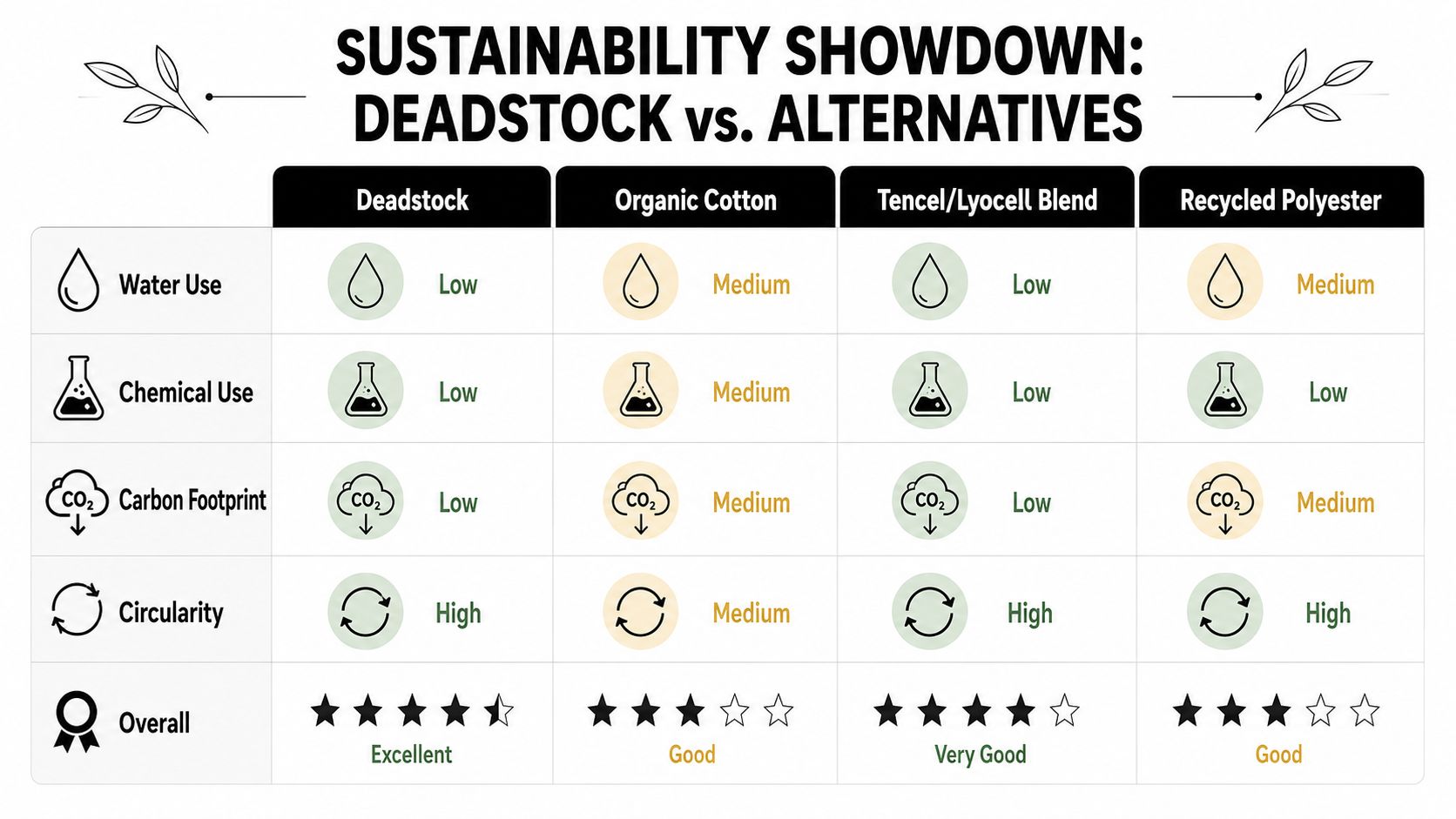
Mystery blends can complicate future recycling because the fibre content is unclear or difficult to separate. Reusing poor-quality acrylic may also preserve a fabric that sheds synthetic fibres during washing. Commercial adoption doesn't remove the need for scrutiny. Lucy & Yak reported that 64% of its products contained deadstock fabric in its 2024 impact report, showing how deadstock can form part of a brand's material mix rather than functioning as a complete sustainability argument. Croft Mill's deadstock fabric range
A useful rule: Match the fabric's durability and fibre information to the project's expected life. Choose the roll you can verify, wear, wash, repair, and keep in use.
If you're organising a public sewing activity or event team that needs a practical way to coordinate people and materials, Banger's Collider for event teams is a separate planning resource worth considering. It doesn't replace fabric testing, but clear coordination helps groups avoid buying unsuitable quantities.
Caring for Deadstock and Frequently Asked Questions
Unknown composition deserves a cautious first wash. Cut a 10 cm square from an edge or sample, record its measurements, and wash it using the temperature and method you expect for the finished garment. Compare the dried swatch with the original, then press it with a cloth between the iron and fabric if you're unsure how the surface will react.
Cotton and viscose rolls may shrink or relax, while loosely woven ex-designer cloth can fray during handling. Use French seams, overlocking, or bias binding where the fabric needs support. Synthetic fabrics can scorch or melt under high heat, so start with a low temperature and test on the swatch before pressing a visible area.
Common questions from UK buyers
Can I reorder the same deadstock fabric?
Usually not. The original batch may have been a cancelled order, part-roll, or finite overrun. Buy enough for your planned project, including matching pieces and likely repairs.
Is deadstock suitable for beginners?
Yes, provided you swatch first and choose a forgiving project. A stable cotton or medium-weight woven is easier than a slippery mystery blend or a fabric that needs precise pattern matching.
Why do prices vary between shops?
Retailers may be selling different qualities, widths, quantities, finishes, or levels of verified information. A short designer sample and a full mill roll can both be called deadstock while offering very different value.
Does deadstock work for school or competition garments?
It can, but check the brief first. If the garment needs a documented fibre content, repeated fabric, or replacement material, confirm those requirements before cutting. A limited roll is better suited to a one-off design when the rules allow it.
Log the fibre content, swatch measurements, wash result, pressing temperature, and any defects with the project notes so you can make informed repairs later.
More Sewing offers a dedicated range of ex-designer, mill-surplus, and end-of-line deadstock dressmaking fabrics, along with sample swatches, haberdashery, patterns, and ready-to-sew kits. Visit More Sewing to check the current fabric lengths, choose a project that suits the available yardage, and find the tools you need before that one-off roll sells through.
