
Fabric
Where to Buy Viscose Fabric: A Practical UK Guide
You've found the colour, imagined the finished dress, and watched the fabric slide beautifully off the roll. Then the first seam goes wrong. The cloth stretches as you handle it, the bodice loses its shape, and the lovely drape that attracted you becomes the reason the garment won't sit properly.
That problem usually isn't poor sewing. Viscose isn't one uniform fabric. Challis, twill, crepe, jersey and deadstock blends can all carry the word “viscose”, yet they behave very differently under scissors, presser foot and iron. If you're deciding where to buy viscose fabric in the UK, choose the construction for the garment first, then choose the retailer.
The Drape on the Bolt That Changed My Mind About Viscose
A dressmaker once pulled a fluid printed length from a roll and held it against a fitted bodice pattern. It looked perfect. The cloth had the soft movement she wanted, a gentle surface and enough colour to make the finished dress feel special.
Halfway through cutting, the warning signs appeared. The fabric shifted under the pattern, the cut edge lengthened when lifted, and the slippery hand made accurate matching difficult. Once the bodice pieces were joined, the fabric followed every curve without offering any recovery. The drape was beautiful, but it was wrong for a close-fitting upper body.
A woven challis would have made a graceful skirt or loose blouse. For that bodice, a stable woven twill or a knit with suitable recovery would have been more sensible. The fabric hadn't failed. The project and the construction didn't match.
Practical rule: Choose viscose by the job you need it to do, not by the name printed on the product page.
This is the mistake that makes searches for where to buy viscose fabric feel confusing. Retailers group many different cloths under one fibre name. A lightweight woven may suit a bias skirt, while a heavier twill can support wide-leg trousers. Crepe can look polished in a work blouse, and jersey can transform a wrap dress, but they won't cut, stretch or press in the same way.
The useful question is therefore not just “Which shop sells viscose?” It's “Which viscose construction will give this pattern the right movement, coverage and stability?” The answer starts with understanding the fibre itself, then narrowing the choice to challis, twill, crepe, jersey or a blend.
What Viscose Actually Is and Where It Came From
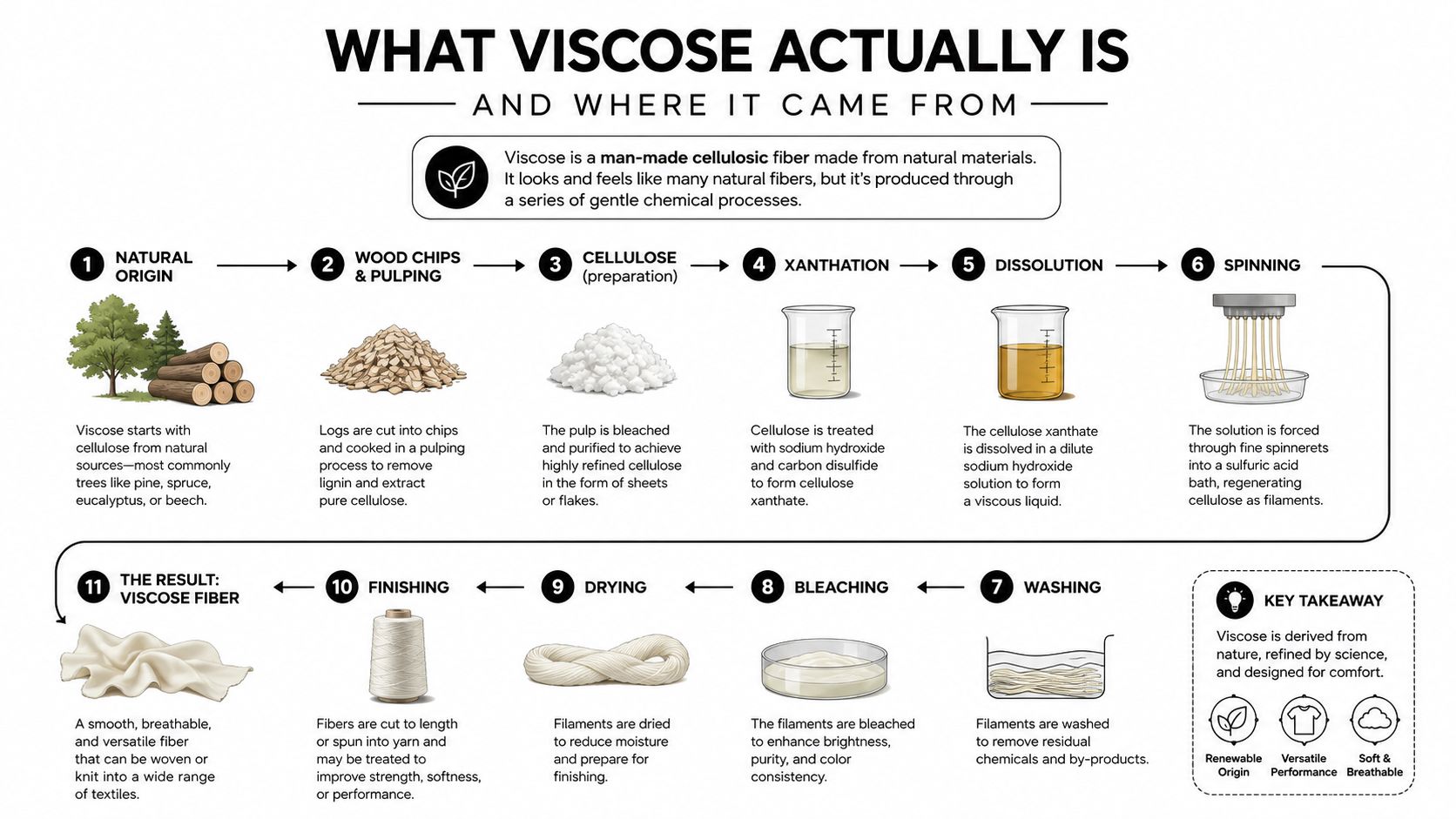
Viscose is a regenerated cellulosic fibre. Manufacturers dissolve cellulose, commonly sourced from wood pulp, and extrude the solution to create filaments that become yarn. A plain-language explanation of the raw material and process is available in this wood pulp fabric guide, which is useful when a product listing gives a fibre name but little manufacturing context.
The fibre has deep British roots. British chemists Charles Frederick Cross, Edward John Bevan and Clayton Beadle patented the viscose process in 1892, and Courtaulds began commercial production in Coventry in 1905. That history helps explain why viscose remains a familiar category in UK dressmaking rather than a specialist novelty. Sarah Marie Day's account of viscose history also notes that viscose is the most important manmade cellulosic fibre, representing roughly 80% of all MMCFs, with global production of about 5.8 million tonnes in 2021.
Why listings use several fibre names
Generic viscose can be woven into smooth plain cloth, textured crepe, soft challis or a heavier twill. Modal is another regenerated cellulosic fibre, usually associated with a particularly soft handle and good strength. “Lyon” or “rayon” may appear in product descriptions or blend names, depending on the retailer and manufacturer.
Those words describe fibre families or trade terminology, not a guaranteed garment performance. A product called “viscose” might be a fluid woven, a stretchy knit or a fabric blended with elastane, linen, cotton or acetate. The construction matters as much as the fibre.
Read the composition line before trusting the title. “Viscose dressmaking fabric” tells you very little by itself. A listing that identifies the fibre percentage, weave or knit, weight and width gives you enough information to plan a garment rather than shop by photograph alone.
Viscose Subtypes and Which Garments They Love
The quickest way to narrow your search is to match surface, weight and stretch to the pattern. A fabric that falls softly in a product photograph may still be too thin for trousers or too unstable for a fitted top.
| Subtype | Typical Weight | Handle | Best For |
|---|---|---|---|
| Woven viscose challis | Lightweight | Soft, fluid and usually matte | Blouses, summer dresses, bias skirts |
| Viscose twill | Medium to heavier | Smooth with more body | Trousers, jumpsuits, structured dresses |
| Viscose crepe | Lightweight to medium | Pebbled, dry and less shiny | Workwear blouses, tea dresses |
| Viscose jersey | Lightweight to medium | Stretchy and fluid | T-shirts, wrap dresses, relaxed tops |
| Modal knit | Lightweight to medium | Very soft with a supple stretch | Drapey knit dresses, layering tops |
| Deadstock viscose blends | Variable | May be slubbed, textured or crisp | Casual shirts, wide-leg trousers, distinctive small runs |
Challis is the classic choice for movement. It's light, soft and easy to imagine in a gathered summer dress, but the same qualities mean it can be slippery on the cutting table and less forgiving in a fitted bodice. It works especially well where the pattern uses gathers, ease or a bias line.
Twill gives you more control. The diagonal weave normally creates a little more body, making it more useful for trousers, jumpsuits and dresses that need a clean outline. It still drapes, but it's less likely to cling to every layer underneath.
Crepe has a pebbled surface that hides minor creasing and gives a blouse or tea dress a more polished appearance. It's a good compromise when you want softness without a glossy finish.
Knits need a different decision
Viscose jersey and modal knit belong in a separate category. They suit T-shirts, wrap dresses and draped knit dresses because the fabric stretches around the body. The critical detail is recovery. A knit can stretch comfortably during wear yet fail to return neatly, especially around a neckline, waist or shoulder.
Deadstock blends are harder to generalise, which is also their appeal. A viscose and linen cloth may have a dry slub and casual texture, while a viscose and acetate blend may feel smoother and more fluid. Treat each roll as an individual fabric, check the specifications and order a swatch before planning a large cut.
How to Judge Viscose Quality Before You Buy
A product photograph can show colour and print scale, but it can't tell you how the fabric will behave in a sleeve or waistband. Before adding viscose to your basket, check the listing against the garment you're planning.
Six checks that prevent expensive mistakes
Composition comes first. Confirm whether the fabric is 100% viscose or blended with elastane, cotton, linen, polyester or another fibre. A blend can be exactly right for your project, but a high polyester content may alter breathability, drape and pressing behaviour. Don't let a title that says “viscose” replace the actual composition.
Find the fabric weight. GSM means grams per square metre and gives you a useful comparison between rolls. A lightweight cloth around 90gsm will behave very differently from a viscose twill around 140gsm, as the practical guidance from Fabricland's viscose buying advice makes clear. The lighter option may suit an airy blouse, while the heavier one can offer better coverage and body.
Check usable width. A wide selvedge-to-selvedge measurement doesn't always equal the usable cutting width. Look for notes about damaged edges, borders or a directional print. Width affects metreage, pattern placement and whether trouser legs can fit side by side.
Test opacity. Hold a swatch against a bright window or lamp. If the print looks pale or the pattern markings show through, plan for lining, an underdress or a different construction. Don't judge opacity from a styled photograph, where lighting and undergarments can hide transparency.
Assess the handle. Move the swatch between your fingers and let it hang from one corner. Does it collapse softly, spring back, feel dry, cling or slide? If there's no video or useful close-up, ask the retailer for a photo with the cloth gathered and hanging. Advice on evaluating fabric specifications can also be paired with this guide to selecting the right uniform fabric, particularly when a listing leaves important technical details unclear.
Allow for shrinkage. Viscose can shrink, so the fabric should be washed, dried and pressed before cutting. If the care information is vague, assume the cloth needs a sample wash and don't buy the exact metreage with no allowance.
A retailer that publishes composition, GSM and width is giving you useful buying information. A page that offers only colour names and phrases such as “beautiful drape” requires more questions before you commit.
Sewing and Caring for Viscose Without Tears
Viscose rewards careful preparation. It can feel delicate when wet, stretch while handled and move across the machine bed, so the finished garment depends on what happens before the first stitch.
Prepare the cloth before cutting
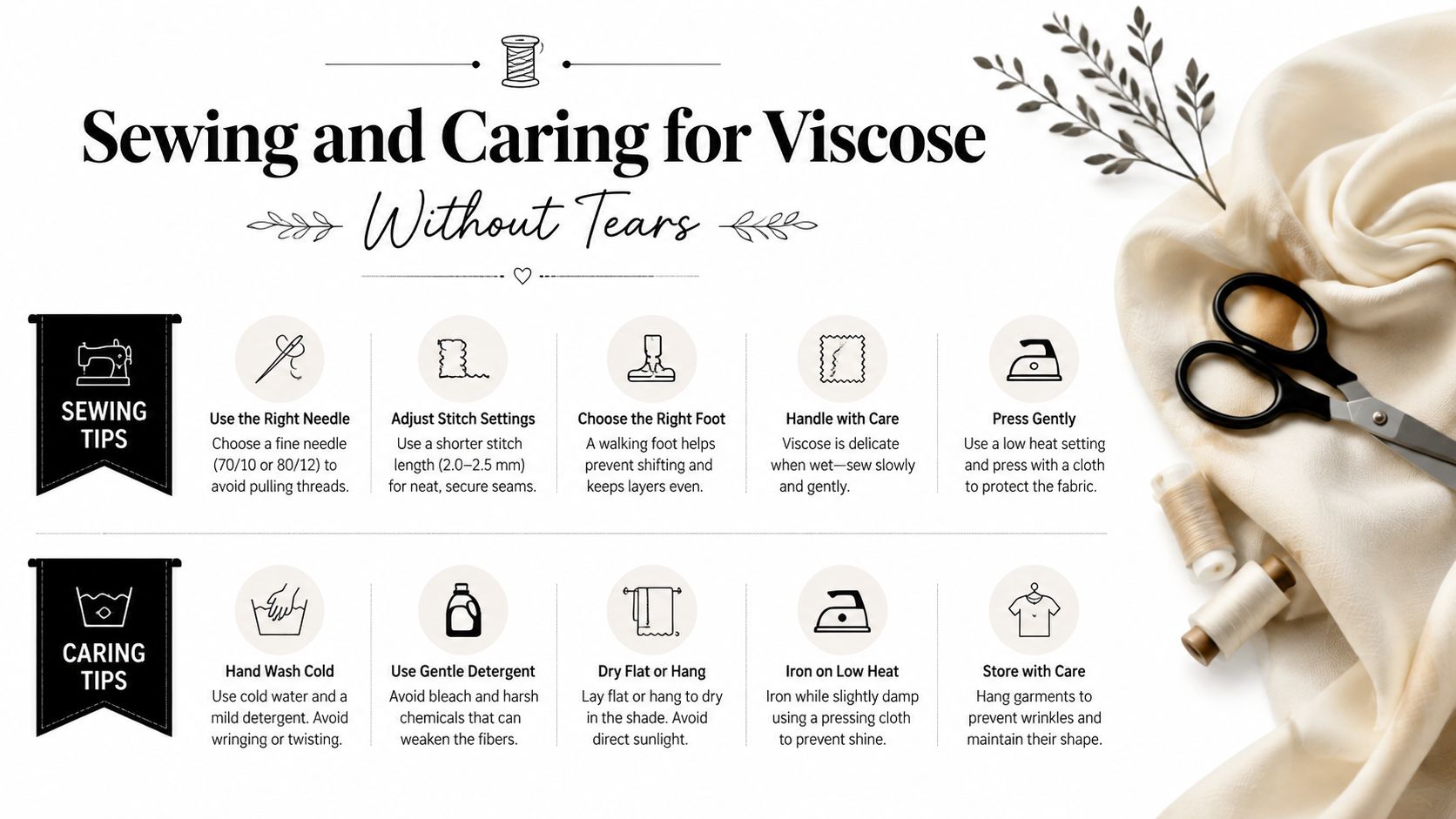
Wash the fabric using the care method you expect to use for the finished garment. Dry it appropriately, press it, and let it settle before placing the pattern. Pound Fabrics' guidance on sewing viscose recommends pre-washing, then using sharp cutting tools such as a rotary cutter and mat to reduce slippage and distortion.
Use a fine-point needle, around 60/70 or 70/10 to 75/11, with fine pins, as recommended by The Sewing Directory's viscose sewing advice. A walking foot can help keep layers moving evenly and reduce stretched or wavy seams. Test the stitch length and tension on a scrap before sewing the garment, especially along a neckline or armhole.
For difficult cuts, place the fabric on a large flat surface rather than allowing it to hang over the edge. Use pattern weights, keep the grainline straight and avoid lifting pieces once cut. Stay-stitch curved edges early, and finish seams with a narrow zigzag, overlocker or fine French seam where the fabric and garment style allow.
Sustainability needs a careful reading
Viscose comes from cellulose, but that doesn't make every viscose product automatically responsible. The Sew Me Sunshine overview of viscose dressmaking fabric notes that the Made-By Environmental Benchmark places viscose and bamboo viscose in Class E on an A to E scale. Look for specific sourcing information instead of relying on words such as “natural” or “plant-based”.
FSC-certified viscose, branded alternatives such as EcoVero or Tencel, and evidence of lower-impact or closed-loop production provide more useful signals. Deadstock can also be a practical lower-impact option because it uses existing fabric rather than creating demand for a new production run, although the exact fibre content and provenance still need checking.
Wash gently, avoid aggressive heat, and air-dry where possible. Follow the care label, press with a suitable temperature and use a pressing cloth if the surface marks easily. Careful washing and drying can make the difference between a garment that stays wearable and one that loses its shape after repeated handling. For a concise maintenance reference, keep this guide to caring for viscose fabric alongside your sewing notes.
Where to Buy Viscose Fabric in the UK
For most UK dressmakers, specialist online retailers are the strongest default. They tend to offer wider viscose ranges than general haberdashery shops, and UK-based buying can make delivery, returns and fabric questions easier to manage. The UK fashion and textile industry contributes £62 billion to the economy, equivalent to about £1 in every £34 of national GVA, while UK textile wholesaling revenue is forecast at £4.2 billion in 2026 to 2027, according to UKFT industry reports and statistics. That scale supports a broad domestic supply network.
UK buyers can find plain viscose, printed challis, twill, crepe, jersey and deadstock blends by the metre through specialist retailers. Fabrics Galore is one example of the type of independent supplier worth checking, particularly when you want to compare fabrics by construction rather than search only by colour.
| Retailer | Best For | Price Band | Notable Strength |
|---|---|---|---|
| Minerva Crafts | Broad project shopping | Budget to mid-range | Large general dressmaking selection |
| Fabric Land | Value and everyday basics | Budget to mid-range | Competitive pricing and accessible ranges |
| Clothspot | Dressmaking-focused viscose | Mid-range | Useful garment-led product information |
| Lamazi Fabrics | Premium European deadstock | Mid-range to premium | Distinctive limited-run fabrics |
| The Fabric Store | Natural-fibre specialists | Mid-range to premium | Strong fabric knowledge and fibre-led selection |
| Backstitch | Indie prints | Mid-range to premium | Characterful designs for modern garments |
| Queen of Fabrics | Ex-designer rolls | Variable | Unusual designer and end-of-line finds |
Choosing between the shops
Minerva Crafts and Fabric Land make sense when you need breadth, competitive pricing or fabric for several projects in one order. They're useful starting points, but check the technical listing carefully because a broad catalogue may include many constructions under the same fibre label.
Clothspot is a better fit when the pattern is already chosen and you want dressmaking-specific information. Lamazi Fabrics and Queen of Fabrics are worth visiting for deadstock, ex-designer cloth and prints that won't look like every other garment in the wardrobe. The trade-off is availability. A successful sample can't always be reordered.
The Fabric Store suits shoppers who want to compare natural-fibre options, while Backstitch is a strong destination for independent prints. For swatch-first shopping, check local independent fabric shops, haberdashery counters and selected John Lewis haberdashery departments. The range can be narrower, but handling the fabric in person is valuable when you're unsure about opacity or recovery.
Before ordering, check whether the retailer sells by the metre or in minimum increments, whether samples are free or charged, and whether delivery becomes free above a stated threshold. Read the returns policy before buying cut fabric, since opened or cut lengths may have different conditions. UK specialist suppliers can offer fast turnaround, but stock, dispatch timing and return terms still vary by shop.
Matching Your Project to the Right Viscose
Start with the pattern, not the retailer. A bias-cut maxi dress needs fluidity and enough opacity for the silhouette, while wide-leg trousers need more body and a surface that won't cling at every step.
| Garment Project | Recommended Viscose Subtype | Target Weight (gsm) | Key Construction Note |
|---|---|---|---|
| Bias-cut maxi dress | Woven viscose challis | 110gsm | Fluid drape, careful grain and stabilised seams |
| Button-front blouse | Viscose crepe or light challis | Lightweight | Soft movement with manageable surface texture |
| Wide-leg trousers | Viscose twill | 140gsm | More body and coverage than a sheer challis |
| Wrap top | Viscose jersey or modal knit | Depends on knit | Check stretch and recovery at the neckline |
| Structured knit top | Ponte or stable viscose blend | 200gsm | Firm construction for shape retention |
| Casual wide-leg trousers | Deadstock viscose and linen blend | Variable | Texture and slub, with composition checked first |
The listed weights are project-planning examples, not substitutes for a swatch. A 110gsm challis may be ideal for a flowing dress but too transparent for trousers. A 140gsm twill may support structured legs but feel excessive in a floaty blouse. For jersey, stretch percentage and recovery matter more than GSM alone.
Order samples where possible. If a retailer doesn't offer a swatch, buy a small cut such as 0.25 metre where available, then wash and dry it exactly as you'll treat the finished garment. Press it, hang it, stretch it across your hand and check whether the colour bleeds, the surface changes or the fabric loses recovery.
That process tells you more than a product photograph. Once the cloth passes the wash, handle and opacity tests, calculate metreage from the usable width, account for print direction and only then place the full order.
More Sewing offers viscose and Tencel blends, jerseys, ex-designer deadstock, fabric swatches and the haberdashery needed to handle fluid cloth properly. Visit More Sewing to compare suitable fabrics, order samples and find the tools for your next dressmaking project.
