
Viscose jersey is a knitted fabric made from viscose, a regenerated cellulose fibre made from wood pulp, with stretch and drape that come from its looped knit structure. The fibre name on its own won't tell you whether that cloth will cling, bag or shrink.
You're at the cutting table with a bolt that feels cooler than the cotton jersey you usually buy. The ticket might say 100% viscose, or 95% viscose with 5% elastane, and you're deciding if it's right for a top, a dress or lounge trousers. I would ignore any eco wording on the shelf card and read the knit, the weight and the care symbol before you commit the length.
What the Two Words in Viscose Jersey Mean
Read a bolt ticket in two halves. Viscose names the fibre family, a regenerated cellulose fibre made by chemically dissolving plant cellulose, usually wood pulp, and reforming it into filaments. Jersey names the construction: interlocked loops that give the cloth extension, drape and a degree of recovery. The first word tells you what the yarn is; the second tells you how the cloth is built.
A Journal of Cleaner Production material-flow paper reports viscose at approximately 10% of UK clothing fibre use, behind 48% cotton and 26% polyester, and puts production of one tonne of viscose at about 30 tonnes of carbon-dioxide equivalent, roughly 3,800 cubic metres of water and around 1.6 tonnes of waste. Softness is real, and so is the resource cost behind it.
The label combinations follow the same split. A 100% viscose single jersey is all regenerated cellulose yarn in one looped knit. A 95% viscose, 5% elastane ticket keeps the same fibre base and adds snap-back for closer fits. Both can carry the word viscose while behaving differently on the table and in wear.
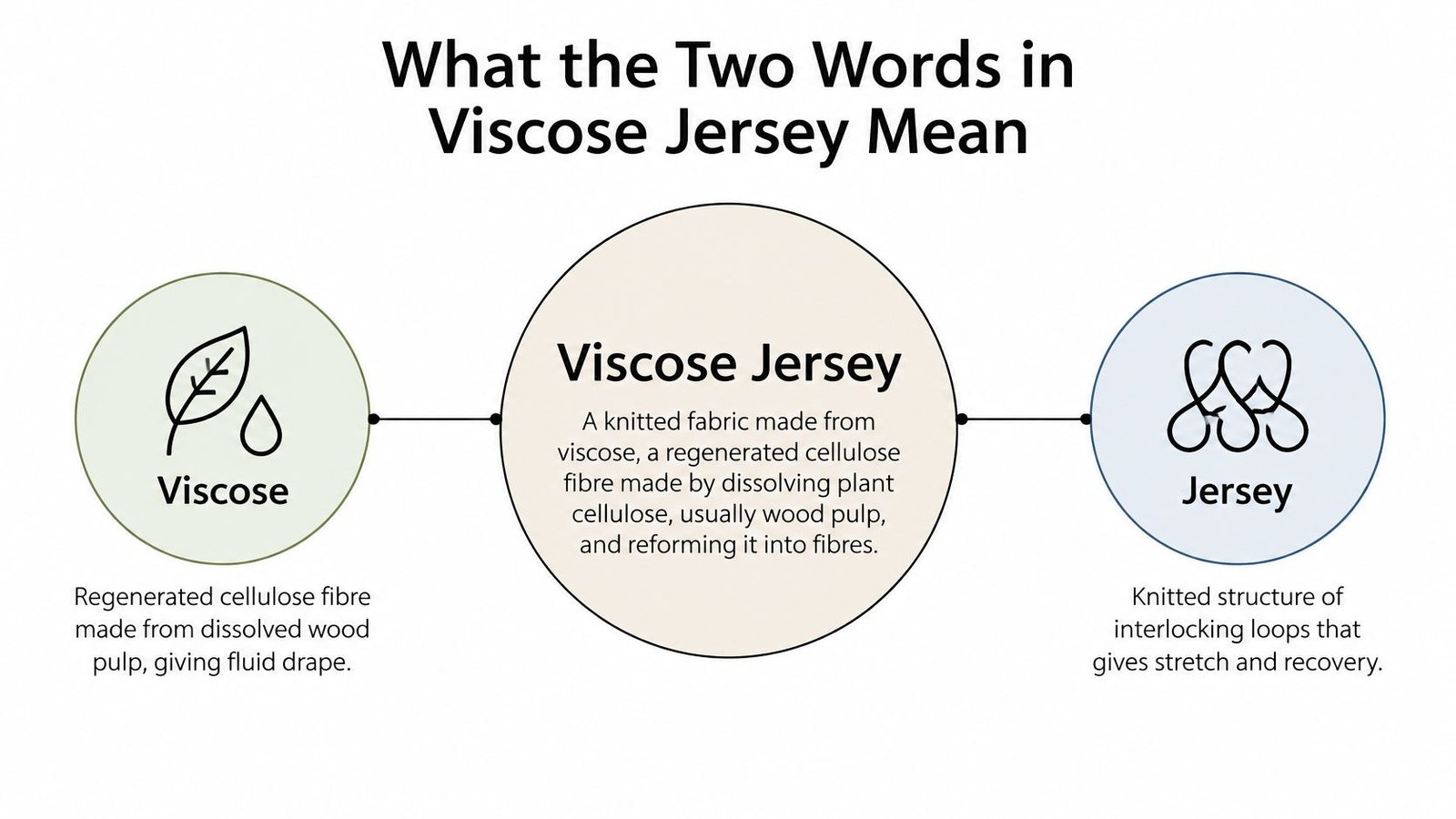
Read the fibre line for what the yarn is, then read the knit wording and elastane share for how the finished cloth is likely to move. That separation keeps the word viscose from doing more work than it can.
How Viscose Fibre and Knit Structure Work Together
Think of a woven cloth as a chain-link fence, a fixed grid that barely gives. A knit is a field of interlocked loops, more like a stack of springs. That is why jersey stretches and, to a point, bounces back. The fibre sitting inside those loops is a separate story.
UK educational textile guidance explains that viscose is made from wood pulp such as eucalyptus, pine or beech, and can also use cotton linters, a waste product from cotton processing, according to WJEC textiles guidance. The pulp is dissolved and reformed into filaments. Those filaments are smooth, so the cloth feels soft, hangs in a fluid fall and stays breathable. The same guidance says viscose can absorb up to 14% water vapour, drapes well and stays low in static because it holds some moisture. It also has poor elasticity, creases easily and becomes significantly weaker when wet.
Where the give actually comes from
Most of the stretch is the loop, not the fibre. A plain viscose jersey will extend across the width and then sit there, because the fibre itself doesn't snap back. Elastane is added when a fitted top has to recover. A knit is not a fixed quality level. Weight, loop density and that small elastane share change the cloth more than the word viscose does.
Try two checks on a cut edge before you buy a length.
- Watch the loops: Pull a cut edge gently across the width and watch the loops open. If they stay open, recovery is coming only from the knit.
- Compare two pieces: Do the same pull on a viscose-elastane piece. It should close again within a few seconds. If it doesn't, that percentage is too low for a bodysuit.
Prewash and dry a length the way you'll treat the finished garment, and don't stretch wet jersey while you cut or press.
On a loose shoulder, a strip of clear elastic or narrow lightweight tape, cut to the seam length and sewn without pulling the cloth, stops the springy loops from growing as you stitch.
Drape, Weight, Stretch and Breathability Compared
Two jerseys can both say viscose and still cut like different cloth. The fibre sets softness and moisture uptake; gsm, loop density and elastane decide how the finished piece hangs, stretches and recovers. Use the table as typical shop behaviour, with room for an unusual bolt to sit outside a row.
| Property | Viscose jersey | Cotton jersey | Polyester jersey |
|---|---|---|---|
| Drape | Fluid, follows the body | Softer, holds shape | Smooth, can feel stiff |
| Typical weight | 120–200 gsm | 150–220 gsm | 140–200 gsm |
| Stretch and recovery | Moderate from knit; higher with elastane | Moderate from knit; higher with elastane | High, good recovery |
| Breathability | Good; absorbs moisture and feels cool | Very good | Lower; traps heat |
| Static | Low | Low | High |
| Wet strength | Weakens significantly when wet | Strong when wet | Strong when wet |
| Washing | Gentle cycle, dry flat or line dry | Machine wash, dries quickly | Machine wash, dries quickly |
Drape. Viscose flows and clings to curves, which is lovely on a bias dress and unforgiving on a boxy shirt you wanted to stand away from the body. Cotton holds a softer shape. Polyester can look smooth and still feel boardy if the knit is dense.
Weight. A 140 gsm viscose jersey will skim. A 200 gsm one will hang with more body. That gap changes a pattern more than swapping the fibre name on an otherwise similar knit.
Stretch and recovery. The loop supplies the give. Elastane raises recovery. Under UK textile-fibre regulations, ordinary viscose and high-wet-modulus regenerated cellulose are separated by measured breaking force, including wet force at 5% elongation. Ordinary viscose loses strength when wet and can distort if you yank it, stretch it under the foot, or dry it under tension.
What you feel on the skin
Viscose takes up moisture and feels cool. Cotton breathes well and keeps its strength in the wash. Polyester traps heat and builds static, which shows up as cling on a dry day. Warmth sits on a different axis: these jerseys are cool to neutral layers, while merino versus cashmere sweater warmth belongs to a sweater-knit decision about insulation.
UK rules require a textile product with more than one fibre to name each component, so read the label for elastane and blends before you judge the cloth. Pick viscose where movement and a cool hand matter. Pick cotton where a crisper shape and simpler washing matter more. Pick polyester when fast drying and recovery outweigh the risk of a clammy feel.
Where Viscose Jersey Works in Garments and Projects
Viscose jersey earns its place where softness and movement matter more than a crisp edge. Heavy tailoring, sharp collars and anything that must hold a pressed crease will fight you.
| Garment | Stretch needed | Notes for the sewist |
|---|---|---|
| Fluid T-shirt or blouse | Low to moderate | 120–160 gsm drapes easily and makes a sound first project |
| Bias-cut dress | Moderate | 160–200 gsm, shows every wrinkle, hem with care |
| Gathered skirt | Low | 150–180 gsm, gathers hold in a lightweight knit |
| Fitted top or bodysuit | High | 180–220 gsm with 5–8% elastane for recovery |
| Relaxed lounge trousers | Moderate | 180–220 gsm so the knees don't bag |
A wrap top in the lighter band is the project I'd start with. Facings stay narrow, shoulders get a strip of clear elastic, and you learn how the cloth feeds before you cut a long dress. A midi with a bound neckline wants the mid weight. Too light and the binding flips. Too heavy and the skirt pulls the binding down. Pyjama trousers with an elastic waist want the heavier band so the seat recovers after you sit.
Fluid viscose rewards a simple silhouette and punishes a heavy, structured design.
A gathered skirt is the forgiving one. You can ease fullness into a waistband without the loops tunnelling, as long as you don't drag the cloth from behind the machine. On a fitted bodysuit, skip plain viscose. Without elastane the seat will grow by the end of the day. Use a stretch needle so you don't cut the loops, and support the weight of the cloth as it approaches the foot.
Viscose isn't only a jersey story. Woven polyviscose is cut for structured skirts and kilts, which is a different hand entirely. If you want to see that firmer cloth in a finished garment, you can explore Kilts4Less ready-made kilts and compare the hang with the fluid knit on your table.
Washing and Sewing Viscose Jersey Without Distortion
Moisture, heat, agitation and relaxed knitted loops are what move viscose jersey. The fibre name does not decide the outcome; knit density, elastane and your wash routine do. A small change in length or width shows fast in a fluid dress, top or skirt, so treat prewashing as part of cutting.
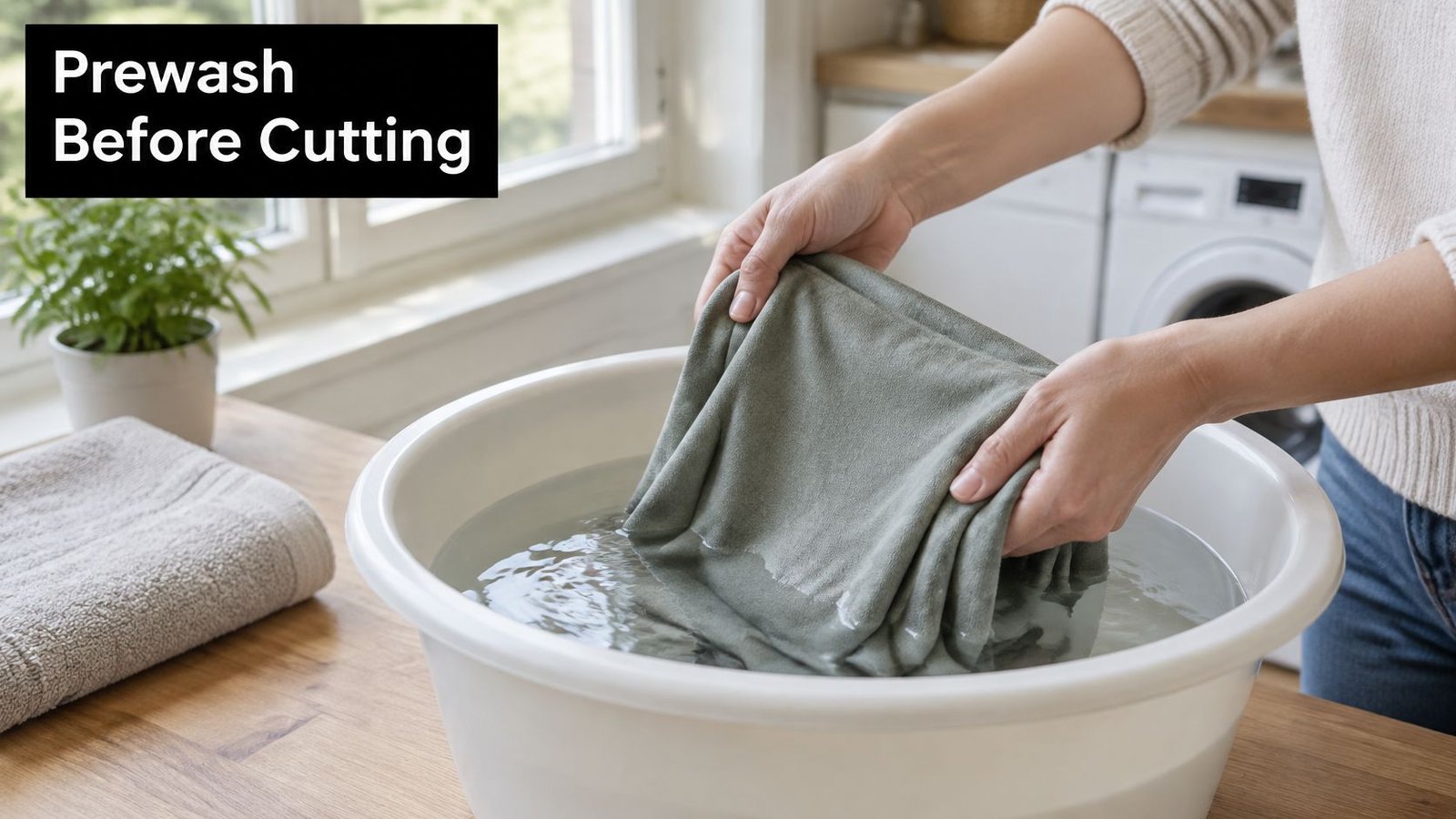
Prewash before you trust a length
- Cut a representative swatch of at least 50 cm, from the same piece you'll sew, including a selvedge if the cloth curls.
- Mark two grain lines, one along the length and one across the width, with thread tacks rather than a pen that might run.
- Wash on the care method you'll use, usually 30–40°C on a gentle cycle, inside a mesh bag so the loops aren't dragged.
- Dry it flat, or hang it the way the garment will dry. Don't tumble it "just to see".
- Measure both lines again once the swatch is fully dry, not while it's still damp and heavy.
A 50 cm length that changes by 5% becomes 47.5 cm. Skip the swatch and a hem you thought was level can come up short. In the Apparel Testing Manual, the cited dimensional-change limits are about +3%/−7% for 100% viscose and other regenerated-cellulosic fabrics or blends, and 5% dimensional stability for knitted fabrics or cloth over 55% viscose; BS EN ISO 6330 at 40°C is the wash used to measure that change. The same guidance treats washing colourfastness, wet rubbing, perspiration and light fading as separate checks.
| Fabric | Dimensional-change limits cited in UK testing guidance | Measured by |
|---|---|---|
| 100% viscose | about +3% / −7% | BS EN ISO 6330 wash at 40°C |
| Knitted fabric or over 55% viscose | 5% dimensional-stability tolerance | BS EN ISO 6330 wash at 40°C |
| Worked example: 50 cm swatch shrinking 5% | 47.5 cm | Mark, wash, dry and remeasure before cutting |
Stitches that keep their give
Let the cloth dry fully before you cut or press it, since wet viscose hangs heavier than it will wear. Support the length so it doesn't stretch as it feeds. A ballpoint or stretch needle slips between loops instead of splitting them. Join sides and shoulders with a narrow zigzag or a stretch stitch. Hem with a twin needle so the seam can still extend. Stabilise shoulders with clear elastic, feeding it at its own length with no extra pull.
For the finished garment, wash inside out on a gentle 30–40°C cycle, lay flat or line dry away from direct heat, and press on the reverse with a cool iron. Never tumble dry. A stained special piece is a different decision from a weekly T-shirt. CleanOnline's comparison of wet versus dry cleaning for delicate fabrics is worth reading before you hand a viscose dress to a cleaner who defaults to solvent.
If you want to see the feed and needle choice in motion, this short demo shows the handling to copy.
The Sustainability Trade-off Behind a Soft Fabric
Viscose starts as cellulose rather than petroleum. That origin doesn't make every viscose fabric a lower-impact buy. Chemical processing, forestry practice, blend, dye, washing and what happens at the end of the garment's life all change the result.
UK parliamentary evidence describes viscose as cellulose-based yet capable of behaving similarly to oil-based fibres in how it persists, and notes that evidence for complete biodegradability is weak, in a written submission to Parliament. Scale sits on top of that chemistry. In 2024, UK brands and retailers in the Textiles Pact placed 17% more textiles on the market than in 2019, bringing a 10% increase in total carbon emissions and a 7% rise in water use, according to WRAP. More than 300 million trees were reported in 2024 as logged each year to produce cellulosic fabrics such as viscose, in FashionUnited's report citing Canopy research.
A durable, well-fitting viscose jersey worn for years can beat a cheaper cloth you abandon after a season. You control three things.
- Trust the blend and the dye: Buy a composition you can read, and a colour that won't force you to bin the garment after one wash.
- Buy the length you'll wear: Match weight to the garment, and don't take an extra metre "just in case" that becomes offcuts.
- Wash cool and repair early: Line dry, and restitch a shoulder before the seam opens and the piece feels finished.
Fit, repair and years of wear matter more than the fibre word on the label.
Choose Your Viscose Jersey Before You Cut
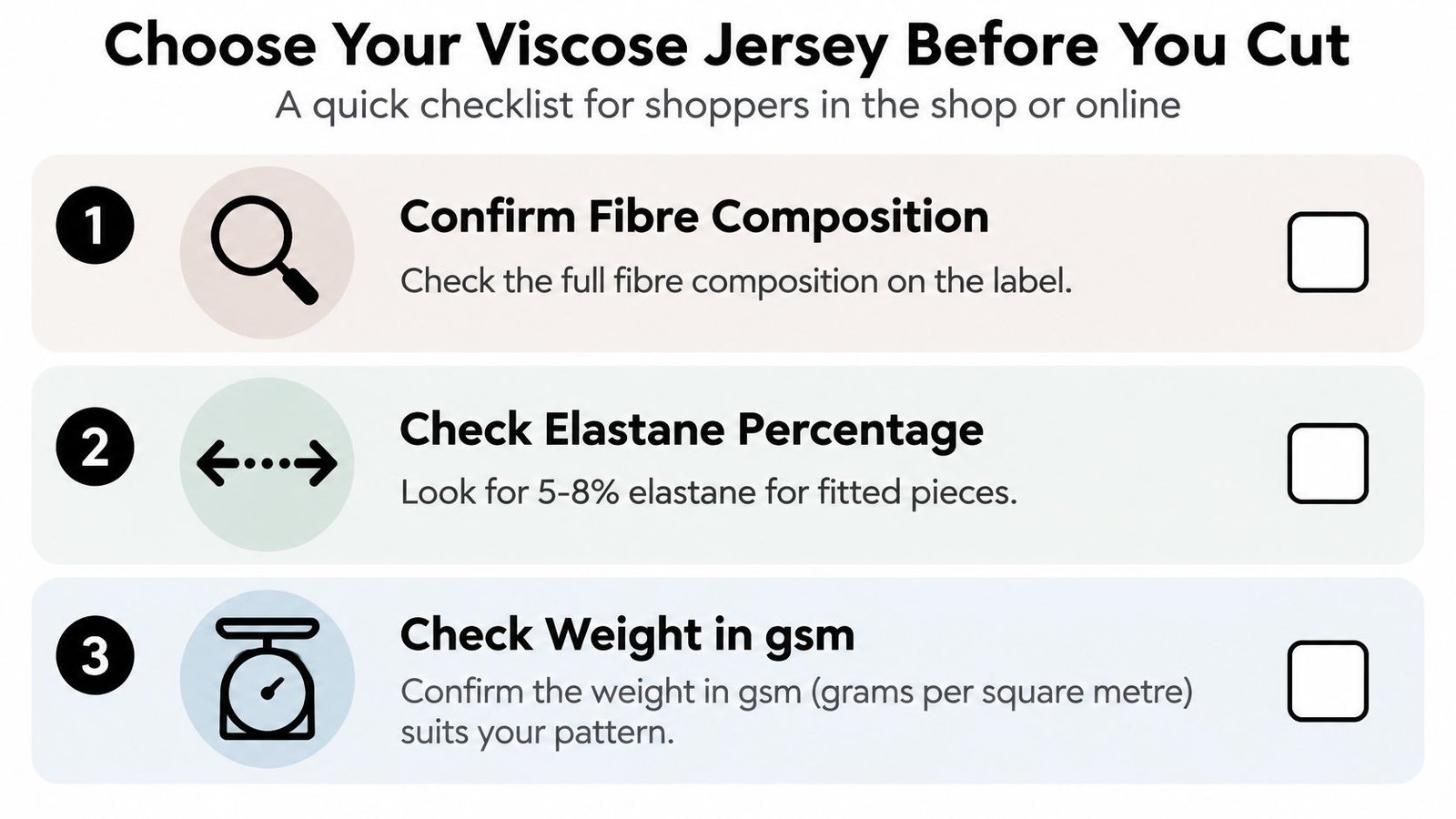
Use this in the shop or on a product page, in order.
- Confirm the full fibre composition. A viscose-elastane cloth should show both percentages, not a vague "stretch jersey" line.
- Check elastane. 5–8% is the band I want for fitted pieces. Under that, expect the seat and elbows to grow.
- Match gsm to the garment. A 130 gsm cloth is a blouse. It isn't lounge trousers.
- Read the care label against how you'll wash. If you need a hot cycle, this isn't the cloth.
- Ask whether shrinkage has been tested. If the seller can't say, the swatch test is on you.
What to do with the swatch
Order a swatch, prewash it on your real care method, stretch it across the grain and watch recovery, then drape it over your hand. If it feels stiff in the hand, it will feel stiff on a body. More Sewing lists viscose jersey and can supply swatches where they're available, so check the product page before you order a full length. Order the swatch, run the shrinkage check, and cut only after it passes.
More Sewing is a UK fabric shop with viscose jersey, other dressmaking cloth and swatches so you can test weight and recovery before you cut. If you're choosing a knit for a top, dress or lounge piece, start with a swatch rather than a full length. Visit More Sewing to check current viscose jersey and order a sample where one is listed.
