You're standing at the cutting table or scrolling a fabric site, and every listing says the same things. Soft. Premium. Natural. None of that tells you whether the cotton will hold a pleat, drape over a shoulder, or survive a first wash without turning awkward and small.
Buying cotton fabric by the metre gives you control that pre-cut bundles can't. You choose the width, the weight, the weave, and the exact amount you need, which matters whether you're making a summer shirt, lined curtains, or a tote that has to stand up on its own. The trick is learning to read the specs with the same confidence you'd use to read a pattern envelope.
Why Cotton Fabric Remains the Dressmaker's Favourite
A customer once came in with three cottons open on her phone, all described in the same cheerful language. One was for a blouse, one for a child's dress, and one for kitchen curtains, but the words on the screen didn't explain why one looked crisp and another looked almost translucent. That's the daily problem with shopping for cotton fabric by the metre, because the label rarely tells you what the cloth will do once it's cut, sewn, and washed.
The appeal is practical, not sentimental
Cotton became central to mass-market clothing because mechanised spinning and weaving made it widely available, and that historic shift still shapes how the UK buys fabric today, with cloth sold by the metre as a normal, practical format (Library of Congress cotton statistics guide). The point for dressmakers is simple. Cotton is usually easier to press, easier to sew, and more predictable than many slick or springy fibres.
Practical rule: if a project needs clean seams, straightforward pressing, and a fabric that behaves well on the cutting table, cotton is usually the first place to look.
That doesn't mean every cotton works for every job. A light lawn behaves very differently from a dense canvas, even though both count as cotton. The buyer who learns to read GSM, yarn count, weave structure, and fibre length stops guessing and starts matching fabric to project.
Why the metre format matters
Buying by the metre lets you order for the pattern, not for a packaged guess. If you need an extra length for facings, a lined bodice, or matched print placement, you can ask for it directly instead of trying to make a pre-cut bundle fit. That flexibility is especially useful in UK sewing, where fabric shops still sell cloth in piece-based lengths rather than only as finished garments.
It also helps with quality control. When fabric is sold by the metre, you can compare the same cloth at different widths, inspect a swatch, and decide whether the texture suits your needle, your seam finish, and your washing routine. That kind of decision-making saves more time than any marketing label ever will.
Understanding the Main Types of Cotton Fabric
Lightweight cottons suit movement and softness
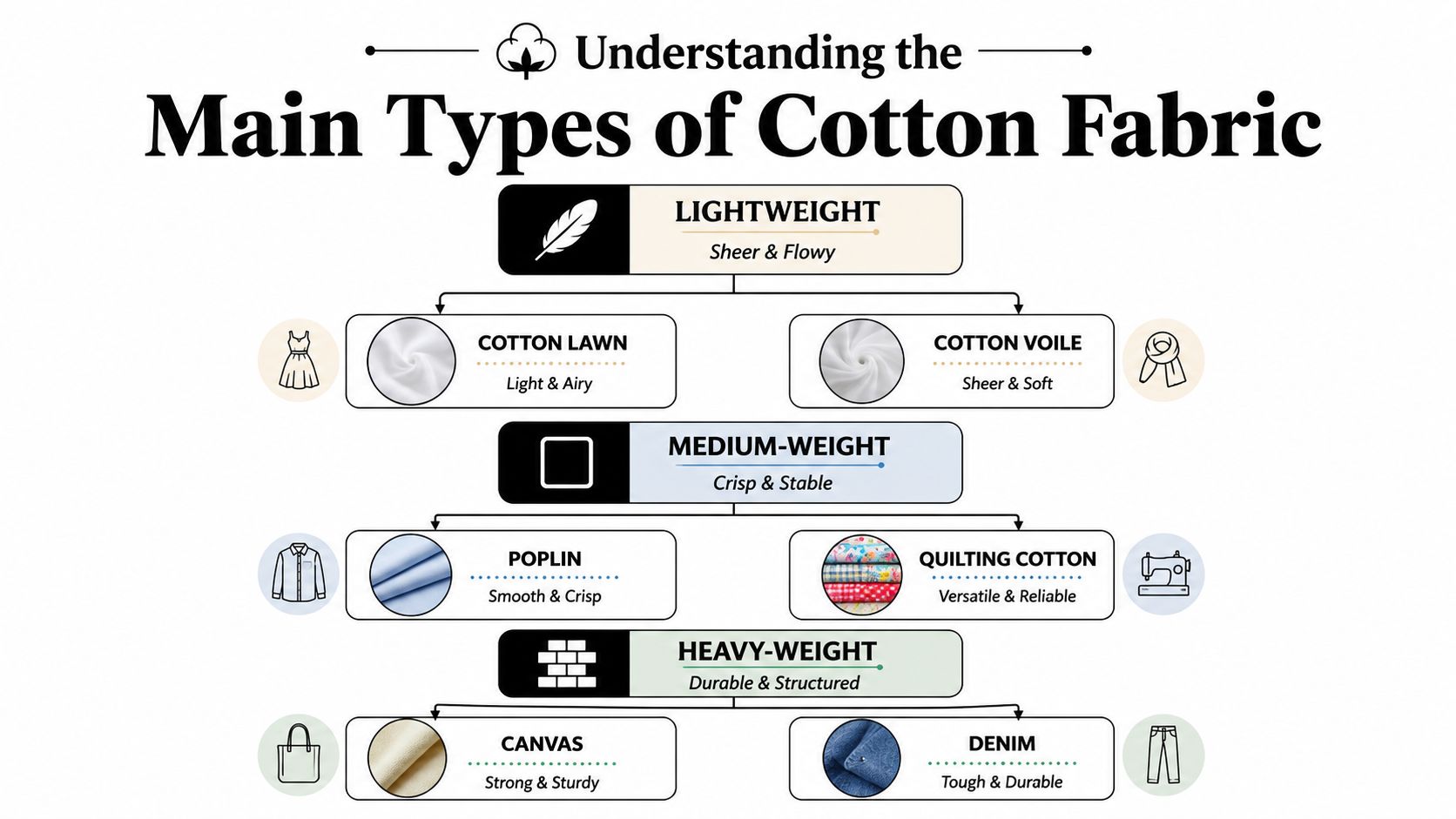
Cotton lawn and voile are the fabrics people reach for when they want airier garments, softer gathers, and a lighter feel against the skin. Lawn is often prized because its finer fibres can give a smoother finish than standard everyday cotton, while still sewing more cleanly than something very slippery. Voile is more floaty, so it works well for linings, blouses, and layered summer pieces, but it can frustrate beginners if they expect it to behave like a stable shirt cotton.
A gathered dress, a sleeved blouse, or a lined child's garment often benefits from these lighter fabrics. French seams are a strong choice for lawn because they enclose raw edges neatly and suit the delicate handle of the cloth. Voile needs careful pinning, a sharp needle, and a calm hand on the presser foot, because the fabric will show any rushed cutting.
Medium-weight cottons do the everyday work
Poplin and quilting cotton sit in the middle where many home sewists spend most of their time. A common dressmaking poplin weight in the UK market is about 110 to 130 g/m² (Craft Fix cotton fabric types), and that range is a useful benchmark for shirts, simple dresses, and light craft projects. It has enough structure for clean seams without feeling board-like, which is why it's often the safest choice when a pattern calls for a stable woven.
Quilting cotton has a tighter weave, so it holds a crisp seam and presses well, but it can feel stiffer on the body than people expect. It shines in patchwork, cushion covers, bunting, and some structured skirts, but it is not always the best choice for flowing garments. Flat-felled seams work neatly in poplin for shirts, while quilting cotton is often happier with straightforward seam finishes and topstitching.
Heavy cottons need firmer planning
Canvas and denim-weight cottons are the fabrics you pick when the item has to carry shape, resist wear, or stand upright. Tote bags, apron fronts, structured cushions, and workwear-style pieces usually benefit from this sturdier category. These cloths ask for stronger needles, longer stitch lengths, and more pressing patience.
Heavy cotton does not forgive vague cutting. If you use it on a pattern designed for a lighter fabric, the result can feel bulky at the seams and awkward in curved areas. A good test is to ask whether the pattern relies on drape or structure. If it relies on structure, heavy cotton may be ideal.
Match the fabric to the finish you want
A dressmaker should choose cotton by the job, not by the adjective on the shelf.
That sounds obvious, but it prevents most buying mistakes. A summer top wants softness and recovery through pressing. A tote bag wants body and abrasion resistance. A curtain wants enough weight to hang well, but not so much bulk that the heading becomes hard to sew.
Here's the shorthand I use in practice.
- Lightweight cottons: choose for blouses, linings, gathers, and layered garments.
- Medium-weight cottons: choose for shirts, everyday dresses, quilting, and many home projects.
- Heavy-weight cottons: choose for bags, aprons, cushions, and pieces that need structure.
Decoding Fabric Weight and GSM for Better Results
Most shoppers touch a fabric, like the feel, and then hope for the best. That works until the first wash, or until the hem hangs differently from what the pattern photo suggested. GSM, yarn count, and weave structure give you a more reliable way to judge cotton than words like “soft” or “premium”.
GSM tells you how much fabric is there, not just how it feels
GSM means grams per square metre. In plain terms, it helps you compare how light or dense a cloth is, which affects opacity, drape, and how much support it gives a garment. The same pattern sewn in a low-GSM cotton and a higher-GSM cotton can look like two different designs, even if the measurements are identical.
The useful habit is to ask for the GSM whenever you shop online. If the listing gives a swatch, compare its hand feel with the stated weight, then decide whether the cloth needs lining, whether it will gather cleanly, or whether it should stay in a more structured category. A shirt fabric around the 110 to 130 g/m² range is usually a more forgiving place to start than something much heavier or much lighter.
| Cotton Fabric Weight Guide by Project Type | |||
|---|---|---|---|
| GSM Range | Fabric Types | Best Projects | Sewing Tips |
| Light | Lawn, voile | Blouses, linings, soft dresses | Use fine needles, test seam allowance on scraps |
| Medium | Poplin, quilting cotton | Shirts, dresses, quilting, cushions | Press each seam as you go, watch for crisp edges |
| Heavy | Canvas, denim-weight cotton | Bags, aprons, structured home projects | Lengthen stitches, use stronger thread, trim bulk carefully |
Yarn count and weave change the result
Yarn count is a clue to how fine the yarn is. Higher counts generally mean finer yarns, which often produce smoother, softer cloth. That matters if you want a blouse that feels refined rather than rustic, or a shirt that sits neatly under a jacket.
Weave structure matters just as much. Plain weave gives balanced stability. Twill adds diagonal texture and often more visible drape. Satin weave creates a smoother surface, but it can be less forgiving in sewing because it shifts more easily and can show marks. If you're comparing products online, look for these weave clues instead of trusting “luxury” language.
For a side-by-side perspective on fabric choice in garment sewing, the discussion in rayon or cotton: the verdict is a useful reminder that fibre content alone never tells the full story. The way the cloth is constructed matters just as much.
Read the spec sheet like a sewist
If a retailer gives you GSM, weave, and width, use all three. A pattern for a gathered skirt may work beautifully in a medium cotton, then look heavy in a dense cloth. A fitted shirt may need a stable plain weave, while a drapier dress could benefit from a finer weave with a softer hand.
Practical test: if a fabric description uses only mood words and gives no measurable specs, assume you still don't know enough to buy confidently.
Choosing the Right Fabric Width for Your Pattern
Width changes how patterns fit on the cloth
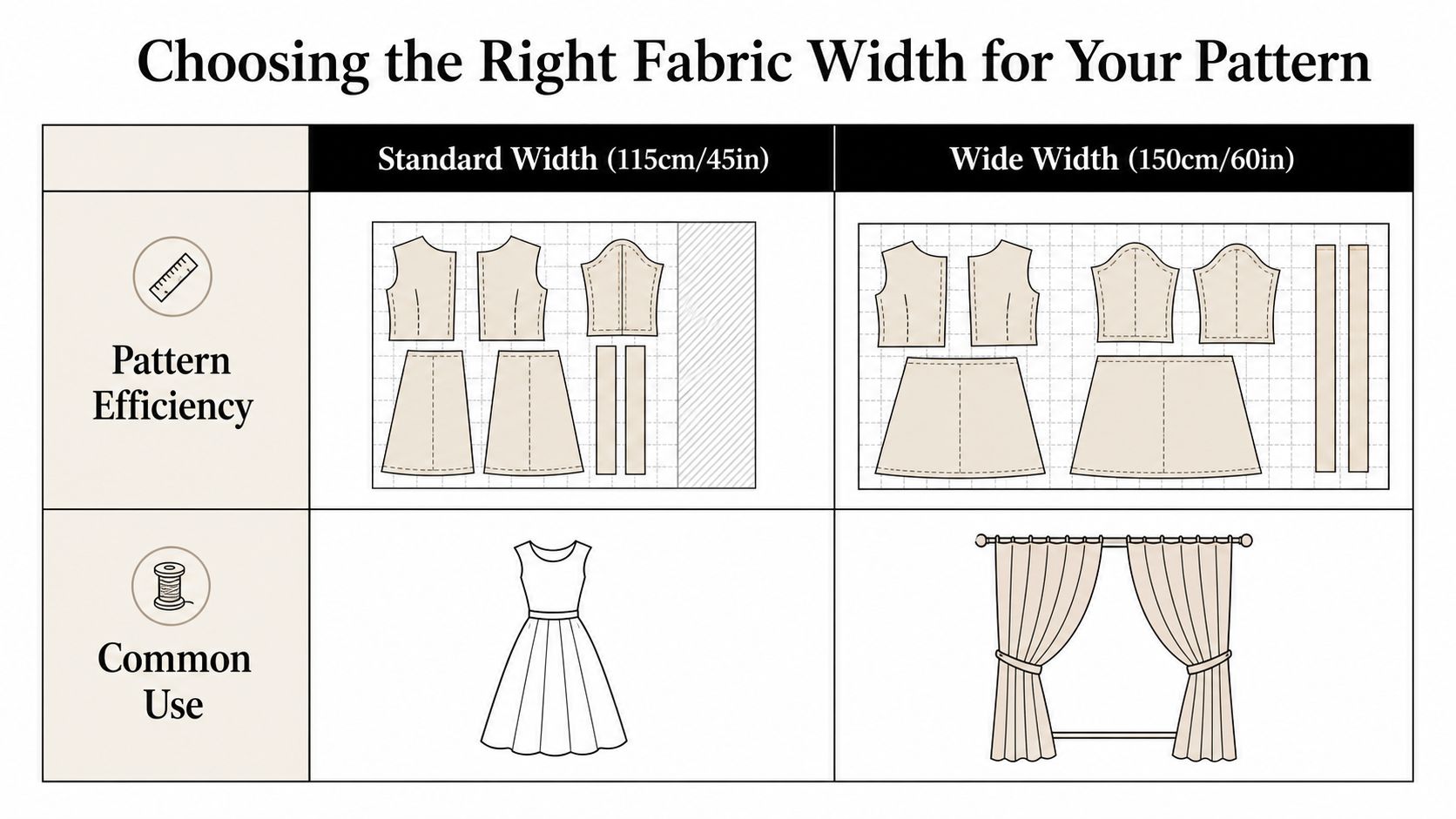
UK shoppers can buy 150 cm wide plain cotton fabric by the metre (Etsy listing with width specification), and that extra width changes the whole cutting plan. A wider cloth often lets you place larger pattern pieces side by side, which can reduce joins and waste. A narrower cloth may still be perfectly fine, but the layout can become more fragmented.
This matters most with garments that have wide pieces, such as circle skirts, wrap dresses, or wide-leg trousers. On a wider width, those pieces may fit with fewer seams and less fiddling. On a narrower width, the same pattern may demand more careful layout and a little more fabric.
Read the pattern envelope with both widths in mind
Most commercial sewing patterns list fabric requirements for multiple widths. Don't treat those numbers as suggestions. They reflect how the pieces are expected to fit on the cloth, and they're the quickest way to avoid under-ordering.
If your chosen fabric width differs from the pattern width, spread the pieces out on paper before you cut anything. A simple paper layout, or even chalking the pieces on the floor, shows whether the cloth will accept the pattern without awkward joins. Quilting pieces are often smaller, so narrower widths can still work well there, while dressmaking can benefit more clearly from the wider option.
Buy for the layout, not just the style
The widest cloth isn't always the best buy. If a project only uses small pieces, the cost of extra width may not buy you much advantage. But if a project involves large panels, the reduction in seam count and waste can be worth it because the garment or home piece ends up cleaner and easier to assemble.
A good habit is to check the grainline arrows and the largest pattern piece first. If that piece fits comfortably within the cloth width, the rest is usually manageable. If it doesn't, adjust the plan before you commit to the cut.
Preparing and Caring for Cotton Fabric Before Sewing
Cotton is a cellulose fibre, and that gives it a few predictable habits in the wash and under the iron. It also means you can make it behave very well if you prepare it properly before you cut. The biggest mistake I see is skipping preparation because the fabric “looks fine” on the roll.
Pre-wash before the scissors come out
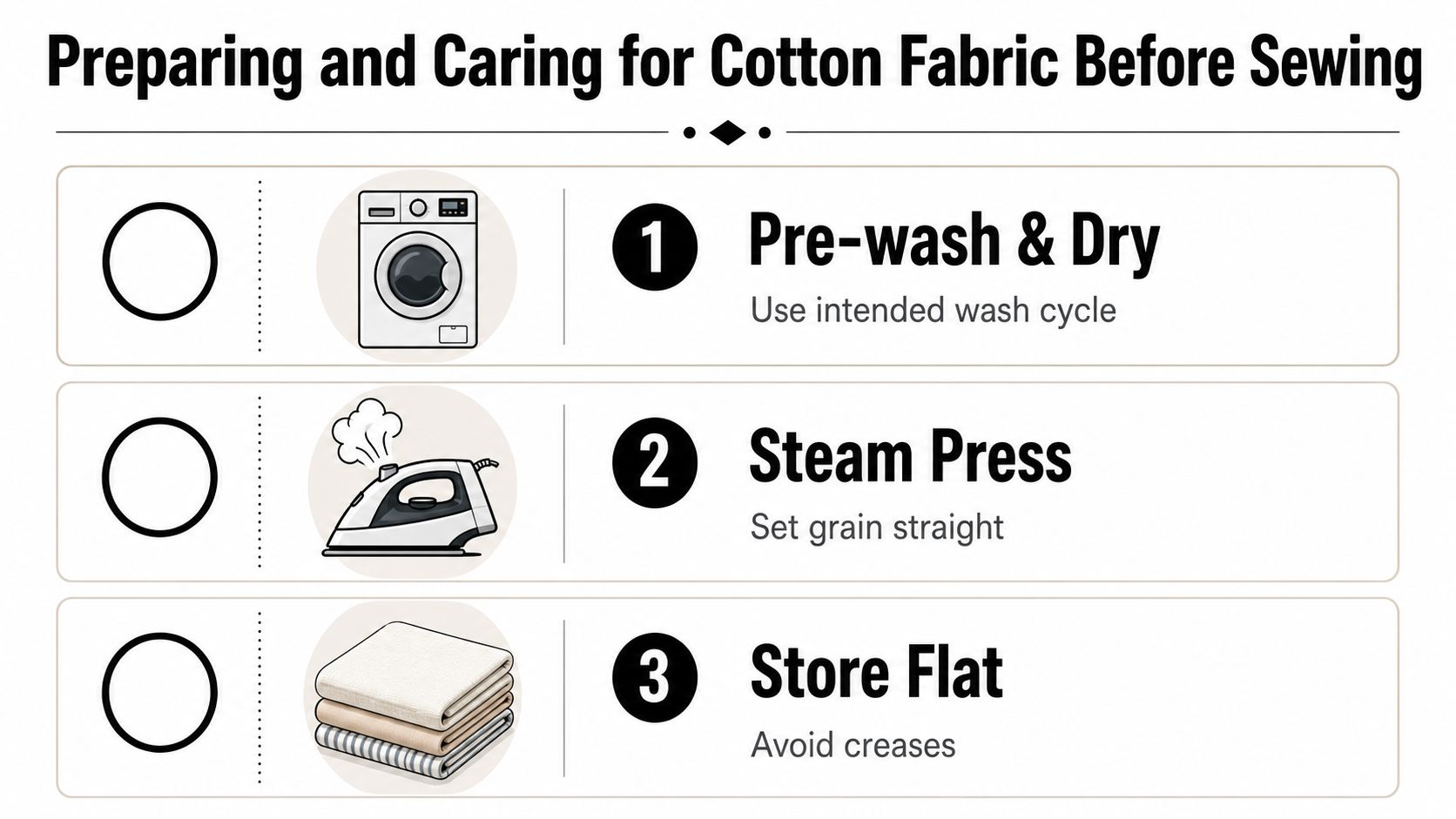
Pre-washing is the one step that saves more disappointment than almost anything else. Cotton can shrink on its first wash, and if you cut a garment before that happens, the finished piece may fit differently after cleaning. Wash the fabric in the way you expect the final item to be washed, then dry it the same way if possible.
A swatch test is worth the effort. Cut a small square, mark the dimensions, wash and dry it, then measure again. If the grain shifts or the edges twist, you'll know the cloth needs a more careful press and re-square before cutting. That's especially useful for shirts, children's clothes, and anything fitted.
Press, don't flatten the life out of it
Use steam for most medium cottons, but go gently with delicate lawn or voile so you don't distort the weave. Heavy cottons often need a firmer dry press first, then steam to settle the seams. Pressing should set the seam, not stretch it.
If the cloth skews after washing, hang it briefly or lay it flat, then realign the grain by pulling the crosswise threads back into place before you cut. That step is tedious, but it prevents a lot of crooked hems and twisted side seams. A ruler, a long cutting mat, and a sharp rotary cutter help, but only if the grain is true.
Give the finished item care notes
Cotton garments last longer when recipients know how to treat them. A simple care note can say to wash the piece with similar colours, avoid overly harsh heat, and reshape it while damp if needed. That advice protects colour and helps the item keep its original fit for longer.
Useful habit: if a fabric wrinkled badly in the wash before you sewed it, assume the finished garment will want the same level of care.
Evaluating Cotton Sustainability Claims Honestly
A lot of people assume cotton is automatically the cleaner choice because it's a natural fibre. That's too simple. Cotton can carry real environmental and social costs, including water use and labour concerns, so a thoughtful buyer needs more than a feel-good label.
Ask for proof, not just a promise
Fashion Revolution encourages consumers to ask brands for evidence about environmental and labour impacts, including how cotton is sourced and what the claim covers (Fashion Revolution on cotton sourcing and labour). That matters because “organic”, “Fairtrade”, and “regenerative” are not interchangeable words. Each label points to a different standard or set of claims, and none of them should be treated as a magic stamp that solves every issue.
If a retailer cannot explain where the cotton came from, what the certification means, or whether the supply chain is traced, the sustainability message is weak. Green words are easy. Verifiable sourcing is harder.
The best fibre depends on the job
Cotton still makes sense for many projects. It's breathable, familiar, and often the easiest cloth to sew well. But linen or hemp may be the better option in some cases if lower resource use is the priority and the finished look suits the project.
The trade-off is practical. Linen creases differently. Hemp can feel stiffer. Organic cotton may reduce chemical inputs, but that doesn't make every organic cotton ideal for every garment or home project. The right question is not whether cotton is perfect. It's whether that specific cotton suits the sewing job and the values behind it.
Buy with longevity in mind
The greenest fabric is often the one you use for years. A well-chosen cotton shirt or curtain that gets repaired, re-hemmed, and re-used has more value than a trendy piece that falls apart after a season. Strong seams, sensible washing, and thoughtful storage all help extend life.
Cotton by the metre can be a sensible purchase when you want something durable, repairable, and familiar to work with. But the buyer still has to stay alert, ask questions, and choose with eyes open.
Smart Buying Strategies for Cotton Fabric by the Metre
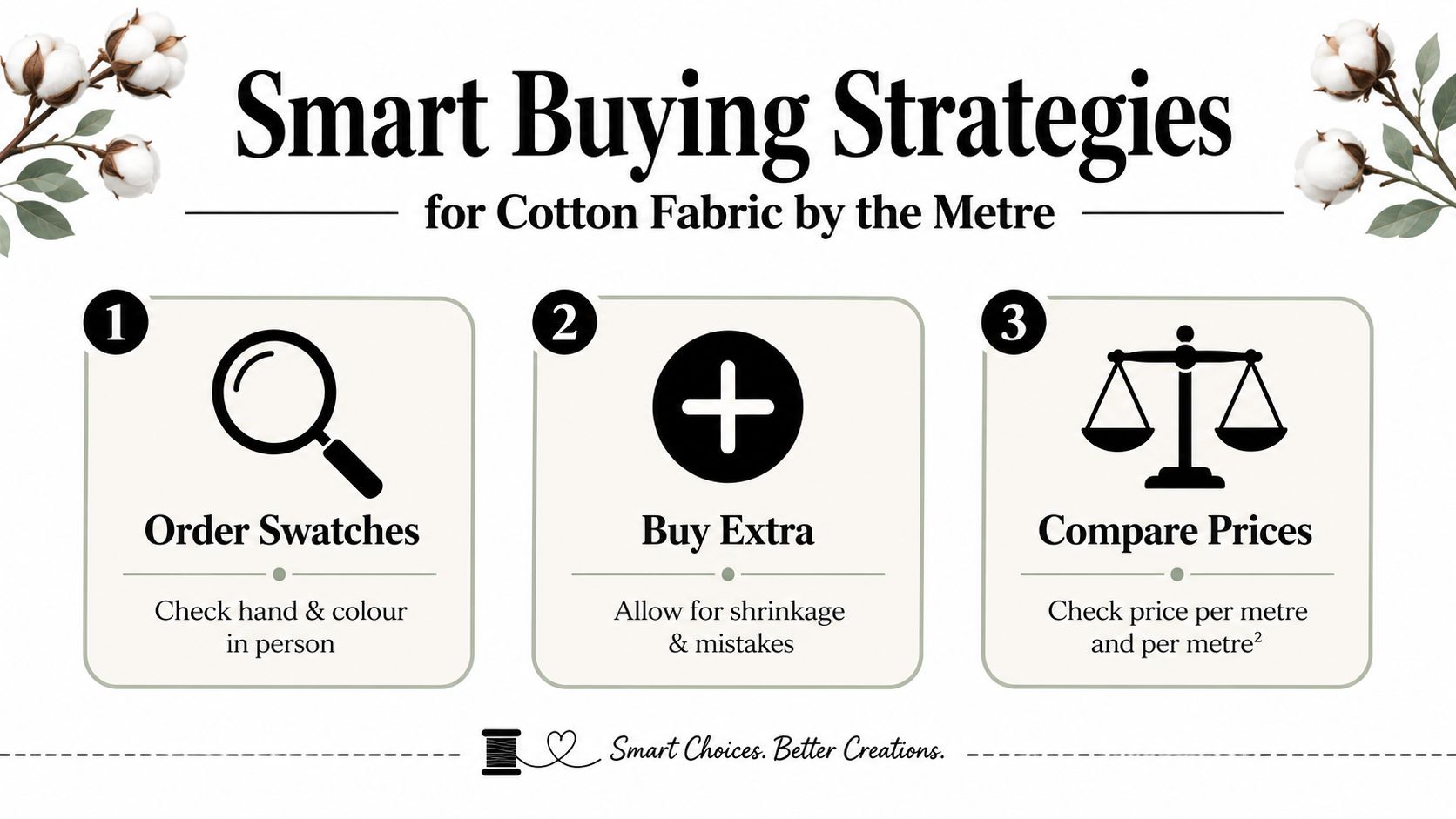
Order swatches before you commit
A swatch tells you what the screen can't. Feel the hand, check the opacity, and see how the cloth folds at the seam allowance. If the colour matters, compare it in daylight and under indoor light because online photos often flatten tone and texture.
A proper swatch test also shows whether the cloth creases sharply, stretches on the bias, or feels thinner than expected. That matters more than a product description ever will.
Buy a little more than the bare minimum
When you're calculating quantity, allow for shrinkage, pattern matching, and the mistakes that happen when a cut doesn't land where you expected. A print can demand more than a plain fabric because the motif needs to line up. A solid cotton may need less, but it still benefits from sensible allowance.
For precise yardage planning, the On Pins & Needles fabric guide is a useful companion because it keeps the focus on practical measurement rather than guesswork. That kind of methodical calculation is what saves a project from being under-ordered halfway through.
Compare price by metre and by area
Price per metre tells only part of the story. A wider cloth gives you more usable surface than a narrower one, so compare the practical working width as well as the sticker price. A slightly more expensive fabric can be better value if it wastes less and needs fewer joins.
- Order swatches: check hand and colour in person.
- Buy extra: allow for shrinkage and mistakes.
- Compare prices: look at price per metre and usable width.
Store leftover cotton flat or neatly folded, away from damp and direct sunlight. If you build a stash, keep it curated, not random. The best fabric cupboard is the one that helps you start the next project quickly, with cloth you already trust.
If you want fabric advice that stays practical, not vague, More Sewing is a good place to start for quality cottons, useful cuts, and the kind of guidance that helps you buy with confidence. Visit More Sewing when you're ready to choose cotton fabric by the metre for a project that needs to sew well, wash well, and finish beautifully.
