You're standing in a Bristol workroom with two denim bolts on the cutting table. One is 11 oz rigid denim, the other is 12 oz with 3% elastane, and the pattern for a new pair of barrel-leg trousers needs cutting before the afternoon disappears. Both fabrics look suitable. They won't behave the same under the needle, through the waistband, or after washing.
That's the practical value of a denim fabric specification. It turns a cloth that feels “about right” into measurable choices about drape, recovery, shrinkage, seam bulk, colour, and durability. The useful question isn't just whether a denim is heavy or stretchy. It's whether its construction matches the garment you're making.
What a Denim Fabric Specification Actually Covers
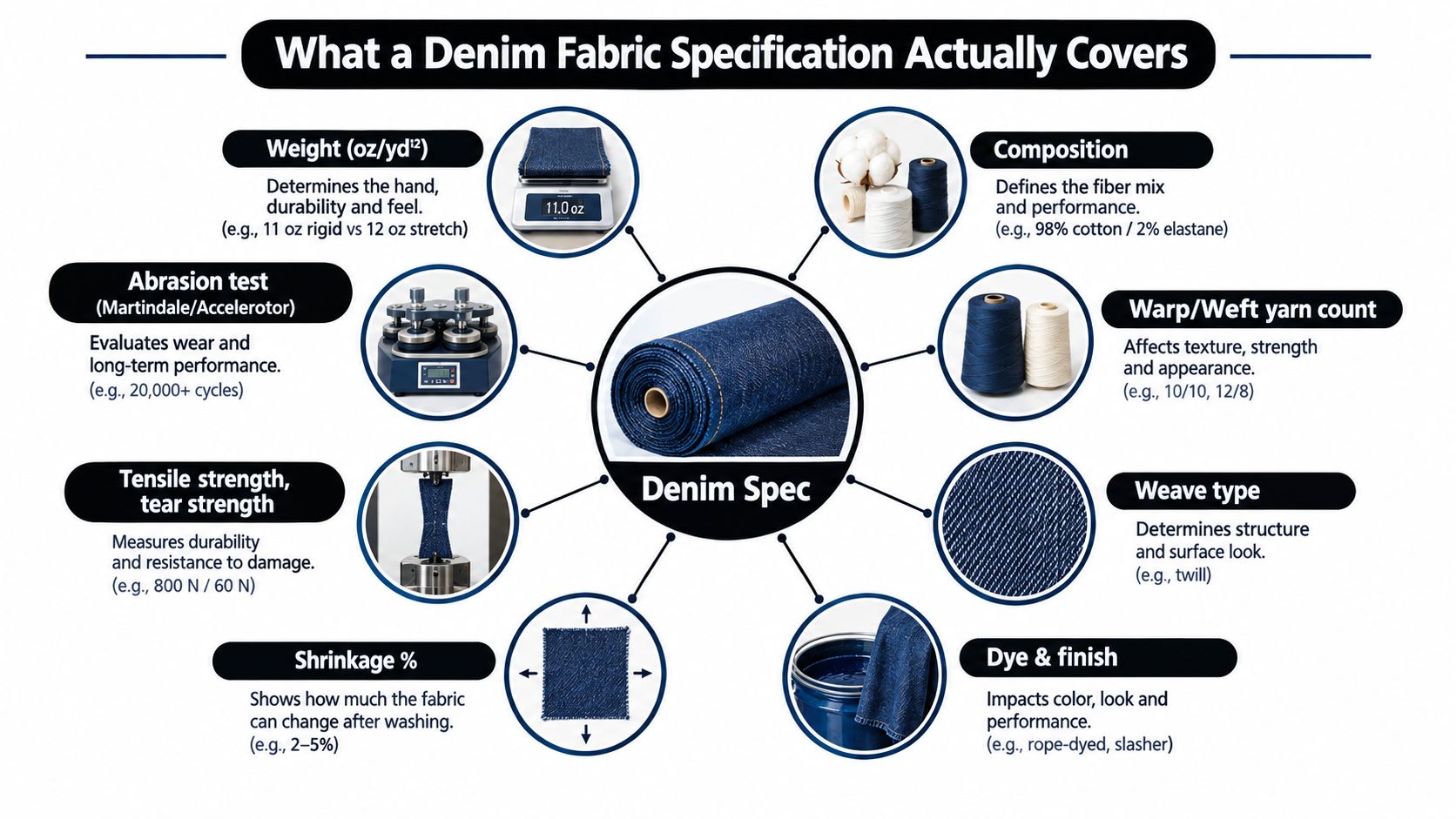
A mill specification sheet is the working contract between the fabric supplier and the maker. It normally records weight, fibre composition, weave structure, yarn count, shrinkage allowance, finish, colourfastness, width, and performance results. Each line predicts something you'll meet in the studio.
The 11 oz rigid bolt may hold a barrel-leg silhouette cleanly, but it'll need more easing at curved seams and a deliberate needle choice. The 12 oz fabric with 3% elastane may feel easier to wear, yet its recovery matters more than its initial stretch. If it grows at the knees or seat, a carefully drafted trouser can lose its line.
Practical rule: Treat every figure on the sheet as a sewing instruction in disguise.
Weight affects cutting resistance, needle size, and seam thickness. Fibre composition tells you whether you're working with a crisp all-cotton cloth or a blend that may recover differently. Weave controls the diagonal surface, drape, and how the fabric responds when folded through a collar, waistband, or cuff.
Shrinkage is the figure that decides whether you pre-wash. Finish explains whether the cloth has been sanforised, softened, enzyme-washed, or left closer to loom state. Colourfastness matters particularly with dark indigo, where rubbing can mark lighter layers and thread.
For UK buying, this technical approach is more than mill-room fussiness. UK trade reporting separates heavy woven denim under commodity code 520942, defined as denim containing at least 85% cotton with a fabric weight above 200 g/m². In 2024, the UK imported $996.82K and 75,432 kg in this category, with Italy and Turkey among the major suppliers, as recorded in the UK heavy cotton denim trade data. The market may be specialised, but the specification is precise.
Denim Weight in GSM and Ounces with Conversion Examples
Denim weight appears on supplier listings in either ounces per square yard or grams per square metre, abbreviated as GSM. The conversion is 1 oz/yd² ≈ 33.91 GSM, as explained in this denim weight conversion guide.
To convert ounces into GSM, multiply the ounce figure by 33.91.
- 8 oz shirt denim: 8 × 33.91 gives approximately 271 GSM.
- 12 oz jeans denim: 12 × 33.91 gives approximately 407 GSM.
- 16 oz heavy selvedge: 16 × 33.91 gives approximately 543 GSM.
The practical bands are more useful than the conversion alone. Lightweight denim around 200–280 GSM suits shirts and summer garments. Standard jeans denim generally sits around 300–380 GSM, while workwear and vintage-style cloth commonly falls around 380–450 GSM, according to this GSM denim weight reference. A UK-facing sewing guide also places lightweight denim around 6–8 oz, standard jeans around 10–12 oz, and heavy denim around 14–16 oz in its denim weight guide.
| Weight | Weight (GSM approx) | Typical Garment | Needle Size |
|---|---|---|---|
| 6–8 oz | 204–271 GSM | Shirts, skirts, light dresses | 70/10 to 90/14 |
| 10–12 oz | 339–407 GSM | Everyday jeans, trousers | 90/14 to 100/16 |
| 14–16 oz | 475–543 GSM | Structured jackets, workwear | 100/16 to 110/18 |
Ask whether the quoted weight is the finished fabric weight or greige weight. For a production decision, finished weight is the useful figure because dyeing, washing, softening, and drying alter the cloth. Also confirm the unit before ordering. A supplier's “12” may mean ounces, not GSM, and that difference is substantial.
Warp, Weft, and Yarn Composition Explained
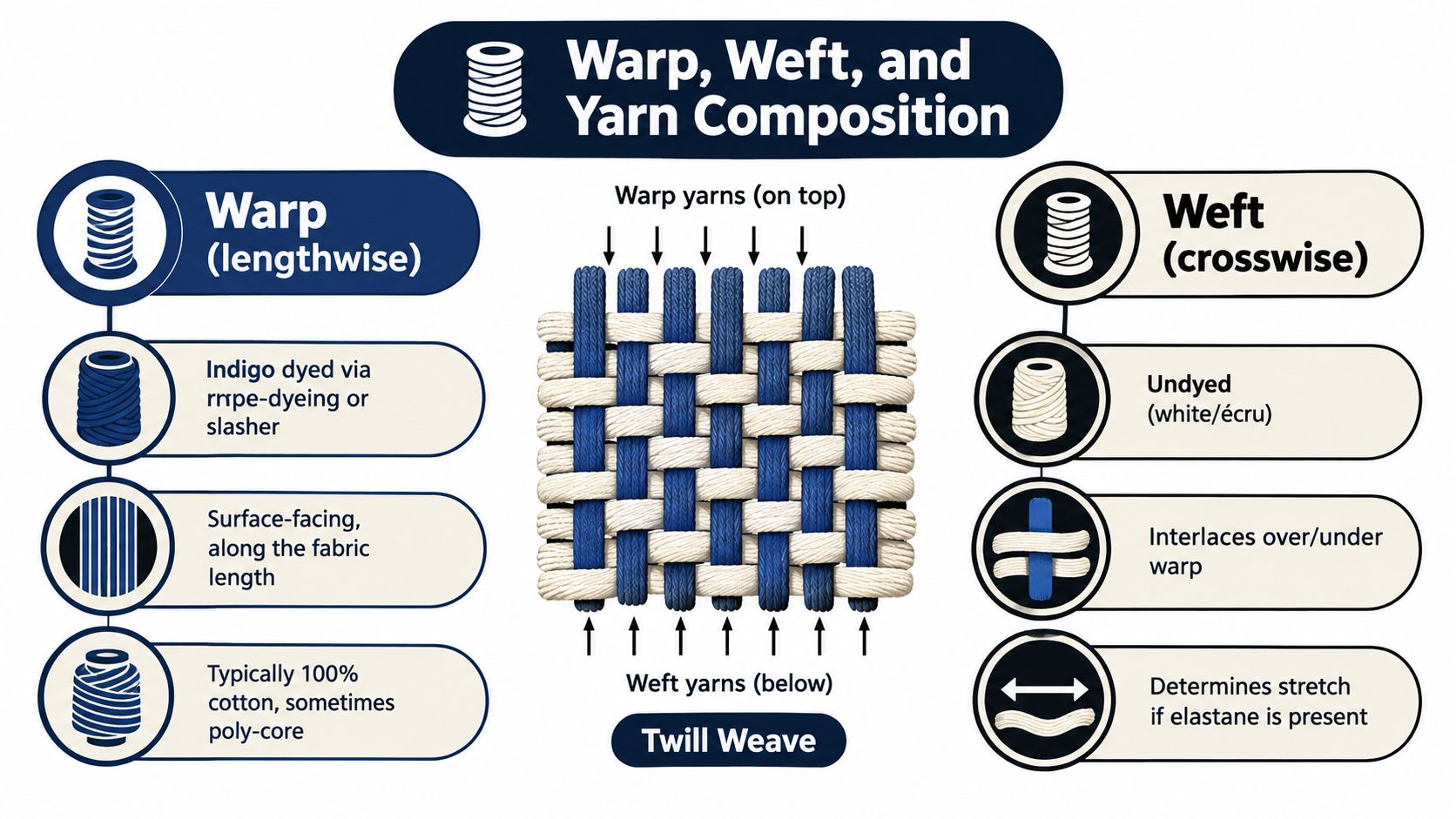
Denim is usually a warp-faced twill. Warp yarns run lengthwise and sit more visibly on the front. They're commonly dyed indigo through rope dyeing or slasher dyeing, while the crosswise weft remains white or écru and becomes more obvious on the reverse.
The warp is where the classic fade story begins. As jeans are worn, the raised indigo warp surface receives friction first. The blue wears back to reveal lighter fibre beneath, while the undyed weft helps create contrast. That's why two fabrics with similar weight can develop very different fades if their yarns and dye routes differ.
Mill sheets often use the Ne, or English cotton count, system. A higher Ne number indicates a finer yarn. In practical terms, 7/1 Ne warp is coarser than 10/1 Ne warp, while a 16/1 Ne weft is finer still. Coarser yarns can give heavier texture and a more pronounced surface, but yarn count works with density and weave, so it shouldn't be read in isolation.
How spinning changes the hand
Ring-spun yarns often produce a more irregular, characterful surface and can support vintage-looking fades. Open-end yarns are generally more uniform and can be a practical choice where consistency matters. Slub yarns deliberately vary in thickness, creating visual movement, but they need an approved reference swatch. Otherwise, a buyer's “slub” and a mill's “slub” may mean entirely different things.
Ply also matters. A plied yarn, such as a 2/1 construction reference on a mill sheet, combines yarn strands for additional strength and a different surface character. For heavy denim, that extra firmness can improve wear resistance, but it also increases bulk at folded seams.
Weave Types from Classic Twill to Broken Twill and Dobby
The weave determines how the yarns interlace, how long the warp floats remain visible, and how the diagonal rib travels across the cloth. A classic 3/1 right-hand twill places the warp prominently on the face and gives the familiar denim appearance. It's a dependable choice for jeans and structured jackets, but it can feel firm under a presser foot.
Left-hand twill reverses the diagonal direction. It may feel smoother or develop a different wear pattern, although the practical difference depends on the yarn, finish, and final weight. Broken twill interrupts the continuous diagonal, which can reduce torque and create a less directional surface. It's useful where you want a calmer appearance or better control in a reworked garment.
Dobby denim introduces small geometric or textured effects through a more varied weave. It can add interest to a boxy jacket or wide-leg trouser, but the texture may affect seam pressing and topstitch visibility. Check the reverse as well as the face. Some weaves feed differently when the fabric is folded, especially through thick intersections.
| Weave Type | Surface Appearance | Diagonal Direction | Drape and Behaviour | Best Garment Uses |
|---|---|---|---|---|
| 3/1 right-hand twill | Traditional pronounced rib | Rises to the right | Structured, stable, can feel firm | Jeans, trucker jackets, workwear |
| Left-hand twill | Softer-looking directional rib | Rises to the left | Smooth hand with individual wear character | Jeans, casual jackets |
| Broken twill | Interrupted or less obvious rib | Alternates or breaks | Helps control torque and gives a calmer face | Trousers, reworked denim, jackets |
| Dobby | Textured or geometric surface | May be irregular | Adds surface interest, can affect pressing | Fashion jackets, skirts, wide-leg shapes |
Decode supplier shorthand before buying. A cloth described only as “premium denim” tells you almost nothing about construction. Ask for the twill type, yarn count, finished weight, and finish route together.
Stretch versus Rigid Denim and How to Read the Blend
A label reading 98% cotton, 2% elastane describes a very different cloth from 70% cotton, 28% polyester, 2% elastane, even though both are stretch denim. Fibre percentages tell you what the fabric contains. They don't tell you how far it stretches, how quickly it recovers, or whether it will bag out at the knees.
Rigid 100% cotton denim gives the cleanest structure for a barrel-leg trouser, chore jacket, or reworked panelled garment. It won't accommodate fit in the same way as stretch denim, so pattern accuracy and pre-washing matter more. Its reward is a stable line and a convincing break-in over time.
A low-elastane cotton blend can add comfort without destroying structure. Core-spun elastane places the stretch fibre inside a stronger yarn system, while mechanical stretch polyester achieves give through yarn construction rather than elastane alone. The mill should identify which route it uses because recovery behaviour differs.
| Blend Composition | Stretch Range | Recovery Quality | Best Garment Use |
|---|---|---|---|
| 100% cotton | Rigid or mechanical give only | Stable, with natural wear relaxation | Structured jeans, jackets, workwear |
| 98% cotton, 2% elastane | Low comfort stretch | Depends on elastane and finishing | Close-fit trousers, mid-rise jeans |
| 97% cotton, 3% elastane | Noticeable comfort stretch | Must be tested at knees and seat | Fitted jeans, shaped barrel legs |
| Cotton, polyester and elastane blend | Variable | Can be stable, but hand and fade change | Work trousers, uniform-style garments |
Stretch percentage is only useful alongside recovery. A fabric that stretches generously but doesn't return can look excellent on the cutting table and tired after wear. For close-fit trousers, check growth at the knees and seat. For wide-leg trousers, excessive stretch can soften the hem and remove the clean swing that makes the silhouette work.
Finishes Including Sanforisation, Enzyme Wash, and Mercerisation
Sanforisation compresses the cloth during finishing to reduce later dimensional change. UK testing guidance pairs fabric weight with washing stability, and the UK and EU apparel testing manual identifies fabric mass checks to BS 2471:2005 and dimensional stability after washing to BS EN ISO 6330:2012. It also gives about ±5% for claimed fabric mass and around ±3% dimensional change for woven fabrics under the stated testing framework.
Sanforised denim is the safer starting point for most home sewing. Unsanforised or loom-state denim may shrink more dramatically, so the pattern needs to account for the cloth after its first wash rather than before it.
| Finish Type | Shrinkage Expectation | Hand-Feel and Appearance | Pre-Wash Recommendation |
|---|---|---|---|
| Sanforised | Controlled residual shrinkage | More predictable, often smoother | Wash a swatch and confirm before cutting |
| Unsanforised | Higher and less predictable | Firmer, more raw, may change character | Pre-wash full yardage before pattern cutting |
| Enzyme wash | Depends on base cloth and process | Softer, faded, less rigid | Test the finished cloth, not just greige denim |
| Stone wash | Depends on wash intensity | Broken-in texture and visible abrasion | Wash separately and check surface change |
| Acid wash | Variable and strongly directional | High-contrast, irregular appearance | Test colour transfer and handle |
| Mercerised | Process-dependent | More lustre and potentially stronger dye uptake | Check hand, shrinkage, and colourfastness |
Enzyme and stone washes soften denim and remove some surface colour. Aggressive treatment can also reduce strength and alter the balance between face and reverse. Mercerisation changes the cotton fibre surface and can improve lustre and dye response, but it isn't a substitute for testing the finished fabric.
Before cutting production yardage, wash a representative piece separately. If the supplier gives a shrinkage allowance, overcut according to that figure, then test a swatch in the intended cold wash and tumble-dry routine. Don't assume a gentle hand-wash test predicts a tumble-dried garment.
Matching Specification to Current UK Denim Silhouettes
The looser denim shapes currently appearing across UK fashion coverage, including barrel-leg, wide-leg, low-rise, and baggier styles, need more than a generic “medium-weight denim” recommendation. The 2025 UK denim trend coverage points towards silhouettes with more volume and surface, while the industry trend discussion for 2025 highlights reworked, recycled, and sustainability-led directions.
A 12.5 oz rigid 3/1 twill is a strong choice for a structured barrel-leg trouser. It gives the leg enough body to hold the curved outline rather than collapsing into an ordinary wide leg. The trade-off is seam bulk at the crotch, pocket opening, waistband, and hem.
An 11 oz broken twill with 2% elastane suits a mid-rise straight trouser where movement matters more than a sculptural silhouette. A 9 oz dobby denim can work for a boxy cropped jacket, particularly when you want surface interest without the armour-like feel of heavy cloth.
| Silhouette | Weight (oz/GSM) | Stretch % | Weave | Notes |
|---|---|---|---|---|
| Barrel-leg trouser | 12.5 oz, approximately 424 GSM | 0% | 3/1 rigid twill | Holds curved volume and crisp pleats |
| Mid-rise straight | 11 oz, approximately 373 GSM | 2% | Broken twill | Adds movement and helps reduce torque |
| Boxy cropped jacket | 9 oz, approximately 305 GSM | 0–2% | Dobby | Keeps seams manageable and adds texture |
| Wide-leg reworked trouser | 10–12 oz, approximately 339–407 GSM | Low or none | Broken twill or classic twill | Avoid excessive recovery at the hem |
| Carpenter-style trouser | 12–14 oz, approximately 407–475 GSM | 0–2% | 3/1 twill | Heavy sanforised cloth supports cuffs and tool-pocket structure |
Very light denim can crease sharply below a yoke or at a pocket junction because it lacks the body to distribute stress. Conversely, heavy denim can overwhelm a boxy jacket, especially where collar stands, cuffs, and plackets stack. Elastane earns its place at the knees and seat of fitted shapes. It can spoil the architectural line of a wide-leg hem or oversized jacket.
Testing Standards and Quality Markers for Denim
A useful test report names the method, specimen, conditioning, wash route, and result. A generic supplier sheet that just says “good colourfastness” gives you little to work with. For a UK maker, the test should relate to the failure you're trying to prevent.
For fabric mass, ask how the supplier measured GSM. UK testing guidance references BS 2471:2005 for mass per unit area. Washing stability is tied to BS EN ISO 6330:2012 in the UK apparel testing manual already cited. These methods matter because the result depends on how the sample was conditioned and washed.
| Property | Standard | Typical Tolerance | Why It Matters |
|---|---|---|---|
| Fabric mass | BS 2471:2005 | Around ±5% against the claimed specification | Confirms the cloth matches the ordered weight |
| Washing dimensional change | BS EN ISO 6330:2012 | Around ±3% for woven fabrics in the stated guidance | Protects fit, symmetry, and seam alignment |
| Fabric mass measurement | BS EN 12127 may be specified by suppliers | Confirm the supplier's stated tolerance | Creates a repeatable GSM comparison |
| Tear strength | ISO 13937 family | Supplier should state a result and direction | Useful for heavy denim and workwear |
| Colourfastness to light | ISO 105-B02 | Ask for the grade and test conditions | Helps assess indigo fading in exposed use |
| Colourfastness to washing | ISO 105-C06 | Ask for colour change and staining results | Predicts transfer during laundering |
| Rubbing fastness | ISO 105-X12 | Ask for dry and wet results | Important for indigo crocking on collars and linings |
Check slippage resistance, spirality, and skew as well as headline strength. A strong denim that twists after washing is still a poor choice for a pair of trousers. A fabric with acceptable tear results can still produce wavy plackets if the finish is unstable or the weave is skewed.
The UK manual also notes that fabric weight should match its claimed specification within the stated tolerance and that dimensional stability needs to be checked after washing. That is the useful distinction between a real test certificate and a marketing datasheet. The certificate tells you what was measured and how.
Sewing Settings Driven by Denim Specification
Your machine setup should follow the fabric, not a generic denim label. Heavy cloth needs a larger needle and longer stitch length, while lighter denim can tolerate a finer needle and closer stitching. Guidance for heavy-woven denim recommends size 16 or 100 needles with about 10 stitches per inch, while lighter denim suits size 11 or 14 needles with about 12 stitches per inch. The technical sewing guidance for denim also recommends testing on double thickness and adjusting presser-foot pressure so the layers feed evenly.
| Weight Band | Needle | Thread (Tex) | Stitch Length | Seam Finish |
|---|---|---|---|---|
| Under 9 oz | 90/14 | Tex 30 | 2.5 mm | Bound or flat-felled |
| 10–12 oz rigid | 100/16 | Tex 40–60 | 3 mm | Flat-felled with waistband topstitching |
| 13 oz and above | 110/18 or jeans needle | Tex 60–80 | 3–3.5 mm | Flat-felled with bar tacks at stress points |
| Stretch denim | 90/14 stretch or ballpoint | Tex 40 polyester core-spun | 2.5 mm | Narrow zigzag or chain stitch where recovery is needed |
For an 11 oz trouser, start with a 100/16 jeans needle, Tex 40 or Tex 60 thread, and a 3 mm stitch. Sew a sample through the actual stack, including waistband layers, pocket bags, belt loops, and seam intersections. If the machine labours or the needle deflects, reduce the stack rather than forcing the seam.
Stretch denim needs a slightly different mindset. A narrow zigzag can preserve give, while a straight stitch in a high-stress area may pop as the garment moves. Keep the zigzag narrow enough to avoid a visibly wavy seam, then test recovery after pressing.
For long runs of topstitching, a large thread spool avoids frequent changes and helps maintain consistent tension. A dedicated king spool of denim thread is one practical option to consider alongside your chosen needle and machine setup.
Specification Considerations for Sustainable and Deadstock Denim
Deadstock and recycled denim can be excellent choices, but the usual mill sheet may be incomplete. A roll can have an attractive price and strong design potential while lacking a reliable record of yarn count, finishing route, residual shrinkage, or batch consistency.
Recycled cotton deserves particular caution because fibre length and strength can vary. The specification should tell you what has been added to stabilise the cloth, whether through a denser construction or a blended fibre. Don't assume a recycled-content label predicts durability on its own.
Questions to ask before buying
- Batch consistency: Can the supplier identify the lot, shade, weight, and finishing route?
- Residual shrinkage: Has the cloth already been washed or sanforised, and is a test result available?
- Surface damage: Does reworked denim contain abrasion, needle holes, stains, or weakened areas?
- Certification: If you're selling garments, check whether relevant GOTS or OEKO-TEX documentation applies to the exact fabric, not just to the supplier generally.
- Cutting waste: Can you place pattern pieces around flaws without compromising grain or symmetry?
Deadstock can lower the fabric cost but increase cutting waste and shade-lot inconsistency. That trade-off is manageable for a one-off jacket or visible-panel rework, but it needs pricing discipline for a small brand. Record every roll and keep a cutting map, especially when combining old jeans panels with new denim.
Reworked denim also changes sewing settings. Existing abrasion can make the surface fragile, so test needle penetration and topstitch tension on the weakest area. A slightly lighter thread and reduced presser-foot pressure may prevent further damage, while a bar tack should be placed only where the remaining cloth can support it.
Quick Reference Spec Sheet for UK Makers
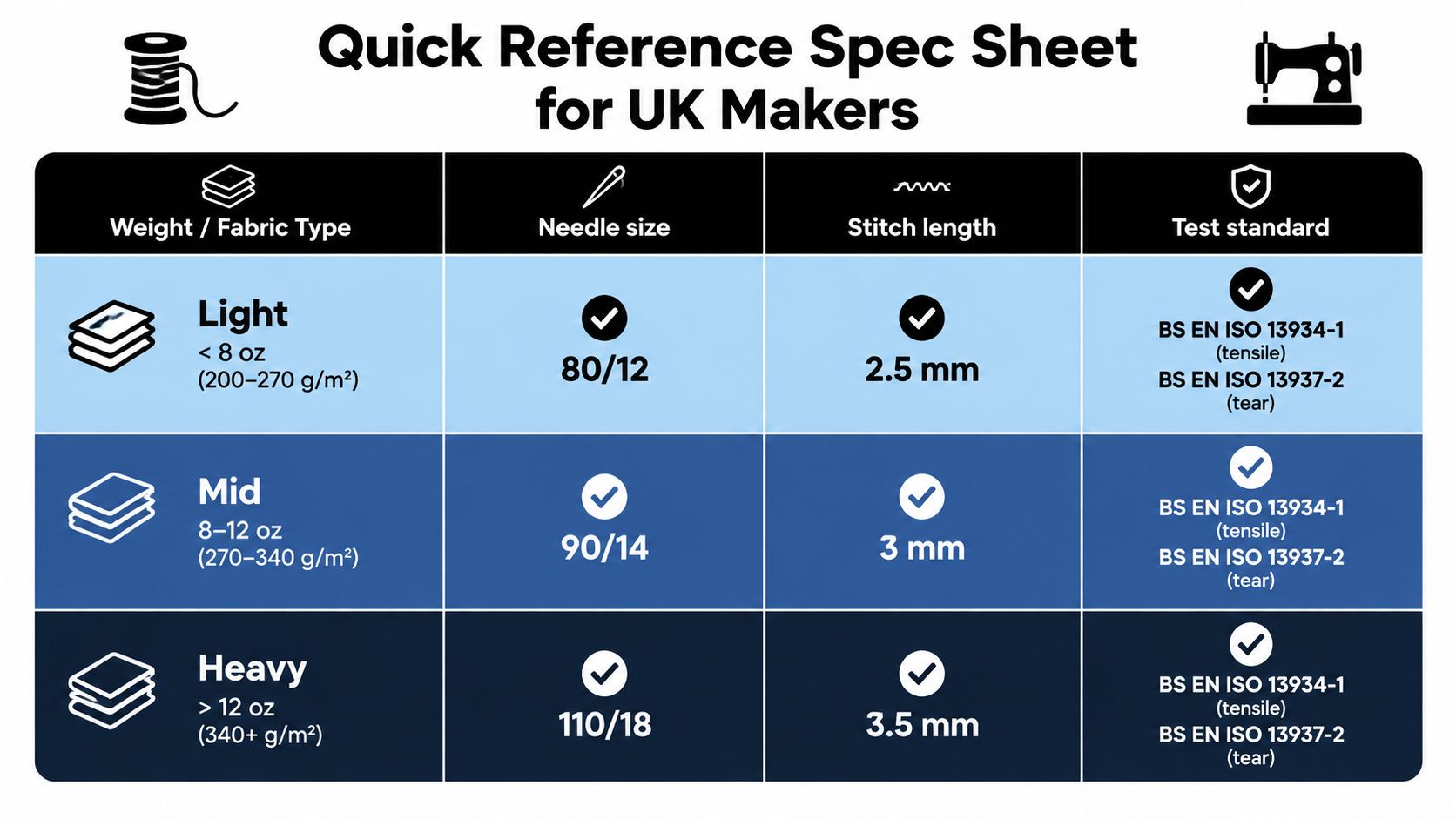
A compact spec sheet should let you make a decision before the fabric reaches the cutting table. Record the weight in both units, fibre blend, weave, stretch and recovery, finish, shrinkage, usable width, colourfastness, and test methods. Then add the machine settings you'll use for the actual garment.
The weight bands below are practical sewing categories rather than rigid industry definitions. The GSM conversions follow the 1 oz/yd² ≈ 33.91 GSM rule cited earlier.
| Category | Approximate Weight | Needle Size | Stitch Length | Useful Test References |
|---|---|---|---|---|
| Light | Under 8 oz, up to about 271 GSM | 70/10 to 90/14 | 2.5 mm | BS EN 12127, ISO 105-C06 |
| Mid | 8–12 oz, about 271–407 GSM | 90/14 to 100/16 | 2.5–3 mm | BS EN 12127, ISO 13937 |
| Heavy | 12–16 oz, about 407–543 GSM | 100/16 to 110/18 | 3–3.5 mm | ISO 13937, ISO 105-C06 |
| Very heavy or selvedge | 16 oz and above, 543 GSM and above | 110/18, test machine capacity | 3.5–4 mm | Tear, abrasion, wash, and colourfastness testing |
For shrinkage, use the supplier's stated result rather than relying on a category label. Sanforised cloth should be treated as shrink-controlled, while unsanforised cloth needs a full pre-wash and measurement check. UK testing guidance gives around ±3% dimensional change for woven fabrics under its stated washing framework, but the fabric's actual finish and your laundering method still decide the result.
Keep this checklist beside the machine:
- Weight: Record oz and GSM, and confirm the supplier's unit.
- Composition: Note cotton, elastane, polyester, lyocell, or recycled content.
- Construction: Record weave, warp count, weft count, and selvedge status.
- Finish: Mark sanforised, enzyme-washed, stone-washed, mercerised, or raw.
- Shrinkage: Test the finished cloth using the intended care routine.
- Colour: Check dry and wet rubbing, washing, and lightfastness where relevant.
- Sewing: Test the needle, thread, stitch length, and thickest seam stack.
Worked Examples of Denim Specification in Practice
A specification becomes useful when it changes what you do with the cloth. These three combinations show how the numbers translate into pattern preparation, machine settings, and expected wear.
Barrel-leg trousers
Take 10 oz sanforised rigid twill with 3% elastane. The weight gives a barrel leg enough body to hold its shape without becoming excessively bulky at the waistband. The elastane adds comfort, but the waistband still needs stay tape or another stabilising treatment because the fabric can relax during wear.
Pre-wash a representative piece, then check the leg width and waistband length after drying. Sew a test through the pocket opening and side seam before committing to the final cut.
Chore jacket
A 14 oz raw selvedge denim gives a chore jacket excellent structure and a firm break-in. Expect 8% initial shrinkage in the planned example, so pre-wash the full yardage rather than a small swatch if the finished measurements matter.
Use a 110/18 needle where the layers stack, Tex 60 thread, and a 4 mm topstitch if the machine forms it cleanly. Keep the collar, cuff, and front placket samples because those areas reveal needle lines and seam distortion first.
Boxy shirt
A 7 oz enzyme-washed broken twill gives a boxy shirt softer drape and manageable seam bulk. The broken twill reduces the strongly directional appearance, while the enzyme finish supplies a worn hand without requiring a heavy cloth.
Use a finer needle, moderate thread, and 12 mm flat-felled seams where the pattern allows. Check the finished shirt after washing for skew at the placket and collar, because a soft surface can hide instability until the garment is laundered.
The reliable habit is simple. Read the weight, composition, weave, stretch, and finish together, then test the exact seam stack you'll sew.
More Sewing offers denim, cottons, Tencel blends, deadstock fabrics, haberdashery, and ready-to-sew kits, with fabric sample swatches available for checking weight and handle before you commit. Visit More Sewing to compare suitable cloth and sewing supplies for your next pair of trousers, jacket, or reworked denim project.
