
You've cut a hooded robe, matched the seams, and sewn what looks like a beautifully generous hem. Then the first wash arrives. The fabric tightens, the edges pull out of alignment, and the robe feels much heavier when wet than it did on the cutting table. Terry towelling can be wonderfully forgiving, but only if you account for what's happening beneath the soft surface.
The mistake is treating it as merely absorbent cotton. Loop height, pile density, GSM, fibre composition and finishing treatments all influence how terry towelling fabric behaves under the needle and in the laundry. Once you understand those details, you can choose a cloth that suits the project instead of trying to make the wrong cloth work harder.
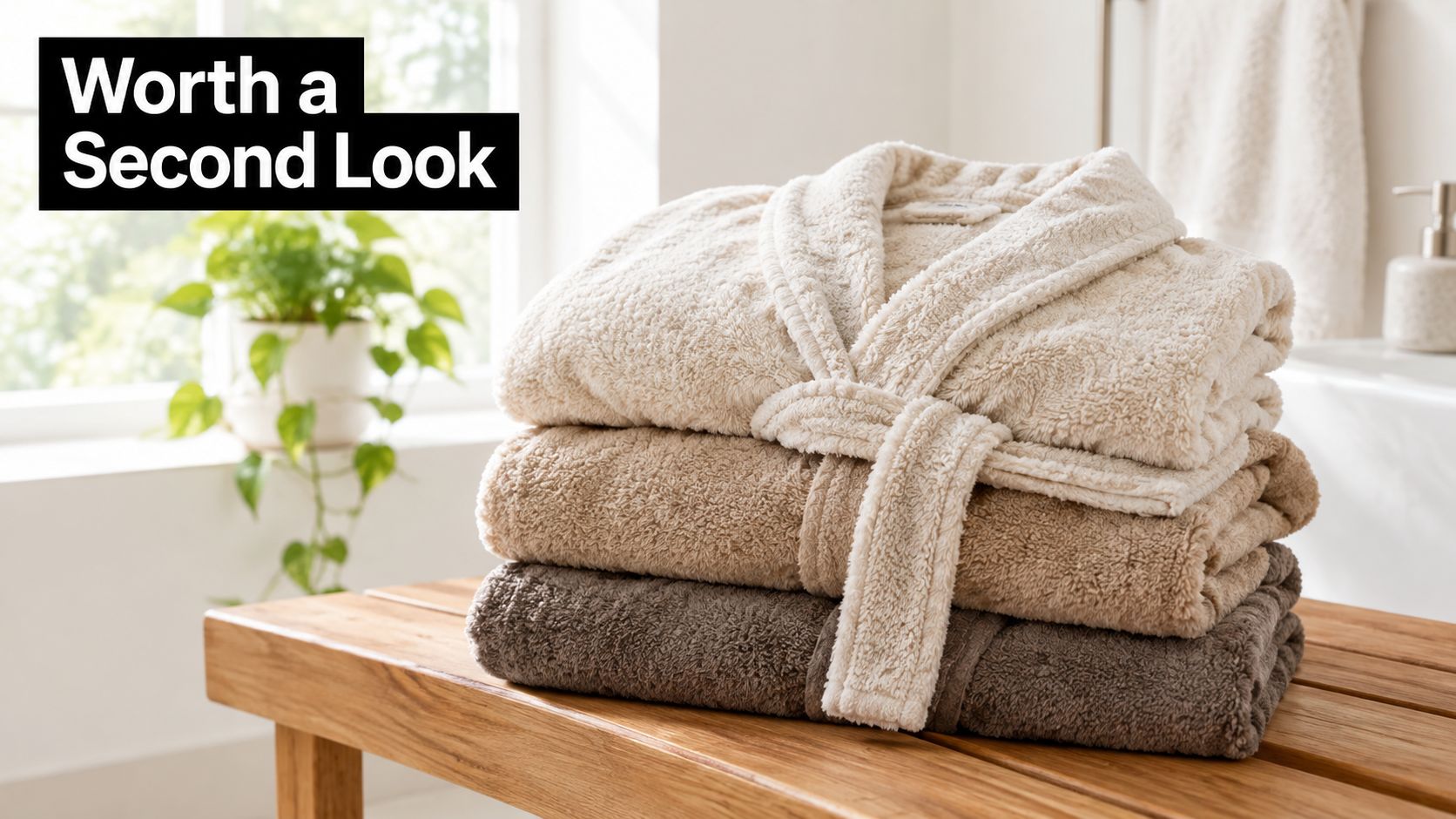
Why Terry Towelling Deserves a Second Look
A bathrobe project often starts with a tactile decision. You handle a thick roll in the fabric shop, enjoy the plush pile, and assume the heaviest option will produce the most luxurious result. That choice can disappoint if the robe becomes cumbersome when wet, takes too long to dry, or shrinks enough to alter the sleeve and hem proportions.
The problem usually isn't terry itself. It's the gap between how the fabric feels on the roll and how it performs after laundering. A lighter, well-finished terry can be more practical than a dense cloth with a lofty pile, particularly for children's garments, travel towels or reusable nappies.
The fabric behind the comfort
Terry towelling is a looped fabric. Its raised loops create more exposed surface area than a flat woven cloth and provide pathways that pull moisture away from the skin. Absorbency comes from geometry as well as fibre, so two fabrics with a similar cotton content can still feel and perform differently.
Finishing also matters. Scouring and other pretreatments can remove sizing and hydrophobic processing residues, allowing water to enter the fabric more readily. Those treatments can also cause relaxation shrinkage, changing dimensions and increasing the fabric's basis weight, which is why an untreated swatch may not behave like the same cloth after washing. The technical evidence is described in this study of terry finishing and water absorption.
A short history worth knowing
The UK's industrial breakthrough took place in Lancashire during the mid-nineteenth century. Samuel Holt, a weaver associated with Droylsden, east of Manchester, developed a mechanised loom capable of producing uncut warp loops. His first towelling loom operated in 1848, and commercial towel production began in 1850, according to this history of terry towelling's development.
Holt later refined the design into a two-warp system. One warp formed the structural ground, while the other created the raised looped pile responsible for terry's absorbency. The process was patented in Britain and helped move looped towelling from labour-intensive craft production into repeatable factory manufacture. That history explains why terry remains such a useful sewing-room fabric: its softness comes from a carefully engineered structure, not from weight alone.
Understanding Terry Towelling Construction
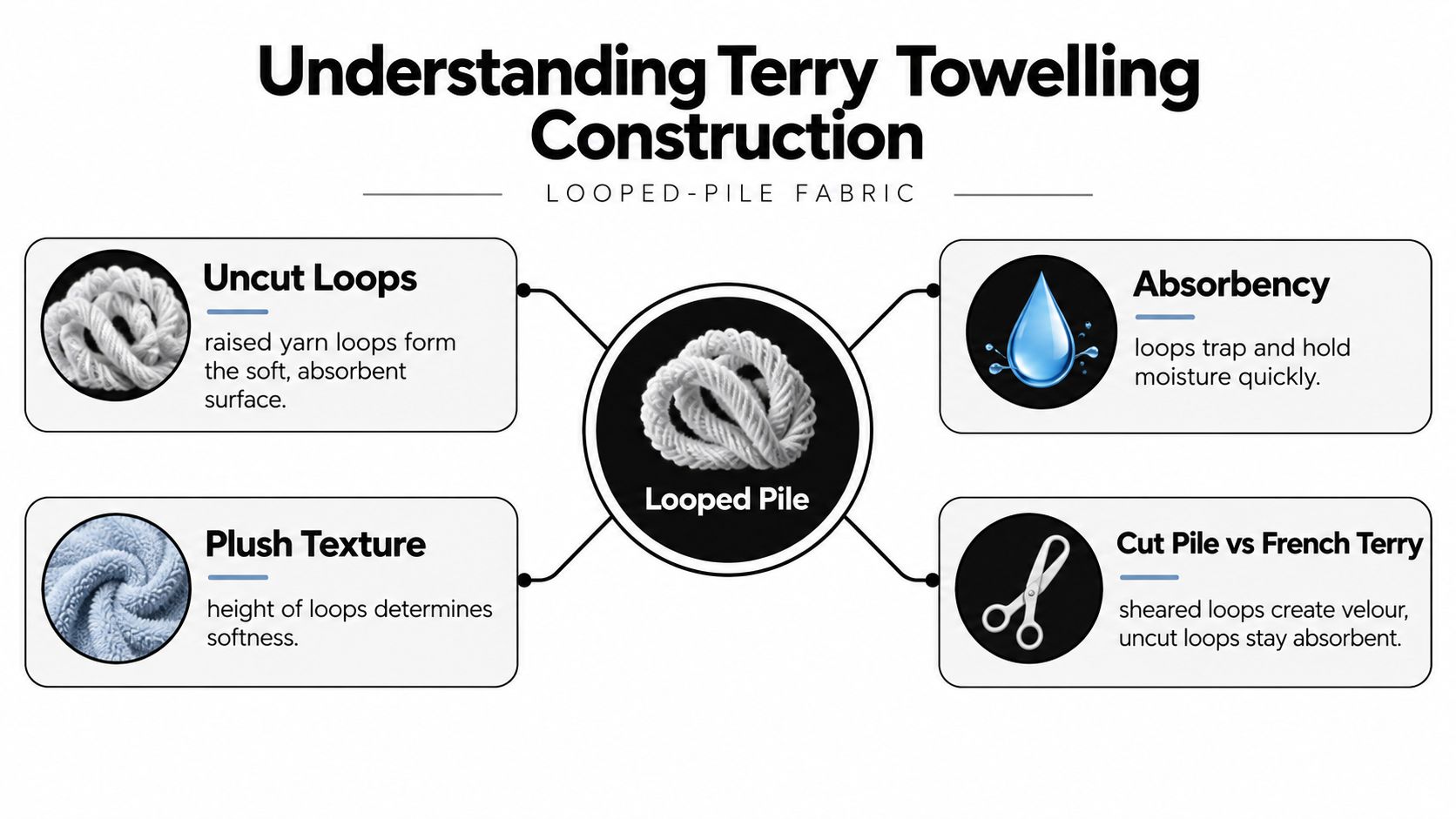
Start by turning the fabric over and looking at its two jobs. The ground is the stable foundation that holds the cloth together. The pile is the raised layer of loops that touches the body, catches water and gives terry its characteristic softness.
A useful analogy is a lawn supported by soil. The ground is the soil, keeping everything in place. The loops are the blades of grass, standing above the surface and creating texture. Cut those loops and you produce a different handle. Leave them intact and you retain the open, absorbent surface associated with traditional towelling.
How the loops are formed
Traditional terry uses an additional warp system to create loops above the ground cloth. The structural warp stays comparatively stable, while the pile warp is controlled to form the loops. This is the two-warp arrangement developed in the nineteenth-century mechanised process.
You may also encounter descriptions of warp-loop and weft-loop terry. Warp-loop construction forms loops along the length of the fabric and is associated with durable towelling. Weft-loop construction forms loops across the width and can be used where a different degree of stretch, texture or production flexibility is wanted. Ask the supplier which construction is being offered if the product description is vague.
Loop height changes the feel immediately. Short, dense loops can feel firm and resist flattening, while taller loops feel plush but may catch more easily and shed more during early washes. Yarn twist affects softness, strength and the way the pile holds its shape. Fibre type affects drying, shrinkage and moisture movement.
What to inspect on a swatch
Rub the pile in different directions. It should recover rather than remain permanently flattened. Look for thin areas, missed loops and loose yarns, especially if you're buying fabric for a robe or towel that will receive heavy use.
Stretch the swatch gently across the width and length. Some movement is normal, but excessive distortion can make binding and pocket openings difficult to control. For hooded garments, inspect the reverse side too. A loose ground can allow seam allowances to creep into the pile and make neat pressing difficult.
If you're making a hooded robe, a practical guide to after-surf hooded robe tips can help you think through bulk, shaping and construction details before cutting.
Choosing the Right GSM and Fibre Composition
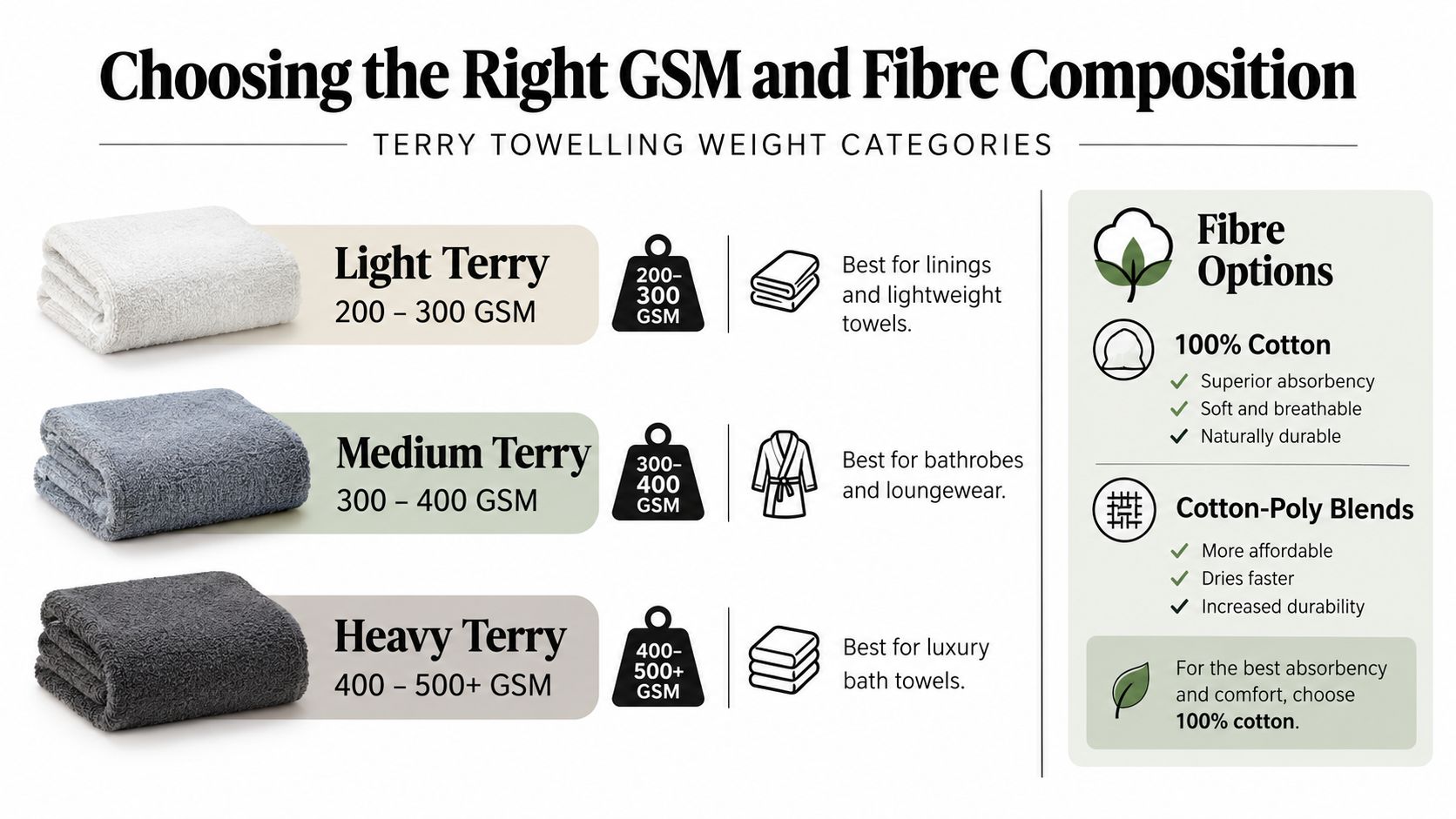
GSM, or grams per square metre, is a useful screening measure, not a complete performance specification. UK technical guidance places light terry at approximately 300 to 450 GSM, midweight terry at about 450 to 600 GSM, and heavier grades at 600 GSM or more, as outlined in this UK terry towelling buying guide.
Light terry suits quick-drying accessories, children's garments and travel pieces. Midweight cloth offers a practical compromise for robes, everyday towels and bath-related accessories. Heavy terry gives a more enveloping feel and can hold more moisture, but it also adds bulk, weight and drying time. For a robe, that trade-off matters at the shoulder seams and belt loops, not just at the point of purchase.
Compare the whole specification
Two fabrics with the same GSM can behave very differently. Pile-yarn twist, loop height, ground construction and fibre type all influence softness, linting, capillary uptake and wash durability.
| Check | Why it matters |
|---|---|
| GSM | Indicates approximate fabric mass and helps compare like with like |
| Fibre composition | Affects absorbency, drying, shrinkage and stability |
| Pile construction | Influences plushness, snagging and moisture movement |
| Width | Determines pattern layout and fabric quantity |
| Post-wash dimensions | Shows whether the cloth will distort after laundering |
| Colourfastness | Matters for towels, baby items and frequent washing |
Fibre composition deserves particular attention. Cotton terry is a strong choice where moisture absorption is the priority. A cotton-polyester blend may dry faster and hold its dimensions more reliably, although it can offer a different hand and moisture response. Don't infer the content from the words “towel fabric”. Ask for the percentages and check whether the pile and ground use different fibres.
A fabric swatch is more useful than a product photograph. Weigh it before and after washing, record the dimensions in both directions, time how long it takes to dry, and compare how much lint remains in the machine filter. If you're comparing fabric weights for another project, this overview of how to choose the right tee weight provides a useful reminder that weight should always be matched to end use.
Best Applications for Terry Towelling Projects
A robe and a baby wipe may both need to absorb moisture, but they don't need the same cloth. The robe needs a comfortable drape, manageable bulk and seams that won't become unwieldy. A wipe needs a soft surface, easy washing and a drying time that fits everyday use.
Match construction to the project
For dressing gowns and bathrobes, midweight terry is often the easiest starting point. It provides substance without making every seam excessively thick. Heavyweight cloth creates a luxurious result, but use it selectively. A very dense pile can overwhelm a collar, make a belt knot bulky and place strain on a hanging loop.
Baby items need softness and predictable laundering. A hooded towel benefits from a stable ground and a pile that doesn't shed excessively. For burp cloths, washcloths and bath blankets, a lighter or midweight terry is easier to handle, bind and dry than a deep-pile luxury cloth.
Reusable nappies and cloth wipes need a different balance. Absorbency matters, but so does drying speed. A fabric that holds a great deal of water can become inconvenient if it stays damp between washes. Use a swatch to assess how thick the finished layers will be, particularly if you're folding terry into an insert.
| Project | Look for | Avoid |
|---|---|---|
| Hooded robe | Stable midweight pile and manageable seam bulk | Very loose loops around the hood and neckline |
| Bath towel | Strong ground and resilient loops | Thin patches or easily pulled pile |
| Washcloth | Soft, flexible surface with quick laundering | Excessive thickness that stays damp |
| Reusable nappy insert | Absorbent layers that can dry thoroughly | Dense construction that becomes slow to dry |
| Cleaning cloth | Durable, washable fabric and firm edges | Decorative trims that cannot tolerate regular washing |
Kitchen towels, pot holders and oven mitts can also make good use of terry, but check the heat requirements. Terry can absorb moisture effectively, yet it isn't automatically suitable as the only heat barrier near hot cookware. Layer it with an appropriate heat-resistant material where the project demands protection.
For visual ideas around wearable towel designs, you can compare women's towel bathrobes, then assess each style by its likely fabric weight, seam bulk and laundering needs rather than appearance alone.
Sewing Techniques for Terry Towelling Success
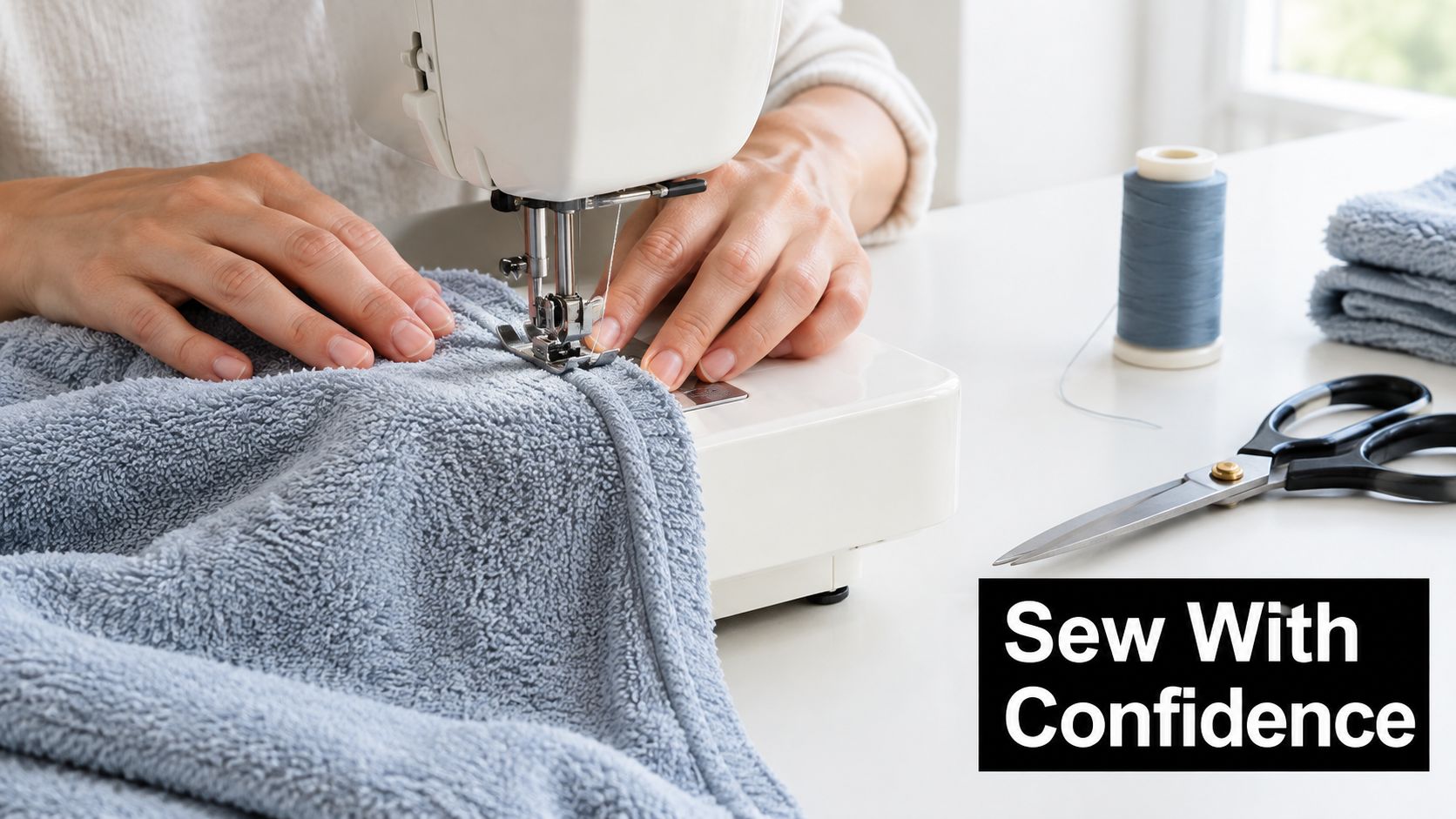
Terry rewards preparation. The pile can hide stitching, shift under a presser foot and shed around freshly cut edges, so a careful setup saves time later.
Begin with a fresh needle suited to the cloth. A universal or ballpoint needle is a sensible starting point for stable terry, while a stretch needle can help if the fabric contains synthetic fibres or has noticeable elasticity. If the needle drags, skips stitches or pushes loops into the seam, change it rather than trying to compensate with tension adjustments.
Use a medium stitch length and test it on a doubled scrap. A stitch that is too short can create a perforated seam and compress the pile. A stitch that is too long may not secure a bulky edge effectively. Reduce presser-foot pressure if your machine allows it, and use a walking foot when layers creep.
Control the edges
Terry frays at cut edges, especially where the ground is loose or the pile is trimmed. Finish seams promptly with an overlocker, zigzag stitch or a carefully applied binding. French seams can work on lighter terry, but bulky midweight and heavyweight cloth may sit more neatly with an overlocked seam pressed to one side.
For hems, test the turning before committing to the garment. A narrow double-fold hem can become stiff when it contains a deep pile. Bias binding gives a clean finish around curved edges, cuffs and hood openings, and a cotton binding can make the edge easier to control.
Prewash before cutting
Prewashing is not optional for fitted terry projects. Finishing residues can affect absorbency, and laundering can alter both dimensions and handle. Wash the fabric at the care temperature you intend to use for the finished item, dry it completely, then measure the length and width again. The technical study on finishing and absorption explains why treatments and relaxation can change the cloth after washing.
Practical rule: Keep a washed sample with your pattern notes. Record the original and post-wash measurements, the care setting and any change in pile height or softness.
Cut with the pile running consistently in one direction. Mark the nap on the wrong side, transfer notches clearly and use clips where pins could disappear into the loops. A rotary cutter can reduce distortion, but scissors work well when the fabric is supported on a flat surface and cut in a single layer.
Caring for Your Terry Towelling Creations
Good care protects the loops, and the loops are where terry earns its place. Wash finished items according to the fibre content and the care instructions established during your prewash. Avoid fabric softener for towels, robes and absorbent inserts because it can coat the pile and reduce its ability to take up water.
Choose a thorough but not unnecessarily aggressive wash. Reduced agitation and a smaller wash-liquor ratio can lower fibre release, while repeated washing reduces shedding substantially before it reaches a plateau after about three washes, according to UK household-laundry microfibre research. The same research found that real wash loads released an average of 114 ± 66.8 mg of microfibres per kg of fabric, with fibres mainly coming from natural materials such as cotton.
A practical care routine
- Wash by composition: Follow the needs of cotton, synthetic or blended fibres rather than assuming every towel should receive the same treatment.
- Dry with restraint: Line drying is gentle when conditions allow. If you tumble dry, use a lower heat setting appropriate to the fabric and avoid baking the pile dry.
- Protect the loops: Shake items out before drying and don't overload the drum. Crowding encourages uneven drying and can flatten the surface.
- Press from the reverse: Use moderate heat on the wrong side if pressing is necessary. Light steam is preferable to crushing the loops under a hot iron.
- Store with support: Fold heavy robes and towels instead of leaving them hanging for long periods, which can strain shoulders, hanging loops and seams.
Reusable nappies and cloth wipes need particular attention to detergent build-up and drying. If absorbency drops, review the wash routine and rinse thoroughly rather than immediately adding more product. Test any occasional vinegar treatment on a spare piece first, especially where elastane, trims or mixed fibres are present.
Sourcing Quality Terry Towelling in the UK
A reliable purchase starts with a written specification. Before ordering, decide whether the project needs rapid drying, maximum moisture holding, a soft surface, dimensional stability or a balance of all four. Then use the supplier's information to test whether the fabric fits that purpose.
The description should include GSM, width, fibre composition and pile type. Add colourfastness, expected dimensional change after washing and any information about finishing. If the listing only says “terry” or “towel fabric”, contact the seller before buying. A vague name tells you almost nothing about how the cloth will behave in a robe, nappy insert or bound towel.
Check the label, not the assumption
UK textile rules require products to state the name and percentage by weight of every constituent fibre, listed in descending order. The information should be durable, legible, visible, accessible and securely attached. Fabric sold by the metre may show the composition on the length or roll. The UK textile labelling guidance also matters where separate components have different fibre contents.
That last point is easy to miss. A towel item may have a cotton pile but a different-fibre backing, trim or laminated layer. Don't describe the whole product as cotton unless the composition supports that description. Preserve the fibre information with your project notes, particularly if you plan to sell the finished item.
Order a swatch whenever possible. Wash it as the finished project will be washed, measure shrinkage in both directions, inspect edge fraying, check lint and assess drying time. If the result works, buy enough fabric from the same batch and keep the original sample as a reference.
End-of-life planning belongs in the buying decision too. England's local-authority-managed waste evidence records 98 kilotonnes of textiles, or 9%, collected for recycling in 2023–24, while 856 kilotonnes, or 77%, went to energy-from-waste facilities, according to this UK textile-flow report. Reuse the cloth for washable cleaning pieces or absorbent inserts while it remains sound, separate mixed-material trims where practical, and check local textile-collection rules rather than placing fabric in ordinary household recycling.
For terry towelling projects, More Sewing offers quality fabrics, haberdashery, sewing kits and sample swatches to help you check handle, composition and suitability before cutting. Visit More Sewing to find practical materials for your next robe, towel, reusable cloth or home-sewing project.
