
You've cut a favourite cotton fabric, sewn the side seams and tried it on, only to find that reaching forward pulls the whole bodice out of shape. Or perhaps you made a child's leggings from a firm cotton and watched the knees bag after an afternoon of running, climbing and sitting. These are not always pattern problems. Often, the fabric wasn't chosen for the movement the garment needs.
Stretch cotton fabrics sit between rigid woven cotton and very fluid jersey. Cotton brings softness and breathability, while a small amount of elastane, the term normally used on UK garment labels, adds give and helps the cloth recover after movement. The useful question isn't just whether a fabric stretches. It's how far it stretches, which direction it stretches in, and whether it springs back.
The choices at the cutting table follow from those answers. You'll need to consider the fabric's blend, weight, grain, bias, recovery, needle and stitch before you decide whether it belongs in a fitted top, a pair of trousers or a child's leggings.
When a Plain Cotton Just Will Not Do
A crisp cotton lawn can make a beautiful blouse, but it won't forgive every movement. If the shoulder seams pull when you reach for a shelf, the cloth is telling you that the garment needs either more ease or more movement in the fabric. A cotton-elastane alternative may give the same fresh, breathable feel while allowing the bodice to follow your shoulders.
The opposite problem appears with a favourite pair of jeans. A rigid denim can hold a sharp shape, but sitting, kneeling and climbing stairs all place stress on the seat and knees. Stretch cotton denim gives the wearer a little more freedom without turning the garment into a soft, loose knit.
That small difference changes how you sew. A woven stretch cotton may still need a conventional grainline, structured seams and careful pressing, but the finished garment can move more comfortably than an equivalent non-stretch fabric.
Classroom observation: Stretch is useful only when it appears in the direction your garment needs. A fabric that stretches across the body won't solve a sleeve that needs movement from front to back.
The history is relatively modern. Elastane was invented in 1937 but didn't enter widespread use until around 1960, so stretch cotton is a comparatively recent development rather than an old natural-textile tradition, as outlined in this UK guide to elastane and cotton blends. Elastane can stretch to about seven times its relaxed length, although the actual fabric performance depends on construction, blend, weight and recovery.
In practical terms, you're looking for a controlled compromise. Use a cotton-rich cloth when you want a familiar hand, breathability and a defined shape. Add stretch when the garment must follow the body, resist strain at the knees or waist, or feel easier to wear through a full day.
What Stretch Cotton Actually Means
Stretch cotton is cotton fabric combined with a recoverable stretch fibre. The cloth may be a woven denim, sateen or twill, or it may be a knitted jersey. The cotton content provides the main surface and hand feel, while elastane supplies much of the spring-back that stops the fabric remaining permanently stretched.
UK fabric and clothing descriptions generally use elastane. American descriptions may use spandex, and some product names use other trade terminology. When you're shopping online, read the fibre composition rather than relying on the product title. A fabric called “cotton stretch” may have very different behaviour from another fabric with the same marketing phrase.
Two blend ratios appear frequently in UK dressmaking and clothing:
- 98% cotton and 2% elastane gives subtle ease while preserving a strongly cotton-rich feel. It suits woven workwear, light tailoring, shirts, skirts and trousers where you want movement without a close-fitting, compressed effect. A Portwest technical data sheet for cotton-elastane workwear fabric illustrates this cotton-rich specification.
- 95% cotton and 5% elastane provides more noticeable give and is widely associated with jeans, fitted tops and other garments that need movement and shape retention. It can work in a fitted dress or pull-on skirt, provided the fabric's actual stretch and recovery suit the pattern.
The ratio isn't a complete description. Two fabrics with the same composition can behave differently because one is a dense woven denim and the other is a soft jersey. A 95/5 jersey may stretch readily in several directions, while a 95/5 woven may offer more controlled movement, often concentrated across the width.
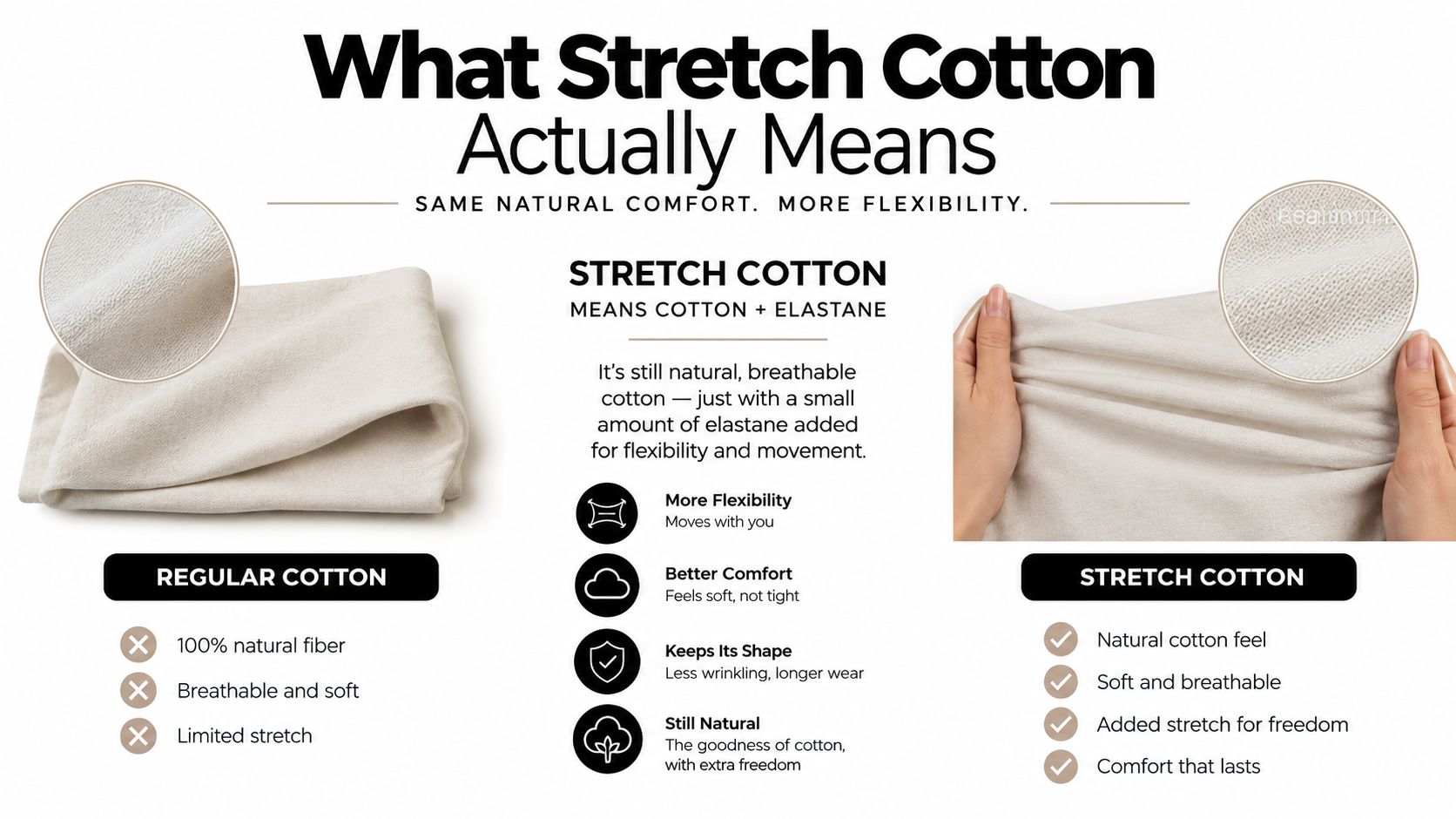
Don't choose the fabric from the fibre percentage alone. Check the product description for woven or knitted construction, stretch direction, fabric weight, recovery and recommended uses. Then test a sample before cutting. That test tells you more about the finished garment than the composition label by itself.
How Common Stretch Cotton Has Become in UK Wardrobes
Stretch fibre is no longer limited to specialist sportswear. A UK-focused analysis found elastane in 34% of millions of items available for sale online, including 52% of jeans, 27% of T-shirts, sweatshirts and tank tops, 73% of swimwear and 86% of underwear, according to this UK report on elastane prevalence in clothing.
| Garment category | Approx. % containing elastane |
|---|---|
| Jeans | 52% |
| T-shirts, sweatshirts and tank tops | 27% |
| Swimwear | 73% |
| Underwear | 86% |
The figures matter at the sewing table because ready-to-wear has trained people to expect comfort at the waist, seat, knees and shoulders. A home-sewn pair of trousers made from rigid cotton may fit correctly when standing but feel restrictive when sitting. A jersey top without enough recovery may feel comfortable at first and then lose its neckline or hem shape.
The same report found elastane in 47% of Shein products and 46% of PrettyLittleThing products, showing that stretch construction is also well established in mass-market clothing. That doesn't mean every stretch fabric is a good choice, or that every garment needs it. It means you're likely to encounter stretch cotton in fabric shops, deadstock bundles and recycled clothing streams, not just in specialist performance ranges.
What this means for home sewing
Treat stretch as a design property, not an optional bonus. Check whether the pattern expects a stable woven, a fabric with crosswise ease or a fabric that stretches in both directions. A pattern drafted for non-stretch cotton may become too loose in a highly elastic cloth, while a close-fitting pattern may be uncomfortable in a fabric with little recovery.
This prevalence also raises an end-of-life question. Blended fibres can be harder to separate and recycle than a single-fibre cloth, so the best use of stretch cotton is one where its movement and recovery provide a clear benefit. A well-fitting garment that you repair and wear repeatedly may be a more considered choice than buying stretch only because it is familiar.
Testing Stretch and Recovery Before You Buy
A fabric can stretch in two ways that matter to a dressmaker. Two-way stretch generally means the cloth gives mainly across the width or mainly along one direction. Four-way stretch gives both across and along the fabric, although the amount of movement may still differ between the two directions.
Never assume the direction from the word “stretch” on a listing. Hold the fabric by the selvedges and gently pull. Then turn it a quarter turn and test again. The direction with greater movement is usually the one you'll want to place around the body for a close-fitting garment, unless the pattern says otherwise.
Measure the extension
A simple sample test makes the fabric easier to judge. Cut a strip or square with a 10 cm reference length, as recommended in this UK sewing and fabric-care guidance. Mark the relaxed points, then stretch the sample gently in the direction you're assessing. Record the new length without forcing the fabric until it distorts.
The change from the relaxed length gives you a practical stretch percentage. If the sample barely extends, reserve it for a pattern requiring ease rather than close fit. If it extends readily, it may suit a fitted top or pull-on garment, but you still need to assess recovery.
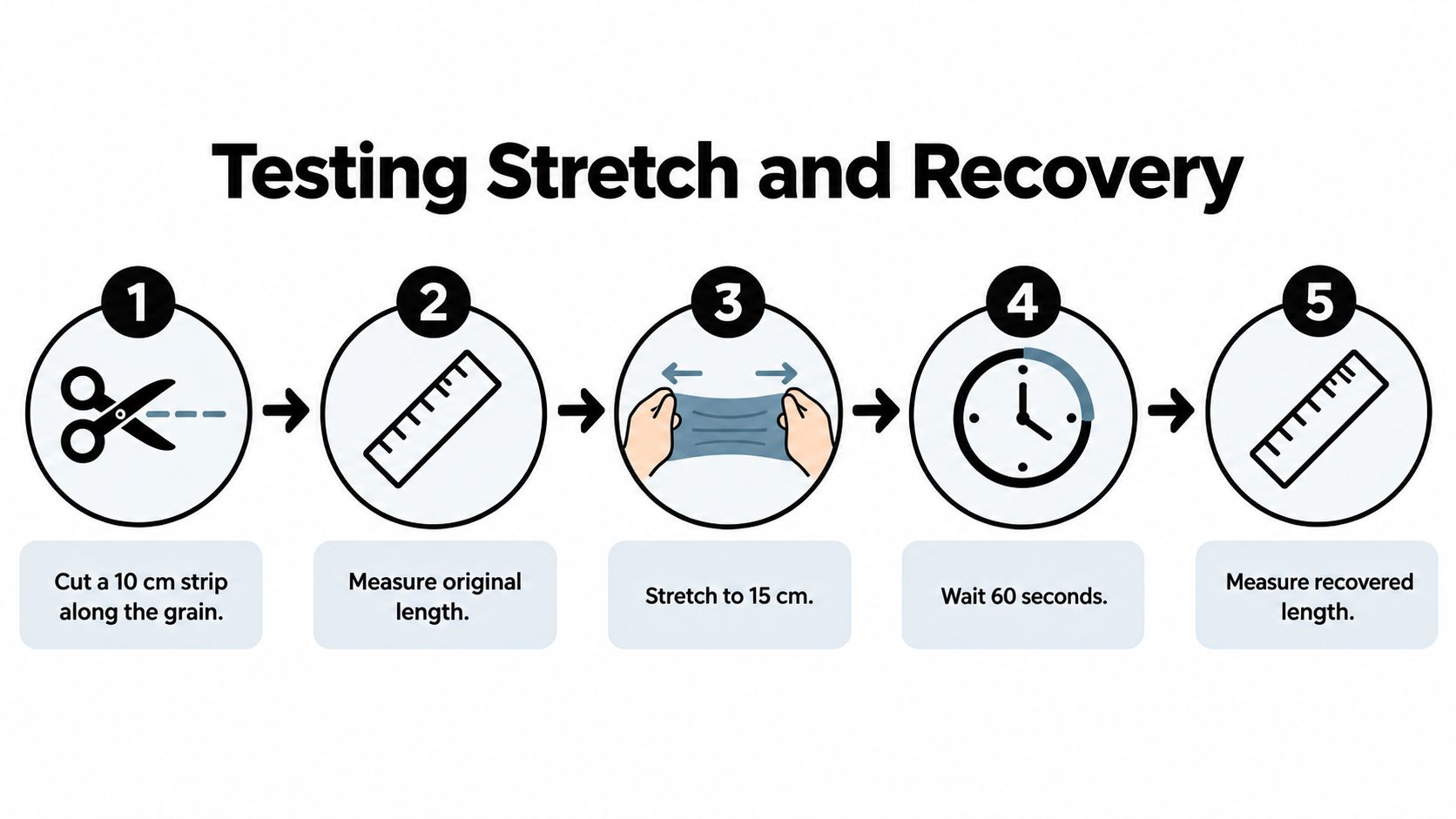
Recovery is what happens after you release the fabric. A good sample moves back towards its original size with little rippling or permanent distortion. A fabric that extends impressively but stays wavy, limp or longer after release may bag at the knees, neckline or seat.
Recovery check: Stretch the sample, release it and look at the edge. If the edge remains visibly longer or develops wrinkles, don't treat the maximum stretch as a reliable guide to garment fit.
For jeans, a cotton-rich denim with 2% elastane can feel almost firm on the bolt yet recover cleanly after movement. For children's clothing, recovery often matters more than maximum extension because constant activity repeatedly pulls at knees, hips and waistbands. Choose the cloth that returns to shape rather than the cloth that stretches furthest.
Choosing Weight, Bias and Pre-Wash Settings
Fabric weight sets the character of a garment before you sew a seam. A lightweight stretch cotton may drape into a blouse, while a dense denim or sateen can support trousers, a structured skirt or a jacket. The same pattern can produce entirely different results if you change from a fluid jersey to a firm woven.
Bias adds another layer. Woven fabrics usually offer their most obvious diagonal movement on the bias, while elastane adds recoverable stretch according to the fabric's construction and fibre placement. A bias-cut bodice can skim around the bust and waist, but a heavy cloth with limited stretch may resist the shape and twist at the seams.
| Fabric behaviour | Typical project direction | Bias recommendation |
|---|---|---|
| Lightweight and softly draping | Blouses, relaxed tops and summer dresses | Use the straight grain for stability, or test a bias piece before committing |
| Cotton-rich fabric with moderate movement | Fitted tops, skirts and everyday trousers | Keep major seams on the grain and use the stretch across the body |
| Dense denim, twill or sateen | Jeans, structured trousers and jackets | Avoid unnecessary bias cutting unless the sample proves the cloth can support it |
These are decisions about behaviour, not fixed categories. Drape the fabric over your hand, fold it on the bias and compare that with a straight-grain fold. If the bias collapses attractively but the cloth becomes difficult to control, use the effect in a small panel, neckline or skirt section rather than cutting the whole garment diagonally.
Pre-wash before pattern placement
Shrinkage can change both fit and grain. One UK source gives 2% to 8% as a practical planning allowance for stretch cotton denim, while another notes that stretch fabrics can have around 5% shrinkage tolerance and recommends checking against standard wash testing such as BS EN ISO 6330 at 30°C, as described in this stretch denim care and shrinkage guide.
Cut a 10 cm square sample, wash it as you intend to wash the finished garment, and check for shrinkage, colour loss, texture change and edge distortion. Pre-wash the full length in the same way before cutting, especially if the garment will be washed regularly. Let the fabric rest flat so the grain settles, then press it according to the cloth's needs.
For pressing, use a medium iron while the fabric is slightly damp if the fibre and care instructions allow it. Cotton lawn generally responds well to line drying and hot ironing with steam, but elastane-containing cloth may need gentler handling. Do not assume a hot tumble-dry cycle is suitable just because the fabric is cotton-rich.
Sewing Machine Setup and Stitch Choices
Stretch cotton becomes much easier when the needle, feeding method and stitch all agree with the fabric. A plain straight stitch locks the seam into a fixed length. If the garment stretches across that seam, the thread may pop even when the fabric itself remains intact.
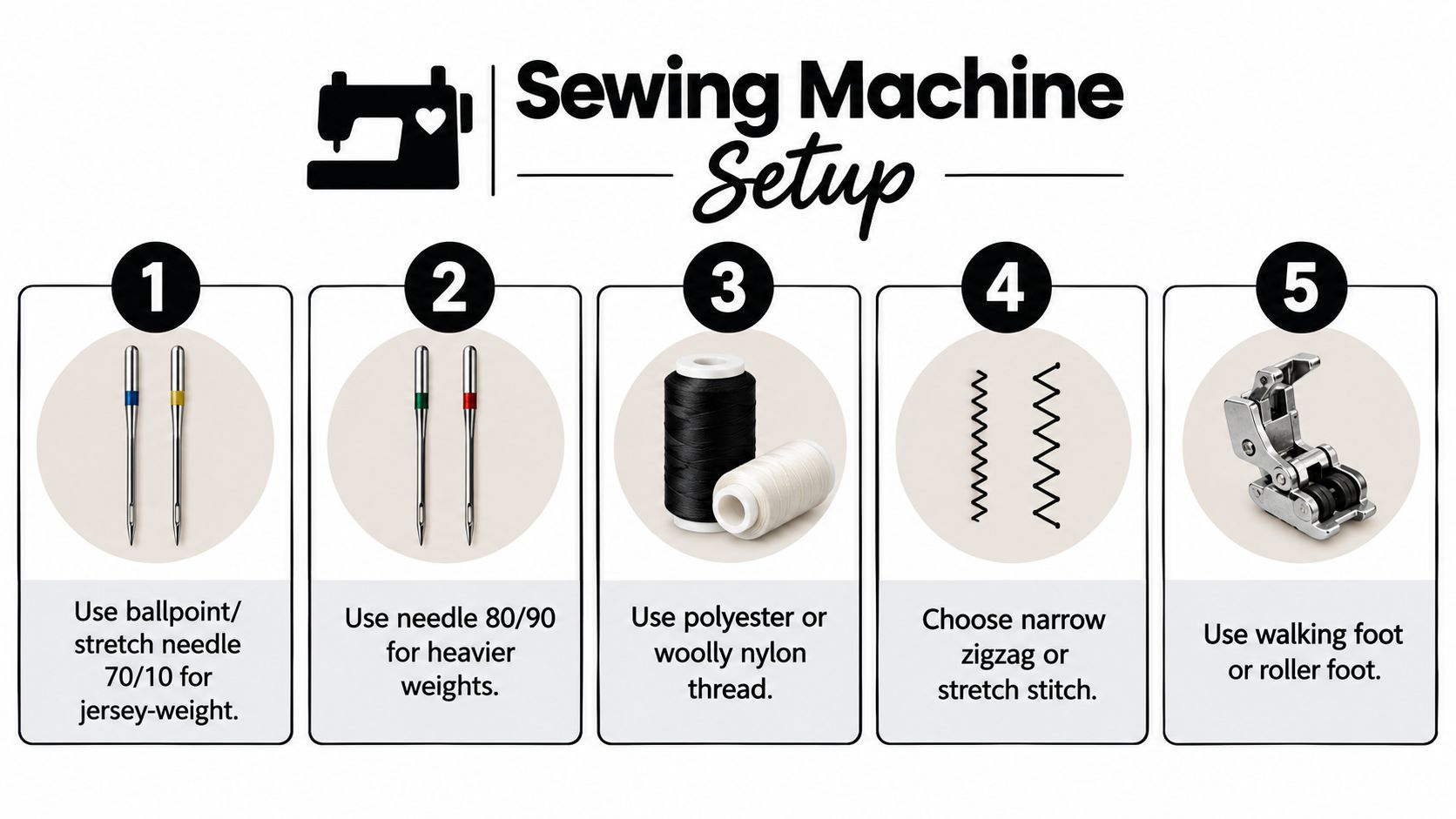
Start with the needle. UK sewing guidance recommends a ballpoint or stretch needle for stretch fabrics because the rounded tip moves between fabric strands instead of piercing them directly. Other needle advice lists Universal H, Ballpoint H-SUK and Stretch HS options, with pins kept inside the seam allowance to reduce visible holes, as explained in this UK guide to sewing stretch cotton.
Match the stitch to the movement
Use a narrow zigzag, a stretch stitch or an overedge stitch where the seam needs to flex. The width and length should be tested on a scrap because a dense stitch can create a stiff ridge, while a very open stitch may not hold a curved seam securely.
Sew in the direction with the least tendency to stretch the layers. Don't pull the fabric behind the presser foot. If the top layer creeps ahead of the bottom layer, a walking foot can feed both layers more evenly. A serger can also help finish edges and accommodate movement, but test the differential feed and cutting action on scraps first.
Before the garment: Sew a sample seam, stretch it as the finished seam will be worn, and inspect both the stitches and the fabric. A seam that looks neat while flat may fail when pulled.
Pins belong within the seam allowance, not across the stitching line. This is especially useful with elastane-containing cloth, where misplaced pins can leave holes or weaken the edge. If the fabric curls, slips or grows during sewing, stabilise the area with temporary paper, a strip of lightweight stabiliser or careful handling rather than forcing it under the foot.
Build a test square
Use scraps cut in the same grain and direction as the garment. Test the shoulder seam, side seam or waistband area most likely to experience movement. Try the fabric with a conventional seam finish, then with a stretch-friendly stitch, and compare how each behaves when pulled.
For stretch denim, a longer topstitch can give a cleaner ready-to-wear appearance, but the seam beneath still needs to tolerate movement. A twin needle may create a useful flexible hem, provided your machine handles it and you test thread tension first.
This Goldsmiths textiles sewing guide also recommends zigzag or stretch stitches and notes that a walking foot or serger can help feed stretchy fabric evenly. Its practical value is simple: solve feeding and stitch problems on an offcut before the machine reaches a visible neckline or waistband.
The video below demonstrates a practical setup for working with stretch fabrics.
Three Stretch Cotton Projects Worth Trying
A fitted top is a useful first project because it makes stretch direction and recovery easy to evaluate. Choose a soft cotton-elastane jersey with movement across the body and enough recovery to return after you pull it over your head. Cut the front and back so the main stretch runs around the chest, then test the shoulder seams before attaching the neckband.
A neckband needs a fabric that can extend around the opening and recover without standing away from the neckline. If the band looks wavy, the issue may be excessive stretching during attachment rather than a faulty pattern. Sew slowly, support the fabric in front of and behind the needle, and avoid dragging the neckline through the machine.
A child's legging
Leggings demand a different decision. The fabric doesn't need to stretch furthest if the pattern already includes close fit and the cloth has dependable recovery. A heavier cotton-rich jersey with stretch mainly across the width can work well when the stretch direction follows the child's legs and hips.
The common beginner mistake is to cut without checking direction. If the strongest stretch runs vertically instead of around the body, the garment may feel tight even though the fabric looked flexible in the shop. Check the sample, mark the stretch direction on the wrong side and transfer that information to your cutting layout.
A summer dress
A woven-look stretch cotton sateen creates a more structured dress than jersey. Its modest mechanical stretch can make a fitted waist or bust more comfortable while preserving a crisp surface. Keep the grain straight through the bodice unless your sample proves that a bias section hangs cleanly.
Sateen also highlights a needle mistake. A ballpoint needle is intended for knitted stretch structures, while a woven sateen may need a needle suited to its surface and density. Test the chosen needle on a concealed scrap, then examine the fabric under good light for snags, skipped stitches or puncture marks.
Across all three projects, pre-washing comes first. Skipping that step can leave a top shorter, leggings tighter or a dress altered at the waist after the first laundering. Treat the test sample as part of the garment, not as a delay before the “real” sewing begins.
Key Takeaways and Next Sewing Steps
Before cutting stretch cotton, make four decisions:
- Test the movement. Use a 10 cm sample to assess extension in each direction, then release it and check recovery. Don't choose a close-fitting pattern from stretch alone.
- Pre-wash the cloth. Use a 30°C wash test where suitable for the fabric and finished garment, then measure and inspect the result before pattern placement.
- Match the needle to the structure. Use a ballpoint or stretch needle for knitted stretch fabrics, and test the needle on woven stretch cotton such as sateen or denim.
- Choose a flexible seam method. Test a zigzag, stretch or overedge stitch before sewing the garment. Support the fabric and use a walking foot if the layers are moving unevenly.
The next useful skill is pattern ease. Learn how negative ease affects a close-fitting top, practise attaching a knit neckband without stretching the neckline out, or test a twin needle on a hem. Each skill becomes easier once you understand what the fabric is doing.
Take one stretch cotton from your stash today. Cut the sample, mark the relaxed length, wash it as the finished garment will be washed and check its recovery before you cut the pattern.
More Sewing offers cotton, jersey and stretch dressmaking fabrics, along with haberdashery, patterns, kits and sample swatches to help you match fabric behaviour to a project. Visit More Sewing to choose your cloth and sewing supplies, or to find machine servicing and repairs if your equipment needs attention.
