
Guides
Colour Fastness Testing: Sewist’s Guide to No-Bleed Fabrics
You finish a blouse, press the seams, admire the drape, and finally wash it before wearing. Out it comes with the white facings tinged pink, the underarm area slightly duller than the rest, and the matching belt now a different shade from the bodice. That sinking feeling is why sewists care about colour fastness testing.
It's not just about obvious disasters, either. Sometimes the problem is quieter. A dark denim jacket leaves blue marks on a pale crossbody bag. A vivid viscose print looks fine in the shop but loses crispness after laundering. A striped top doesn't fully bleed, but the white stripe picks up enough dye to look grubby. When you've spent hours cutting, interfacing, unpicking, and finishing, even “slight” dye movement feels like a project failure.
Most makers have had at least one fabric teach them this lesson the hard way. The frustration isn't only the wasted fabric. It's the lost confidence. You start wondering whether a bold print is worth the risk, whether deadstock is too unpredictable, or whether dark colours are best avoided altogether.
That's where colour fastness stops being a dry lab phrase and becomes practical sewing knowledge. It tells you how well a fabric keeps its own colour and how likely it is to transfer dye to something else. Once you understand that, you can make smarter choices before the scissors come out.
The Heartbreak of a Bleeding Fabric
A customer once described it perfectly. She said the first wash of a handmade dress feels like the definitive handover. Until then, the garment is still on trial. That's especially true with saturated reds, inky navies, black linen, indigo denim, and some small-batch prints.
When the problem shows up
Bleeding fabric usually reveals itself in a few familiar ways:
The mixed-load disaster. A newly sewn garment releases dye and lightly stains lighter pieces in the same wash.
The self-staining problem. Contrast details such as collars, facings, pockets, or binding pick up colour from the main fabric.
The wear-transfer issue. Dye rubs onto handbags, shoes, sofas, or other garments during use.
The slow fade. The fabric doesn't bleed dramatically, but the richness drops away after washing or regular wear.
None of those failures feels minor when the garment was handmade.
A fabric can sew beautifully and still perform badly once water, friction, sweat, or sunlight get involved.
Why sewists get caught out
The trouble is that many fabrics don't advertise risk clearly. A cloth can feel high quality in the hand and still have disappointing fastness. Deadstock can be excellent, but it can also vary from one lot to another. Dark shades often deserve more caution than pale ones, because deeper colour can be harder to keep stable in use.
Sewists also tend to judge fabric at the cutting table, where colour is static. Real life isn't static. Garments get washed, sat on, rubbed under coat sleeves, exposed to window light, and worn against skin on warm days. Fastness problems only show up once the fabric meets those conditions.
That's why a quick pre-project check matters so much. It's less glamorous than choosing buttons, but it saves more projects than almost any other habit. Good colour fastness testing, even at a simple home level, helps you decide whether a fabric is right for a shirt, better for a jacket, or best kept away from anything with white contrast details.
What Is Colour Fastness Really
Colour fastness is the fabric's ability to keep its colour where it belongs and keep that colour looking right in use.
A polished wooden table gives a useful comparison. A good finish stands up to spills, sunlight, and daily handling. A poor one marks, fades, or wears thin at the edges. Fabric colour behaves much the same way. The dye or print has to stay put through washing, rubbing, wear, sweat, and light.
In practice, colour fastness is not one single yes or no judgement. It is a group of separate performance checks. A fabric can behave well in the wash and still fade in a sunny room. It can hold its own colour reasonably well but still leave dye on a lining, a bag strap, or pale topstitching. That is the part that often gets missed when sewists only hear the vague label “colourfast.”
Two different kinds of failure
Most problems fall into two categories:
Colour change means the fabric itself fades, dulls, or shifts shade.
Colour staining means dye transfers onto another material.
That split matters at the cutting table.
A dark cotton sateen for a dress might look rich and stable on the bolt, then lose depth after a few washes. A navy twill for trousers might keep its colour fairly well but rub onto a light sofa or the inside of a pale coat. Those are different failures, and they affect different projects in different ways.
What sewists should ask instead
The better question is not “Is this fabric colourfast?” The better question is “Colourfast to what?”
For curtains, window seat cushions, and garments that spend time in strong daylight, light resistance matters more. For a tote bag, jeans-style skirt, or any dark cloth that will scrape against other surfaces, rubbing resistance matters more. For shirts, dresses, quilts, and children's clothes, wash performance and staining risk usually matter most. If your project includes white buttons, contrast binding, a pale lining, or mixed fabrics in one garment, transfer risk deserves extra attention.
Colour fastness testing transforms lab language from abstract to practical. It provides a method to match fabric to purpose. This helps you spot whether a cloth is suitable for an everyday blouse, acceptable for an occasional jacket, or risky for anything with white details.
That is what really matters for sewing. You do not need a perfect score in every category. You need the right kind of colour stability for the job the fabric is about to do.
Common Colour Fastness Tests Explained
A fabric can behave beautifully in one situation and fail badly in another. I see this all the time in the shop. Someone chooses a saturated print for a summer dress, and the risk is repeated washing. Someone else picks a deep navy for curtain panels, and sunlight is the bigger problem. The test only matters if it matches the life your project will have.
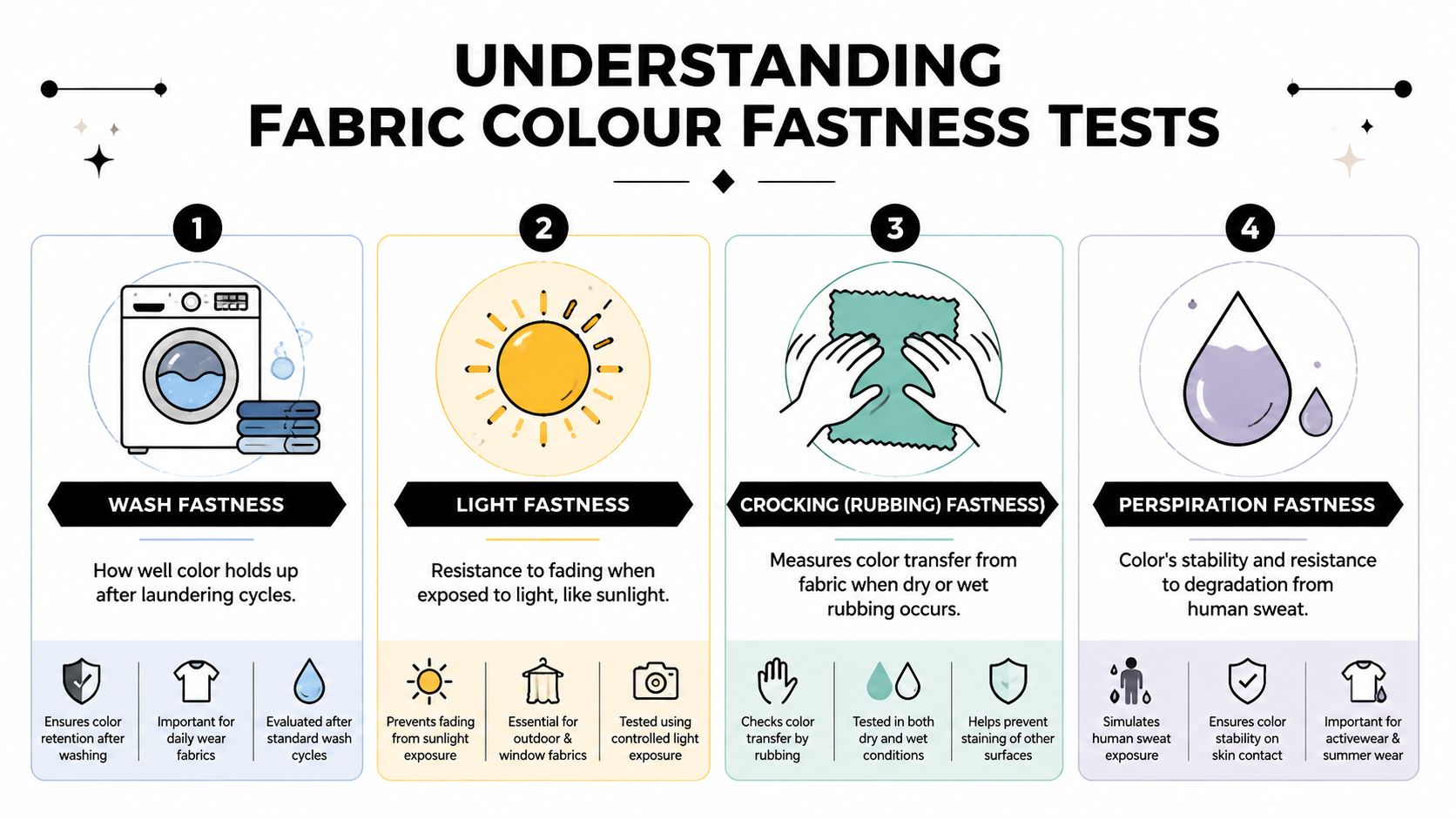
Labs separate these risks so you can judge them one by one. If you ever end up reading a supplier sheet, or navigating lab results for compliance, these are the tests you are most likely to see and the plain-English question each one answers.
Wash fastness
Wash fastness checks what happens to colour during laundering. It looks at two things. Does the fabric itself fade or change, and does dye move onto other materials washed with it?
For sewing, this is usually the first result to care about. It affects everyday dresses, shirts, children's clothes, quilts, pyjamas, bedding, and anything likely to be washed on repeat. If a fabric has weak wash fastness, bright shades can lose clarity, darks can look tired surprisingly quickly, and pale linings or facings can pick up stray colour.
Prewashing helps, but it does not fix a fabric that is fundamentally poor in this area.
Light fastness
Light fastness measures resistance to fading from daylight or stronger artificial light exposure. This is the test behind the classic problem of one side fading faster than the other.
It matters most for curtains, blinds, cushion covers in bright rooms, and garments worn outdoors for long stretches. A fabric can wash well and still lose colour badly in sun. That catches people out.
Watch for uneven fading on fold lines, shoulder areas, sleeve tops, and the edge of a curtain nearest the window.
Crocking or rubbing fastness
Crocking, also called rubbing fastness, checks whether colour transfers when the fabric is rubbed. Labs usually look at both dry and wet rubbing because moisture often makes loose dye travel more easily.
This is one of the most useful tests for sewists working with dark or heavily dyed cloth. Denim is the obvious example, but it also matters for twill, brushed cotton, canvas, cord, and some bold prints. If a fabric fails here, the problem often shows up on light bags, pale upholstery, shirt hems, coat linings, or even your hands during cutting and pressing.
Wet crocking is often the one that causes real-life complaints.
Perspiration fastness
Perspiration fastness checks how dye holds up against sweat and body salts. That sounds technical, but the sewing consequence is simple. Areas that sit close to skin and get warm can fade, shift in tone, or transfer colour sooner than the rest of the garment.
This test matters for fitted tops, shirts, dresses, activewear, headscarves, waistbands, underarm areas, and necklines. It is especially relevant if the fabric is dark, bright, or likely to be worn in heat.
A garment can look perfect on the hanger and still struggle here after a few wears.
Dry cleaning fastness
Dry cleaning fastness looks at colour stability in solvent cleaning rather than water washing. This matters for fabrics that will realistically be taken to the cleaner because of fibre type, structure, interfacing, or finish.
Tailoring cloth, formalwear, coated fabrics, and some linings are the usual candidates. If the colour is unstable under dry cleaning, the finished garment may come back duller, patchy, or mismatched where one component reacts differently from another.
That is a costly mistake when the fabric itself was expensive.
Colour Fastness Test Cheat Sheet
| Test Type | What It Simulates | Best Checked For These Projects |
|---|---|---|
| Wash fastness | Repeated home laundering | Dresses, shirts, quilts, children's wear |
| Light fastness | Sunlight and bright room exposure | Curtains, blinds, cushion covers, summer garments |
| Crocking fastness | Dry or damp rubbing in use | Denim, trousers, jackets, bags |
| Perspiration fastness | Sweat and body contact | Sportswear, fitted tops, dark linings |
| Dry cleaning fastness | Solvent-based professional cleaning | Tailoring, occasionwear, structured garments |
The useful habit is matching the test to the project. A café curtain, a black linen dress, and a pair of indigo trousers do not need the same kind of colour stability.
How to Interpret Ratings and Standards
The most useful colour fastness result for sewists is often the simplest one. A fabric gets a grade, and that grade tells you whether the change or staining was slight or obvious. The catch is that the number only becomes helpful when you connect it to an actual project.
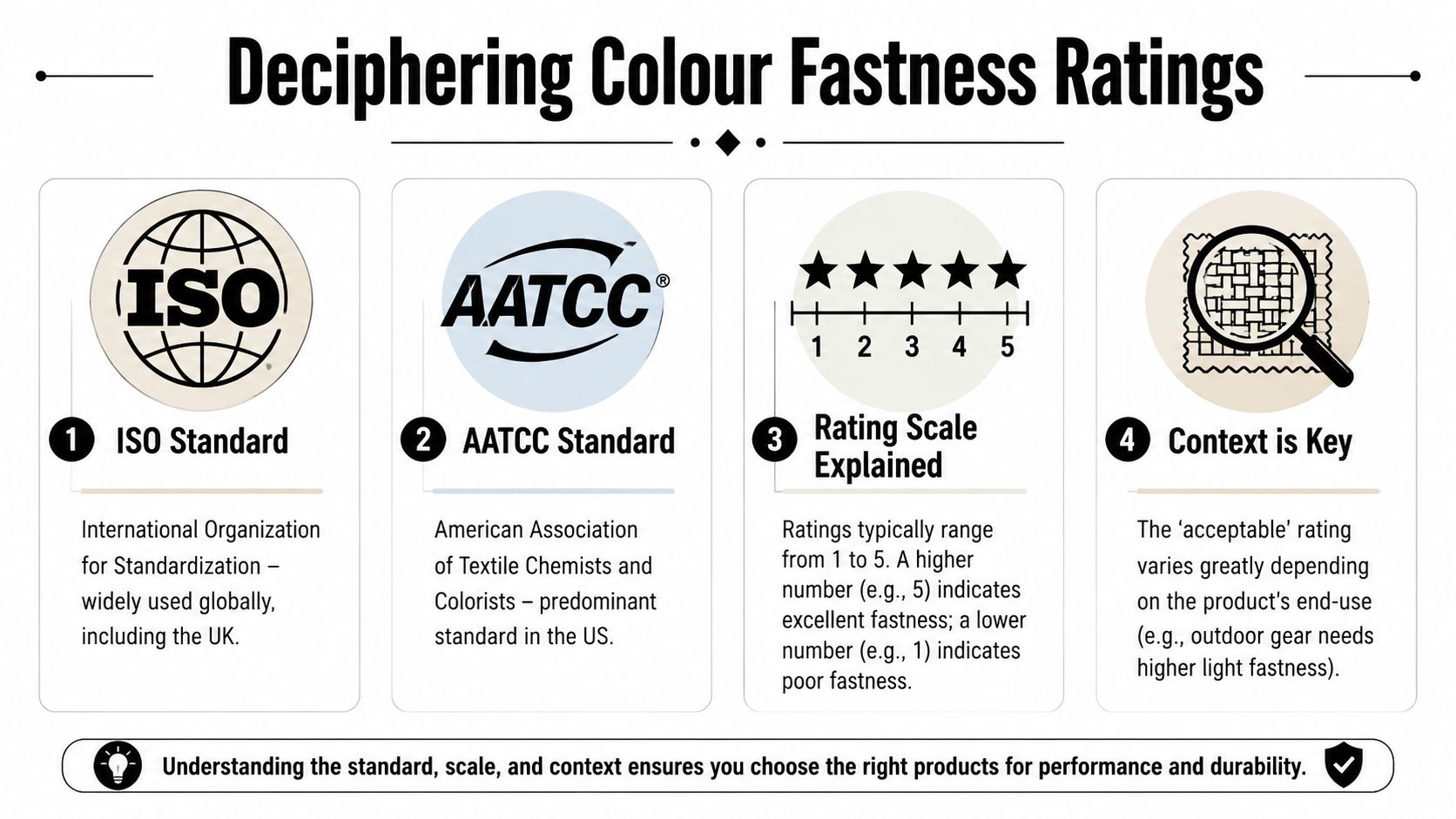
The 1 to 5 scale in plain English
A practical UK benchmark uses the grey-scale grading system from 1 to 5, where 1 means severe failure and 5 means no visible change or staining. For many apparel and home textile decisions, Grade 4.0 is treated as the standard for high-quality use, while Grade 3.0 is often the minimum acceptable level for more demanding items such as dark-wash denim, especially where wet crocking or staining risk is part of the equation, as summarised in this explanation of colour fastness grades and thresholds.
Here's how that plays out in sewing terms:
Grade 5. You'd expect little to no visible problem.
Grade 4. Usually solid for clothing and many home projects.
Grade 3. Potentially acceptable, but only if the project and fabric type make that compromise reasonable.
Grades 1 to 2. High risk for visible disappointment.
Context changes the decision
A Grade 3 result doesn't mean “bad fabric” in every case. It means you need judgement.
For example:
Grade 3 for wet crocking on dark denim may be workable if you expect some initial dye transfer, pre-wash thoroughly, and avoid pairing it with white bags or shoes.
Grade 3 for wash fastness on a red-and-white striped jersey is a warning. The white stripe is exactly where staining will show.
Grade 4 staining with Grade 3 colour change may suit a casual overshirt, but it's less reassuring for a fitted dress where you want the shade to stay crisp over time.
Lab numbers are only useful when you compare them to the real punishment your finished item will take.
Standards matter because the method matters
A rating is only worth trusting if the test was done in a repeatable way. That's the value of recognised standards such as ISO in the UK and AATCC in the US. They give labs a common method, so a result means more than a shop assistant's guess.
If you ever need help making sense of a formal report, especially one full of abbreviations and pass thresholds, this guide on navigating lab results for compliance gives a useful framework for reading technical results without overcomplicating them.
A quick decision filter
Use this simple lens when reading any fastness rating:
Where will the fabric live. In the wash, in the sun, against skin, or against upholstery?
What is nearby. White collars, pale linings, contrast topstitching, trim, or other laundry?
What's normal for the fabric type. Dark denim can be serviceable with a lower rubbing result than a nursery fabric or blouse fabric.
How much imperfection can you tolerate. Everyday utility wear allows more compromise than a special-occasion piece.
That's the difference between reading a number and making a good sewing decision.
Easy At-Home Colour Fastness Tests
Home tests won't replace a lab, but they're one of the most useful habits a sewist can build. They help you spot obvious risks before you cut into precious metreage, and they're especially worthwhile with dark shades, deadstock, viscose blends, dense prints, and unfamiliar suppliers.
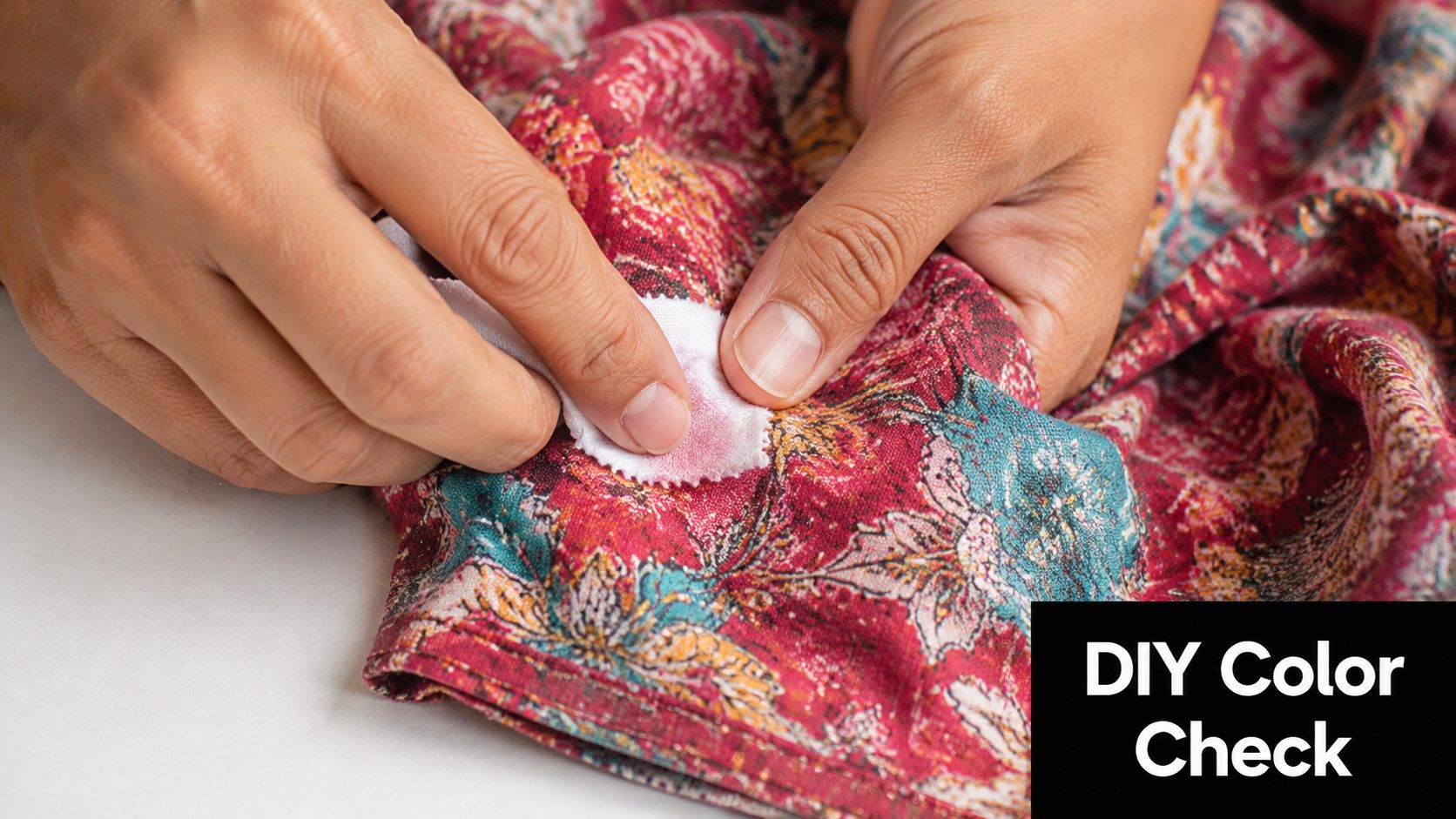
The damp cloth rub test
This is the quickest way to check for crocking risk.
Cut a small swatch from an unobtrusive area if possible.
Use a plain white cotton cloth or scrap of white lawn, calico, or old pillowcase.
Dampen the white cloth so it's moist, not dripping.
Rub firmly over the fabric several times, focusing on the darkest area or printed section.
Check the white cloth immediately for colour transfer.
If you see clear transfer, treat the fabric as higher risk for rubbing during wear. That doesn't always make it unusable. It may still suit a jacket, overshirt, or bag lining better than a fitted white-collared blouse.
The swatch wash test
This one checks for washing bleed and self-staining.
Cut a fabric swatch large enough to observe clearly after washing.
Place it with a piece of white cotton so any migrated dye has somewhere obvious to show.
Wash it as you plan to wash the finished garment.
Dry it fully before judging the result.
Compare before and after for both fading and transfer.
Look for two things separately. Has the original swatch changed? Has the white cotton picked up colour? Those answers tell you different things.
What works and what doesn't
At-home testing works best as a screening tool.
Useful for spotting obvious bleeding, obvious crocking, and comparing one candidate fabric against another.
Less reliable for subtle grading decisions, printed fabrics with multiple colour areas, and situations where trim, coating, or finishing complicates the result.
A home test can also miss differences between components. One shade in a floral print may behave well while another runs. A zip tape, contrast binding, or repair patch may respond differently from the main cloth.
Worth remembering: A clean home test result is reassuring. It isn't a warranty.
That caution matters because colour fastness testing depends on careful area selection and controlled conditions. Inconsistent sample preparation, humidity, or visual assessment under non-standard lighting can shift the result, which is why home checks are a good indicator rather than a guarantee, as discussed in this note on handling poor rubbing fastness and test variation.
How to get more useful home results
A few small habits make your checks more trustworthy:
Test before pre-washing and after if the fabric worries you.
Try the darkest section first. That's where trouble usually reveals itself fastest.
Check under decent neutral light rather than a warm evening lamp.
Test trims separately if you'll use contrast tape, lace, or a bold zip.
Keep notes on which fabrics bled, faded, or stayed stable. Your own experience becomes a strong buying guide over time.
Smart Fabric Buying Tips for Sewists
The cheapest insurance in sewing is usually a swatch. Not because swatches are exciting, but because they let you test before commitment. If a fabric is going to bleed, fade, or rub off, it's far better to discover that on a small sample than on three metres and a nearly finished garment.
Buy for the project, not for the abstract ideal
For UK sewists, one of the main challenges is translating lab-style thinking into practical garment choices, especially with deadstock where dye consistency can vary. It's more useful to focus on the tests that matter for your project, such as wash fastness for a quilt or light fastness for curtains, than to chase perfection in every category, as noted in this discussion of colour fastness techniques and real-world priorities.
That means buying with a shortlist in mind:
For dresses and shirts. Prioritise wash behaviour and staining risk.
For curtains. Put fading resistance near the top.
For denim and dark twill. Expect to think about crocking.
For sportswear and fitted summer pieces. Don't ignore perspiration exposure.
Pre-washing isn't optional
Pre-washing does two jobs. It deals with shrinkage, and it gives you an early look at dye behaviour. If a fabric is going to cause trouble, this is often when it starts talking.
Be especially strict with:
Dark denim
Bright cottons
Linen in saturated shades
Viscose prints
Deadstock and small-batch fabrics
Read descriptions like a risk checklist
Certain phrases should prompt curiosity rather than fear.
Deadstock can mean beautiful quality and unique prints, but it can also mean less consistency from one roll to the next.
Small batch can be exciting, though it may deserve extra testing.
Suitable for curtains, ideal for dressmaking, or wash before use all hint at likely end use and expected care.
If a supplier offers certificates or lab information, treat that as more useful than vague reassurance. If they offer swatches, use them. A good buying decision in sewing rarely comes from optimism alone.
Frequently Asked Questions on Colour Fastness
Can I fix poor colour fastness at home
Sometimes you can lower the risk, but a fabric with weak dye performance rarely turns into a dependable one. Pre-washing and repeated rinsing may remove loose dye sitting near the surface. A dye fixative can help in some cases, especially on fabrics that keep releasing excess colour in the first few washes.
Vinegar is the old standby people mention in sewing groups, but it does not solve every dye problem. Many modern dyes do not respond to it in any meaningful way. The practical question is whether the fabric becomes trustworthy enough for your project. If it still marks a white cloth, fades badly, or bleeds into rinse water after careful washing, save it for a lower-risk make.
Do trims, thread, and zips need testing too
Yes, and this catches people out more often than they expect.
A well-behaved main fabric can still be spoiled by one unstable extra. Red zip tape on a pale skirt, dark binding inside a dressing gown, or contrast topstitching on a washed garment can all release colour separately from the base cloth. Then the finished piece looks faulty, even though the actual problem came from the trim.
For sewing, that means testing the full combination where possible, not just the fashion fabric on its own. If a project includes contrasting parts, treat each one as a possible source of staining.
Why do darker fabrics seem riskier
Darker shades often carry more dye, so there is more colour available to move under washing, rubbing, sweat, or light exposure. That does not mean dark fabric is poor quality. It means the margin for trouble is smaller, especially if the fabric is heavily saturated.
I see this most often with dark denim, black viscose, deep red cotton, and navy linen. They can sew up beautifully and still need more care at the testing stage. Before pairing them with white collars, pale linings, or contrast straps, do a rubbing test and a proper pre-wash. That small check is much cheaper than remaking a finished garment after the first wash.
If you'd like to start with fabrics you can feel confident about, browse the swatches, dressmaking fabrics, and sewing essentials at More Sewing. It's a practical place to compare options, test before you commit, and build projects that still look good after real wear.
