
Guides
Do Jeans Stretch Over Time? a Complete Maker’s Guide
Yes. All jeans stretch over time, but the amount depends on fibre content. In raw denim after about eight months of daily wear without washing, the waistband can grow by up to 1 inch, the seat by about 1⅝ inches, and the thigh by about ¾ inch.
That matters whether you're choosing a ready-to-wear pair or cutting into denim at your sewing table. If you understand what kind of stretch you're dealing with, you stop treating fit changes like a mystery and start planning for them.
That Familiar Feeling When Your Jeans Change Size
You pull on a pair of jeans in the morning and they feel firm, supportive, almost structured. By late afternoon, the waistband is easier, the seat has softened, and the knees don't look quite as crisp. That isn't your imagination, and it doesn't always mean the jeans are poor quality.
It isn't whether jeans stretch. It's how they stretch, where they stretch, and whether they recover. Those are three different issues, and sewists need to separate them if they want good results.
For all-cotton denim, the answer is especially easy to misunderstand. Lands' End explains that 100% cotton jeans are not inherently stretchy, but "no, but they do stretch". That's the distinction many people miss. Cotton denim doesn't behave like leggings or ponte. It softens and gives through wear, then gradually moulds to the body.
What changes during wear
A few areas nearly always tell the story first:
- Waistband pressure points loosen from sitting, breathing, and bending.
- Seat and upper thigh areas take repeated strain every time you walk or climb stairs.
- Knees and front hip creases begin to hold the shape of movement.
If you sew, in this context, fit decisions become practical rather than theoretical. A waistband that feels slightly firm at first in rigid denim may become ideal. A stretch denim waistband that already feels loose can become annoying very quickly.
Practical rule: Judge denim on its likely behaviour after wear, not just on how it feels fresh off the bolt or straight from the changing room.
Why makers need a different answer
Most fit advice is written for shoppers. Makers need more than "buy your usual size" or "they'll give a bit". You need to know whether to pre-treat, whether to stabilise, whether to size down, and where to expect movement.
That is why the same pair of jeans can feel brilliant in the first fitting and disappointing a month later. The pattern may be sound. The issue is usually that the fabric's stretch and recovery were never tested properly.
The Science of Stretch Why Denim Changes Shape
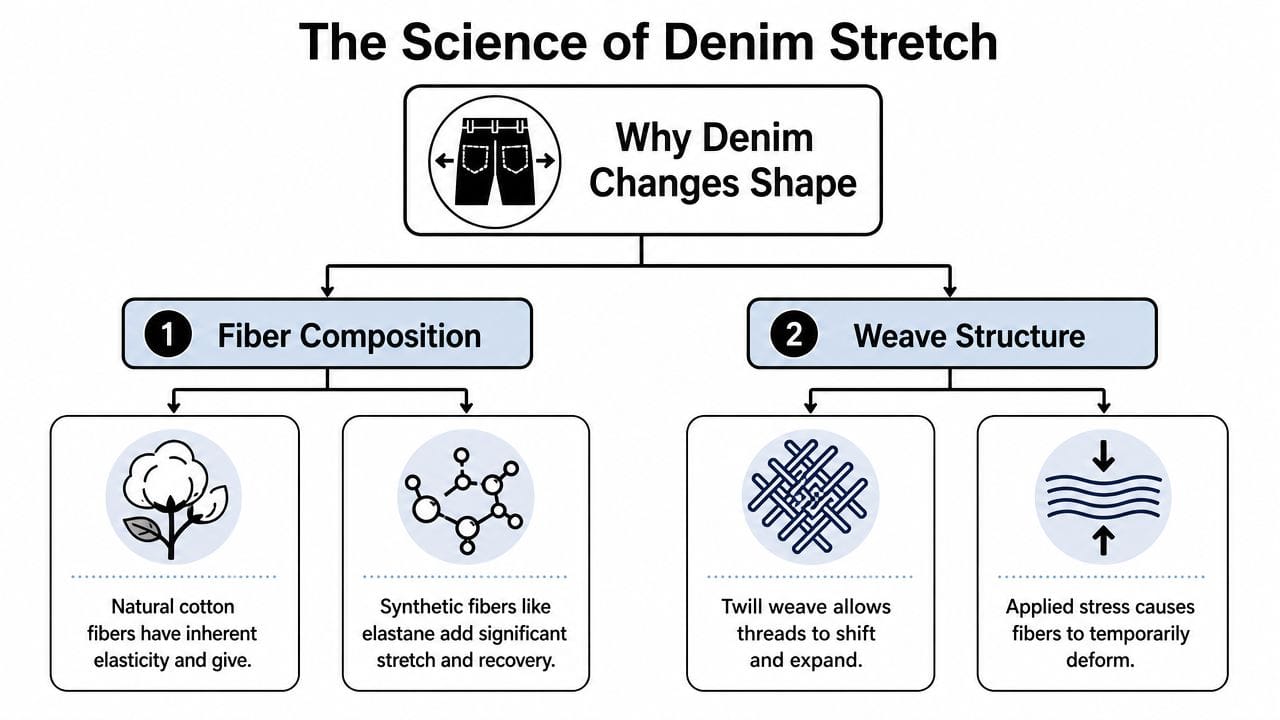
Denim changes shape for two main reasons. One comes from the structure of the cloth. The other comes from what fibres are inside it.
Cotton behaves like a bent paperclip
Traditional rigid denim is usually easiest to understand if you think of cotton threads like a paperclip. Bend a paperclip once and it doesn't spring back perfectly. Bend it again and again, and it begins to keep the new shape.
Cotton denim reacts in a similar way under repeated stress. Sitting, walking, crouching, cycling, and climbing stairs all push the yarns to shift within the twill weave. The cloth doesn't become elastic. It becomes deformed by use.
That is why traditional 100% cotton jeans can stretch up to 2 inches in the waist over time because the threads expand but cannot retract. The fabric gives, but it doesn't have a built-in spring to pull itself back into its original dimensions.
Elastane behaves like a rubber band
Now compare that with a denim containing elastane, spandex, or Lycra. Those fibres behave more like a rubber band. Pull them, and they resist. Release them, and they try to return to their starting point.
That doesn't mean stretch denim never relaxes. It does. But it usually relaxes differently. The goal isn't just stretch. The goal is recovery, meaning how well the cloth returns after strain.
A useful maker's distinction looks like this:
| Fabric type | What you feel first | What happens later |
|---|---|---|
| 100% cotton denim | Firm, rigid, sometimes unforgiving | Gradual moulding and longer-term bagging in stress zones |
| Denim with elastane | Immediate comfort and easier movement | Better shape recovery, unless heat or poor quality fibres damage it |
The weave matters too
Even without elastane, denim's twill weave allows threads to shift under pressure. That's one reason jeans can loosen in specific body zones without the whole garment growing evenly. The waistband, rise, and thigh don't all receive the same strain, so they don't all change at the same rate.
For sewists, this matters when you evaluate a fabric scrap in your hands. A quick tug across the crosswise grain tells you very little on its own. You also need to crumple it, steam it, wear-test it if possible, and watch how quickly it drops back.
If a denim stretches easily on the first pull but looks tired after a few more, that's not softness. That's weak recovery.
How Much Do Jeans Actually Stretch
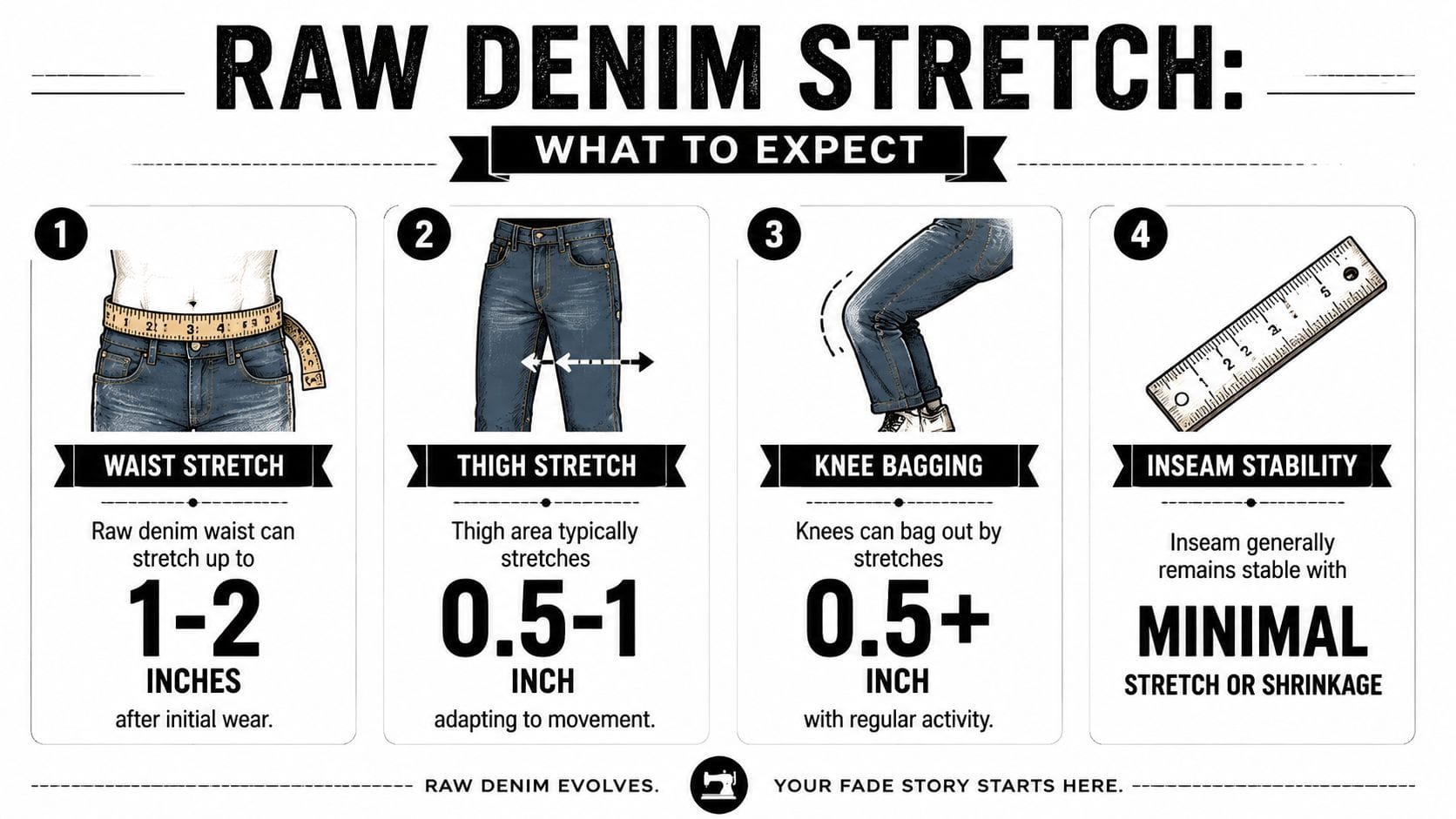
Theory helps, but fit decisions get easier once you attach numbers to a real example. Raw denim gives the clearest benchmark because the fabric hasn't been softened and stabilised in the same way as many washed denims.
Raw denim gives the clearest baseline
Williamsburg Garment measured raw denim after about eight months of daily wear without washing and found that the waistband can expand by up to +1 inch, the seat by +1⅝ inches, and the thigh by +¾ inch. Those are not random changes. They happen in the exact places where the body repeatedly flexes the cloth.
For a maker, that means a close fit in raw denim should be judged with patience. If the seat feels comfortably exact on day one, it may not feel exact for long. If the thigh is already generous, it may become sloppy.
Where stretch shows up first
The growth isn't evenly distributed across the garment. Some zones are much more active than others.
- Waistband tends to ease from constant expansion and compression through the day.
- Seat often changes most dramatically because it takes strain whenever you sit.
- Thigh responds to walking and stair climbing.
- Lower leg and hem usually show less change unless the cut is very close.
That unevenness is why one pair can feel perfect in the waist and loose through the seat, or vice versa. Fabric memory and body movement create a map of stress.
What this means when buying or cutting
If you're buying ready-to-wear rigid jeans, don't panic if the first try-on feels a touch snug in the right places. With rigid cotton, mild firmness is often part of the fitting logic.
If you're sewing, treat your fitting shell and your final denim differently. Calico won't tell you what denim will do. Even one denim won't necessarily tell you what another will do. A soft washed deadstock denim and a dry rigid selvedge can come from the same pattern and wear like two different garments.
A useful check before cutting is to compare these factors side by side:
| Question | Rigid cotton denim | Stretch denim |
|---|---|---|
| Should it feel close at first? | Usually yes | Only to a point |
| Will it mould through wear? | Yes, often noticeably | Somewhat |
| Will it spring back well? | Limited | Depends on recovery quality |
| Should you rely on guesswork? | No | Also no |
A good jeans fit isn't static. You're fitting the garment after movement, after sitting, and after the fabric has learned your shape.
Managing Stretch Washing Shrinking and Relaxing
When jeans start feeling too loose or too tight, laundering and moisture become your main tools. Used properly, they help you manage fit. Used carelessly, they ruin recovery.
If your jeans have gone loose
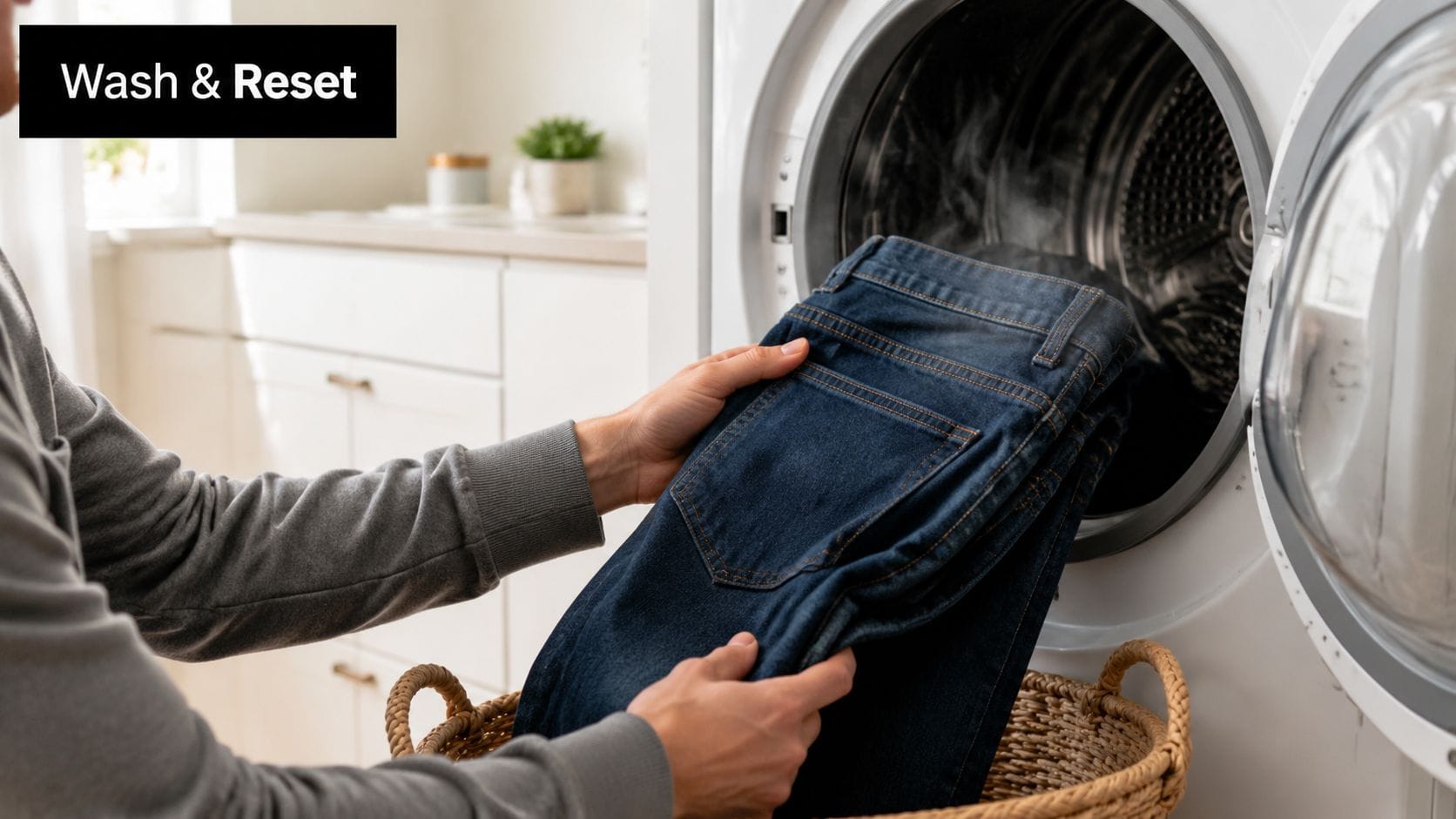
With 100% cotton denim, washing often acts like a reset. The fibres tighten up again and the garment feels firmer once dry. That reset isn't permanent. Wear will open the cloth back out, especially in the usual stress zones, but washing can bring a bagged-out pair back into rotation.
Try this approach:
- Wash according to the fabric type. For rigid cotton, a normal wash is often enough to restore some hold.
- Reshape before drying. Smooth the waistband, align the side seams, and flatten twisted areas by hand.
- Let the jeans fully dry before judging fit. Half-damp denim can feel deceptively close.
Stretch denim needs more caution. Elastic fibres like Lycra and elastane degrade rapidly when exposed to heat, so washing in cold water and always line-drying helps preserve shape. If you tumble dry stretch jeans on high heat, you're training the recovery fibres to fail sooner.
If your new jeans feel too tight
You don't always need to unpick or recut. Sometimes the fabric only needs gentle persuasion.
Use one of these methods first:
- Damp stretch the waistband by lightly moistening that area, then pulling it over the back of a chair or a waistband stretcher.
- Wear them for short sessions indoors so the cloth warms and relaxes in your actual movement pattern.
- Steam and hand-shape tight spots such as the hip curve or upper thigh, then let them cool flat.
These methods work best on cotton-rich denim. For stretch denim, be gentler. You're trying to relax the cloth, not exhaust the recovery fibres.
A visual walkthrough can help if you're troubleshooting fit changes after washing or wear:
What doesn't work well
Some common habits make jeans worse rather than better:
- Hot dryers for stretch denim shorten the life of elastane.
- Over-washing can leave denim stiff, dull, and harder to evaluate accurately.
- Aggressive stretching by force can distort waistbands, pocket openings, and side seams.
Treat cotton denim and stretch denim as different materials. They may look similar on the hanger, but they don't respond to care in the same way.
A Sewists Guide to Sewing with Denim
The biggest mistake I see in home sewing is assuming all denim with elastane behaves alike. It doesn't. If you skip testing and sew by assumption, you risk a saggy seat, a stretched waistband, or knees that collapse by lunchtime.
Start with a fabric test, not a pattern size
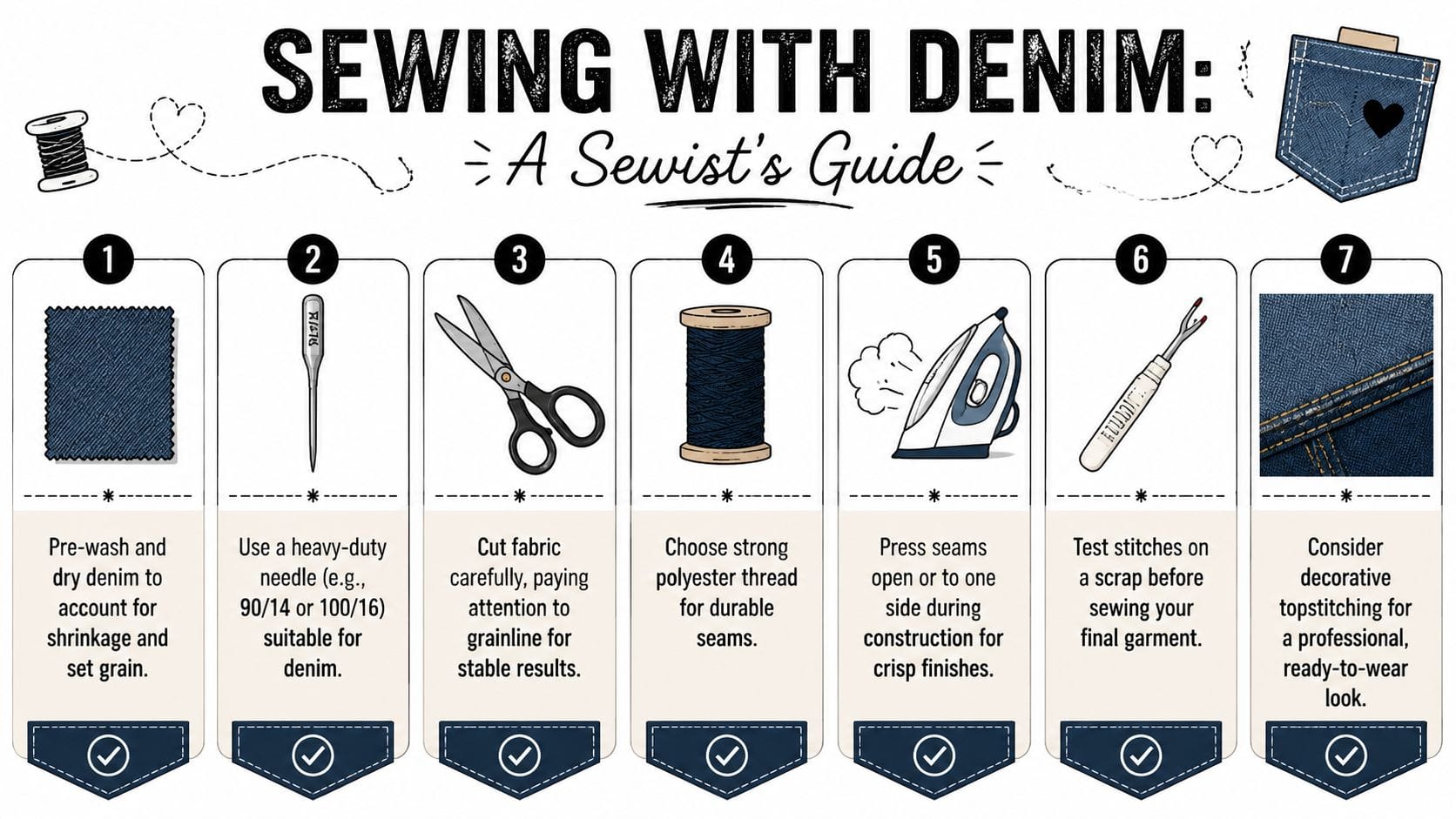
The smartest approach is simple. Wash the fabric the way the finished jeans will be washed, cut a generous test strip across the width, stretch it firmly, release it, and watch what happens. Then scrunch it, steam it, and hang it overnight.
That matters even more now because many UK sewists mistakenly size down on all stretch jeans, but modern recovery-focused denims with 2% elastane and auxiliary fibres hold their shape best when cut to size, whereas traditional 100% cotton stretches most and often requires sizing down. Many fitting problems stem from this approach. Sewists treat every stretch denim as if it will bag out like old low-recovery blends, and some modern denims won't.
Construction choices that control stretch
Good jeans sewing is partly about fit and partly about restraint. You decide where the garment is allowed to move.
Use these techniques deliberately:
- Stabilise the waistband. A firm woven interfacing or waistband stay stops gradual growth where it matters most.
- Reinforce pocket openings. Pocket edges distort fast, especially on softer denims. Stay tape helps.
- Secure the zip area. A fly front cut on a slightly lively denim benefits from extra stability.
- Watch the yoke and back crotch seam. Those seams shape the seat. If the fabric grows, weak stitching won't save it.
- Test topstitch tension on scraps. Denim layers can tunnel or ripple if the machine isn't balanced.
Tools that make the job easier
You don't need a factory setup, but the right kit helps.
| Job | Helpful tool | Why it matters |
|---|---|---|
| Seaming thick denim | Denim needle such as 90/14 or 100/16 | Reduces skipped stitches through dense layers |
| Accurate pressing | Steam iron and clapper | Sets bulky seams flatter |
| Topstitching | Strong thread and edge guide | Keeps lines even and durable |
| Hammering seam allowances | Tailor's hammer or mallet | Softens stacked layers before stitching |
A hump jumper, point turner, and good rivet-setting tools also earn their place if you sew jeans regularly.
What I recommend for different denim types
For 100% cotton denim, I cut for a closer fit at the waist and upper hip if the fabric feels rigid and stable after pre-treatment. I still leave enough room to sit properly. A too-tight rigid jean isn't noble. It's just uncomfortable.
For stretch denim with good recovery, I avoid automatic sizing down. I cut closer to the pattern's intended fit, stabilise key areas, and trust the recovery only after testing it. This is especially important with deadstock, where fibre labels can be incomplete and the handle can be misleading.
For makers planning to sell what they sew, the same testing mindset matters even more. If you're moving from personal projects into building an online fashion shop, your denim choices need repeatable behaviour, not lucky outcomes from one flattering sample.
Cut one pocket, one waistband sample, and one hip test before committing to the whole garment. A half-hour test can save a pair of jeans.
Your Perfect Denim Fit Awaits
Jeans stretching over time isn't a flaw. It's part of how denim lives on the body. The trick is knowing whether you're working with cotton that slowly moulds, stretch fibres that recover, or a blend that looks promising on the bolt and disappoints in wear.
For buyers, that means judging fit with a little foresight. For sewists, it means pre-treating properly, testing recovery, and stabilising the parts of the garment that carry the most strain. A good jeans fit comes from decisions made before the first proper wear.
That same fit logic is starting to matter beyond the sewing room as digital shopping tools improve. If you're curious how brands are trying to solve fit uncertainty before checkout, MerchLoom's guide to e-commerce virtual try-on is a useful look at where online garment fitting is heading.
The best part is that once you understand the behaviour of your denim, you're no longer reacting to jeans that seem to change at random. You can predict the give, manage the recovery, and sew with far more confidence.
If you're ready to turn that knowledge into a better pair of jeans, More Sewing is a solid place to start for quality denim, haberdashery, sewing kits, and practical supplies that make testing, fitting, and finishing much easier.
