
You're probably here because you've fallen for a dress that looks impossibly polished. The sort of gown with a clean neckline, a bodice that sits exactly where it should, and a skirt that holds a graceful line instead of puddling into limp folds. Then you spot the fabric name: duchess satin material. It sounds glamorous, expensive, and a little bit unforgiving.
That instinct is fair. Duchess satin does have a reputation for being a fabric that shows every choice you make, both good and bad. But that's also why dressmakers love it. If you want shape, smoothness, and a finish that reads “couture” rather than “craft project”, this is one of the most useful fabrics you can learn.
I've always thought of duchess satin as the fabric for garments that need backbone. It doesn't do all the work for you, but it rewards careful sewing beautifully. Used well, it can turn a simple pattern into something that looks far more expensive than its paper envelope suggests.
An Introduction to Duchess Satin
You choose a pattern with clean lines, a fitted bodice, and a skirt that needs to hold its shape. Then the fabric decision becomes the whole project. Duchess satin is often the point where a home sewist decides whether the finished dress will look crisp and deliberate or shiny.
Duchess satin has earned its reputation because it gives structure and polish at the same time. It keeps necklines neat, supports shaping through the waist, and helps formalwear look composed under light instead of limp or overly soft. That is why it turns up so often in bridalwear, evening dresses, corsetry, and occasion pieces that need body.
Its place in British bridal history is well established. Queen Elizabeth II's wedding gown was made from duchess satin on 20 November 1947, a detail often cited in accounts of the fabric's role in royal couture and bridal fashion. Historical descriptions of the cloth also point to its dense, heavyweight construction and note that it sold at a premium in the post-war market, with prices reported at 30 to 40% above standard satin in period references (historical overview of duchess satin in British bridal tradition).
I usually tell beginners one simple thing about duchess satin. It is far more manageable than it looks, but it does not hide careless cutting, rough pressing, or uneven stitching.
That is also why the silk versus polyester question matters so much from the start. Silk duchess satin usually presses more beautifully and has a richer, quieter surface, but it costs more and can feel less forgiving if you are still practising. Polyester duchess satin is easier to find and easier on the budget, yet it can show needle marks, heat damage, and cheap-looking shine if the quality is poor. Knowing those trade-offs before you buy saves money, time, and a great deal of unpicking.
If you are new to the fabric, the good news is straightforward. Success with duchess satin comes from method, not nerves. The right needle, careful handling, tested pressing, and a few fabric-specific sewing habits prevent most of the mistakes that make this material seem difficult.
What Is Duchess Satin Material
Duchess satin material is a firm, structured satin made to hold shape. It has the smooth face satin is known for, but with more density and body than the light, fluid satins many beginners meet first. That extra substance is why dressmakers reach for it when a design needs support through the cloth itself, especially for bridal bodices, corseted styles, formal skirts, and eveningwear with clean architectural lines.
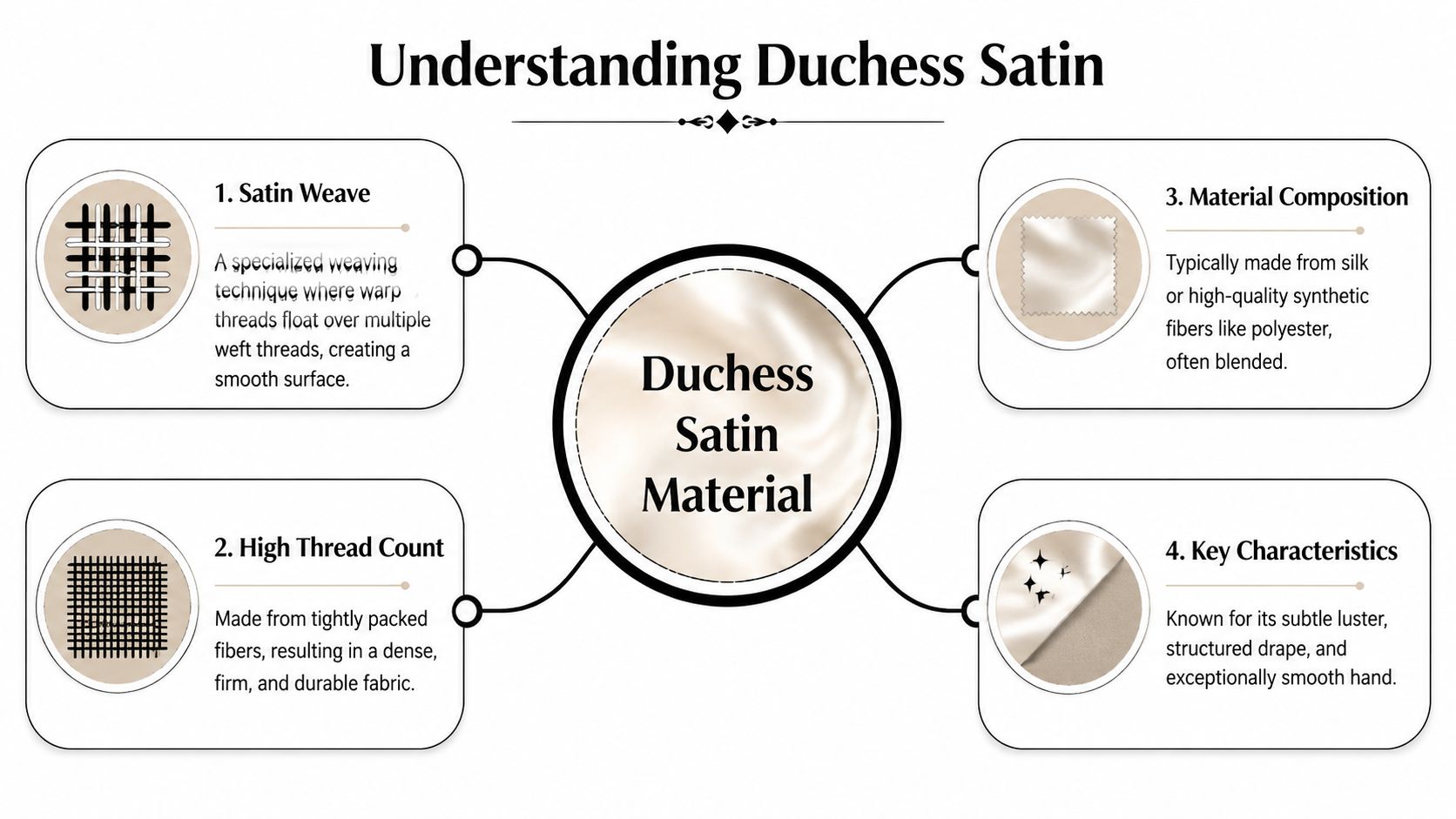
The name describes a fabric type more than a fibre. In practice, “duchess satin” tells you to expect a satin-faced fabric with weight, firmness, and a polished finish. It does not tell you whether the cloth is silk, polyester, or a blend, which is exactly why two fabrics sold under the same name can behave quite differently on the cutting table.
That point catches beginners out all the time.
Some shops use “duchesse” or “duchess satin” quite strictly for silk versions, while others use it more loosely for polyester and blended satins with a similar look, as noted in New Tess's discussion of duchesse fabric terminology. The listing matters more than the label. Check fibre content, fabric weight, width, and whether the seller describes the cloth as bridal, coutil-adjacent, or dressmaking satin. Those clues tell you far more about how it will sew.
A simple comparison helps here. Charmeuse drapes and slips. Duchess satin stands up and supports shape. If a pattern relies on sculpted seams, a stable neckline, or skirt volume that does not collapse by lunchtime, duchess satin is usually the better fit.
Weave first, fibre second
For sewing purposes, start with the weave behaviour, then judge the fibre. The satin construction creates the smooth, reflective surface. The fibre changes how the fabric presses, how it reacts to heat, how breathable it feels, and how much risk you take on with every pin, needle, and iron pass.
You will usually find duchess satin sold as:
- Silk duchess satin, the traditional luxury option with a richer hand
- Polyester duchess satin, the version most home sewists see in retail fabric shops
- Blended duchess satin, which sits somewhere between the two on price and performance
Silk versus polyester in real sewing terms
In contemporary UK manufacturing, duchess satin is typically 85 to 90% polyester with 10 to 15% rayon (UK duchess satin manufacturing and bridal market summary), a blend that became standard from the 1970s (UK duchess satin manufacturing and bridal market summary) and is described as 60% more cost-effective to produce than silk-based equivalents (UK duchess satin manufacturing and bridal market summary). The same industry summary notes that over 75% of duchess satin sold in UK fabric stores is now non-silk based (UK duchess satin manufacturing and bridal market summary), with fabric weights around 140 to 160 grams per square metre (UK duchess satin manufacturing and bridal market summary) compared with 80 to 100 g/m² for regular satin (UK duchess satin manufacturing and bridal market summary). It also states that duchess satin accounts for about 25% of bridal fabric sales in the UK (UK duchess satin manufacturing and bridal market summary).
Those numbers match what many home sewists see in shops. Polyester duchess satin is easier to find, easier to replace if a cut goes wrong, and often sensible for a first formal project. Silk duchess satin usually has the nicer hand and presses into shape more beautifully, but it asks for steadier handling and a larger budget.
| Version | What usually works well | What can catch you out |
|---|---|---|
| Silk duchess satin | Beautiful hand, refined finish, breathable feel | Higher cost, stressful cutting, more caution needed with moisture and heat |
| Polyester duchess satin | Easier to source, lower cost, practical for toiles and first formalwear projects | Can show needle marks, can scorch or shine under too much heat, sometimes looks harsh under bright light |
| Blend duchess satin | Balanced price and performance in some ranges | Quality varies widely between suppliers, so swatching matters |
The important question is not which fibre is best in theory. It is which one suits the garment, your budget, and your confidence level. For a wedding dress or heirloom piece, silk may justify the spend. For a structured evening dress, a prom bodice, or a practice version before cutting the expensive cloth, a good polyester duchess satin can be the smarter choice.
The Signature Characteristics of Duchess Satin
You can tell a lot about duchess satin before you even unfold it fully. It has presence in the hand. It doesn't collapse over your arm the way a soft satin does, and that tells you immediately what sort of garment it wants to become.
The sheen is controlled
Duchess satin has subtle lustre, not the glassy shine of some cheaper satins. That difference matters more than many beginners expect. A softer sheen reads formal and expensive because the fabric reflects light without looking wet or flashy.
This is why it works so well in simple designs. A plain bodice with careful seaming can look rich because the fabric surface already does part of the visual work.
The body is the whole point
A defining characteristic of duchess satin is its firmness. It has enough weight and structure to support sculpted shapes. Necklines stay cleaner. Pleats hold. Waist seams feel more anchored. A full skirt keeps volume rather than deflating by the end of the day.
That doesn't mean it's cardboard-like. Good duchess satin still bends and moulds, but it resists drooping. If your pattern relies on drape, gathers that melt softly, or a slinky silhouette, this usually isn't the right fabric.
Practical rule: If the design needs to stand away from the body a little, duchess satin is often a good candidate. If it needs to skim and pour, choose something else.
It feels smooth, but it isn't forgiving
The surface is smooth and the hand feels refined, yet this isn't a fabric that hides weak technique. Stitching can show through. Needle marks can remain visible. Pressing mistakes can leave impressions you won't easily erase.
That's why accuracy matters more than speed with this fabric. A slightly wobbly seam on a printed cotton might disappear into the pattern. On duchess satin, the fabric can expose it.
It's more stable than lighter satins
One of the nicest surprises for beginners is that duchess satin often behaves better on the cutting table than slippery, lightweight satin. It has enough substance to stay put more willingly. You still need care, but you're not wrestling a liquid.
Here's what that stability means in practice:
- During cutting you can keep edges more accurate if the fabric is laid flat and left undisturbed.
- During assembly bodices and waist seams feel easier to control than on a drapey satin.
- During wear the finished garment usually keeps its intended silhouette more reliably.
The trade-off is that seams, darts, and internal construction need to be clean because the fabric supports shape so clearly. In other words, the structure is a gift, but it does ask you to meet it halfway.
The Best Uses for Duchess Satin
You spot a pattern for a dramatic dress, buy a glossy satin, and picture crisp folds, a clean neckline, and a skirt that holds its shape through an evening. Then the wrong satin turns every careful line limp. Duchess satin earns its place when the design needs structure you can rely on.
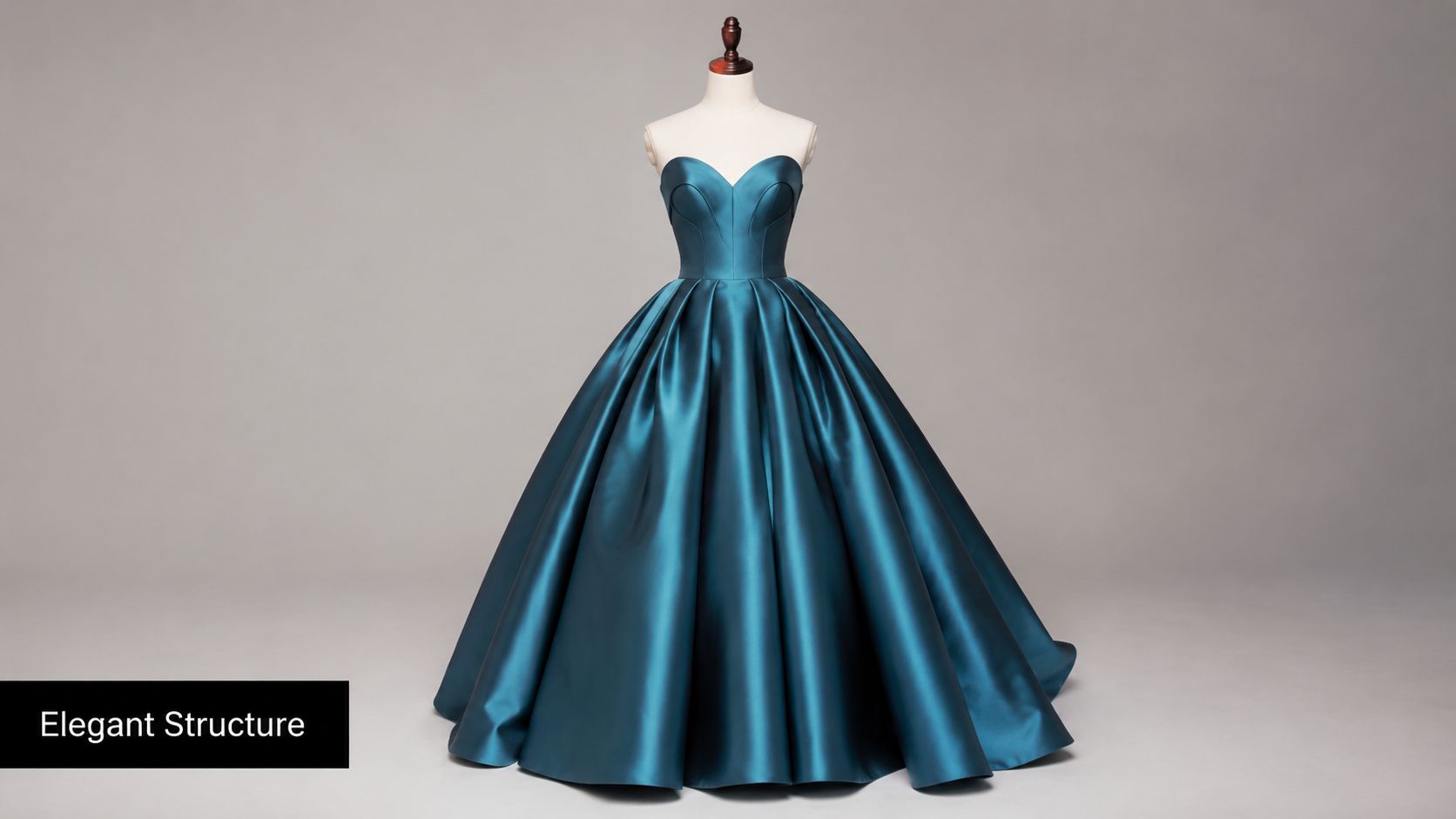
That is why it shows up so often in bridal and formalwear. It suits garments that need body, control, and a polished surface, especially where the fabric must support the design rather than drape over it. For a home sewist, that makes it one of the clearest cases of matching fabric to function.
Bridal projects that suit it beautifully
Weddingwear is the natural home for duchess satin, but some bridal styles benefit from it far more than others.
It performs especially well in:
- Fitted bodices that need a smooth, refined outer layer
- A-line skirts that should stay shapely instead of collapsing
- Ballgown silhouettes where the fabric needs to support volume
- Trains and overskirts that look better with crisp folds and a formal finish
It also works beautifully for bridal separates. A corseted top, sculpted mini dress, or detachable overskirt all gain from the fabric's firmness. If you want a clear example of how a structured satin behaves over serious internal support, this Luxury steel-boned overbust corset shows the kind of clean line duchess satin can hold.
One practical note matters here. Silk duchess satin usually gives the richest hand and a more complex, quiet sheen, which is lovely for bridal close-ups and custom work. Polyester duchess satin is often easier on the budget, more widely available, and sometimes a little tougher in wear, but the shine can read flatter or harsher depending on the quality. For a first formal project, a good polyester duchess can be the smarter choice if it lets you budget for test garments, extra yardage, and proper interfacing.
Eveningwear and occasionwear
Duchess satin also earns its keep outside the wedding aisle. It suits black-tie dresses, cocktail dresses with defined waists, sculptural peplum tops, and skirts with pleats or controlled fullness. A simple evening jacket can work well too, provided the cut is precise and the style does not ask the fabric to behave softly.
The fabric is less convincing in designs built around movement and fluidity. Bias slips, cowls, very soft gathers, and lingerie-inspired shapes usually look better in charmeuse or another satin with more flow. That is a useful trade-off to remember before cutting. Duchess satin gives shape generously, but softness is not its strong point.
Good pattern matches
The easiest way to judge a pattern is to ask one question: should the fabric hold the design up, or should it fall around the body?
Choose duchess satin for details like these:
| Pattern feature | Why duchess satin works |
|---|---|
| Boned bodice | Supports structured shaping without looking flimsy |
| Princess seams | Helps sculpt the body cleanly |
| Full skirt | Holds volume and keeps the silhouette clear |
| Strapless neckline | Maintains a crisp edge better than drapier satins |
| Statement bow or sash | Keeps its form instead of going soft |
For beginners, the safest projects are usually the ones with clean lines and intentional structure. A plain dress with excellent fabric choice often looks far more expensive than an overworked design made in a satin that cannot support it. That is one of the most useful lessons duchess satin teaches.
How to Sew and Tailor Duchess Satin
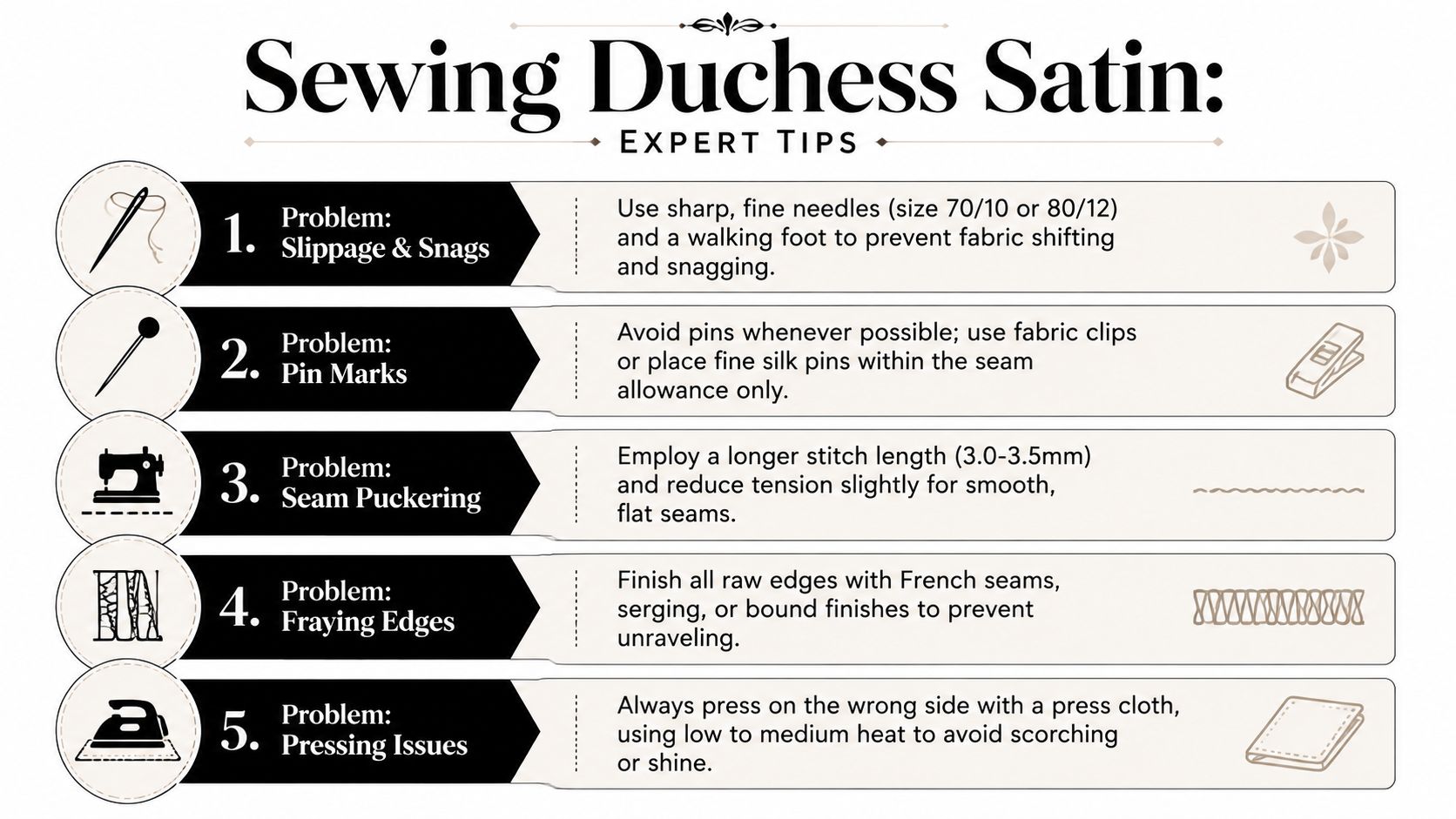
You lay out the fabric, cut carefully, stitch one seam, and suddenly every tiny decision is visible. That is the challenge with duchess satin. It is not difficult because it is fragile in the way chiffon is fragile. It is difficult because it records your handling. Needle marks can stay. Pressing can leave shine. A seam allowance can print through on the right side if the fabric is heavy enough and the light catches it.
Silk and polyester duchess satin behave differently here, and beginners should know that before they start. Silk duchess usually presses more willingly and often looks richer in depth of color, but it can water-spot, bruise under a hot iron, and cost enough to make every mistake feel expensive. Polyester duchess is usually less costly and often easier to source, but it can hold needle holes, pick up shine from heat faster, and melt or flatten if you press carelessly. Neither version is automatically easier. Silk is often kinder under the iron. Polyester is often kinder to the budget.
Cutting without regret
Cutting is where expensive problems begin.
Use a single layer layout for any project where matching panels matters. Duchess satin can shift just enough to throw off a princess seam or make one skirt panel reflect light differently from the next. I also prefer pattern weights over a forest of pins. Pins are useful, but too many of them can mark the fabric and distort the edge you are trying to cut accurately.
A few habits make the job calmer:
- Lay the fabric flat and let it relax before cutting
- Cut in a single layer when the pattern allows
- Use silk pins sparingly, or clip only in seam allowances
- Keep tissue paper underneath if the fabric drags on the table
- Use very sharp shears or a rotary cutter with a fresh blade
- Mark only what you must, and test the marking method on a scrap first
Do not keep lifting and re-smoothing the fabric to chase perfection. Align the grain, smooth it once, then cut. Rehandling often causes more trouble than a slightly awkward layout.
If two panels catch the light differently after sewing, the issue is often the nap or grain direction, not your stitch line.
Machine setup that prevents trouble
A domestic machine is perfectly capable of sewing duchess satin. The setup matters more than the price of the machine. I start with a fresh Microtex or sharp needle, usually in a fine size, and I test on scraps from the actual fabric, not a random satin left over from another project.
This combination is a reliable starting point:
- Fresh Microtex or sharp needle
- Fine polyester thread or high-quality all-purpose thread
- Short to moderate stitch length, tested first
- Walking foot if the layers creep
- Scrap tests for stitching, unpicking, and pressing
The University of Kentucky Cooperative Extension notes that satin weaves show surface damage easily and benefit from careful handling, fine needles, and testing before construction (University of Kentucky guidance on sewing special occasion fabrics). That matches what dressmakers learn quickly at the machine. The wrong needle leaves a trail. The right one slips through cleanly.
If your machine wants to chew the seam allowance at the start, begin stitching a little in from the raw edge or start on a scrap leader. That small habit saves a lot of panic.
If you'd like to watch the process in action, this demonstration is worth a look before you start stitching:
Seams, finishes, and pressing
Construction choices depend on the weight of the duchess satin and whether the garment is lined. Heavy duchess satin does not always suit French seams, especially across curved or bulky areas. They can become thick fast. For many dresses, a plain seam that is graded, pressed carefully, and finished neatly gives a better result than a fancier finish that adds bulk.
These finishes tend to work well:
- Princess and curved seams, clipped where needed, graded, and pressed over a ham
- Serged or overlocked raw edges on lined garments where speed and control matter
- Hong Kong or bound seams on unlined garments or special interiors
- Catch-stitched seam allowances in fitted sections where you want less imprinting
Pressing deserves more restraint than force. Press from the wrong side when you can. Use a press cloth. Lift and lower the iron instead of sliding it. A seam roll keeps allowance ridges from showing through. A tailor's ham keeps curved areas curved.
Here is the rule I give beginners. If you are not sure the iron is safe, it is too hot.
| Problem | Better approach |
|---|---|
| Flattened curved seam | Press over a ham to preserve shape |
| Shine on the right side | Use a press cloth and lower heat |
| Seam allowance imprint | Grade layers and press on a seam roll |
| Crushed edge at neckline | Finger-press first, then use light steam carefully |
Basting helps more than people expect. Hand-baste necklines, waist seams, and any area that must match exactly. On silk duchess, basting reduces the amount of unpicking, which protects the fabric. On polyester duchess, it reduces the risk of permanent needle trails from stitching twice in almost the same place.
One final tailoring point. Understructure matters. Interfacing, underlining, and boning should be tested with the fashion fabric, because duchess satin can look beautiful on its own and still collapse at the edge if the inside is doing the wrong job. A one-hour test sample is cheaper than remaking a bodice.
Duchess Satin vs Charmeuse Mikado and Heavy Satin
A fabric can be cut beautifully, sewn carefully, and still disappoint if its hand fights the pattern. That is why this comparison matters. Home sewists often blame themselves for a bodice that collapses or a skirt that stands away from the body, when the problem began at the fabric shop.
Duchess satin versus charmeuse
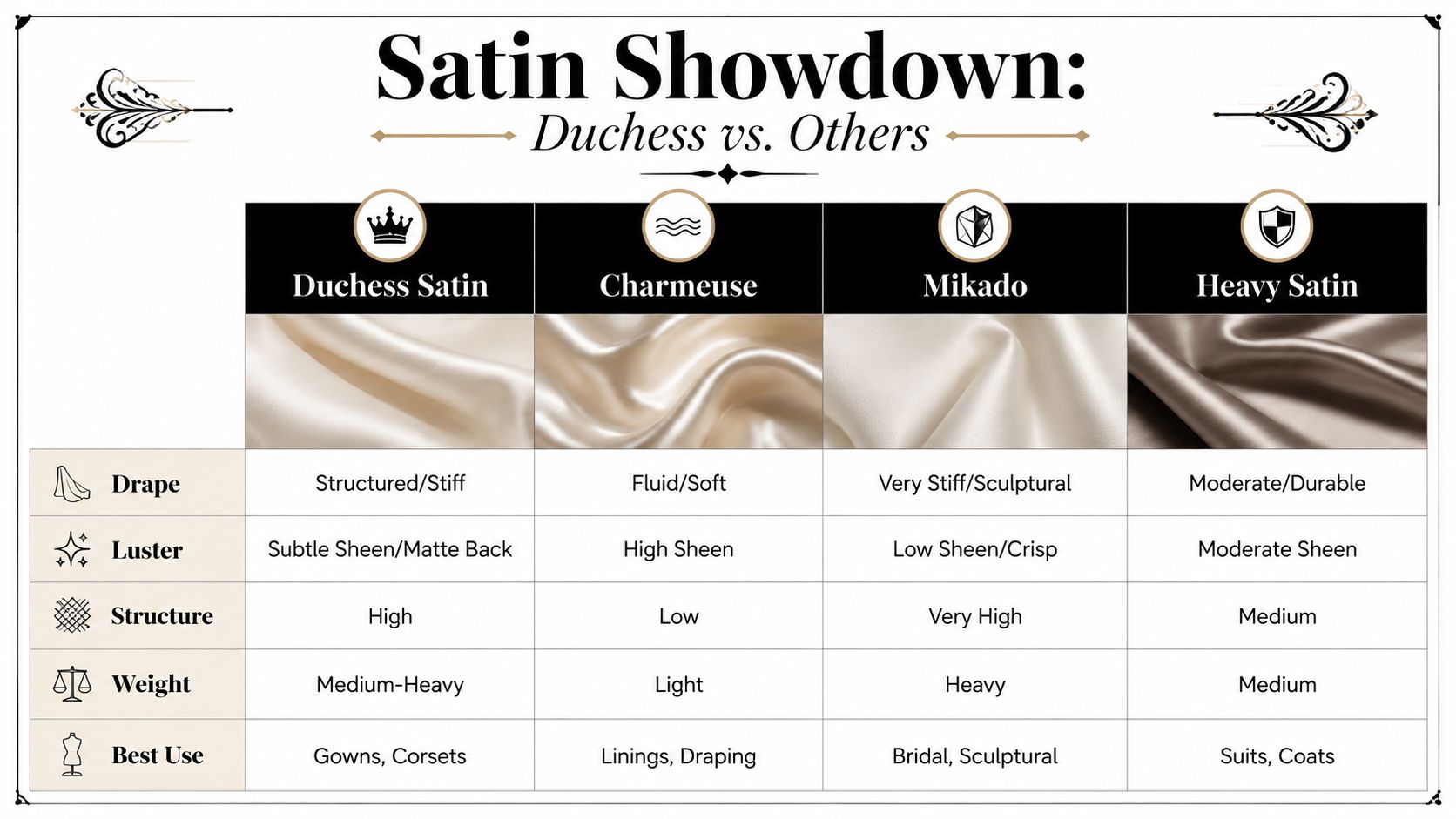
Duchess satin has body. Charmeuse has flow.
That single difference changes almost everything about how the garment wears. Duchess satin supports a shaped bodice, holds a waistband neatly, and gives formal skirts that poised look people often want for bridalwear and eveningwear. Charmeuse slides and drapes close to the figure, which is lovely for bias cuts, soft cowls, and slip-style dresses, but much less forgiving if the pattern depends on firmness.
Choose duchess satin for:
- structured bodices
- defined waistlines
- skirts that need shape without heavy crinoline
Choose charmeuse for:
- soft drape
- fluid movement
- styles meant to skim rather than stand
Fibre content sharpens that choice. Silk duchess usually feels richer and molds more gracefully than polyester duchess, while polyester charmeuse can be especially slippery and heat-sensitive. Beginners usually get better results by matching the pattern to the fabric's natural behavior instead of trying to force one satin to act like another.
Duchess satin versus mikado
Duchess satin and mikado both suit formalwear, but they create different kinds of structure. Mikado is usually crisper and more sculptural, with a drier hand and a sharper fold. Duchess satin still has body, yet it reads smoother and a little softer on the figure.
For a gown with dramatic pleats, oversized bows, or a skirt that needs to hold a strong silhouette away from the body, mikado often does the harder job better. For a dress that needs polish, density, and shape without looking rigid, duchess satin is often the better cloth.
I use a simple test in person. Crush a small section lightly in your hand, then let it fall. Mikado tends to keep a sharper memory of the fold. Duchess satin usually drops back with a smoother surface.
Duchess satin versus heavy satin
“Heavy satin” is often a shop label rather than a precise fabric type. It tells you the fabric has weight, but not how it was woven, how dense it is, or whether it will support clean tailoring. Some heavy satins work well enough for party dresses or separates. Others look glossy on the roll and disappoint once seams, darts, and hems are in place.
Here is the practical difference:
| Fabric | Best for | Watch out for |
|---|---|---|
| Duchess satin | Structured gowns, formal bodices, corseted styles | Needle marks, seam impression, stiffness in very draped designs |
| Charmeuse | Slip dresses, soft cowls, fluid eveningwear | Cling, shifting during sewing, lack of support |
| Mikado | Architectural bridalwear, sculptural skirts, statement folds | Bulk at seams, too much crispness for soft shaping |
| Heavy satin | General occasionwear, some skirts and separates | Inconsistent body, vague labeling, weaker recovery |
If you are shopping online, ask better questions than “Is it good quality?” Ask whether it is silk or polyester, whether it creases sharply, whether it holds a fold, and whether the seller would use it for a structured bodice or a draped dress. That will tell you far more.
For trim pairings and finish details, shoe choices can help clarify the look you are building. A clean, formal satin shoe has a different visual weight from a softer draped dress, and this guide to white satin pumps is a useful reference point for that polished end of the spectrum.
The best fabric is the one that behaves the way the pattern asks. Silk duchess gives a more luxurious hand and often presses more beautifully, but it costs more and punishes rough handling. Polyester duchess is usually easier to source and kinder to the budget, but it can show heat damage, shine, and needle trails faster. Choose with the silhouette, your skill level, and your tolerance for testing in mind.
Choosing and Caring for Your Duchess Satin
Buying well solves half the project. If you can, order a swatch first and handle it in daylight. Fold it, drape it over your hand, and check whether the sheen feels refined or harsh. Run your fingers lightly across the surface and look for snagging, slubs, or stripey shade variation.
For UK sourcing, duchess satin commonly comes in silk or polyester constructions, with widths around 137 to 150 cm. Premium silk versions are often described by momme weight, and one useful benchmark is a 100% silk duchess satin listed at 27 momme, 54 inches (137.16 cm) wide, opaque, and with minimal drape, which tells you a lot about the body and finish you can expect (example of 27 momme silk duchess satin specification).
What to check before buying
- Read the fibre content carefully. Don't assume “duchess satin” means silk.
- Check the width so you can plan yardage and layout properly.
- Look for descriptions of drape and opacity. “Minimal drape” is often a good sign if you want structure.
- Order enough for testing. You'll want offcuts for needle, stitch, and pressing trials.
Care needs caution. Silk and polyester duchess satin don't respond identically, but both deserve gentle treatment. For a special garment, professional cleaning is usually the safest route. Store the finished piece where the fabric won't be crushed, and pad hanging points if the garment is heavy. If you're styling a finished satin outfit from head to toe, a good shoe reference can help too. This guide to white satin pumps is useful if you're trying to match the polish of the garment with the right accessories.
Duchess satin isn't difficult because it's fussy. It's difficult because it's honest. Sew it with care, and it looks magnificent.
If you're ready to test swatches, pick up the right needles, or start your next special-occasion project, More Sewing is a handy UK resource for fabrics, haberdashery, and practical sewing supplies.
