You've found a jeans pattern you love, or maybe you're thinking about a workwear jacket, a neat skirt, or an easy pinafore. Then you open a fabric listing and see words like selvedge, raw, rigid, stretch, twill, 12 oz, 14 oz. Suddenly the fabric choice feels harder than the sewing.
That's completely normal.
Denim looks familiar because we wear it all the time, but fabric denim can behave very differently from one bolt to the next. One denim folds softly and makes a lovely shirt dress. Another stands up on its own and wants to become structured jeans. A third looks similar online but contains stretch, shifts under the presser foot, and needs a different pattern choice altogether.
If you sew at home, that difference matters more than any trend. You're not buying a finished garment. You're choosing the raw material that decides how your project will sit, move, wash, fade, and last.
An Introduction to the World of Denim
Denim has earned its reputation. It isn't just a casual fabric that happened to become popular. It has a long technical history, beginning in Nîmes, France, where the cloth that became known as denim first developed, and later becoming central to hard-wearing clothing through the copper-rivet patent secured by Levi Strauss and Jacob Davis on May 20, 1873, a date often treated as the birthday of blue jeans, as outlined in Hawthorn's history of denim.
That staying power still shows today. Denim remains a foundational textile, and the worldwide denim market was valued at US$57.3 billion in 2020 and projected to reach US$76.1 billion by 2026, according to the denim overview on Wikipedia. For sewists, that scale tells you something useful. This isn't a niche fabric with one use. It's one of the most important woven fabrics in modern dressmaking.
What denim actually is
Denim is a sturdy cotton warp-faced twill. That sounds technical, but the idea is simple. The face of the fabric shows more of the lengthwise yarns, and those yarns are often indigo dyed. The crosswise yarns are usually lighter. That's why classic denim often looks blue on one side and paler on the other.
The twill structure also gives denim its diagonal rib.
Practical rule: If you can see a clear diagonal line and the cloth feels firmer than a plain cotton, you're probably handling some form of denim or a denim-like twill.
Why sewists get stuck
Most confusion comes from thinking denim is one thing. It isn't. Two blue denims can look similar on a screen and sew like completely different fabrics.
You'll make better choices if you ask these questions first:
- What am I making: jeans, skirt, jacket, shirt, dress, dungarees?
- Do I want structure or drape: crisp and sculpted, or softer and easier?
- Do I need stretch: close fit, sitting comfort, or a rigid classic shape?
- How much bulk can my machine handle: especially at hems, waistbands, and flat-felled seams?
Once you know how to read weight and weave, the rest gets much easier.
Understanding Denim Weight and Weave
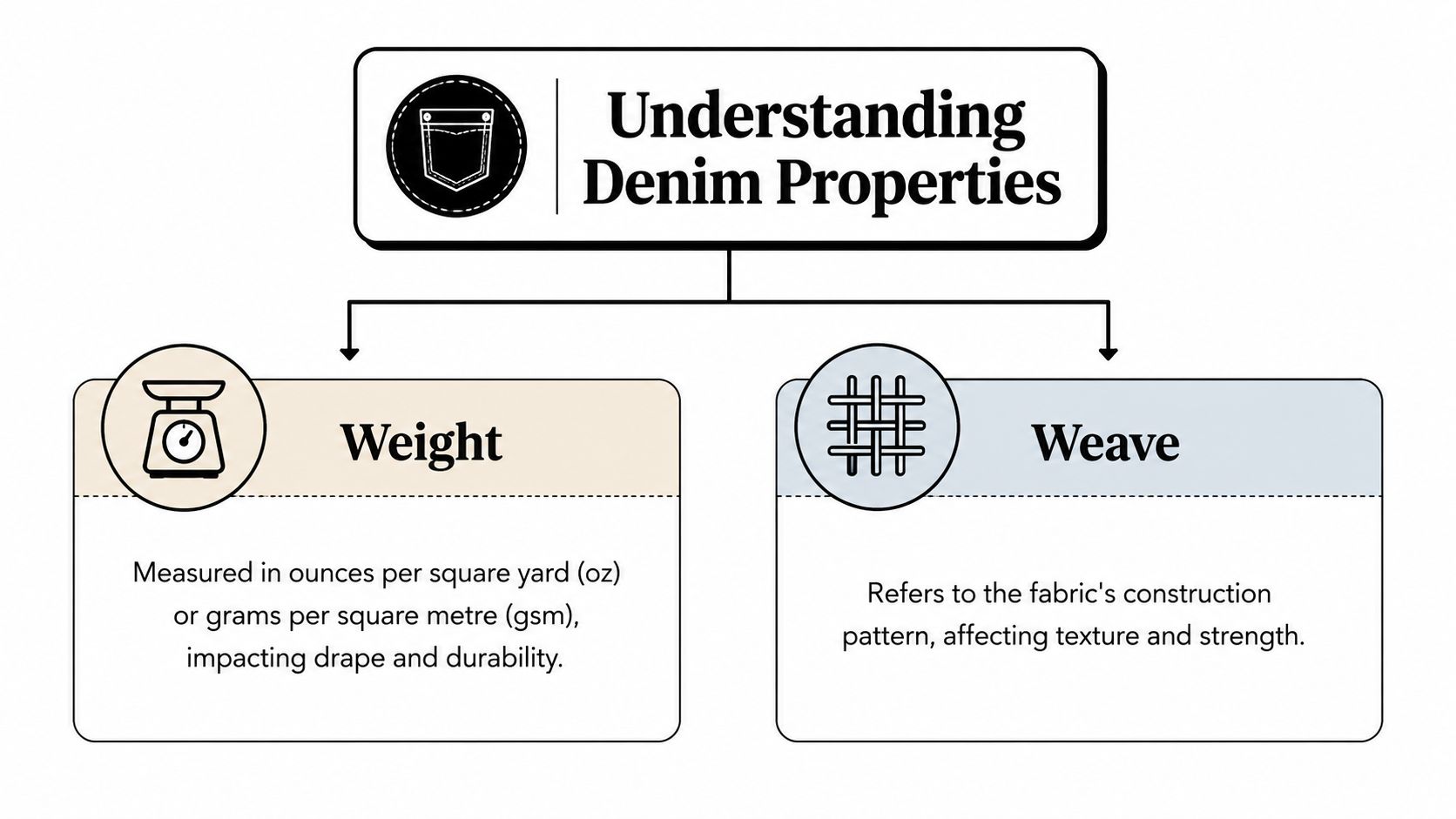
If I could only teach one thing about fabric denim, it would be this. Weight tells you how denim behaves. Before colour, finish, or brand, weight usually decides whether the fabric will make a crisp jean, a comfortable skirt, or a floppy shirt that never quite looks right.
What weight means in real sewing
Denim weight is commonly given in ounces per square yard, often shortened to oz or oz/yd². In practical terms, lighter denim bends and drapes more easily. Heavier denim feels denser, resists folding, and stands up to abrasion better.
A useful benchmark comes from Cotton Incorporated's denim manufacturing guide. Classic bottom-weight denim is typically around 14.5 oz/yd², built with approximately 60 to 64 warp yarns per inch and 38 to 42 weft picks per inch. That dense construction improves abrasion resistance, but it also makes the cloth less pliable.
That trade-off matters at the cutting table.
- Lighter denim suits shirts, loose dresses, soft overshirts, and children's clothes.
- Mid-weight denim is often the easiest all-round choice for skirts, pinafores, work shirts, and relaxed trousers.
- Heavier denim is where classic jeans, chore jackets, and hard-wearing utility garments live.
A quick way to judge it by hand
When you're holding fabric, try this:
- Scrunch it in your fist. If it springs back with body, it's more structured.
- Let a corner fall off the table. If it drops softly, it has drape.
- Fold four layers together. If that fold already feels bulky, expect challenging hems and thick seam intersections.
- Look at the cut edge. Dense, compact yarns usually signal a firmer cloth.
A denim can be beautiful on the bolt and still be wrong for your pattern. Weight decides whether the garment cooperates.
What weave means
The second key is the weave. Denim is usually a twill, which creates those diagonal lines across the surface. That diagonal isn't just decoration. It affects wear, softness, and how the fabric twists or settles after washing.
You'll hear these terms:
- Right-hand twill often shows a diagonal running one way and is the classic look many people associate with jeans.
- Left-hand twill is often described by sewists as feeling a bit softer after wear.
- Broken twill interrupts the diagonal pattern and is often chosen to help reduce the twisting effect you sometimes see in trouser legs.
If a shop listing doesn't mention the twill direction, don't panic. Weight, fibre content, and stretch matter more for most home projects. But if you're making serious jeans and want that classic feel, twill type becomes part of the personality of the garment.
Why weight and weave must be read together
A soft-feeling twill in a lower weight will sew very differently from a dense, rigid twill even if both are labelled denim. That's why beginners sometimes buy “denim” for jeans and end up with trousers that feel more like soft casual trousers, or they buy a dramatic heavyweight and try to turn it into a dress.
The label tells you the family. The weight and weave tell you the behaviour.
A Guide to Common Denim Fabric Types
Once you understand that denim is a family rather than a single fabric, shopping gets far less frustrating. You stop asking, “Is this denim?” and start asking, “What kind of denim is this, and what will it do?”
The main families you'll meet
Raw or dry denim is denim that hasn't been pre-washed into softness. It often feels firmer, looks cleaner and deeper in colour, and develops wear marks through use. If you love the idea of jeans that become more personal over time, raw denim is appealing. If you want immediate softness, it may feel stubborn at first.
Selvedge denim refers to fabric woven with a self-finished edge. It's often prized for heritage-style jeans making and clean internal finishes where the edge can be shown off. The important practical point is width. This denim width explanation notes that selvedge denim is typically around 70 to 80 cm wide, while standard denim is often 140 to 150 cm wide. For home sewists buying by the metre, that can change the overall cost of a project because you may need more fabric.
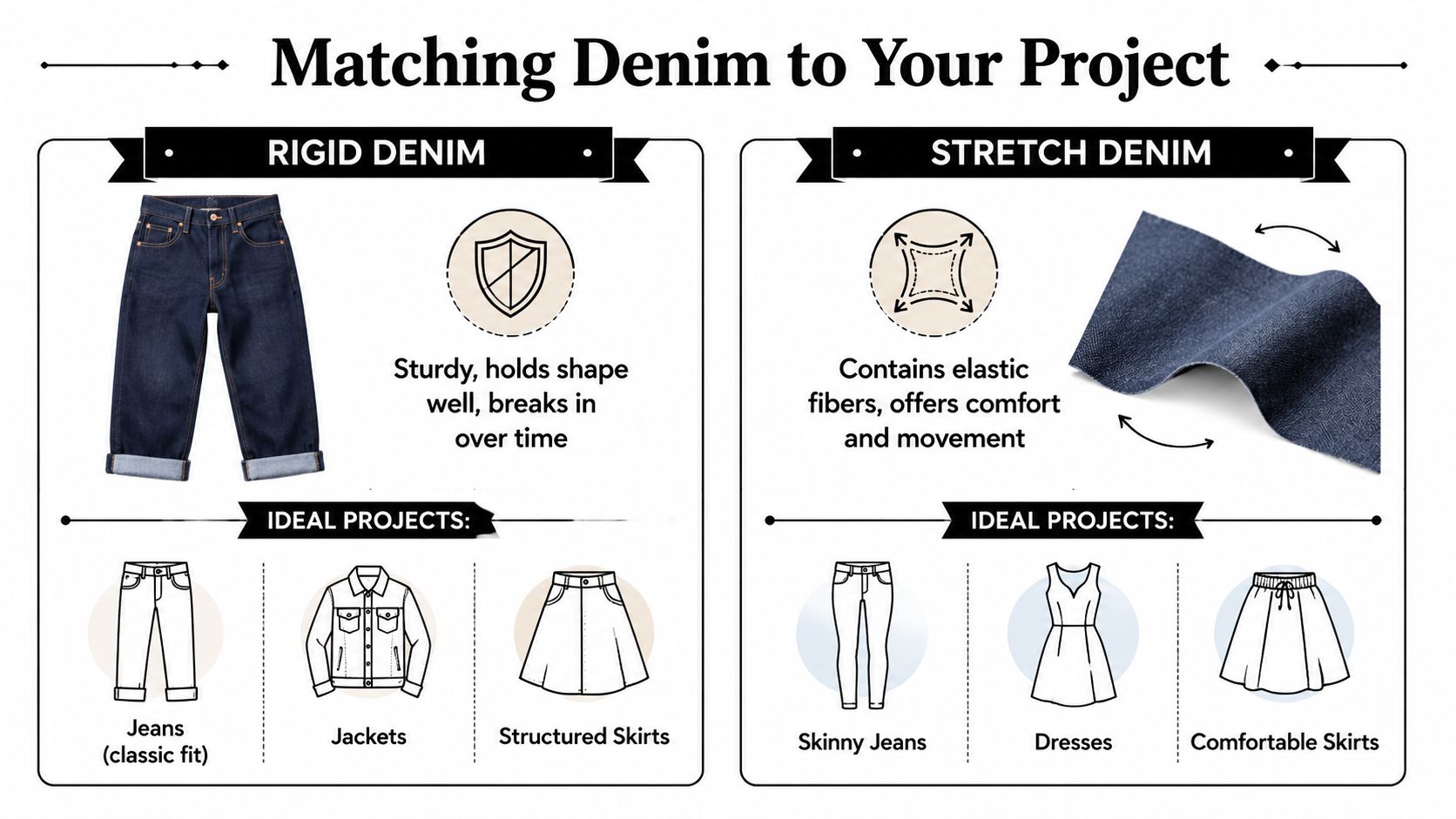
Stretch denim contains elastic fibres and gives you more movement. It's brilliant for close-fitting jeans, fitted skirts, and garments you'll sit in all day. It also behaves differently under the machine, especially when topstitching or attaching waistbands, so matching the pattern to the stretch level matters.
Chambray is often grouped into denim conversations because it gives a similar casual blue look, but it's lighter and softer. If you want a denim-style shirt or dress with drape, chambray often gives a better result than true bottom-weight denim.
Bull denim is a sturdy twill, usually dyed rather than showing the classic blue-and-white denim look. It's useful when you want firmness and toughness without the traditional indigo face.
Coated or printed denim changes the surface appearance. These fabrics can be striking, but they may need gentler pressing and a bit of testing first, especially if the finish marks easily.
Denim type comparison
| Denim Type | Key Characteristic | Best For | Sewing Difficulty |
|---|---|---|---|
| Raw denim | Unwashed, firmer hand, develops character with wear | Classic jeans, structured jackets | Medium to high |
| Selvedge denim | Clean self-finished edge, usually narrower width | Heritage jeans, visible seam details | Medium to high |
| Stretch denim | Contains elastic fibres for comfort | Fitted jeans, pencil skirts, close-fit dresses | Medium |
| Chambray | Lighter, softer, more drape | Shirts, shirt dresses, soft tops | Low to medium |
| Bull denim | Dense, sturdy twill with a solid look | Trousers, aprons, utility jackets, bags | Medium |
| Coated or printed denim | Decorative surface finish | Statement jackets, skirts, fashion pieces | Medium |
How to choose between them
If you're torn between two options, think about the finished garment in use rather than on the hanger.
- For a traditional jeans look choose rigid denim or raw denim.
- For comfort first choose stretch denim and a pattern designed for it.
- For visible selvedge details check the pattern pieces and decide whether that edge will show.
- For a softer everyday garment pick chambray or a lighter denim instead of forcing heavy cloth into a drapey design.
A common beginner mistake is buying selvedge because it sounds premium, then realising the narrow width means awkward layout and more metreage. Premium doesn't always mean practical for your project.
Matching Denim to Your Sewing Project
The best fabric denim isn't the most expensive or the most authentic. It's the one that matches the shape, fit, and use of the garment you want to wear.
Jeans and structured trousers
If you want that classic, non-stretch jeans feel, choose a mid to heavy rigid denim. This is the kind of cloth that holds a waistband neatly, supports topstitching, and gives definition through the leg.
Patterns with a straight leg, wide leg, stovepipe shape, or vintage-style fit usually look better in rigid denim than in soft stretch fabric. The cloth gives the silhouette its architecture.
Good project matches include:
- Classic five-pocket jeans
- Workwear trousers
- Utility overalls
- Structured shorts
If you're new to jeans sewing, avoid the heaviest fabric in the shop for your first attempt. You want enough body for a jeans look, but not so much bulk that every belt loop becomes a fight.
Skirts, pinafores, and easy everyday pieces
A mid-weight denim is often the sweet spot for home sewing. It's stable, easy to cut, and structured without becoming armour.
This weight works well for:
- A-line skirts
- Button-front skirts
- Pinafores
- Pull-on trousers with shape
- Simple overshirts
These projects are forgiving because they don't usually ask the denim to mould around the body as tightly as skinny jeans do. You still get the satisfying look of denim, but with easier sewing and easier wearing.
If you want a garment to skim the body rather than stand away from it, move slightly lighter than you first planned.
Jackets and outer layers
For denim jackets, chore coats, and shackets, think about what you'll wear underneath. A dense rigid denim can make a brilliant outer layer, but if the design includes collars, cuffs, pockets, plackets, and topstitched seams, bulk builds fast.
Choose with the seam intersections in mind.
A jacket denim should usually do three things:
- Hold its shape at the collar and front band
- Support pockets without drooping
- Still feed through your machine at cuff and hem joins
If your machine struggles with thickness, a slightly lighter jacket denim is often the wiser choice.
Dresses and shirts
Many people buy the wrong fabric. If you want gathers, movement, and a softer silhouette, don't reach automatically for jean-weight denim just because the pattern says “denim suitable”.
Use lightweight denim or chambray for:
- Shirt dresses
- Denim shirts
- Peasant tops
- Soft tunics
- Loose summer trousers
A good test is to imagine the sleeve. If you want it to gather, puff, roll, or drape, you need a softer cloth.
Rigid or stretch
Ask one plain question. Do you want the garment to fit by shape or fit by give?
- Choose rigid denim when the pattern includes enough ease and structure.
- Choose stretch denim when the fit is close and comfort depends on movement through the cloth.
Never swap one for the other casually. A rigid jeans pattern in stretch can end up baggy. A stretch pattern in rigid denim can become unwearable.
Essential Tips for Sewing with Denim
Denim has a reputation for being difficult, but most problems come from a few predictable places: blunt needles, short stitch lengths, bulky seam crossings, and skipped prep.
Start with preparation, not bravado
Wash your denim before cutting, especially if it's dark, rigid, or likely to shrink or release dye. In professional denim specifications, performance is often defined after washing, including shrinkage tolerance, skew or leg twist, and colour fastness. This denim specification guide also notes the use of ISO 105-X12 rubbing tests to predict indigo transfer, which matters for sewists because crocking shows up on hands, pocket linings, and lighter garments.
That's the technical version of a very ordinary sewing truth. Denim can change once washed.
Pre-wash the fabric the way you expect to wash the finished garment. That gives you the version of the fabric you'll actually be wearing.
Tools that make denim easier
You don't need an industrial machine, but the right setup helps a lot.
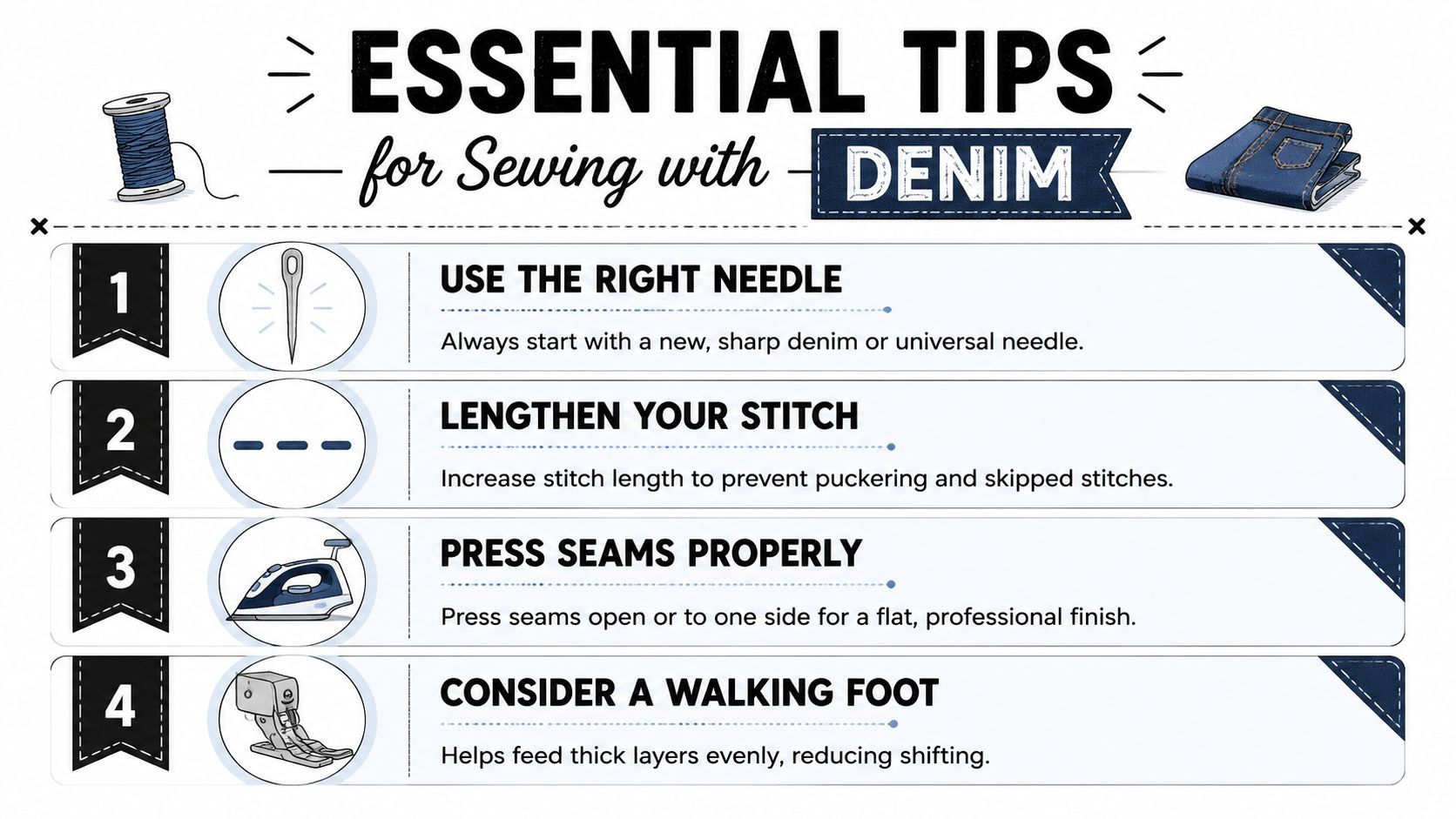
- Use a fresh needle. A new denim or jeans needle handles dense yarns better than the one already in your machine.
- Choose strong thread. Good polyester thread is dependable for construction seams. For visible topstitching, use dedicated topstitching thread where your machine can handle it.
- Keep a hump jumper nearby. A jean-a-ma-jig or hump jumper helps the presser foot stay level when climbing over bulky seams.
- Try a walking foot. It can help feed multiple layers evenly, especially with stretch denim or thick hems.
Here's a helpful demonstration to watch before you start wrestling thick seams:
Techniques that give a cleaner finish
The difference between homemade-looking denim and polished denim often comes down to handling bulk well.
Grade and trim seam allowances
If several layers meet at one point, trim each layer to a slightly different width. This spreads the bulk instead of stacking it. It's especially useful on waistbands, collar points, pocket corners, and flat-felled seams.
Press every step
Don't wait until the end. Press after stitching, press seams open or to one side as needed, and use plenty of steam if your fabric allows it. A clapper can help flatten bulky areas after pressing.
Lengthen topstitching
Denim usually looks better with a slightly longer stitch than fine blouse fabrics. Test on scraps first. Short stitches can look crowded and may pucker on dense cloth.
Hammer carefully when needed
For very bulky hem intersections, some sewists gently tap the seam with a hammer to compress the layers before sewing. Protect the fabric with a pressing cloth or scrap and work on a firm surface.
Seam finishes worth knowing
For home sewing, these are the most practical options:
- Overlocked or zigzagged edges for simple, neat internal seams
- Flat-felled seams for classic jeans styling and strength
- Mock flat-fell seams if you want the look without the full bulk
- Bound seams for special jackets or unlined garments where the inside will show
If your machine struggles, choose the finish that gets the garment made well. You don't need to recreate factory construction exactly to make beautiful denim.
Sustainable Sourcing and Long-Term Care
A good denim garment earns its place by being worn often and kept for years. That makes care and sourcing part of the same conversation.
Care for the fabric you actually bought
Dark denim can bleed. Rigid denim can soften. Some fabrics relax after wear and settle again after washing. So treat your first wash as part of the making process, not an afterthought.
For home sewing, these habits are sensible:
- Pre-wash dark denim separately if you suspect dye transfer
- Turn finished garments inside out to help preserve surface colour
- Wash in cool water if you want to be gentler on colour and fibres
- Air dry when possible to reduce stress from heat
If you're sewing a lined jacket, pocket bag, or contrast facing into denim, test for dye transfer first. A quick rub test on a damp white scrap can save a nasty surprise.
Sustainable choices are broader than labels
The useful shift in denim is that sustainability isn't being discussed only in terms of recycled content anymore. The Sustainable Angle coverage discussed by Carved in Blue highlights a move toward lower-impact fibres and supply-chain transparency. For sewists, that matters because a responsible choice still has to function well.
A denim that pills, bags badly, or loses shape quickly isn't automatically the better buy just because the label sounds green. Performance still matters.
Thoughtful sourcing ideas
You can make more sustainable choices without becoming overwhelmed.
- Choose for longevity. Make a garment you'll reach for often.
- Look at deadstock. Ex-designer or leftover production fabric can be excellent quality and keeps usable cloth in circulation.
- Match fabric to project properly. A wrong fabric often becomes an unworn garment, and that's waste too.
- Save your offcuts. Denim scraps are useful for pocket linings, repairs, patchwork, tool rolls, and sample topstitching tests.
The most sustainable denim is often the denim that becomes a favourite and stays in your wardrobe.
Start Your Denim Project with More Sewing
The best next step isn't buying the boldest denim you can find. It's getting your hands on the right one. Denim is tactile. You need to feel the weight, fold it, and picture it as a real garment.
That's why swatches matter so much. A small sample tells you more than a product photo ever can. You can test drape, check the shade of indigo in daylight, see how stiff the cloth feels, and compare one denim against another before you commit.
If you're making jeans for the first time, it also helps to gather everything at once. Fabric, hardware, thread, and a suitable pattern all need to work together. And if your machine hasn't tackled heavy seams in a while, having it checked before a denim project can save a lot of frustration.
A good denim project doesn't start with bravery. It starts with choosing a cloth that suits both the garment and the sewer. If you do that, the sewing itself becomes much more enjoyable.
If you're ready to start, take a look at More Sewing for denim fabrics, sample swatches, sewing kits, and practical extras that help you sew with confidence. If you're local to Worthing, you can also visit the shop in person and sort out sewing machine servicing before you tackle a heavier denim project.
