
You're probably looking at a row of printed fleece right now and thinking two things at once. First, it's hard not to love it. Second, which one will work for what you want to sew?
That's the point where fleece can get surprisingly tricky. A print that looks brilliant online can feel too bulky for a hoodie, too flimsy for a blanket, or too warm for the wrong kind of garment. And while fleece is often described as “easy to sew”, that only tells half the story. The best results come from matching the right fleece print fabric to the right project, then handling its stretch, pile, and care properly from the start.
We see the same questions come up again and again in the shop. Why does one fleece feel denser than another? Why do some prints stay looking fresh while others bobble quickly? Is printed fleece suitable for children's clothes, or better for robes and throws? Those are the practical questions that matter more than the print alone.
An Introduction to Fleece Print Fabric
Printed fleece has a way of pulling you in. One minute you're searching for a simple winter fabric, and the next you're comparing woodland animals, stars, checks, florals, cartoon themes, and every shade from soft neutrals to bright novelty prints.
That variety is exactly why a little fabric knowledge helps. Fleece print fabric isn't just “soft fabric with a pattern on it”. It has weight, stretch, pile, warmth, and care requirements that affect how your finished project will look and wear. A blanket, snood, robe, hoodie lining, and pet bed might all use printed fleece, but they won't all use the same kind.
In practice, the print is only half the decision. The other half is asking a few grounded questions before you buy:
What are you sewing. A throw, a zip-up top, a hat, a lining, or a toy?
How much drape do you need. Soft and floppy, or thick and structured?
Will the fabric sit next to skin. That changes comfort and suitability.
Does the print need matching. Directional motifs and large repeats need more planning.
Practical rule: Cute print first, technical suitability second is the fastest way to end up with unused fabric.
Printed fleece is a modern sewing fabric, not a traditional woven cloth. It came into the market in the early 1980s as a synthetic alternative to wool, and that shift is a big reason it became such a common choice for clothing, blankets, and home sewing in the UK, as noted in this fleece fabric history overview.
The good news is that fleece is forgiving in useful ways. It doesn't fray like a woven. It hides small stitching imperfections better than many smooth fabrics. It's often comfortable to handle on the sewing table. Once you understand what gives it warmth and bulk, choosing becomes much simpler.
What Exactly Is Fleece Fabric
Fleece isn't woven like cotton poplin or linen. It's a knitted fabric, and that matters because the knit structure gives it give and softness before the finishing process even begins.
Most printed fleece sold for sewing is polyester-based. After knitting, the fabric is brushed so the surface becomes fluffy and raised. That brushing pulls up fibres into a soft nap or pile. The result is the familiar cosy finish people associate with fleece.
Why fleece feels warm
The warmth doesn't come from heaviness alone. The brushed surface traps still air, and that trapped air is what gives fleece much of its insulation. If you run your hand over the face of printed fleece, you're feeling that raised nap doing its job.
A useful way to think about it is this. Velvet has a pile that changes the look and feel of the surface. Fleece also has a pile, but instead of a neat, directional finish, it's softer, loftier, and built for warmth rather than polish.
UK sewing guidance also treats polyester as the usual base for printed fleece because it's lightweight, quick-drying, and easy to print. That same guidance notes that fleece can also be made from fibres including cotton, viscose, merino wool, recycled plastic, and hemp. For printed versions, polyester matters technically because sublimation printing works best on polyester and gives durable colour on the brushed face, as explained in this fleece sewing guide.
Why printed fleece is a modern fabric
Printed fleece belongs firmly to modern textile production. It isn't a heritage British woven with a long pre-industrial history behind it. It's a post-1980s product category built on synthetic pile construction and industrial printing methods.
That's useful to remember because it explains a lot about how fleece behaves:
It's usually stable enough for beginners, but not rigid like a woven.
It can stretch under the presser foot, especially on cross-grain.
The pile affects print clarity, seam bulk, and surface wear.
The fibre base affects comfort, drying time, and long-term care.
Fleece works best when you treat it as an engineered fabric with a soft surface, not just a cosy novelty textile.
What that means at the cutting table
If you've sewn with jersey, you'll recognise some of the same handling issues. The difference is that fleece has more body and loft. That can be helpful because it doesn't usually curl at the cut edge the way some knits do, but the bulk can build quickly at seams, hems, collars, and enclosed corners.
For many home sewists, that's why fleece feels easier to sew than slippery viscose or fine jersey, yet still needs a bit more care than a stable cotton. It's friendly, but it isn't foolproof.
Understanding Fleece Properties and Types
The fastest way to choose the wrong fleece is to buy by print alone. The best way is to check weight, finish, pile, and intended use together.
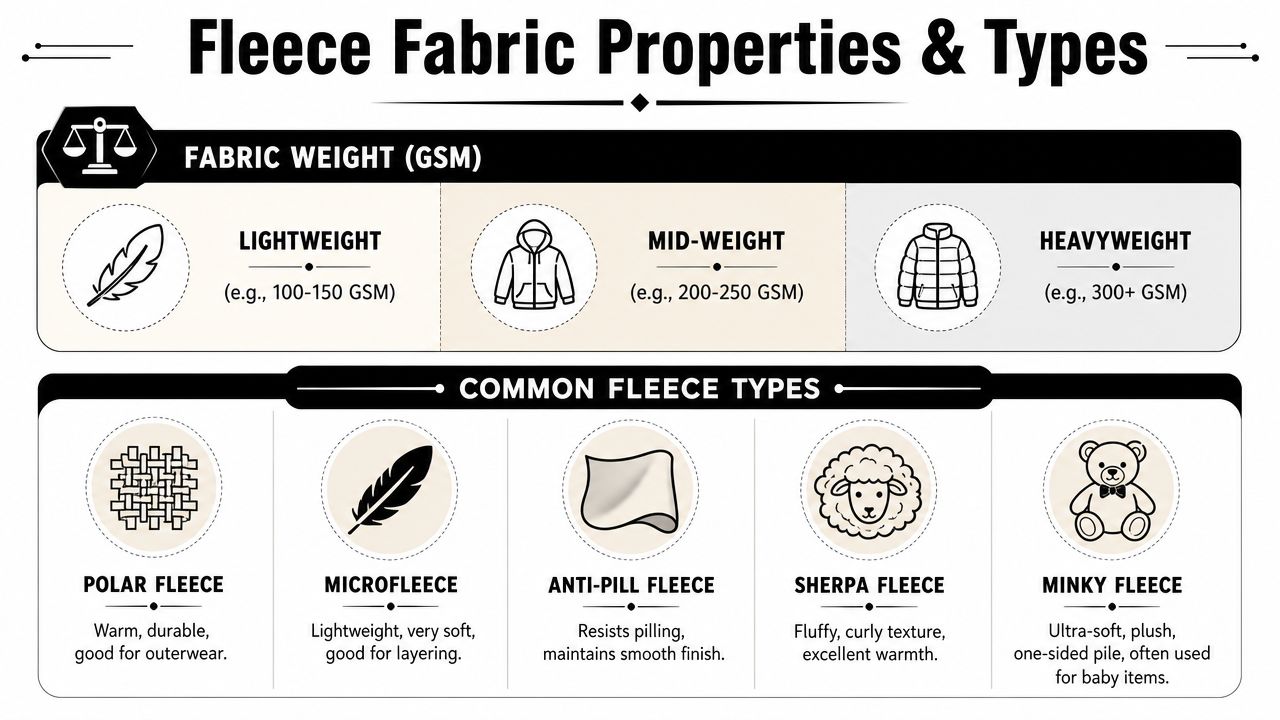
Start with weight
Weight changes almost everything. It affects how a fleece hangs, how warm it feels, how bulky the seams become, and whether it suits clothing or homeware better.
UK fleece teaching material treats 210 gsm as medium weight and 315 gsm as medium-to-heavy weight in this fleece class reference. Those two points are useful benchmarks because they sit around the choices most sewists face in practice.
A medium weight printed fleece is often easier for hoodies, linings, simple pullovers, and children's makes. A heavier fleece gives more insulation, but it also adds seam bulk and can make enclosed details harder to sew neatly.
Common fleece types at a glance
| Fleece Type | Key Characteristic | Best For |
|---|---|---|
| Polar fleece | Standard brushed polyester fleece with warmth and body | Blankets, robes, outer layers |
| Anti-pill fleece | Finished to resist surface bobbling better than basic fleece | Garments and throws that will be washed often |
| Microfleece | Lighter, thinner, less bulky | Layering pieces, lighter accessories |
| Brushed-back fleece | Smooth outer face with brushed inside | Sweatshirt-style garments |
| Sherpa-style fleece | Deep, textured pile with a woolly look | Cosy linings, jackets, throws |
| Minky-style fleece | Plush surface with a very soft hand | Comfort items, soft blankets, sensory projects |
What the finish changes
An anti-pill finish can make a real difference when the fabric will be rubbed often, such as a robe, a pram blanket, or a child's everyday layer. Basic fleece can still be useful, but if the pile is loose or low quality, the surface can start looking tired earlier than you'd like.
The brushed face also affects your sewing choices. A lofty fleece hides topstitching more than a flatter one. That can be a blessing if your seams aren't perfectly even, but it can be frustrating if you want crisp visible detail on the outside.
Here's the practical trade-off we mention most often in the shop:
Lower loft fleece gives clearer stitching lines and less seam bulk.
Higher loft fleece feels cosier and warmer, but can look chunkier at joins.
Dense fleece often wears better than very spongy fleece.
Very soft fleece may feel lovely in the hand but can shift more while sewing.
Pay attention to stretch and grain
Fleece is knitted, so it usually has more stretch across the width than down the length. That doesn't make it a highly elastic fabric, but it does mean you need to respect grain and direction when cutting.
If you cut pattern pieces carelessly, the fabric can stretch where you don't want it to. On some garments that leads to droopy hems, wavy shoulder seams, or cuffs that don't recover well.
For prints, grain and direction matter twice over. The fabric has to behave properly, and the design has to sit properly.
How to Choose the Right Print for Your Project
The print is the fun part, but it also decides whether the finished item looks thoughtful or accidental.
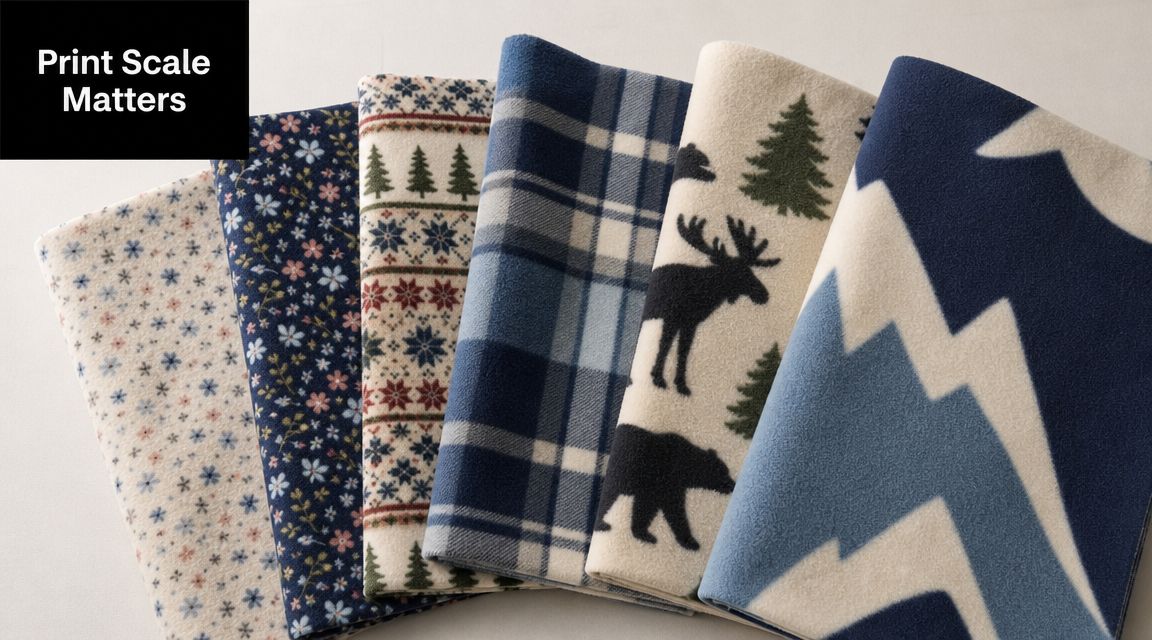
Match print scale to project size
Large motifs need space. A bold dinosaur, oversized floral, or scenic woodland print can look brilliant on a blanket, roomy hoodie, or dressing gown. The same motif can look chopped up and awkward on mittens, baby booties, or a small hat.
Small repeats are easier to use on compact projects. Tiny stars, ditsy florals, checks, and scattered shapes usually read more cleanly when the pattern pieces are narrow or curved.
A quick way to judge scale is to imagine the central motif landing on the smallest key piece in your pattern. If that motif can't fit attractively on a pocket, sleeve, or hood panel, it may be too large for the project.
Check whether the print is directional
Some prints have an obvious top and bottom. Rows of animals, upright rainbows, text, rockets, or trees all count as directional. If you use them, every visible pattern piece needs to face the same way.
That changes your layout. You lose the freedom to rotate pieces to save fabric, and you need to be more deliberate with nap and print direction together.
If a print has faces, words, vehicles, or anything that “stands up”, lay out the whole project before cutting a single piece.
Think about the finished use, not just the shelf appeal
A print may look charming in the fold and still be the wrong mood for the item. Busy novelty prints often suit lounge pieces, blankets, pet projects, and children's daywear. A more restrained print, such as a tartan look, scattered leaf, subtle animal pattern, or tonal geometric, can make fleece feel more wearable for adults.
This is especially relevant if you're sewing accessories or branded pieces. If you're looking at hats or winter merch, it helps to study how print and colour placement affect the final look. A useful example is this guide on how to customize beanies for your brand, which shows how design decisions need to suit the finished shape rather than just the flat material.
A simple print-selection checklist
For blankets and throws. Go larger and bolder because the project gives the print room to read.
For hoods, hats, and cuffs. Choose smaller repeats or all-over textures.
For matching family makes. Pick a print with enough movement that minor mismatches won't show.
For gift sewing. Avoid very specific novelty themes unless you know the recipient will love them long term.
The best printed fleece projects usually don't come from the loudest print. They come from the print that still looks good once it's cut, stitched, folded, and worn.
Essential Tips for Sewing with Fleece
Fleece is pleasant to sew in many ways. It doesn't fray, it's forgiving to handle, and it usually presses you toward simple construction. But a few habits make the difference between a smooth project and one that fights back.
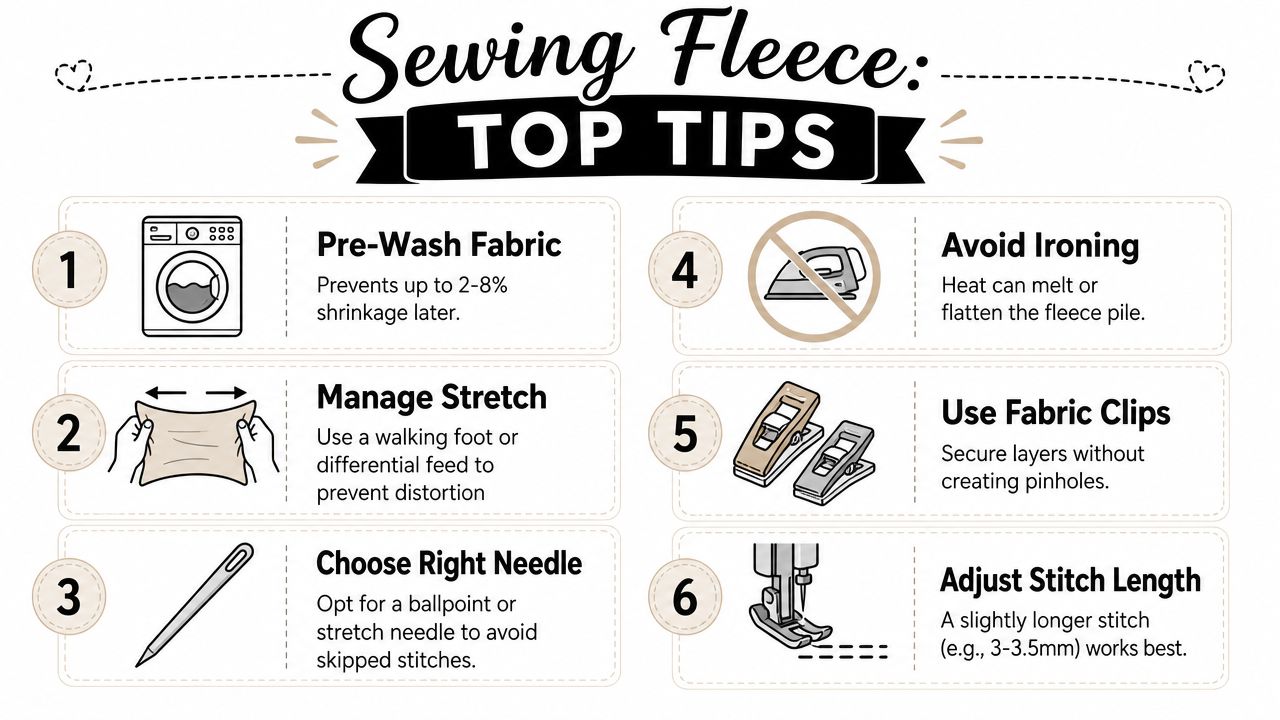
Pre-wash before you cut
This is the step people skip when they're eager to start. Don't skip it for garments.
Printed fleece commonly carries a 2 to 8% shrinkage allowance in product guidance, and that's why pre-washing matters for pattern fit and print alignment, as noted in this fleece performance reference. If you cut first and the fabric changes after the first wash, hems, cuffs, lengths, and print placement can all shift in ways you can't fix.
Set up the machine for knit behaviour
Use a ballpoint or stretch needle so the needle slides between fibres rather than punching harshly through the knit structure. Pair it with a good polyester thread and test on an offcut before you begin.
A few machine habits help straight away:
Use a walking foot if you have one. It feeds the layers more evenly.
Reduce presser foot pressure if needed. That can stop the seam from stretching out.
Lengthen the stitch slightly. Tiny stitches can sink into thick pile.
Test topstitching first. On fluffy fleece, stitching can disappear more than expected.
Cut with the nap and bulk in mind
Fleece often has a visible nap, even if it's subtle. Run your hand up and down the surface and you'll usually feel a difference. Keep all visible pieces going in the same nap direction unless you have a strong reason not to.
Bulk management matters just as much. Thick fleece can turn a simple collar stand, cuff join, or hood seam into a lumpy area very quickly.
Try these shop-tested fixes:
Grade seam allowances by trimming each layer to a slightly different width.
Trim corners aggressively on enclosed shapes, but don't clip through the seam.
Use clips instead of too many pins when the fabric is lofty.
Avoid very narrow turn-and-stitch details on dense fleece.
Sew the simplest version of the design first. Fleece rewards clean shapes more than fussy construction.
What usually goes wrong
The most common problem is a wavy seam. That usually comes from the machine stretching the fabric as it feeds. The next most common issue is excessive bulk at intersections, especially where hems, bands, and seams meet.
If that happens, stop and reduce complexity. On fleece, a plain hem can work better than a thick cuff. A bound edge can work better than a turned one. A simple patch pocket can behave better than an inset detail.
Fleece isn't hard. It just prefers practical sewing over delicate tailoring.
Caring for Your Finished Fleece Projects
Fleece usually gives good wear if you care for it gently. The problem is that people often treat it like an indestructible fabric, then wonder why the pile looks tired and the print loses its fresh look sooner than expected.
Wash for longevity, not just cleanliness
Polyester fleece doesn't always need frequent washing in the way next-to-skin basics do. If a robe, blanket, or throw has only had light use, airing it out can be enough between washes.
That matters for two reasons. First, less washing reduces wear on the pile and print. Second, polyester fleece sheds microfibres during washing, and that remains an environmental concern in the UK. Responsible care, including washing less often and avoiding tumble dryers where possible, can reduce lifecycle impact, as discussed by Pico Textiles.
Care habits that help
A few habits keep fleece looking better for longer:
Wash gently. A cooler, gentler cycle is kinder to the fibres and surface.
Skip heavy heat. High tumble-dryer heat can flatten pile and age the fabric faster.
Turn garments inside out if the printed face is likely to rub during washing.
Wash similar textures together so rougher items don't abrade the fleece surface.
Why responsible care matters
Printed fleece is a practical fabric. It's warm, quick-drying, and useful. But it's still a synthetic textile, so it makes sense to be realistic about the trade-off. If you buy it, the most sensible thing you can do is make it last.
That means sewing projects you'll use, choosing a quality level that won't pill immediately, and laundering with restraint rather than habit. For many sewists, that's the most balanced approach. Use fleece where it performs well, then care for it in a way that respects both the fabric and the project.
Project Ideas and Expert Buying Advice
Some fabrics are all-purpose on paper but awkward in real life. Printed fleece isn't one of them. It has clear strengths, and the smartest projects lean into those strengths rather than asking the fabric to behave like something it isn't.
Best uses for printed fleece
Printed fleece shines in projects where warmth, softness, and easy wear matter more than crisp tailoring.
Good choices include:
Blankets and throws that show off larger prints
Robes and house layers where softness matters more than sharp structure
Hats, snoods, and scarves that benefit from warmth without fraying edges
Pet accessories and beds where comfort and washability are useful
Simple children's daywear layers such as easy pullovers or outer accessories
Pet sewing is one of the most practical uses for printed fleece, especially for removable liners, crate mats, and cushion covers. If you're matching fabric choice to pet comfort more broadly, this guide to choosing the perfect dog bed is a useful companion read because it focuses on support and use, not just appearance.
What to avoid
Printed fleece is not the answer to every winter sewing idea. It can be too bulky for fitted garments, too warm for some indoor clothing, and too synthetic-feeling for projects that need breathability against the skin.
One area where people need extra care is children's sleepwear. In the UK, children's nightwear falls under the Nightwear (Safety) Regulations, and standard polyester fleece print fabric is often better suited to outer layers such as robes, blankets, and hats than next-to-skin sleepwear, as explained in this UK-focused discussion of fleece suitability.
If you'd like a visual walkthrough of fleece handling and practical uses, this video is worth watching before you cut:
Buying advice that saves disappointment
The most useful buying habit is to read beyond the print name. Check the fabric description for clues about weight, pile, finish, and intended use. If a listing mentions anti-pill, that's often a sign the fabric is meant for repeated wear or laundering. If the fleece looks very lofty, think about seam bulk before choosing a pattern with lots of enclosed edges.
A swatch is often the most sensible first step, especially if you're sewing clothing rather than a blanket. The hand feel, density, and print scale can be very different from what you expect on screen.
The right printed fleece should suit the project even before you've fallen in love with the pattern.
If you're ready to choose fleece print fabric with more confidence, More Sewing is a useful place to start. You'll find carefully selected fabrics, sewing essentials, and helpful support for beginners and experienced makers alike, whether you need a swatch, a full project shop, or advice on what will work at the sewing machine.
