
Dressmaking, Guides
How to Sew a Tweed or Boucle Jacket: Expert Guide 2026
You've probably had this moment already. A length of tweed or bouclé is folded on the table, the texture is gorgeous, the colours are perfect, and then the nerves start. You know this fabric can fray if you look at it the wrong way. You know a jacket has to fit properly. You know the difference between “homemade” and “beautifully made” usually shows up in the places no one notices until they do.
That hesitation is sensible. A tweed jacket asks more from you than a simple blouse or skirt. But it's also one of the most satisfying things you can sew, because the result feels substantial, personal, and lasting in a way few projects do.
The trick is knowing why couture methods matter. On a stable cotton, you can get away with a few shortcuts. On tweed or bouclé, shortcuts usually turn into stretched edges, popped seams, bulky hems, or sleeves that never sit right. Good technique isn't decoration here. It's what keeps the jacket from fighting you at every stage.
Your Guide to Sewing a Timeless Tweed Jacket
A classic tweed jacket has a strange effect on sewists. It looks clean and effortless when finished, but the making of it can feel loaded with risk. The fabric shifts. The weave opens. Every seam seems to need more care than usual. That's why so many people admire this style for years before they cut into their fabric.
The good news is that how to sew a tweed or bouclé jacket isn't a mystery reserved for couture workrooms. It's a sequence of sensible decisions. Choose a pattern that suits the fabric. Prepare the cloth before it ever reaches the cutting stage. Stabilise where the weave wants to loosen. Shape the garment gradually, not forcefully.
A boxy collarless jacket is often the friendliest place to start. It gives you room to focus on texture, finishing, and balance without also wrestling with sharp tailoring lines everywhere. A more fitted style can be beautiful too, but it asks for cleaner shaping through the bust, shoulder, and waist, and bouclé doesn't always forgive repeated unpicking.
Practical rule: If the fabric is doing something awkward, don't sew faster. Slow the process down and add support before you continue.
That's the heart of this project. Every couture technique in a tweed jacket solves a real problem. Quilting gives soft structure. Stabilising stops distortion. Hand finishing controls bulk where machine stitching would show or drag. Once you see the reason behind each method, the project becomes far less intimidating and much more enjoyable.
Your Blueprint Choosing Patterns and Prepping Fabric
A good jacket starts with restraint. Don't pick the most complicated pattern just because the fabric feels luxurious. Pick the pattern that lets the fabric behave well.
Start with the shape, not the fantasy
For a first tweed or bouclé jacket, I'd look at these pattern types:
- Boxy collarless jackets with simple fronts and set-in sleeves. These are forgiving and let the fabric texture do the work.
- Lightly shaped jackets with bust darts or gentle waist shaping. These suit sewists who already know how they fit through the shoulders and upper back.
- Highly fitted styles with multiple panels, strong waist suppression, or elaborate collars. These can look superb, but only if you're prepared for more fitting and more internal support.
If your fabric is thick, spongy, or very loosely woven, a simpler silhouette usually gives the best result. Fine tailoring details can disappear into a textured surface anyway.
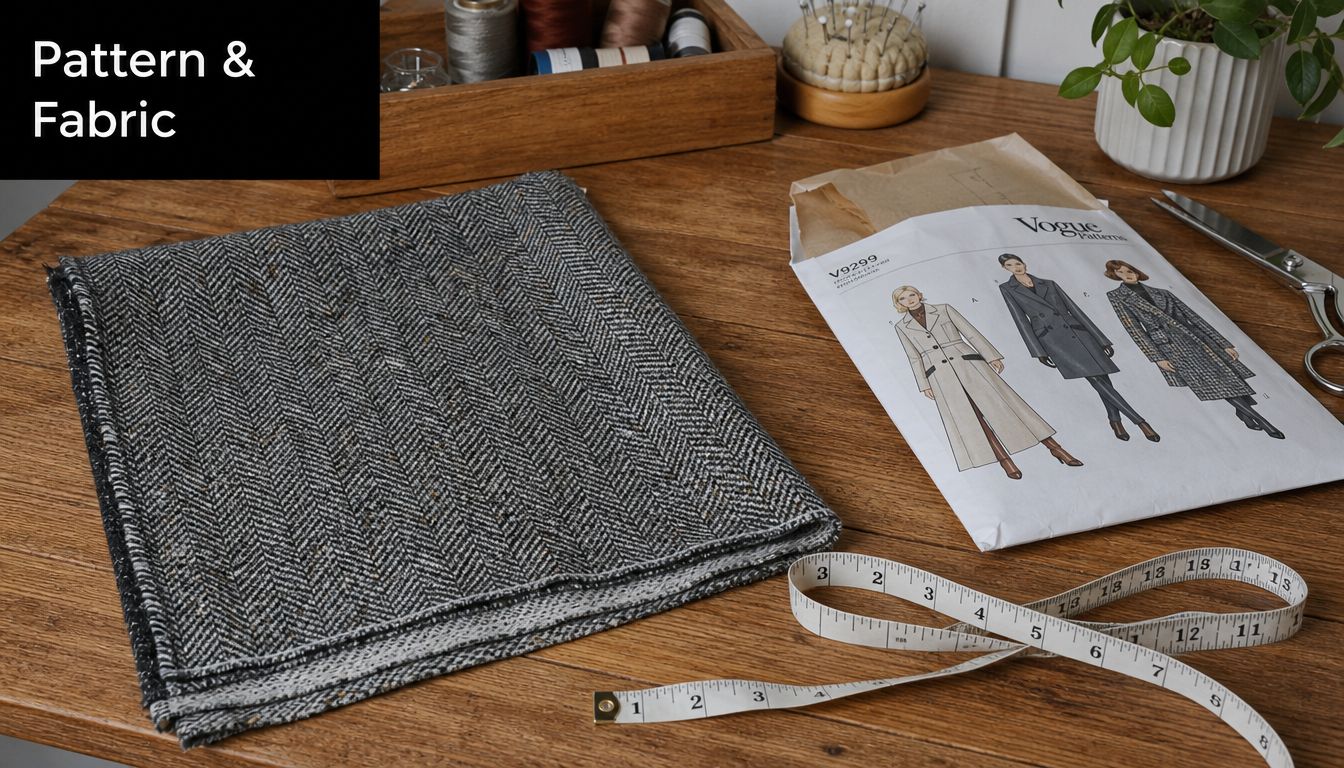
If you're still deciding on cloth, this guide to selecting premium tweed fabric is useful for thinking through texture, weight, and the kind of finish you want from the garment.
Prep the fabric before you even think about cutting
Many jacket projects go wrong due to fabric handling. Bouclé tweed is a loosely woven fabric composed of wool and other unusual fiber content, making it highly prone to fraying and shrinkage; pre-washing is essential, though dry cleaning or steaming is often preferable, and the fabric must be stabilized before cutting by overlocking or zigzag stitching the raw edges to prevent unraveling seams, as noted by Sewdirect's guidance on sewing with bouclé tweed.
That single point explains a lot of jacket disasters. If you cut first and stabilise later, the edges can begin to shed and distort before construction even starts. If you skip pre-treatment, the finished jacket may change after the first clean.
Here's the approach that works reliably:
Inspect the weave
Open the fabric fully and look for areas that are especially loose, slubby, or delicate. Some bouclés contain novelty fibres that react badly to rough handling.Secure the raw edges first
Run the cut ends through the overlocker, or use a wide zigzag on a regular machine. If the fabric is very unstable, a temporary strip of lightweight stabiliser can help at the edges.Choose the gentlest suitable pre-treatment
If the cloth looks as though agitation will rough it up, steaming or professional dry cleaning is often kinder than washing. If you do wash, keep handling minimal and support the fabric fully while drying.Let it rest flat
Don't rush from pre-treatment to cutting. Give the fabric time to settle back into shape.
The supplies worth having on hand
A tweed jacket doesn't require a huge toolkit, but a few items make a visible difference.
| Tool | Why it helps |
|---|---|
| Sharp dressmaking shears | Cleaner edges on textured cloth |
| Fine pins or silk pins | Less snagging in open weaves |
| Tailor's chalk | Visible marking without dragging threads |
| Overlocker or zigzag stitch | Stabilises raw edges early |
| Press cloth | Protects texture and surface fibres |
A jacket project gets easier the moment you stop treating tweed like ordinary suiting. It needs more support and less force.
The Critical Cut Handling and Cutting Your Tweed
Cutting is where control starts. If the fabric stretches or shifts on the table, every problem shows up later as a twisted seam, mismatched front, or sleeve that refuses to hang cleanly.
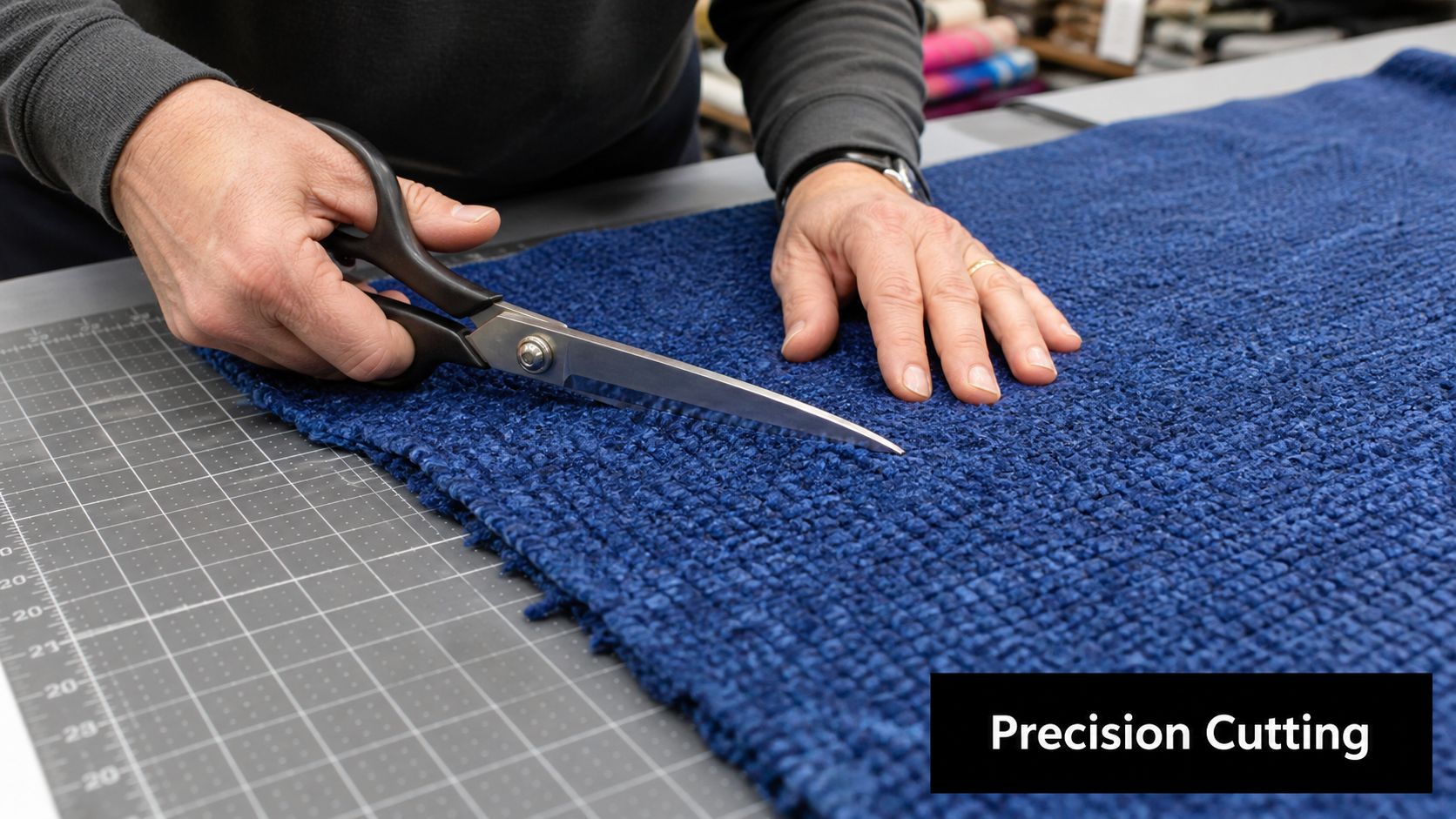
Handle less and support more
For tweed and bouclé, I prefer to cut in a single layer whenever pattern matching matters or the weave feels unstable. A rotary cutter and pattern weights can be better than heavy pinning because they reduce lifting and tugging. If you use shears, keep the fabric flat and move around the table instead of dragging the cloth toward you.
Checked or plaid tweeds deserve extra attention here. Match the most visible horizontal and vertical lines first: centre front, side seams, pocket placement, and sleeve fronts. A beautifully matched jacket always looks more expensive, even in a simple shape.
A useful couture habit is to test your interfacing plan before cutting everything. Some makers call this block fusing when support is applied to a larger area before final cutting, but the core idea is simple. You're checking whether the support changes drape, thickness, or texture before you commit.
Respect the seam allowance
For this style of jacket, seam allowance isn't an afterthought. Tweed and bouclé fabrics for couture jackets are traditionally cut with commercial patterns providing a standard 5/8-inch (approx. 1.57 cm) seam allowance, which is essential for techniques like quilting the lining and creating handmade buttonholes without distorting the loosely woven structure, as demonstrated in this couture jacket sewing video.
That matters because these jackets often tighten slightly as layers are combined and shaped. Too little allowance leaves you no margin for stabilising, trimming, or correcting. Too much can create unnecessary bulk in a thick fabric.
A practical cutting checklist helps:
- Keep the grain honest by aligning each pattern piece carefully before placing weights.
- Mark notches with restraint. Tiny snips can weaken a loose weave, so tailor's tacks or chalk marks are often safer.
- Cut pockets and facings with the same discipline you give the body pieces. Sloppy small pieces show up fast on a jacket.
- Separate right and left pieces clearly as you cut. Tweed textures can make pieces look deceptively similar.
Before you move on, watch a visual demonstration of careful handling and layout:
Couture Construction Techniques for Tweed and Boucle
This is the stage that changes the feel of the jacket. The outside may still look like a collection of flat pieces, but the inside work is what gives the garment calmness. A good tweed jacket doesn't pull, buckle, or collapse at the edges. It has quiet structure.
Stabilise first, then stitch
The most useful couture mindset is this: unstable fabric needs support before it needs speed. For bouclé jackets, stabilising seams with silk organza and using hand-sewn overcast and herringbone stitches can reduce seam distortion by over 40%. Using a walking foot with a longer 3.0–3.5mm stitch length can decrease puckering to under 5%, compared to 30% with a standard foot, according to Mount Crumpet's couture tweed jacket lesson.
That aligns with what many dressmakers discover the hard way. A standard foot can push the top layer ahead while the lower layer lags. On bouclé, that becomes rippling, puckering, or seam lines that never press flat.
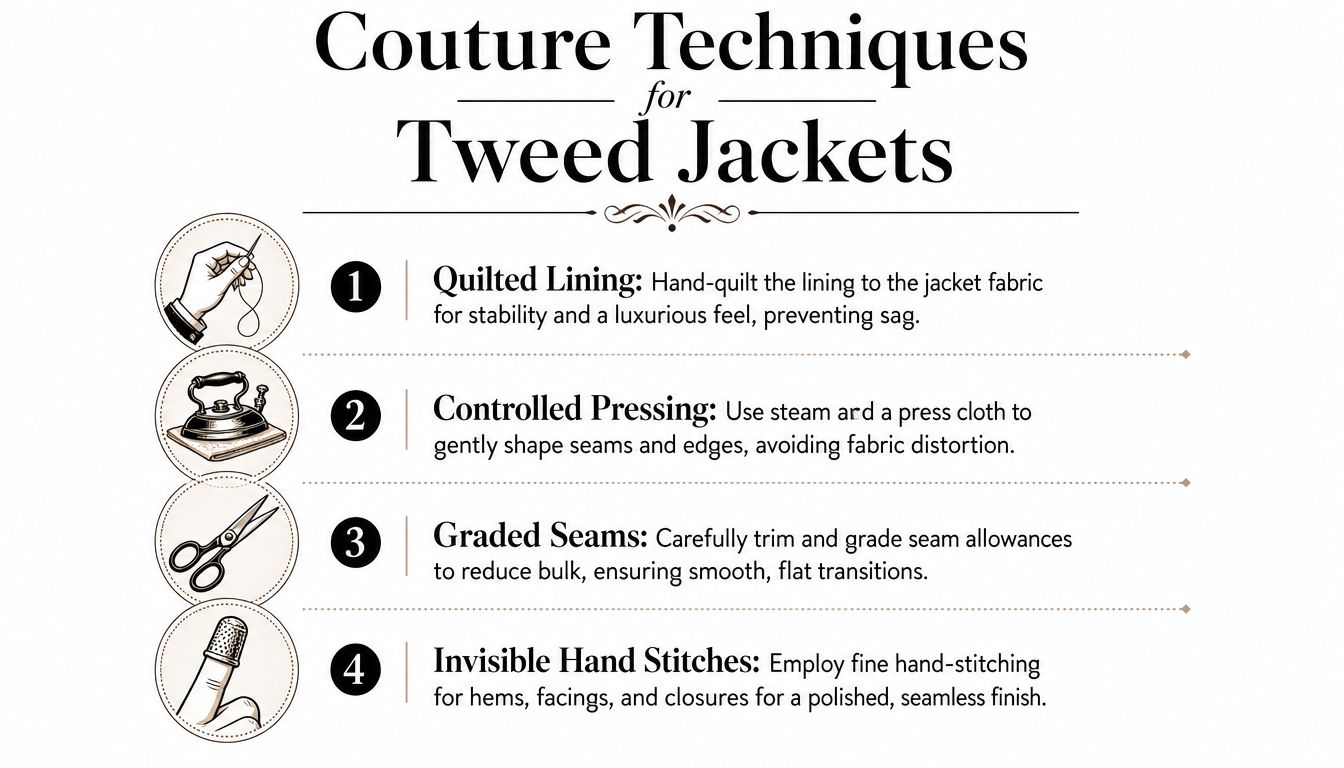
A few methods consistently earn their place:
- Silk organza seam support keeps vulnerable edges from stretching without making them cardboard-stiff.
- Walking foot stitching feeds thick or textured layers more evenly.
- Longer stitch length suits the fabric better than tiny stitches, which can chew into a loose weave.
- Hand overcasting and herringbone stitch hold seam allowances neatly while preserving flexibility.
Quilted lining and soft internal structure
One hallmark of a high-end tweed jacket is a lining that works with the shell, not as a separate slippery layer fighting underneath it. Hand quilting the lining to the jacket pieces gives body and prevents drooping. You don't need dense quilting. Light, thoughtful quilting is enough to help the layers move together.
Fabric choice for the lining matters. A soft lining with some drape feels lovely, but if it's too lively against a very open tweed, it can shift while you sew. Baste generously. A few extra minutes with hand basting can save a great deal of irritation later.
Use hand sewing where machine sewing would leave a hard edge, a visible ridge, or a drag line on the right side.
Interfacing deserves the same restraint. Heavy fusible can flatten texture and make a beautifully supple jacket feel stiff at the front edge. Sew-in support, strips of organza, or selective lightweight interfacing often give a better result than trying to fuse everything into submission.
Pressing that shapes rather than crushes
Textured jackets need pressing, but not aggressive pressing. Steam helps. Pressure often doesn't. A press cloth protects surface fibres, and tools like a tailor's ham or sleeve roll help shape curves without flattening the texture you paid for.
I'd break pressing into small moments rather than saving it all for the end:
| Area | Better approach | What to avoid |
|---|---|---|
| Seam allowances | Steam, finger-press, then light pressing | Hard flattening that leaves shine |
| Curved seams | Ham or sleeve roll for shape | Pressing on a flat board only |
| Edges and facings | Gentle control with cloth | Dragging the iron along the edge |
Grading and hand finishing
Bulk builds quickly in tweed. Facings, trims, hems, and pocket edges can become lumpy if every allowance is left full width. Grade seam allowances where layers stack. Trim one layer narrower than the next so the transition disappears gradually.
The same goes for hems and facings. A catch stitch or herringbone stitch lets the inside sit flat while staying slightly elastic. That flexibility matters in a jacket that needs to move with the body.
If a step feels slow, that usually means you're doing the part that makes the jacket look refined.
Assembling and Fitting Your Jacket
Once the pieces are stabilised, assembly becomes much more manageable. The order matters less than the discipline. Baste, check, press, and only then commit.
Build the body with fit in mind
Join the main seams and test the jacket on the body before finishing every internal detail. Tweed can hide small shaping changes, which is helpful, but it can also become bulky if you keep revising after everything is fully constructed.
Pay close attention to these points as you fit:
- Shoulders should sit where your shoulder ends, not drift down the arm.
- Upper back needs enough room to move, especially in lined jackets.
- Bust area should lie smoothly without the front swinging open awkwardly.
- Hem line should look level when the jacket is worn, not just when it's on a hanger.
A boxy jacket still needs fitting. “Relaxed” doesn't mean shapeless. It means the jacket skims rather than squeezes.
Setting in sleeves without puckers
This is the part many sewists dread, and with good reason. Tweed sleeves can become bulky at the cap and stiff around the armhole if they're forced in. The goal is a rounded shoulder line, not gathered-looking fullness.
To attach sleeves, the sleeve cap circumference must be 2–4 cm larger than the armhole to allow for easing. This fullness is controlled by sewing two rows of long basting stitches within the seam allowance and gently pulling the threads to create even gathers, as shown in this sleeve easing tutorial.
That extra ease shouldn't read as visible gathers in the finished jacket. It should disappear into the cap so the sleeve rolls smoothly over the shoulder.
A reliable method looks like this:
- Sew the two rows of long basting stitches.
- Draw them up only enough to curve the sleeve head.
- Pin with the sleeve supported, not hanging off the table.
- Distribute the fullness between the notches.
- Stitch slowly and check for puckers before pressing.
If the fabric is lofty, a sleeve head can help support the cap from the inside. It's especially useful when the shoulder line needs a bit of lift or when the sleeve cap wants to collapse after wearing.
If you see puckers, don't tell yourself they'll steam out later. Most of the time, they won't.
Small adjustments that save the finish
Bulky fabrics don't welcome endless unpicking, so make the obvious corrections early. If the front edge kicks out, check whether the facing is too firm or the hem is too heavy. If the back strains, release where movement is needed instead of assuming the problem is the sleeve.
A tweed jacket rewards calm fitting. One small correction at the right stage is far better than a major rescue operation after the lining and trim are in.
Professional Finishes That Make the Difference
The final details decide whether the jacket feels polished or merely completed. At this stage, restraint pays off again. Don't add every decorative idea at once. Let the fabric and silhouette lead.
Edges, closures, and trim
A frayed edge finish can be beautiful on the right bouclé, but it needs planning. You want controlled fraying, not progressive disintegration. Stabilise the seam line first, then tease out only as much fringe as suits the scale of the jacket.
Braids and trims offer a different look. They sharpen the outline and can hide subtle irregularities at the edge. On a very textured jacket, a plain trim often works better than anything too ornate.
Closures should respect the weave. Handmade buttonholes can look superb, but they need support so the area doesn't stretch. Hook-and-eye closures are often the cleanest option if you want the front to meet neatly without visual interruption.
The inside finish matters too
A beautiful lining at the sleeve or facing gives the jacket that finished, intentional feel people notice when it moves. Clean hems, secure facings, and unobtrusive hand stitching matter just as much as the outside trim.
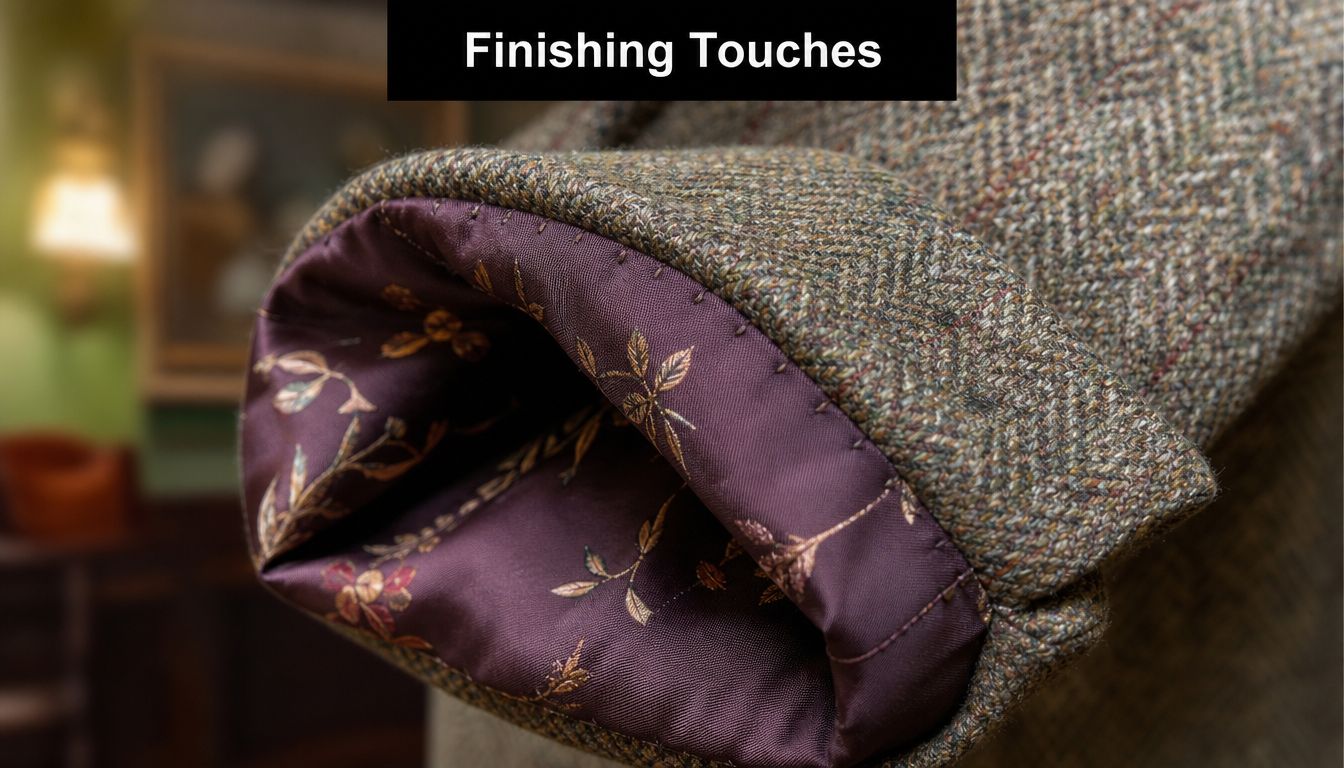
A final press should refine the jacket, not flatten it. Use steam, a press cloth, and shaped pressing tools where needed. Let the garment cool on the hanger before judging the result. Freshly pressed tweed can look unsettled for a few minutes, then relax into shape.
The best finish for a tweed jacket is consistency. Balanced edges, smooth sleeve heads, secure hems, and a lining that sits smoothly all add up to that expensive-looking result. None of these details is dramatic on its own. Together, they're the difference between a jacket you made once and a jacket you'll keep wearing for years.
If you're ready to sew your own tweed or bouclé jacket, More Sewing is a dependable place to find quality dressmaking fabrics, haberdashery, and the practical tools that make demanding projects go more smoothly. From linings and interfacing to everyday essentials that help you finish well, it's a strong starting point for building a jacket you'll be proud to wear.
