
Fabric
What Is Velvet Made of? a Guide for Home Sewists
You're probably here because you've found a velvet you love, then looked at the label and thought, “Yes, but what is velvet made of?” That's the moment where a lot of home sewists hesitate. Velvet looks glamorous on the roll, but the second you start planning a dress, jacket, trousers or even a simple camisole, the questions start piling up. Will it slip? Will it crush? Will it stretch out? Will it be impossible to press?
Those are the right questions. Velvet rewards curiosity. Once you understand that its behaviour comes from both how it's woven and which fibres it's made from, it stops feeling mysterious and starts becoming manageable. That matters at the cutting table, at the machine, and long after the garment is finished.
An Introduction to the Allure of Velvet
Velvet has a way of stopping people in their tracks. You brush your hand across it, the colour shifts, the surface catches the light, and suddenly you're imagining an evening dress, a relaxed jacket, a festive top, or even a pair of dramatic wide-leg trousers. Then doubt kicks in, because velvet has a reputation for being fussy.
It can be fussy, but it isn't impossible.
For home sewists, an essential aspect is knowing what you're handling before you cut into it. Two velvets can look similar on the bolt and behave very differently once they're under the needle. One may drape like liquid and need careful support. Another may feel sturdy, slightly firmer, and far easier to control. The fibre content, pile, finish, and backing all matter.
Velvet isn't difficult for the sake of it. It simply asks you to work with its structure instead of against it.
That's where confidence comes from. If you know why a velvet slips, shines, stretches, bruises, or resists pressing, you can choose the right project and use the right techniques from the start.
The Secret of Velvets Weave and Pile
You bring a bolt of velvet to the cutting table, smooth it flat, and the colour changes under your hand. Turn one pattern piece the opposite way and it can look like a different fabric. That behaviour starts with the way velvet is built.
Velvet is a fabric construction defined by pile. The pile is the short, upright surface that gives velvet its soft hand, shifting sheen, and directional nap. Fibre still matters, but first it helps to understand the structure, because that structure is what affects cutting, pressing, and sewing.
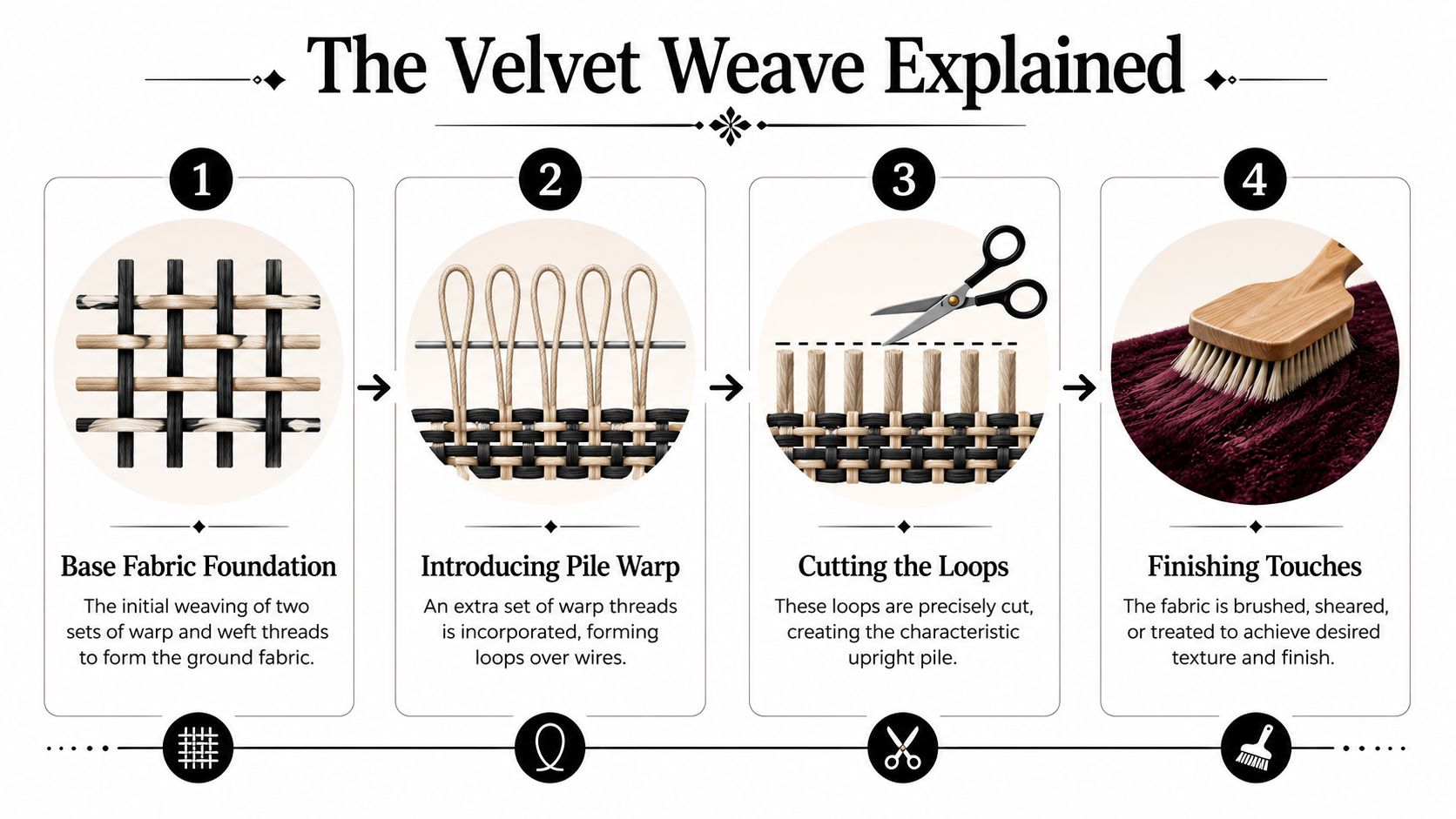
How the pile is created
Velvet is woven with extra yarns that form loops or tufts above the ground fabric. Those raised yarns are then cut or finished to create the plush surface. In many traditional methods, two layers are woven together and separated, leaving pile on each layer.
For a home sewist, the technical part matters because it explains the fabric's behaviour:
The base cloth holds the fabric together
This ground structure gives velvet its underlying stability or lack of it.Extra yarns form the raised surface
Those yarns become the nap you can stroke with your hand.The pile is cut or finished
That step creates the smooth, light-catching face velvet is known for.The surface is refined
Brushing or shearing can make the pile look more even, more lustrous, or more formal.
That raised surface is the reason velvet marks so easily. Finger pressure, pinning, folds, and heavy pressing can flatten the pile and leave temporary or permanent shading. It is also why two layers of velvet like to shift against each other under the presser foot.
Why this matters on your cutting table
Velvet has a nap direction. One direction feels smoother. The other often looks deeper in colour and richer in shine. On a finished garment, all your pattern pieces need to run the same way unless you want that contrast on purpose.
Cut one collar, cuff, or sleeve head in the opposite direction and it may read as darker or lighter than the rest of the garment. Home sewists usually avoid that by using a with-nap layout, even though it takes more fabric.
The pile also creates friction in an unhelpful way. Velvet can creep while you sew, with one layer feeding faster than the other. That is why a fabric that feels luxurious in your hand can suddenly act slippery and stubborn at the machine.
A moving visual helps if you like seeing fabric mechanics in action:
What pile density changes in real life
Pile density changes more than appearance. A dense, full pile usually gives stronger colour depth, a plusher hand, and a dressier look. It can also add bulk at seam allowances, make topstitching sink in, and leave thicker intersections at collars, waist seams, and facings.
A lighter or shorter pile often feels easier to control. It may not have the same dramatic glow, but it can be a better choice for jackets, trousers, or any project that needs more durability and less fuss during construction.
Practical rule: Judge velvet with your hands as much as your eyes. Stroke the nap, crush a corner lightly, and watch how the surface recovers in the light.
If the pile stays marked after light handling, plan for simple seams, minimal unpicking, and careful storage. If it springs back well, you have more room for everyday wear and for projects that need a bit more shaping.
A Guide to Velvet Fibres from Silk to Synthetics
You can cut the same dress pattern in three velvets and end up with three completely different garments. One skims the body and catches the light. One stands away a little and feels structured. One sews more easily but looks less rich up close. That difference starts with fibre content.
For home sewists, fibre is not a dry technical detail. It tells you how much the fabric will drop from the shoulder, how much the pile will mark under your hands, how bulky the seams may get, and whether the finished garment will feel special occasion only or easy enough to wear often. If you shop online, fibre content is one of the quickest ways to narrow the field before you even order samples. The Sofa Cover Crafter's fabric guide is useful for comparing how different furnishing and garment fabrics behave in practical terms.
Silk velvet
Silk velvet has the drape many people hope for when they picture a luxurious velvet garment. It feels soft, fluid, and light in the hand, with a glow that shifts rather than flashes. On evening tops, scarves, loose jackets, bias-cut pieces, and soft dresses, it can look beautiful with very little design fuss.
It also asks for care.
The pile bruises more easily than many modern alternatives, and the base cloth often feels less forgiving during construction. If a project needs a lot of reshaping, repeated unpicking, or sharp pressed edges, silk velvet can turn a pleasant sew into a tense one. I usually suggest it for simpler shapes where the fabric gets to do the work.
Cotton velvet
Cotton velvet has more body and usually less shine. Velveteen sits in the same family, though it is typically heavier, firmer, and less fluid. For sewists, that difference matters straight away. A skirt in cotton velvet holds its shape better than one in silk or viscose, and a jacket collar tends to look more defined.
This is often the better choice for structured garments, children's wear, trousers, waistcoats, trims, and projects that need a slightly sturdier hand. Under the needle, it is often less slippery than fluid velvet, but the trade-off shows up in bulk and drape. Thick seam allowances can build up quickly, and soft gathers or cowls may look stiff instead of graceful.
Viscose velvet
Viscose velvet is often the one people pick up and immediately stroke twice. It usually has a very soft hand, a graceful drape, and a sheen that reads dressy without the price of silk. For tops, relaxed dresses, wide-leg evening trousers, and kimono-style layers, it often gives the most fluid result.
The sewing trade-off is control. Viscose velvet can shift, stretch a little while handling, and mark if pressed carelessly. It rewards a lighter touch and simpler style lines. If your pattern relies on crisp tailoring, this may not be the easiest route.
Polyester velvet
Polyester velvet is common for good reason. It is usually more durable, often easier to care for, and available at prices that make a first velvet project feel less risky. Some polyester velvets are plush and quite convincing at a glance. Others can look flatter or shinier than you may want, so ordering a sample is worth it.
For sewing, polyester can be a practical starting point. It often stands up better to regular wear, costumes, children's clothes, lounge pieces, and party garments that need to survive more than one outing. The downside is heat sensitivity. Pressing needs caution, and some versions feel less breathable than natural-fibre options.
Blends
Many dressmaking velvets are blends, often combining viscose and polyester, and sometimes adding elastane in stretch versions. Blends exist because they solve real problems. Viscose improves softness and movement. Polyester improves wear and lowers cost. A small amount of stretch can make a fitted garment more comfortable, but it also changes how the fabric feeds and recovers.
For many home sewists, a good blend is the most sensible middle ground. You get some of the fluid look people want from velvet, without quite so much delicacy or expense.
Velvet Fibre Comparison for Sewists
| Fibre | Key Properties | Best For | Sewing Difficulty |
|---|---|---|---|
| Silk | Soft, fluid, high lustre, delicate | Evening wear, scarves, special garments | High |
| Cotton | More matte, firmer body, durable feel | Jackets, skirts, trousers, trims | Moderate |
| Viscose | Beautiful drape, soft hand, good sheen | Dresses, tops, flowing styles | Moderate to high |
| Polyester | Durable, practical, often easier care | Everyday garments, costumes, lounge pieces | Moderate |
| Viscose and polyester blends | Balanced softness, sheen, and stability | Versatile dressmaking projects | Moderate |
Choosing by project, not just by fibre name
A fibre label only helps if you connect it to the garment you want to sew.
Choose silk velvet for pieces with simple seams, soft shape, and a clear reason to use a more delicate fabric. Choose cotton velvet or velveteen for garments that need body, such as jackets, trousers, and skirts with structure. Choose viscose velvet for drape-first projects where movement matters more than crisp edges. Choose polyester or a polyester blend if you want a velvet that feels less precious and more wearable day to day.
If this is your first velvet garment, a stable blend is usually the safest place to start. You still need careful cutting and sewing, but the fabric is more likely to forgive small handling mistakes and more likely to end up as something you wear.
Common Types of Velvet for Your Projects
You spot a velvet in the shop, run it through your hand, and assume fibre content will tell you everything. Then you get it home and realise the key difference is in the finish. A polyester stretch velvet, a crushed velvet, and a burnout velvet can all behave so differently that they may as well be separate fabrics once you start cutting and sewing.
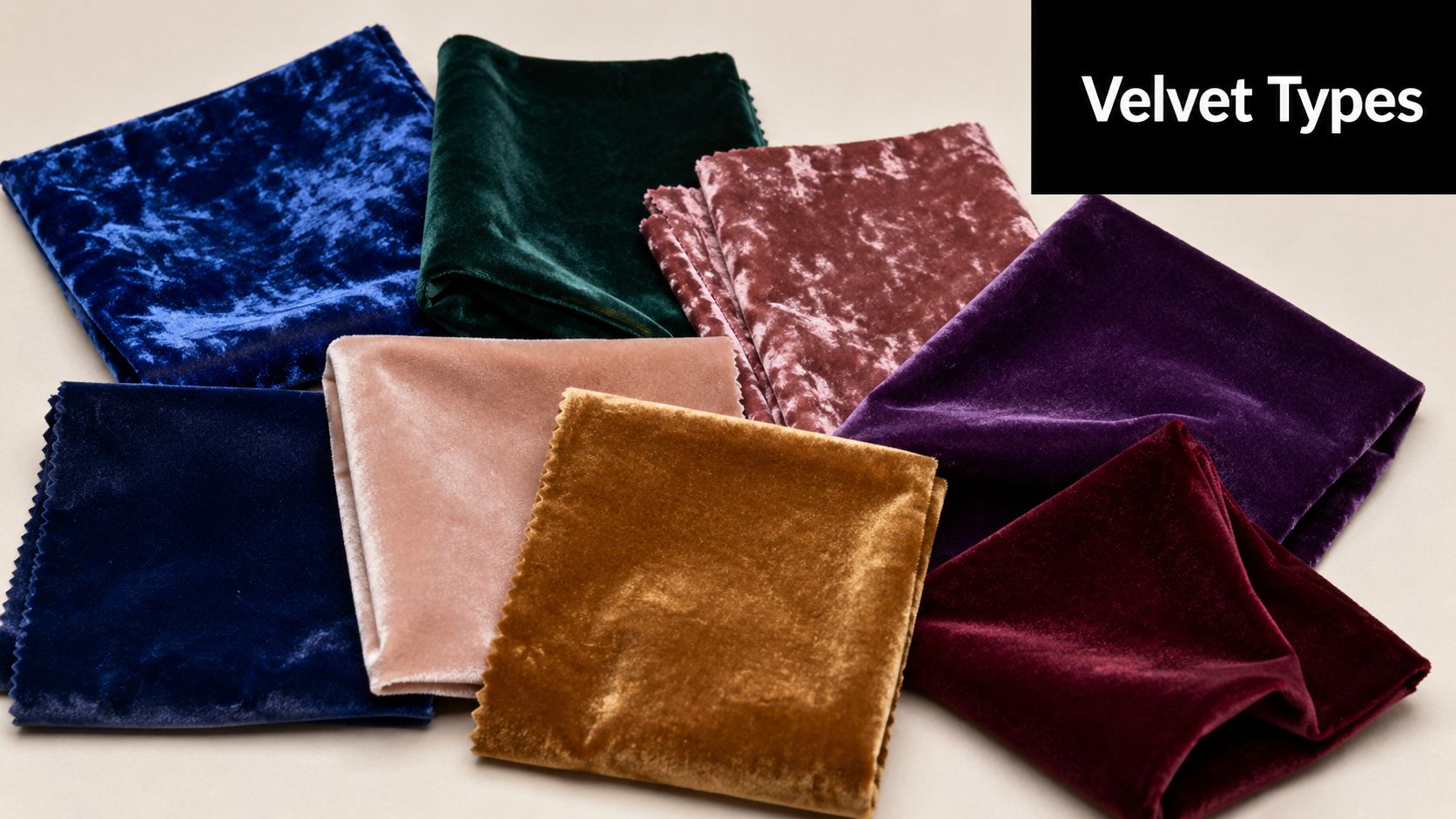
Stretch velvet
Stretch velvet is the one many home sewists reach for first because it promises comfort and fit. It suits close-fitting party dresses, dancewear, simple tops, children's costumes, and pull-on styles that do not need zips or rigid tailoring. Most versions get their give from a small amount of elastane in the base, which changes how the fabric recovers, how it feeds under the presser foot, and how much support your seams need.
For sewing, that matters more than the fibre label alone. Stretch velvet can be very wearable, but it also likes to ripple, creep, and grow if it is handled too much. Necklines can stretch out during construction. Hems can tunnel. Pressing needs a light hand because too much heat can flatten the pile or damage the stretch element.
The safest projects are ones drafted for knits and built around the fabric's flexibility. If a pattern depends on sharp darts, firm facings, or tightly controlled structure, smooth woven velvet is often the better choice.
Crushed and panne velvet
Crushed velvet has a deliberately uneven surface, so the light hits it from several directions at once. That gives it movement even when the garment shape is simple. It works well for relaxed tops, duster jackets, soft skirts, stagewear, and styles where texture does some of the design work for you.
Panne velvet has the pile pressed hard in one direction, which gives a shinier, flatter look. It can be dramatic, but it also reads a bit synthetic in cheaper qualities. If you want richness, check the backing as carefully as the surface. A thin or unstable backing can twist during sewing and make the finished garment look tired quickly.
For beginners, these finishes offer one advantage. They hide minor bruising, finger marks, and small shifts in the pile better than a pristine smooth velvet. The trade-off is that they also show quality differences fast. Good crushed velvet looks intentional. Poor crushed velvet just looks worn.
Devoré and decorative velvet
Devoré, often called burnout velvet, has areas where the pile is removed to create a pattern against a lighter or sheer ground. It is usually better for garments with layering built in, such as kimono jackets, evening tops, sleeve panels, scarves, and overdresses worn over slips. On its own, it can be too revealing for many projects.
This type needs a bit more planning at the pattern stage. You are not only choosing a fabric. You are choosing where opacity, texture, and pattern placement will sit on the body. A neckline that looks lovely on the bolt may place a sheer section in exactly the wrong spot once worn.
Some decorative velvets are made more for visual effect than long wear. They can be perfect for an occasion piece, but less satisfying in a garment that needs to survive frequent sitting, rubbing, and washing. For interiors and heavier decorative sewing ideas, it also helps to study how pile fabrics behave in larger applications. The Sofa Cover Crafter's fabric guide is useful for understanding fabric choice in upholstery contexts, especially if you're comparing durability, surface feel, and practical use beyond dressmaking.
Some velvets earn their keep in real wear. Others are best saved for projects where appearance matters more than durability.
Essential Tips for Sewing with Velvet
Velvet sewing goes well when you control movement. Most problems start because the pile makes the layers shift against each other. That's why a careful setup beats rushing every time.
This quick visual sums up the habits worth keeping beside your machine:
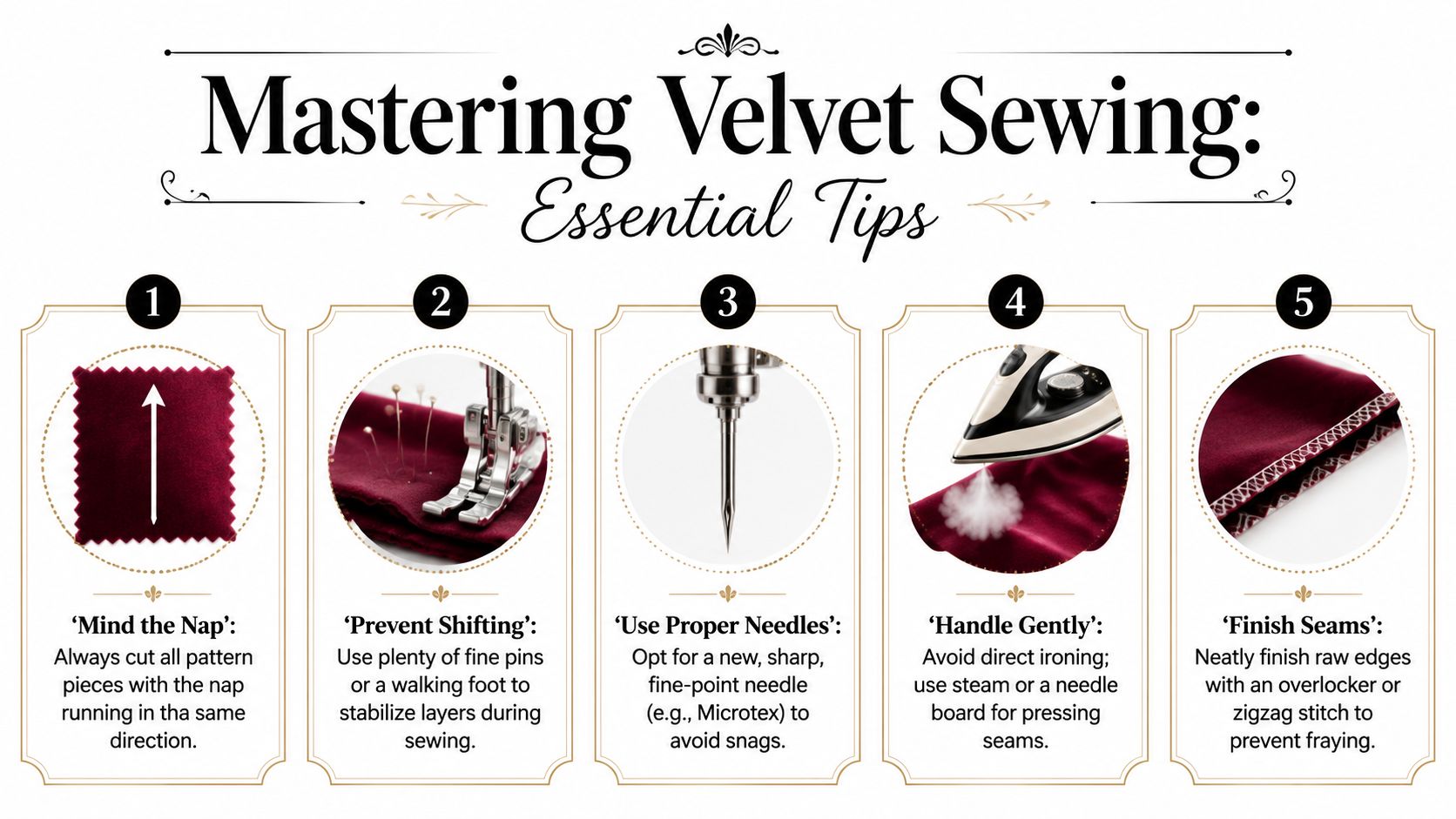
Cutting without chaos
Start by finding the nap and marking it. Then cut every pattern piece in the same direction. Don't try to save fabric by flipping pieces. That shortcut nearly always shows.
For many velvets, single-layer cutting is the safest choice. It takes longer, but accuracy improves because the fabric doesn't slide under itself. Use pattern weights if you can, and if the fabric is especially mobile, a rotary cutter with a fresh blade often gives cleaner control than dressmaking shears.
A few practical cutting habits help a lot:
- Use a with-nap layout so colour stays consistent across the garment
- Cut on a large flat surface because hanging fabric distorts the pile and backing
- Transfer markings sparingly since aggressive chalking or tracing can bruise the surface
- Test the wrong side first if you're using tailor's tacks, chalk, or removable markers
Sewing seams that stay aligned
At the machine, a walking foot is one of the best tools you can use. It helps feed top and bottom layers together, which reduces shifting. If you don't have one, hand-basting key seams can save a lot of frustration.
Use a new sharp needle, often a Microtex for woven velvet or a stretch/ballpoint option for stretch velvet depending on the base. Stitch length usually benefits from being slightly longer than you'd use on a crisp cotton. Tiny stitches can compact the pile and make the seam look tight or puckered.
Try this order of attack:
Test scraps first
Check seam appearance, needle choice, and stitch length before touching the garment.Stabilise where needed
Necklines, shoulder seams, and zip areas often benefit from stay tape or a suitable stabiliser.Sew in one pass if possible
Unpicking velvet can leave marks, needle holes, or a roughened pile.Grade and reduce bulk
Thick seam stacks can become lumpy quickly, especially at facings and hems.
Workshop note: If velvet keeps crawling apart as you sew, baste by hand in the seam allowance first. It takes extra minutes and often saves the whole project.
Pressing without crushing the pile
This is the part people get wrong most often. Don't press velvet face-down on a hard ironing board and clamp the iron onto it. That can flatten the pile permanently.
Instead:
- Steam from above when possible
- Press from the wrong side with care
- Use a needle board or thick towel to protect the pile
- Finger-press first before bringing in heat
For hems, I often prefer a hand-finished approach on finer velvet because heavy machine hemming can imprint on the right side.
Caring for Your Velvet Garments and Fabrics
Velvet care depends on fibre content more than appearance. Two black velvets may look almost identical and need completely different treatment. Always keep the fibre label or fabric note if you can.
Washing and drying by fibre type
Polyester velvet and many stretch velvets are often the most practical options for home laundering. Turn the garment inside out, use a gentle cool wash, and avoid crowding the machine so the pile doesn't get crushed unnecessarily. Air drying is the safer route, especially if the garment has elastane.
Cotton velvet may be washable, but it can change after the first wash. Pre-washing before sewing is usually wise if the finished garment will need laundering at home.
Silk and viscose velvet usually need a much gentler approach. Many sewists treat them as dry-clean fabrics because moisture and handling can alter the pile, backing, or drape.
Pressing and refreshing
If a velvet garment looks creased after storage, steam is usually more useful than direct ironing. Hang it in a steamy room or use a handheld steamer carefully from a short distance. Let the pile relax rather than flattening it with pressure.
For seam pressing during construction, place the velvet pile-down on a needle board or thick towel. That gives the pile somewhere to sink instead of being crushed against a hard surface.
Storage that protects the surface
Velvet hates being squashed for long periods.
Use these habits:
- Hang garments when possible to avoid deep fold lines
- Choose padded hangers for heavier pieces like jackets or dresses
- Avoid tight garment bags that rub against the pile
- Don't stack velvet under heavy items in a wardrobe or drawer
A little care goes a long way. Velvet often ages well when it's handled gently and stored with enough space.
Velvet FAQs for Curious Sewists
What is the difference between velvet and velveteen
The key difference is how the pile is made. Velvet usually has a warp pile, while velveteen has a weft pile.
For sewing, that changes the fabric quite a bit. Velveteen is often firmer, with a shorter, denser surface and less movement than velvet. It suits jackets, trousers, and skirts that need body. Velvet usually feels softer and drapes more fluidly, which makes it a better fit for dresses, tops, and relaxed eveningwear.
Can I use a rotary cutter on velvet
Yes. Many home sewists get cleaner results with a rotary cutter than with dressmaking shears.
Velvet shifts easily, and lifting it while cutting can throw the pile off grain. A rotary cutter lets you keep the fabric flat on the mat, especially if you are cutting in a single layer with pattern weights. That usually means more accurate pieces and fewer surprises when you match seams later.
Is velvet a sustainable fabric choice
That depends on the fibre, the backing, and how long you expect the finished garment to last.
Deadstock velvet can be a sensible choice if it suits your project, because it uses fabric already in circulation. Silk and cotton appeal to sewists who prefer natural fibres, but they still come with resource and care considerations. Polyester and stretch velvets are often hard-wearing and easier to find, though they may shed microfibres in washing and can be harder to recycle.
For a home sewist, the most practical approach is usually to buy the right velvet for the garment, sew it well, and make something you will wear. A well-used dress or jacket often makes better sense than a poor fabric choice that stays in the wardrobe.
What is velvet made of in simple terms
Velvet is made from two things. A pile weave structure, and a fibre content.
The pile weave creates the soft, raised surface. The fibre, such as silk, cotton, viscose, polyester, or a blend, decides how the velvet feels in the hand, how it hangs on the body, and how patient you will need to be at the machine. That is the part home sewists notice first. Some velvets glide and ripple. Others cling, creep, or mark if you press them carelessly.
If you're ready to try velvet for yourself, More Sewing is a strong place to start for dressmaking fabrics, haberdashery, and practical sewing supplies. Whether you're hunting for a beginner-friendly velvet, tools like sharp needles and pattern weights, or inspiration for your next make, their range is built for home sewists who want quality materials without the guesswork.
