You’ve probably had this exact debate at the cutting table. You want the airy look of linen for a warm day in Britain, but you don’t want to spend the entire afternoon looking as though you slept in the dress. Or you want cotton because it’s familiar and forgiving, yet the fabric in your hand feels a bit too limp for the blouse or trousers you’ve got in mind.
That’s where linen cotton fabric earns its place. It sits in a very useful middle ground. You still get texture, breathability and that relaxed, natural look, but with a softer handle and less daily fuss than many pure linens. For home dressmakers, that balance matters far more than marketing language.
I’ve always found this blend especially helpful for real wardrobes rather than fantasy sewing. Not just garments that look lovely on a mannequin, but pieces you’ll wash, press, wear on the school run, take on holiday, and pull from the wardrobe again without a pep talk. If you choose the right weight, prep it properly, and sew it with the fabric’s character in mind, linen cotton fabric can become one of the most dependable cloths in your stash.
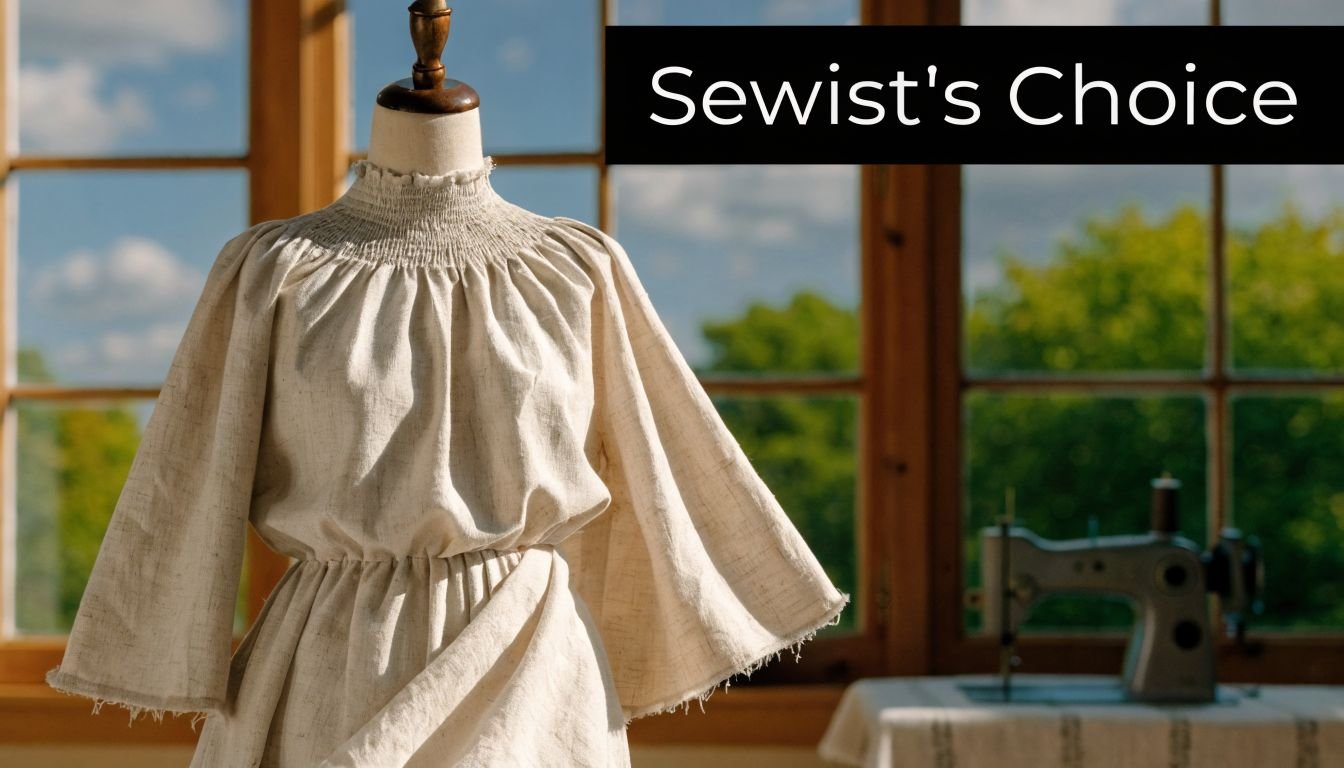
Why Linen Cotton Fabric is a Sewist's Best Friend
A lot of sewists arrive at linen cotton fabric after one disappointment or another. Pure linen can feel glorious in hot weather, but some people don’t enjoy how quickly it creases. Pure cotton can be soft and easy, but it doesn’t always have the body or dry, cool feel that makes summer sewing satisfying.
That’s why the blend works so well. It gives you enough structure for shape, enough softness for comfort, and enough texture to stop a handmade garment looking flat or generic. A simple shell top in linen cotton feels more considered than the same shape in a basic cotton lawn. A pair of pull-on trousers holds its line better without becoming stiff.
Why it behaves so well in everyday sewing
For many home sewists, the sweet spot is simple. You want fabric that:
- Presses cleanly without fighting every seam
- Feels breathable when the weather turns warm
- Has some body for tops, dresses and loose trousers
- Doesn’t collapse into every contour like a very drapey viscose
- Looks good slightly rumpled, rather than messy
Linen cotton fabric does all of that rather well.
Practical rule: If you want a garment to look relaxed rather than strictly polished, this blend often does the job better than either fibre on its own.
It’s also a kind fabric for learning. Beginners usually handle it more confidently than slippery satin, stretch jersey or gauzy voile. Intermediate sewists enjoy it because it responds beautifully to pressing, topstitching and neat finishing. Advanced makers like it because it rewards pattern choice. The same blend can make an easy holiday shirt, a structured blouse, or soft trousers with just enough shape through the leg.
Understanding the Heritage of Linen and Cotton
Linen and cotton didn’t arrive at the modern sewing table as equals. In the British textile story, linen carried an older reputation for quality, durability and utility long before cotton became dominant in mills and wardrobes.
By 1770, Ireland’s linen exports to Great Britain reached approximately 40 million yards annually, a trade that helped support the UK textile industry and cement linen’s status long before cotton took over, according to historical linen trade records discussed here. That history matters because it explains why linen still carries an aura of substance. People expect it to wear well, age well and feel honest in the hand.
Linen’s reputation came from performance
Linen earned its place because it was useful. It suited household textiles, workwear, sailcloth and garments that needed strength. It also developed a reputation for crispness and refinement. Even now, when sewists pick up a linen-rich blend, they often recognise that dry, slightly textured hand straight away.
Its standing in Britain wasn’t accidental. The fibre had an established supply chain, skilled production history and practical uses that made it valuable across classes. That legacy still shapes how we read the fabric today. A linen-looking garment suggests longevity and quiet quality.
Cotton changed the pace of sewing and clothing
Cotton’s rise shifted the balance. Mechanised spinning transformed production, and cotton became the practical giant because mills could scale it quickly and cheaply. It offered softness, versatility and easier everyday wear, which made it a natural fit for mass clothing.
Here’s the interesting part for a sewist. Linen and cotton developed very different identities, but modern blends borrow from both traditions. The blend isn’t a compromise in the disappointing sense. It’s more like a practical inheritance from two fibres that solved different problems.
Linen brings history, structure and surface character. Cotton brings softness, familiarity and easier daily wear.
That’s why linen cotton fabric feels so sensible in contemporary dressmaking. It joins a fibre known for prestige and stamina with one known for comfort and accessibility. If you sew modern wardrobes rather than costume pieces, that pairing makes perfect sense.
What Exactly Is Linen Cotton Fabric?
At its simplest, linen cotton fabric is a woven textile made from flax fibres and cotton fibres spun together or combined in the fabric structure. In practical sewing terms, you’re handling cloth that borrows linen’s strength and texture, then softens the experience with cotton.
Like a recipe, linen is the ingredient that adds body, bite and character. Cotton smooths the edges. Change the proportions, and you change the final result.
What each fibre contributes
Linen comes from flax and has long bast fibres. Cotton has much shorter staple fibres. That difference is one of the reasons the blend performs so nicely in garments that need both wearability and resilience.
The durability of the blend comes from linen’s long fibres, which increase in strength by up to 20% when wet, and those fibres help anchor cotton’s shorter fibres, reducing pilling by 30 to 50% in abrasion tests compared with pure cotton, as described in this discussion of linen fibre properties and care.
For a home sewist, that technical detail translates into something very straightforward. Trousers rub less quickly at stress points. Shirt hems and underarms tend to stay tidier. Frequently worn garments generally keep their surface looking better than many equivalent pure cottons.
How blend ratios change the feel
You’ll often see blends described by percentages. Even without chasing exact formulas, it helps to read the label with intent.
- Higher linen content gives a crisper hand, more visible slub or texture, and a cooler, drier feel.
- Higher cotton content gives a softer surface, a slightly gentler drape, and less pronounced wrinkling.
- Near-balanced blends tend to be the easiest all-rounders for dresses, tops, shirts and casual trousers.
A good way to choose is to ask what the garment needs most.
| Garment need | Better choice |
|---|---|
| Crisp summer shirt | More linen |
| Soft blouse with body | Balanced blend |
| Casual pull-on trousers | Balanced or linen-leaning blend |
| Child’s easy-wear garment | More cotton |
| Relaxed overshirt or smock | More linen |
What it usually looks like at the machine
Most linen cotton fabric is friendly to handle. It isn’t usually as springy as quilting cotton, and it isn’t as stubborn as a coarse pure linen. It has enough grip to stay under the presser foot, enough substance to press sharply, and enough movement to make everyday clothes comfortable.
If a fabric feels slightly crisp in the shop but not scratchy, and it creases softly rather than sharply, that’s often a very good sign for a linen cotton garment.
Comparing Properties Linen vs Cotton vs The Blend
If you’re deciding between three bolts on the shelf, labels alone won’t help much. You need to know how each fabric behaves once it’s cut, pressed, worn and washed.
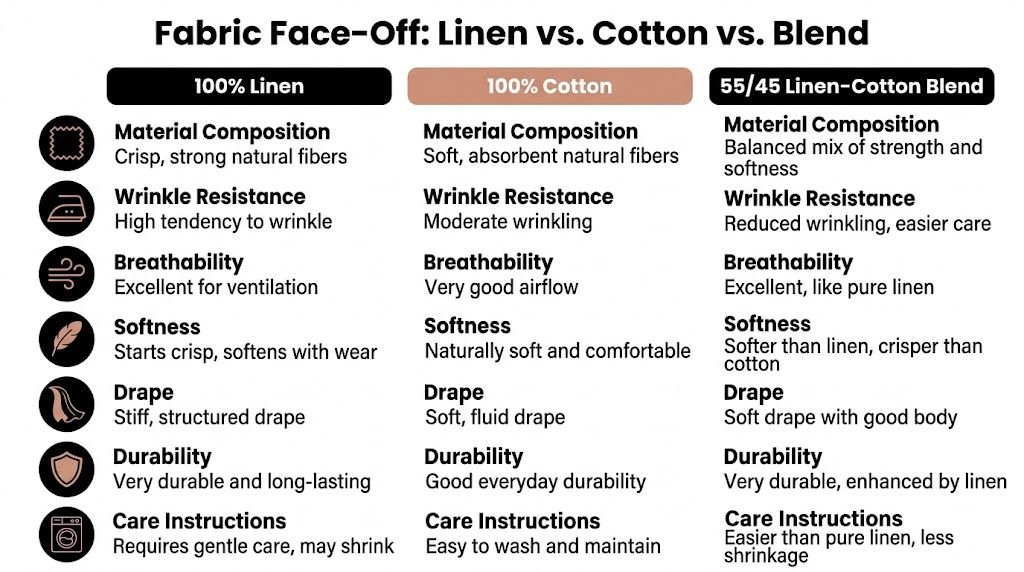
Fabric properties at a glance
| Property | 100% Linen | 100% Cotton | Linen-Cotton Blend |
|---|---|---|---|
| Breathability | Excellent, cool and dry-feeling | Good to very good | Excellent for everyday summer wear |
| Softness | Often starts crisp, softens over time | Soft straight away | Softer than linen, with more texture than cotton |
| Drape | Structured, sometimes firm | Depends on weave, often softer | Balanced, with body and movement |
| Wrinkling | High | Moderate | Lower than pure linen, still relaxed-looking |
| Durability | Strong and long-wearing | Good for daily use | Strong, especially for garments worn often |
| Surface texture | Slubby, visible character | Smoother, plainer | Textured without feeling too rustic |
| Pressing | Presses sharply | Usually easy | Very cooperative with steam |
| Ease for beginners | Can be variable | Familiar and straightforward | Often one of the easiest natural blends to sew |
Where each option wins
Choose pure linen when you want sharp texture, visible fibre character and that classic washed-linen look. It suits artist smocks, boxy shirts, roomy dresses and garments where creasing is part of the charm rather than a problem.
Choose pure cotton when softness, familiarity and easy handling matter most. It’s often the simplest option for pyjamas, children’s makes, casual tops and practice garments.
Choose the blend when you want a garment to look natural and breathable but still feel approachable. This is often the best answer for first summer trousers, shirt dresses, camp shirts, wrap tops and holiday sewing.
The trade-offs that matter in real life
A few honest truths help here.
- The blend still wrinkles. Just less aggressively than many pure linens.
- It won’t mimic fluid rayon or viscose. If you want swish and cling-free drape, look elsewhere.
- It usually improves after washing. Many blends relax and feel more companionable after the first proper launder.
- It rewards a simple pattern. The fabric has enough personality already.
There’s also a lot of wellness talk around linen. Much of it drifts into nonsense. The useful benefits are practical ones: airiness, tactile comfort, and a pleasant dry handle. Claims beyond that need caution. A 2025 NHS-commissioned University of Leeds study found no significant difference in skin microbiome health between linen-cotton blends and pure cotton for UK wearers, which is a helpful corrective to metaphysical marketing claims, as noted in this article discussing linen wellness claims and the Leeds study.
Buy linen cotton fabric because you like how it sews, wears and feels. That’s reason enough.
Ideal Garments for Linen Cotton Fabric
Some fabrics only shine in one lane. Linen cotton fabric is much more generous than that. It can look neat, relaxed, practical or subtly elegant depending on the weight and the pattern.
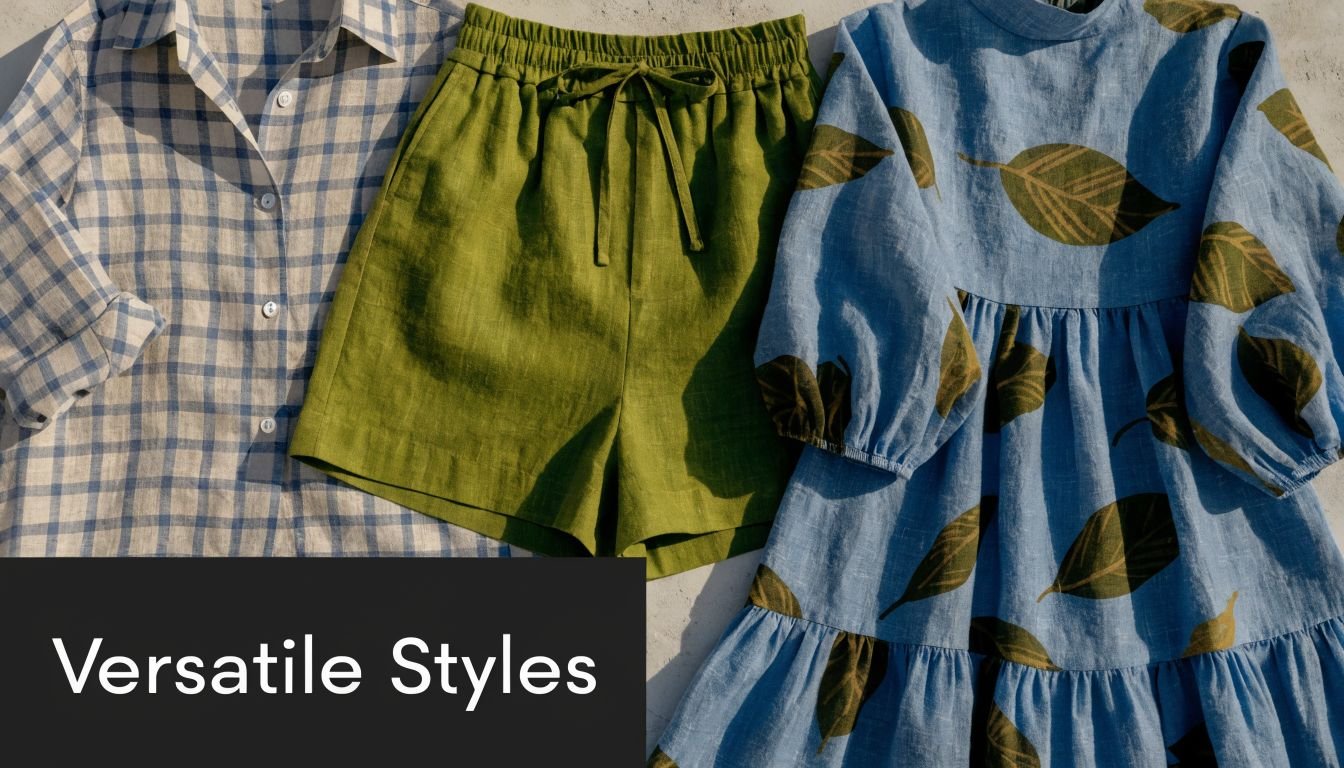
Good first projects
If you’re new to garment sewing, start with shapes that let the fabric do some of the work.
- Boxy tops suit this blend because the cloth holds a clean shoulder line and softens through the body.
- Elastic-waist trousers or shorts are forgiving to fit and let you learn how the fabric presses, gathers and drapes.
- Simple pull-on skirts work well, especially with patch pockets or a lightly gathered waist.
- Loose pyjama sets are excellent if you want a wearable test garment.
One reason harem and barrel shapes work so well is that the fabric has body without becoming cardboard-like. If you want a visual reference for that loose, easy silhouette, these cotton linen harem pants show how the blend supports volume while still looking breathable and wearable.
Best uses for intermediate sewists
Once you’ve handled the fabric once or twice, more options open up.
Shirt dresses are a natural fit. The cloth presses well at collars, plackets and cuffs, but still has enough give in appearance to avoid looking stiff.
Wrap dresses also work beautifully, especially in a balanced blend. You get enough drape for movement, but the skirt doesn’t cling in the same way a lighter drapey fabric might.
Wide-leg trousers are one of my favourite uses. The fabric hangs straight, skims rather than sticks, and keeps a clean line through the leg. Add a flat front, side zip or elasticated back and you’ve got something very wearable.
Here’s a useful visual if you’re deciding whether the blend suits relaxed garments with shape:
Projects that reward the fabric’s structure
For more experienced makers, the blend is excellent for details that need control.
- Camp shirts and overshirts because facings, collars and hems press nicely
- Peasant blouses where the fabric gathers softly without going limp
- Unlined summer jackets because the cloth has enough substance to hold shape
- Aprons and pinafores where durability matters as much as appearance
A simple pattern in a good linen cotton fabric nearly always looks more expensive than an overcomplicated pattern in a fabric that doesn’t suit it.
Practical Tips for Sewing Linen Cotton Blends
Linen cotton blends are much easier on modern machines than many older, coarser linens. The broad shift matters. Mechanised linen spinning changed production in Britain, cotton later dominated through scale and cost, and modern sewists now benefit from blends that are much more manageable at the machine than pure historical linens, as outlined in this piece on the history of linen and mechanised spinning.
That said, “easy” doesn’t mean “ignore the prep”. The best results come from handling the fabric with intention from the start.
Before you cut
Pre-wash the fabric exactly as you plan to wash the finished garment. If you skip that step, you’re gambling with seam rippling, length loss and disappointment after the first wash.
I prefer to press the fabric once it’s dry before laying out pattern pieces. A lightly crumpled blend can distort grainline if you cut it straight from the laundry basket.
Use these tools if you have them:
- A sharp rotary cutter for accurate edges on long pattern pieces
- Pattern weights instead of too many pins
- A large pressing surface so you can keep the fabric flat
- A fine chalk pencil or removable marker that shows clearly on slubby surfaces
Needle, thread and machine setup
Most linen cotton fabric behaves well with a universal or sharps needle. An 80/12 is a very good starting point for many dressmaking weights. If the fabric is particularly fine, go smaller. If it’s more substantial, test before committing.
Use a quality all-purpose polyester thread. It has enough strength for seams that get regular wear and laundering. Cheap thread is one of the fastest ways to spoil a nicely sewn natural-fibre garment.
A few machine habits make a real difference:
- Shorten your stitch slightly for topstitching if you want crisp detail without a loose, homemade look.
- Test tension on a double layer because some blends show puckering quickly if the top tension is too tight.
- Use a walking foot if the layers creep, especially on longer side seams or facings.
Finishing and pressing
This fabric often frays. Plan for that rather than pretending it won’t.
French seams are excellent for lightweight tops and pyjamas. Overlocking works well for everyday garments. Clean turned-and-stitched seam allowances are useful where you want less bulk, such as curved armholes or a waist seam.
Press every seam as you sew. First press it flat to set the stitches, then press it open or to one side. Steam is your friend here. So is a clapper if you like particularly crisp edges on collars, cuffs and plackets.
Don’t wait until the end to “give it a good press”. Linen cotton fabric looks professional because of dozens of small presses during construction.
A few extra techniques worth using:
- Staystitch necklines early so they don’t relax while you handle the garment
- Interface selectively because too much fusible can make the garment feel boardy
- Grade bulky seams at collars, waistbands and pocket edges
- Topstitch hems and pockets carefully because this fabric shows neat stitching beautifully
How to Care for Your Linen Cotton Garments
Once you’ve made the garment well, care is what keeps it looking good. Linen cotton fabric doesn’t need pampering, but it does benefit from sensible washing and drying.
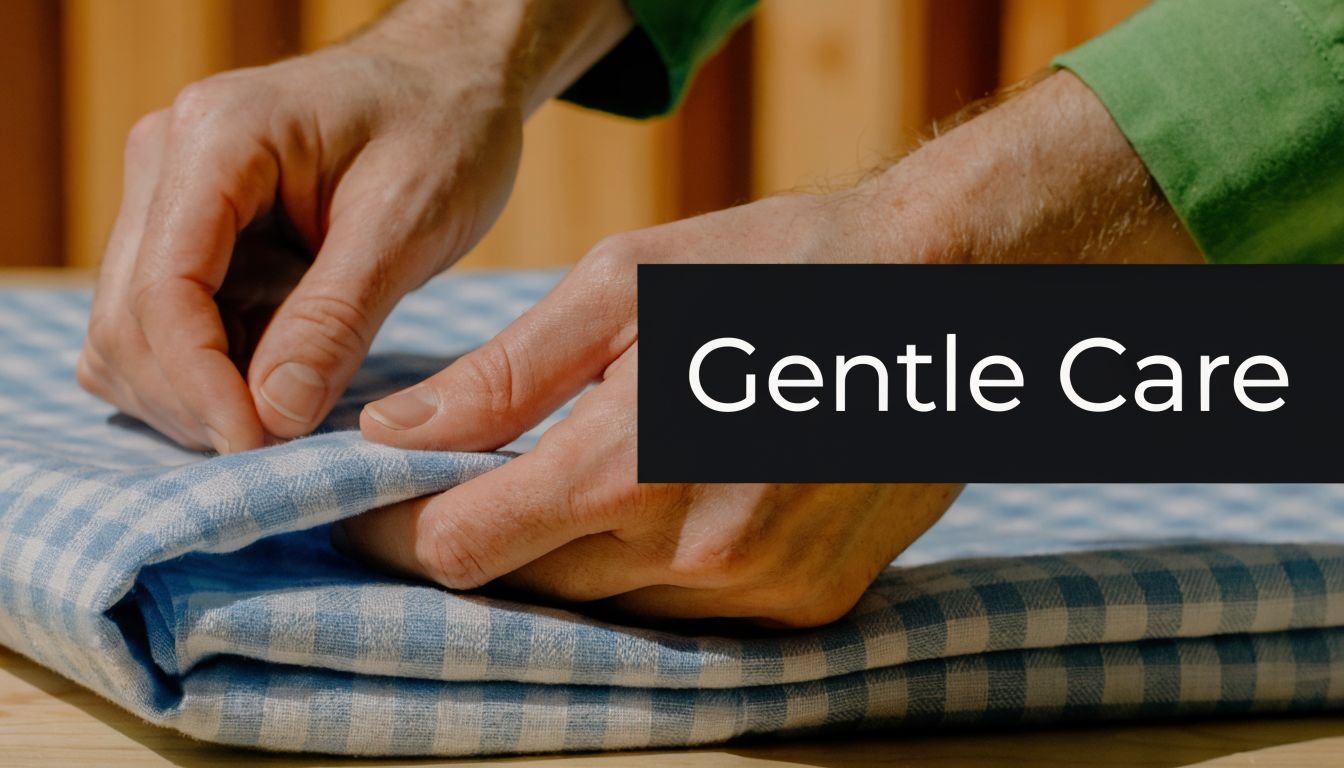
For UK sewists, local laundering advice matters. Following BS EN ISO 6330 standards such as a 40°C wash is important, and 68% of hobbyists report linen-cotton garments lasting 2 to 3 years with this care, according to this discussion of linen, cotton and UK laundering guidance.
Washing and drying
A gentle machine wash works well for most garments. Use cool to warm water, and if you’re following a care routine for regular home wear in the UK, 40°C is the benchmark tied to the guidance above.
For best results:
- Wash similar weights together so heavier items don’t rough up lighter blouses
- Avoid overfilling the machine because tightly packed garments crease harder
- Shake garments out immediately after washing
- Line dry when possible to keep the cloth looking fresher
If you need to tumble dry, use low heat and remove the garment while it’s still slightly damp.
Ironing without fighting the fabric
Linen cotton garments usually press best when they’re not bone dry. Iron on the reverse first if the fabric is dark, saturated, or likely to show shine. Steam helps more than brute force.
If you like a neater finish, press the garment fully and hang it straight away. If you prefer the relaxed look, press only key areas such as collar, button stand, hem and cuffs.
Some creasing is part of the appeal. The fabric looks lived-in, not neglected.
Your Guide to Buying Linen Cotton Fabric
Buying well saves far more frustration than any clever sewing trick later. With linen cotton fabric, the first thing to assess is how the cloth behaves in your hands. Not what the product description promises. Not what the photo suggests. The hand-feel tells you more.
What to check before you commit
Weight matters, but so does finish. A lightweight blend suits blouses, gathered tops and soft shirts. A more substantial cloth is better for trousers, shirt dresses, overshirts and casual jackets. If the fabric feels papery and dry, ask yourself whether that suits the garment you want. If it feels brushed or very soft, consider whether you’ll lose the crispness you were hoping for.
Look closely at these points:
- Surface texture. Smooth and refined, or slubby and rustic?
- Opacity. Hold it to the light before deciding on a dress or summer trousers.
- Recovery after scrunching. Crush a corner in your hand, then release it.
- Drape off the bolt. Does it fold in a soft curve or stand away?
The smartest buying habit
Order a swatch first if you can. It’s the cheapest insurance in sewing.
A sample lets you test the colour in daylight, feel whether the fabric is dry or soft, check whether it’s suitable against the skin, and compare it against the pattern you plan to use. It also tells you whether the fabric suits your sewing style. Some makers love visible slub and texture. Others prefer a cleaner, smoother blend.
If you’re considering deadstock, the same advice applies twice over. Deadstock can be wonderful, but fabric history isn’t always fully documented. A swatch gives you a chance to wash, press and handle it before buying metres you may not enjoy sewing.
If you’re ready to sew with linen cotton fabric, More Sewing is a strong place to start for quality dressmaking fabrics, swatch samples, haberdashery and practical support for home makers. Whether you’re planning your first simple summer top or sourcing a more distinctive blend for a carefully chosen pattern, it’s worth browsing a shop that understands how fabric needs to perform at the cutting table, not just in a product photo.
