Guides
Master Sewing Supplies for Beginners: Your 2026 Guide
You're probably staring at a basket full of things you don't recognise. Fabric shears, dressmaking pins, tailor's chalk, seam rippers, universal needles, ballpoint needles, thread stands, pressing aids. It's easy to feel as if sewing has a secret language and everyone else learnt it years ago.
The good news is that beginners rarely need more tools. They need fewer, better-chosen ones.
A solid first kit isn't about owning every gadget on the shelf. It's about buying the small group of tools that let you measure accurately, cut cleanly, press properly, and stitch without unnecessary frustration. Once those basics are right, your first tote bag, cushion cover, skirt, or simple top becomes far more enjoyable.
That's also why sewing remains approachable for new makers. The UK government's Annual Population Survey has consistently shown that around 45% of adults in Great Britain participate in craft-related activities, with sewing as one of the long-established hobbies in that wider making culture, as noted by The Common Thread Studio. You're not joining a tiny niche. You're stepping into a well-supported hobby with plenty of guidance, classes, patterns, and fellow sewists.
Welcome to Sewing Your Essential First Steps
Most beginners make one of two mistakes. They either buy far too much and end up with a drawer of unused gadgets, or they try to start with the bare minimum and get stuck because they're missing one practical tool that makes the job easier.
The sweet spot sits in the middle. Buy enough to work comfortably, but choose tools that can carry you through many projects rather than one novelty make.
Start with function, not fantasy
When someone is new to sewing supplies for beginners, I usually suggest thinking in jobs rather than products. You don't need to memorise every notion name at once. You need a way to:
- Measure accurately so patterns and hems make sense
- Cut cleanly so fabric pieces match
- Mark clearly so darts, notches, and fold lines don't disappear
- Hold pieces together before stitching
- Sew and press so the finished item looks neat
That simple approach stops you from buying things because they look clever rather than because they solve a real problem.
Sewing gets easier very quickly once your tools stop fighting you.
Choose a kit that lasts past your first weekend
Cheap beginner bundles often look tempting because they seem complete. In practice, many include flimsy scissors, poor pins, rough tape measures, and marking tools that don't show properly on fabric. You save at the till, then replace half the contents later.
A better approach is to spend carefully on the items that affect every project. Scissors are one. Your iron is another. Needles and thread matter more than many people expect. A bad match between those three can make a simple seam feel impossible.
If you want sewing supplies for beginners that help you learn, focus on longevity. A few dependable tools build confidence. A pile of mediocre ones usually creates confusion.
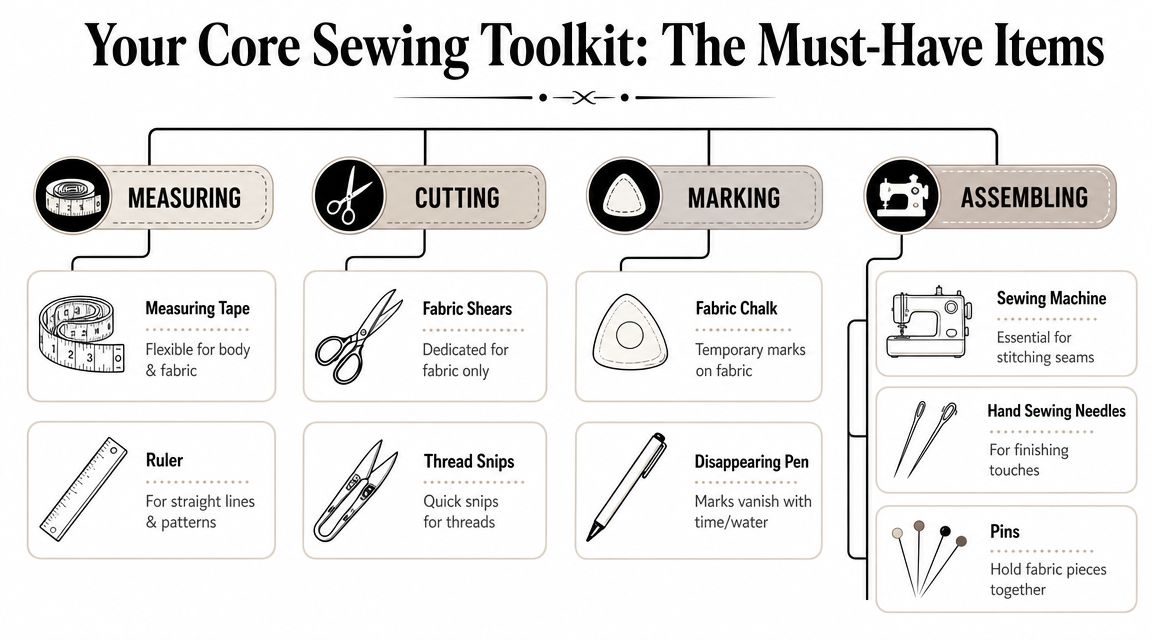
Your Core Sewing Toolkit The Must-Have Items
The core beginner kit has stayed remarkably consistent because it works. In UK sewing history, the term haberdasher became established for sellers of small notions and sewing accessories, while the Worshipful Company of Merchant Taylors received its first royal charter in 1327, a historical trade marker highlighted by Polka Dot Chair. That long division between cloth and notions still shapes what beginners buy today.
You're not assembling a random shopping list. You're building the same core categories makers have relied on for generations.
Measuring tools that prevent avoidable mistakes
A soft tape measure is essential for body measurements, curved areas, and checking garment pieces. Buy one with clear markings and a bit of body to it. The very flimsy ones twist easily, which makes them annoying to use.
A small ruler or seam gauge helps with hems, seam allowances, button spacing, and quick checks at the machine. Beginners often skip this and try to eyeball everything. That usually leads to uneven hems and seam allowances that wander.
Cutting tools worth paying for
I'd spend on this first.
You need fabric shears that are reserved for fabric only. Not paper. Not packaging. Not ribbon with hidden glue. Fabric dulls scissors over time anyway, so there's no point speeding that up by using them for household jobs.
A pair of thread snips or small embroidery scissors is also useful. They're faster for trimming loose ends than hauling out full shears every time.
Practical rule: Buy the best fabric shears you can comfortably afford, then protect them like your sewing depends on them, because it does.
Later on, you may add a rotary cutter and mat. For most beginners, though, one dependable pair of dressmaking shears will do more good than several cheap cutting gadgets.
If you'd like a useful overview of the small items that fall under haberdashery, Lewis and Sheron Textiles has a clear guide to understand essential sewing accessories.
A quick visual reference helps when you're shopping for the first time:
Marking and assembling tools that earn their place
For marking, keep it simple. A piece of tailor's chalk or a washable or disappearing fabric pen covers most beginner needs. Test on a scrap first. Some marks brush away beautifully on one fabric and cling stubbornly to another.
For assembly, the basic set is:
- Dressmaking pins for holding seams, darts, and pattern pieces
- Hand sewing needles for finishing, tacking, or sewing on a button
- All-purpose thread for general construction
- A seam ripper for undoing mistakes cleanly
The seam ripper deserves special respect. New sewists often see it as a sign something went wrong. It's part of normal sewing. Good dressmakers unpick regularly because precision matters more than pretending everything worked first time.
The core kit at a glance
| Category | Start with | Why it matters |
|---|---|---|
| Measuring | Tape measure, small ruler or seam gauge | Accurate sizing, hems, seam allowances |
| Cutting | Fabric shears, thread snips | Clean edges and efficient trimming |
| Marking | Chalk or washable fabric pen | Visible guides for sewing lines and details |
| Assembling | Pins, hand needles, thread, seam ripper | Holds, stitches, fixes, and finishes |
Choosing Your First Fabrics Without Fear
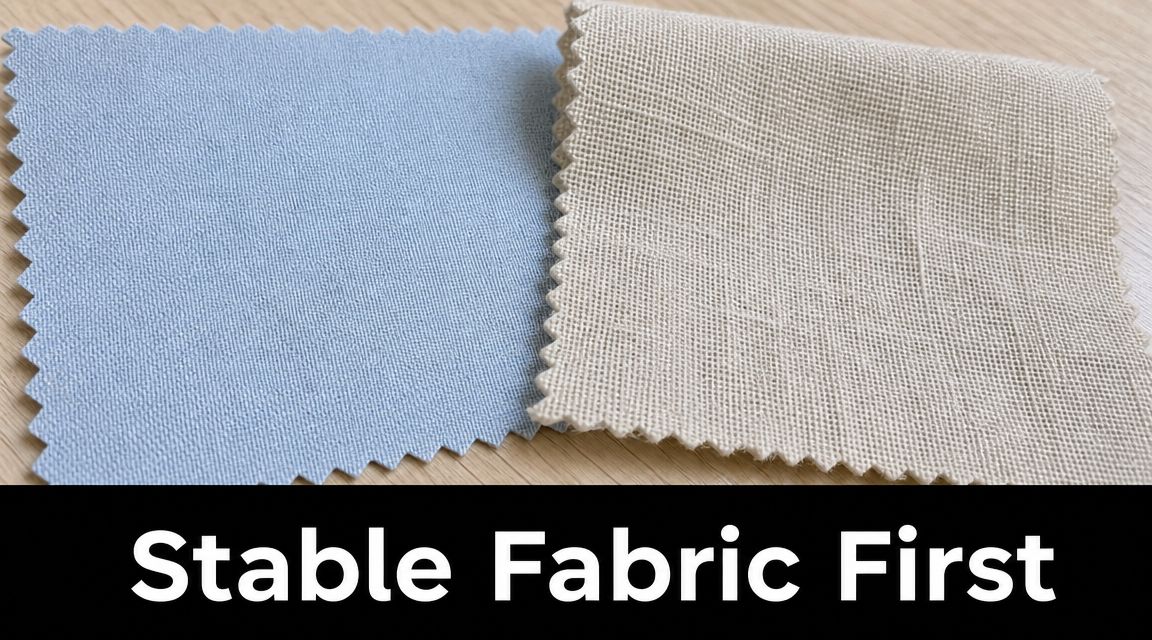
Your first fabric choice has more impact than your first pattern choice. A simple pattern in a cooperative fabric can feel manageable. A simple pattern in a slippery, stretchy, shifting fabric can feel impossible.
The easiest way to understand fabric behaviour is this. A woven fabric is more like a brick wall. Its threads cross over and under each other in a stable grid. A knit fabric is more like a jumper. It's made of loops, so it stretches and moves more easily.
For beginners, stable woven fabrics are usually the friendliest place to start.
Fabrics that make learning easier
For modern home dressmaking in the UK, beginner-friendly choices increasingly favour versatility. Guidance aimed at newer sewists has emphasised stable woven fabrics like cotton poplin, combined with universal needles and a reliable steam iron, especially for repair, upcycling, and small-batch garment making, as discussed in this beginner sewing guidance video.
Good first options include:
- Cotton poplin because it presses well, cuts cleanly, and doesn't slide around much
- Quilting cotton for simple bags, pouches, and practice projects
- Chambray for shirts, relaxed tops, and soft but stable garments
- Cotton lawn if you want something lighter, though it needs a little more care when cutting
These fabrics tend to hold a crease when pressed, accept markings fairly well, and stay where you put them under the needle. That matters more than beginners often realise.
Fabrics to leave for later
Some fabrics aren't bad. They're just unforgiving when you're learning.
Wait a bit before choosing:
- Chiffon, because it shifts and frays easily
- Velvet, because the pile can move and mark
- Slinky jersey, because it stretches, curls, and shows uneven stitching
- Very drapey viscose, because it can distort while cutting
- Sequinned or heavily embellished cloth, because every step becomes harder
If a fabric slides off the cutting table, slips under the presser foot, and refuses to hold a pressed edge, it's not a kind first project fabric.
Buy fabric for more than one project idea
The smartest beginner buys fabric that can do several jobs. A stable cotton woven can become a tote bag, pyjama bottoms, a simple blouse, a cushion cover, pocket practice, or mending patches. That kind of flexibility gives you room to improve without changing your whole toolkit.
This is also why repair and upcycling fit so naturally into beginner sewing. Old cotton shirts, sturdy pillowcases, and stable deadstock offcuts can teach cutting, pressing, patching, topstitching, and seam finishing without the pressure of using expensive fashion fabric.
If you're trying to understand more decorative cloth before buying it, a plain-English explanation of what jacquard fabric is can help you judge whether a textured woven suits your project or should wait until you've got a few makes behind you.
How to Build Your Starter Kit Budget to Premium
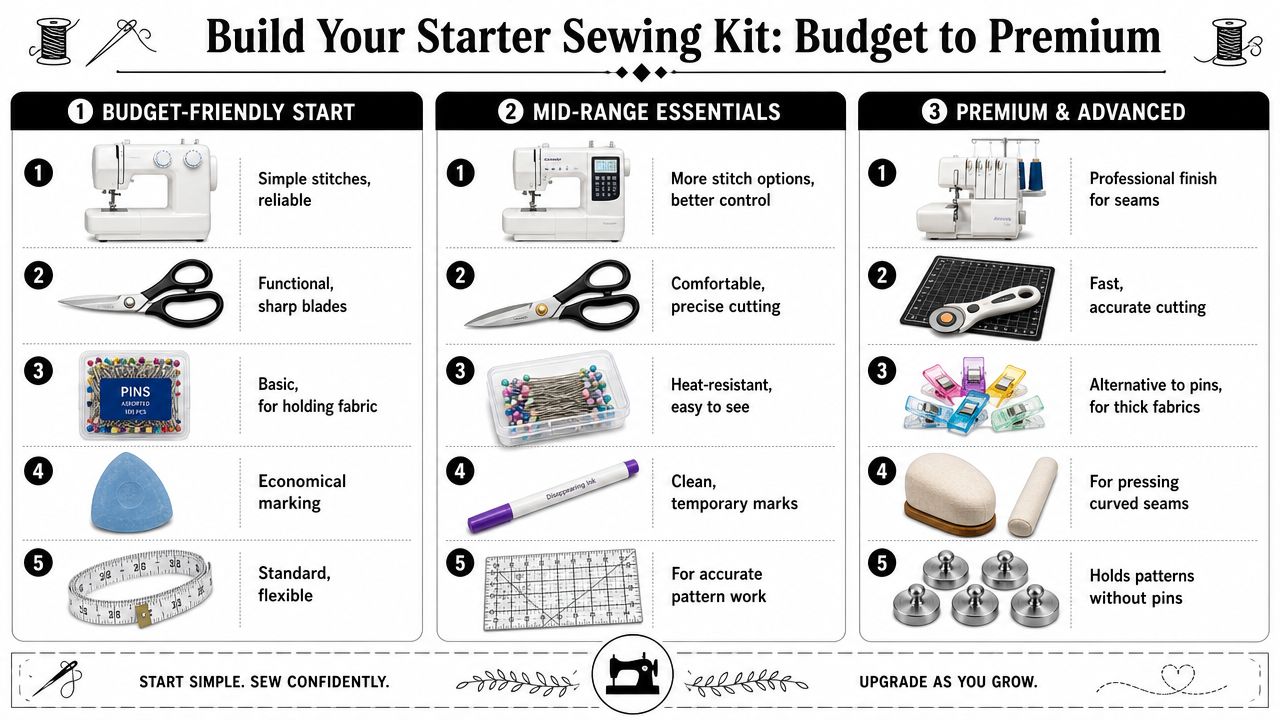
Not everyone needs the same starter kit. Some people want the lowest-cost practical setup. Others would rather buy once and avoid replacing tools later. Both approaches can work if you understand where quality changes the experience and where it doesn't.
Budget-friendly start
This version is for someone who wants to begin sewing supplies for beginners without overcommitting.
Choose:
- A basic sewing machine that does a straight stitch and zigzag reliably
- A functional pair of fabric shears
- A tape measure
- Tailor's chalk
- Pins
- Universal hand sewing needles
- A seam ripper
- All-purpose polyester thread
- A household iron you already own, if it gives decent steam
The key trade-off here is comfort, not capability. You can sew very happily with basic tools if they are sharp, readable, and dependable. What usually lets budget kits down isn't simplicity. It's poor finishing, blunt blades, and pins that bend too easily.
Quality core kit
This is the level I'd recommend for most home dressmakers. It's the point where the tools feel noticeably nicer in the hand and more consistent in use.
Look for:
| Tool | Budget version | Quality-core upgrade | Why it helps |
|---|---|---|---|
| Shears | Standard handles | Ergonomic handles, smoother action | Less hand strain, cleaner cuts |
| Pins | Basic metal pins | Glass head pins | Easier to see and safer near heat |
| Marking tool | Chalk block | Fine chalk pencil or reliable fabric pen | Better control on detailed marks |
| Measuring | Tape measure only | Tape plus clear ruler or seam gauge | Faster, more accurate pattern work |
| Pressing | Any iron | Reliable steam iron | Crisper seams and easier shaping |
This is also the point where I'd think about adding a magnetic pin dish, a clear ruler, or better storage for needles and machine accessories. None of these are required to start, but they reduce little annoyances that slow beginners down.
Good tools don't sew for you. They remove friction so you can pay attention to learning the skill.
Invest for a lifetime
Premium tools make sense when you know you enjoy sewing and want equipment that stays with you for years.
That might include:
- High-quality dressmaking shears
- A rotary cutter and self-healing mat if you cut often
- Pattern weights for accurate cutting
- Clips for thicker or layered fabrics
- A tailor's ham or seam roll for pressing curved seams
- A sturdier machine with better control and smoother feeding
The upgrade here is about precision and comfort over repeated use. Premium tools aren't necessary for a first cushion cover. They become worthwhile when you sew regularly enough to appreciate sharper cutting, better balance, and better pressing results.
Where to spend and where to save
Spend more on the things that affect every seam. Save on the things that are easy to replace.
- Spend on scissors, iron, and decent thread
- Save on basic rulers, starter hand needles, and simple storage tins
- Be cautious with cheap bundled kits, because one weak item often spoils the whole set
First Techniques With Your New Supplies
Buying tools is one thing. Using them well is what turns sewing from frustrating to satisfying.
Match needle, thread, and fabric properly
One of the most important beginner decisions is compatibility. All-purpose polyester thread is widely recommended for general sewing because it is strong and versatile. For woven cottons, start with a universal machine needle in size 80/12. For knit fabrics, switch to a ballpoint needle to help prevent skipped stitches and fibre damage, as outlined in this sewing tools and supplies guide.
Keep these pairings in mind:
- Mid-weight woven cotton calls for all-purpose polyester thread and a universal 80/12 needle
- Fine fabric may need a lighter needle so you don't leave enlarged holes
- Knit fabric usually behaves better with a ballpoint or stretch needle
- Any unfamiliar fabric should be tested on a scrap before the actual seam
If stitches look uneven, the fabric puckers, or the machine starts skipping, don't force ahead. Check the needle first.
Learn to use a seam ripper safely
A seam ripper is small, sharp, and easy to misuse. The goal is to cut stitches, not fabric.
Try this method:
- Lay the work flat with good light.
- Insert the point under every few stitches, not every single one.
- Cut from the bobbin side when possible, because the stitches often release more cleanly.
- Pull the threads gently apart rather than digging aggressively.
- Brush away loose threads before resewing so they don't tangle in the new seam.
Beginners often rush this and jab downward. That's when fabric gets nicked. Keep the blade shallow and controlled.
Cut fabric without lifting it off the table
Clean cutting is a technique, not only a tool choice.
- Keep the lower blade against the table as much as possible
- Open the shears fully for long cuts, then close smoothly
- Don't chew through fabric with tiny bites unless you're cutting a tight curve
- Support the cloth with your free hand so it doesn't drag
When people say they're “bad at cutting”, the issue is often that they're lifting the fabric, not keeping it flat.
A neat cut edge makes every later step easier. A wobbly cut edge creates little problems all the way through the project.
Pin and press like you mean it
Pins should hold the fabric in place, not distort it. Place them perpendicular to the seam line when you want easy removal while sewing, or parallel when you need them out of the machine path entirely.
Pressing is just as important. Press fabric before cutting if it has fold creases. Press seams after stitching. Press hems before sewing them. If the fabric is washable, pre-wash it in the way you plan to care for the finished item so any shrinkage happens before you cut.
That single habit prevents a lot of disappointment later.
Your First Project and How More Sewing Can Help
The best first project is simple, useful, and forgiving. You want something that teaches accuracy without requiring advanced fitting or difficult fabric behaviour.
Three first projects that teach the right lessons
A tote bag is excellent because it teaches straight seams, topstitching, pressing, and handling layers. It's useful even if it isn't perfect, which takes the pressure off.
An envelope-back cushion cover is another strong starting point. You practise cutting rectangles accurately, hemming edges, and assembling layers in the right order. It gives quick satisfaction because the shape is simple and the result looks polished with careful pressing.
Elastic-waist pyjama trousers are a good first garment. They introduce pattern layout, basic leg seams, casings, and fitting ease without asking you to master zips, collars, or set-in sleeves immediately.
What works for a first make and what doesn't
Good beginner projects usually have these qualities:
- Straightforward seams rather than intricate shaping
- Stable woven fabric rather than slinky or stretchy cloth
- A practical finish so minor imperfections don't ruin the item
- Repetition that helps you build muscle memory
Less helpful early choices include fitted shirts, structured jackets, slippery camisoles, and anything that combines difficult fabric with detailed construction.
Where support matters most
Beginners don't usually stop because sewing is impossible. They stop because too many small decisions pile up at once. Which fabric? Which needle? How much thread? Will this shrink? Do I need interfacing? Is this pattern too hard?
That's why curated kits, fabric swatches, and practical guidance matter. A project kit removes guesswork because the main choices have already been narrowed to combinations that make sense together. A fabric swatch lets you feel drape, weight, and surface before committing. Machine servicing matters too, because even a good beginner can lose confidence quickly if a neglected machine starts skipping, bunching, or feeding badly.
For someone learning at home, that kind of support turns sewing from a trial-and-error slog into a steady skill-building process.
If you're ready to start with fewer wrong turns, More Sewing is a practical place to begin. You'll find quality fabrics, haberdashery, beginner-friendly kits, fabric swatches for confident choosing, and local sewing machine servicing and repairs in Worthing, all geared toward helping you sew your first project well and keep going after it.
