You're standing in front of a bolt of fabric that looks perfect. The colour is right, the print is lovely, and the pattern in your hand says it could work. Then the label says poplin, lawn, twill, sateen, jacquard, and suddenly the choice feels less obvious.
That hesitation is sensible. Two fabrics can share the same fibre content and still sew up completely differently because the weave of fabric changes how it behaves. One cotton can hold a collar crisply, another can slump, and another can fight every press because its surface and structure behave in their own way.
Once you start reading weave rather than just colour or fibre, fabric shopping gets much easier. You can predict which cloth will press cleanly, which one will fray the second you cut it, which one will make a dress feel boxy, and which one will give a jacket the right body. That's the difference between hoping a fabric will work and choosing it with confidence.
Why Understanding Fabric Weave Will Make You a Better Sewist
A lot of sewing disappointments start before the first cut. The pattern is fine. The sewing is careful. The problem is that the fabric and the project were never suited to each other.
A classic example is the shirtmaker choosing a beautiful soft fabric because the print feels right, only to end up with a collar that won't sit neatly and cuffs that look tired by lunchtime. The opposite happens too. Someone picks a crisp cotton for a draped blouse, then wonders why the finished garment stands away from the body instead of falling softly.
That's why weave matters so much. The weave is the fabric's internal architecture. It controls stability, drape, surface texture, crease behaviour, and often how easy the cloth is to cut and sew accurately. If you understand that structure, a label like poplin or denim stops being jargon and starts giving you useful information.
What changes when you start noticing weave
You begin to shop differently. Instead of asking only “Do I like this fabric?”, you ask better questions:
- Will it hold shape for a shirt, skirt, bag or structured bodice?
- Will it drop softly enough for gathers, cowls or wide-leg trousers?
- Will it resist wear in high-friction areas like knees, elbows and seat seams?
- Will it show every pin mark and snag while I'm sewing it?
- Will it fight the pattern's grainline or support it?
Practical rule: If a pattern relies on shape, choose structure first and print second. If it relies on movement, choose drape first and surface second.
This knowledge isn't only for weavers or textile students. It's everyday sewing knowledge. It helps when you're buying quilting cotton for a beginner project, selecting a twill for trousers, or deciding whether a lustrous fabric is genuinely suitable for a bias-cut slip dress.
It also connects us to a much older craft tradition. The UK's textile identity was built around woven fabrics. Long before industrialisation, cities like Manchester and Nottingham were specialised weaving centres, employing thousands and shaping British dressmaking and trade, as noted in this historical overview of weaving centres in Britain. That legacy still shows up in the fabrics sewists reach for today.
The Building Blocks of Woven Fabric
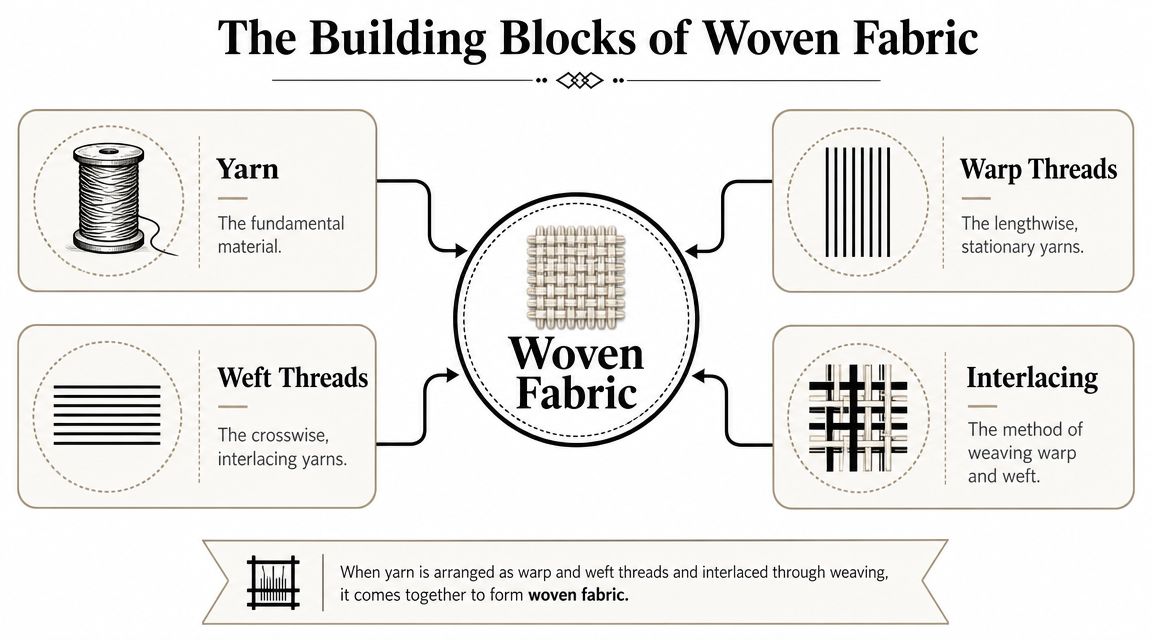
Every woven cloth starts with a crossing of threads. Once you see that clearly, the rest of fabric handling makes much more sense.
Think of a simple paper placemat woven from strips. One set runs up and down. The other goes across. Fabric works the same way, just with yarn under tension on a loom.
Warp, weft and interlacing
The warp threads run lengthwise. They're held under tension on the loom, so they're usually the steadier direction of the fabric.
The weft threads pass across the warp. They interlace over and under the warp threads to build the cloth. How often they cross, how tightly they're packed, and how they sit against each other all affect the final feel.
That crossing is the heart of the weave of fabric. Change the interlacing pattern and you change the fabric's whole personality.
A useful way to remember it is this:
- Warp gives direction and stability
- Weft brings the crossing structure
- Interlacing creates the actual weave pattern
- Density changes firmness, drape and appearance
Woven fabric isn't just fibre turned flat. It's a set of structural decisions.
Weaving is also ancient. Archaeologists have found impressions of woven textiles dating back about 27,000 years, with preserved flax fragments from sites such as Çatalhöyük showing plain weave was already a foundational craft by 7000 BCE, according to this history of plain weave.
Grainline, cross-grain, bias and selvedge
These are the terms sewists use constantly, and they all come from the fabric's woven structure.
| Term | What it means | Why it matters when sewing |
|---|---|---|
| Grainline | Direction parallel to the warp | Usually the most stable direction for garment pieces |
| Cross-grain | Direction parallel to the weft | Often has a little more give than the lengthwise grain |
| Bias | Diagonal direction across the fabric | Has mechanical stretch and more fluid movement |
| Selvedge | Finished edge running along the length | Helps you identify grain and usually doesn't fray the way cut edges do |
If you've ever cut a skirt slightly off grain and watched it twist around the body, you've already met the consequences of ignoring weave. If you've sewn bias binding and noticed how it curves smoothly around a neckline, that's the fabric structure working in your favour.
For sewists who move between woven and knitted cloth, it also helps to compare structures. Knits behave differently because the yarn forms loops rather than crossed threads. If you want a fibre-focused companion piece on that side of fabric choice, knitwear insights from The Lavender Lobster are a useful read.
Your Guide to the Three Core Fabric Weaves
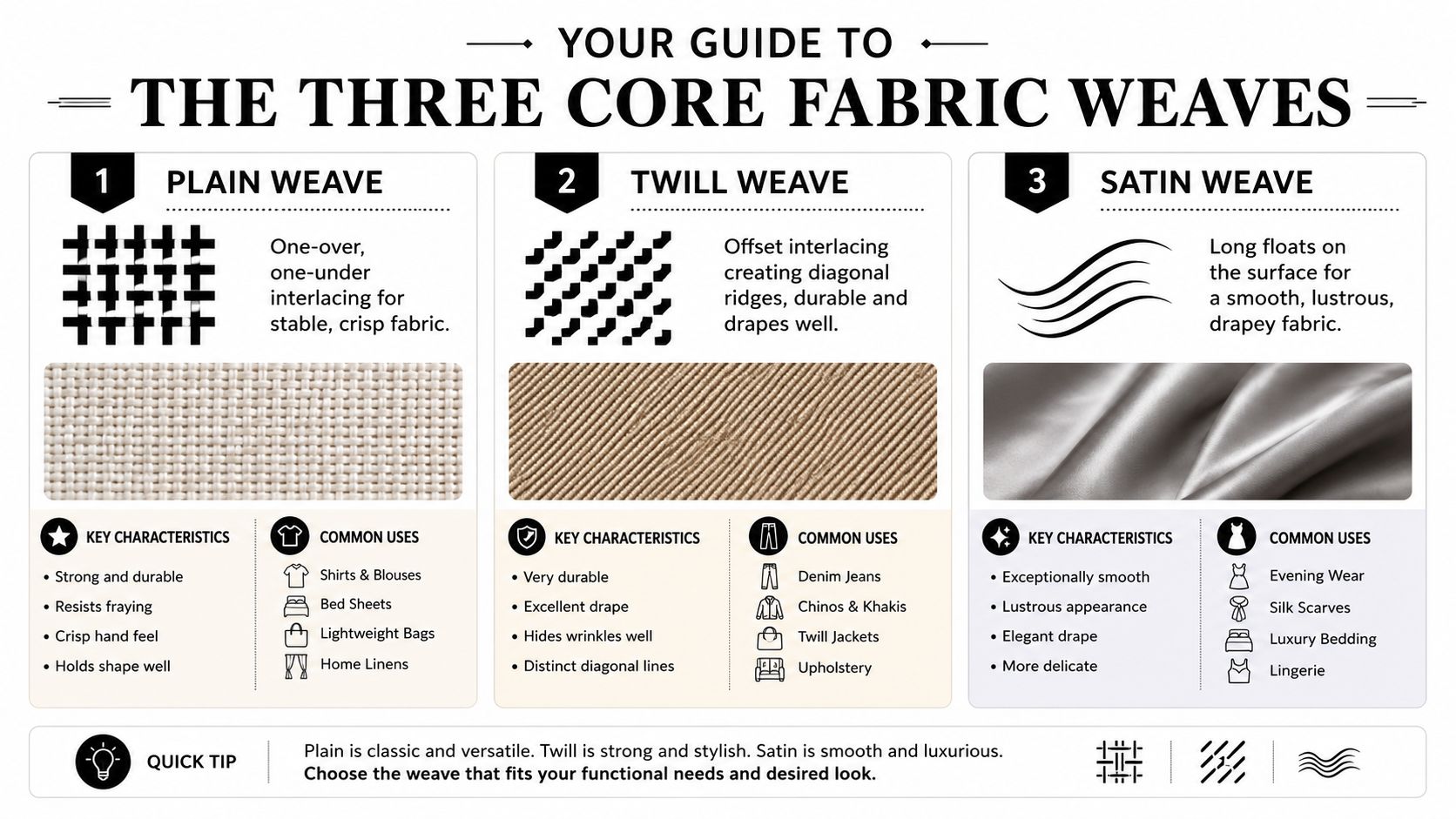
Most of the woven fabrics you sew fall into three broad families. Once you know these, labels become easier to decode and project choices get much more reliable.
Plain weave
Plain weave is the simplest structure. One thread goes over, the next goes under, and that pattern repeats evenly.
This creates a balanced, straightforward cloth that's often stable and easy to understand under the needle. It can be crisp or airy depending on yarn and density, but the structure itself is uncomplicated.
Common plain weave fabrics include:
- Cotton poplin for shirts, dresses and pyjamas
- Quilting cotton for craft sewing, simple tops and children's clothes
- Lawn for blouses and summer dresses
- Voile for soft but lightweight garments
- Chiffon in a much finer, more slippery form
Plain weave is often the best training ground for beginners because the threads are easy to see, the grain is usually obvious, and pressing tends to be predictable. It's also excellent for precision sewing such as patch pockets, collars, facings and button bands.
What doesn't work so well? A plain weave with too much crispness can make a gathered dress look bulky. A very open plain weave can also shift, fray, or seam-pucker if you treat it like a denser cotton.
Twill weave
Twill is the weave most sewists recognise by sight. It forms a diagonal line across the cloth because the interlacing steps are offset.
That diagonal does more than decorate the surface. It usually gives the fabric a combination of durability and pliability that makes twill excellent for hard-working garments.
Typical twill fabrics include:
- Denim
- Chino
- Gabardine
- Drill
- Many workwear and utility cottons
A good twill often presses sharply, wears well, and has enough flexibility to feel less rigid than a plain weave of similar weight. That's why it's so useful for trousers, overshirts, pinafores, jackets and skirts that need structure but still need to move.
Here's the practical point many shopping descriptions skip. Twill isn't one single behaviour. The angle of the twill line changes with construction. As explained in this guide to twill angles, a fabric described as a 45-degree twill may not show a true 45-degree line if warp and weft densities differ. In sewing terms, that can affect how the fabric hangs and how it stretches under load.
That matters with:
- Trousers, where knee and seat stress show up quickly
- Jackets, where the cloth needs to hang cleanly
- Skirts, where diagonal visual lines can subtly affect the look of drape
A twill name tells you the family. The exact construction tells you how that family member behaves.
A quick visual guide can help if you want to see the structures side by side:
Satin weave
Satin weave is built with longer floats. That means yarns pass over several threads before interlacing again, which creates a smoother and more reflective surface.
The result is familiar. Satin often looks lustrous, feels sleek, and drapes beautifully. It can also be frustrating if you expect it to behave like a stable cotton.
Common examples include:
- Charmeuse
- Crepe-back satin
- Duchess satin
- Some sateens, depending on fibre and finish
This is the weave for garments where surface and fluidity matter. Slip dresses, occasionwear, linings, soft blouses and some evening skirts all benefit from that smooth face and elegant fall.
The trade-off is practical. Long floats can snag. Pins can leave marks. Seams can ripple if tension is off. Pressing has to be more careful, and unpicking can scar the surface.
A simple comparison
| Weave | Visual clue | Usually best for | Main caution |
|---|---|---|---|
| Plain | Grid-like crossing | Shirts, crafts, simple dresses, facings | Can feel stiff if too crisp |
| Twill | Diagonal lines | Trousers, jackets, skirts, workwear | Weight and twill angle affect drape |
| Satin | Smooth, lustrous face | Occasionwear, draped garments, linings | Snags and marks easily |
Exploring Decorative and Complex Weaves
Once you move past the basic structural families, you start finding fabrics where the weave itself creates the pattern. That's where cloth becomes much more than a plain base for colour or print.
Two names come up often here: dobby and jacquard. They're easy to confuse when you're shopping online, but they solve different design problems.
Dobby weave
A dobby weave creates small, repeated patterns directly in the cloth. These might be dots, checks, geometric textures, tiny diamonds, stripes, clipped effects or a lightly raised surface.
From a sewing point of view, dobby fabrics often give you visual interest without making the cloth overly theatrical. They can still work beautifully for everyday pieces.
You'll often see dobby used in:
- Shirting, where the pattern is subtle and close-scale
- Cotton blouses, especially with spot or stripe texture
- Waffle-style cloths, where the woven texture is the whole point
- Piqué-style surfaces, where the fabric has a raised geometric effect
The practical upside is that small woven texture can disguise creases, topstitching wobble and everyday wear better than a completely flat fabric face. The downside is that some dobby cloths can be uneven to cut if the texture is pronounced, and pattern matching becomes more important than people expect.
Jacquard weave
Jacquard is the dramatic cousin. Instead of tiny repeated motifs, jacquard allows larger and more complex designs to be woven into the fabric itself.
That distinction matters. A jacquard floral, damask or brocade isn't printed on top. The design is part of the structure. You often see pattern on both sides, though the reverse may look less polished or show the yarn arrangement differently.
Typical jacquard examples include:
- Brocade for structured occasionwear
- Damask for tonal floral or scroll effects
- Tapestry-style cloths
- Large-scale woven furnishing fabrics
Printed fabric gives you surface decoration. Jacquard gives you structure plus decoration.
That means jacquards often have more body than beginners expect. They can be excellent for coats, jackets, corsetry-inspired pieces, statement skirts and formal dresses where shape matters. They're usually less suitable for anything that needs a soft collapse, unless the base cloth is particularly fluid.
How to choose between them
If you want texture that still reads as wearable day to day, dobby is often the easier choice. If you want the fabric itself to do the heavy lifting visually, jacquard is where things get interesting.
A few shop-floor rules help:
- Choose dobby when you want a blouse, shirt or casual dress with quiet detail.
- Choose jacquard when the garment needs presence, shape or a woven statement.
- Check the reverse side before planning facings, cuffs or turned hems. Decorative weaves often look different underneath.
- Test seam bulk with layered scraps if the fabric has raised motifs or metallic yarns.
The craft behind these fabrics is what makes them rewarding. They don't just carry design. They build it into the cloth itself.
How Weave Determines a Fabric's Behaviour
Fabric decisions transition from theoretical concepts to practical applications. You don't sew “plain weave” or “twill” in the abstract. You sew a shirt that must button neatly, trousers that must survive friction, or a dress that needs to move when the wearer walks.
Drape, shape and movement
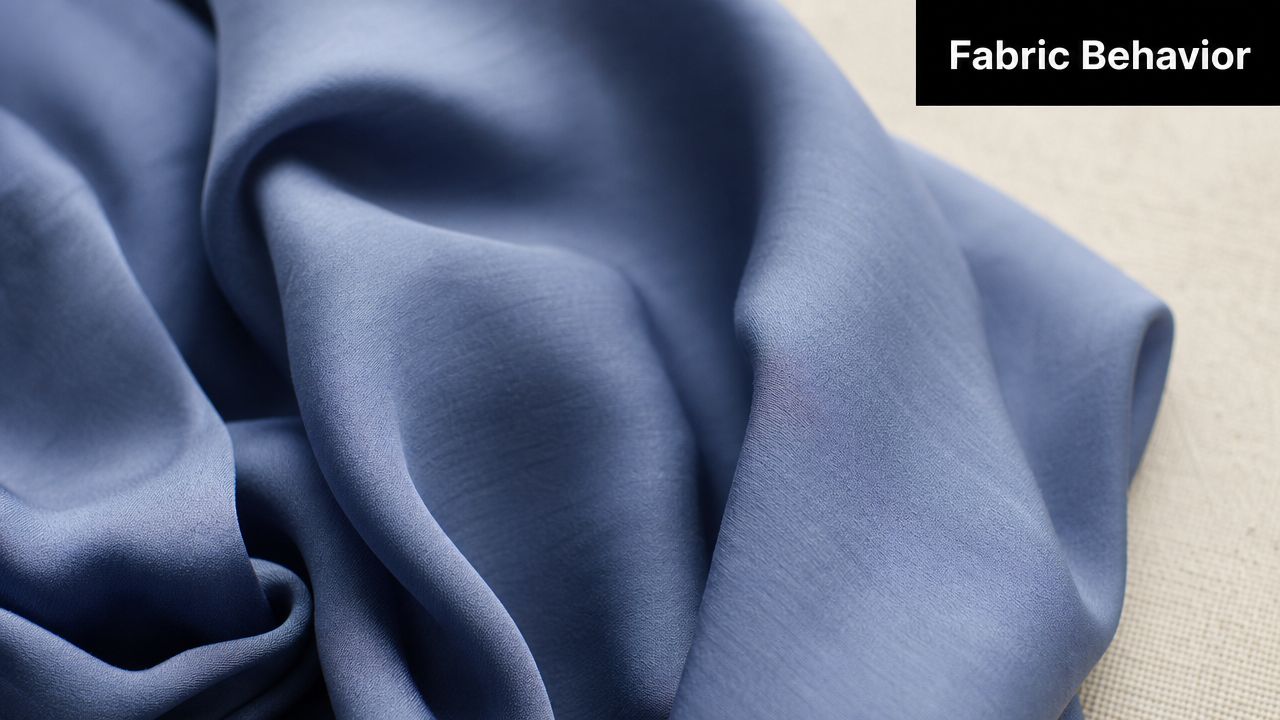
If a fabric has frequent interlacing, it often feels more controlled. If it has longer floats or a more flexible structure, it usually falls more fluidly.
That's why a crisp plain-weave poplin can make a shirt look fresh and architectural, while a satin weave can skim and fold softly across the body. Neither is better. They just solve different design problems.
Use this kind of thinking when matching fabric to pattern:
- Structured shirt dress often suits a firm plain weave
- Utility trousers often benefit from twill
- Bias-cut camisole usually behaves better in a smooth, drapier weave
- Boxy overshirt can look great in twill or a dense plain weave
The same logic shows up in household textiles too. If you're comparing texture and absorbency in woven cloths for everyday use, this discussion of waffle vs terry cloth robes is a good example of how structure changes performance, not just appearance.
Strength, wear and stress points
Twill is popular for garments that work hard because its structure tends to handle abrasion well and still remain wearable. Denim and gabardine aren't just heavy. Their weave helps them cope with repeated use.
What doesn't work is assuming all twills behave identically. The diagonal line can look steeper or flatter depending on construction. As noted earlier from the linked twill reference, thread density affects twill angle, and that changes how the cloth hangs and responds to stress.
That can show up in everyday sewing in ways you notice quickly:
- Trouser knees may soften or bag differently
- Jacket sleeves can twist or hang cleanly depending on cut and grain
- Topstitched seams may stand out more on pronounced twill lines
- Press lines can either sharpen beautifully or disappear faster than expected
Lustre, snagging and surface marks
Satin weave reflects light because of those longer surface floats. That gives you shine, but it also creates vulnerability.
If a fabric has long floats, then it can:
- catch on jewellery
- show pin holes more easily
- bruise under an iron
- shift while cutting
That doesn't mean satin is difficult by nature. It means you need different handling. Fine pins, a sharp microtex needle, smaller seam allowances where suitable, and a cutting surface that keeps the fabric flat all make a difference.
Treat smooth, float-heavy fabrics gently from the first cut. Most satin problems start at the table, not at the machine.
Stretch, bias and edge control
Woven fabrics usually don't stretch much on the straight grain, but they do have mechanical give, especially on the bias. That's why a woven skirt cut on the bias can move very differently from the same skirt cut on the straight grain.
For anyone weaving by hand or repurposing strips into woven projects, edge control matters too. Handwoven guidance notes that a balanced plain weave typically starts with a weft angle of about 25 degrees, though the right angle varies with structure and beating method, as explained in this discussion of weft angle and draw-in. The sewing lesson is similar. Tension, direction and structure all affect whether an edge stays neat or starts to distort.
A useful habit is to test a strip before cutting the full project. Pull it lengthwise, crosswise and on the bias. Fold it over your hand. Scrunch it. Press a corner. The fabric will tell you much more through those simple checks than a pretty product photo ever will.
Choosing and Identifying Weaves for Your Projects
When you're shopping, you rarely get a loom diagram. You get a label, a product photo, and maybe a short description. So the key skill is learning how to spot structure quickly.
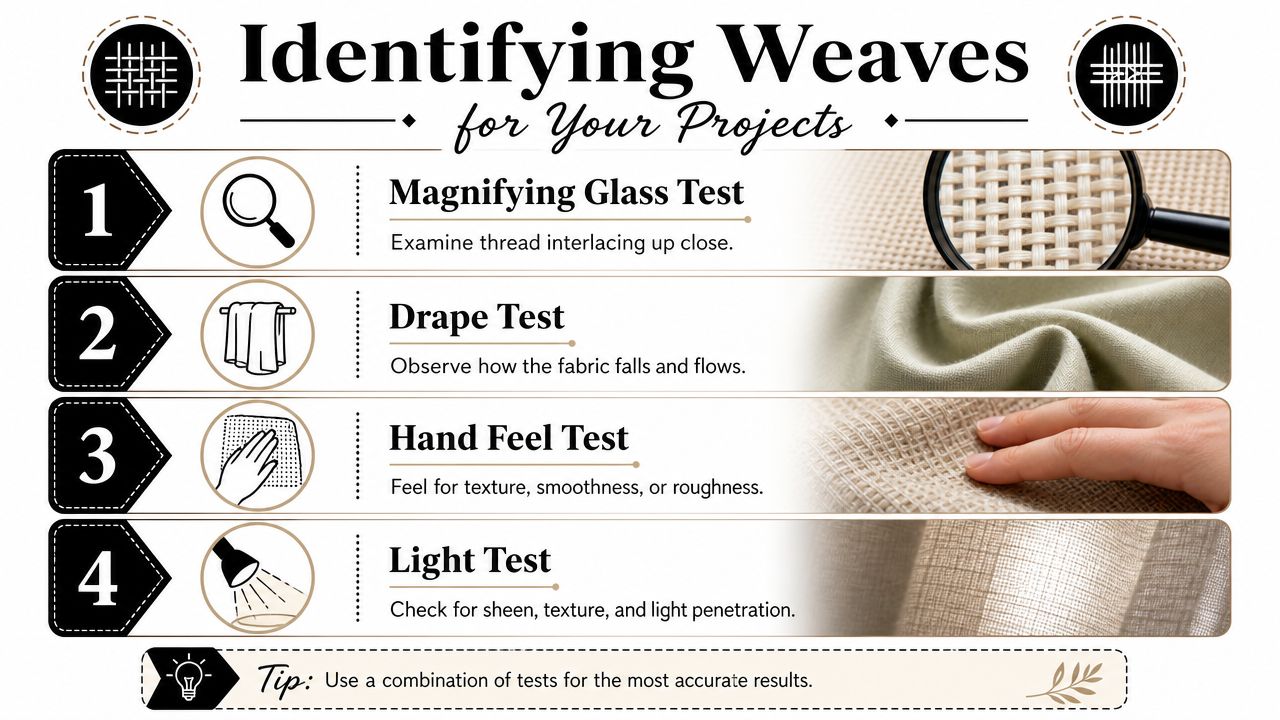
Four simple ways to identify weave
You don't need specialist equipment. A phone camera, your hands and a bit of patience usually do the job.
Use a close-up view
Zoom in with your phone or use a small magnifying glass. Plain weave shows a checker-like crossing. Twill shows diagonal ribs. Satin looks smoother because the interlacing is less visible on the face.Try the drape test
Let the fabric fall from your hand or over the edge of a table. A crisp plain weave often holds shape. Twill usually bends with more ease. Satin tends to flow and fold.Run the fingernail lightly over the surface
This is helpful with satin and textured weaves. A smooth-faced cloth with longer floats often feels slicker and may show temporary marking if handled roughly. Textured dobby or jacquard will feel more broken, raised or patterned.Hold it to the light
You'll see density, texture and surface variation more clearly. Open structures and small woven motifs often reveal themselves quickly this way.
Project pairing that works in real life
The easiest way to use weave knowledge is to match it to the job the garment needs to do.
| Project | Usually a good weave choice | Why it works |
|---|---|---|
| Classic shirt | Plain weave poplin or lawn | Stable, easy to press, good for collars and plackets |
| Workwear trousers | Cotton twill, denim, gabardine | Durable and practical with enough flexibility |
| Soft blouse | Lightweight plain weave or drapier satin-type weave | Better movement and less bulk in gathers |
| Occasion dress | Satin or jacquard | Surface interest, drape or structure depending on style |
| Statement jacket | Twill or jacquard | Holds shape and shows design clearly |
If the pattern photo shows sharp edges, clean seams and body through the silhouette, a floppy fabric will disappoint you. If the design relies on swish and movement, a crisp cloth will fight it.
Care and handling by weave type
Different weaves reward different habits at the machine and the ironing board.
For plain weave
Stay alert for fraying on lightweight versions. Finish seam allowances promptly on lawn, voile and loosely woven cottons. Press as you go because these fabrics often respond well to shaping.For twill
Watch nap and directional surface on fabrics like denim or brushed twill. Cut all major pieces in the same direction if the face changes with light. Use a clapper or firm press cloth for sharp creases on trousers and jackets.For satin
Keep the table smooth, pins fine, and seam ripping to a minimum. Test the iron first. Even a good satin can mark if it's pressed too hot or from the wrong side.For decorative weaves
Check motif placement before cutting. Dobby and jacquard can make a garment look expensive, but only if the pattern pieces respect the woven design.
A final habit saves a lot of regret. Order or check a sample whenever you can, then compare it to the pattern's needs, not just to your mood. Fabric choice is where good sewing starts.
If you're ready to put this into practice, explore the fabric range at More Sewing. You'll find quality dressmaking fabrics, useful swatches, and sewing supplies that make it easier to choose the right weave for the project you want to sew.
